Ken Research Logo

Global Gypsum Board Market Outlook to 2030

Region:Global

Author(s):Sanjeev kumar

Product Code:KROD4784

Published On

December 2024

Total pages

95

About the Report

Global Gypsum Board Market Overview

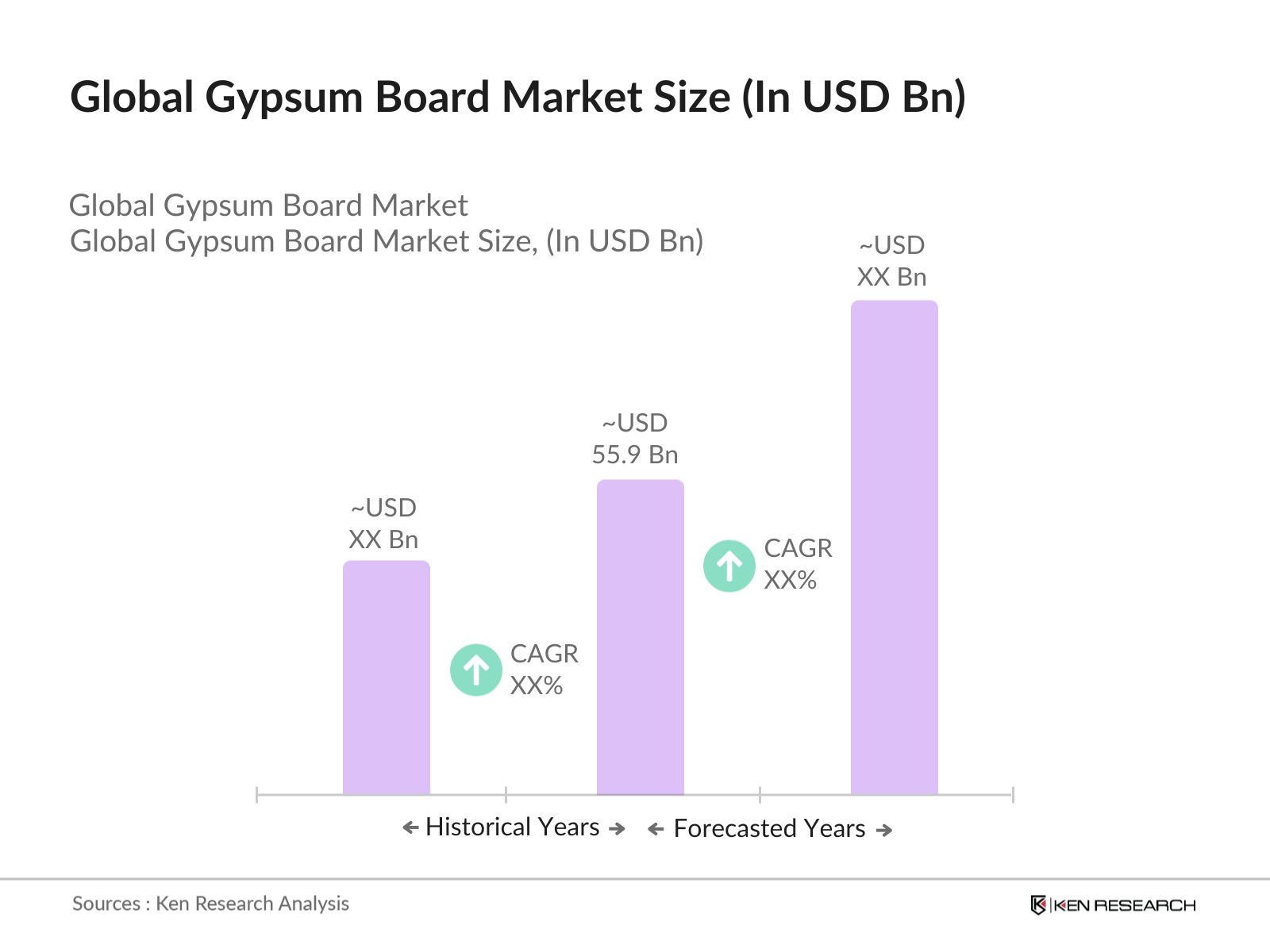
  • The global gypsum board market is valued at USD 55.9 billion and is primarily driven by the growing demand in the construction sector, particularly in residential and commercial applications. The market has experienced robust growth due to increased urbanization, government initiatives promoting infrastructure development, and the rising trend of sustainable building materials. Additionally, the demand for fire-resistant and moisture-resistant gypsum boards has surged in recent years due to strict building safety codes and regulations.
  • Countries like the United States, China, and India dominate the gypsum board market due to their large-scale infrastructure projects and strong construction activities. In the U.S., residential construction drives demand, while China's growth is fueled by its expanding urban population and industrial projects. India, with its rapid urbanization and government-backed housing schemes, has emerged as a significant market player, benefiting from cost-effective production and extensive raw material availability.
  • The International Building Code (IBC) and other regulatory frameworks mandate strict fire safety and environmental standards, driving the demand for fire-resistant gypsum boards. In 2024, over 90 countries have adopted the IBC or equivalent standards, particularly in high-rise buildings. For instance, in New York City, all new buildings over 75 feet must comply with stringent fire resistance requirements, which has led to increased use of gypsum boards that can offer up to 2-hour fire resistance. market overviews

Global Gypsum Board Market Segmentation

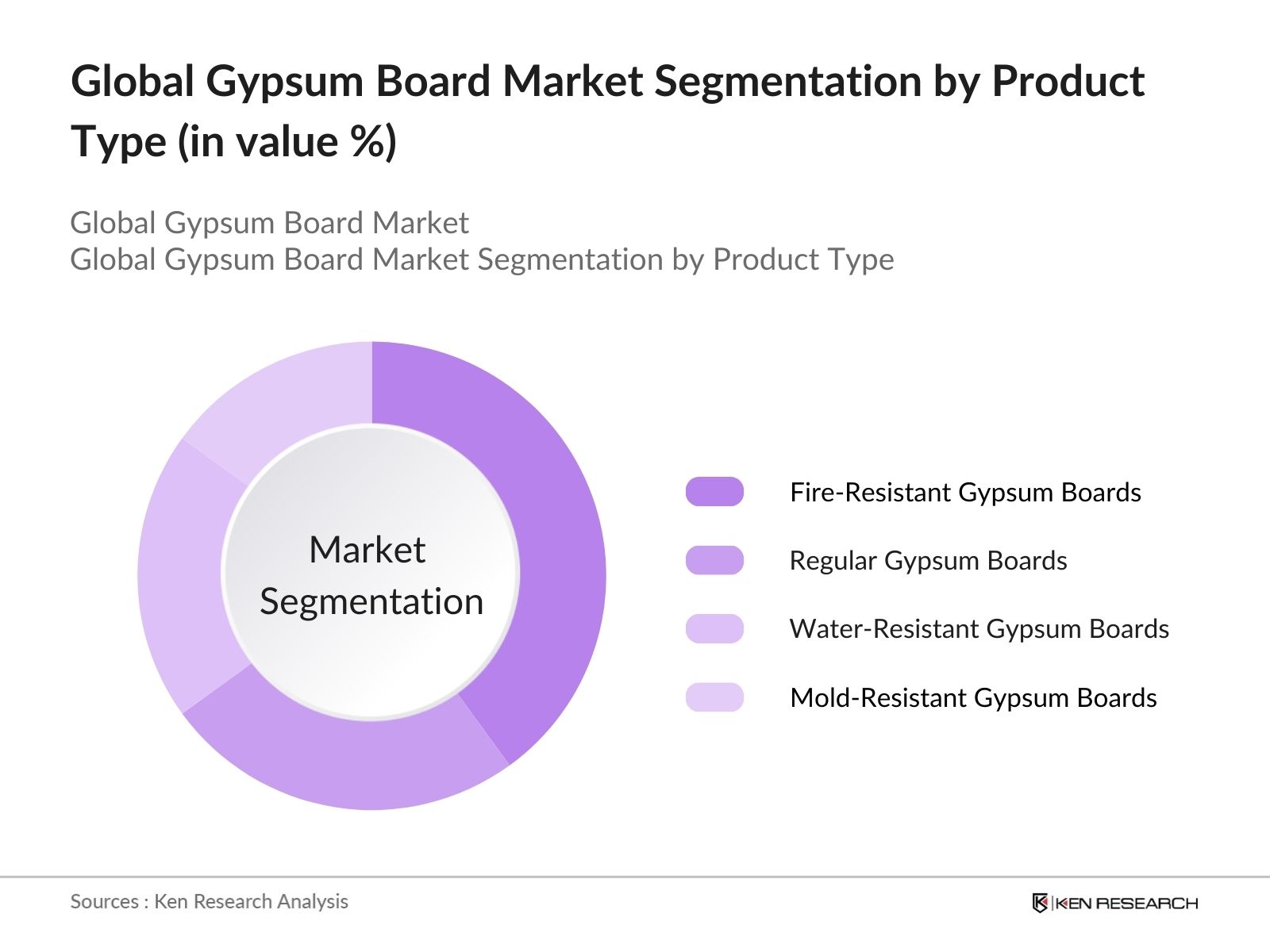
  • By Product Type: The global gypsum board market is segmented by product type into regular gypsum boards, fire-resistant gypsum boards, water-resistant gypsum boards, mold-resistant gypsum boards, and soundproof gypsum boards. Fire-resistant gypsum boards dominate the market share, driven by stringent building safety standards globally. These boards are highly preferred in high-rise buildings, commercial establishments, and institutional structures due to their fire-retardant properties, making them a critical component in modern construction. market overviews
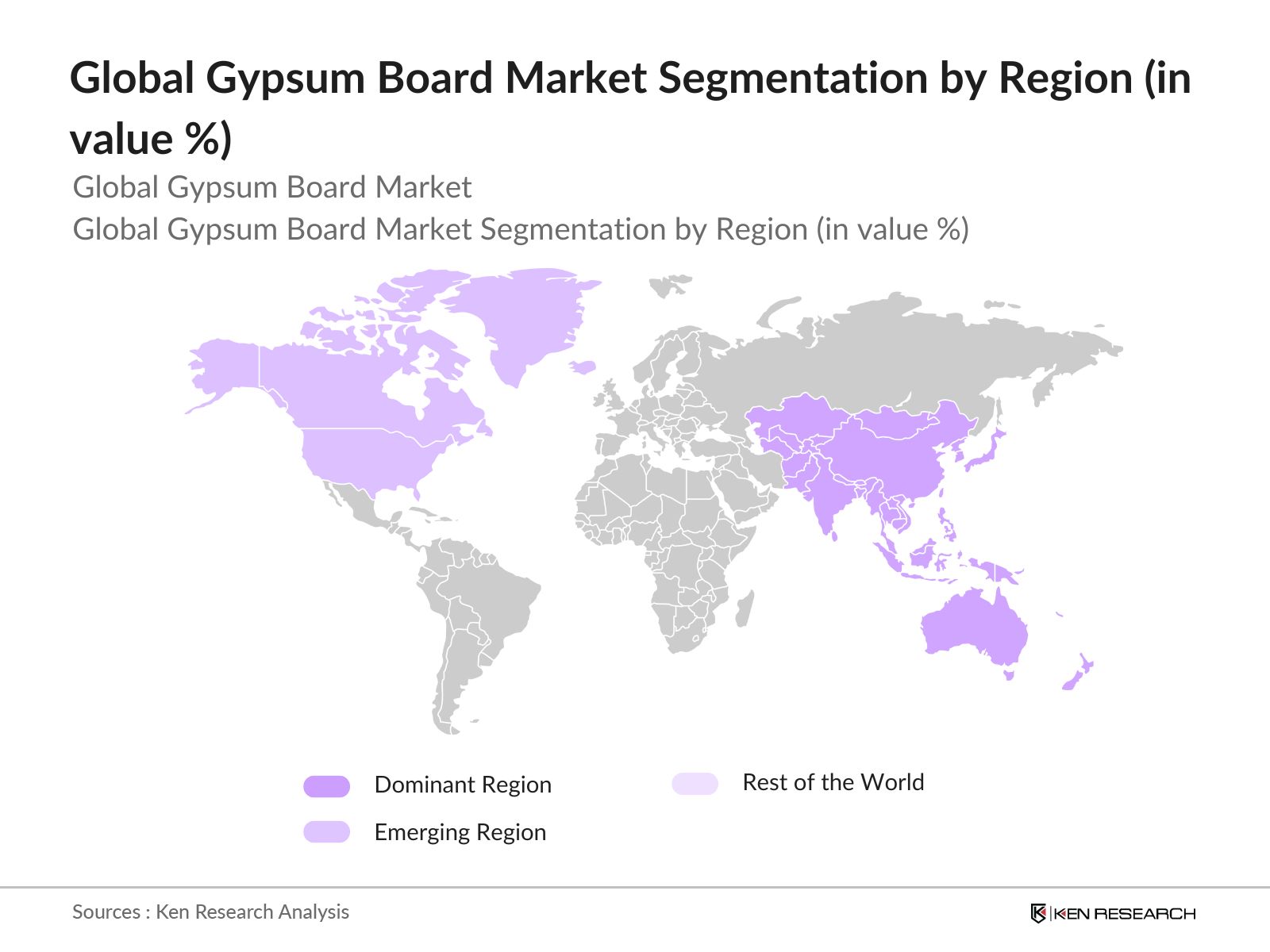
  • By Region: Regionally, the gypsum board market is segmented into North America, Europe, Asia-Pacific, Middle East & Africa, and Latin America. Asia-Pacific is the largest and fastest-growing regional market, driven by the rapid urbanization in China and India. The demand for gypsum boards in this region is largely propelled by government initiatives focused on affordable housing and large-scale infrastructural projects. market overviews
  • By Application: The gypsum board market is further segmented by application into residential construction, commercial construction, institutional construction, and industrial construction. Residential construction holds the largest share due to the increasing need for sustainable and affordable housing solutions in developing regions. The cost-effectiveness and durability of gypsum boards make them highly suitable for residential buildings, especially in developing countries with fast-growing urban populations.

Global Gypsum Board Market Competitive Landscape

The global gypsum board market is dominated by a mix of local and international players. These key companies control a large portion of the market through extensive product portfolios, manufacturing capacities, and strong distribution networks. Their focus on innovation and sustainability practices is essential to maintain a competitive edge in the market.

Company Name

Establishment Year

Headquarters

Installed Capacity

Product Portfolio

Geographical Presence

R&D Investment

Sustainability Practices

Strategic Initiatives

Saint-Gobain

1665

France

-

-

-

-

-

-

USG Corporation

1902

United States

-

-

-

-

-

-

Knauf

1932

Germany

-

-

-

-

-

-

Etex Group

1905

Belgium

-

-

-

-

-

-

Georgia-Pacific

1927

United States

-

-

-

-

-

-

Global Gypsum Board Industry Analysis

Growth Drivers

  • Growth in the Construction Sector (Urbanization, Residential and Commercial Developments): Urbanization continues to accelerate globally, particularly in emerging economies, driving the demand for new residential and commercial structures. By 2024, over 57% of the global population will live in urban areas, up from 54% in 2020, with major cities in Asia and Africa expanding significantly. In India, the Ministry of Housing and Urban Affairs reports that over 15 million new housing units are expected by 2025. The U.S. construction industry is also projected to grow significantly due to urban redevelopment projects, especially in metropolitan areas like New York and Los Angeles. This surge directly increases the demand for gypsum boards as they are preferred for interior finishing in modern construction.
  • Increase in Sustainable Building Practices (Energy Efficiency, Green Building Certifications): Sustainable construction practices are becoming a priority globally, with over 40% of new commercial constructions in 2024 adhering to green building standards, including LEED certification, according to the U.S. Green Building Council. Governments are enforcing stricter energy efficiency norms to reduce the construction sectors environmental footprint, spurring the adoption of gypsum boards for their insulation properties. For example, in Europe, regulations under the European Energy Performance of Buildings Directive require energy-saving measures in all new builds, increasing demand for gypsum boards known for their thermal efficiency.
  • Rising Demand in Emerging Markets (Asia-Pacific, Middle East): The Asia-Pacific and Middle East regions are experiencing a construction boom fueled by population growth and infrastructure investments. By 2024, Asia-Pacific is expected to account for 60% of global infrastructure spending, with large-scale projects in China, India, and Southeast Asia, including urban housing developments and public infrastructure. The Middle East is witnessing growth driven by Vision 2030 initiatives, particularly in Saudi Arabia, where over 30 new megacities and infrastructure projects are under construction. The demand for gypsum boards in these regions is rising sharply, as they are a cost-effective solution for partitions and ceilings in large developments.

Market Restraints

  • Fluctuation in Raw Material Prices (Gypsum, Paper) Gypsum board manufacturers face volatility in the prices of raw materials such as gypsum and paper, which are largely influenced by global supply chain disruptions. According to the International Monetary Fund, raw gypsum prices have risen by 12% from 2022 to 2024 due to increased mining costs and limited supply in major exporting countries like China and Oman. Paper, another critical component in gypsum boards, has seen a price surge of 10% over the same period due to deforestation concerns and higher transportation costs. These fluctuations make pricing strategies more challenging for manufacturers.
  • High Competition Among Local and Global Players (Pricing Pressure, Quality Differentiation) The gypsum board market faces intense competition from both global and local manufacturers. In countries like China, local producers hold a significant market share, driving down prices. In the United States, large players like National Gypsum and USG Corp dominate, but they are increasingly pressured by international firms entering the market. This competition creates a challenging landscape where manufacturers must balance cost reductions with product quality enhancements. Additionally, regional manufacturers often differentiate by offering superior fire-resistant or eco-friendly gypsum boards, further increasing market fragmentation.

Global Gypsum Board Market Future Outlook

Over the next five years, the global gypsum board market is expected to see significant growth driven by increasing demand for sustainable construction materials, advancements in manufacturing technologies, and expansion into emerging markets. The growing trend of lightweight, eco-friendly, and fire-resistant gypsum boards will fuel market growth, especially in regions such as Asia-Pacific and North America. Furthermore, government initiatives promoting green building solutions and infrastructure investments will support the overall market expansion.

Market Opportunities

  • Innovation in Lightweight and Fire-Resistant Gypsum Boards Technological advancements have led to the development of lighter and more fire-resistant gypsum boards, making them highly desirable in the construction of residential and commercial buildings. For example, newer gypsum board models offer 30-minute fire resistance for every 1 cm of board thickness. These innovations meet the growing demand for safety regulations in high-rise buildings, particularly in fire-prone regions such as California, where over 100,000 new homes are required to comply with strict fire safety standards.
  • Expansion of Gypsum Board Applications (Prefabricated Structures, Modular Construction) Gypsum boards are increasingly being used in prefabricated and modular construction, which is projected to account for over 20% of all new building projects in developed nations by 2025, according to the United Nations. Prefabricated structures rely heavily on materials that are light, durable, and easy to transport, making gypsum boards an ideal choice. This trend is particularly visible in countries like Japan, where modular construction has been adopted as a solution to housing shortages, and in the U.S., where prefab homes are being increasingly built in states like Texas and Florida.

Scope of the Report

Segments

Sub-Segments

By Product Type

Regular Gypsum Boards


Fire-Resistant Gypsum Boards


Water-Resistant Gypsum Boards


Mold-Resistant Gypsum Boards


Soundproof Gypsum Boards

By Application

Residential Construction


Commercial Construction


Institutional Construction


Industrial Construction

By End User

Builders and Contractors


Architects and Designers


Gypsum Board Manufacturers

By Thickness

9.5mm Gypsum Boards


12.5mm Gypsum Boards


15mm Gypsum Boards

By Region

North America


Europe


Asia-Pacific


Middle East and Africa


Latin America

Products

Key Target Audience

  • Gypsum Board Manufacturers

  • Builders and Contractors

  • Architects and Designers

  • Government and Regulatory Bodies (e.g., U.S. Environmental Protection Agency, Building Codes Australia)

  • Investor and Venture Capitalist Firms

  • Real Estate Developers

  • Raw Material Suppliers

  • Distributors and Wholesalers

Companies

Players Mentioned in the Report:

  • Saint-Gobain

  • USG Corporation

  • Knauf

  • Etex Group

  • Georgia-Pacific

  • National Gypsum Company

  • Boral Limited

  • LafargeHolcim

  • Yoshino Gypsum Co., Ltd.

  • Gypsemna

  • China National Building Material (CNBM)

  • Taishan Gypsum Co., Ltd.

  • American Gypsum Company LLC

  • Siniat Ltd.

  • Panel Rey

Table of Contents

1. Global Gypsum Board Market Overview

1.1 Definition and Scope
1.2 Market Taxonomy
1.3 Market Growth Rate (CAGR, Market Size %)
1.4 Market Segmentation Overview

2. Global Gypsum Board Market Size (in USD Mn)

2.1 Historical Market Size
2.2 Year-On-Year Growth Analysis
2.3 Key Market Developments and Milestones

3. Global Gypsum Board Market Analysis

3.1 Growth Drivers
3.1.1 Growth in the Construction Sector (Urbanization, Residential and Commercial Developments)
3.1.2 Increase in Sustainable Building Practices (Energy Efficiency, Green Building Certifications)
3.1.3 Rising Demand in Emerging Markets (Asia-Pacific, Middle East)
3.2 Market Challenges
3.2.1 Fluctuation in Raw Material Prices (Gypsum, Paper)
3.2.2 High Competition Among Local and Global Players (Pricing Pressure, Quality Differentiation)
3.2.3 Transportation and Supply Chain Disruptions (Costs, Logistics Challenges)
3.3 Opportunities
3.3.1 Innovation in Lightweight and Fire-Resistant Gypsum Boards
3.3.2 Expansion of Gypsum Board Applications (Prefabricated Structures, Modular Construction)
3.3.3 Technological Advancements (Automation in Production, Smart Manufacturing)
3.4 Trends
3.4.1 Growth in Demand for Water and Moisture-Resistant Gypsum Boards (Residential, Commercial)
3.4.2 Increase in Use of Recyclable and Eco-Friendly Gypsum Boards
3.4.3 Adoption of Digital Construction and Building Information Modeling (BIM)
3.5 Regulatory Environment
3.5.1 International Building Codes (IBC, Fire Safety, Environmental Standards)
3.5.2 Energy-Efficiency Requirements (Green Building Certifications, LEED Standards)
3.5.3 Safety Regulations (Fire Resistance, Soundproofing Requirements)
3.6 SWOT Analysis
3.7 Stakeholder Ecosystem
3.8 Porters Five Forces
3.9 Competition Ecosystem

4. Global Gypsum Board Market Segmentation

4.1 By Product Type (In Value %)
4.1.1 Regular Gypsum Boards
4.1.2 Fire-Resistant Gypsum Boards
4.1.3 Water-Resistant Gypsum Boards
4.1.4 Mold-Resistant Gypsum Boards
4.1.5 Soundproof Gypsum Boards

4.2 By Application (In Value %)
4.2.1 Residential Construction
4.2.2 Commercial Construction
4.2.3 Institutional Construction
4.2.4 Industrial Construction

4.3 By End User (In Value %)
4.3.1 Builders and Contractors
4.3.2 Architects and Designers
4.3.3 Gypsum Board Manufacturers

4.4 By Thickness (In Value %)
4.4.1 9.5mm Gypsum Boards
4.4.2 12.5mm Gypsum Boards
4.4.3 15mm Gypsum Boards

4.5 By Region (In Value %)
4.5.1 North America
4.5.2 Europe
4.5.3 Asia-Pacific
4.5.4 Middle East and Africa
4.5.5 Latin America

5. Global Gypsum Board Market Competitive Analysis

5.1 Detailed Profiles of Major Companies
5.1.1 Saint-Gobain
5.1.2 USG Corporation
5.1.3 Knauf
5.1.4 Etex Group
5.1.5 Georgia-Pacific
5.1.6 National Gypsum Company
5.1.7 Boral Limited
5.1.8 LafargeHolcim
5.1.9 Yoshino Gypsum Co., Ltd.
5.1.10 Gypsemna
5.1.11 China National Building Material (CNBM)
5.1.12 Taishan Gypsum Co., Ltd.
5.1.13 American Gypsum Company LLC
5.1.14 Siniat Ltd.
5.1.15 Panel Rey

5.2 Cross Comparison Parameters (Revenue, Installed Capacity, Market Share, Product Portfolio, Geographical Presence, Strategic Initiatives, Manufacturing Facilities, Sustainability Practices)
5.3 Market Share Analysis
5.4 Strategic Initiatives
5.5 Mergers and Acquisitions
5.6 Investment Analysis
5.7 Government Grants and Subsidies
5.8 Private Equity Investments

6. Global Gypsum Board Market Regulatory Framework

6.1 Building Standards and Certifications
6.2 Environmental and Safety Regulations
6.3 Compliance Requirements

7. Global Gypsum Board Future Market Size (In USD Mn)

7.1 Future Market Size Projections
7.2 Key Factors Driving Future Market Growth

8. Global Gypsum Board Future Market Segmentation

8.1 By Product Type (In Value %)
8.2 By Application (In Value %)
8.3 By End User (In Value %)
8.4 By Thickness (In Value %)
8.5 By Region (In Value %)

9. Global Gypsum Board Market Analysts Recommendations

9.1 TAM/SAM/SOM Analysis
9.2 Customer Cohort Analysis
9.3 Marketing Initiatives
9.4 White Space Opportunity Analysis

Disclaimer Contact Us

Research Methodology

Step 1: Identification of Key Variables

The first step involves creating a comprehensive ecosystem of stakeholders within the global gypsum board market, identifying critical factors that influence market dynamics. Extensive secondary research from proprietary and public databases is conducted to map out the key variables driving market growth.

Step 2: Market Analysis and Construction

In this stage, historical data related to the gypsum board market is compiled and analyzed to determine market trends, regional market share distribution, and product demand patterns. This analysis helps in estimating the total addressable market (TAM) and serviceable available market (SAM).

Step 3: Hypothesis Validation and Expert Consultation

Market hypotheses are generated based on secondary research and validated through interviews with key industry experts, including gypsum board manufacturers, distributors, and end-users. These insights provide operational and financial data essential to refining the overall market analysis.

Step 4: Research Synthesis and Final Output

The final step consolidates data gathered from both primary and secondary research to produce a final market report, ensuring that the analysis is comprehensive, accurate, and reflective of current market trends and dynamics.

Frequently Asked Questions

01. How big is the global gypsum board market?

The global gypsum board market is valued at USD 55.9 billion, driven by strong demand from the construction industry and increasing urbanization.

02. What are the challenges in the global gypsum board market?

The market faces challenges such as fluctuations in raw material prices, transportation costs, and increasing competition among local and global players.

03. Who are the major players in the global gypsum board market?

Key players include Saint-Gobain, USG Corporation, Knauf, Etex Group, and Georgia-Pacific, known for their strong manufacturing capacities and innovation in product development.

04. What are the growth drivers of the global gypsum board market?

Growth drivers include increased demand for sustainable construction materials, stringent building codes, and the rise of residential and commercial infrastructure projects worldwide.

Why Buy From Us?

RRR
Refine Robust Result (RRR) Framework

What makes us stand out is that our consultants follows Robust, Refine and Result (RRR) methodology. i.e. Robust for clear definitions, approaches and sanity checking, Refine for differentiating respondents facts and opinions and Result for presenting data with story

Our Reach Is Unmatched

We have set a benchmark in the industry by offering our clients with syndicated and customized market research reports featuring coverage of entire market as well as meticulous research and analyst insights.

Research
Shifting the Research Paradigm

While we don't replace traditional research, we flip the method upside down. Our dual approach of Top Bottom & Bottom Top ensures quality deliverable by not just verifying company fundamentals but also looking at the sector and macroeconomic factors.

Insite
More Insights-Better Decisions

With one step in the future, our research team constantly tries to show you the bigger picture. We help with some of the tough questions you may encounter along the way: How is the industry positioned? Best marketing channel? KPI's of competitors? By aligning every element, we help maximize success.

Trust
Transparency and Trust

Our report gives you instant access to the answers and sources that other companies might choose to hide. We elaborate each steps of research methodology we have used and showcase you the sample size to earn your trust.

support
Round the Clock Support

If you need any support, we are here! We pride ourselves on universe strength, data quality, and quick, friendly, and professional service.

Why Client Choose Us?

400000+ Reports in repository
150+ Consulting project a year
100+ Analysts
8000+ Client Queries in 2022