















Global Handgun Market Outlook 2030
Region:Global
Author(s):Shivani Mehra
Product Code:KROD7832
November 2024
100
About the Report
Global Handgun Market Overview
- The Global Handgun Market, valued at USD 3.4 billion, is primarily driven by increasing demand for personal security, law enforcement requirements, and military modernization programs. Civilian ownership has seen a rise due to concerns over personal safety and the growing trend of recreational shooting. Additionally, advancements in handgun technology, such as smart guns and enhanced safety features, have further accelerated market demand. The strong presence of various manufacturers in the industry and the focus on customization options for consumers are other critical growth drivers.
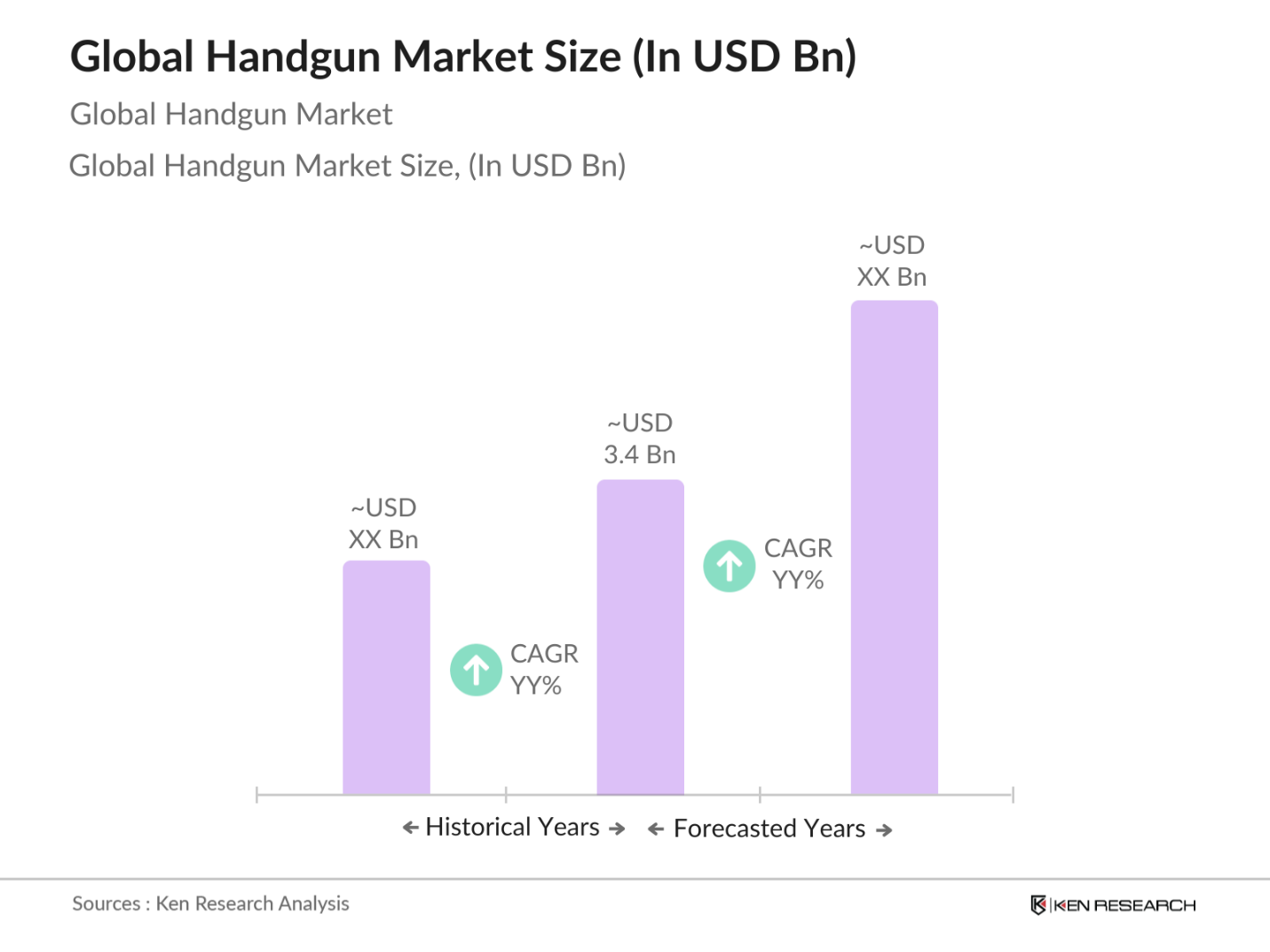
- The global handgun market is dominated by the United States, which has a robust civilian market driven by cultural and constitutional factors. Additionally, countries such as Germany and Italy are key players in Europe due to their established handgun manufacturing industries. These countries have a long history of producing high-quality firearms, and government procurement programs further enhance their dominance. The Middle East is also a growing market, particularly in countries with high defense spending and increased internal security concerns.
- Government regulations on firearm licensing continue to shape the global handgun market. In the United States, nearly 1.6 million handgun permits were issued in 2023, with states such as Texas and Florida leading in the number of licenses issued. Meanwhile, European countries like Germany and the U.K. maintain stricter licensing laws, with only a few thousand licenses granted annually. The Asian market, led by India and South Korea, has also tightened licensing processes, making it more difficult for civilians to own handguns without thorough background checks.
Global Handgun Market Segmentation
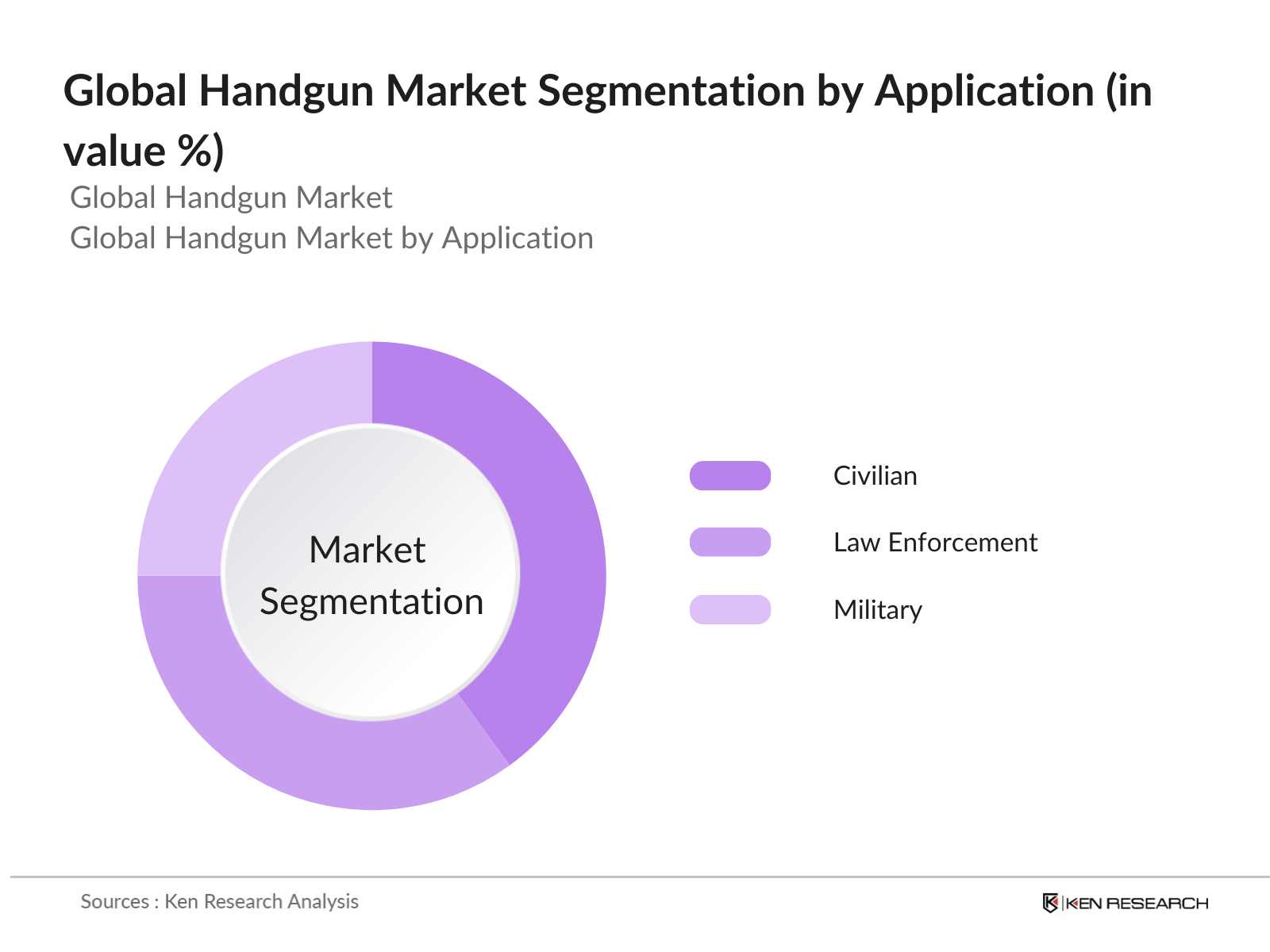
By Application: The market is further divided into military, law enforcement, and civilian applications. The civilian segment holds the largest market share, owing to increased consumer demand for self-defense firearms, particularly in countries with relaxed gun laws like the United States. Military applications also remain significant due to the continued investment in upgrading military arsenals and modernizing equipment in many nations.
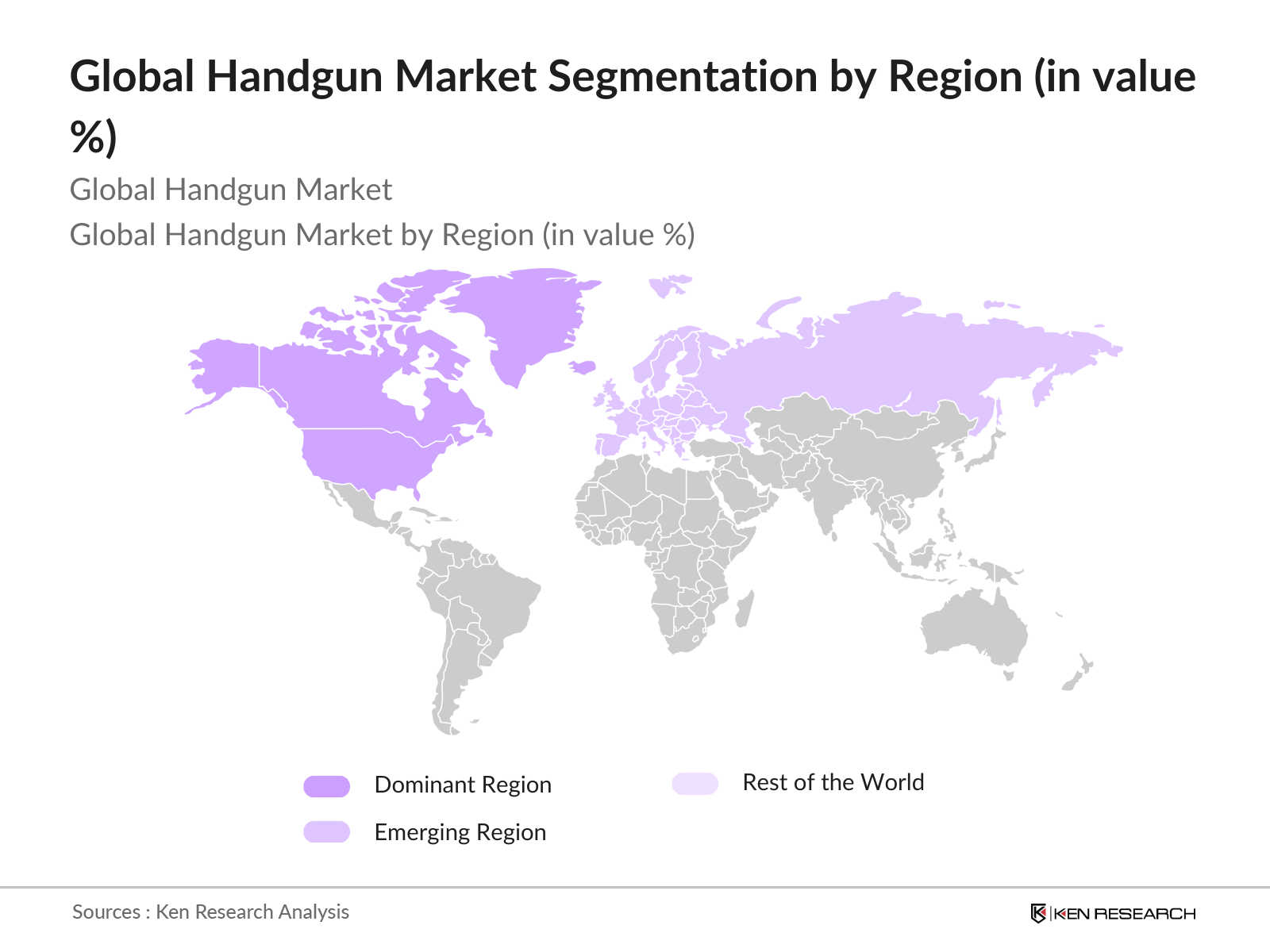
By Region: The handgun market is geographically segmented into North America, Europe, Asia Pacific, Middle East & Africa, and Latin America. North America leads the market, driven by both civilian demand and military procurement in the U.S. Meanwhile, Europe has seen significant growth due to rising concerns over internal security, and the Middle East is emerging as a key player, with several countries increasing their defense budgets.
Global Handgun Market Competitive Landscape
The Global Handgun Market is characterized by the presence of several key players, each with distinct competitive strengths. The market is dominated by well-established firearm manufacturers with strong brand recognition, extensive product portfolios, and a long history of innovation. Companies in this market have been consolidating through mergers and acquisitions, enhancing their technological capabilities to remain competitive.
|
Company |
Establishment Year |
Headquarters |
Global Reach |
R&D Expenditure |
Product Portfolio |
Annual Sales (USD Bn) |
Defense Contracts |
Distribution Network |
|
Smith & Wesson Brands Inc. |
1852 |
U.S. |
||||||
|
Glock GmbH |
1963 |
Austria |
||||||
|
Sturm, Ruger & Co., Inc. |
1949 |
U.S. |
||||||
|
Beretta Holding S.P.A. |
1526 |
Italy |
||||||
|
Sig Sauer GmbH |
1853 |
Germany |
Global Handgun Market Analysis
Market Growth Drivers
- Civilian Ownership and Self-Defense: The increasing demand for handguns among civilians for self-defense has surged significantly in recent years. In the United States alone, nearly 400 million civilian-owned firearms exist, with handguns accounting for over half of this figure. This reflects the growing concerns over personal safety, particularly in regions experiencing political unrest or high crime rates. Countries like Brazil and Mexico have witnessed a sharp rise in handgun acquisitions for self-defense. The availability of handguns at legal gun shops in these regions, coupled with self-defense laws, further boosts demand.
- Law Enforcement Demand: Handgun demand from law enforcement agencies remains high, driven by modernization efforts across global police forces. In 2022, the United States invested $7.1 billion in local law enforcement equipment procurement, with handguns comprising a large portion of this investment. European countries, including Germany and France, have also increased handgun purchases for their police forces as part of broader public safety initiatives. In developing economies like India, law enforcement agencies are increasingly modernizing their handgun inventories, with over 80,000 handguns procured for police forces in 2023.
- Rising Political Instability: Regions facing political instability and conflict have seen heightened demand for handguns. In Latin America, particularly Venezuela and Colombia, rising political unrest and economic instability have contributed to a 35% increase in firearm registrations in 2023, as reported by local authorities. In Africa, countries like South Africa and Nigeria have also seen a spike in handgun acquisitions by both civilians and private security firms due to growing concerns over political violence and civil unrest.
Market Challenges
- Ethical Concerns and Public Opinion: Public opinion and ethical concerns surrounding handgun ownership present additional challenges. In 2023, widespread protests erupted in countries such as the United States and Brazil following several high-profile incidents involving handguns. These events have increased scrutiny on the ethical implications of handgun manufacturing and sales. Governments in the European Union have responded by proposing tighter regulations on handgun advertising and restricting access to minors.
- High Manufacturing Costs: High manufacturing costs, particularly for advanced handguns with specialized features, are another barrier to market growth. In Germany, the cost of producing a standard semi-automatic handgun can range from 500 to 700, depending on materials and labor. This has led many manufacturers to outsource production to countries with lower labor costs, such as China and Mexico, where production costs are significantly reduced. However, this outsourcing comes with challenges related to quality control and supply chain management, which can affect the quality of the final product and increase operational complexities for manufacturers.
Global Handgun Market Future Outlook
Over the next five years, the Global Handgun Market is expected to experience sustained growth. Increasing concerns over personal safety and the continued militarization in several regions will drive demand for both civilian and defense handguns. Technological advancements in firearm safety and performance are likely to boost market prospects. In addition, growing international interest in recreational and competitive shooting will create further market opportunities.
Market Opportunities:
- Smart Guns and Firearm Technology: Smart gun technology continues to be a key trend in the market. The introduction of guns that can only be fired by authorized users, verified through biometric recognition or RFID tags, is seeing rising demand. In 2023, over 20,000 smart guns were sold globally, reflecting consumer interest in enhanced safety features. The U.S. government has introduced initiatives encouraging law enforcement agencies to adopt smart guns, providing financial incentives for departments to upgrade their firearms to these safer, more secure models.
- Growth in Competitive Shooting Sports: Competitive shooting sports are on the rise globally, leading to increased handgun sales. In 2023, over 150,000 individuals participated in shooting competitions in the U.S., according to the National Shooting Sports Foundation. The trend is similarly observed in Europe, where countries like Germany and France have witnessed rising participation in shooting events, with over 50,000 licensed competitive shooters. This growth in shooting sports has created a demand for specialized handguns, designed for precision and performance.
Scope of the Report
|
By Type |
Revolvers Semi-Automatic Pistols |
|
By Application |
Military Law Enforcement Civilian |
|
By Caliber |
Small Caliber Medium Caliber Large Caliber |
|
By Technology |
Smart Guns Conventional Guns |
|
By Region |
North America Europe Asia Pacific Middle East & Africa Latin America |
Products
Key Target Audience
Handgun Manufacturers
Law Enforcement Agencies
Military and Defense Procurement Agencies
Civilian Gun Enthusiasts
Firearms Retailers
Investments and Venture Capitalist Firms
Government and Regulatory Bodies (ATF, U.S. Department of Defense)
Competitive Shooting Sports Organization
Companies
Players Mention in the Report
Smith & Wesson Brands Inc.
Glock GmbH
Sturm, Ruger & Co., Inc.
Sig Sauer GmbH
Beretta Holding S.P.A.
Heckler & Koch GmbH
FN Herstal
Taurus Holdings, Inc.
Colt's Manufacturing Company LLC
CZG esk Zbrojovka Group SE
Walther Arms
Israel Weapon Industries (IWI)
Browning Arms Company
Desert Tech
Kahr Arms
Table of Contents
1. Global Handgun Market Overview
1.1. Definition and Scope
1.2. Market Taxonomy
1.3. Market Growth Rate
1.4. Market Segmentation Overview
2. Global Handgun Market Size (In USD Bn)
2.1. Historical Market Size
2.2. Year-on-Year Growth Analysis
2.3. Key Market Developments and Milestones
3. Global Handgun Market Analysis
3.1. Growth Drivers
3.1.1. Civilian Ownership and Self-Defense
3.1.2. Law Enforcement Demand
3.1.3. Rising Political Instability
3.1.4. Military Modernization Programs
3.2. Market Challenges
3.2.1. Stringent Gun Control Regulations
3.2.2. Ethical Concerns and Public Opinion
3.2.3. High Manufacturing Costs
3.3. Opportunities
3.3.1. Emerging Markets Expansion
3.3.2. Technological Advancements in Firearms
3.3.3. Customization and Niche Markets
3.4. Trends
3.4.1. Smart Guns and Firearm Technology
3.4.2. Increase in Female Handgun Ownership
3.4.3. Growth in Competitive Shooting Sports
3.5. Government Regulation (Firearm Licensing, Import/Export Controls, Manufacturing Standards)
3.5.1. Firearm Licensing Laws
3.5.2. Import and Export Controls
3.5.3. Firearm Manufacturing Standards
3.6. SWOT Analysis
3.7. Stakeholder Ecosystem
3.8. Porters Five Forces
3.9. Competition Ecosystem
4. Global Handgun Market Segmentation
4.1. By Type (In Value %)
4.1.1. Revolvers
4.1.2. Semi-Automatic Pistols
4.2. By Application (In Value %)
4.2.1. Military
4.2.2. Law Enforcement
4.2.3. Civilian
4.3. By Caliber (In Value %)
4.3.1. Small Caliber
4.3.2. Medium Caliber
4.3.3. Large Caliber
4.4. By Technology (In Value %)
4.4.1. Smart Guns
4.4.2. Conventional Guns
4.5. By Region (In Value %)
4.5.1. North America
4.5.2. Europe
4.5.3. Asia Pacific
4.5.4. Middle East & Africa
4.5.5. Latin America
5. Global Handgun Market Competitive Analysis
5.1. Detailed Profiles of Major Companies
5.1.1. Smith & Wesson Brands Inc.
5.1.2. Glock GmbH
5.1.3. Sturm, Ruger & Co., Inc.
5.1.4. Sig Sauer GmbH
5.1.5. Beretta Holding S.P.A.
5.1.6. Heckler & Koch GmbH
5.1.7. FN Herstal
5.1.8. Taurus Holdings, Inc.
5.1.9. Colt's Manufacturing Company LLC
5.1.10. CZG esk Zbrojovka Group SE
5.1.11. Walther Arms
5.1.12. Israel Weapon Industries (IWI)
5.1.13. Browning Arms Company
5.1.14. Desert Tech
5.1.15. Kahr Arms
5.2. Cross Comparison Parameters (Firearms Production Capacity, Number of Patents, Global Distribution Network, Revenue)
5.3. Market Share Analysis
5.4. Strategic Initiatives
5.5. Mergers and Acquisitions
5.6. Investment Analysis
5.7. Venture Capital Funding
5.8. Government Grants
5.9. Private Equity Investments
6. Global Handgun Market Regulatory Framework
6.1. Global and Regional Firearm Regulations
6.2. Compliance Requirements for Manufacturers
6.3. Certification Processes
7. Global Handgun Future Market Size (In USD Bn)
7.1. Future Market Size Projections
7.2. Key Factors Driving Future Market Growth
8. Global Handgun Future Market Segmentation
8.1. By Type (In Value %)
8.2. By Application (In Value %)
8.3. By Caliber (In Value %)
8.4. By Technology (In Value %)
8.5. By Region (In Value %)
9. Global Handgun Market Analysts Recommendations
9.1. TAM/SAM/SOM Analysis
9.2. Customer Cohort Analysis
9.3. Marketing Initiatives
9.4. White Space Opportunity Analysis
Disclaimer Contact UsResearch Methodology
Step 1: Identification of Key Variables
In this phase, we construct a comprehensive ecosystem map covering all major stakeholders in the Global Handgun Market. Extensive desk research is conducted using secondary and proprietary databases to identify the critical variables influencing market dynamics.
Step 2: Market Analysis and Construction
We compile and analyze historical data on market penetration and the ratio of civilian to military use. This step also includes evaluating the impact of technology on product development and sales. The objective is to ensure the reliability of revenue estimates by assessing market dynamics and emerging trends.
Step 3: Hypothesis Validation and Expert Consultation
During this phase, we validate market hypotheses through interviews with industry experts, including representatives from leading firearms manufacturers and law enforcement agencies. These consultations provide critical operational insights and assist in refining market estimates.
Step 4: Research Synthesis and Final Output
The final step involves synthesizing research findings and directly engaging with manufacturers to verify product-level data and customer preferences. This interaction complements bottom-up analysis, ensuring a well-rounded and validated market report.
Frequently Asked Questions
01. How big is the Global Handgun Market?
The global handgun market is valued at USD 3.4 billion, driven by rising consumer demand for personal security and military modernization efforts worldwide.
02. What are the challenges in the Global Handgun Market?
Key challenges include stringent gun control regulations, ethical concerns, and public opposition to firearm ownership in some regions, making market penetration difficult in certain countries.
03. Who are the major players in the Global Handgun Market?
Leading players in the market include Smith & Wesson, Glock, Sig Sauer, Beretta, and Sturm, Ruger & Co., among others. These companies dominate due to their extensive product offerings and strong global distribution networks.
04. What are the growth drivers of the Global Handgun Market?
The market is driven by increasing personal security concerns, military modernization programs, and growing interest in recreational shooting sports. Technological advancements in smart guns also contribute to market growth.
Why Buy From Us?

What makes us stand out is that our consultants follows Robust, Refine and Result (RRR) methodology. i.e. Robust for clear definitions, approaches and sanity checking, Refine for differentiating respondents facts and opinions and Result for presenting data with story

We have set a benchmark in the industry by offering our clients with syndicated and customized market research reports featuring coverage of entire market as well as meticulous research and analyst insights.

While we don't replace traditional research, we flip the method upside down. Our dual approach of Top Bottom & Bottom Top ensures quality deliverable by not just verifying company fundamentals but also looking at the sector and macroeconomic factors.

With one step in the future, our research team constantly tries to show you the bigger picture. We help with some of the tough questions you may encounter along the way: How is the industry positioned? Best marketing channel? KPI's of competitors? By aligning every element, we help maximize success.

Our report gives you instant access to the answers and sources that other companies might choose to hide. We elaborate each steps of research methodology we have used and showcase you the sample size to earn your trust.

If you need any support, we are here! We pride ourselves on universe strength, data quality, and quick, friendly, and professional service.