
Global Handheld Vacuum Cleaner Market Outlook to 2030
Region:Global
Author(s):Naman Rohilla
Product Code:KROD8944
December 2024
91
About the Report
Global Handheld Vacuum Cleaner Market Overview
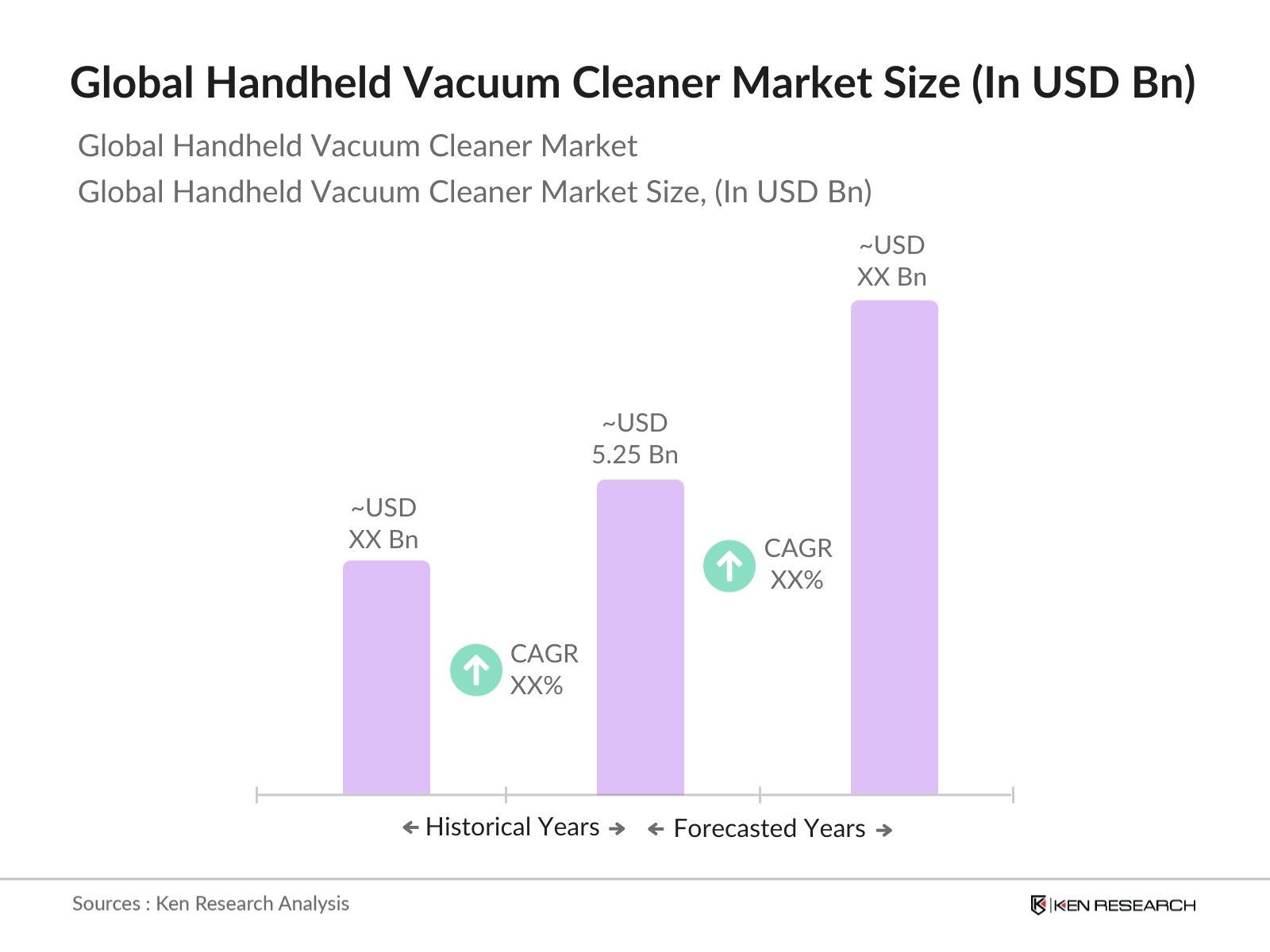
- The Global Handheld Vacuum Cleaner market is valued at USD 5.25 billion, driven by consumer demand for portable, high-efficiency cleaning solutions. With technological advancements focusing on battery life, suction power, and compact design, handheld vacuum cleaners are becoming a popular choice among urban consumers. The market growth is particularly supported by the increasing adoption of smart home devices and the rising preference for ergonomic and portable home cleaning solutions. This trend underscores a shift towards compact yet powerful devices in the cleaning appliance industry.
- Countries like the United States, China, and Japan dominate this market due to their strong technological infrastructure and consumer demand for advanced home appliances. The U.S. leads in innovation, while China benefits from its vast manufacturing capabilities and expanding consumer base. Japans demand is propelled by high urbanization rates, where space efficiency and product innovation are key consumer priorities. These regions, with their market strengths, highlight the diverse drivers of demand for handheld vacuum cleaners.
- Energy efficiency standards are influencing the handheld vacuum market, with regulators in the U.S. mandating energy consumption limits for household appliances. In 2023, the U.S. Department of Energy set minimum efficiency standards for handheld vacuums to reduce household energy consumption, aligning with national sustainability goals. Compliance with these standards can impact production costs and influence consumer choice, favouring energy-efficient models.
Global Handheld Vacuum Cleaner Market Segmentation
- By Product Type: The handheld vacuum cleaner market is segmented by product type into cordless handheld vacuum cleaners and corded handheld vacuum cleaners. Cordless vacuum cleaners dominate this segment, attributed to their mobility and ease of use, which meet the demands of urban consumers looking for lightweight and portable solutions. Leading brands focus on improving battery life, suction power, and reducing overall device weight, driving the popularity of cordless models among consumers who value convenience in their home cleaning routines.

- By Battery Type: Within battery types, the market divides into lithium-ion batteries, nickel-metal hydride batteries, and other types. Lithium-ion batteries dominate due to their longer battery life and faster recharge times, making them highly suitable for the performance demands of handheld vacuum cleaners. The focus on lithium-ion technology also aligns with advancements in lightweight, energy-dense batteries that allow for prolonged usage, catering to consumer expectations for longer operation times without compromising device weight.
- By Region: Geographically, the handheld vacuum cleaner market is segmented into North America, Europe, Asia-Pacific, Latin America, and Middle East & Africa. North America holds a notable share, largely due to high consumer purchasing power and interest in advanced household cleaning devices. Furthermore, the demand for environmentally conscious, portable home appliances drives this segment in the U.S. and Canada, as consumers seek compact cleaning solutions that complement their home efficiency.

Global Handheld Vacuum Cleaner Market Competitive Landscape
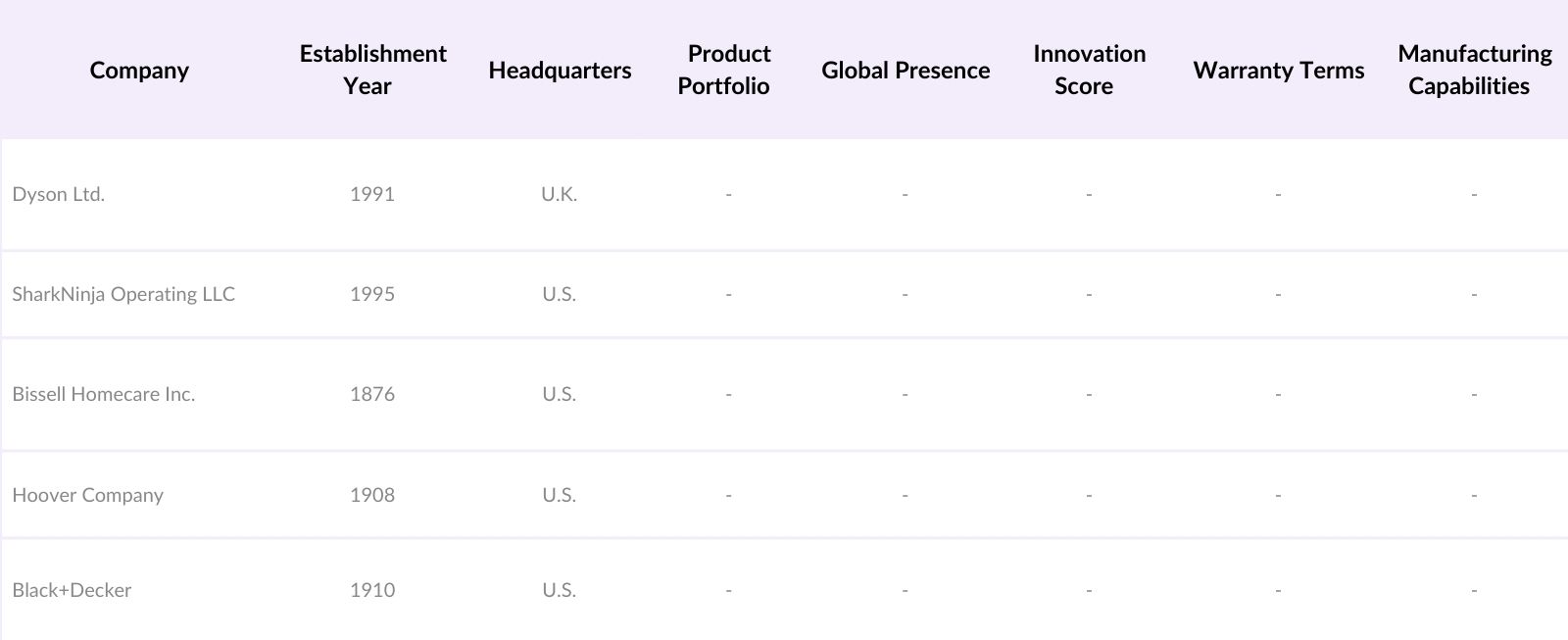
The handheld vacuum cleaner market is competitive, with a mix of established brands and emerging players focusing on innovation and product development. Key players include Dyson Ltd., SharkNinja Operating LLC, and Bissell Homecare Inc., known for their extensive product lines and focus on high-performance, energy-efficient devices. This markets competitive nature is defined by companies investing in technology that enhances product functionality, lightweight design, and consumer-oriented features.
Global Handheld Vacuum Cleaner Market Analysis
Market Growth Drivers
- Increasing Urbanization: The demand for handheld vacuum cleaners is strongly correlated with urbanization, as compact and efficient cleaning solutions become essential in smaller living spaces. In 2023, the global urban population reached 57%, supported by infrastructure development in countries like China and India. In India alone, urban population growth reached 35%, emphasizing a growing need for convenient, space-efficient appliances. This urban influx intensifies the demand for handheld vacuums, particularly in high-density areas where quick, versatile cleaning solutions are preferred.
- Rising Disposable Income: Higher disposable incomes have fueled consumer interest in compact, high-performance appliances such as handheld vacuums. In the U.S., disposable income per capita reached $45,850 in 2024. Similarly, China saw a 5% rise in disposable income, improving consumers' purchasing power for high-quality, portable cleaning products. This trend aligns with consumer spending behavior towards premium home appliances that are both functional and compact.
- Increasing Adoption of Smart Home Products: The growing adoption of smart home ecosystems has led to a parallel rise in demand for compatible handheld vacuums. As of 2024, 38% of households in North America have integrated at least one smart device, a figure projected to rise due to investments in connected home infrastructure (World Bank, 2023). Handheld vacuums compatible with smart home systems are seeing increased adoption as they align with the broader consumer shift towards interconnected, automated living environments.
Market Challenges
- Competition from Robot Vacuums: Robot vacuums have created substantial competition for handheld vacuum cleaners by offering convenience and automated cleaning. In 2023, robot vacuum penetration in U.S. households reached 11% (Consumer Technology Association, 2023), signalling a shift towards autonomous cleaning devices. This trend poses a challenge for handheld vacuums, as more households opt for fully automated solutions that require minimal manual effort, thereby affecting the growth potential for handheld models.
- Battery Life Limitations: Battery limitations remain a core challenge in handheld vacuums, particularly for prolonged cleaning needs. While recent advancements have improved battery capacity, the average usage duration still falls short for larger cleaning tasks, averaging only 2030 minutes per full charge in 2023 (IEA, 2023). This limitation restricts their utility for consumers with larger homes or extensive cleaning requirements, potentially limiting market adoption.
Global Handheld Vacuum Cleaner Market Future Outlook
Over the coming years, the handheld vacuum cleaner market is expected to grow, driven by consumer preference for compact, efficient, and technologically advanced cleaning solutions. Innovations in battery technology, enhanced suction capabilities, and sustainable product designs are set to play a critical role. With an increasing emphasis on indoor air quality and convenience, the markets growth will likely reflect a shift toward products that align with eco-friendly and efficient home cleaning solutions.
Market Opportunities
- Integration with IoT for Smart Homes: Integrating handheld vacuums with IoT for smart homes offers considerable growth potential. In 2024, IoT-enabled home devices, including handheld vacuums, are seeing greater adoption, with over 50 million homes in Europe having at least one connected device. Handheld vacuums that can communicate with other smart devices in a home ecosystem could further attract tech-savvy consumers seeking seamless, automated cleaning solutions.
- Growth in Emerging Economies: Emerging economies present a growth opportunity for handheld vacuums, driven by increasing middle-class populations and urbanization. In Southeast Asia, urban household numbers grew by 8% in 2023, with rising demand for modern, efficient home appliances. Increased purchasing power among middle-income households in regions like Indonesia and Vietnam further supports the adoption of handheld vacuums, expanding market prospects.
Scope of the Report
|
By Product Type |
Cordless Handheld Vacuum Cleaners Corded Handheld Vacuum Cleaners |
|
By Battery Type |
Lithium-Ion Batteries Nickel-Metal Hydride Batteries Others |
|
By Application |
Residential Commercial |
|
By Distribution Channel |
Online Offline |
|
By Region |
North America Europe Asia-Pacific Latin America Middle East & Africa |
Products
Key Target Audience
Consumer Electronics Retailers
Online Retail Platforms
Investor and Venture Capitalist Firms
Government and Regulatory Bodies (EPA, FCC)
Home Appliance Manufacturers
Battery Technology Providers
Banks and Financial Institutions
Environmental Sustainability Advocates
Smart Home Integrators
Companies
Players Mentioned in the Report
Dyson Ltd.
SharkNinja Operating LLC
Bissell Homecare Inc.
Hoover Company
Black+Decker
LG Electronics Inc.
Tineco Intelligent Technology
Koninklijke Philips N.V.
Panasonic Corporation
Stanley Black & Decker Inc.
Table of Contents
1. Global Handheld Vacuum Cleaner Market Overview
1.1 Definition and Scope
1.2 Market Taxonomy
1.3 Market Growth Rate
1.4 Market Segmentation Overview
2. Global Handheld Vacuum Cleaner Market Size (In USD Bn)
2.1 Historical Market Size
2.2 Year-On-Year Growth Analysis
2.3 Key Market Developments and Milestones
3. Global Handheld Vacuum Cleaner Market Analysis
3.1 Growth Drivers
3.1.1 Increasing Urbanization
3.1.2 Rising Disposable Income
3.1.3 Technological Advancements in Battery Life
3.1.4 Increasing Adoption of Smart Home Products
3.2 Market Challenges
3.2.1 Competition from Robot Vacuums
3.2.2 Battery Life Limitations
3.2.3 High Initial Costs for Advanced Models
3.3 Opportunities
3.3.1 Integration with IoT for Smart Homes
3.3.2 Growth in Emerging Economies
3.3.3 Demand for Lightweight, Portable Models
3.4 Trends
3.4.1 Demand for Cordless Solutions
3.4.2 Rising Focus on Sustainability
3.4.3 Inclusion of HEPA Filters for Allergen Control
3.5 Regulatory Environment
3.5.1 Energy Efficiency Standards
3.5.2 Environmental Compliance for Materials
3.5.3 Safety Standards for Lithium-Ion Batteries
3.6 SWOT Analysis
3.7 Stakeholder Ecosystem
3.8 Porters Five Forces
3.9 Competition Ecosystem
4. Global Handheld Vacuum Cleaner Market Segmentation
4.1 By Product Type (In Value %)
4.1.1 Cordless Handheld Vacuum Cleaners
4.1.2 Corded Handheld Vacuum Cleaners
4.2 By Battery Type (In Value %)
4.2.1 Lithium-Ion Batteries
4.2.2 Nickel-Metal Hydride Batteries
4.2.3 Others
4.3 By Application (In Value %)
4.3.1 Residential
4.3.2 Commercial
4.4 By Distribution Channel (In Value %)
4.4.1 Online
4.4.2 Offline
4.5 By Region (In Value %)
4.5.1 North America
4.5.2 Europe
4.5.3 Asia-Pacific
4.5.4 Latin America
4.5.5 Middle East & Africa
5. Global Handheld Vacuum Cleaner Market Competitive Analysis
5.1 Detailed Profiles of Major Companies
5.1.1 Dyson Ltd.
5.1.2 Black+Decker
5.1.3 SharkNinja Operating LLC
5.1.4 Bissell Homecare Inc.
5.1.5 Hoover Company
5.1.6 LG Electronics Inc.
5.1.7 Tineco Intelligent Technology
5.1.8 Koninklijke Philips N.V.
5.1.9 Panasonic Corporation
5.1.10 Stanley Black & Decker Inc.
5.1.11 Eureka Forbes
5.1.12 Techtronic Industries Co. Ltd.
5.1.13 Miele & Cie. KG
5.1.14 iRobot Corporation
5.1.15 Electrolux AB
5.2 Cross Comparison Parameters (Market Presence, Product Portfolio Depth, Price Range, Innovation Index, Distribution Network Size, Customer Satisfaction Score, Advertising Spend, Warranty Terms)
5.3 Market Share Analysis
5.4 Strategic Initiatives
5.5 Mergers and Acquisitions
5.6 Investment Analysis
5.7 Venture Capital Funding
5.8 Government Grants
5.9 Private Equity Investments
6 Global Handheld Vacuum Cleaner Market Regulatory Framework
6.1 Environmental Standards for Manufacturing
6.2 Compliance Requirements for Battery Disposal
6.3 Certification Processes for Safety Standards
7. Global Handheld Vacuum Cleaner Market Future Market Size (In USD Bn)
7.1 Future Market Growth Potential
7.2 Key Drivers Influencing Future Market Trends
8. Global Handheld Vacuum Cleaner Market Future Segmentation
8.1 By Product Type (In Value %)
8.2 By Battery Type (In Value %)
8.3 By Application (In Value %)
8.4 By Distribution Channel (In Value %)
8.5 By Region (In Value %)
9. Global Handheld Vacuum Cleaner Market Analysts' Recommendations
9.1 TAM/SAM/SOM Analysis
9.2 Customer Cohort Analysis
9.3 Marketing Strategy Suggestions
9.4 White Space Opportunity Analysis
Disclaimer Contact UsResearch Methodology
Step 1: Identification of Key Variables
The initial phase involves developing a market ecosystem map for the handheld vacuum cleaner market. Desk research and database analysis help pinpoint the core variables influencing market trends and consumer demand.
Step 2: Market Analysis and Construction
In this phase, we compile historical data and assess variables like market penetration, product demand across key regions, and competitive landscape, ensuring robust market estimates through statistical validation.
Step 3: Hypothesis Validation and Expert Consultation
Key market assumptions are validated through expert interviews with stakeholders across the industry, providing firsthand insights into operational dynamics, technology, and consumer preferences.
Step 4: Research Synthesis and Final Output
The final phase involves synthesizing data and insights from manufacturers, distributors, and retailers, ensuring a validated analysis aligned with industry benchmarks and market realities.
Frequently Asked Questions
01. How big is the Global Handheld Vacuum Cleaner Market?
The global handheld vacuum cleaner market is valued at USD 5.25 billion, propelled by demand for convenient, portable, and efficient cleaning devices.
02. What are the challenges in the Global Handheld Vacuum Cleaner Market?
Key challenges include technological limitations in battery life, intense competition from robotic and larger vacuum cleaners, and consumer demand for environmentally sustainable products.
03. Who are the major players in the Global Handheld Vacuum Cleaner Market?
Leading companies in this market include Dyson Ltd., SharkNinja, Bissell Homecare Inc., and Hoover, all known for innovation and extensive product lines.
04. What are the growth drivers of the Global Handheld Vacuum Cleaner Market?
The market is driven by advancements in cordless technology, lightweight designs, and the increasing consumer focus on ease of use and air quality in home cleaning solutions.
Why Buy From Us?

What makes us stand out is that our consultants follows Robust, Refine and Result (RRR) methodology. i.e. Robust for clear definitions, approaches and sanity checking, Refine for differentiating respondents facts and opinions and Result for presenting data with story

We have set a benchmark in the industry by offering our clients with syndicated and customized market research reports featuring coverage of entire market as well as meticulous research and analyst insights.

While we don't replace traditional research, we flip the method upside down. Our dual approach of Top Bottom & Bottom Top ensures quality deliverable by not just verifying company fundamentals but also looking at the sector and macroeconomic factors.

With one step in the future, our research team constantly tries to show you the bigger picture. We help with some of the tough questions you may encounter along the way: How is the industry positioned? Best marketing channel? KPI's of competitors? By aligning every element, we help maximize success.

Our report gives you instant access to the answers and sources that other companies might choose to hide. We elaborate each steps of research methodology we have used and showcase you the sample size to earn your trust.

If you need any support, we are here! We pride ourselves on universe strength, data quality, and quick, friendly, and professional service.