
Global Health Drinks Market Outlook to 2030
Region:Global
Author(s):Sanjna
Product Code:KROD4870
Region:Global
Author(s):Sanjna
Product Code:KROD4870
December 2024
93

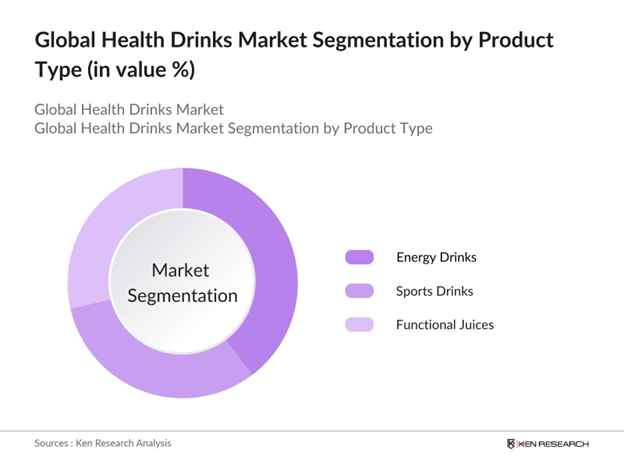
By Product Type: The Global Health Drinks Market is segmented by product type into energy drinks, sports drinks, functional juices, meal replacement shakes, and plant-based drinks. Recently, plant-based drinks have taken the dominant market share in this segment due to the rising consumer preference for vegan and lactose-free alternatives. Brands like Oatly and Califia Farms have leveraged this trend by offering a wide range of dairy-free health drinks, which are increasingly popular due to their perceived health benefits and lower environmental impact.
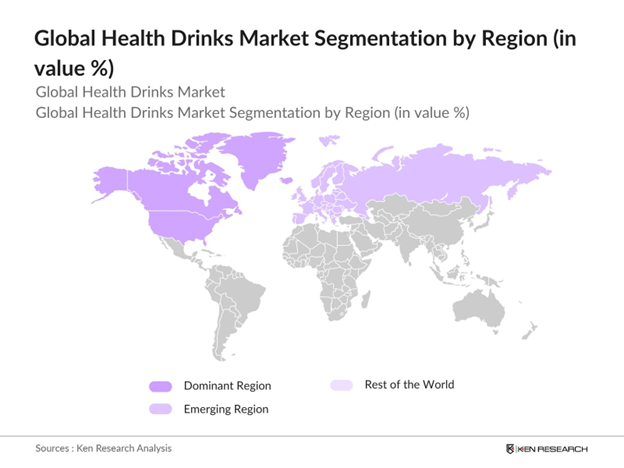
By Region: The market is segmented into North America, Europe, Asia Pacific, Latin America, and the Middle East & Africa. North America is the dominant region, accounting for the largest market share. This is largely due to high levels of health awareness and significant consumption of functional and plant-based beverages. Major players like PepsiCo and The Coca-Cola Company have also played a crucial role in expanding the market by continuously launching new health drinks targeting fitness and wellness enthusiasts. Additionally, the regions strong retail and online presence helps facilitate the distribution of these products.
By Consumer Type: The market is segmented by consumer type into adults, children, athletes, and seniors. Among these, the adult consumer group holds the largest market share. This is primarily due to the increasing number of health-conscious adults who are seeking beverages that not only provide hydration but also offer additional benefits such as energy-boosting or detoxifying properties. Adults are also more likely to engage in fitness and wellness activities, thereby increasing their consumption of health drinks such as energy and sports beverages.
The Global Health Drinks Market is dominated by a few major players that have established a significant presence across various product categories. Companies like PepsiCo, The Coca-Cola Company, and Red Bull GmbH lead the market due to their extensive distribution networks and strong product portfolios that cater to a wide range of consumer preferences. Furthermore, innovative product launches focusing on functional ingredients and eco-friendly packaging have enabled these companies to maintain a competitive edge.
|
Company |
Establishment Year |
Headquarters |
Revenue (USD) |
Product Portfolio |
Geographical Presence |
Sustainability Initiatives |
R&D Investment |
Innovation in Packaging |
Digital Strategy |
|
PepsiCo, Inc. |
1965 |
Purchase, NY, USA |
- |
- |
- |
- |
- |
- |
- |
|
The Coca-Cola Company |
1892 |
Atlanta, GA, USA |
- |
- |
- |
- |
- |
- |
- |
|
Red Bull GmbH |
1987 |
Fuschl am See, Austria |
- |
- |
- |
- |
- |
- |
- |
|
Danone S.A. |
1919 |
Paris, France |
- |
- |
- |
- |
- |
- |
- |
|
Nestl S.A. |
1867 |
Vevey, Switzerland |
- |
- |
- |
- |
- |
- |
- |
3.1 Growth Drivers
Challenges
The Global Health Drinks Market is expected to experience robust growth driven by a number of key factors. These include the rising consumer demand for natural and organic products, increased focus on sustainability, and continuous innovations in the functional beverage segment. Manufacturers are expected to expand their portfolios to cater to specific consumer needs, including immunity-boosting drinks and energy enhancers.
Market Opportunities
|
By Product Type |
Energy Drinks Sports Drinks Functional Juices Meal Replacement Shakes Plant-based Drinks |
|
By Consumer Type |
Adults Children Athletes Seniors |
|
By Distribution Channel |
Online Retail Supermarkets & Hypermarkets Specialty Stores Direct-to-Consumer |
|
By Packaging |
Bottles Cans Tetra Packs |
|
By Region |
North America Europe Asia Pacific Latin America Middle East & Africa |
1.1 Definition and Scope
1.2 Market Taxonomy
1.3 Market Growth Rate
1.4 Market Segmentation Overview
2.1 Historical Market Size
2.2 Year-On-Year Growth Analysis
2.3 Key Market Developments and Milestones
3.1 Growth Drivers
3.1.1 Increasing Health Consciousness
3.1.2 Rising Demand for Functional Beverages
3.1.3 Influence of Fitness Trends and Diet Awareness
3.2 Market Challenges
3.2.1 Regulatory Constraints
3.2.2 Price Sensitivity Among Consumers
3.2.3 Ingredient Sourcing Issues
3.3 Opportunities
3.3.1 Technological Innovation in Beverage Processing
3.3.2 Expansion into Emerging Markets
3.3.3 Growing E-commerce Channels
3.4 Trends
3.4.1 Popularity of Plant-based Health Drinks
3.4.2 Adoption of Sugar-free and Organic Formulations
3.4.3 Personalized Nutrition and Customizable Drinks
3.5 Regulatory Landscape
3.5.1 Food and Safety Regulations
3.5.2 Labeling and Ingredient Disclosure
3.5.3 Government Initiatives for Health Promotions
3.6 SWOT Analysis
3.7 Stakeholder Ecosystem
3.8 Porters Five Forces
3.9 Competition Ecosystem
4.1 By Product Type (In Value %)
4.1.1 Energy Drinks
4.1.2 Sports Drinks
4.1.3 Functional Juices
4.1.4 Meal Replacement Shakes
4.1.5 Plant-based Drinks
4.2 By Consumer Type (In Value %)
4.2.1 Adults
4.2.2 Children
4.2.3 Athletes
4.2.4 Seniors
4.3 By Distribution Channel (In Value %)
4.3.1 Online Retail
4.3.2 Supermarkets & Hypermarkets
4.3.3 Specialty Stores
4.3.4 Direct-to-Consumer
4.4 By Packaging (In Value %)
4.4.1 Bottles
4.4.2 Cans
4.4.3 Tetra Packs
4.5 By Region (In Value %)
4.5.1 North America
4.5.2 Europe
4.5.3 Asia Pacific
4.5.4 Latin America
4.5.5 Middle East & Africa
5.1 Detailed Profiles of Major Companies
5.1.1 PepsiCo, Inc.
5.1.2 The Coca-Cola Company
5.1.3 Red Bull GmbH
5.1.4 Danone S.A.
5.1.5 Nestl S.A.
5.1.6 Monster Beverage Corporation
5.1.7 Abbott Laboratories
5.1.8 Glanbia Plc
5.1.9 Keurig Dr Pepper Inc.
5.1.10 GSK Plc
5.1.11 Herbalife Nutrition Ltd.
5.1.12 Suntory Beverage & Food Limited
5.1.13 Amway Corporation
5.1.14 Yakult Honsha Co., Ltd.
5.1.15 Unilever Plc
5.2 Cross Comparison Parameters (Headquarters, Product Portfolio, Revenue, Market Share, R&D Investments, Sustainability Initiatives, Geographical Reach, Production Capacity)
5.3 Market Share Analysis
5.4 Strategic Initiatives
5.5 Mergers and Acquisitions
5.6 Investment Analysis
5.7 Venture Capital Funding
5.8 Private Equity Investments
6.1 Food Safety Standards
6.2 Labeling Requirements
6.3 Ingredient Restrictions and Additives
6.4 Nutritional Claims and Certifications
7.1 Future Market Size Projections
7.2 Key Factors Driving Future Market Growth
8.1 By Product Type (In Value %)
8.2 By Consumer Type (In Value %)
8.3 By Distribution Channel (In Value %)
8.4 By Packaging (In Value %)
8.5 By Region (In Value %)
9.1 TAM/SAM/SOM Analysis
9.2 Product Innovation Opportunities
9.3 Market Penetration Strategies
9.4 Consumer Preference Analysis
The initial phase involves creating a market map identifying key players, consumers, and product offerings within the Global Health Drinks Market. Desk research is utilized to collect data on market size, major players, and product innovation. Additionally, secondary sources such as industry reports and company press releases are used to gather insights into current market dynamics.
At this stage, historical market data is analyzed, focusing on growth trends, market penetration, and regional consumption patterns. Statistical tools and databases are used to compile a detailed market analysis, which includes assessing key consumer behaviors and their impact on product sales and revenue generation.
Market hypotheses, developed through the analysis of historical data and consumer trends, are validated through direct interviews with industry professionals. Experts from various sectors within the health drinks market, including manufacturers and distributors, provide feedback that helps refine the accuracy of the market estimates.
The final stage involves integrating data from primary interviews with secondary research findings to produce a comprehensive analysis of the market. This ensures that the report is supported by both qualitative and quantitative data, offering an accurate and detailed outlook for the Global Health Drinks Market.
The Global Health Drinks Market is valued at USD 340 billion, driven by increasing consumer awareness of health and wellness, alongside the growing demand for functional beverages.
Challenges of Global Health Drinks Market include regulatory constraints regarding labeling and ingredient transparency, high price sensitivity among consumers, and difficulties in sourcing high-quality, natural ingredients.
Key players in the Global Health Drinks market include PepsiCo, The Coca-Cola Company, Red Bull GmbH, Danone S.A., and Nestl S.A., all of which dominate due to their strong product portfolios and distribution networks.
The Global Health Drinks Market is driven by rising health awareness, the increasing popularity of plant-based and functional beverages, and advancements in beverage packaging and distribution technologies.

What makes us stand out is that our consultants follows Robust, Refine and Result (RRR) methodology. i.e. Robust for clear definitions, approaches and sanity checking, Refine for differentiating respondents facts and opinions and Result for presenting data with story

We have set a benchmark in the industry by offering our clients with syndicated and customized market research reports featuring coverage of entire market as well as meticulous research and analyst insights.

While we don't replace traditional research, we flip the method upside down. Our dual approach of Top Bottom & Bottom Top ensures quality deliverable by not just verifying company fundamentals but also looking at the sector and macroeconomic factors.

With one step in the future, our research team constantly tries to show you the bigger picture. We help with some of the tough questions you may encounter along the way: How is the industry positioned? Best marketing channel? KPI's of competitors? By aligning every element, we help maximize success.

Our report gives you instant access to the answers and sources that other companies might choose to hide. We elaborate each steps of research methodology we have used and showcase you the sample size to earn your trust.

If you need any support, we are here! We pride ourselves on universe strength, data quality, and quick, friendly, and professional service.