















Global Holographic Displays Market Outlook to 2030
Region:Global
Author(s):Naman Rohilla
Product Code:KROD8159
December 2024
90
About the Report
Global Holographic Displays Market Overview
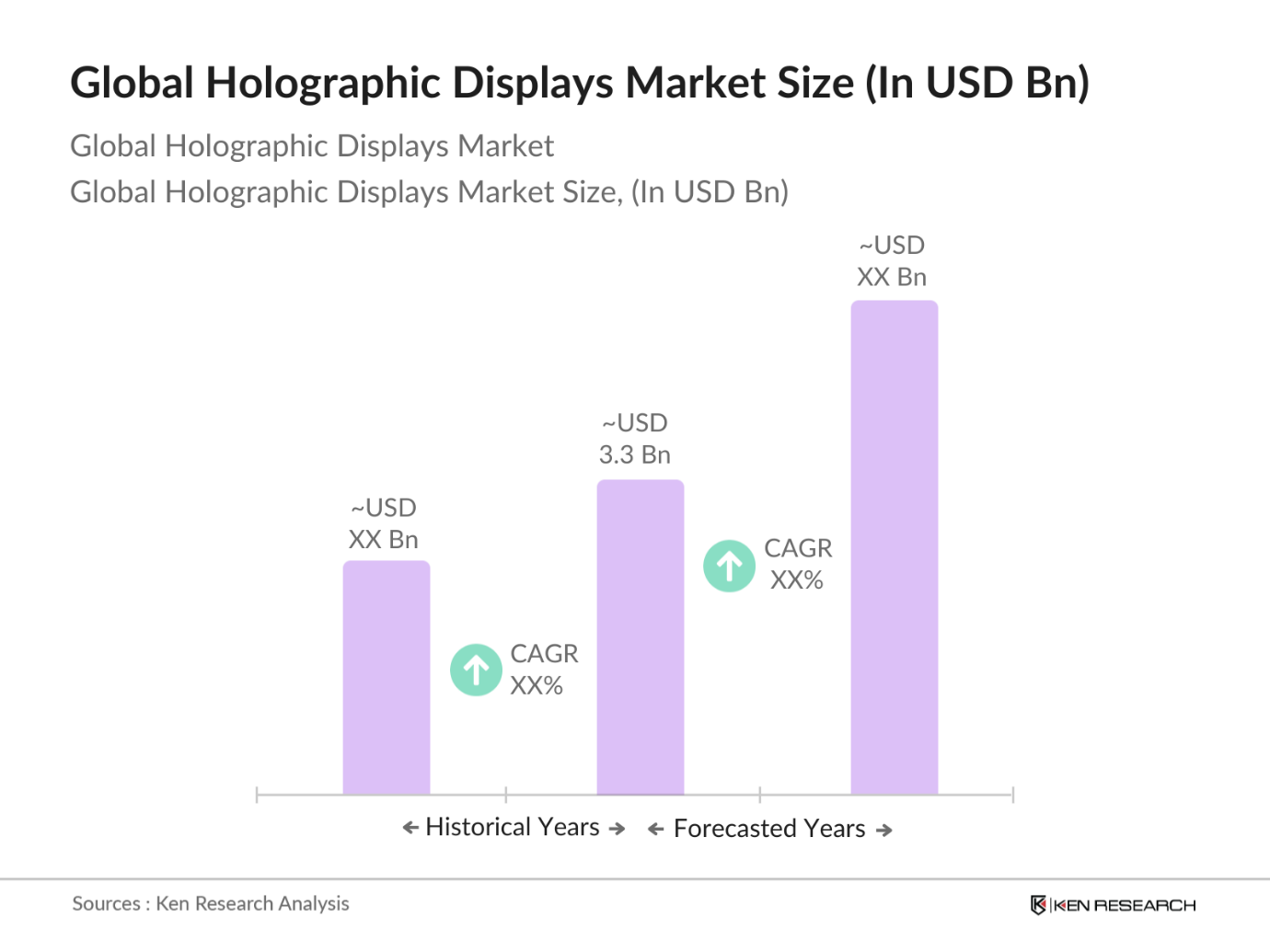
- The global holographic displays market is valued at USD 3.3 billion based on a five-year historical analysis, driven by the rapid adoption of 3D visualization technologies across various industries, such as healthcare, retail, and entertainment. The increasing demand for immersive user experiences and advancements in optoelectronics are fueling the growth of the market. The technologys ability to project high-quality, interactive visuals in 3D is revolutionizing how businesses engage with consumers and professionals in critical applications like medical imaging and automotive displays.
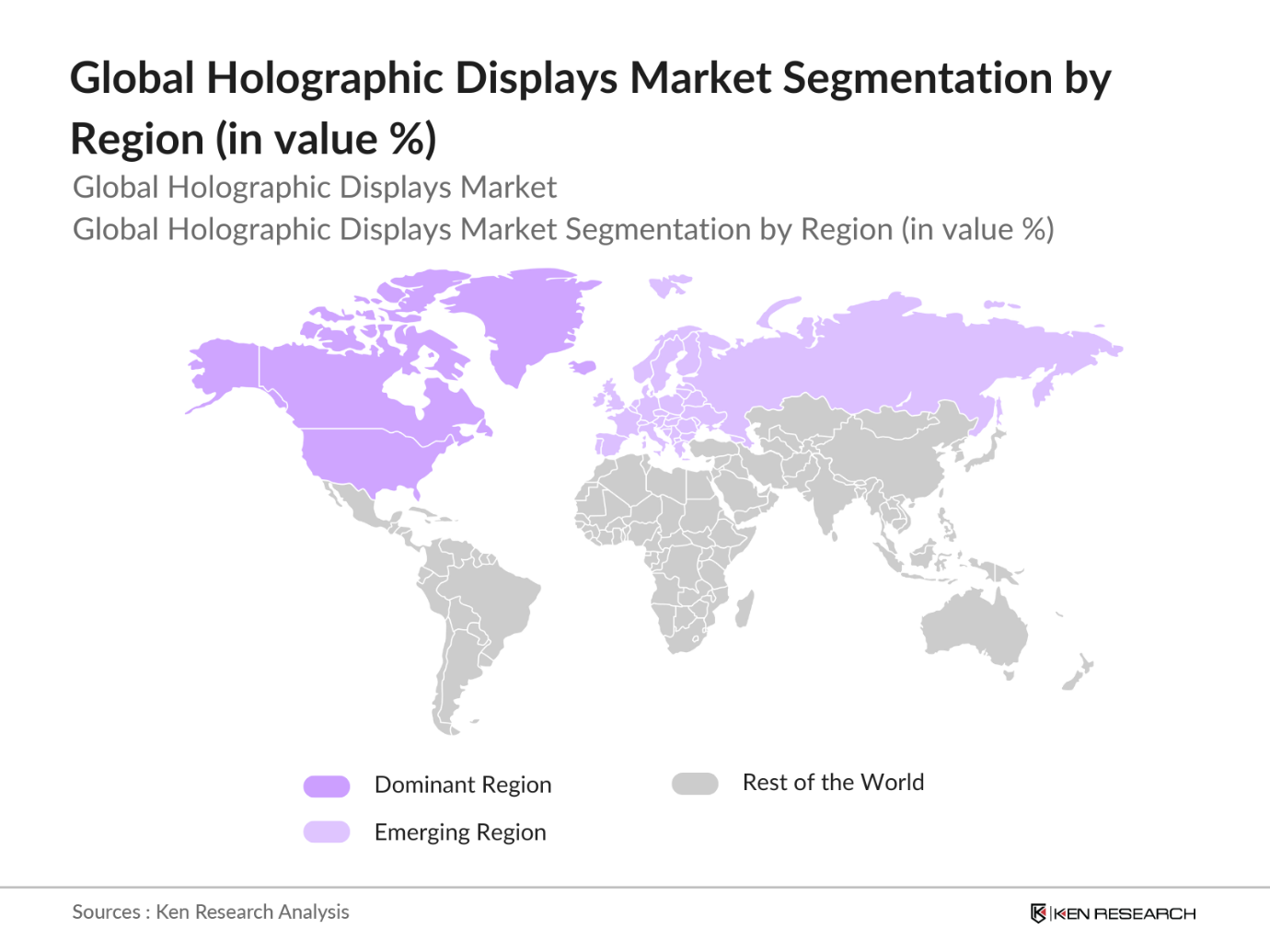
- Countries such as the United States, Japan, and Germany dominate the holographic displays market. The dominance of these regions can be attributed to their high level of technological innovation, investments in R&D, and the presence of leading companies in the display technologies sector. Additionally, government support for cutting-edge technologies and the growing demand for advanced display solutions in retail, medical, and defense sectors reinforce their leadership in the market.
- Holographic displays are increasingly being adopted in consumer retail to create immersive shopping experiences. Retailers are using holography for virtual product demonstrations, window displays, and interactive marketing. Global investments in retail technology exceeded USD 200 billion in 2023, with holographic displays accounting for a growing share of this investment. Leading retail chains in Asia and North America have already incorporated holographic technology to boost customer engagement and reduce the need for physical inventory, enhancing operational efficiency.
Global Holographic Displays Market Segmentation
- By Display Type: The global holographic displays market is segmented by display type into electro-holographic displays, laser plasma displays, and full parallax holography. Among these, laser plasma displays hold the dominant market share due to their capacity to generate high-resolution 3D images without the need for special glasses. The ability to produce full-color, dynamic 3D holograms has driven their adoption in industries such as advertising, automotive, and medical imaging. The precision and scalability of laser plasma displays make them especially valuable for professional use in medical diagnostics and large-scale advertising campaigns.
- By Component: By component, the holographic displays market is categorized into light modulators, projectors, software, and sensors. Projectors are the most dominant sub-segment, owing to the critical role they play in generating and projecting holographic images. The advancements in laser projection technologies have resulted in more efficient, higher-quality displays, thus enhancing the user experience in both commercial and medical applications. The continuous development of compact and high-performance projectors is driving their adoption in consumer electronics and professional fields alike.

- By Region: The regional segmentation of the holographic displays market includes North America, Europe, Asia Pacific, the Middle East & Africa, and Latin America. North America is the leading region in terms of market share, primarily driven by the presence of major technology companies, high consumer demand for advanced display technologies, and the integration of holographic solutions in sectors like healthcare, defense, and entertainment. The regions robust infrastructure for research and development, along with strong consumer purchasing power, continues to fuel its dominance in the global market.
Global Holographic Displays Market Competitive Landscape
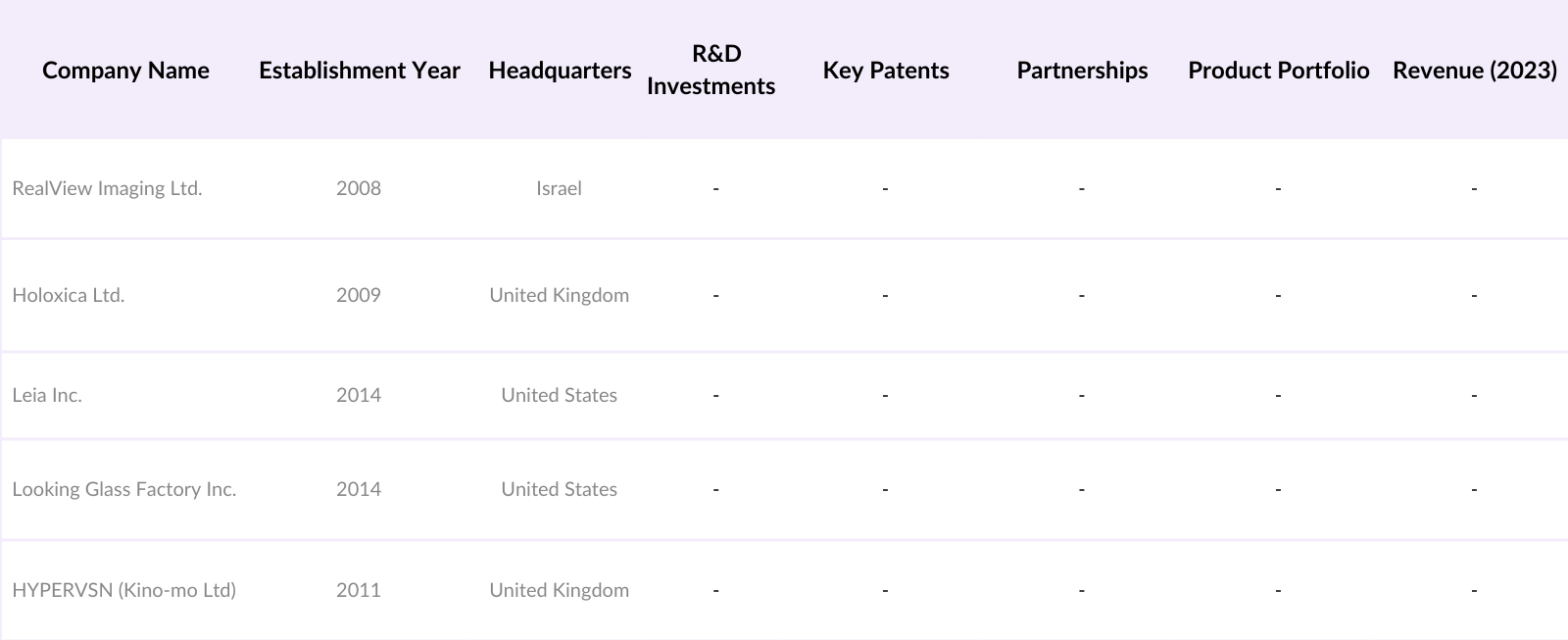
The global holographic displays market is dominated by several major players who have established a strong presence through technological advancements and strategic partnerships. The competitive landscape is shaped by the growing demand for holographic solutions across various industries, particularly in retail, healthcare, and automotive sectors. Companies are investing heavily in research and development to improve display quality, reduce costs, and expand applications.
Global Holographic Displays Market Analysis
Global Holographic Displays Market Growth Drivers
- Increasing Demand for 3D Visualization: The demand for 3D visualization is rising across sectors such as retail, medical imaging, and education. In retail, holographic displays offer interactive product demonstrations, improving consumer engagement. The healthcare sector sees a surge in demand for 3D imaging, with holographic displays enhancing diagnostics and surgery planning. According to 2023 data, healthcare investments in advanced display technologies reached USD 30 billion globally, particularly for medical imaging and diagnostics. Education is also adopting holographic technology for immersive learning experiences, with global education technology spending growing to USD 227 billion.
- Expanding Applications: Holographic displays are finding new applications in entertainment, automotive, and defense sectors. In entertainment, holographic concerts and virtual characters are creating immersive experiences for audiences. For instance, the global box office for immersive technologies, including holography, surpassed USD 14 billion in 2023. In the automotive industry, holographic heads-up displays (HUDs) are improving driver safety by projecting real-time data on windshields. Moreover, defense sectors in countries like the U.S. and Israel have been heavily investing in holographic technologies for training and battlefield visualization, with defense budgets exceeding USD 2 trillion globally.
- Initiatives and Funding for Holographic Innovations: Government funding and initiatives for holographic innovations are driving the market forward. Countries like the United States, China, and South Korea are investing heavily in display technologies through research grants and tax incentives. In 2023, the U.S. government allocated over USD 150 billion for advanced technology research, including holography. Furthermore, South Koreas Ministry of Science and ICT has invested USD 120 million in developing holographic content for sectors like education and defense. This funding supports ongoing innovations, which are crucial for commercializing holographic display technologies across multiple industries.
Global Holographic Displays Market Challenges
- High Production Costs: The high production costs associated with manufacturing and R&D in holographic displays present major challenges. Advanced manufacturing processes for producing high-resolution holographic displays involve expensive materials and precision equipment. In 2024, global R&D expenditure in electronics manufacturing surpassed USD 600 billion, with a large portion directed toward overcoming challenges in display technology. Additionally, the limited availability of cost-effective components for light field displays has further increased production expenses, deterring mass adoption, especially for small and medium enterprises (SMEs) looking to implement this technology.
- Technical Barriers: One of the key technical challenges in the holographic displays market is content creation and the demand for high-resolution visuals. Unlike traditional displays, holographic content requires sophisticated software and hardware integration to achieve depth and clarity. As of 2024, more than USD 20 billion was invested globally in developing new content creation tools, specifically targeting 3D and holographic technologies. The demand for ultra-high-resolution displays, such as 8K and beyond, has also intensified, putting pressure on manufacturers to innovate and produce displays that meet industry-specific requirements.
Global Holographic Displays Market Future Outlook
Over the next five years, the global holographic displays market is expected to witness growth driven by rapid technological advancements, increasing demand for immersive visual experiences, and the expanding applications of holographic technology in industries such as retail, healthcare, and automotive. The integration of holographic displays with augmented reality (AR) and virtual reality (VR) platforms will further fuel market growth. Moreover, the development of cost-efficient holographic displays and the expansion of 5G technology will enhance real-time applications, propelling the market to new heights.
Global Holographic Displays Market Opportunities
- Integration with Augmented Reality and Virtual Reality Platforms: The integration of holographic displays with augmented reality (AR) and virtual reality (VR) platforms offers vast opportunities for market expansion. In 2024, global investments in AR and VR technologies surpassed USD 120 billion, with increasing focus on holography to create immersive experiences. The blending of these technologies enhances applications across gaming, healthcare, and education, offering real-time 3D interactions in physical spaces. AR and VR developers are actively partnering with holographic technology companies to explore new avenues for innovation, particularly in industries that require interactive, lifelike simulations.
- Expansion in Consumer Electronics and Advertising: Holographic displays are rapidly expanding in consumer electronics and advertising, offering new ways to engage consumers. In 2023, global spending on advertising reached USD 850 billion, with an increasing share dedicated to innovative display solutions like holographic signage. Consumer electronics companies are integrating holographic technology into devices like smartphones, laptops, and tablets, enhancing user experience with 3D projections. The rise of digital marketing platforms has accelerated the adoption of holography in advertising, as brands seek novel ways to captivate audiences with interactive, immersive advertisements.
Scope of the Report
|
Display Type |
Electro-Holographic Displays Laser Plasma Displays Touchable Holography Full Parallax Holography |
|
Component |
Light Modulators Projectors Software Sensors |
|
Application |
Medical Imaging Retail Displays Automotive Defense and Security Entertainment and Gaming |
|
Technology |
Reflection Holography Transmission Holography Hybrid Holography |
|
Region |
North America Europe Asia Pacific Middle East & Africa Latin America |
Products
Key Target Audience
Holographic Display Manufacturers
Consumer Electronics Companies
Automotive Manufacturers
Banks and Financial Institutions
Healthcare and Medical Device Companies
Retail and Advertising Companies
Government and Regulatory Bodies (e.g., FDA, FCC)
Investor and Venture Capitalist Firms
Defense Contractors and Security Agencies
Companies
Players Mentioned in the Market
RealView Imaging Ltd.
Holoxica Ltd.
Leia Inc.
Looking Glass Factory Inc.
HYPERVSN (Kino-mo Ltd)
Provision Holding Inc.
MDH Hologram Ltd.
EON Reality Inc.
Konica Minolta Inc.
Lyncee Tec SA
Table of Contents
1. Global Holographic Displays Market Overview
1.1 Definition and Scope
1.2 Market Taxonomy
1.3 Market Growth Drivers (Technological Advancements, Rising Demand in Retail and Healthcare, 3D Imaging Adoption)
1.4 Market Segmentation Overview
2. Global Holographic Displays Market Size (In USD Mn)
2.1 Historical Market Size
2.2 Year-On-Year Growth Analysis (Market Trends, Industry Expansion)
2.3 Key Market Developments and Milestones
3. Global Holographic Displays Market Analysis
3.1 Growth Drivers
3.1.1 Technological Advancements (Display Technology, Light Field Processing, Optoelectronic Advancements)
3.1.2 Increasing Demand for 3D Visualization (Retail Displays, Medical Imaging, Education)
3.1.3 Expanding Applications (Entertainment, Automotive, Defense)
3.1.4 Government Initiatives and Funding for Holographic Innovations
3.2 Market Challenges
3.2.1 High Production Costs (Manufacturing and R&D Expenses)
3.2.2 Technical Barriers (Content Creation, High-Resolution Demand)
3.2.3 Lack of Standardization
3.3 Opportunities
3.3.1 Integration with Augmented Reality and Virtual Reality Platforms
3.3.2 Expansion in Consumer Electronics and Advertising
3.3.3 Growing Investments in Research and Development
3.4 Trends
3.4.1 Rising Adoption of Holographic Technology in Consumer Retail
3.4.2 Increased Use of Holographic Displays in Healthcare for Diagnostics and Surgery
3.4.3 Miniaturization of Holographic Displays for Wearable Devices
3.5 Government Regulations
3.5.1 IP and Patent Regulations for Holographic Innovations
3.5.2 Compliance with Display Industry Standards
3.5.3 Tax Incentives for Holographic Research and Development
3.5.4 International Collaborations and Trade Regulations
3.6 SWOT Analysis
3.7 Stake Ecosystem
3.8 Porters Five Forces
3.9 Competition Ecosystem
4. Global Holographic Displays Market Segmentation
4.1 By Display Type (In Value %)
4.1.1 Electro-Holographic Displays
4.1.2 Laser Plasma Displays
4.1.3 Touchable Holography
4.1.4 Full Parallax Holography
4.2 By Component (In Value %)
4.2.1 Light Modulators
4.2.2 Projectors
4.2.3 Software
4.2.4 Sensors
4.3 By Application (In Value %)
4.3.1 Medical Imaging
4.3.2 Retail Displays
4.3.3 Automotive
4.3.4 Defense and Security
4.3.5 Entertainment and Gaming
4.4 By Technology (In Value %)
4.4.1 Reflection Holography
4.4.2 Transmission Holography
4.4.3 Hybrid Holography
4.5 By Region (In Value %)
4.5.1 North America
4.5.2 Europe
4.5.3 Asia Pacific
4.5.4 Middle East & Africa
4.5.5 Latin America
5. Global Holographic Displays Market Competitive Analysis
5.1 Detailed Profiles of Major Companies
5.1.1 RealView Imaging Ltd.
5.1.2 Looking Glass Factory Inc.
5.1.3 Holoxica Ltd.
5.1.4 EON Reality Inc.
5.1.5 HYPERVSN (Kino-mo Ltd)
5.1.6 Provision Holding Inc.
5.1.7 Leia Inc.
5.1.8 MDH Hologram Ltd.
5.1.9 Konica Minolta Inc.
5.1.10 Lyncee Tec SA
5.1.11 Holografika Kft.
5.1.12 Light Field Lab Inc.
5.1.13 AV Concepts
5.1.14 Musion 3D Ltd.
5.1.15 zSpace Inc.
5.2 Cross Comparison Parameters (Market Share, Number of Patents, Technology Innovations, Revenue, Market Presence, M&A Activities, Strategic Alliances, Product Portfolio Strength)
5.3 Market Share Analysis
5.4 Strategic Initiatives
5.5 Mergers and Acquisitions
5.6 Investment Analysis
5.7 Venture Capital Funding
5.8 Government Grants
5.9 Private Equity Investments
6. Global Holographic Displays Market Regulatory Framework
6.1 Display Technology Standards
6.2 IP Protection and Licensing
6.3 Government Initiatives Supporting Holographic Technology
6.4 Certification Processes
7. Global Holographic Displays Future Market Size (In USD Bn)
7.1 Future Market Size Projections
7.2 Key Factors Driving Future Market Growth (Technological Advancements, Industry Collaborations, Market Expansion)
8. Global Holographic Displays Market Future Segmentation
8.1 By Display Type
8.2 By Component
8.3 By Application
8.4 By Technology
8.5 By Region
9. Global Holographic Displays Market Analysts Recommendations
9.1 TAM/SAM/SOM Analysis
9.2 Customer Cohort Analysis
9.3 Marketing Initiatives
9.4 White Space Opportunity Analysis
Research Methodology
Step 1: Identification of Key Variables
The initial phase involves constructing an ecosystem map encompassing all major stakeholders within the global holographic displays market. This step is underpinned by extensive desk research, utilizing a combination of secondary and proprietary databases to gather comprehensive industry-level information. The primary objective is to identify and define the critical variables that influence market dynamics.
Step 2: Market Analysis and Construction
In this phase, we will compile and analyze historical data pertaining to the global holographic displays market. This includes assessing market penetration, technological advancements, and the resultant revenue generation. Furthermore, an evaluation of quality statistics will be conducted to ensure the reliability and accuracy of the revenue estimates.
Step 3: Hypothesis Validation and Expert Consultation
Market hypotheses will be developed and subsequently validated through computer-assisted telephone interviews (CATIs) with industry experts representing a diverse array of companies. These consultations will provide valuable operational and financial insights directly from industry practitioners, which will be instrumental in refining and corroborating the market data.
Step 4: Research Synthesis and Final Output
The final phase involves direct engagement with multiple holographic display manufacturers to acquire detailed insights into product segments, sales performance, consumer preferences, and other pertinent factors. This interaction will serve to verify and complement the statistics derived from the bottom-up approach, thereby ensuring a comprehensive, accurate, and validated analysis of the global holographic displays market.
Frequently Asked Questions
01. How big is the global holographic displays market?
The global holographic displays market is valued at USD 3.3 billion, driven by increasing demand for immersive visual experiences across industries like healthcare, retail, and automotive.
02. What are the challenges in the global holographic displays market?
Challenges in the holographic displays market include high production costs, lack of standardization, and technical barriers in developing high-resolution content.
03. Who are the major players in the global holographic displays market?
Key players in the holographic displays market include RealView Imaging Ltd., Holoxica Ltd., Leia Inc., Looking Glass Factory Inc., and HYPERVSN (Kino-mo Ltd).
04. What are the growth drivers of the global holographic displays market?
Growth drivers include advancements in display technology, increasing demand for 3D visualization, and expanding applications in sectors like healthcare, retail, and automotive.
Why Buy From Us?

What makes us stand out is that our consultants follows Robust, Refine and Result (RRR) methodology. i.e. Robust for clear definitions, approaches and sanity checking, Refine for differentiating respondents facts and opinions and Result for presenting data with story

We have set a benchmark in the industry by offering our clients with syndicated and customized market research reports featuring coverage of entire market as well as meticulous research and analyst insights.

While we don't replace traditional research, we flip the method upside down. Our dual approach of Top Bottom & Bottom Top ensures quality deliverable by not just verifying company fundamentals but also looking at the sector and macroeconomic factors.

With one step in the future, our research team constantly tries to show you the bigger picture. We help with some of the tough questions you may encounter along the way: How is the industry positioned? Best marketing channel? KPI's of competitors? By aligning every element, we help maximize success.

Our report gives you instant access to the answers and sources that other companies might choose to hide. We elaborate each steps of research methodology we have used and showcase you the sample size to earn your trust.

If you need any support, we are here! We pride ourselves on universe strength, data quality, and quick, friendly, and professional service.