
Global Industrial Ceiling Fans Market Outlook to 2030
Region:Global
Author(s):Yogita Sahu
Product Code:KROD5331
November 2024
99
About the Report
Global Industrial Ceiling Fans Market Overview
- The global industrial ceiling fans market was valued at USD 4.12 billion. This market is driven by the rapid expansion of large-scale commercial and industrial infrastructure, primarily in sectors such as manufacturing, agriculture, and warehousing. The increasing demand for energy-efficient and high-volume fans, which provide better air circulation with lower energy consumption, is also contributing to the market's growth.
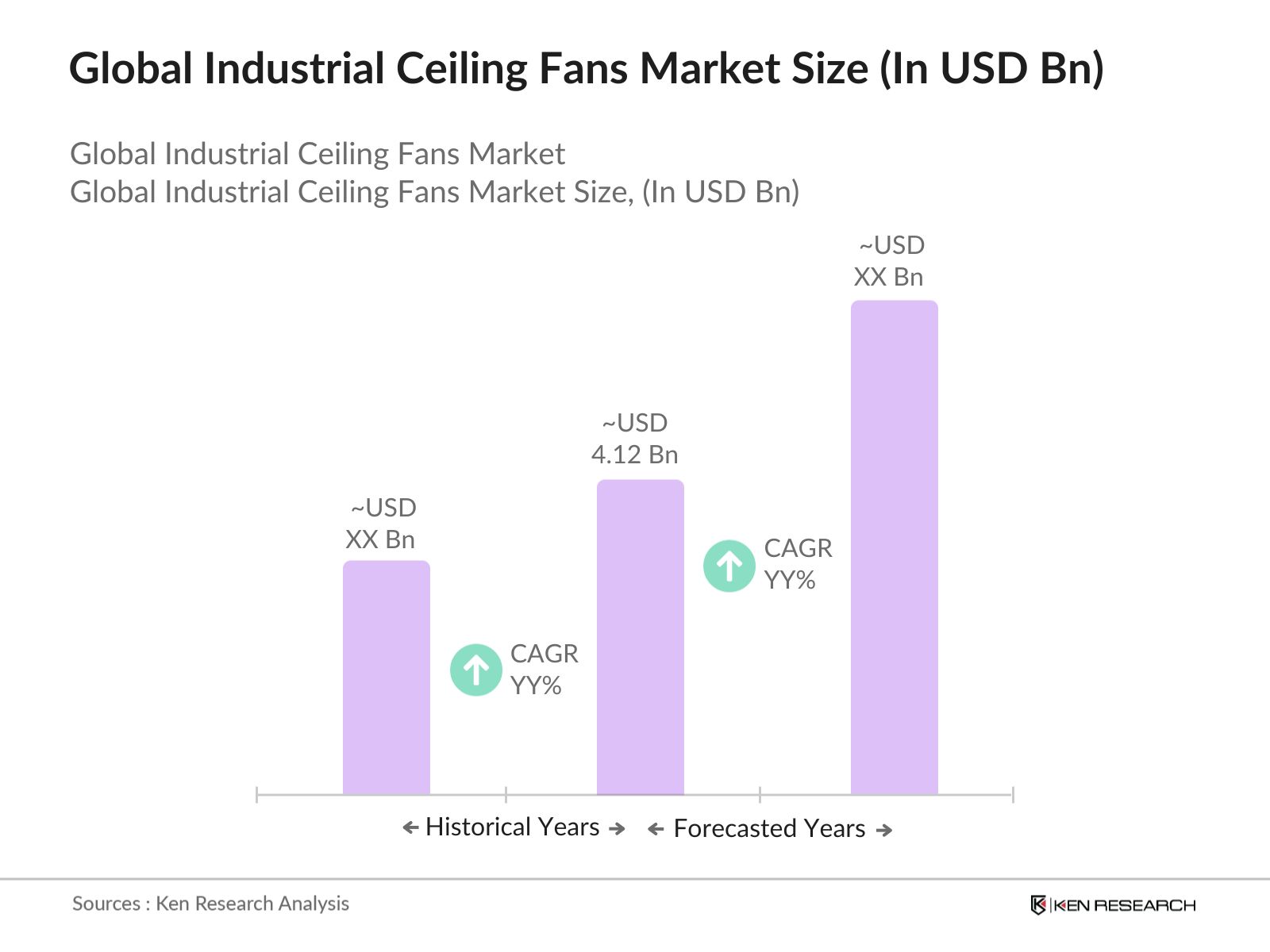
- Key regions dominating the market include North America and Asia-Pacific. In North America, the extensive use of industrial fans in warehouses and manufacturing plants, along with government regulations emphasizing energy efficiency, boosts demand. In Asia-Pacific, countries like India and China lead due to rapid industrialization and infrastructural developments.
- The U.S. governments new energy efficiency policies, introduced in 2024, are incentivizing industries to adopt energy-saving technologies. Under these initiatives, manufacturers of industrial ceiling fans that meet the new standards will receive tax credits and grants. This policy is expected to support the installation of over 200,000 energy-efficient ceiling fans in the next five years, directly driving market growth as businesses rush to capitalize on the incentives.
Global Industrial Ceiling Fans Market Segmentation
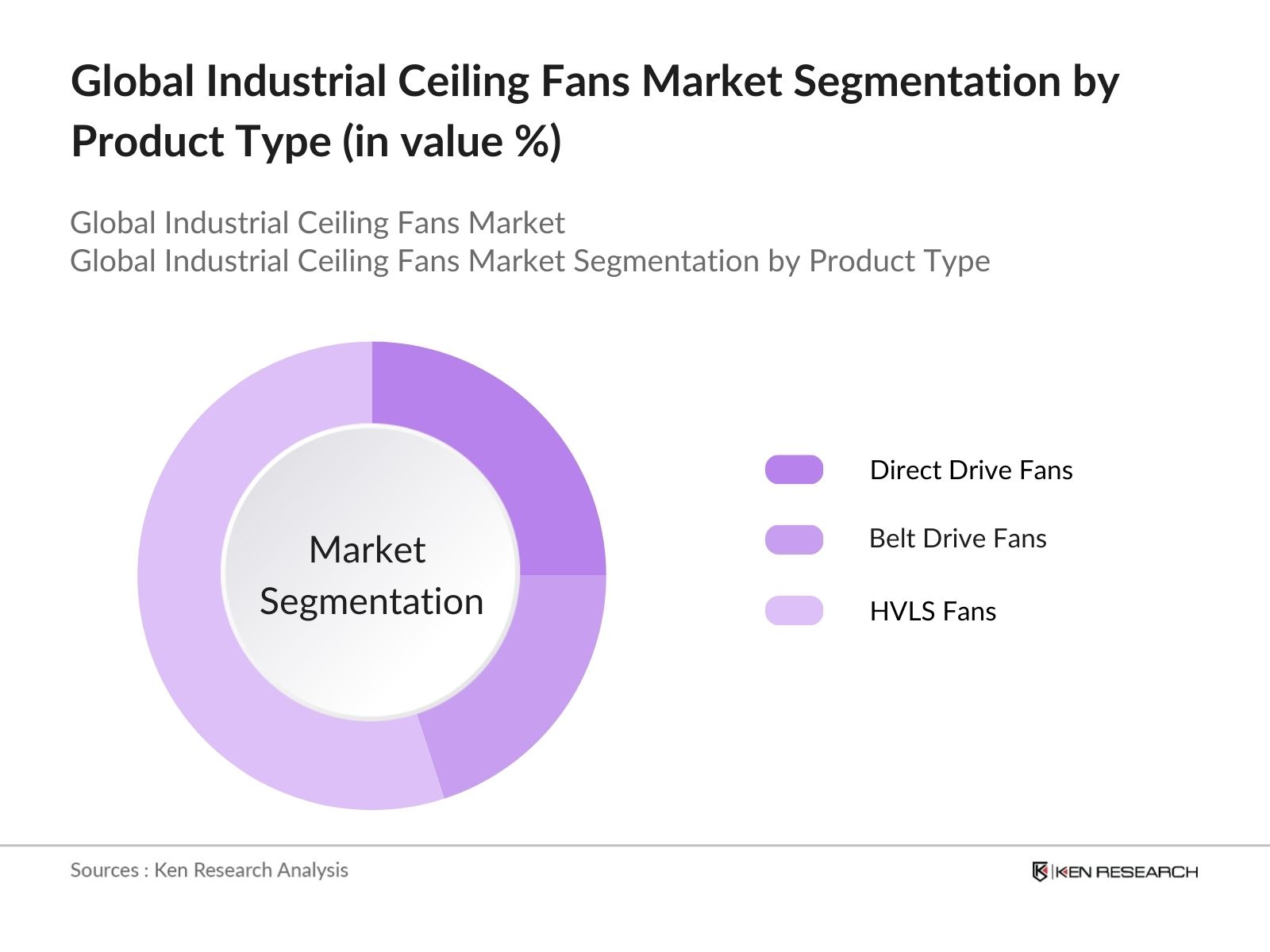
By Product Type: The market is segmented by product type into direct drive fans, belt drive fans, and high-volume low-speed (HVLS) fans. HVLS fans dominate the market due to their capability to cover larger areas with fewer units, making them highly efficient for industries with large floor spaces such as warehouses and factories. Additionally, advancements in HVLS technology allow for more cost-efficient cooling and ventilation, which continues to drive the segments dominance in the market.
By Application: The market is segmented by application into manufacturing plants, warehouses, agricultural facilities, and sports halls. Warehouses currently hold the largest market share due to the necessity of proper ventilation and cooling in large spaces where goods are stored. The increased number of logistics and distribution centers driven by e-commerce and retail industries also contributes to the dominance of warehouses in this segment.
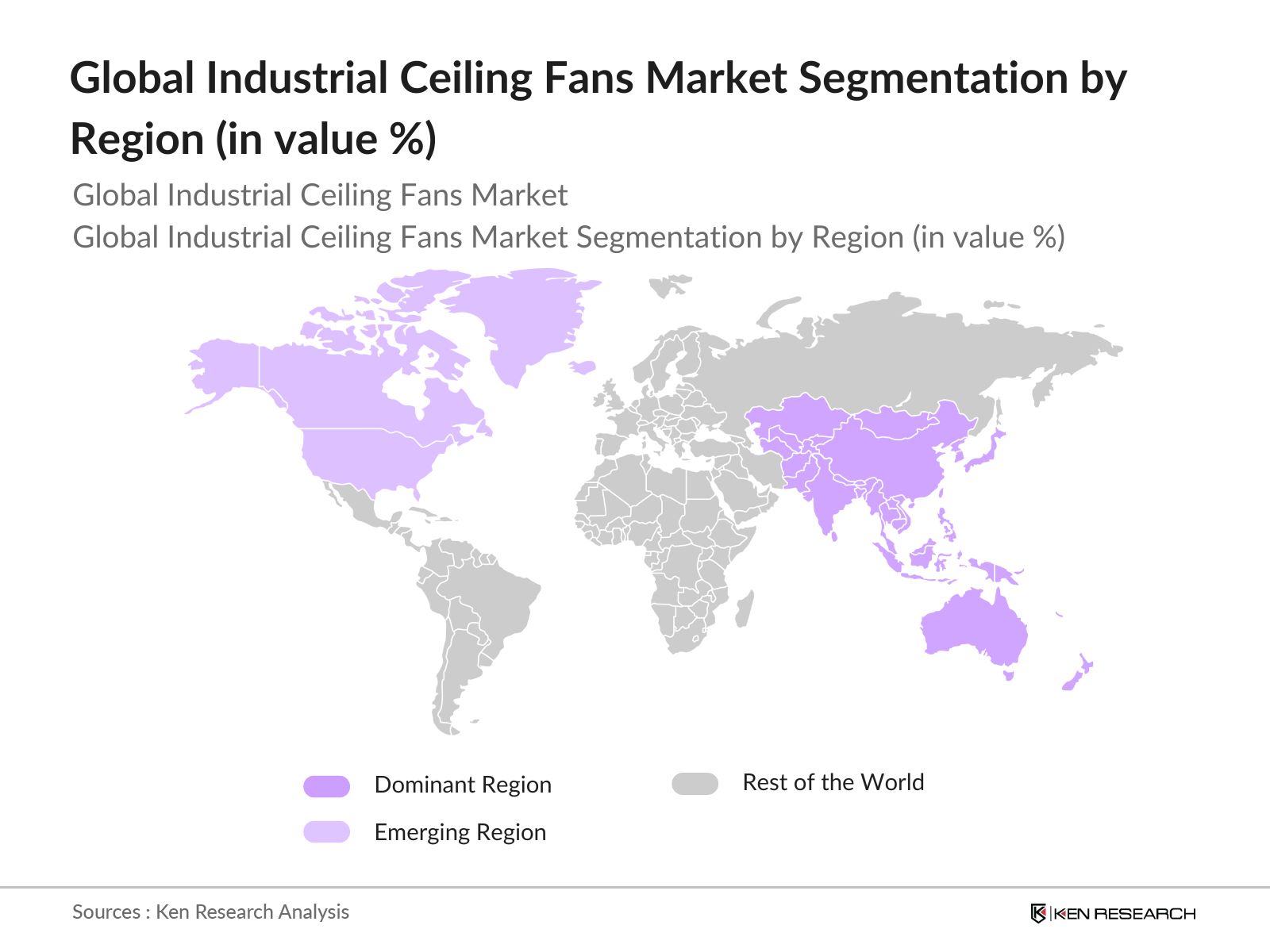
By Region: The industrial ceiling fans market is segmented by region into North America, Europe, Asia-Pacific, Latin America, and the Middle East & Africa. The Asia-Pacific region dominates due to its large manufacturing sector, growing industrialization, and infrastructural investments, particularly in countries like China and India. Additionally, government initiatives to promote energy efficiency in the industrial sector further drive the demand for these fans.
Global Industrial Ceiling Fans Market Competitive Landscape
The market is dominated by several key players that have a strong presence in various regions. These companies focus on product innovation, partnerships, and expanding their distribution channels to maintain their market positions.
|
Company Name |
Establishment Year |
Headquarters |
R&D Investments |
Production Capacity |
Global Reach |
Revenue (USD) |
Customer Base |
Patents |
|
Hunter Industrial Fan |
1886 |
Nashville, USA |
||||||
|
Big Ass Fans |
1999 |
Kentucky, USA |
||||||
|
Crompton Greaves |
1937 |
Mumbai, India |
||||||
|
Emerson Electric |
1890 |
Missouri, USA |
||||||
|
Delta T LLC |
2001 |
Lexington, USA |
Global Industrial Ceiling Fans Market
Market Growth Drivers
- Expansion in Industrial Construction Projects: The increasing number of industrial construction projects globally, with a focus on sectors such as manufacturing, warehousing, and logistics, is driving the demand for high-capacity industrial ceiling fans. In 2024, the global industrial sector is projected to see a rise in new constructions, with over 2,000 new large-scale factories being set up in key regions such as Southeast Asia, Europe, and North America. This expansion is contributing to a surge in the demand for climate control solutions, including industrial ceiling fans, which help maintain optimal air circulation in these massive facilities.
- Government Energy Efficiency Mandates: Governments worldwide are increasingly introducing regulations that mandate energy efficiency in industrial facilities. For instance, in 2024, the U.S. Department of Energy (DOE) introduced new guidelines aimed at reducing energy consumption in manufacturing plants by 10 million kWh annually through better climate control, among other strategies. This regulatory push has directly influenced companies to adopt large ceiling fans that can operate with lower power consumption, significantly cutting down energy bills.
- Rising Need for Worker Comfort in Large Factories: Large-scale factories and warehouses, some spanning over 100,000 square feet, face significant challenges in maintaining optimal indoor temperatures, especially during hot climates. With over 50 million factory workers in Asia alone in 2024, there is a growing need to ensure comfortable working environments to boost productivity. Ceiling fans with long airflow reach, often covering areas up to 10,000 square feet, have become a go-to solution for industrial players looking to enhance workforce efficiency while controlling the temperature in a cost-effective manner.
Market Challenges
- Availability of Low-Cost Alternatives: In several developing markets, local manufacturers are producing low-cost alternatives to branded industrial ceiling fans. These fans, often priced at 20-30% lower than international brands, have started capturing significant market share in regions such as Africa and parts of Asia. For instance, in India, around 5 million units of low-cost ceiling fans were sold in 2023, compared to only 3 million units of premium industrial ceiling fans.
- Logistics and Distribution Complexities: The global logistics sector has faced disruptions in recent years, particularly following geopolitical tensions and port blockages. In 2024, delays in shipping industrial products, including ceiling fans, caused a backlog of over 150,000 units at major international ports. This distribution complexity is proving to be a barrier for manufacturers trying to meet global demand, as they grapple with supply chain inefficiencies and rising shipping costs, making it harder to expand into new markets.
Global Industrial Ceiling Fans Market Future Outlook
Over the next five years, the global industrial ceiling fans industry is expected to experience growth, driven by technological advancements, increased industrialization, and government regulations on energy efficiency.
Future Market Opportunities
- Integration of AI in Industrial Ceiling Fans: In the next five years, AI-driven industrial ceiling fans will likely dominate the market. These fans will feature built-in artificial intelligence systems that automatically adjust fan speed based on real-time temperature and airflow requirements, optimizing energy consumption. By 2029, it is anticipated that over 1 million AI-enabled ceiling fans will be in use globally, with major demand coming from large factories in Europe and North America.
- Increasing Adoption of Renewable Energy-Powered Fan: The use of solar and wind energy to power industrial ceiling fans will gain momentum. Governments are expected to increase subsidies for renewable energy products by 2030, with projections indicating that around 300,000 solar-powered fans will be sold annually by 2028. This trend will especially be noticeable in remote and off-grid industrial zones where traditional energy sources are either unreliable or expensive.
Scope of the Report
|
Product Type |
Direct Drive Fans Belt Drive Fans HVLS Fans |
|
Application |
Manufacturing Plants Warehouses Agricultural Facilities Sports Halls |
|
Blade Material |
Steel Blades Aluminum Blades Composite Blades |
|
Distribution Channel |
Direct Sales Online Retail Offline Retail |
|
Region |
North America Europe Asia-Pacific Latin America Middle East & Africa |
Products
Key Target Audience Organizations and Entities Who Can Benefit by Subscribing This Report:
Industrial Fan Manufacturers
Warehousing and Logistics Firms
Banks and Financial Institution
Government and Regulatory Bodies (Energy Efficiency Regulatory Bodies, EPA)
Construction and Infrastructure Companies
Private Equity Firms
Investment and Venture Capitalist Firms
Companies
Players Mentioned in the Report:
Hunter Industrial Fan
Big Ass Fans
Greenheck Fan Corporation
Vornado Air, LLC
Emerson Electric Co.
Crompton Greaves
Havells India Ltd.
Panasonic Corporation
KDK Company
Minka Group
Modern Forms
Orient Electric
Delta T LLC
MacroAir Technologies
Fanimation, Inc.
Table of Contents
Global Industrial Ceiling Fans Market Overview
1.1 Definition and Scope
1.2 Market Taxonomy
1.3 Market Growth Rate
1.4 Market Segmentation Overview
Global Industrial Ceiling Fans Market Size (In USD Bn)
2.1 Historical Market Size
2.2 Year-On-Year Growth Analysis
2.3 Key Market Developments and Milestones
Global Industrial Ceiling Fans Market Analysis
3.1 Growth Drivers
3.1.1 Energy Efficiency Initiatives
3.1.2 Industrial Infrastructure Expansion
3.1.3 Increasing Demand in Warehouses & Factories
3.1.4 Advancements in Motor Technology
3.2 Market Challenges
3.2.1 High Initial Investment Costs
3.2.2 Supply Chain Disruptions
3.2.3 Limited Availability of Skilled Labor
3.3 Opportunities
3.3.1 Rising Demand for Smart Fans
3.3.2 Growth in Emerging Markets
3.3.3 Increasing Adoption in Agricultural Facilities
3.4 Trends
3.4.1 Integration of IoT in Industrial Fans
3.4.2 Customizable Designs for Specific Industries
3.4.3 Sustainability and Low-Carbon Emission Focus
3.5 Government Regulations
3.5.1 Energy Efficiency Standards
3.5.2 Industrial Safety Regulations
3.5.3 Mandatory Noise Control Measures
3.6 SWOT Analysis
3.7 Stakeholder Ecosystem
3.8 Porters Five Forces Analysis
3.9 Competitive Landscape
Global Industrial Ceiling Fans Market Segmentation
4.1 By Product Type (In Value %)
4.1.1 Direct Drive Fans
4.1.2 Belt Drive Fans
4.1.3 High-Volume Low-Speed (HVLS) Fans
4.2 By Application (In Value %)
4.2.1 Manufacturing Plants
4.2.2 Warehouses
4.2.3 Agricultural Facilities
4.2.4 Sports Halls
4.3 By Blade Material (In Value %)
4.3.1 Steel Blades
4.3.2 Aluminum Blades
4.3.3 Composite Blades
4.4 By Distribution Channel (In Value %)
4.4.1 Direct Sales
4.4.2 Online Retail
4.4.3 Offline Retail
4.5 By Region (In Value %)
4.5.1 North America
4.5.2 Europe
4.5.3 Asia-Pacific
4.5.4 Latin America
4.5.5 Middle East & Africa
Global Industrial Ceiling Fans Market Competitive Analysis
5.1 Detailed Profiles of Major Companies
5.1.1 Hunter Industrial Fan
5.1.2 Big Ass Fans
5.1.3 Greenheck Fan Corporation
5.1.4 Vornado Air, LLC
5.1.5 Emerson Electric Co.
5.1.6 Crompton Greaves
5.1.7 Havells India Ltd.
5.1.8 Panasonic Corporation
5.1.9 KDK Company
5.1.10 Minka Group
5.1.11 Modern Forms
5.1.12 Orient Electric
5.1.13 Delta T LLC
5.1.14 MacroAir Technologies
5.1.15 Fanimation, Inc.
5.2 Cross Comparison Parameters (Revenue, Headquarters, No. of Employees, R&D Investments, Production Capacity, Global Reach, Customer Base, Manufacturing Facilities)
5.3 Market Share Analysis
5.4 Strategic Initiatives
5.5 Mergers and Acquisitions
5.6 Investment and Funding Analysis
5.7 Venture Capital Funding
Global Industrial Ceiling Fans Market Regulatory Framework
6.1 International Energy Efficiency Standards
6.2 Environmental Compliance Regulations
6.3 Certification and Labeling Requirements
Global Industrial Ceiling Fans Future Market Size (In USD Bn)
7.1 Future Market Size Projections
7.2 Key Factors Driving Future Growth
Global Industrial Ceiling Fans Future Market Segmentation
8.1 By Product Type
8.2 By Application
8.3 By Blade Material
8.4 By Distribution Channel
8.5 By Region
Global Industrial Ceiling Fans Market Analysts Recommendations
9.1 TAM/SAM/SOM Analysis
9.2 Key Marketing Strategies
9.3 Customer Acquisition Initiatives
9.4 Expansion Opportunities in Niche Markets
Disclaimer Contact UsResearch Methodology
Step 1: Identification of Key Variables
The initial stage involves mapping the industrial ceiling fan market ecosystem by identifying key stakeholders such as manufacturers, distributors, and industrial end-users. Data is gathered from industry reports, databases, and primary research.
Step 2: Market Analysis and Construction
Historical data and market trends were analyzed to determine the revenue generated in each segment. The growth rate was calculated based on the current demand for energy-efficient industrial fans, industrial expansion, and other market dynamics.
Step 3: Hypothesis Validation and Expert Consultation
We conducted interviews with industry experts to validate key market assumptions and provide operational insights. This included consultations with manufacturers, distributors, and energy consultants.
Step 4: Research Synthesis and Final Output
Data from various sources were synthesized and verified through a bottom-up approach, including industry surveys and interviews. The final report was structured to offer a comprehensive view of the global industrial ceiling fans market.
Frequently Asked Questions
01. How big is the Global Industrial Ceiling Fans Market?
The global industrial ceiling fans market was valued at USD 4.12 billion, driven by rising demand for energy-efficient ventilation solutions in warehouses, manufacturing plants, and agricultural facilities.
02. What are the challenges in the Global Industrial Ceiling Fans Market?
Key challenges in the global industrial ceiling fans market include high initial installation costs, supply chain disruptions for key components, and the lack of skilled labor for installation and maintenance of advanced ceiling fans.
03. Who are the major players in the Global Industrial Ceiling Fans Market?
Major players in the global industrial ceiling fans market include Hunter Industrial Fan, Big Ass Fans, Emerson Electric Co., Crompton Greaves, and Delta T LLC. These companies dominate due to their extensive distribution networks, product innovations, and strong R&D investments.
04. What are the growth drivers of the Global Industrial Ceiling Fans Market?
Growth in the global industrial ceiling fans market is driven by factors such as the expansion of industrial infrastructure, increased demand for energy-efficient HVAC solutions, and advancements in motor technologies that make industrial fans more efficient and environmentally friendly.
05. Which region dominates the Global Industrial Ceiling Fans Market?
Asia-Pacific leads the global industrial ceiling fans market due to rapid industrialization, growing infrastructure projects, and government initiatives aimed at improving energy efficiency in industries.
Why Buy From Us?

What makes us stand out is that our consultants follows Robust, Refine and Result (RRR) methodology. i.e. Robust for clear definitions, approaches and sanity checking, Refine for differentiating respondents facts and opinions and Result for presenting data with story

We have set a benchmark in the industry by offering our clients with syndicated and customized market research reports featuring coverage of entire market as well as meticulous research and analyst insights.

While we don't replace traditional research, we flip the method upside down. Our dual approach of Top Bottom & Bottom Top ensures quality deliverable by not just verifying company fundamentals but also looking at the sector and macroeconomic factors.

With one step in the future, our research team constantly tries to show you the bigger picture. We help with some of the tough questions you may encounter along the way: How is the industry positioned? Best marketing channel? KPI's of competitors? By aligning every element, we help maximize success.

Our report gives you instant access to the answers and sources that other companies might choose to hide. We elaborate each steps of research methodology we have used and showcase you the sample size to earn your trust.

If you need any support, we are here! We pride ourselves on universe strength, data quality, and quick, friendly, and professional service.