
Global Industrial Salt Market Outlook to 2030
Region:Global
Author(s):Shambhavi
Product Code:KROD3715
Region:Global
Author(s):Shambhavi
Product Code:KROD3715
December 2024
91
By Product Type:
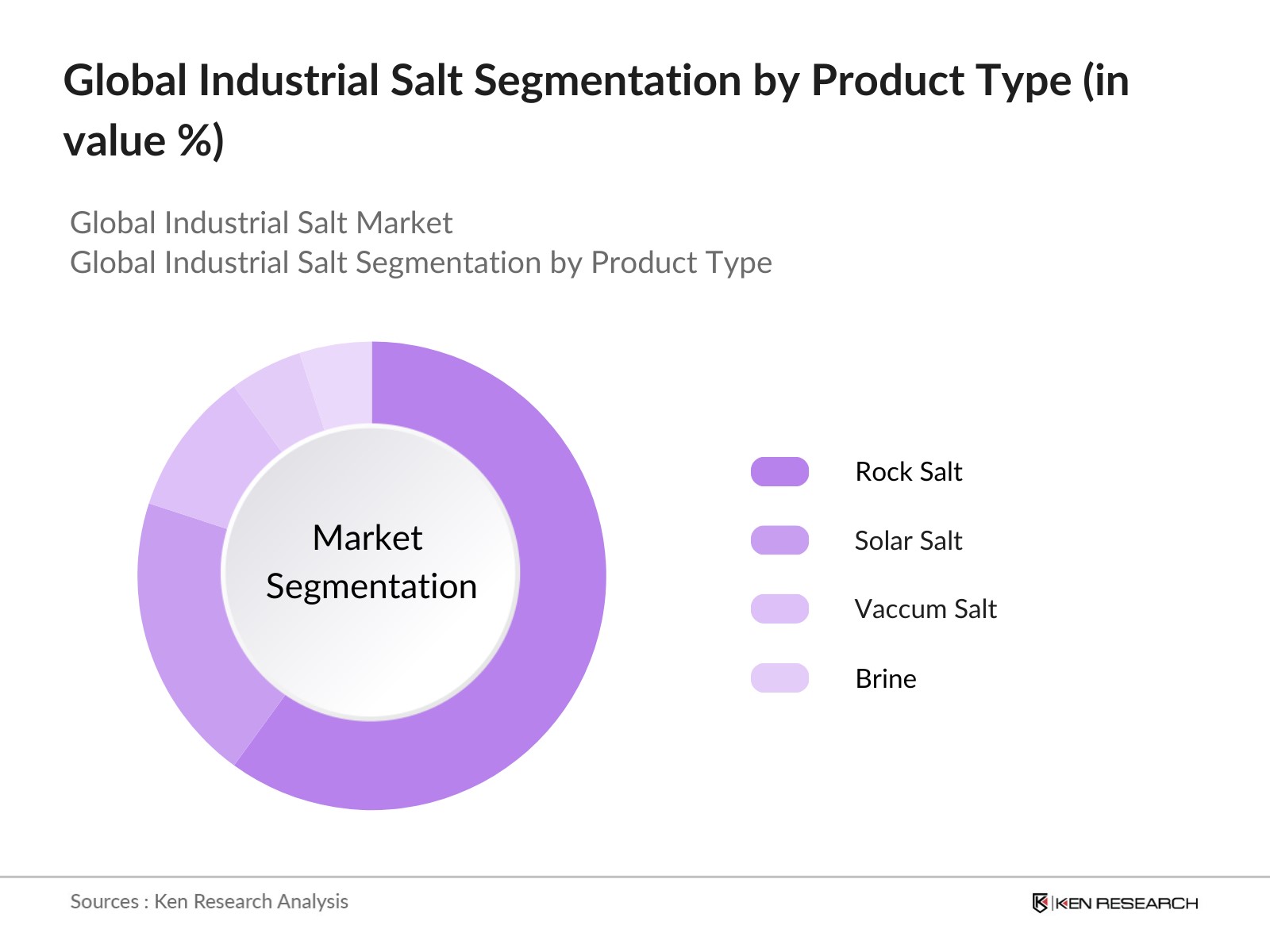
The global industrial salt market is segmented by product type into rock salt, solar salt, vacuum salt, and brine. Recently, rock salt holds a dominant market share, as it is the most abundant and cost-effective form of salt used for industrial purposes, particularly in chemical processing and de-icing applications. Rock salts robust demand in countries like the U.S. and Canada, where it is extensively used for de-icing during harsh winters, significantly boosts its consumption. Furthermore, the ease of mining and availability of large reserves contribute to its market leadership.
By Application:
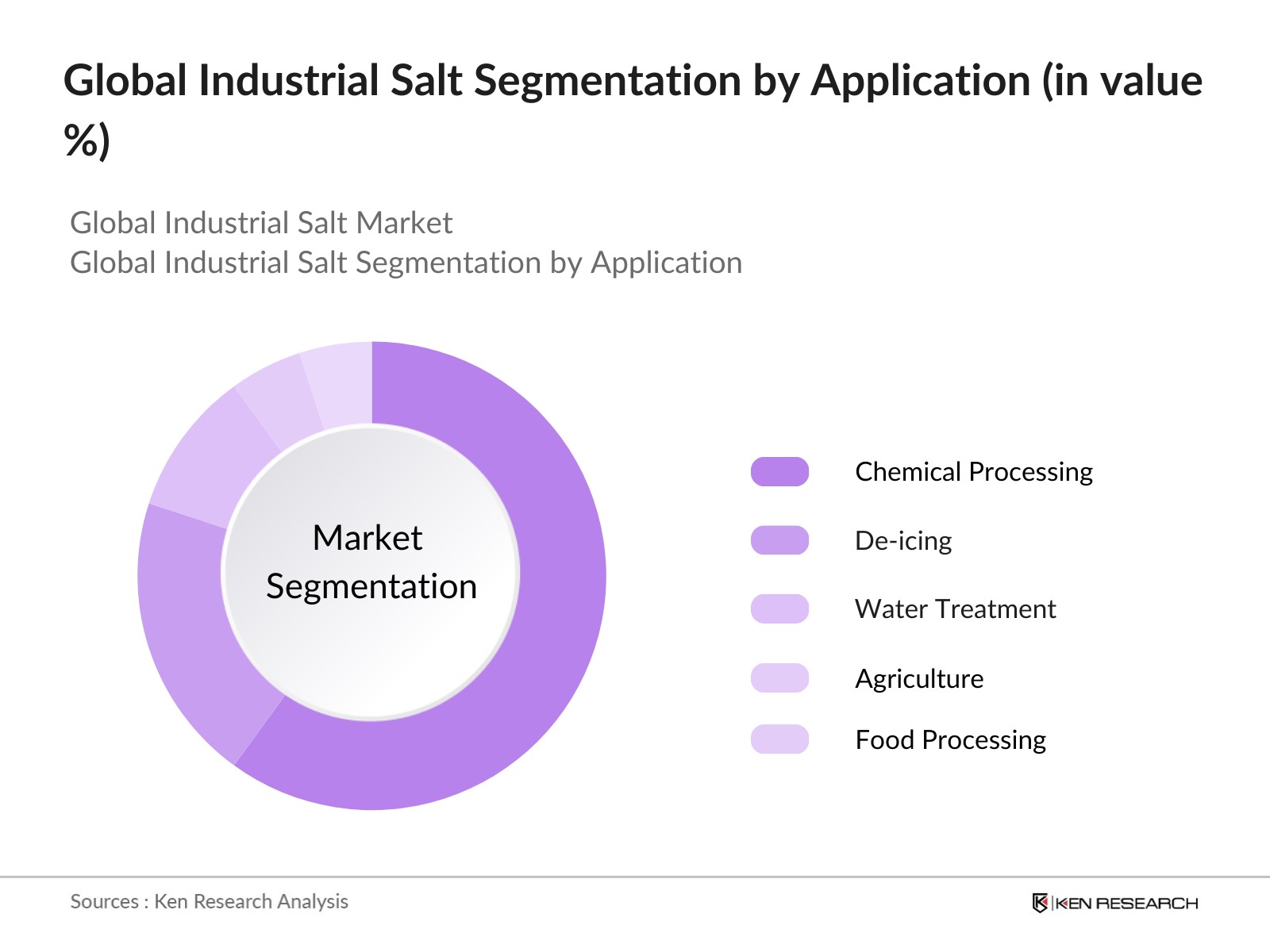
The industrial salt market is segmented by application into chemical processing, de-icing, water treatment, agriculture, and food processing. Chemical processing holds the largest market share due to its significant use of salt in the production of chlorine, caustic soda, and soda ash. These chemicals are essential for various industries, including paper, plastics, and textiles. The steady growth of these end-use industries, coupled with industrialization in developing countries, reinforces the dominance of chemical processing as the largest application of industrial salt.
The global industrial salt market is dominated by several major players, each with unique strengths in areas such as production capacity, global distribution networks, and technological innovation in salt processing. These companies maintain a strong presence through strategic partnerships, acquisitions, and investments in R&D. The market features well-established players such as Cargill, K+S AG, and Compass Minerals International, who dominate due to their extensive salt production capacities and global distribution channels. Companies from China and India are also making inroads due to increasing domestic demand and the availability of vast salt reserves.
|
Company |
Establishment Year |
Headquarters |
Production Capacity (MT/Year) |
Global Reach (Countries) |
Revenue (USD Bn) |
Key Product |
R&D Investment (USD Mn) |
Strategic Initiatives |
|
Cargill, Inc. |
1865 |
U.S. |
- |
- |
- |
- |
- |
- |
|
K+S AG |
1889 |
Germany |
- |
- |
- |
- |
- |
- |
|
Compass Minerals International |
1844 |
U.S. |
- |
- |
- |
- |
- |
- |
|
Tata Chemicals Ltd. |
1939 |
India |
- |
- |
- |
- |
- |
- |
|
Mitsui & Co., Ltd. |
1947 |
Japan |
- |
- |
- |
- |
- |
- |
Over the next five years, the global industrial salt market is expected to witness moderate growth, driven by steady demand from the chemical industry and increasing applications in emerging sectors such as renewable energy. The use of salt in new technologies, such as salt-based energy storage systems in solar power plants, will also play a key role in shaping the future demand. Additionally, the growing focus on sustainable and eco-friendly production processes will lead to innovations in salt extraction and processing. As industrialization and urbanization continue to rise, particularly in developing regions such as Asia-Pacific, the market is likely to experience a significant increase in demand for industrial salt, particularly for chemical processing, de-icing, and water treatment applications.
1.1 Definition and Scope
1.2 Market Taxonomy (By Type, Application, End-User Industry)
1.3 Market Growth Rate (CAGR, Volume, Value)
1.4 Market Segmentation Overview
2.1 Historical Market Size (Global and Regional Levels)
2.2 Year-On-Year Growth Analysis
2.3 Key Market Developments and Milestones
3.1 Growth Drivers
3.1.1 Increasing Demand in Chemical Processing (Caustic Soda, Soda Ash Production)
3.1.2 Expanding Applications in De-icing and Water Treatment
3.1.3 Rising Use in Food Processing
3.1.4 Growth in Oil & Gas Industry (Drilling Fluids)
3.2 Market Challenges
3.2.1 Impact of Environmental Regulations (Salt Mining and Production)
3.2.2 Volatility in Raw Material Supply Chain (Salt Reserves, Extraction Techniques)
3.2.3 Impact of Weather and Climate Changes (De-icing Demand Fluctuations)
3.3 Opportunities
3.3.1 Expansion in Renewable Energy Sector (Salt for Solar Power Generation)
3.3.2 Increasing Demand for Purified and Specialty Salts (Pharmaceuticals, Food Grade)
3.3.3 Technological Advancements in Extraction and Processing Techniques
3.4 Trends
3.4.1 Growing Use of Salt in Battery Manufacturing (Lithium-Ion Batteries)
3.4.2 Development of Eco-Friendly De-icing Solutions
3.4.3 Automation in Salt Mining and Processing Plants
3.5 Government Regulation
3.5.1 Regulatory Framework for Environmental Impact (Sustainability Standards)
3.5.2 Compliance with Food Safety Standards (Codex Alimentarius, FDA, EU)
3.5.3 Global Trade Regulations (Tariffs, Import/Export Quotas)
3.6 SWOT Analysis
3.7 Stakeholder Ecosystem (Producers, Distributors, End-Users, Regulators)
3.8 Porters Five Forces
3.9 Competition Ecosystem
4.1 By Product Type (In Value %)
4.1.1 Rock Salt
4.1.2 Solar Salt
4.1.3 Vacuum Salt
4.1.4 Brine
4.2 By Application (In Value %)
4.2.1 Chemical Processing (Soda Ash, Chlor-Alkali)
4.2.2 De-icing
4.2.3 Water Treatment
4.2.4 Agriculture
4.2.5 Food Processing
4.3 By End-User Industry (In Value %)
4.3.1 Chemical Industry
4.3.2 Municipalities (De-icing, Water Softening)
4.3.3 Oil & Gas
4.3.4 Food & Beverage
4.3.5 Pharmaceuticals
4.4 By Source (In Value %)
4.4.1 Seawater
4.4.2 Rock Salt Deposits
4.4.3 Salt Lakes
4.5 By Region (In Value %)
4.5.1 North America
4.5.2 Europe
4.5.3 Asia-Pacific
4.5.4 Middle East & Africa
4.5.5 Latin America
5.1 Detailed Profiles of Major Companies
5.1.1 Cargill, Incorporated
5.1.2 K+S AG
5.1.3 Compass Minerals International, Inc.
5.1.4 Tata Chemicals Ltd.
5.1.5 Mitsui & Co., Ltd.
5.1.6 Rio Tinto PLC
5.1.7 Akzo Nobel N.V.
5.1.8 Dampier Salt Limited
5.1.9 China National Salt Industry Corporation (CNSIC)
5.1.10 ICL Group
5.1.11 INEOS Group Holdings S.A.
5.1.12 Dominion Salt Ltd.
5.1.13 Exportadora de Sal S.A.
5.1.14 Salins Group
5.1.15 Morton Salt, Inc.
5.2 Cross Comparison Parameters (No. of Employees, Headquarters, Production Capacity, Revenue, Market Share, Key Products, Global Reach, Strategic Initiatives)
5.3 Market Share Analysis
5.4 Strategic Initiatives (New Product Launches, Expansion Plans, Collaborations)
5.5 Mergers and Acquisitions
5.6 Investment Analysis (Private Equity, Government Grants, Corporate Investments)
5.7 Venture Capital Funding
6.1 Environmental Standards (Pollution Control, Resource Management)
6.2 Compliance Requirements (Food Safety, Mining Regulations)
6.3 Certification Processes (ISO, HACCP, GMP)
7.1 Future Market Size Projections
7.2 Key Factors Driving Future Market Growth (Technological Innovations, Shifts in End-Use Demand)
8.1 By Product Type (In Value %)
8.2 By Application (In Value %)
8.3 By End-User Industry (In Value %)
8.4 By Source (In Value %)
8.5 By Region (In Value %)
9.1 TAM/SAM/SOM Analysis
9.2 Customer Cohort Analysis
9.3 Marketing Initiatives (Brand Positioning, Advertising)
9.4 White Space Opportunity Analysis
The first step involves creating an ecosystem map that covers major stakeholders, including producers, suppliers, and end-users of industrial salt. Extensive desk research is conducted using secondary and proprietary databases to gather comprehensive industry-level information, focusing on production capacity, global trade flows, and consumption trends.
Historical data is compiled and analyzed to assess the global industrial salt market. This includes examining production and consumption rates, price trends, and trade statistics across different regions. The analysis also includes evaluating the quality of service delivery by suppliers and distributors.
Market hypotheses are developed and validated through consultations with industry experts. Structured interviews and questionnaires are conducted with key personnel from major industrial salt producers, chemical manufacturers, and regulatory agencies to gain insights into market dynamics and emerging trends.
The final phase synthesizes the collected data and insights into a comprehensive market report. The synthesis involves direct engagement with manufacturers and distributors to cross-verify data obtained from the bottom-up analysis. This ensures a well-rounded, accurate depiction of the market.
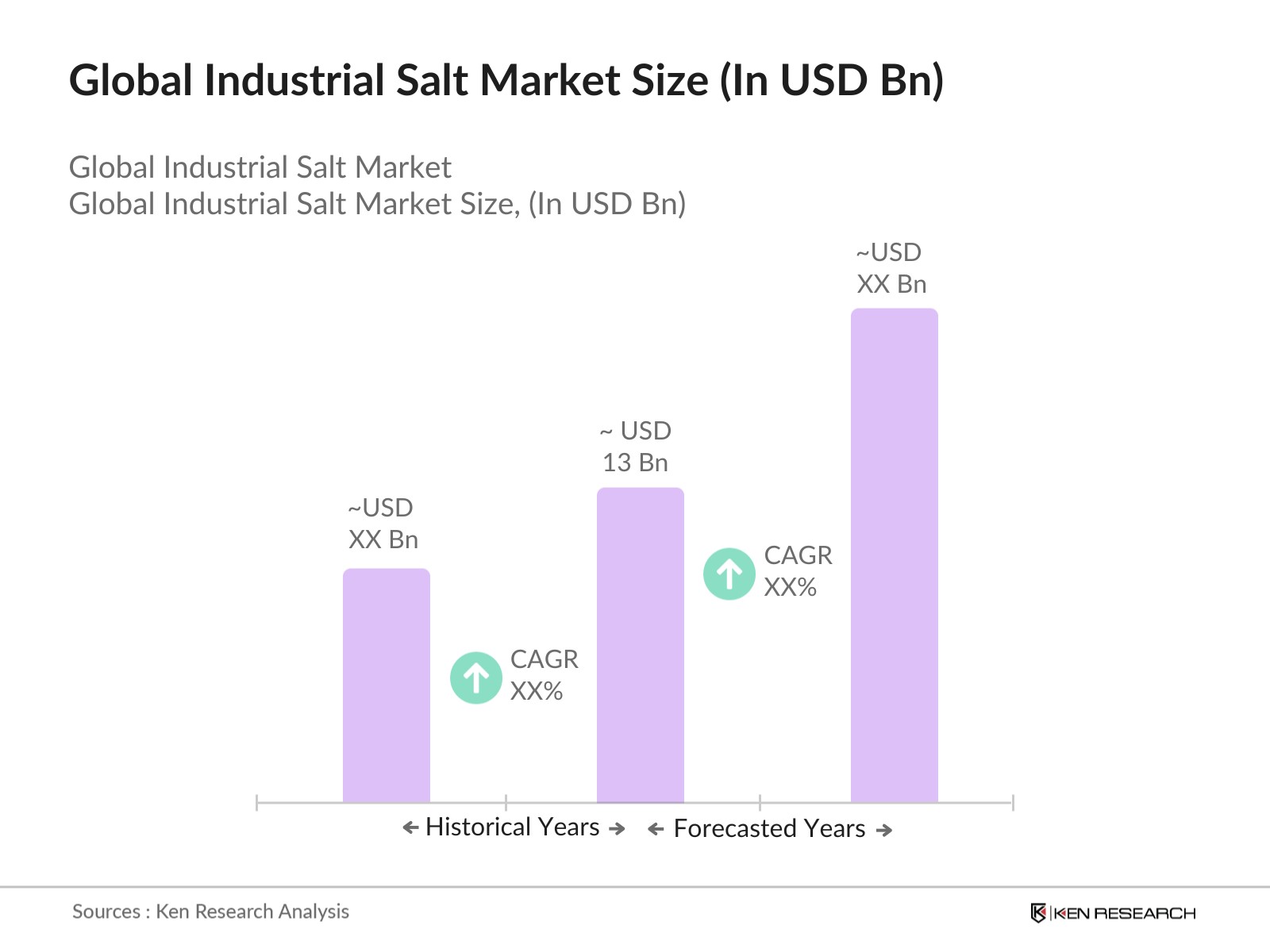
The global industrial salt market is valued at USD 17 billion, driven by its applications across chemical manufacturing, de-icing, and food processing sectors.
Key challenges include the environmental impact of salt extraction and production, fluctuating raw material costs, and the introduction of stringent environmental regulations.
Major players include Cargill, K+S AG, Compass Minerals International, Tata Chemicals, and Mitsui & Co., Ltd., all of which maintain significant global reach and production capacities.
Growth drivers include the rising demand for chlorine and caustic soda in chemical industries, increasing de-icing applications, and the expansion of water treatment facilities across urban areas.
Countries like China, the U.S., and India dominate due to their large salt reserves, significant industrial base, and robust infrastructure for salt extraction and distribution.

What makes us stand out is that our consultants follows Robust, Refine and Result (RRR) methodology. i.e. Robust for clear definitions, approaches and sanity checking, Refine for differentiating respondents facts and opinions and Result for presenting data with story

We have set a benchmark in the industry by offering our clients with syndicated and customized market research reports featuring coverage of entire market as well as meticulous research and analyst insights.

While we don't replace traditional research, we flip the method upside down. Our dual approach of Top Bottom & Bottom Top ensures quality deliverable by not just verifying company fundamentals but also looking at the sector and macroeconomic factors.

With one step in the future, our research team constantly tries to show you the bigger picture. We help with some of the tough questions you may encounter along the way: How is the industry positioned? Best marketing channel? KPI's of competitors? By aligning every element, we help maximize success.

Our report gives you instant access to the answers and sources that other companies might choose to hide. We elaborate each steps of research methodology we have used and showcase you the sample size to earn your trust.

If you need any support, we are here! We pride ourselves on universe strength, data quality, and quick, friendly, and professional service.