















Global IoT in Retail Market Outlook to 2030
Region:Global
Author(s):Yogita Sahu
Product Code:KROD3172
October 2024
95
About the Report
Global IoT in Retail Market Overview
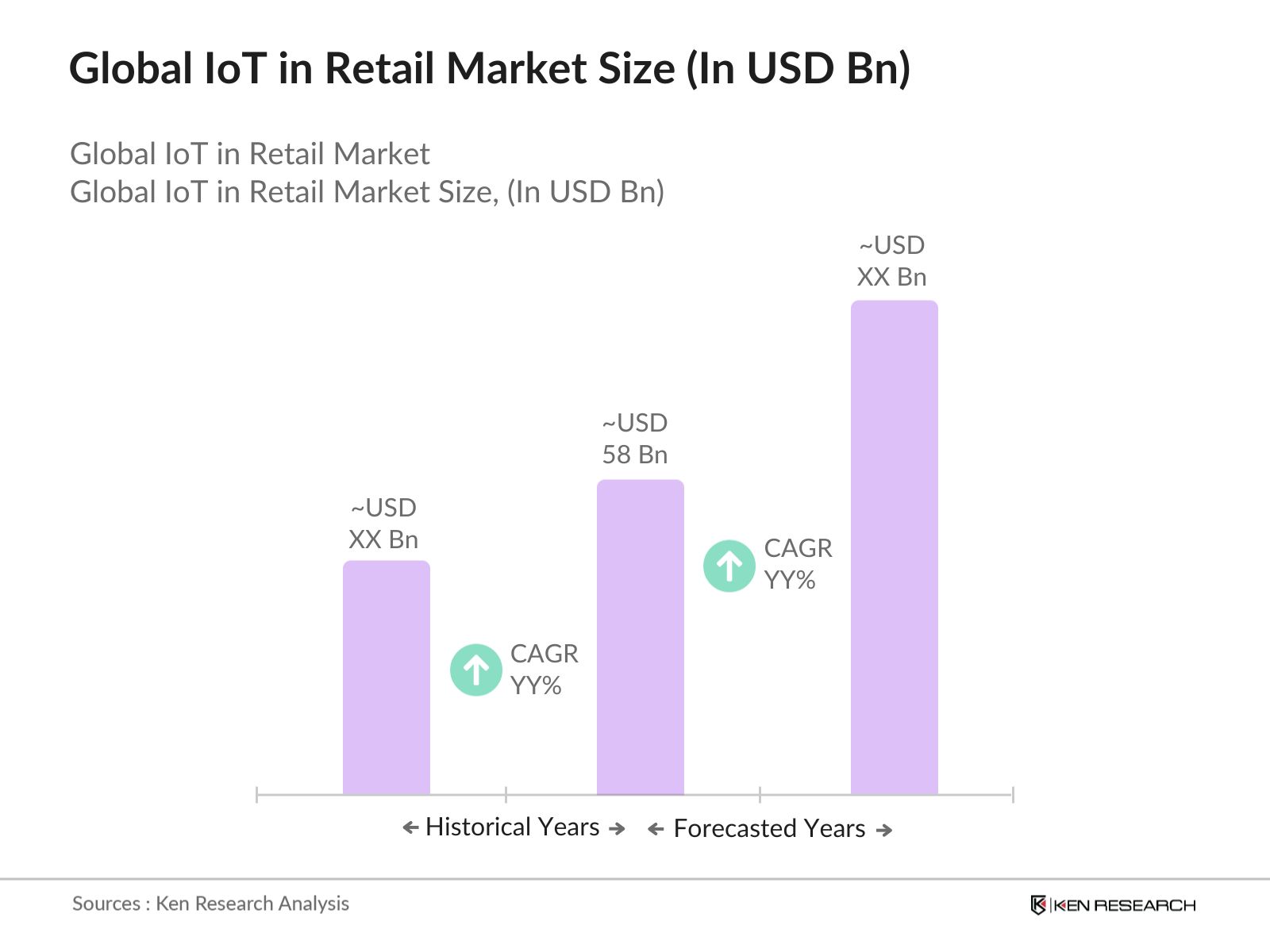
- The Global IoT in Retail Market has witnessed substantial growth, with the market valued at USD 58 billion based on a five-year historical analysis. This growth is driven by the increasing adoption of IoT solutions for enhancing in-store operations, customer engagement, and supply chain management. Retailers are integrating IoT technology to offer personalized customer experiences, optimize inventory management, and streamline logistics, which has led to higher operational efficiency and profitability.
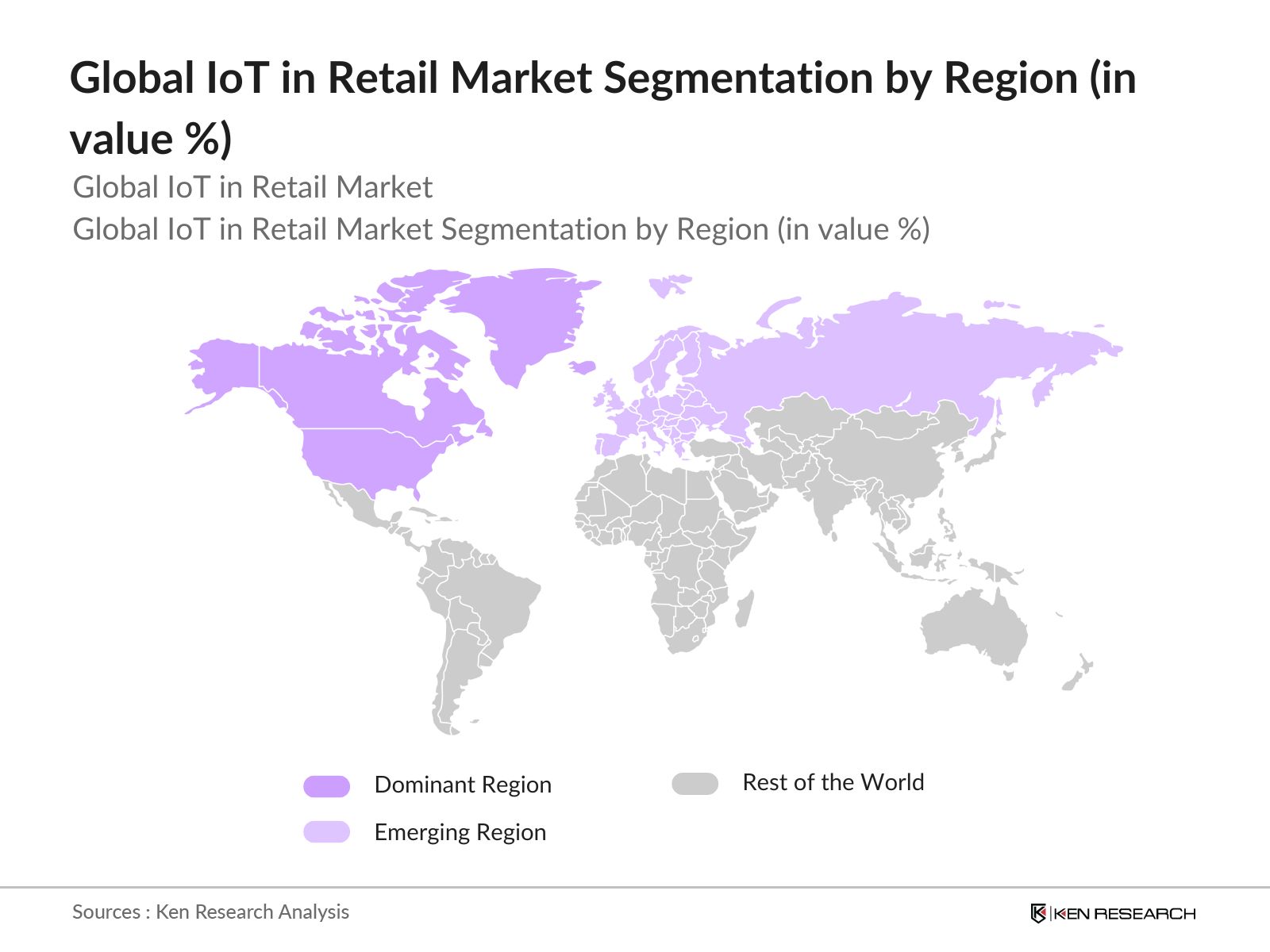
- Countries like the United States, China, and Germany dominate the IoT in Retail market. The United States leads the market due to the high concentration of tech-savvy retailers and the early adoption of advanced technologies. In China, a strong e-commerce ecosystem and government support for digitization have accelerated the integration of IoT in retail.
- The European Unions General Data Protection Regulation (GDPR) is shaping the use of IoT in retail. As of 2024, businesses across Europe must comply with stringent data security and privacy regulations, making it necessary for retailers to adopt secure IoT solutions. These regulations are promoting the implementation of encrypted IoT systems that ensure customer data protection while driving the adoption of advanced technologies in the retail sector.
Global IoT in Retail Market Segmentation
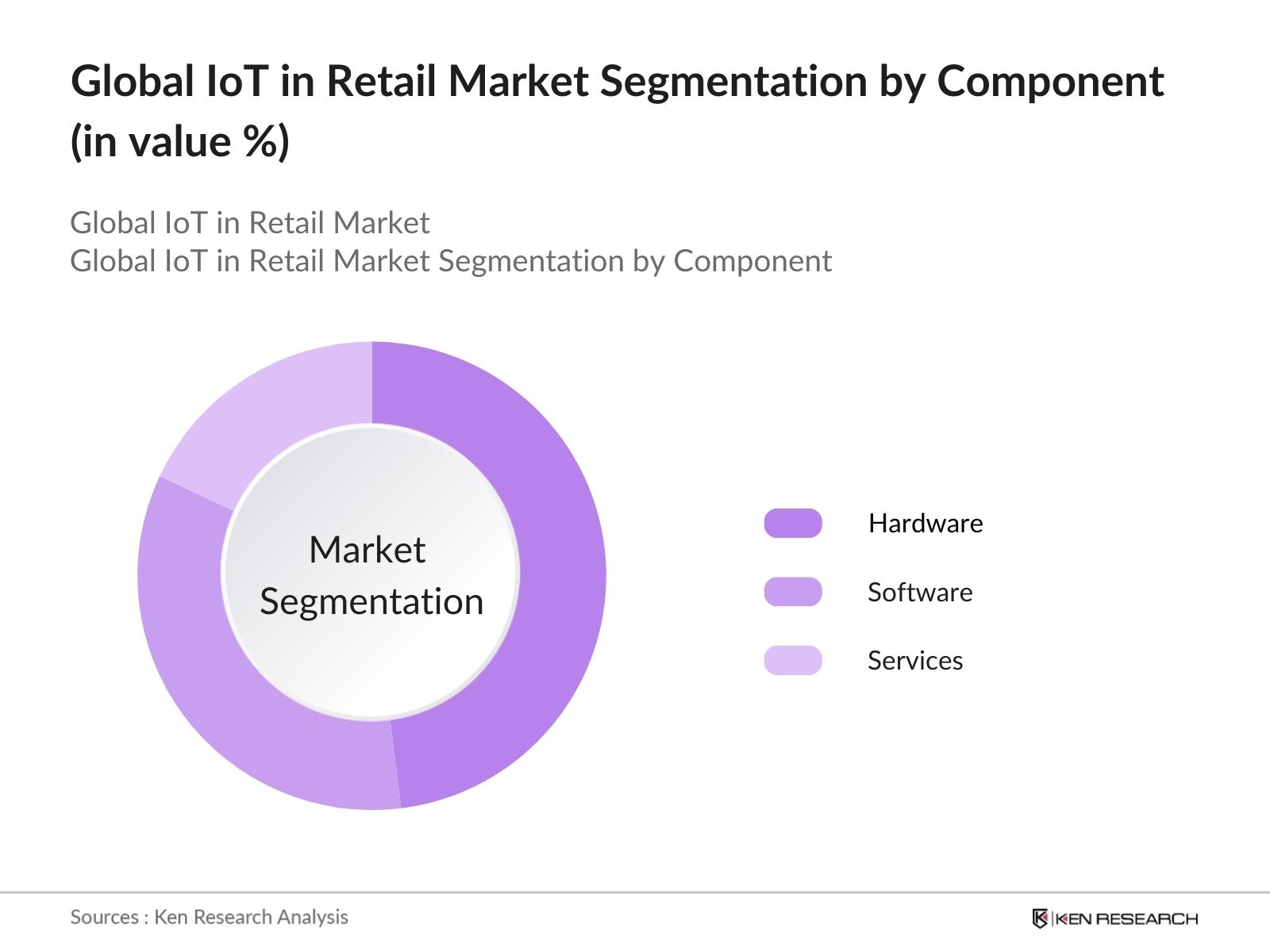
By Component: The market is segmented by component into hardware, software, and services. Recently, hardware has maintained a dominant market share within the component segment. This is due to the growing demand for IoT sensors, RFID tags, and beacons, which are essential for tracking inventory, monitoring customer behavior, and automating in-store processes. Retailers are increasingly investing in hardware solutions to support IoT-driven innovations, further boosting this sub-segment's growth.
By Application: The market is segmented by application into inventory management, smart checkout, customer relationship management (CRM), and supply chain optimization. Inventory management dominates this segment, driven by the need for real-time tracking of stock levels and preventing product shortages. IoT-enabled inventory systems allow retailers to minimize manual interventions, reduce waste, and increase operational efficiency, making it a critical aspect of IoT integration in retail.
By Region: The market is segmented into North America, Europe, Asia-Pacific, Latin America, and the Middle East and Africa. North America has dominated the market, mainly due to the presence of key players, advanced retail ecosystems, and the increasing investments in IoT technologies by major retail chains. The U.S. leads in adopting smart retail solutions, while Canada also contributes significantly due to government support for digital transformation.
Global IoT in Retail Market Competitive Landscape
The market is characterized by the presence of key global players offering innovative solutions across various segments. These companies focus on integrating IoT technologies with retail operations to enhance customer experience, inventory management, and data analytics. Leading firms invest heavily in R&D, strategic partnerships, and acquisitions to stay competitive.
|
Company |
Establishment Year |
Headquarters |
No. of Employees |
R&D Investments |
IoT Product Portfolio |
Revenue |
Geographic Presence |
IoT Patents |
|
IBM Corporation |
1911 |
Armonk, USA |
||||||
|
Microsoft Corporation |
1975 |
Redmond, USA |
||||||
|
Cisco Systems, Inc. |
1984 |
San Jose, USA |
||||||
|
Intel Corporation |
1968 |
Santa Clara, USA |
||||||
|
SAP SE |
1972 |
Walldorf, Germany |
Global IoT in Retailed Market Analysis
Market Growth Drivers
- Increasing Adoption of Connected Devices in Retail: The increasing use of connected devices such as smart shelves, sensors, and IoT-enabled kiosks is revolutionizing the retail sector globally. In 2024, it is estimated that more than 40 billion IoT-connected devices will be in operation across industries, driving demand for IoT solutions in retail. Retailers are leveraging IoT devices to monitor inventory in real-time, optimize supply chains, and enhance customer experiences through personalized services.
- Rising Demand for Enhanced Customer Experiences: Consumers are seeking personalized and seamless shopping experiences, which is driving the demand for IoT technology in retail. With over 4.9 billion global internet users in 2023, retailers are using IoT to provide real-time data analysis, enabling tailored marketing, automatic restocking, and personalized product recommendations. Global retail giants are adopting beacon technology to engage customers and provide real-time offers.
- Advancement in 5G Technology: The rollout of 5G networks is one of the most critical drivers for IoT in retail. By 2024, 5G subscriptions are projected to reach over 1.7 billion globally, providing faster connectivity, low latency, and enhanced data transfer capabilities, which are crucial for the large-scale deployment of IoT devices. Retailers can now deploy smart technologies, such as augmented reality (AR) for virtual try-ons and automated checkout systems, enhancing both the operational efficiency and customer experience.
Market Challenges
- Interoperability Issues Across Devices: The lack of standardization in IoT technologies poses a challenge for retail businesses. Retailers face difficulty in integrating devices from different manufacturers, which leads to inefficiencies and system breakdowns. In 2024, the global IoT market will consist of more than 1,000 different device manufacturers, contributing to the complexity of creating a unified system that can seamlessly operate across various platforms.
- Complexity of Implementing IoT Solutions in Small Retail Businesses: Small and medium-sized retail businesses often lack the resources to implement complex IoT solutions. In 2024, it is expected that around 95% of retail businesses globally are small enterprises, many of which face challenges in adopting IoT due to high costs and technical know-how. These businesses struggle to integrate advanced systems such as smart shelves, automated checkout, and data-driven customer engagement tools.
Global IoT in Retail Market Future Outlook
Over the next five years, the Global IoT in Retail industry is expected to experience growth, driven by technological advancements such as the integration of AI, 5G, and blockchain into IoT platforms. Retailers will increasingly focus on leveraging IoT solutions to provide personalized and seamless customer experiences, as well as optimizing supply chains and store operations.
Future Market Opportunities
- Increased Use of Autonomous Retail Systems: In the coming years, the retail sector will witness a surge in autonomous retail systems, including self-checkout stations and robotic assistants. By 2028, it is projected that over 500,000 retail outlets globally will have implemented autonomous systems powered by IoT. These systems will reduce labor costs, enhance customer service, and streamline operational processes.
- Expansion of IoT-Based Predictive Analytics: Retailers will increasingly rely on IoT-driven predictive analytics to forecast consumer behavior, optimize inventory levels, and improve supply chain efficiency. By 2028, predictive analytics is expected to be a cornerstone of retail operations, allowing businesses to respond proactively to market demands. This shift will be powered by real-time data from IoT devices embedded in stores and warehouses.
Scope of the Report
|
By Component |
Hardware Software Services |
|
By Application |
Inventory Management Smart Checkout CRM Supply Chain Optimization |
|
By Retail Type |
Supermarkets & Hypermarkets Specialty Stores E-Commerce Department Stores |
|
By Technology |
RFID NFC BLE Sensors & Beacons |
|
By Region |
North America Europe Asia-Pacific Latin America Middle East & Africa |
Products
Key Target Audience Organizations and Entities Who Can Benefit by Subscribing This Report:
IoT Solution Providers
Government and Regulatory Bodies (US Federal Communications Commission, European Commission)
Investments and Venture Capitalist Firms
Payment Gateway Providers
Cloud Service Providers
Telecommunications Companies
Companies
Players Mentioned in the Report:
IBM Corporation
Microsoft Corporation
Cisco Systems, Inc.
Intel Corporation
SAP SE
Google LLC
Amazon Web Services (AWS)
Honeywell International Inc.
Zebra Technologies Corporation
PTC Inc.
Oracle Corporation
Huawei Technologies Co., Ltd.
Fujitsu Limited
AT&T Inc.
Software AG
Table of Contents
1. Global IoT in Retail Market Overview
1.1. Definition and Scope
1.2. Market Taxonomy
1.3. Market Growth Rate
1.4. Market Segmentation Overview
2. Global IoT in Retail Market Size (In USD Bn)
2.1. Historical Market Size
2.2. Year-On-Year Growth Analysis
2.3. Key Market Developments and Milestones
3. Global IoT in Retail Market Analysis
3.1. Growth Drivers
3.2. Market Challenges
3.3. Opportunities
3.4. Trends
3.5. Government Regulations
3.6. SWOT Analysis
3.7. Stakeholder Ecosystem
3.8. Porters Five Forces
3.9. Competition Ecosystem
4. Global IoT in Retail Market Segmentation
4.1. By Component (In Value %)
4.1.1. Hardware
4.1.2. Software
4.1.3. Services
4.2. By Application (In Value %)
4.2.1. Inventory Management
4.2.2. Smart Checkout
4.2.3. Customer Relationship Management (CRM)
4.2.4. Supply Chain Optimization
4.3. By Retail Type (In Value %)
4.3.1. Supermarkets and Hypermarkets
4.3.2. Specialty Stores
4.3.3. E-Commerce
4.3.4. Department Stores
4.4. By Technology (In Value %)
4.4.1. Radio-Frequency Identification (RFID)
4.4.2. Near Field Communication (NFC)
4.4.3. Bluetooth Low Energy (BLE)
4.4.4. Sensors and Beacons
4.5. By Region (In Value %)
4.5.1. North America
4.5.2. Europe
4.5.3. Asia-Pacific
4.5.4. Latin America
4.5.5. Middle East and Africa
5. Global IoT in Retail Market Competitive Analysis
5.1. Detailed Profiles of Major Companies
5.1.1. IBM Corporation
5.1.2. Microsoft Corporation
5.1.3. Cisco Systems, Inc.
5.1.4. Intel Corporation
5.1.5. SAP SE
5.1.6. Google LLC
5.1.7. Amazon Web Services (AWS)
5.1.8. Huawei Technologies Co., Ltd.
5.1.9. Zebra Technologies Corporation
5.1.10. PTC Inc.
5.1.11. Honeywell International Inc.
5.1.12. Oracle Corporation
5.1.13. AT&T Inc.
5.1.14. Software AG
5.1.15. Fujitsu Limited
5.2. Cross Comparison Parameters (Revenue, IoT Product Portfolio, Geographic Presence, R&D Investments, No. of Patents, Customer Base, Strategic Partnerships, IoT Platform Capabilities)
5.3. Market Share Analysis
5.4. Strategic Initiatives
5.5. Mergers and Acquisitions
5.6. Investment Analysis
5.7. Venture Capital Funding
5.8. Government Grants
5.9. Private Equity Investments
6. Global IoT in Retail Market Regulatory Framework
6.1. IoT Data Security Regulations
6.2. Consumer Privacy Laws
6.3. Compliance with International IoT Standards
6.4. Cybersecurity Protocols
7. Global IoT in Retail Future Market Size (In USD Bn)
7.1. Future Market Size Projections
7.2. Key Factors Driving Future Market Growth
8. Global IoT in Retail Future Market Segmentation
8.1. By Component (In Value %)
8.2. By Application (In Value %)
8.3. By Retail Type (In Value %)
8.4. By Technology (In Value %)
8.5. By Region (In Value %)
9. Global IoT in Retail Market Analysts Recommendations
9.1. TAM/SAM/SOM Analysis
9.2. Customer Cohort Analysis
9.3. Marketing Initiatives
9.4. White Space Opportunity Analysis
Research Methodology
Step 1: Identification of Key Variables
The initial phase involves constructing an ecosystem map for the Global IoT in Retail Market. This step includes secondary and proprietary research to gather industry-level data. The goal is to identify the critical variables influencing market growth.
Step 2: Market Analysis and Construction
In this phase, historical data regarding IoT adoption in retail will be analyzed. The focus will be on penetration rates, the ratio of connected stores to total retail outlets, and revenue generation from IoT-driven processes.
Step 3: Hypothesis Validation and Expert Consultation
Market hypotheses will be validated through consultations with IoT experts. Interviews will be conducted with senior professionals to gain operational insights into IoT applications in retail.
Step 4: Research Synthesis and Final Output
The final step involves synthesizing the findings through direct engagement with retailers using IoT technology. This step ensures that the data collected from secondary sources is validated and accurate, reflecting the real market dynamics.
Frequently Asked Questions
1. How big is the Global IoT in Retail Market?
The Global IoT in Retail Market is valued at USD 58 billion based on a five-year historical analysis. This growth is driven by increasing IoT adoption in retail operations, enhancing customer experiences and inventory management.
2. What are the challenges in the Global IoT in Retail Market?
Challenges in the Global IoT in Retail Market include data privacy concerns, high implementation costs, and the lack of skilled personnel to handle complex IoT systems. Moreover, integrating legacy systems with IoT infrastructure can be a hurdle.
3. Who are the major players in the Global IoT in Retail Market?
Major players in the Global IoT in Retail Market include IBM Corporation, Microsoft Corporation, Cisco Systems, Intel Corporation, and SAP SE. These companies lead the market due to their advanced IoT portfolios and global presence.
4. What are the growth drivers of the Global IoT in Retail Market?
Key growth drivers in the Global IoT in Retail Market include the demand for personalized customer experiences, real-time inventory tracking, and enhanced supply chain efficiency. The integration of AI and 5G with IoT solutions is expected to further propel market growth.
5. Which regions dominate the Global IoT in Retail Market?
North America leads the Global IoT in Retail Market, followed by Europe and Asia-Pacific. The U.S. holds a dominant position due to its tech-savvy retailers and advanced IoT infrastructure.
Why Buy From Us?

What makes us stand out is that our consultants follows Robust, Refine and Result (RRR) methodology. i.e. Robust for clear definitions, approaches and sanity checking, Refine for differentiating respondents facts and opinions and Result for presenting data with story

We have set a benchmark in the industry by offering our clients with syndicated and customized market research reports featuring coverage of entire market as well as meticulous research and analyst insights.

While we don't replace traditional research, we flip the method upside down. Our dual approach of Top Bottom & Bottom Top ensures quality deliverable by not just verifying company fundamentals but also looking at the sector and macroeconomic factors.

With one step in the future, our research team constantly tries to show you the bigger picture. We help with some of the tough questions you may encounter along the way: How is the industry positioned? Best marketing channel? KPI's of competitors? By aligning every element, we help maximize success.

Our report gives you instant access to the answers and sources that other companies might choose to hide. We elaborate each steps of research methodology we have used and showcase you the sample size to earn your trust.

If you need any support, we are here! We pride ourselves on universe strength, data quality, and quick, friendly, and professional service.