
Global IQF Fruits & Vegetables Market Outlook 2030
Region:Global
Author(s):Shivani Mehra
Product Code:KROD11379
December 2024
91
About the Report
Global IQF Fruits & Vegetables Market Overview
- The global IQF (Individually Quick Frozen) fruits and vegetables market is valued at USD 5,134.5 million, driven primarily by the increasing demand for convenient and long-lasting food products. Consumers are turning to frozen alternatives for fruits and vegetables due to the longer shelf life, ease of preparation, and preservation of nutritional value. This market is significantly influenced by the growth of the food service industry and the expansion of cold storage capacities, enhancing the reach of IQF products globally.
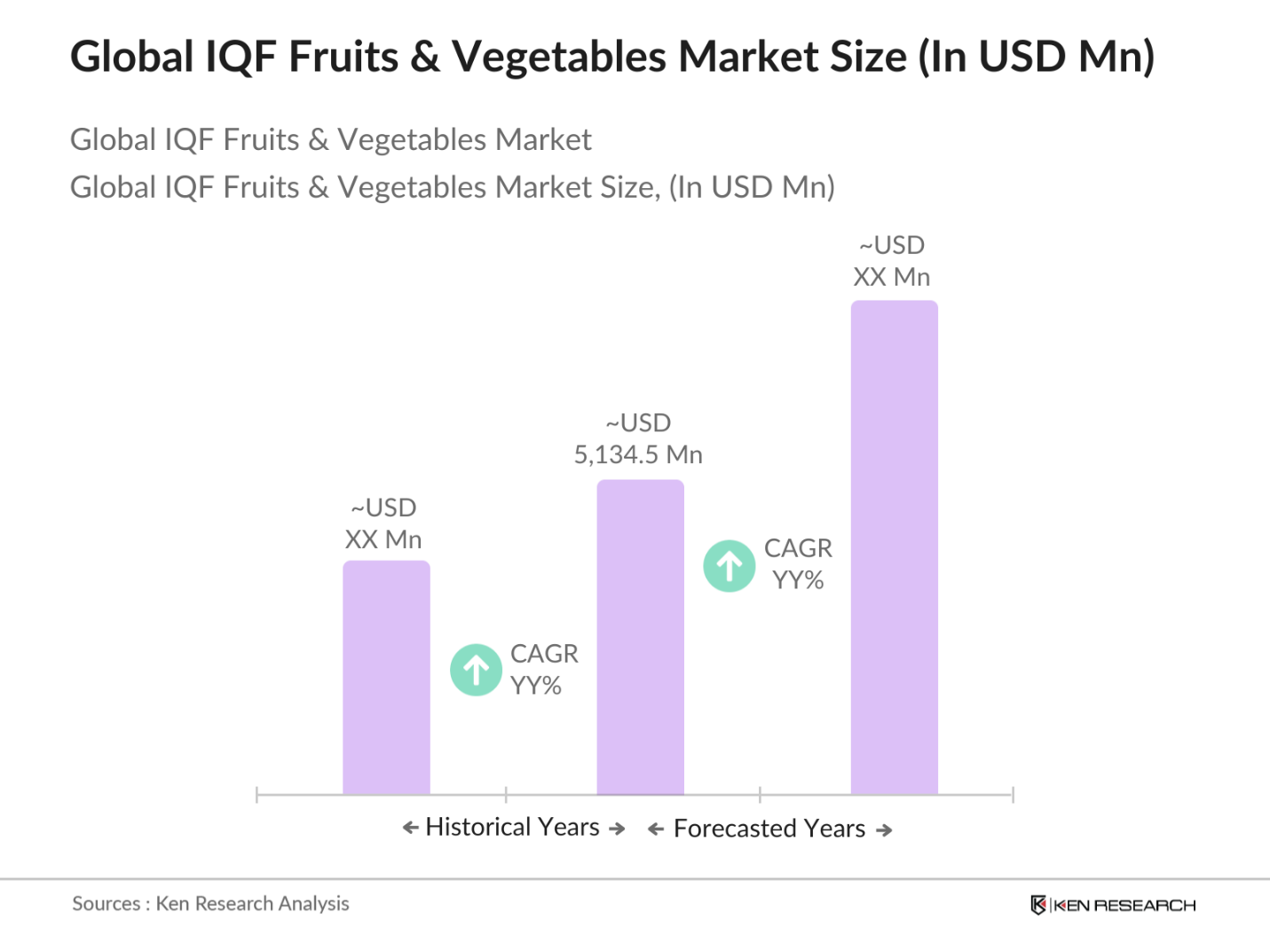
- Countries such as the United States, China, and India dominate the global IQF fruits and vegetables market due to their well-established food processing industries, large consumer bases, and advancements in cold chain logistics. The United States leads with its robust retail sector, while China and India have rapidly growing middle-class populations that favor affordable and convenient food options. These countries are also investing heavily in technological innovations, further consolidating their positions in the market.
- Governments in regions like the European Union are offering subsidies and tax incentives to companies that adopt sustainable practices in food production, including the IQF sector. The EUs Common Agricultural Policy (CAP) provides financial support to farmers and producers who implement environmentally friendly practices, such as organic farming and the use of renewable energy in cold storage. These incentives encourage the production and distribution of organic IQF products, aligning with consumer demand for clean-label and eco-friendly food options.
Global IQF Fruits & Vegetables Market Segmentation
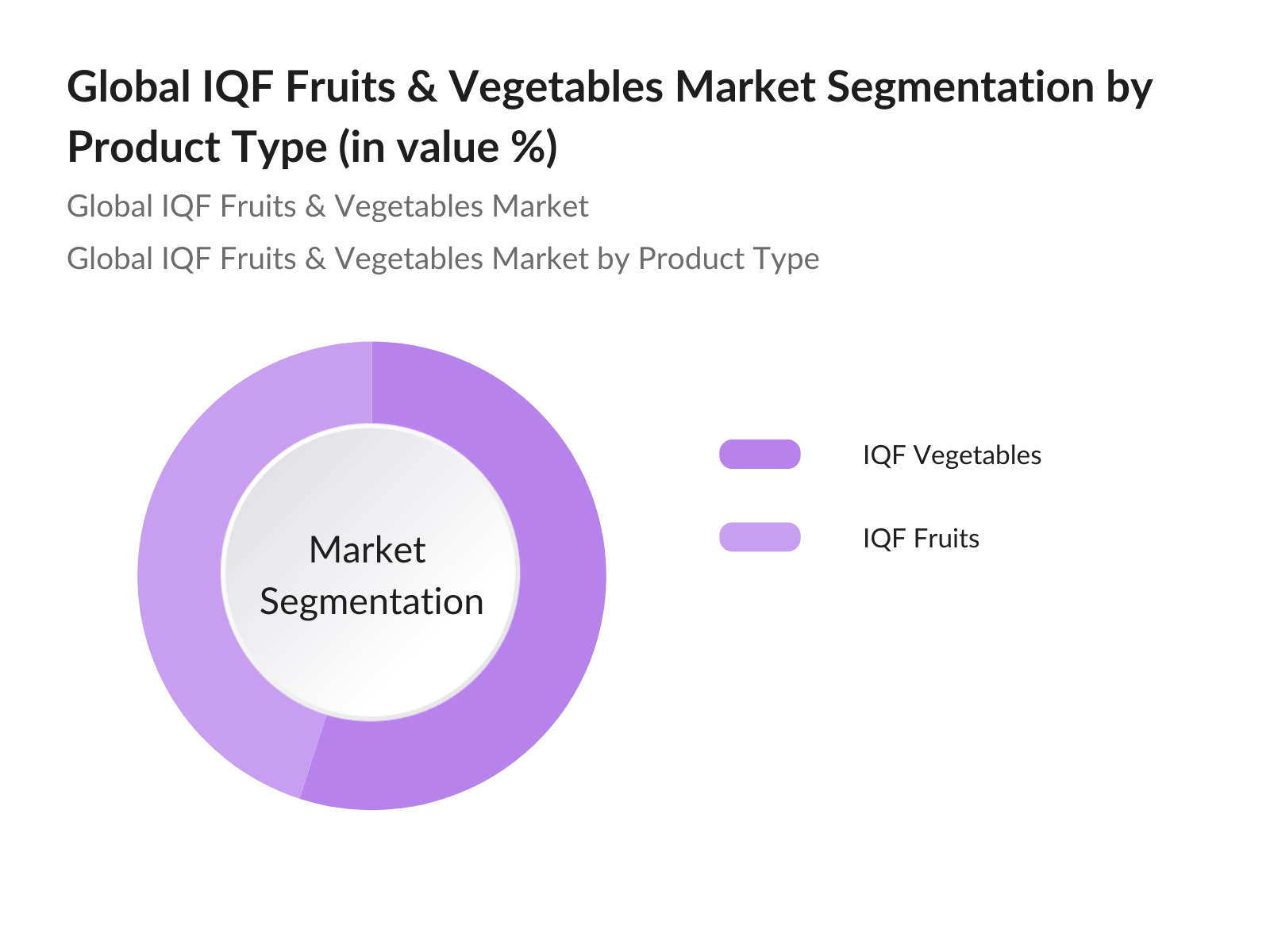
By Product Type: The global IQF fruits and vegetables market is segmented by product type into IQF fruits and IQF vegetables. Among these, IQF vegetables hold a dominant share in the market, driven by the growing demand from food service industries such as restaurants, hotels, and catering services. The appeal of frozen vegetables lies in their consistent quality, ease of preparation, and ability to reduce food waste. Additionally, vegetables like peas, spinach, and broccoli are consumed year-round, making them a staple in both household and commercial kitchens.
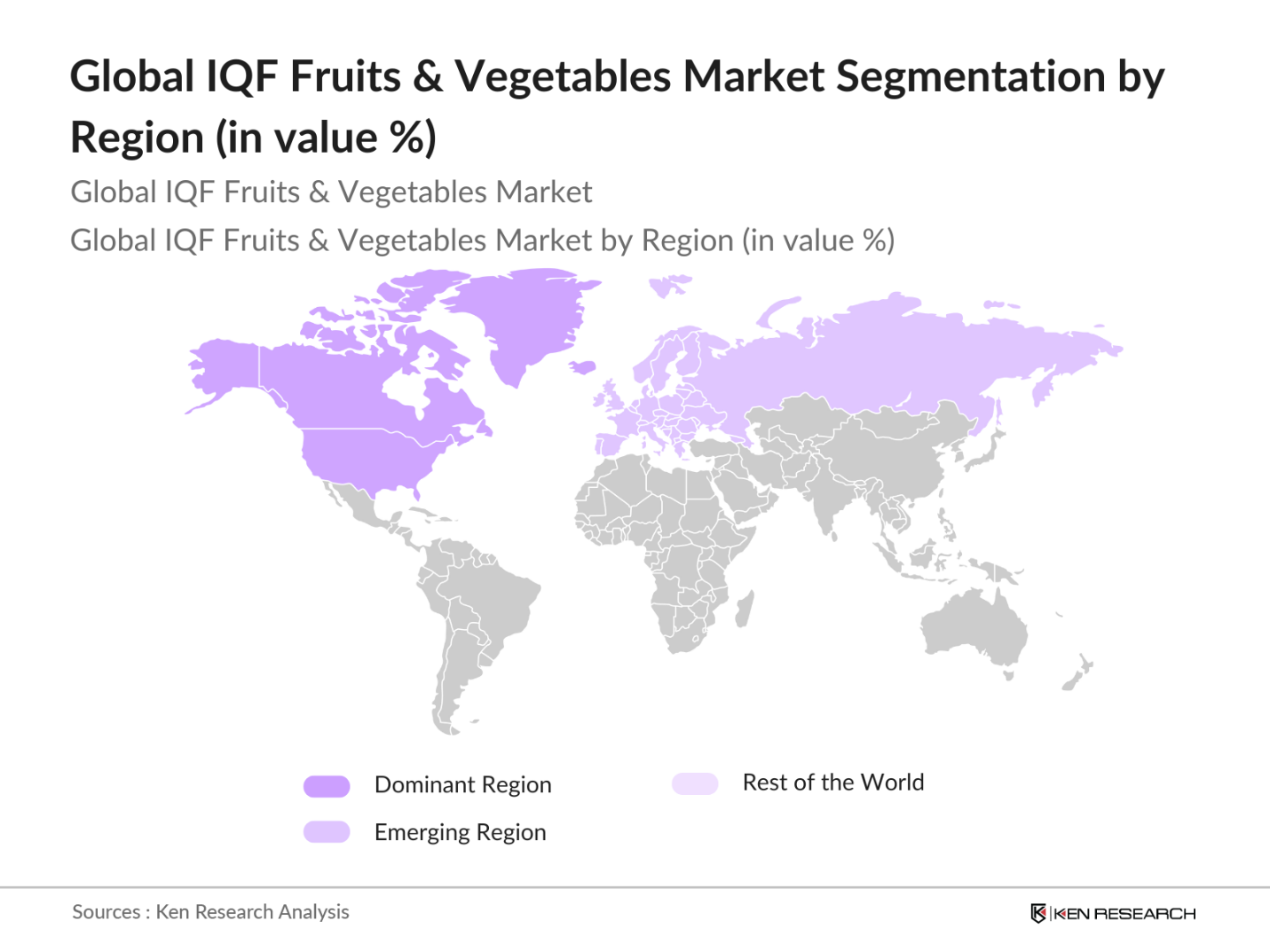
By Region: The global IQF fruits and vegetables market is segmented by region into North America, Europe, Asia-Pacific, Middle East & Africa, and Latin America. North America dominates the market, accounting for the largest share due to its well-established cold chain infrastructure, advanced food processing technologies, and high consumer demand for frozen foods. The rise of health-conscious consumers and increasing preference for convenient meal solutions further propels the demand for IQF products in this region.
Global IQF Fruits & Vegetables Market Competitive Landscape
The global IQF fruits and vegetables market is characterized by several key players dominating the market. These companies possess strong distribution networks, advanced processing capabilities, and a focus on innovation to cater to the evolving demands of consumers. The competition among these players is primarily based on product variety, quality, sustainability initiatives, and pricing strategies.
|
Company Name |
Establishment Year |
Headquarters |
Processing Capabilities |
Sustainability Initiatives |
Innovation in Freezing Tech |
Global Reach |
Strategic Partnerships |
Market Presence |
Revenue (USD bn) |
|
B&G Foods Holdings |
1889 |
USA |
Advanced |
- |
- |
- |
- |
- |
- |
|
J.R. Simplot Company |
1929 |
USA |
Extensive |
- |
- |
- |
- |
- |
- |
|
Nomad Foods |
1989 |
UK |
Extensive |
- |
- |
- |
- |
- |
- |
|
Ardo N.V. |
1977 |
Belgium |
High |
- |
- |
- |
- |
- |
- |
|
Conagra Brands, Inc. |
1919 |
USA |
High |
- |
- |
- |
- |
- |
- |
Global IQF Fruits & Vegetables Market Analysis
Market Growth Drivers
- Rising Urban Population Driving Demand for Convenience Foods: The shift in demographics with a growing urban population is fueling the demand for convenient, ready-to-eat foods, including IQF fruits and vegetables. This surge in urbanization has led to busier lifestyles, resulting in a higher preference for convenient and quick meal options. IQF products, with their longer shelf life and easy-to-store nature, have become a popular choice for urban consumers worldwide, driving market growth.
- Extended Shelf Life of IQF Products Reducing Food Waste: IQF technology ensures that fruits and vegetables retain their nutritional value and remain fresh for longer periods. Unlike traditional freezing methods, IQF preserves the individual integrity of food items, reducing spoilage. This extended shelf life helps minimize food waste, making IQF products an attractive option for both consumers and retailers, particularly in markets where food preservation is a concern.
- Expansion of Cold Storage Infrastructure in Developed Markets: Developed regions like Europe and North America are witnessing substantial investments in cold storage infrastructure, which is essential for the preservation and distribution of IQF products. According to the Global Cold Chain Alliance (GCCA), the global cold storage capacity grew by 3.1 million cubic meters in 2022, with Europe and North America accounting for the majority of this expansion. This increased capacity allows for better distribution networks and the ability to cater to rising consumer demand for IQF fruits and vegetables, facilitating market growth.
Market Challenges:
- Underdeveloped Cold Chain Infrastructure in Emerging Markets: One of the major challenges in the IQF fruits and vegetables market is the lack of developed cold chain infrastructure in emerging economies. In countries like India, Brazil, and parts of Southeast Asia, insufficient cold storage facilities lead to significant food spoilage during transport and storage. This gap in infrastructure limits the availability of IQF products, causing supply chain disruptions and reducing market potential in these regions.
- High Energy Costs Impacting Profitability: Energy costs are a critical factor in maintaining cold storage and transportation systems for IQF products. The refrigeration process, which is essential for preserving IQF fruits and vegetables, consumes a substantial amount of energy. With rising global energy prices, particularly in regions heavily reliant on non-renewable energy sources, operational costs for cold storage and transportation increase, impacting the profitability of companies operating in this space.
Global IQF Fruits & Vegetables Market Future Outlook
Over the next five years, the global IQF fruits and vegetables market is expected to experience steady growth, driven by increasing consumer demand for convenient and nutritious food options. The expansion of cold storage capacities, coupled with technological advancements in freezing methods, will further propel the market's growth. Rising health consciousness and an increasing preference for natural, preservative-free frozen foods are likely to provide new opportunities for market expansion.
Market Opportunities:
- Growing Demand for Organic IQF Products in Developed Markets: Consumers in developed markets, particularly in Europe and North America, are increasingly prioritizing organic and clean-label food products. The shift towards healthier, chemical-free options has spurred a rise in demand for organic IQF fruits and vegetables. Organic food sales in Europe, for instance, have grown steadily in recent years as consumers seek healthier, more sustainable food options. IQF producers focusing on organic offerings can tap into this growing market, catering to health-conscious consumers looking for convenient, high-quality frozen products.
- Expanding Market Potential in Emerging Economies: Emerging markets, such as Southeast Asia, Latin America, and Africa, present significant opportunities for the IQF market as cold chain infrastructure gradually improves in these regions. As economies in these regions grow and disposable incomes rise, there is a greater demand for convenient, nutritious food products. Investments in cold storage facilities and better distribution networks in these areas make IQF products more accessible, creating new market opportunities for companies willing to invest in these developing regions.
Scope of the Report
|
By Product Type |
IQF Fruits IQF Vegetables |
|
By End-User |
Retail Consumers Food Service Providers Industrial Processors |
|
By Distribution Channel |
Supermarkets & Hypermarkets Online Retail Convenience Stores |
|
By Processing Type |
Individual Quick Freezing Cryogenic Freezing |
|
By Region |
North America Europe Asia-Pacific Middle East & Africa Latin America |
Products
Key Target Audience
Food service providers
Retailers and supermarkets
Frozen food manufacturers
Cold chain logistics companies
Industrial food processors
Government and regulatory bodies (FDA, EFSA)
Investment and venture capitalist firms
Health-conscious consumer groups
Companies
Players Mention in the Report
B&G Foods Holdings
J.R. Simplot Company
Nomad Foods
Ardo N.V.
Conagra Brands, Inc.
Greenyard N.V.
Pinnacle Foods, Inc.
Agristo N.V.
Birds Eye Foods, Inc.
Unilever Plc
Dole Food Company, Inc.
Earthbound Farm, LLC
Bonduelle Group
Kerry Group Plc
General Mills, Inc.
Table of Contents
1. Global IQF Fruits & Vegetables Market Overview
1.1. Definition and Scope
1.2. Market Taxonomy
1.3. Market Growth Rate
1.4. Market Segmentation Overview
2. Global IQF Fruits & Vegetables Market Size (in USD Mn)
2.1. Historical Market Size
2.2. Year-on-Year Growth Analysis
2.3. Key Market Developments and Milestones
3. Global IQF Fruits & Vegetables Market Analysis
3.1. Growth Drivers (consumer preference for frozen foods, convenience, shelf life)
3.2. Market Challenges (logistics, cold chain infrastructure, energy costs)
3.3. Opportunities (increased demand for organic IQF products, emerging markets)
3.4. Trends (sustainability, clean-label demand, technological innovations)
3.5. Government Regulations (food safety standards, import/export restrictions)
3.6. SWOT Analysis
3.7. Stake Ecosystem
3.8. Porters Five Forces
3.9. Competition Ecosystem
4. Global IQF Fruits & Vegetables Market Segmentation
4.1. By Product Type (in Value %)
4.1.1. IQF Fruits
4.1.2. IQF Vegetables
4.2. By End-User (in Value %)
4.2.1. Retail Consumers
4.2.2. Food Service Providers
4.2.3. Industrial Processors
4.3. By Distribution Channel (in Value %)
4.3.1. Supermarkets & Hypermarkets
4.3.2. Online Retail
4.3.3. Convenience Stores
4.4. By Processing Type (in Value %)
4.4.1. Individual Quick Freezing
4.4.2. Cryogenic Freezing
4.5. By Region (in Value %)
4.5.1. North America
4.5.2. Europe
4.5.3. Asia-Pacific
4.5.4. Middle East & Africa
4.5.5. Latin America
5. Global IQF Fruits & Vegetables Market Competitive Analysis
5.1. Detailed Profiles of Major Companies
5.1.1. B&G Foods Holdings
5.1.2. J.R. Simplot Company
5.1.3. Nomad Foods
5.1.4. Ardo N.V.
5.1.5. Conagra Brands, Inc.
5.1.6. Greenyard N.V.
5.1.7. Pinnacle Foods, Inc.
5.1.8. Agristo N.V.
5.1.9. Birds Eye Foods, Inc.
5.1.10. Unilever Plc
5.1.11. Dole Food Company, Inc.
5.1.12. Earthbound Farm, LLC
5.1.13. Bonduelle Group
5.1.14. Kerry Group Plc
5.1.15. General Mills, Inc.
5.2. Cross Comparison Parameters (market presence, product portfolio, processing capabilities, sustainability initiatives, innovation, pricing strategies, distribution network, market share)
5.3. Market Share Analysis
5.4. Strategic Initiatives
5.5. Mergers and Acquisitions
5.6. Investment Analysis
5.7. Venture Capital Funding
5.8. Government Grants
5.9. Private Equity Investments
6. Global IQF Fruits & Vegetables Market Regulatory Framework
6.1. Food Safety Standards (FDA, EFSA guidelines)
6.2. Compliance Requirements (HACCP, GMP certifications)
6.3. Certification Processes (ISO 22000, BRC)
7. Global IQF Fruits & Vegetables Future Market Size (in USD Mn)
7.1. Future Market Size Projections
7.2. Key Factors Driving Future Market Growth
8. Global IQF Fruits & Vegetables Future Market Segmentation
8.1. By Product Type (in Value %)
8.2. By End-User (in Value %)
8.3. By Distribution Channel (in Value %)
8.4. By Processing Type (in Value %)
8.5. By Region (in Value %)
9. Global IQF Fruits & Vegetables Market Analysts Recommendations
9.1. TAM/SAM/SOM Analysis
9.2. Customer Cohort Analysis
9.3. Marketing Initiatives
9.4. White Space Opportunity Analysis
Disclaimer
Contact Us
Research Methodology
Step 1: Identification of Key Variables
The first step in the research methodology involves mapping the entire IQF fruits and vegetables ecosystem, focusing on all major stakeholders. Extensive desk research, leveraging secondary databases and proprietary resources, is conducted to gather critical data on market dynamics and performance indicators.
Step 2: Market Analysis and Construction
The second phase includes the compilation and analysis of historical data on market trends, such as the market size, segment performance, and competitive landscape. This data is used to assess market penetration and revenue generation patterns for both fruits and vegetables.
Step 3: Hypothesis Validation and Expert Consultation
Market hypotheses are developed based on the collected data and then validated through consultations with industry experts. These interviews provide direct insights from key players in the IQF sector, refining the accuracy of the research findings.
Step 4: Research Synthesis and Final Output
The final stage consolidates all collected data into a comprehensive report. In this phase, the statistics from the bottom-up approach are cross-validated by engaging with cold storage and food processing companies to ensure that the conclusions are both accurate and actionable.
Frequently Asked Questions
1. How big is the global IQF fruits and vegetables market?
The global IQF fruits and vegetables market was valued at USD 5,134.5 billion, driven by the increasing demand for convenient, nutritious, and preservative-free frozen foods.
2. What are the challenges in the global IQF fruits and vegetables market?
Challenges include logistical issues in maintaining cold chain infrastructure, rising energy costs, and the requirement for advanced freezing technologies to preserve quality.
3. Who are the major players in the IQF fruits and vegetables market?
Key players include B&G Foods Holdings, J.R. Simplot Company, Nomad Foods, Ardo N.V., and Conagra Brands, Inc. These companies dominate due to their global distribution networks and advanced freezing technologies.
4. What are the growth drivers of the IQF fruits and vegetables market?
Key growth drivers include the rising demand for convenient meal options, technological advancements in freezing methods, and the expansion of cold chain infrastructure globally.
Why Buy From Us?

What makes us stand out is that our consultants follows Robust, Refine and Result (RRR) methodology. i.e. Robust for clear definitions, approaches and sanity checking, Refine for differentiating respondents facts and opinions and Result for presenting data with story

We have set a benchmark in the industry by offering our clients with syndicated and customized market research reports featuring coverage of entire market as well as meticulous research and analyst insights.

While we don't replace traditional research, we flip the method upside down. Our dual approach of Top Bottom & Bottom Top ensures quality deliverable by not just verifying company fundamentals but also looking at the sector and macroeconomic factors.

With one step in the future, our research team constantly tries to show you the bigger picture. We help with some of the tough questions you may encounter along the way: How is the industry positioned? Best marketing channel? KPI's of competitors? By aligning every element, we help maximize success.

Our report gives you instant access to the answers and sources that other companies might choose to hide. We elaborate each steps of research methodology we have used and showcase you the sample size to earn your trust.

If you need any support, we are here! We pride ourselves on universe strength, data quality, and quick, friendly, and professional service.