
Global Kiwi Fruit Market Outlook to 2030
Region:Global
Author(s):Shreya Garg
Product Code:KROD10408
Region:Global
Author(s):Shreya Garg
Product Code:KROD10408
December 2024
91
By Product Type: The market is segmented by product type into green kiwi, gold kiwi, organic kiwi, and conventional kiwi. Recently, green kiwi has maintained a dominant market share in the market under the product type segmentation. This is due to its widespread consumer acceptance, lower price point compared to gold kiwi, and year-round availability. Green kiwi's long shelf life and robust flavor profile make it a popular choice among consumers and retailers, especially in the European and North American markets. 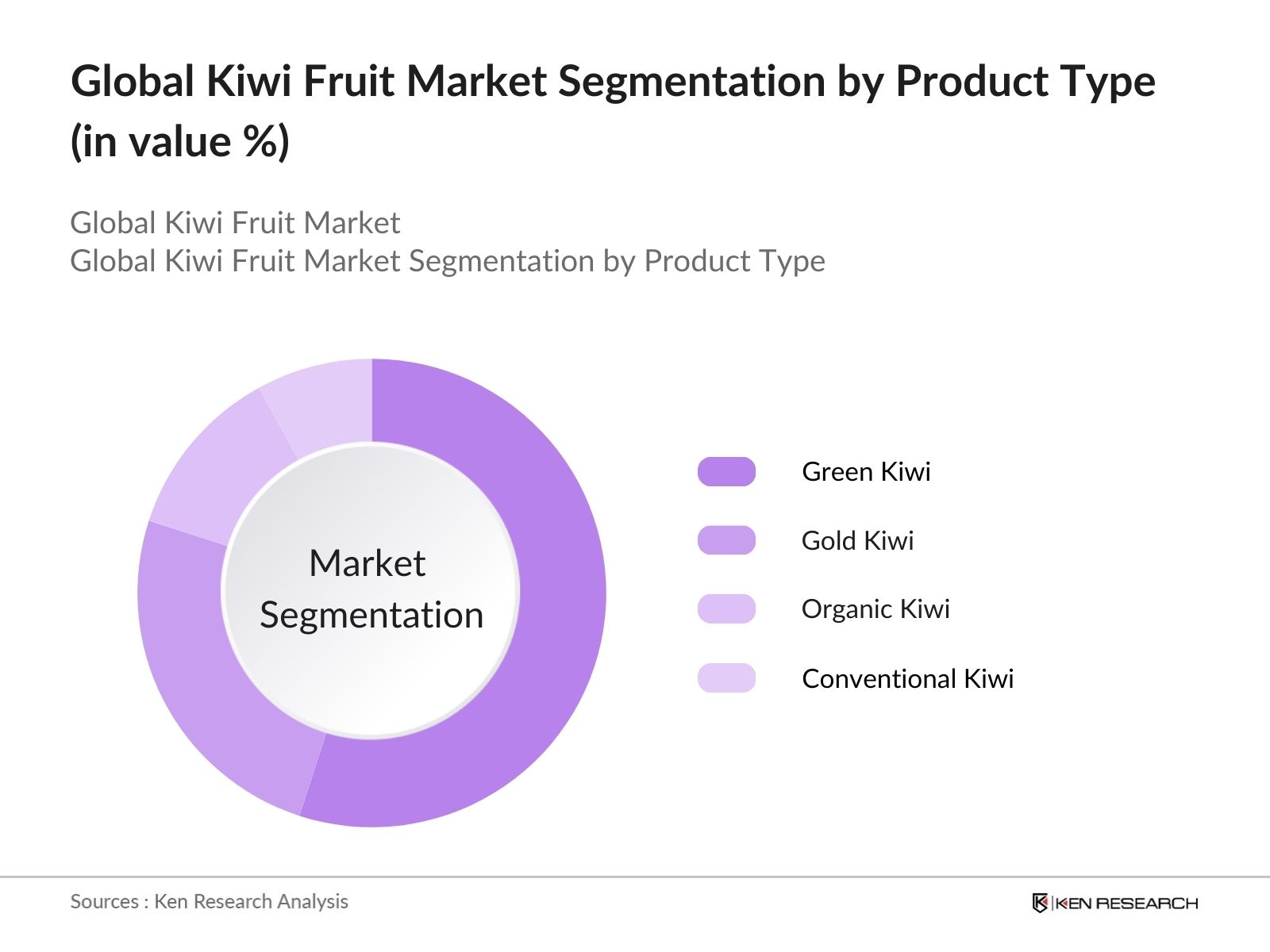
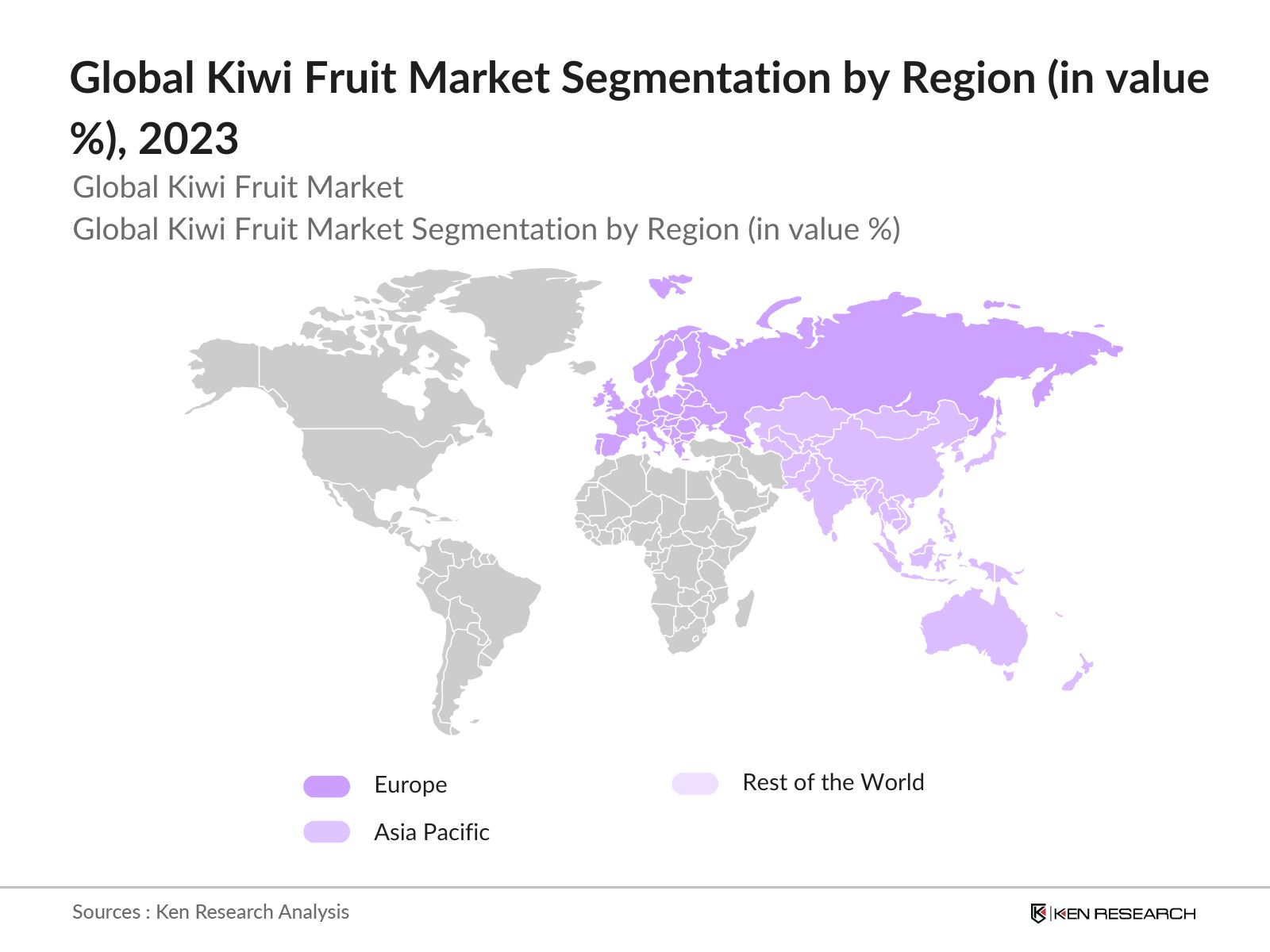
By Region: The market is segmented by region into North America, Europe, Asia Pacific, Latin America, and the Middle East & Africa. Europe leads the market due to its high consumption rates and established import networks, followed closely by the Asia Pacific region. Europe's dominance is mainly due to the strong demand for fresh kiwi in countries like Germany and France, which value premium quality and organic produce. The Asia Pacific region, especially China, is seeing rapid growth due to increasing domestic consumption and investments in kiwi cultivation.
By Application: The market is segmented by application into food & beverage industry, pharmaceutical industry, cosmetics & personal care, and nutraceuticals. The food & beverage industry holds a significant market share due to the versatile use of kiwi in juices, smoothies, desserts, and as a fresh fruit. The increasing trend of using natural ingredients in food processing has further fueled the demand for kiwi, especially in processed foods and healthy snacks.
The global kiwi fruit market is dominated by key players with a significant presence in production, distribution, and export. Companies like Zespri International Limited and The Wonderful Company LLC play a crucial role in shaping the market dynamics, leveraging strong branding and quality control to maintain a competitive edge.
|
Company |
Established |
Headquarters |
Cultivation Area (Hectares) |
Export Volume (Tons) |
R&D Investments (USD Mn) |
Organic Certification |
Supply Chain Partners |
Sustainability Programs |
|
Zespri International Limited |
1997 |
Mount Maunganui, NZ |
||||||
|
The Wonderful Company LLC |
1979 |
Los Angeles, USA |
||||||
|
Jingold Spa |
2001 |
Cesena, Italy |
||||||
|
Naturipe Farms LLC |
1917 |
California, USA |
||||||
|
Bostock New Zealand |
1985 |
Hawke's Bay, NZ |
Over the next five years, the Global Kiwi Fruit market is expected to witness steady growth, driven by rising consumer demand for nutritious and exotic fruits, increasing interest in organic produce, and expanding e-commerce channels. The development of advanced post-harvest technologies and enhanced storage solutions will play a critical role in preserving product quality, thus reducing wastage and enhancing market reach. Growth in emerging markets, particularly in Asia Pacific and the Middle East, will provide lucrative opportunities for expansion, as consumers in these regions increasingly adopt healthier eating habits and seek fresh fruit options.
|
By Product Type |
Green Kiwi Gold Kiwi Organic Kiwi Conventional Kiwi |
|
By Application |
Food & Beverage Industry Pharmaceutical Industry Cosmetics & Personal Care Nutraceuticals |
|
By Distribution Channel |
Supermarkets & Hypermarkets Online Retail Specialty Stores Direct Sales |
|
By End-User |
Households Food Processing Companies Nutraceutical Manufacturers Institutional Buyers (Hotels, Restaurants) |
|
By Region |
North America Europe Asia Pacific Latin America Middle East & Africa |
1.1. Definition and Scope
1.2. Market Taxonomy
1.3. Value Chain Analysis (Cultivation, Processing, Distribution)
1.4. Market Growth Rate
1.5. Market Segmentation Overview
2.1. Historical Market Size
2.2. Year-On-Year Growth Analysis
2.3. Key Market Developments and Milestones
3.1. Growth Drivers
3.1.1. Increasing Health Awareness (Nutritional Value, Antioxidants)
3.1.2. Expanding Organic Farming (Organic Certification, Sustainable Practices)
3.1.3. Rising Demand in Food & Beverage Industry (Smoothies, Juices, Desserts)
3.1.4. Enhanced Supply Chain (Cold Storage, Logistics Optimization)
3.2. Market Challenges
3.2.1. Climate Sensitivity (Frost, Drought Conditions)
3.2.2. Fluctuating Export Tariffs (Trade Agreements, Import Duties)
3.2.3. High Production Costs (Labor, Water Management)
3.3. Opportunities
3.3.1. Emerging Markets (Asia Pacific, Middle East)
3.3.2. Innovation in Packaging (Biodegradable, Shelf Life Extension)
3.3.3. Rise of E-Commerce Channels (Direct-to-Consumer Sales)
3.4. Trends
3.4.1. Demand for Organic Kiwi Fruits (Certification Growth, Consumer Preferences)
3.4.2. Increasing Investment in R&D (New Varieties, Disease Resistance)
3.4.3. Traceability and Blockchain Integration (Farm-to-Fork Transparency)
3.5. Government Regulation
3.5.1. Import/Export Regulations (Quarantine Standards, Phytosanitary Requirements)
3.5.2. Subsidies for Organic Farming (Government Support, Incentives)
3.5.3. Food Safety Standards (Global GAP Certification, HACCP)
3.6. SWOT Analysis
3.7. Stake Ecosystem (Growers, Exporters, Distributors)
3.8. Porters Five Forces
3.9. Competition Ecosystem
4.1. By Product Type (In Value %)
4.1.1. Green Kiwi
4.1.2. Gold Kiwi
4.1.3. Organic Kiwi
4.1.4. Conventional Kiwi
4.2. By Application (In Value %)
4.2.1. Food & Beverage Industry
4.2.2. Pharmaceutical Industry
4.2.3. Cosmetics & Personal Care
4.2.4. Nutraceuticals
4.3. By Distribution Channel (In Value %)
4.3.1. Supermarkets & Hypermarkets
4.3.2. Online Retail
4.3.3. Specialty Stores
4.3.4. Direct Sales
4.4. By End-User (In Value %)
4.4.1. Households
4.4.2. Food Processing Companies
4.4.3. Nutraceutical Manufacturers
4.4.4. Institutional Buyers (Hotels, Restaurants)
4.5. By Region (In Value %)
4.5.1. North America
4.5.2. Europe
4.5.3. Asia Pacific
4.5.4. Latin America
4.5.5. Middle East & Africa
5.1. Detailed Profiles of Major Companies
5.1.1. Zespri International Limited
5.1.2. The Wonderful Company LLC
5.1.3. Naturipe Farms LLC
5.1.4. Jingold Spa
5.1.5. Dole Food Company Inc.
5.1.6. McCarren Farms
5.1.7. Primland SA
5.1.8. Alion Fruit Services Inc.
5.1.9. Bostock New Zealand
5.1.10. Kiwi Gold
5.1.11. Mount Pack & Cool
5.1.12. Turners & Growers Ltd.
5.1.13. David Oppenheimer & Company
5.1.14. Euroberry
5.1.15. Agriza S.A.
5.2. Cross Comparison Parameters (Market Share, Export Volume, Supply Chain Efficiency, Product Portfolio Diversity, Sustainability Practices, Geographic Presence, Strategic Partnerships, R&D Investments)
5.3. Market Share Analysis
5.4. Strategic Initiatives
5.5. Mergers and Acquisitions
5.6. Investment Analysis
5.7. Venture Capital Funding
5.8. Government Grants
5.9. Private Equity Investments
6.1. Trade Policies and Import Tariffs
6.2. Organic Certification Standards
6.3. Quality Control Regulations
7.1. Future Market Size Projections
7.2. Key Factors Driving Future Market Growth
8.1. By Product Type (In Value %)
8.2. By Application (In Value %)
8.3. By Distribution Channel (In Value %)
8.4. By End-User (In Value %)
8.5. By Region (In Value %)
9.1. TAM/SAM/SOM Analysis
9.2. Customer Cohort Analysis
9.3. Marketing Initiatives
9.4. White Space Opportunity Analysis
The initial phase involves mapping the entire value chain of the Global Kiwi Fruit Market. This step includes desk research utilizing proprietary and public databases to gather data on cultivation, export trends, and consumption patterns. Key variables such as production costs, trade volumes, and climatic conditions are identified for further analysis.
In this phase, historical data of the Global Kiwi Fruit Market is analyzed to identify trends in production and consumption. Market penetration is assessed through data on kiwi exports to major regions, while a comparative analysis of pricing trends is conducted. This helps in establishing a clear picture of market dynamics.
Hypotheses are developed based on data trends and then validated through telephonic and in-person interviews with industry experts, including growers, exporters, and distributors. These insights provide practical perspectives on market trends, production challenges, and trade dynamics, ensuring the accuracy of market estimates.
The final phase involves synthesizing research insights to create a comprehensive report. Detailed interviews with major exporters help verify export volumes and pricing strategies, while insights into consumer preferences are gathered through market surveys. This ensures a balanced and data-backed analysis of the Global Kiwi Fruit Market.
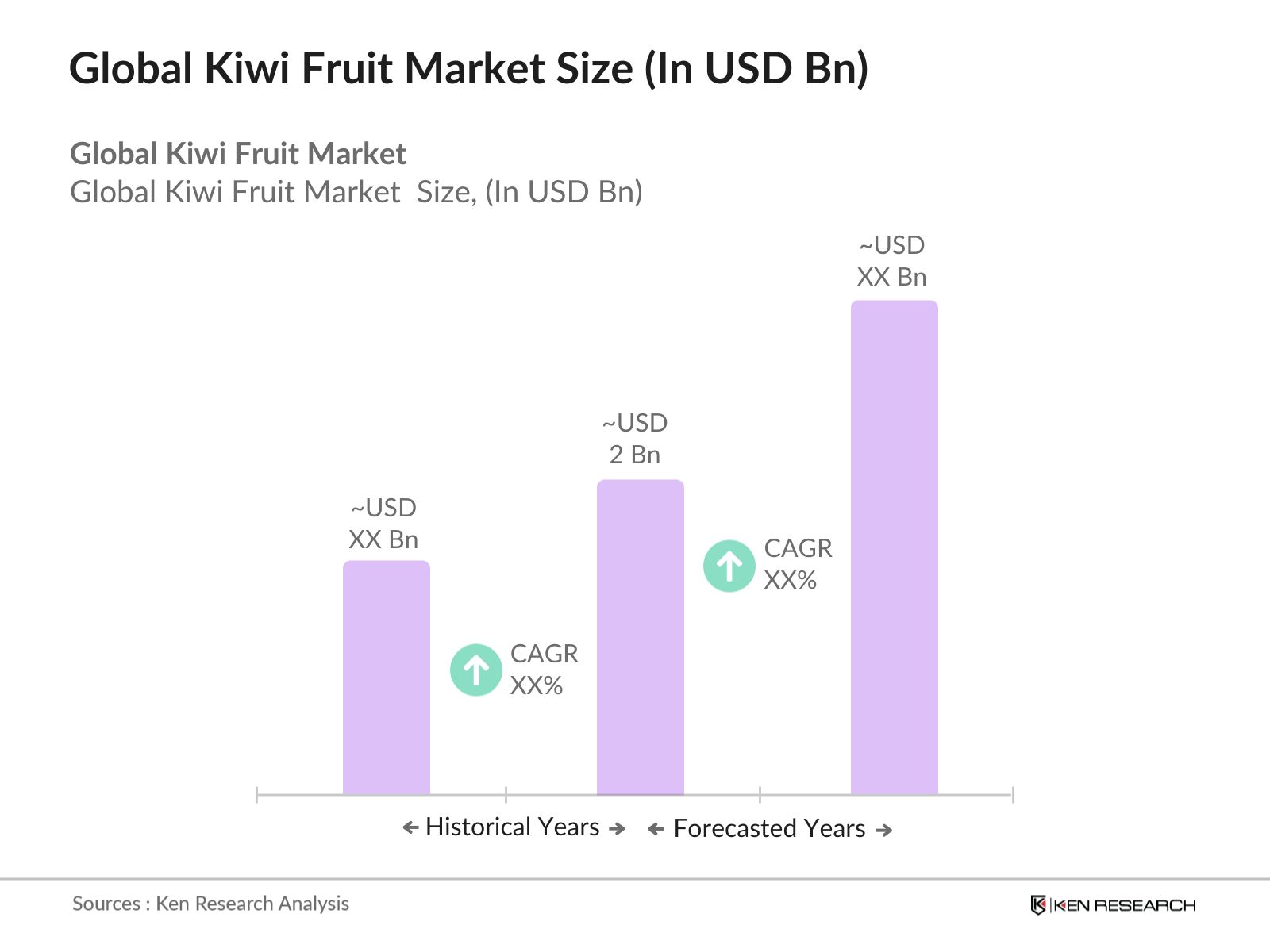
The global kiwi fruit market is valued at USD 2 billion, driven by the increasing demand for fresh, nutritious fruits and expanding trade routes that support international exports.
Key challenges include climate sensitivity affecting yields, high production costs due to labor and water requirements, and fluctuating tariffs that impact international trade.
Major players in the market include Zespri International Limited, Jingold Spa, The Wonderful Company LLC, Naturipe Farms, and Primland SA. Their dominance is due to extensive distribution networks and a focus on quality.
Growth drivers include increasing consumer demand for healthy eating, expansion of organic farming, and improved cold storage technologies that maintain product quality over long distances.
Europe and the Asia Pacific are key regions in the market, driven by high consumption rates in countries like Italy and China, supported by robust cultivation practices and export networks.

What makes us stand out is that our consultants follows Robust, Refine and Result (RRR) methodology. i.e. Robust for clear definitions, approaches and sanity checking, Refine for differentiating respondents facts and opinions and Result for presenting data with story

We have set a benchmark in the industry by offering our clients with syndicated and customized market research reports featuring coverage of entire market as well as meticulous research and analyst insights.

While we don't replace traditional research, we flip the method upside down. Our dual approach of Top Bottom & Bottom Top ensures quality deliverable by not just verifying company fundamentals but also looking at the sector and macroeconomic factors.

With one step in the future, our research team constantly tries to show you the bigger picture. We help with some of the tough questions you may encounter along the way: How is the industry positioned? Best marketing channel? KPI's of competitors? By aligning every element, we help maximize success.

Our report gives you instant access to the answers and sources that other companies might choose to hide. We elaborate each steps of research methodology we have used and showcase you the sample size to earn your trust.

If you need any support, we are here! We pride ourselves on universe strength, data quality, and quick, friendly, and professional service.