















Global Large Language Model Market Outlook to 2030
Region:Global
Author(s):Paribhasha Tiwari
Product Code:KROD9875
December 2024
99
About the Report
Global Large Language Model Market Overview
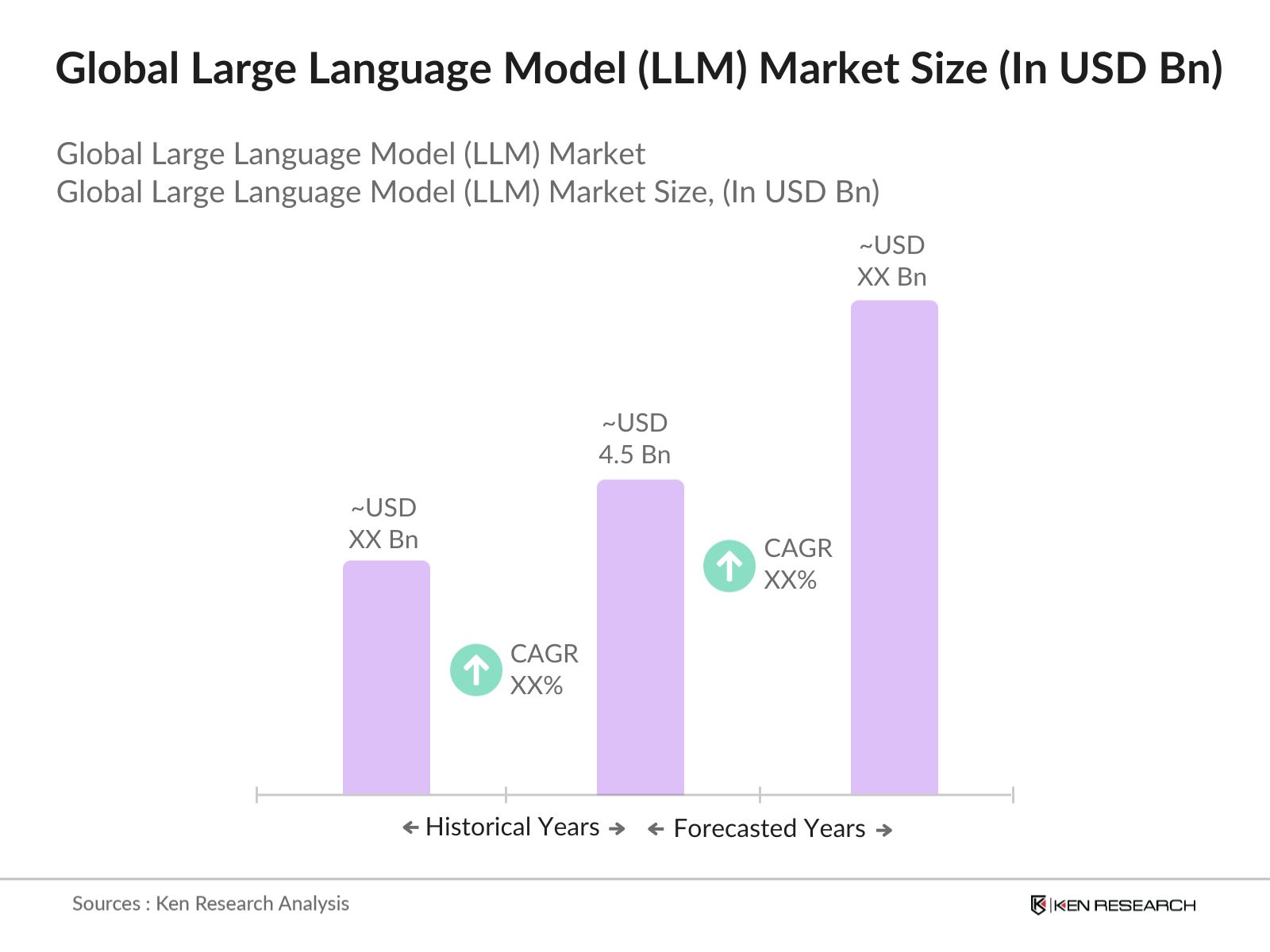
- The global Large Language Model (LLM) market has experienced significant growth, reaching a valuation of USD 4.5 billion. This expansion is primarily driven by the increasing demand for Natural Language Processing (NLP) applications, including customer service automation, content generation, and language translation. The integration of zero human intervention features in training systems has further accelerated market growth by enhancing efficiency and scalability.
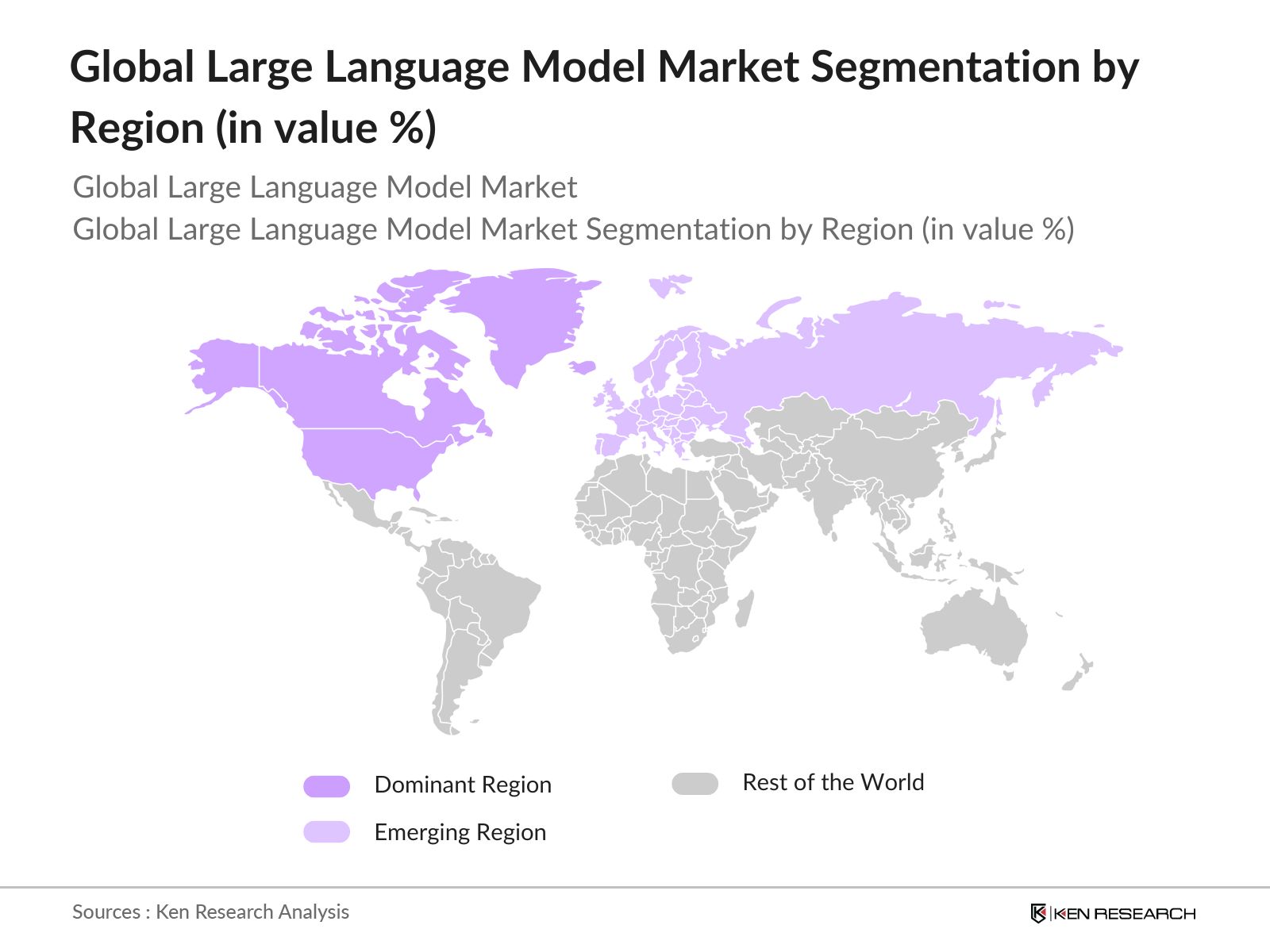
- North America, particularly the United States, dominates the LLM market due to its advanced technological infrastructure, substantial investments in AI research, and the presence of leading AI companies. The region's focus on innovation and early adoption of AI technologies has solidified its leadership position in the global market.
- Governments are increasingly implementing AI in public sector projects for efficiency. By 2024, more than 1,000 AI-powered initiatives were active across municipal and federal levels globally, spanning areas such as traffic management, environmental monitoring, and public health. These initiatives underscore the commitment of governments to integrate AI into essential services.
Global Large Language Model Market Segmentation
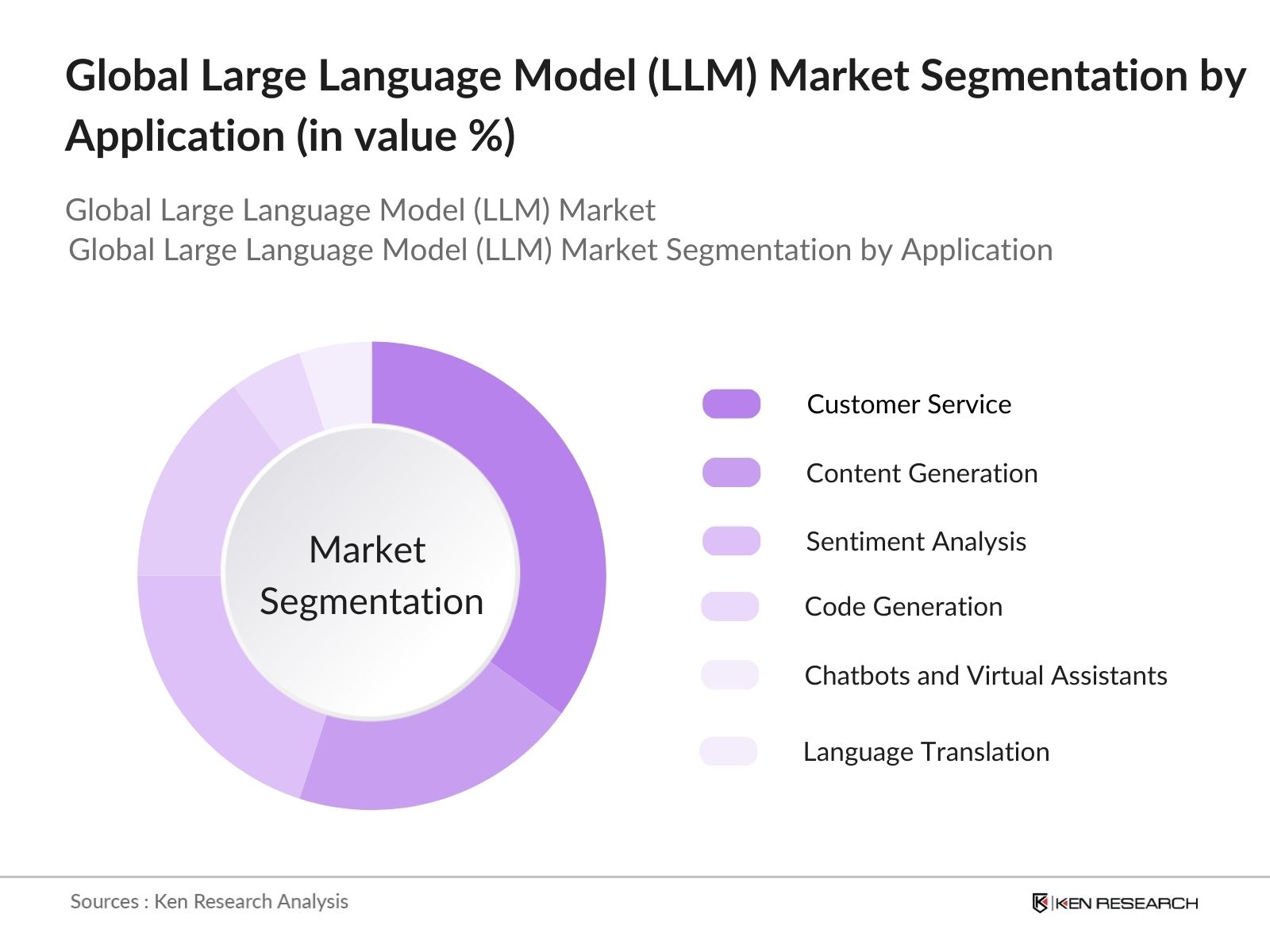
By Application: The LLM market is segmented by application into customer service, content generation, sentiment analysis, code generation, chatbots and virtual assistants, and language translation. Among these, customer service applications hold a dominant market share. This is attributed to the widespread adoption of AI-driven chatbots and virtual assistants by businesses aiming to enhance customer engagement and operational efficiency. LLMs enable these applications to understand and respond to customer inquiries with high accuracy, leading to improved customer satisfaction.
By Region: Regionally, the LLM market is segmented into North America, Europe, Asia-Pacific, Latin America, and the Middle East and Africa. North America holds the largest market share, driven by technological advancements, substantial investments in AI research, and the presence of key industry players. The region's focus on innovation and early adoption of AI technologies has solidified its leadership position in the global market.
By Deployment: In terms of deployment, the market is divided into cloud-based and on-premises solutions. Cloud-based deployments are leading the market share due to their scalability, cost-effectiveness, and ease of integration. Organizations prefer cloud-based LLMs as they offer flexibility and reduce the need for significant upfront infrastructure investments. Additionally, cloud providers offer robust security measures, ensuring data protection and compliance with regulations.
Global Large Language Model Market Competitive Landscape
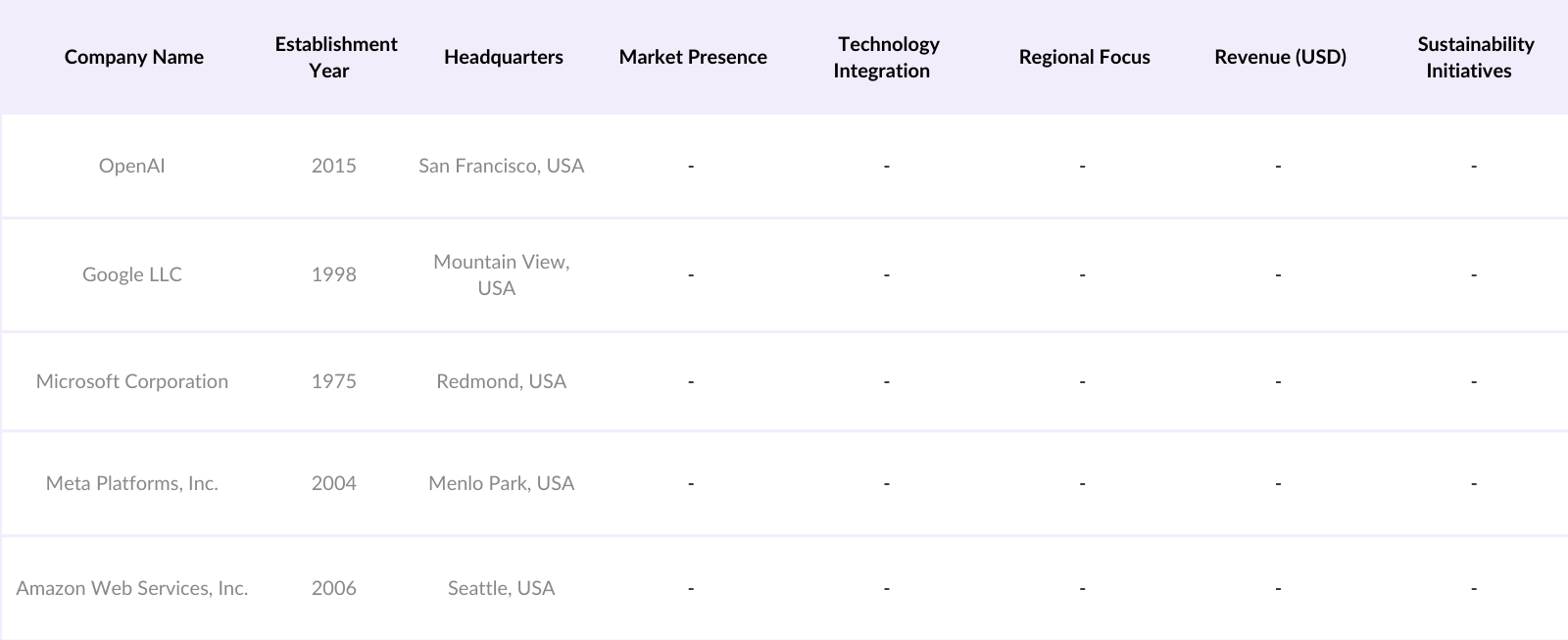
The LLM market is characterized by the presence of several key players who drive innovation and competition. These companies are at the forefront of AI research and development, contributing significantly to market growth.
Global Large Language Model Market Analysis
Growth Drivers
- Advancements in Natural Language Processing (NLP): The market is benefiting from substantial advancements in NLP, which enable AI models to process and understand human language more effectively. For instance, models like OpenAI's GPT series are capable of handling over a trillion parameters, significantly enhancing their contextual understanding and response accuracy. This improvement supports broader AI applications, including chatbots and virtual assistants, with large-scale adoption in sectors like healthcare, finance, and education.
- Increasing Demand for AI-Powered Applications: The demand for AI-powered applications has surged across industries due to their potential to improve efficiency and reduce operational costs. The global spending on AI software alone exceeded 45 billion units in 2024, with enterprises increasingly investing in AI for tasks such as predictive analytics and personalized customer experiences. This adoption is further reinforced by rising productivity gains and scalability offered by AI models.
- Expansion of Digital Content Creation: AI-driven tools have transformed content creation, enabling faster and more personalized content generation at scale. In 2024, over 800 million units of digital content were generated or supported by AI-based tools, especially for marketing, media, and e-commerce. The demand for dynamic, customizable content has accelerated investments in these tools, especially as businesses prioritize digital presence and online customer engagement.
Market Challenges
- High Computational Costs: The high computational power required for AI and NLP models represents a significant cost barrier, especially for small and medium enterprises. For instance, the training of advanced models can require up to 1,000 high-performance GPUs, each costing around $10,000, making AI adoption financially challenging for smaller firms. The operational costs also escalate with the power required to run these models continuously.
- Data Privacy and Security Concerns: Growing concerns over data privacy and security have posed challenges for AI adoption, especially with regulations such as GDPR and CCPA. These regulations impact the collection and processing of vast datasets, which are essential for training AI models. The costs associated with compliance and the potential penalties for data breaches, which have risen to an average of $4 million per breach globally in 2024, underscore the challenges in handling sensitive data.
Global Large Language Model Market Future Outlook
Over the next five years, the global LLM market is expected to experience substantial growth, driven by continuous advancements in AI technologies, increasing adoption across various industries, and the development of more sophisticated and efficient models. The integration of LLMs into diverse applications such as healthcare diagnostics, financial analysis, and personalized education is anticipated to further propel market expansion.
Market Opportunities
- Integration with Emerging Technologies: The convergence of AI with emerging technologies such as IoT and edge computing has opened new avenues. For example, by 2024, over 5 billion IoT devices worldwide are generating data that can be processed with AI to improve efficiency and predictive maintenance across industries. This integration supports real-time analytics and automation in manufacturing, healthcare, and smart city applications, creating opportunities for enhanced AI utilization.
- Expansion into New Industry Verticals: AI adoption is rapidly extending beyond traditional sectors, with new industries such as agriculture and logistics seeing increased AI integration. In 2024, over 100 million data points from agricultural sensors have been processed using AI-driven analytics for crop monitoring and precision farming. Logistics firms are similarly leveraging AI to optimize delivery routes and manage inventory, driving efficiency in an increasingly competitive market.
Scope of the Report
|
By Application |
Customer Service |
|
By Deployment |
Cloud-Based |
|
By Industry Vertical |
Healthcare |
|
By Model Size |
Below 100 Billion Parameters |
|
By Region |
North America |
Products
Key Target Audience
Artificial Intelligence Developers
Technology Solution Providers
Enterprises Implementing AI Solutions
Government and Regulatory Bodies (e.g., U.S. Federal Trade Commission, European Data Protection Board)
Investors and Venture Capitalist Firms
Academic and Research Institutions
Cloud Service Providers
Data Security and Privacy Consultants
Companies
Players Mentioned in the Report:
OpenAI
Google LLC
Microsoft Corporation
Meta Platforms, Inc.
Amazon Web Services, Inc.
IBM Corporation
NVIDIA Corporation
Baidu, Inc.
Tencent Holdings Limited
Huawei Technologies Co., Ltd.
Table of Contents
1. Global Large Language Model Market Overview
1.1 Definition and Scope
1.2 Market Taxonomy
1.3 Market Growth Rate
1.4 Market Segmentation Overview
2. Global Large Language Model Market Size (USD Billion)
2.1 Historical Market Size
2.2 Year-On-Year Growth Analysis
2.3 Key Market Developments and Milestones
3. Global Large Language Model Market Analysis
3.1 Growth Drivers
3.1.1 Advancements in Natural Language Processing (NLP)
3.1.2 Increasing Demand for AI-Powered Applications
3.1.3 Expansion of Digital Content Creation
3.1.4 Rising Adoption in Customer Service Automation
3.2 Market Challenges
3.2.1 High Computational Costs
3.2.2 Data Privacy and Security Concerns
3.2.3 Ethical and Bias Issues in AI Models
3.3 Opportunities
3.3.1 Integration with Emerging Technologies
3.3.2 Expansion into New Industry Verticals
3.3.3 Development of Multilingual Models
3.4 Trends
3.4.1 Shift Towards Smaller, Task-Specific Models
3.4.2 Open-Source Model Development
3.4.3 Increased Focus on Model Interpretability
3.5 Government Regulations
3.5.1 Data Protection Laws
3.5.2 AI Ethics Guidelines
3.5.3 International AI Collaboration Initiatives
3.6 SWOT Analysis
3.7 Stakeholder Ecosystem
3.8 Porters Five Forces Analysis
3.9 Competitive Landscape
4. Global Large Language Model Market Segmentation
4.1 By Application (Value %)
4.1.1 Customer Service
4.1.2 Content Generation
4.1.3 Sentiment Analysis
4.1.4 Code Generation
4.1.5 Chatbots and Virtual Assistants
4.1.6 Language Translation
4.2 By Deployment (Value %)
4.2.1 Cloud-Based
4.2.2 On-Premises
4.3 By Industry Vertical (Value %)
4.3.1 Healthcare
4.3.2 Finance
4.3.3 Retail and E-commerce
4.3.4 Media and Entertainment
4.3.5 Others (Education, Legal, Gaming)
4.4 By Model Size (Value %)
4.4.1 Below 100 Billion Parameters
4.4.2 100 Billion to 500 Billion Parameters
4.4.3 Above 500 Billion Parameters
4.5 By Region (Value %)
4.5.1 North America
4.5.2 Europe
4.5.3 Asia-Pacific
4.5.4 Latin America
4.5.5 Middle East and Africa
5. Global Large Language Model Market Competitive Analysis
5.1 Detailed Profiles of Major Companies
5.1.1 OpenAI
5.1.2 Google LLC
5.1.3 Meta Platforms, Inc.
5.1.4 Microsoft Corporation
5.1.5 Amazon Web Services, Inc.
5.1.6 IBM Corporation
5.1.7 NVIDIA Corporation
5.1.8 Baidu, Inc.
5.1.9 Tencent Holdings Limited
5.1.10 Huawei Technologies Co., Ltd.
5.1.11 Alibaba Group Holding Limited
5.1.12 Cohere Inc.
5.1.13 Anthropic
5.1.14 AI21 Labs
5.1.15 Yandex NV
5.2 Cross Comparison Parameters (Number of Employees, Headquarters, Inception Year, Revenue, R&D Investment, Market Share, Product Portfolio, Regional Presence)
5.3 Market Share Analysis
5.4 Strategic Initiatives
5.5 Mergers and Acquisitions
5.6 Investment Analysis
5.6.1 Venture Capital Funding
5.6.2 Government Grants
5.6.3 Private Equity Investments
6. Global Large Language Model Market Regulatory Framework
6.1 Data Protection and Privacy Regulations
6.2 AI Ethics and Compliance Standards
6.3 Certification Processes
7. Global Large Language Model Future Market Size (USD Billion)
7.1 Future Market Size Projections
7.2 Key Factors Driving Future Market Growth
8. Global Large Language Model Future Market Segmentation
8.1 By Application (Value %)
8.2 By Deployment (Value %)
8.3 By Industry Vertical (Value %)
8.4 By Model Size (Value %)
8.5 By Region (Value %)
9. Global Large Language Model Market Analysts Recommendations
9.1 Total Addressable Market (TAM), Serviceable Available Market (SAM), and Serviceable Obtainable Market (SOM) Analysis
9.2 Customer Cohort Analysis
9.3 Marketing Initiatives
9.4 White Space Opportunity Analysis
Disclaimer Contact UsResearch Methodology
Step 1: Identification of Key Variables
The initial phase involves constructing an ecosystem map encompassing all major stakeholders within the global LLM market. This step is underpinned by extensive desk research, utilizing a combination of secondary and proprietary databases to gather comprehensive industry-level information. The primary objective is to identify and define the critical variables that influence market dynamics.
Step 2: Market Analysis and Construction
In this phase, we compile and analyze historical data pertaining to the global LLM market. This includes assessing market penetration, the ratio of marketplaces to service providers, and the resultant revenue generation. Furthermore, an evaluation of service quality statistics is conducted to ensure the reliability and accuracy of the revenue estimates.
Step 3: Hypothesis Validation and Expert Consultation
Market hypotheses are developed and subsequently validated through computer-assisted telephone interviews (CATIs) with industry experts representing a diverse array of companies. These consultations provide valuable operational and financial insights directly from industry practitioners, which are instrumental in refining and corroborating the market data.
Step 4: Research Synthesis and Final Output
The final phase involves direct engagement with multiple AI developers and enterprises to acquire detailed insights into product segments, sales performance, consumer preferences, and other pertinent factors. This interaction serves to verify and complement the statistics derived from the bottom-up approach, thereby ensuring a comprehensive, accurate, and validated analysis of the global LLM market.
Frequently Asked Questions
01. How big is the global Large Language Model (LLM) market?
The global LLM market is valued at USD 4.5 billion, driven by increasing demand for NLP applications, advancements in AI technologies, and expanding use cases in industries such as healthcare, finance, and customer service.
02. What are the main growth drivers of the global Large Language Model (LLM) market?
The growth drivers of the LLM market include the rising adoption of AI in customer service, content creation, and language translation, along with increased investments in AI research and advancements in computing infrastructure that support large-scale models.
03. Who are the key players in the global Large Language Model (LLM) market?
Major players in the global LLM market include OpenAI, Google LLC, Microsoft Corporation, Meta Platforms, Inc., Amazon Web Services, Inc., and IBM Corporation. These companies lead due to their R&D capabilities and extensive AI resources.
04. What are the challenges faced by the global Large Language Model (LLM) market?
Challenges in the LLM market include high computational costs, data privacy and security concerns, and ethical issues related to biases in AI models. Managing these challenges is essential for sustained growth and industry trust.
Why Buy From Us?

What makes us stand out is that our consultants follows Robust, Refine and Result (RRR) methodology. i.e. Robust for clear definitions, approaches and sanity checking, Refine for differentiating respondents facts and opinions and Result for presenting data with story

We have set a benchmark in the industry by offering our clients with syndicated and customized market research reports featuring coverage of entire market as well as meticulous research and analyst insights.

While we don't replace traditional research, we flip the method upside down. Our dual approach of Top Bottom & Bottom Top ensures quality deliverable by not just verifying company fundamentals but also looking at the sector and macroeconomic factors.

With one step in the future, our research team constantly tries to show you the bigger picture. We help with some of the tough questions you may encounter along the way: How is the industry positioned? Best marketing channel? KPI's of competitors? By aligning every element, we help maximize success.

Our report gives you instant access to the answers and sources that other companies might choose to hide. We elaborate each steps of research methodology we have used and showcase you the sample size to earn your trust.

If you need any support, we are here! We pride ourselves on universe strength, data quality, and quick, friendly, and professional service.