
Global Laser Printer Market Outlook to 2030
Region:Global
Author(s):Yogita Sahu
Product Code:KROD8170
Region:Global
Author(s):Yogita Sahu
Product Code:KROD8170
December 2024
98
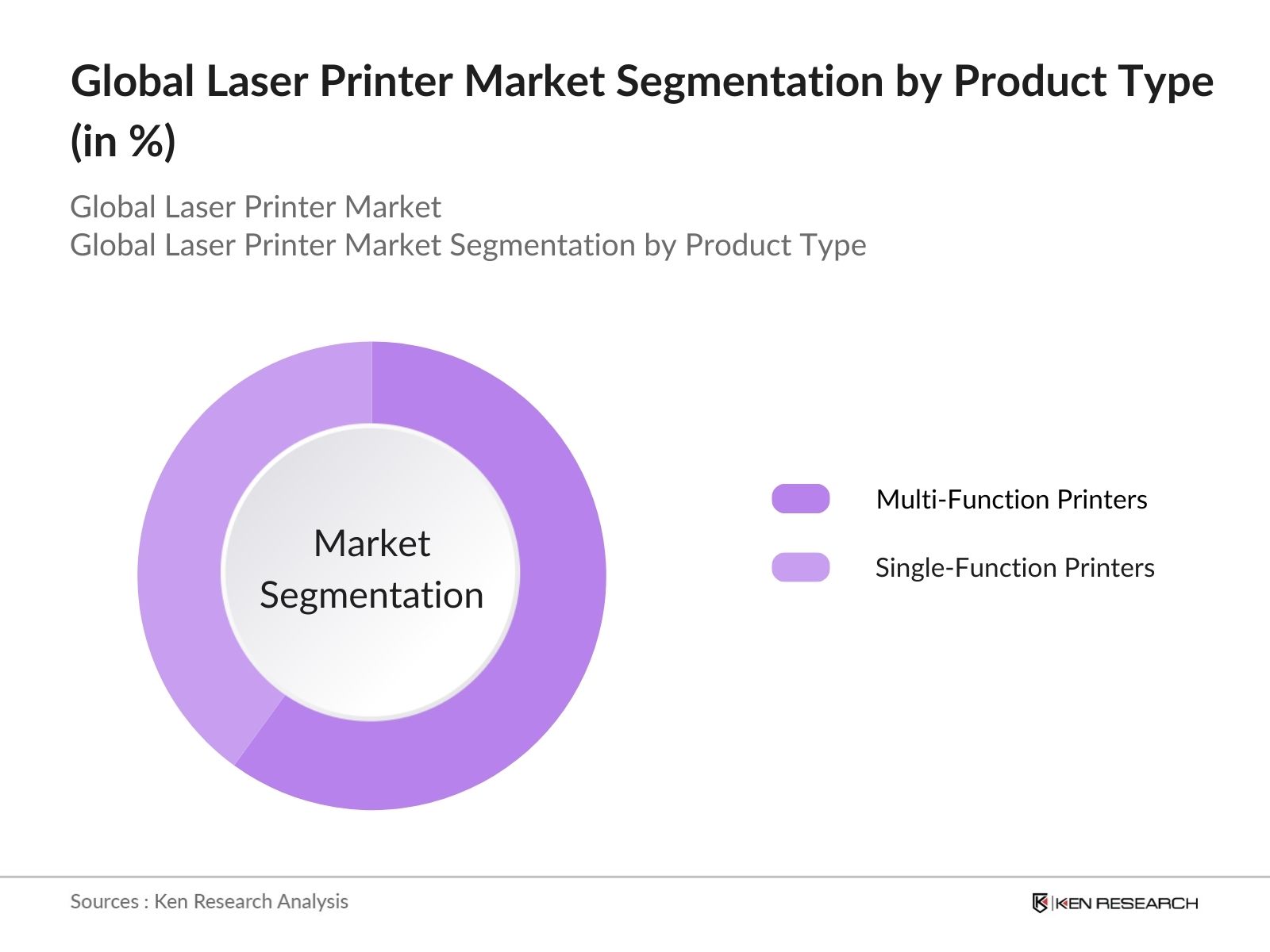
By Product Type: The market is segmented by product type into single-function and multi-function printers. Multi-function printers (MFPs) have captured a dominant market share due to their versatility, offering functionalities like copying, scanning, and faxing in addition to printing. These devices are highly popular in corporate environments and SMEs, where the demand for compact, cost-efficient solutions is growing. The ability to integrate multiple office tasks into one device makes MFPs a preferred choice for offices with space constraints.
By Laser Type: Laser printers are further segmented by laser type into helium-neon lasers and semiconductor lasers. Semiconductor lasers dominate this segment due to their widespread use in modern laser printers. They are more energy-efficient, compact, and cost-effective compared to helium-neon lasers, making them suitable for mass production and commercial use. As a result, semiconductor lasers are preferred by manufacturers to keep up with the growing demand for high-volume printing.
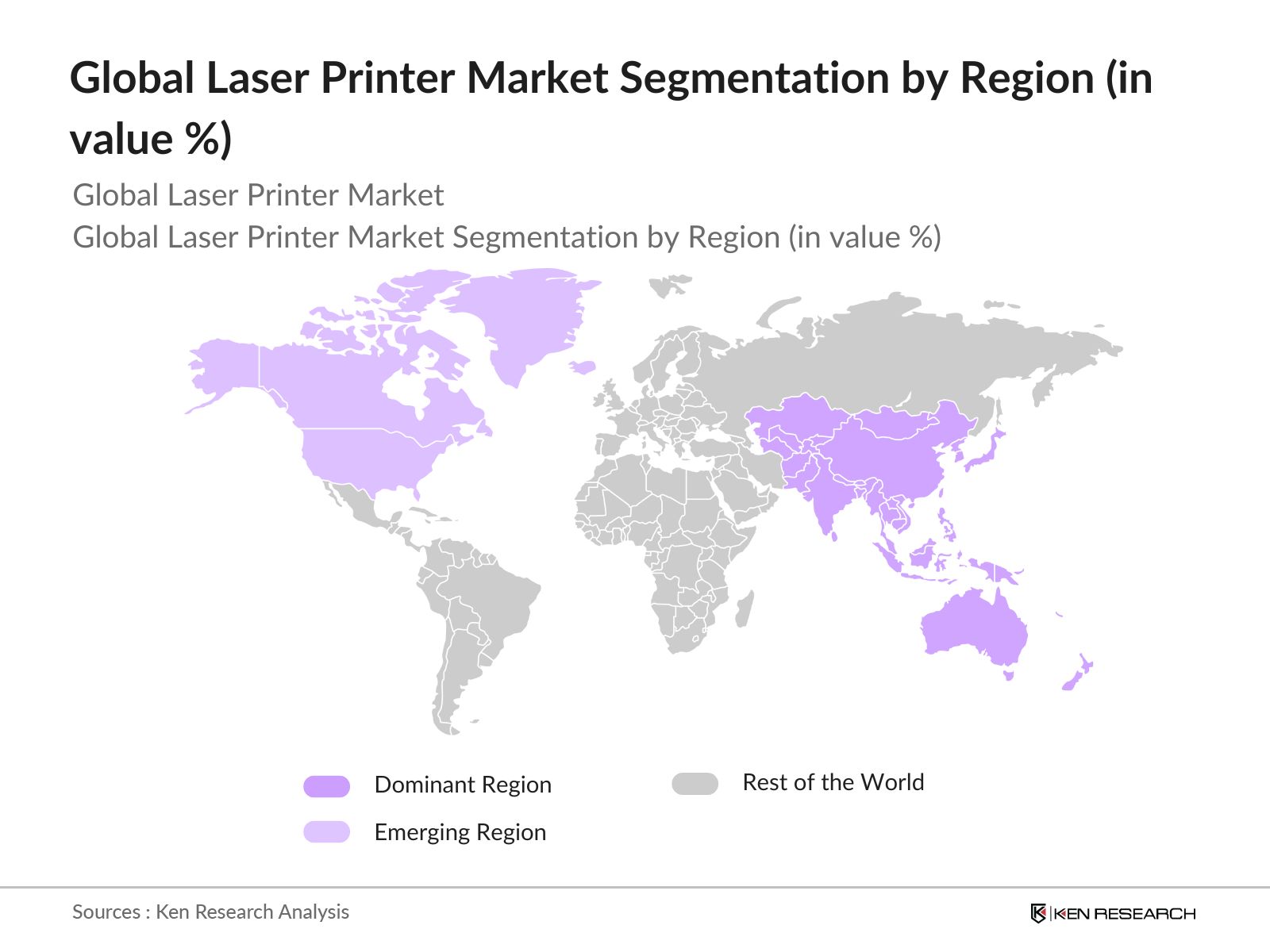
By Region: Regionally, the market is divided into North America, Europe, Asia-Pacific, and the Middle East and Africa. Asia-Pacific holds the largest market share due to the presence of key manufacturing hubs in countries like China, Japan, and South Korea. The region's rapid industrialization, economic growth, and growing corporate sector fuel the demand for laser printers. China, in particular, has become a significant market, thanks to the expansion of its corporate and industrial sectors.
The market is dominated by a few key players who play a role in shaping the market dynamics. These companies continually innovate and develop new products to stay competitive.
|
Company Name |
Year Established |
Headquarters |
No. of Employees |
Revenue (2023) |
Major Product Lines |
Recent Innovation |
Key Strengths |
|
Brother Industries Ltd. |
1908 |
Japan |
|||||
|
Xerox Corporation |
1906 |
U.S. |
|||||
|
HP Inc. |
1939 |
U.S. |
|||||
|
Canon Inc. |
1937 |
Japan |
|||||
|
Ricoh Company Ltd. |
1936 |
Japan |
Over the next five years, the global laser printer industry is expected to witness sustained growth driven by technological advancements, rising demand for eco-friendly solutions, and the expanding adoption of multifunction printers in corporate and home office settings.
|
By Type |
Multi-Function Single-Function |
|
By Laser Type |
Helium-Neon Laser Semi-Conductor Laser |
|
By Application |
Commercial Residential Industrial |
|
By Technology |
Wireless Cloud-Based |
|
By Region |
North America Europe Asia-Pacific MEA |
1.1. Definition and Scope
1.2. Market Taxonomy
1.3. Market Growth Rate
1.4. Market Segmentation Overview
2.1. Historical Market Size
2.2. Year-On-Year Growth Analysis
2.3. Key Market Developments and Milestones
3.1. Growth Drivers
3.1.1. Expansion of Remote and Hybrid Work Arrangements
3.1.2. Increasing Demand for Multi-Function Printers (MFPs)
3.1.3. Advancements in Laser Printing Technology
3.1.4. Growth in E-commerce and Online Printing Services
3.2. Market Challenges
3.2.1. Environmental Concerns Related to Toner and Emissions
3.2.2. High Initial Setup and Maintenance Costs
3.2.3. Growing Adoption of Cloud-Based Data Storage
3.3. Opportunities
3.3.1. Integration of 3D Printing with Laser Technology
3.3.2. Demand for Compact and Affordable Laser Printers
3.3.3. Growth in Emerging Markets (e.g., India, Southeast Asia)
3.4. Trends
3.4.1. Rising Preference for Energy-Efficient and Eco-Friendly Printers
3.4.2. Development of Compact Models for Home Offices
3.4.3. Increased Use of Remote and Mobile Printing Solutions
3.5. Government Regulation
3.5.1. Environmental Standards for Printer Waste Disposal
3.5.2. Tax Incentives for Eco-Friendly Technologies
3.6. SWOT Analysis
3.7. Stakeholder Ecosystem
3.8. Porters Five Forces Analysis
3.9. Competition Ecosystem
4.1. By Type (In Value %)
4.1.1. Multi-Function
4.1.2. Single-Function
4.2. By Laser Type (In Value %)
4.2.1. Helium-Neon Laser
4.2.2. Semi-Conductor Laser
4.3. By Application (In Value %)
4.3.1. Commercial (Corporate, Small & Medium Enterprises)
4.3.2. Residential (Home Office, Personal Use)
4.3.3. Industrial
4.4. By Technology (In Value %)
4.4.1. Wireless and Mobile Printing
4.4.2. Cloud-Based Printing
4.5. By Region (In Value %)
4.5.1. North America
4.5.2. Europe
4.5.3. Asia-Pacific
4.5.4. Middle East and Africa
5.1 Detailed Profiles of Major Companies
5.1.1. Brother Industries Ltd.
5.1.2. Xerox Corporation
5.1.3. HP Inc.
5.1.4. Canon Inc.
5.1.5. Ricoh Company Ltd.
5.1.6. Epson
5.1.7. Lexmark International
5.1.8. Dell Inc.
5.1.9. Samsung Electronics Co. Ltd.
5.1.10. OKI Electric
5.1.11. Seiko Epson Corporation
5.1.12. South Yuesen (China)
5.1.13. Sharp Corporation
5.1.14. Kyocera Document Solutions
5.1.15. Konica Minolta Inc.
5.2 Cross Comparison Parameters (No. of Employees, Headquarters, Revenue, Product Range, Technological Innovations)
5.3 Market Share Analysis
5.4 Strategic Initiatives
5.5 Mergers and Acquisitions
5.6 Investment Analysis
5.7 Venture Capital Funding
5.8 Government Grants
5.9 Private Equity Investments
6.1 Environmental Standards and Sustainability Policies
6.2 Certification Requirements
6.3 Regulatory Compliance
7.1. Future Market Size Projections
7.2. Key Factors Driving Future Market Growth
8.1. By Type (In Value %)
8.2. By Laser Type (In Value %)
8.3. By Application (In Value %)
8.4. By Technology (In Value %)
8.5. By Region (In Value %)
9.1. TAM/SAM/SOM Analysis
9.2. Customer Cohort Analysis
9.3. White Space Opportunity Analysis
9.4. Marketing Initiatives
Disclaimer Contact UsIn the initial stage, we constructed an ecosystem map to identify major stakeholders and key variables impacting the laser printer market. This was achieved through a combination of desk research and the analysis of proprietary databases to ensure the coverage of all critical aspects of the market.
Historical data on the market was analyzed, including information on product penetration and technological advancements. Revenue estimates were generated through secondary data validation and product demand analysis, ensuring accurate figures for market trends.
Key market hypotheses were validated through consultations with industry experts. These experts provided insights into the latest innovations and challenges facing the industry, which were essential for refining the market outlook and segmentation.
Data gathered from manufacturers and service providers was synthesized to create a comprehensive report, which was further validated through bottom-up and top-down approaches. The final output was cross-referenced with market benchmarks to ensure accuracy.
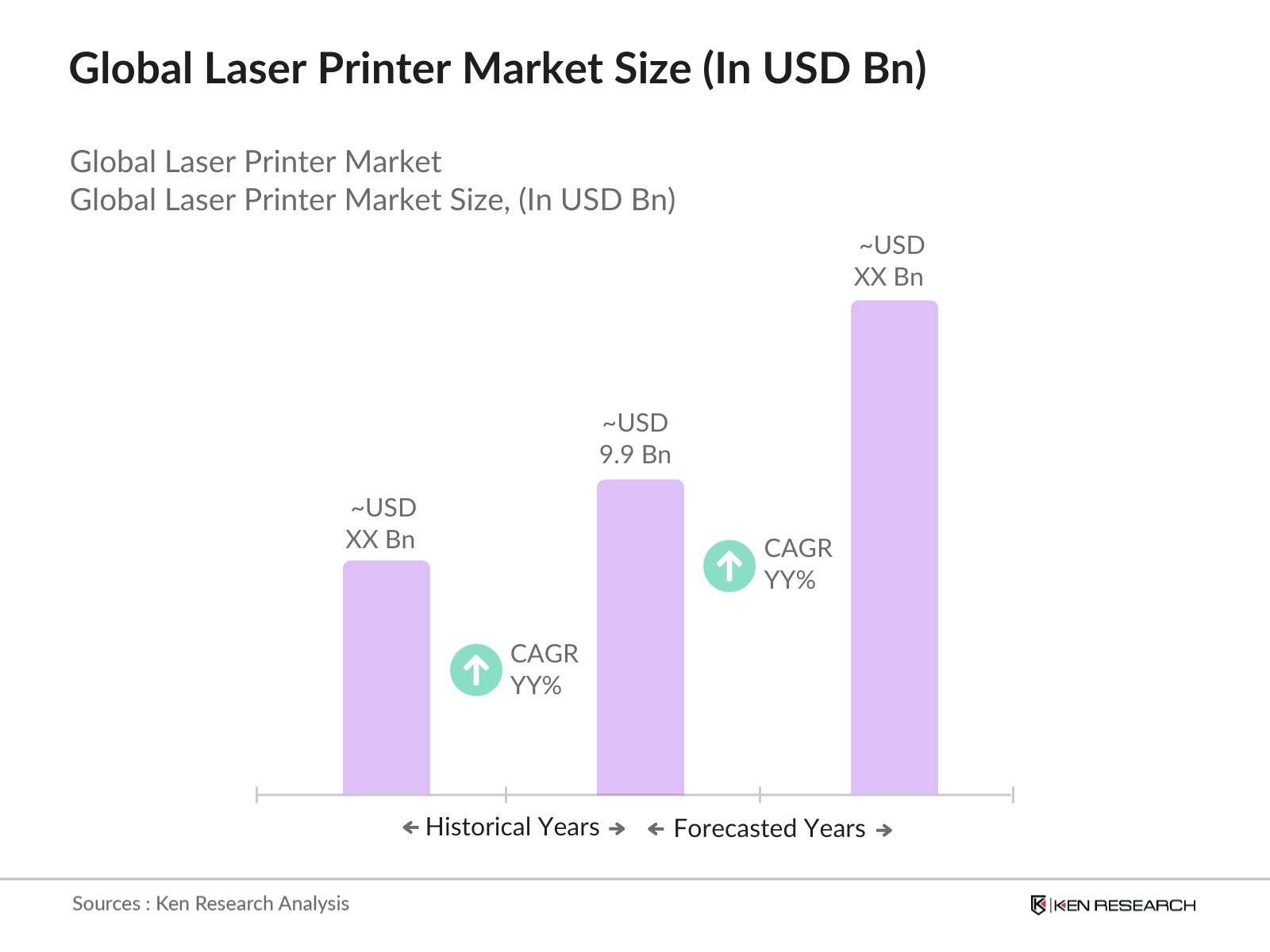
The global laser printer market is valued at USD 9.9 billion, driven by rising demand for high-quality and efficient printing solutions in corporate and industrial settings.
Challenges in the global laser printer market include high initial setup costs, environmental concerns related to toner emissions, and the growing adoption of cloud-based solutions that reduce the need for physical printing.
Major players in the global laser printer market include Brother Industries Ltd., Xerox Corporation, HP Inc., Canon Inc., and Ricoh Company Ltd. These companies dominate due to their extensive product portfolios and innovations in printing technology.
Growth in the global laser printer market is driven by advancements in laser printing technology, increasing demand for multi-function printers, and the growing adoption of remote and hybrid work setups, which require efficient home office printing solutions.
Asia-Pacific, led by China, Japan, and South Korea, dominates the global laser printer market due to their strong manufacturing base and rapid industrialization, which drives demand for high-volume printing solutions.

What makes us stand out is that our consultants follows Robust, Refine and Result (RRR) methodology. i.e. Robust for clear definitions, approaches and sanity checking, Refine for differentiating respondents facts and opinions and Result for presenting data with story

We have set a benchmark in the industry by offering our clients with syndicated and customized market research reports featuring coverage of entire market as well as meticulous research and analyst insights.

While we don't replace traditional research, we flip the method upside down. Our dual approach of Top Bottom & Bottom Top ensures quality deliverable by not just verifying company fundamentals but also looking at the sector and macroeconomic factors.

With one step in the future, our research team constantly tries to show you the bigger picture. We help with some of the tough questions you may encounter along the way: How is the industry positioned? Best marketing channel? KPI's of competitors? By aligning every element, we help maximize success.

Our report gives you instant access to the answers and sources that other companies might choose to hide. We elaborate each steps of research methodology we have used and showcase you the sample size to earn your trust.

If you need any support, we are here! We pride ourselves on universe strength, data quality, and quick, friendly, and professional service.