















Global Liquid Synthetic Rubber Market Outlook to 2030
Region:Global
Author(s):Faqiha Frozan
Product Code:KENGR015
October 2024
94
About the Report
Global Liquid Synthetic Rubber Market Overview
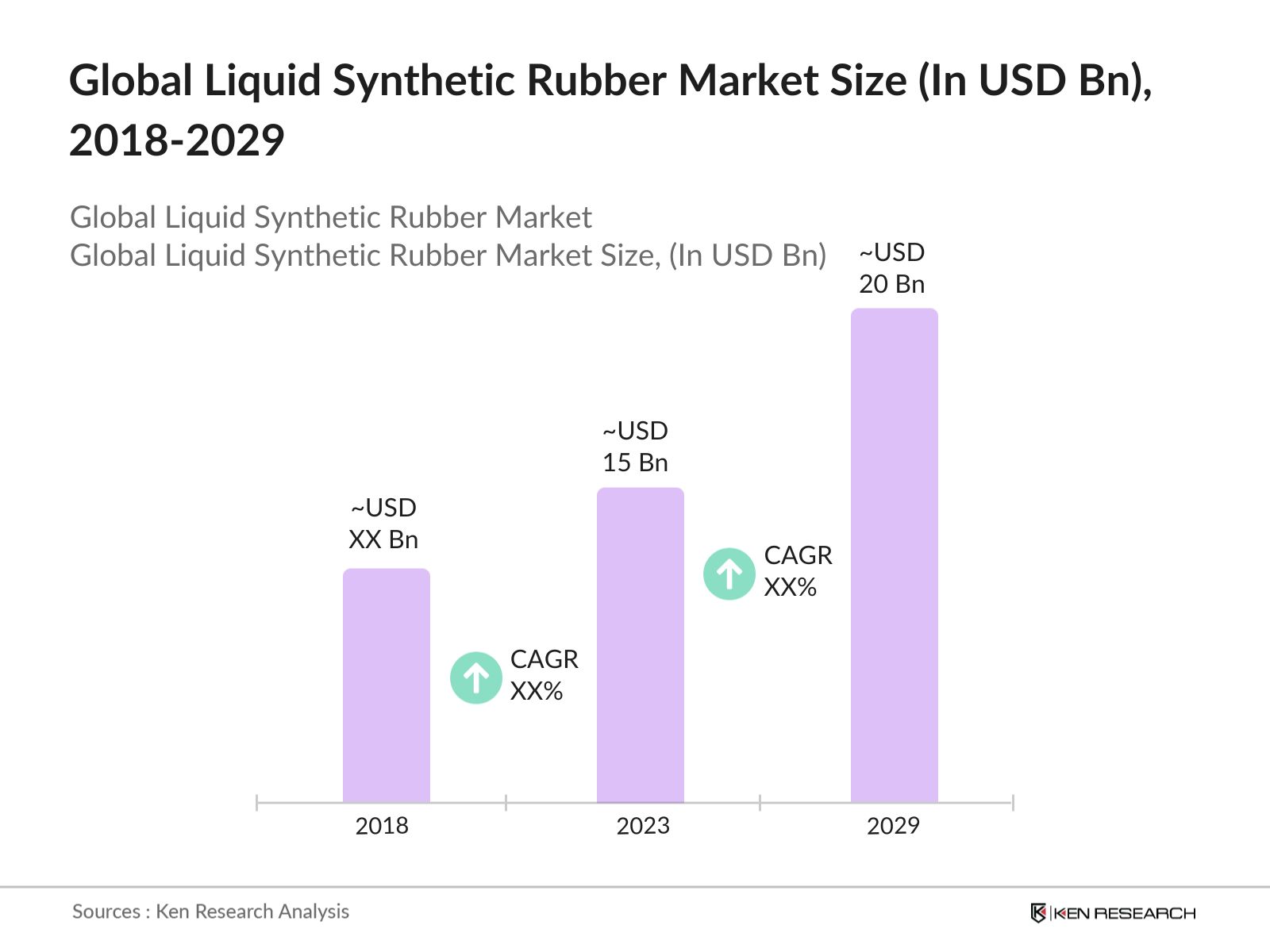
- In 2023, the global liquid synthetic rubber market was valued at USD 15 billion. This market is primarily driven by the rising demand for synthetic rubber in automotive and industrial applications. Liquid synthetic rubber is preferred for its superior properties, such as high flexibility and resistance to wear and tear, which are critical for manufacturing tires and industrial products.
- The market is dominated by key players such as Asahi Kasei, China National Petroleum Corporation, Kumho Petrochemical, ENEOS Corporation and Evonik. These companies dominate the market due to their extensive product portfolios, strong distribution networks, and continuous investment in research and development to innovate and improve the quality of synthetic rubber products.
- In October 2023, Asahi Kasei announced an investment of USD 260 million in Hipore lithium-ion battery separators to meet the rising demand for electric vehicle applications and decided to invest in US-based startup NFW to innovate car interiors.
Global Liquid Synthetic Rubber Current Market Analysis
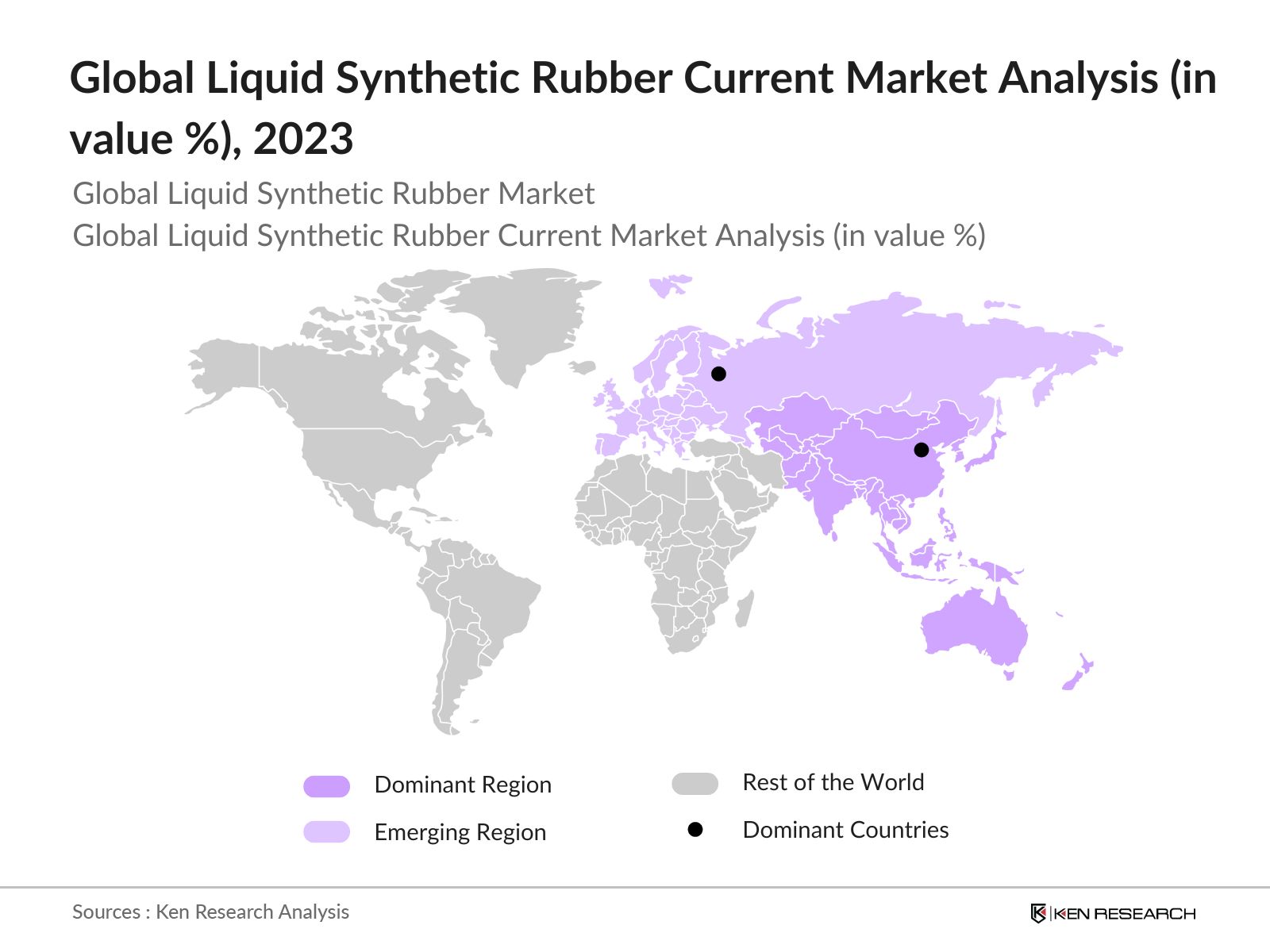
- APAC as dominant region: The Asia-Pacific (APAC) region leads the global liquid synthetic rubber market, driven by rapid industrialization, particularly in countries like China and India. In 2024, the APAC region's industrial production index is projected to grow by 5%, supported by government initiatives and substantial foreign direct investments (FDI). According to the World Bank, China's industrial output alone is anticipated to reach USD 4.5 trillion in 2024, emphasizing the region's industrial might.
- Europe as emerging region: Europe is emerging as a promising region for the liquid synthetic rubber market, driven by automotive sector and stringent environmental regulations promoting sustainable materials. The European Union's Green Deal aims to achieve climate neutrality by 2050, pushing industries towards eco-friendly products. In 2024, Europe's construction spending is expected to reach USD 2 trillion, driven by infrastructure renewal projects.
- China as dominant country: China stands out as the most dominant country in the global liquid synthetic rubber market due to its vast manufacturing base and strong automotive industry.The China Association of Automobile Manufacturers (CAAM) reported that in 2022, 26.86 million vehicles were sold, with an increase of about 2.1% from the year 2021. Furthermore, China's industrial output, driven by government policies like the Made in China 2025 initiative, continues to grow, solidifying its position as a key player in the synthetic rubber market.
Global Liquid Synthetic Rubber Market Segmentation
The Global Liquid Synthetic Rubber market can be segmented based on several factors:
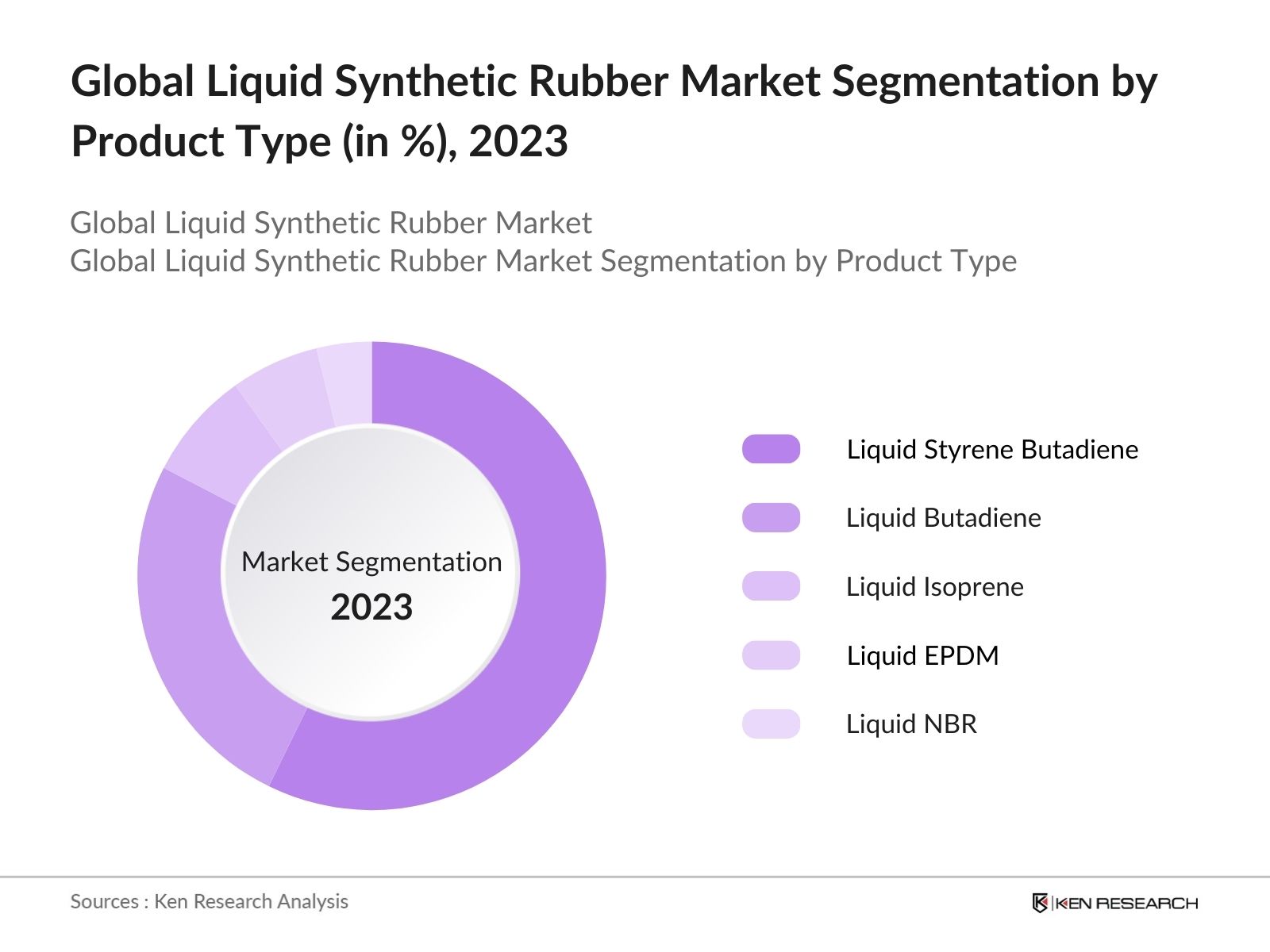
By Product Type: Global liquid synthetic rubber market segmentation by product type is divided into liquid styrene butadiene, liquid butadiene, liquid isoprene, liquid EPDM and liquid NBR. In 2023, liquid styrene butadiene dominates due to its excellent abrasion resistance and traction properties contribute enhanced grip on the road surface, which is crucial for safety and handling. It is cost-effective as compared to liquid butadiene.
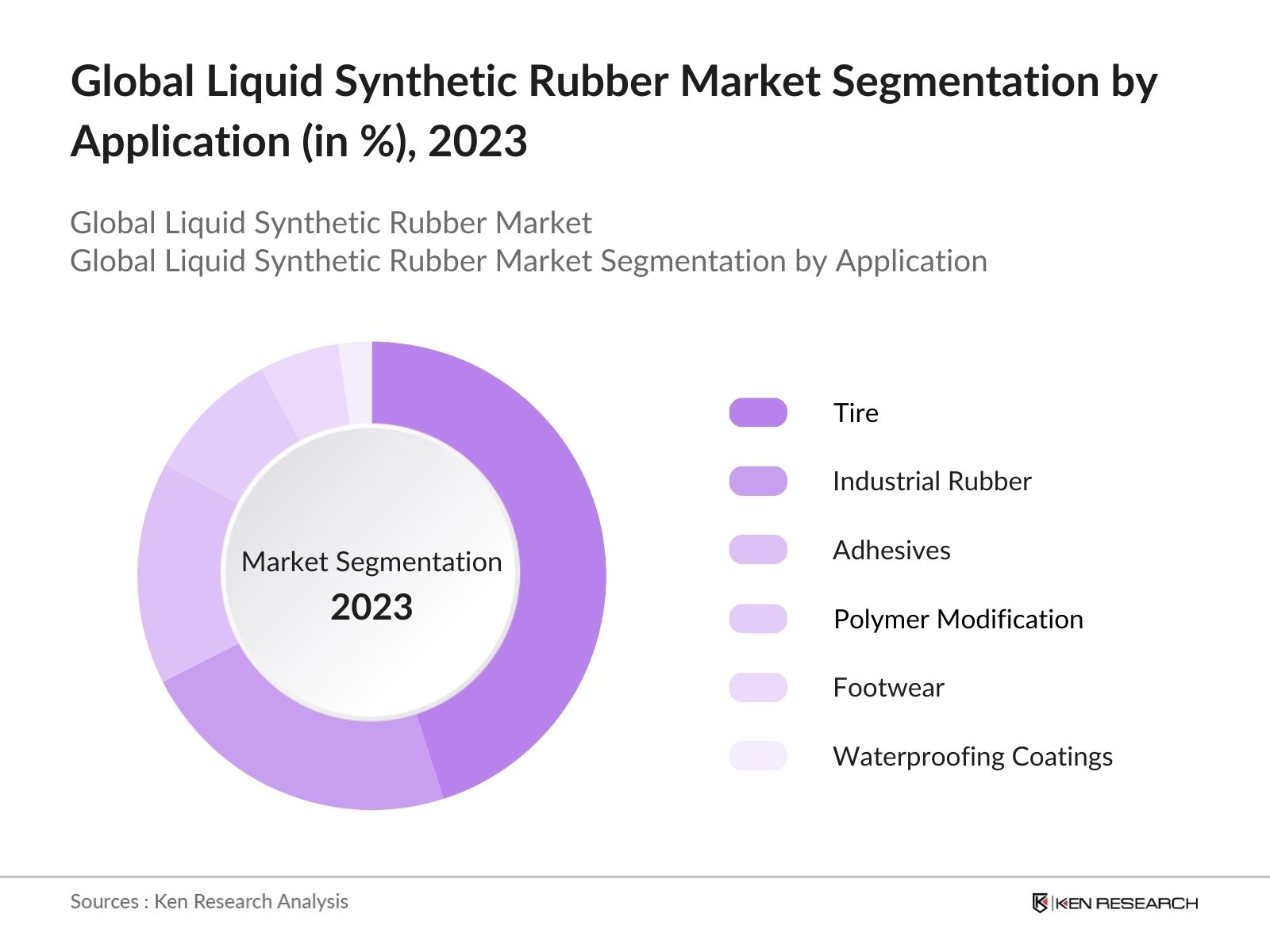
By Application: Global liquid synthetic rubber market segmentation by application is divided into tire, industrial rubber, adhesives, polymer modification, footwear and waterproofing coatings. In 2023, the tire segment led the market due to liquid synthetic rubber's (LSR) ability to retain its properties at high temperatures, making it perfect for automotive applications. Furthermore, LSR's compatibility with bonding metals and plastics enhances its versatility in various automotive components.
By Distribution Channel: Global liquid synthetic rubber market segmentation by distribution channel is divided into offline and online. In 2023, Offline channel dominates due to well-established distribution networks, offering personalized technical support, fostering trust through face-to-face interactions, and overcoming limitations posed by limited internet penetration especially in developing nations.
Global Liquid Synthetic Rubber Market Competitive Landscape
|
Company |
Headquarters |
Establishment Year |
Geographical Presence |
|
Asahi Kasei |
Tokyo, Japan |
1931 |
30 Countries |
|
China National Petroleum Corporation |
Beijing, China |
1988 |
29 Countries |
|
Kumho Petrochemical |
Seoul, Republic of Korea |
1970 |
6 Countries |
|
ENEOS Corporation |
Tokyo, Japan |
1888 |
10 Countries |
|
Evonik |
Essen, Germany |
2007 |
27 Countries |
|
Arlanxeo |
The Hague, Netherlands |
2016 |
30 Countries |
|
Kuraray Co. Ltd |
Tokyo, Japan |
1926 |
31 Countries |
|
H.B. Fuller Company |
Minnesota, United States |
1887 |
45 Countries |
- China National Petroleum Corporation (CNPC): In August 2023, CNPC and Sinochem Group signed a strategic cooperation agreement aimed at enhancing chemical product procurement. This partnership is expected to streamline and strengthen the supply chain for both companies.
- Kumho Petrochemical: In February 2024, Kumho Petrochemical signed a Memorandum of Understanding (MOU) with SK geo centric and Tongsuh Petrochemical for the establishment of a sustainable bio raw material supply chain. This agreement emphasizes the company's dedication to sustainability and environmental responsibility.
- Evonik: In February 2024, Evonik launched TROGAMID eCO Impact 75, a new polymer designed for injection molding applications. This innovative material offers improved performance and sustainability, demonstrating Evonik's dedication to advancing material science and meeting industry demands for high-quality, eco-friendly products.
Global Liquid Synthetic Rubber Industry Analysis
Global Liquid Synthetic Rubber Market Growth Drivers:
- Increasing Demand for Tire Sector: The rising demand for high-performance tires in the automotive sector is significantly boosting the need for liquid synthetic rubber. In 2023, global vehicle sales reached 92 million units, driven by the increasing preference for premium vehicles.
- Advancements in Industrial Applications: Liquid synthetic rubber is widely utilized across industries like manufacturing and electronics due to its outstanding properties like flexibility, weather resistance, and chemical stability. In 2023, the global industrial manufacturing sector reached revenues of USD 9 trillion, driven by technological advancements and increased automation.
- Infrastructure Development: Growth in infrastructure development and construction activities, particularly in regions like China and India, has increased the demand for adhesives, further boosting the need for liquid synthetic rubber. In 2023, China invested USD 1.2 trillion in infrastructure projects, while India allocated around USD 600 billion to its infrastructure development.
Global Liquid Synthetic Rubber Market Challenges:
- Raw Material Price Volatility: Fluctuating crude oil prices, geopolitical tensions, and supply chain disruptions pose challenges for the liquid synthetic rubber market, impacting raw material costs and profitability, leading to pricing uncertainties. For instance, in 2023, brent crude oil averaged $83 per barrel, down from $101 in 2022, showing a $19 decrease.
- Environmental Regulations: Strict environmental regulations, particularly in regions like Europe and the United States, pose challenges for the liquid synthetic rubber industry. Compliance with these regulations can impact production processes and costs, affecting market dynamics.
Global Liquid Synthetic Rubber Future Market Outlook
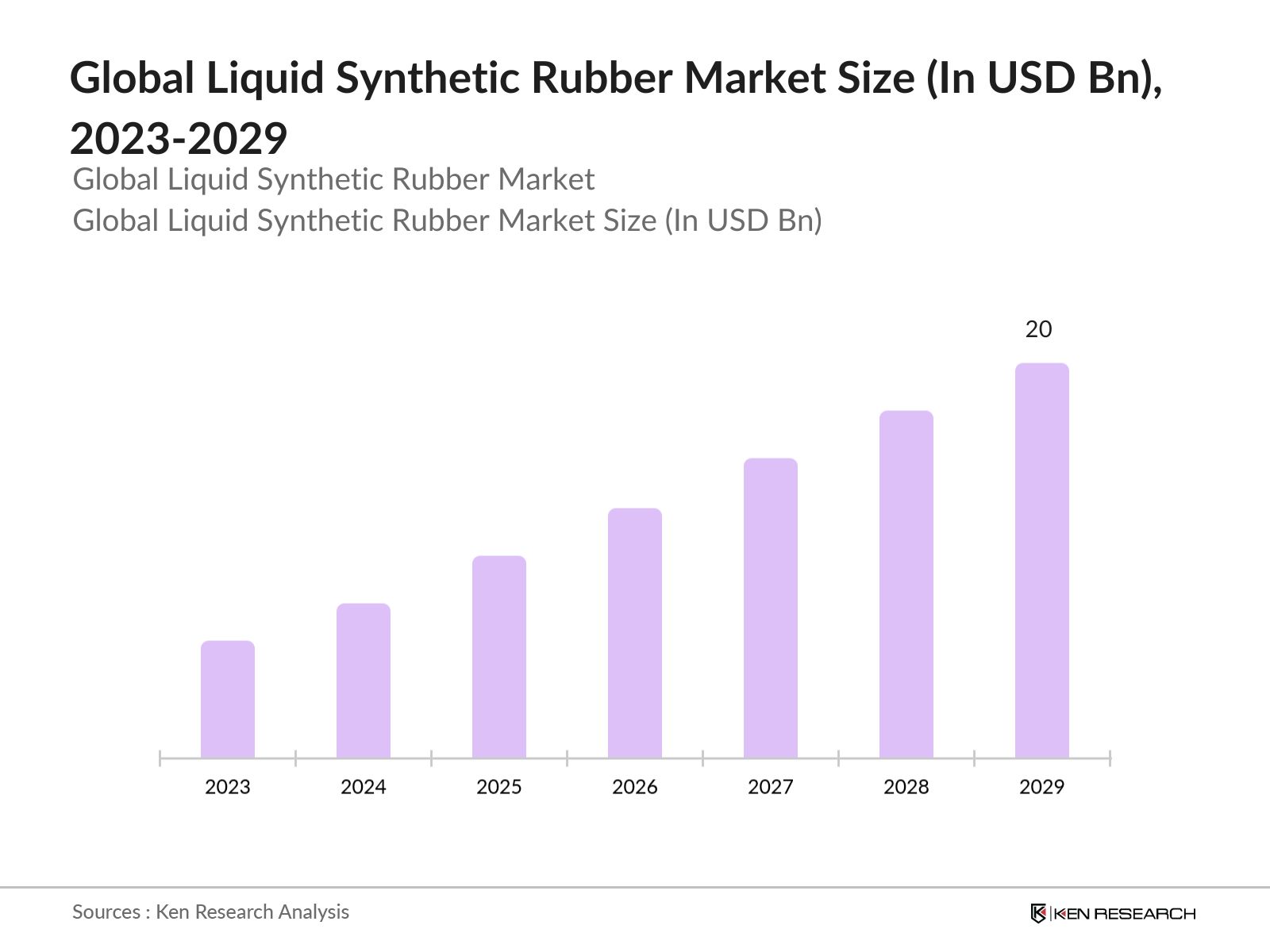
By 2029, the global liquid synthetic rubber market is expected to reach USD 20 billion, driven by continuous advancements in synthetic rubber technology and the rising demand from the automotive and construction industries. Innovations in sustainable and high-performance rubber products will play a crucial role in shaping the market's future.
Future Market Trends
- Rise in Green Manufacturing Practices: The adoption of green manufacturing practices is set to transform the liquid synthetic rubber market by 2029. Governments and industry stakeholders are increasingly focusing on reducing the environmental impact of manufacturing processes. As a result, investments in eco-friendly production technologies and bio-based synthetic rubber are anticipated to rise. This shift towards sustainability will drive innovation and create new growth opportunities in the market.
- Advancements in Polymer Science: Advancements in polymer science are likely to revolutionize the synthetic rubber market by 2029. Research and development efforts are expected to yield new formulations of liquid synthetic rubber with enhanced properties, such as improved heat resistance and elasticity. These innovations will expand the applications of synthetic rubber in various industries, including automotive, construction, and industrial sectors, driving market growth.
Scope of the Report
|
By Region |
North America APAC Europe Latin America MEA |
|
By Product Type |
Liquid Styrene Butadiene Liquid Butadiene Liquid Isoprene Liquid EPDM Liquid NBR |
|
By Product Type of L-SBR |
Emulsion Styrene Butadiene Solution Styrene Butadiene |
|
By Application |
Tire Industrial Rubber Adhesives Polymer Modification Footwear Waterproofing Coatings |
|
By Distribution Channel |
Offline Channel Online Channel |
Products
Key Target Audience:
Automotive Manufacturers
Tire Manufacturers
Industrial Rubber Product Manufacturers
Construction Companies
Chemical Industry Investors
Raw Material Suppliers
Government and Regulatory Bodies (Environmental Protection Agency, European Chemicals Agency)
Investments and Venture Capitalist Firms
Rubber Industry Associations
Time Period Captured in the Report:
Historical Period: 2018-2023
Base Year: 2023
Forecast Period: 2023-2029
Companies
Players Mentioned in the Report:
Asahi Kasei
China National Petroleum Corporation
Kumho Petrochemical
ENEOS Corporation
Evonik
Arlanxeo
Kuraray Co. Ltd
H.B. Fuller Company
Table of Contents
1. Executive Summary
1.1 Global Rubber Market
1.2 Global Liquid Synthetic Rubber Market
2. Global Overview
2.1 Overview of Global Rubber Industry
2.2 Global Rubber Production and Supply Chain Dynamics
2.3 Global Rubber Pricing Trends and Market Forecasts
3. Global Liquid Synthetic Rubber Market Overview
3.1 Global Liquid Synthetic Rubber Market Ecosystem
3.2 Global Liquid Synthetic Rubber Market Value Chain
4. Global Liquid Synthetic Rubber Market Size (in USD Bn), 2018-2023
5. Global Liquid Synthetic Rubber Market Segmentation (in value %), 2018-2023
5.1 Global Liquid Synthetic Rubber Market Segmentation by Region (in value %), 2018-2023
5.2 Global Liquid Synthetic Rubber Market Segmentation by Business Model (in value %), 2018-2023
5.3 Global Liquid Synthetic Rubber Market Segmentation by Product Type (in value %), 2018-2023
5.4 Global Liquid Synthetic Rubber Market Segmentation by Product Type of L-SBR (in value %), 2018-2023
5.5 Global Liquid Synthetic Rubber Market Segmentation by Application (in value %), 2018-2023
5.6 Global Liquid Synthetic Rubber Market Segmentation by Distribution Channel (in value %), 2018-2023
6. Global Liquid Synthetic Rubber Market Competition Landscape
6.1 Global Liquid Synthetic Rubber Market Share Analysis
6.2 Global Liquid Synthetic Rubber Market Cross Comparison
6.3 Global Liquid Synthetic Rubber Market Comparison Matrix
7.Global Liquid Synthetic Rubber Market Dynamics
7.1 Global Liquid Synthetic Rubber Market Growth Drivers
7.2 Global Liquid Synthetic Rubber Market Challenges
7.3 Global Liquid Synthetic Rubber Market Trends
7.4 Global Liquid Synthetic Rubber Market Strategic Initiatives
8.Global Liquid Synthetic Rubber Future Market Size (in USD Bn), 2023-2029
9. Global Liquid Synthetic Rubber Future Market Segmentation (in value%), 2023-2029
9.1 Global Liquid Synthetic Rubber Future Market Segmentation by Region (in value %), 2023-2029
9.2 Global Liquid Synthetic Rubber Future Market Segmentation by Business Model (in value%), 2023-2029
9.3 Global Liquid Synthetic Rubber Future Market Segmentation by Product Type (in value %), 2023-2029
9.4 Global Liquid Synthetic Rubber Future Market Segmentation by Product Type of L-SBR (in value %), 2023-2029
9.5 Global Liquid Synthetic Rubber Future Market Segmentation by Application (in value %), 2023-2029
9.6 Global Liquid Synthetic Rubber Future Market Segmentation by Distribution Channel (in value %), 2023-2029
10. Analyst Recommendations
11. Research Methodology
11.1 Market Definitions and Assumptions
11.2 Abbreviations
11.3 Market Sizing Approach
11.4 Consolidated Research Approach
11.5 Understanding Market Potential Through In-Depth Industry Interviews
11.6 Primary Research Approach
11.7 Limitations and Future Conclusion
Disclaimer
Contact Us
Research Methodology
Step 1: Hypothesis Creation:
The research team formulated a hypothesis regarding the Global Liquid Synthetic Rubber Market by analyzing industry factors sourced from company reports, trade magazines, academic journals, online articles, government ministries, associations, and databases such as EMIS.
Step 2: Market Sizing:
The market size was determined by assessing the revenue generated from liquid synthetic rubber sales in major countries across five key regions (North America, APAC, Europe, LATAM, MEA). Regional revenues were aggregated to calculate the overall market size of the Global Liquid Synthetic Rubber Market.
Step 3: Hypothesis Testing:
To validate the hypothesis, the research team conducted Computer-Assisted Telephone Interviews (CATIs) with industry experts and decision-makers from leading companies in the liquid synthetic rubber ecosystem, including key players like Dow Chemical, ExxonMobil, and Lanxess. Insights gathered from these interviews were used to confirm or refine the initial hypothesis.
Step 4: Interpretation and Proofreading:
The final analysis and findings were interpreted by our expert team and meticulously proofread to ensure accuracy before being incorporated into the research report on the Global Liquid Synthetic Rubber Market.
Frequently Asked Questions
01. How big is the Global Liquid Synthetic Rubber market?
The global liquid synthetic rubber market was valued at USD 15 billion in 2023. The market is primarily driven by the rising demand for synthetic rubber in automotive and industrial applications.
02. What are the challenges in the global Liquid Synthetic Rubber market?
Challenges in the global liquid synthetic rubber market include volatility in raw material prices, stringent environmental regulations, and competition from natural rubber alternatives. Fluctuating crude oil prices, geopolitical tensions, and supply chain disruptions pose challenges for the liquid synthetic rubber market, impacting raw material costs and profitability, leading to pricing uncertainties.
03. Who are the major players in the global Liquid Synthetic Rubber market?
Major players in the global liquid synthetic rubber market include Asahi Kasei, China National Petroleum Corporation, Kumho Petrochemical, ENEOS Corporation and Evonik. These companies are prominent due to their extensive product portfolios and continuous innovation.
04. What are the growth drivers of the global Liquid Synthetic Rubber market?
The global liquid synthetic rubber market is driven the rising automotive production, expanding industrial applications, and increasing infrastructure development. These factors boost the demand for liquid synthetic rubber in various sectors.
Why Buy From Us?

What makes us stand out is that our consultants follows Robust, Refine and Result (RRR) methodology. i.e. Robust for clear definitions, approaches and sanity checking, Refine for differentiating respondents facts and opinions and Result for presenting data with story

We have set a benchmark in the industry by offering our clients with syndicated and customized market research reports featuring coverage of entire market as well as meticulous research and analyst insights.

While we don't replace traditional research, we flip the method upside down. Our dual approach of Top Bottom & Bottom Top ensures quality deliverable by not just verifying company fundamentals but also looking at the sector and macroeconomic factors.

With one step in the future, our research team constantly tries to show you the bigger picture. We help with some of the tough questions you may encounter along the way: How is the industry positioned? Best marketing channel? KPI's of competitors? By aligning every element, we help maximize success.

Our report gives you instant access to the answers and sources that other companies might choose to hide. We elaborate each steps of research methodology we have used and showcase you the sample size to earn your trust.

If you need any support, we are here! We pride ourselves on universe strength, data quality, and quick, friendly, and professional service.