
Global Magnesium Fluoride Market Outlook 2030
Region:Global
Author(s):Shivani Mehra
Product Code:KROD11385
December 2024
88
About the Report
Global Magnesium Fluoride Market Overview
- The global magnesium fluoride market, valued at approximately USD 925.34 million, is primarily driven by its wide application in optics and electronics. Magnesium fluoride is critical in the manufacturing of optical coatings and components due to its high transparency in the ultraviolet spectrum and exceptional durability. The growing demand for optical devices, including lenses, mirrors, and windows, in sectors such as telecommunications, aerospace, and electronics, contributes significantly to the market's growth.
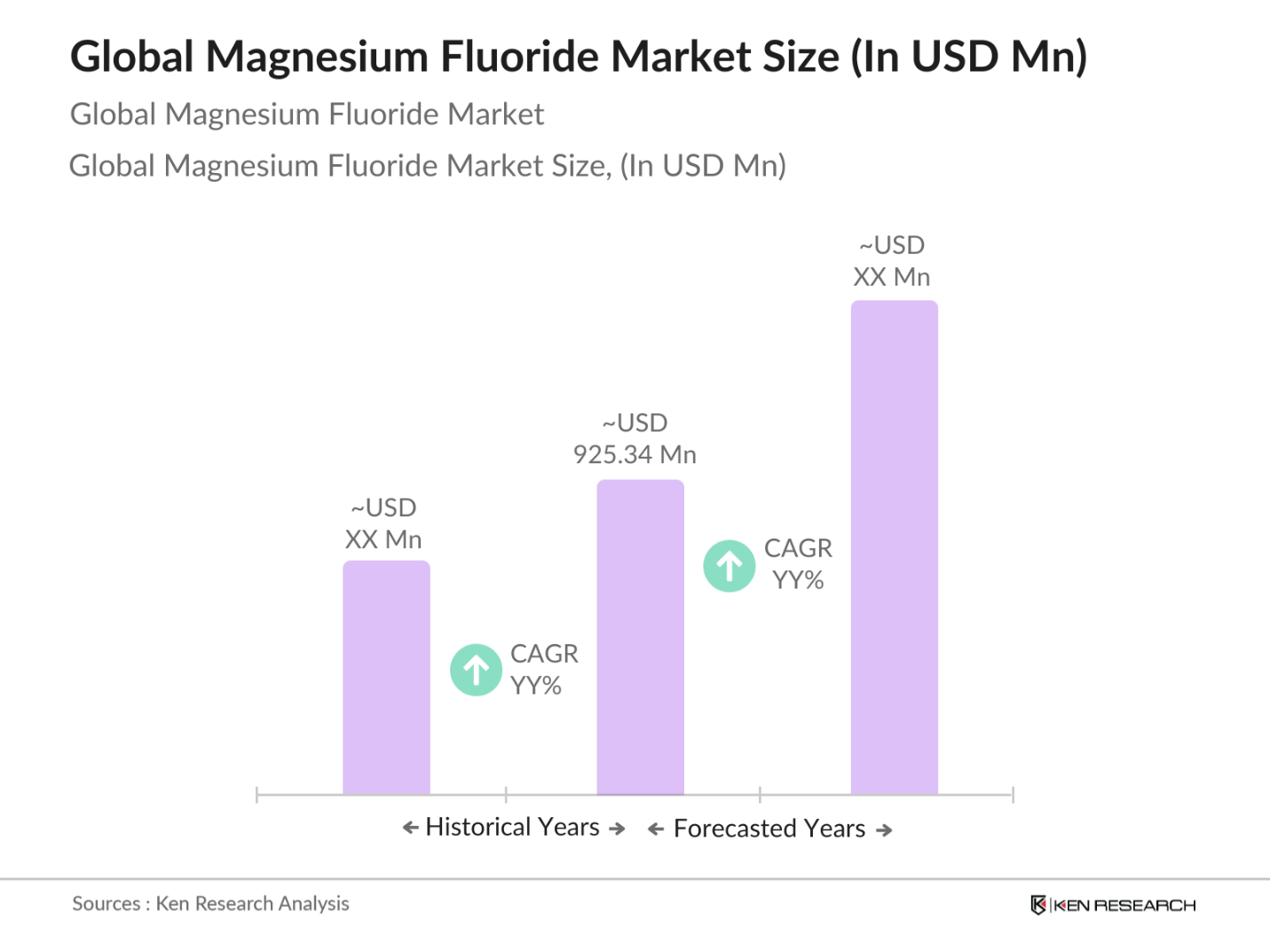
- Countries such as the United States, China, and Germany dominate the magnesium fluoride market due to their well-established industrial bases and technological advancements in optics and electronics. The U.S. leads in innovation for optical materials, supported by a large number of research institutions and defense-related applications. China, on the other hand, benefits from large-scale manufacturing and high domestic consumption of electronic devices. Germany stands out for its cutting-edge optical technologies and machinery exports, positioning it as a key player in this market.
- Government regulations surrounding international material safety standards are essential in shaping the magnesium fluoride market. In 2022, the global regulatory landscape saw an increase in safety standards to ensure the safe use of materials in various industries. Compliance with these standards is crucial for manufacturers aiming to enter international markets. The World Bank indicates that adherence to safety regulations not only mitigates risks but also enhances market access, allowing for broader distribution of magnesium fluoride products.
Global Magnesium Fluoride Market Segmentation
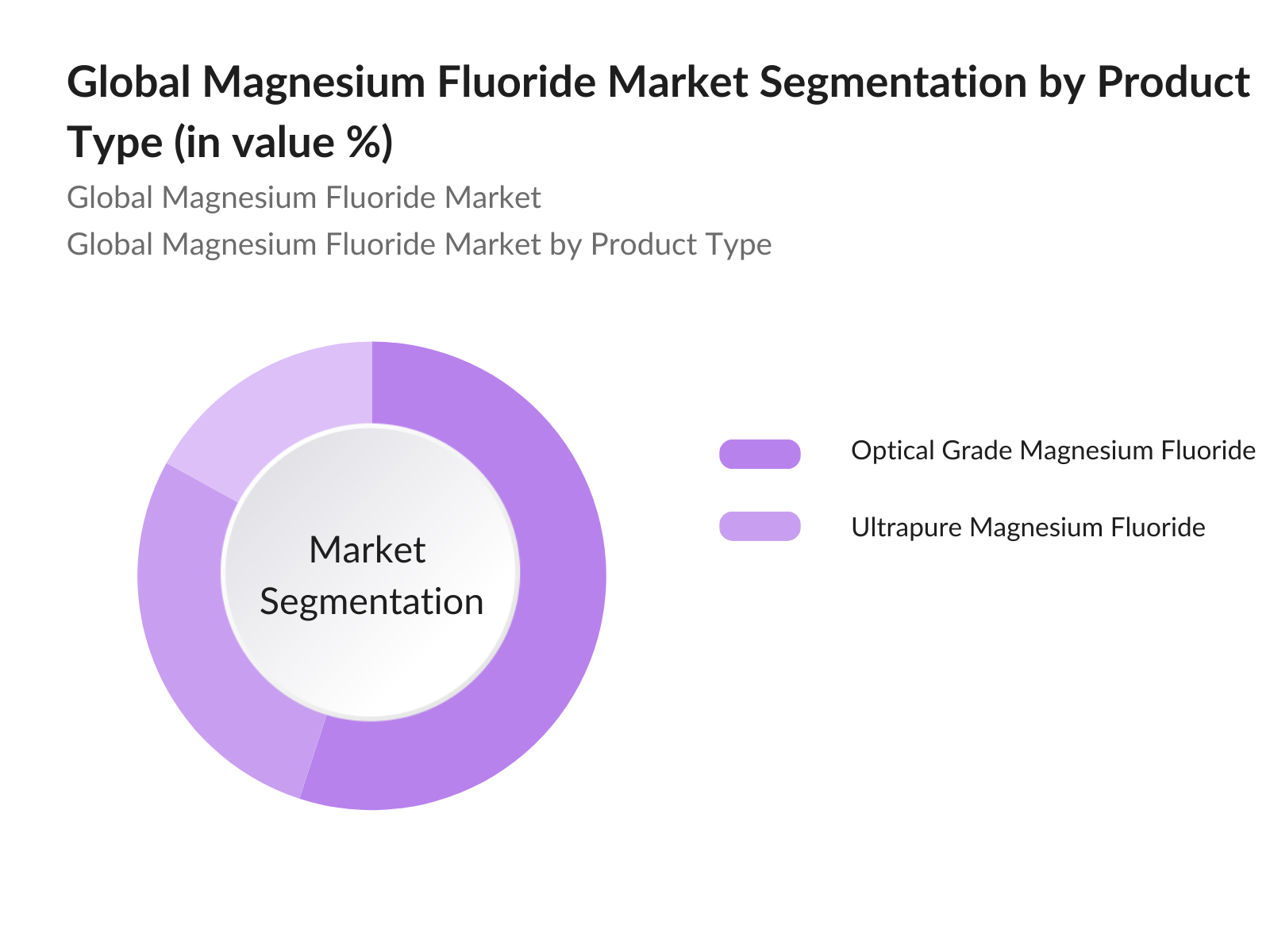
By Product Type: The global magnesium fluoride market is segmented by product type into optical grade magnesium fluoride and ultrapure magnesium fluoride. Optical grade magnesium fluoride dominates the market share due to its critical role in high-precision optical instruments. Its extensive usage in UV and infrared optics, particularly in camera lenses, telescope components, and space equipment, drives demand. As precision optics are critical for military, space exploration, and advanced consumer electronics, the optical grade magnesium fluoride segment remains strong.
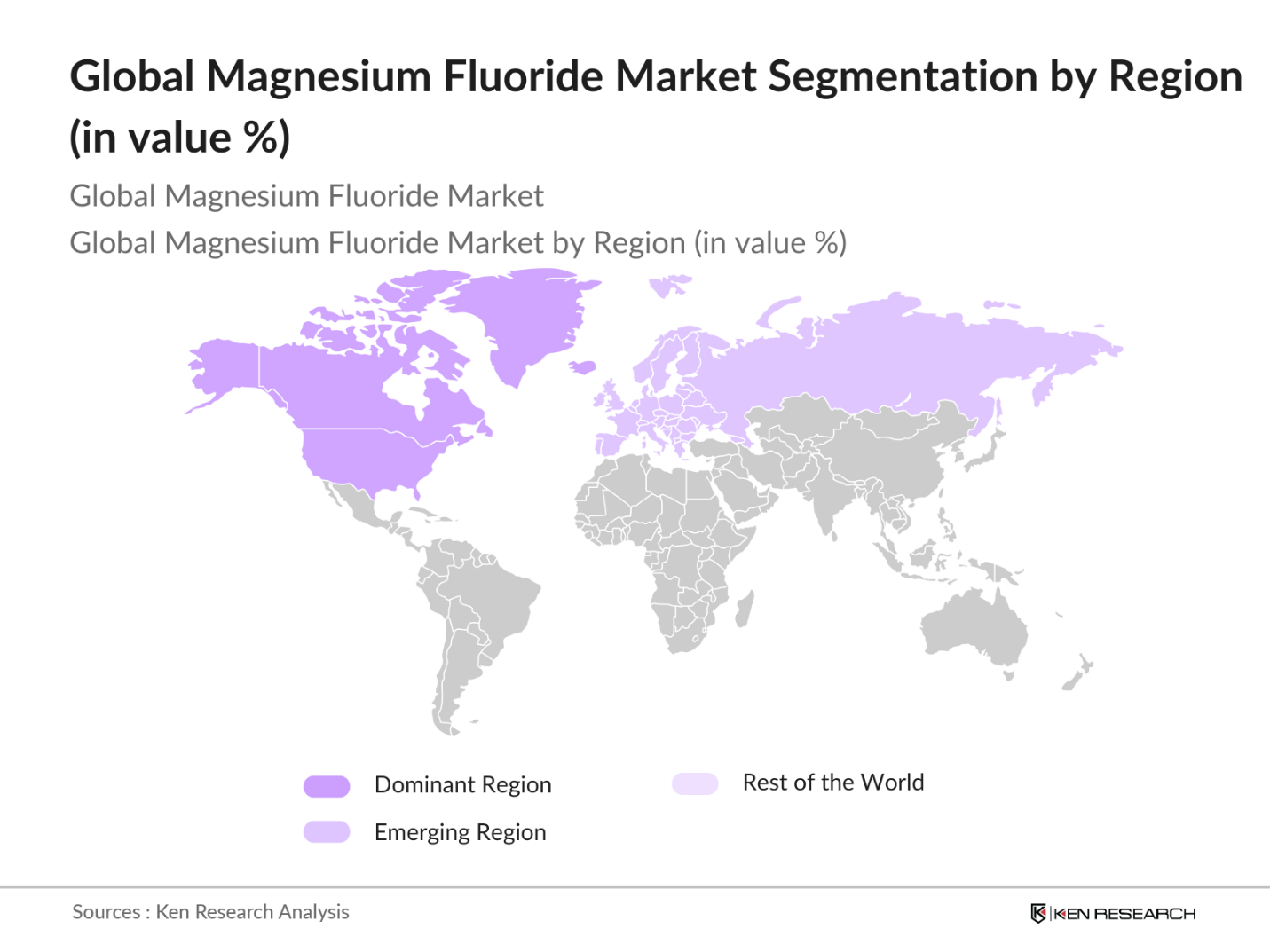
 By Region: The magnesium fluoride market is regionally segmented into North America, Europe, Asia-Pacific, Middle East & Africa, and Latin America. North America holds the dominant market share owing to its strong industrial base, particularly in the defense and aerospace sectors, which heavily rely on magnesium fluoride for high-performance optical devices. Additionally, the regions significant investment in technological advancements and research further supports its market position.
Global Magnesium Fluoride Market Competitive Landscape
The global magnesium fluoride market is highly competitive, with key players focusing on technological advancements and product innovation to maintain their market position. The market is characterized by a mix of global players and specialized regional manufacturers. Companies are investing in R&D to enhance product quality and expand their application areas, particularly in the rapidly evolving fields of optics and electronics.
|
Company |
Year Established |
Headquarters |
Revenue |
Product Portfolio |
R&D Investments |
Number of Employees |
Market Presence |
Partnerships |
|
Corning Incorporated |
1851 |
Corning, USA |
||||||
|
Materion Corporation |
1931 |
Ohio, USA |
||||||
|
Edmund Optics Inc. |
1942 |
New Jersey, USA |
||||||
|
Thorlabs Inc. |
1989 |
New Jersey, USA |
||||||
|
Evaporated Coatings Inc. |
1960 |
New York, USA |
Global Magnesium Fluoride Market Analysis
Market Growth Drivers
- Rising Demand in Optics & Electronics (End-User Industry Influence): The demand for magnesium fluoride is significantly influenced by the optics and electronics sectors. In 2023, the global optics market was valued at approximately $36 billion, driven by advancements in consumer electronics and telecommunications. The increasing integration of optical coatings in smartphones and optical devices is expected to push the demand for magnesium fluoride. According to the World Bank, global investments in technology-related sectors reached $1.7 trillion in 2022, highlighting the growing emphasis on optical technologies that utilize magnesium fluoride.
- Technological Advancements in Coating Materials (Technology Impact): Technological innovations in coating materials are propelling the growth of the magnesium fluoride market. The global coatings industry was valued at $155 billion in 2022, and with ongoing advancements, this sector is projected to witness significant growth. In particular, the development of high-performance coatings that leverage magnesium fluoride for improved durability and optical clarity is notable. The IMF indicates that R&D investments in materials science have surged, with global expenditures exceeding $300 billion in 2022, reflecting a robust environment for technological advancements.
- Increasing Industrial Applications (Industrial Demand): Industrial applications for magnesium fluoride are expanding rapidly, driven by diverse sectors including telecommunications, automotive, and manufacturing. In 2022, the manufacturing sector was valued at around $14 trillion. The increasing reliance on advanced materials for manufacturing processes has created a steady demand for magnesium fluoride as a reliable component in various applications. The World Bank reports that global industrial production reached over $18 trillion in 2022, with a notable emphasis on sustainable practices, which is further driving the need for magnesium fluoride across multiple industries.
Market Challenges:
- High Production Costs (Cost Structure): High production costs remain a significant challenge for the magnesium fluoride market. In 2023, the average production cost of magnesium fluoride was estimated at around $4,500 per ton, driven by the expenses associated with raw materials and energy consumption. The IMF reported a 12% increase in energy prices in 2022, exacerbating the cost challenges faced by manufacturers. Furthermore, fluctuations in the availability of raw materials contribute to unstable production costs, impacting the overall market dynamics and profitability.
- Environmental Regulations (Regulatory Impact): Stringent environmental regulations are impacting the magnesium fluoride market, requiring manufacturers to comply with increasingly rigorous standards. In 2022, the global environmental protection expenditures were reported to be over $300 billion, with significant investments aimed at reducing emissions and promoting sustainability. Regulatory bodies are enforcing stricter guidelines on the production processes of magnesium fluoride to mitigate environmental impacts, leading to increased operational costs and necessitating investments in cleaner technologies. The World Bank emphasizes that non-compliance can result in penalties, affecting market competitiveness.
Global Magnesium Fluoride Market Future Outlook
Over the next few years, the global magnesium fluoride market is expected to experience significant growth, driven by increasing demand from the optics, aerospace, and electronics industries. With advancements in coating technologies and growing applications in laser systems and UV optics, the market will see robust expansion. The market will also benefit from increased investments in space exploration and defense, where magnesium fluoride plays a crucial role in optical components.
Market Opportunities:
- Emerging Applications in Space and Aerospace (Application Expansion): The magnesium fluoride market is poised for growth through emerging applications in space and aerospace industries. In 2022, global spending on space exploration reached approximately $60 billion, driven by advancements in satellite technology and the increasing demand for high-performance materials. Magnesium fluoride's unique properties make it ideal for optical components in aerospace applications, particularly in satellite and telescope systems. With countries like the U.S. and China investing heavily in space exploration, the demand for magnesium fluoride is expected to expand significantly in these sectors.
- Growing Usage in UV and Laser Applications (Application Growth): The increasing use of magnesium fluoride in ultraviolet (UV) and laser applications is a significant trend influencing the market. In 2022, the global UV application market was valued at approximately $10 billion, reflecting its widespread adoption in various industries, including healthcare, printing, and manufacturing. Magnesium fluoride's excellent optical properties make it a preferred choice for UV and laser optics, driving demand in this segment. The World Bank highlights the rising trend in laser technology investments, which reached $5 billion in 2023, further underscoring the growth potential for magnesium fluoride in these applications.
Scope of the Report
|
By Product Type |
Optical Grade Magnesium Fluoride |
|
By Application |
Optics & Photonics Electronics Aerospace & Defense Chemical Processing |
|
By Technology |
Thin Film Coating |
|
By End-Use Industry |
Telecommunications Semiconductor Space Exploration Automotive |
|
By Region |
North America Europe Asia-Pacific Middle East & Africa Latin America |
Products
Key Target Audience
Optical Component Manufacturers
Aerospace & Defense Contractors
Electronics and Semiconductor Companies
Telecommunications Providers
Space Exploration Agencies (NASA, ESA)
Government & Regulatory Bodies (U.S. Department of Defense, European Space Agency)
Investment and Venture Capitalist Firms
Research and Development Institutions
Companies
Players Mention in the Report
Corning Incorporated
Materion Corporation
Edmund Optics Inc.
Thorlabs Inc.
Evaporated Coatings Inc.
Almaz Optics
Knight Optical Ltd
Solvay
Sigma-Aldrich (Merck)
Crystran Ltd
UQG Optics
Acton Optics & Coatings
Sydor Optics
Laser Components GmbH
Lambda Research Optics Inc.
Table of Contents
01. Global Magnesium Fluoride Market Overview
1.1. Definition and Scope
1.2. Market Taxonomy
1.3. Market Growth Rate (Unit Price Trends, CAGR)
1.4. Market Segmentation Overview
02. Global Magnesium Fluoride Market Size (In USD)
2.1. Historical Market Size
2.2. Year-On-Year Growth Analysis
2.3. Key Market Developments and Milestones
03. Global Magnesium Fluoride Market Analysis
3.1. Growth Drivers
3.1.1. Rising Demand in Optics & Electronics (End-User Industry Influence)
3.1.2. Technological Advancements in Coating Materials (Technology Impact)
3.1.3. Increasing Industrial Applications (Industrial Demand)
3.1.4. Growing Investment in R&D (R&D Investment)
3.2. Market Challenges
3.2.1. High Production Costs (Cost Structure)
3.2.2. Raw Material Price Volatility (Supply Chain Risk)
3.2.3. Environmental Regulations (Regulatory Impact)
3.3. Opportunities
3.3.1. Emerging Applications in Space and Aerospace (Application Expansion)
3.3.2. Development of Low-Cost Manufacturing Techniques (Innovation)
3.3.3. Expansion in Developing Economies (Geographical Expansion)
3.4. Trends
3.4.1. Growing Usage in UV and Laser Applications (Application Growth)
3.4.2. Adoption of Nanotechnology in Material Science (Material Advancement)
3.4.3. Increasing Use in Precision Optics (Precision Technology)
3.5. Government Regulations
3.5.1. International Material Safety Standards (Safety Standards)
3.5.2. Import/Export Regulations (Trade Compliance)
3.5.3. Environmental Protection Acts (Environmental Standards)
3.6. SWOT Analysis
3.7. Stakeholder Ecosystem
3.8. Porters Five Forces
3.9. Competition Ecosystem
04. Global Magnesium Fluoride Market Segmentation
4.1. By Product Type (In Value %)
4.1.1. Optical Grade Magnesium Fluoride
4.1.2. Ultrapure Magnesium Fluoride
4.2. By Application (In Value %)
4.2.1. Optics & Photonics
4.2.2. Electronics
4.2.3. Aerospace & Defense
4.2.4. Chemical Processing
4.3. By Technology (In Value %)
4.3.1. Thin Film Coating
4.3.2. Vacuum Evaporation
4.4. By End-Use Industry (In Value %)
4.4.1. Telecommunications
4.4.2. Semiconductor
4.4.3. Space Exploration
4.4.4. Automotive
4.5. By Region (In Value %)
4.5.1. North America
4.5.2. Europe
4.5.3. Asia-Pacific
4.5.4. Middle East & Africa
4.5.5. Latin America
05. Global Magnesium Fluoride Market Competitive Analysis
5.1. Detailed Profiles of Major Companies
5.1.1. Corning Incorporated
5.1.2. Materion Corporation
5.1.3. Edmund Optics Inc.
5.1.4. Thorlabs Inc.
5.1.5. Almaz Optics
5.1.6. Evaporated Coatings Inc.
5.1.7. Knight Optical Ltd
5.1.8. Laser Components GmbH
5.1.9. Lambda Research Optics Inc.
5.1.10. Sydor Optics
5.1.11. Solvay
5.1.12. Sigma-Aldrich (Merck)
5.1.13. Crystran Ltd
5.1.14. UQG Optics
5.1.15. Acton Optics & Coatings
5.2. Cross Comparison Parameters (No. of Employees, Headquarters, Product Portfolio, Market Share, Revenue, Manufacturing Facilities, Key Clients, R&D Spending)
5.3. Market Share Analysis
5.4. Strategic Initiatives
5.5. Mergers and Acquisitions
5.6. Investment Analysis
5.7. Venture Capital Funding
5.8. Government Grants
5.9. Private Equity Investments
06. Global Magnesium Fluoride Market Regulatory Framework
6.1. Safety and Environmental Standards
6.2. Compliance Requirements
6.3. Certification Processes
07. Global Magnesium Fluoride Future Market Size (In USD)
7.1. Future Market Size Projections
7.2. Key Factors Driving Future Market Growth
08. Global Magnesium Fluoride Future Market Segmentation
8.1. By Product Type (In Value %)
8.2. By Application (In Value %)
8.3. By Technology (In Value %)
8.4. By End-Use Industry (In Value %)
8.5. By Region (In Value %)
09. Global Magnesium Fluoride Market Analysts Recommendations
9.1. TAM/SAM/SOM Analysis
9.2. Customer Cohort Analysis
9.3. Marketing Initiatives
9.4. White Space Opportunity Analysis
Disclaimer
Contact Us
Research Methodology
Step 1: Identification of Key Variables
The research begins by mapping out the ecosystem of the global magnesium fluoride market. This involves desk research using secondary and proprietary databases to identify key stakeholders, including manufacturers, suppliers, and consumers. The aim is to recognize the variables influencing market dynamics, such as raw material supply, technological innovations, and end-user demand.
Step 2: Market Analysis and Construction
In this step, historical data is analyzed to understand market trends and patterns. The ratio of magnesium fluoride production to its consumption across various industries is evaluated. This analysis includes revenue generation from product sales, market penetration, and the influence of technological advancements on market growth.
Step 3: Hypothesis Validation and Expert Consultation
To validate the market hypotheses, consultations are conducted with industry experts through telephonic interviews. These experts provide critical insights into the operational, technical, and financial aspects of the market, which helps in refining market estimates and projections.
Step 4: Research Synthesis and Final Output
In the final stage, data from manufacturers and distributors is integrated with the bottom-up research approach to produce a comprehensive market report. This ensures that the analysis is accurate, validated, and ready for publication.
Frequently Asked Questions
01. How big is the Global Magnesium Fluoride Market?
The global magnesium fluoride market, valued at USD 925.34 million, is primarily driven by its widespread use in optics and electronics, including applications such as coatings and laser systems.
02. What are the challenges in the Global Magnesium Fluoride Market?
Key challenges include the volatility in raw material prices and stringent environmental regulations governing the production and disposal of fluoride-based materials.
03. Who are the major players in the Global Magnesium Fluoride Market?
Key players in the market include Corning Incorporated, Materion Corporation, Edmund Optics Inc., Thorlabs Inc., and Evaporated Coatings Inc. These companies dominate due to their strong technological capabilities and extensive product portfolios.
04. What are the growth drivers of the Global Magnesium Fluoride Market?
The market is driven by the increasing demand for high-performance optical materials in sectors such as telecommunications, aerospace, and defense, as well as advancements in coating technologies.
Why Buy From Us?

What makes us stand out is that our consultants follows Robust, Refine and Result (RRR) methodology. i.e. Robust for clear definitions, approaches and sanity checking, Refine for differentiating respondents facts and opinions and Result for presenting data with story

We have set a benchmark in the industry by offering our clients with syndicated and customized market research reports featuring coverage of entire market as well as meticulous research and analyst insights.

While we don't replace traditional research, we flip the method upside down. Our dual approach of Top Bottom & Bottom Top ensures quality deliverable by not just verifying company fundamentals but also looking at the sector and macroeconomic factors.

With one step in the future, our research team constantly tries to show you the bigger picture. We help with some of the tough questions you may encounter along the way: How is the industry positioned? Best marketing channel? KPI's of competitors? By aligning every element, we help maximize success.

Our report gives you instant access to the answers and sources that other companies might choose to hide. We elaborate each steps of research methodology we have used and showcase you the sample size to earn your trust.

If you need any support, we are here! We pride ourselves on universe strength, data quality, and quick, friendly, and professional service.