
Global Main Battle Tank Market
Region:Global
Author(s):Naman Rohilla
Product Code:KROD4837
December 2024
98
About the Report
Global Main Battle Tank Market Overview
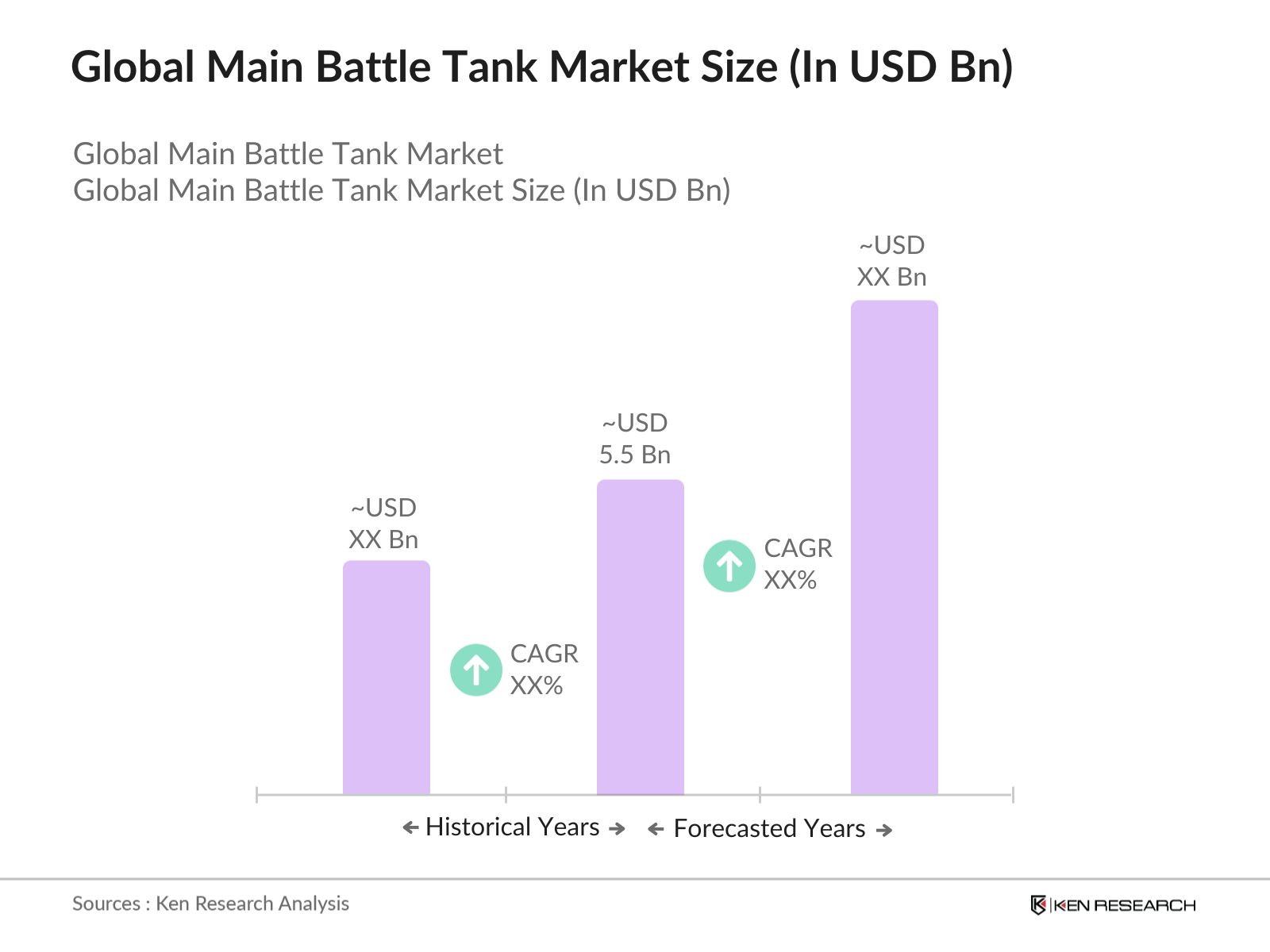
- The global main battle tank market is valued at USD 5.5 billion based on a five-year historical analysis. This growth is driven by increasing global defence expenditures, geopolitical tensions, and a surge in demand for advanced land warfare capabilities. The need for modernized military equipment and advanced protection systems, such as active protection and composite armor, are key contributors to the growth. Additionally, various countries are focused on military modernization programs, which further drive the demand for new-generation battle tanks.
- Several countries dominate the global main battle tank market, including the United States, Russia, and China, due to their substantial defence budgets and their capability to develop and manufacture technologically advanced battle tanks. The dominance of these countries is largely attributed to their advanced military R&D facilities, government-supported defence industries, and the continuous innovation in tank warfare technology that aligns with their defence strategies and geopolitical influence.
- National defence acquisition programs are pivotal in shaping the battle tank market. Countries such as India and China have prioritized indigenous manufacturing through their defence policies to reduce dependence on foreign arms. India, for instance, launched the 'Make in India' initiative, which saw its Defence Procurement Procedure revised to emphasize local production. As a result, Indias defence procurement budget for 2023-2024 allocated $20 billion toward indigenous projects, including the development of advanced tanks. These policies promote self-reliance and stimulate domestic defence industries, bolstering tank production capabilities.
Global Main Battle Tank Market Segmentation
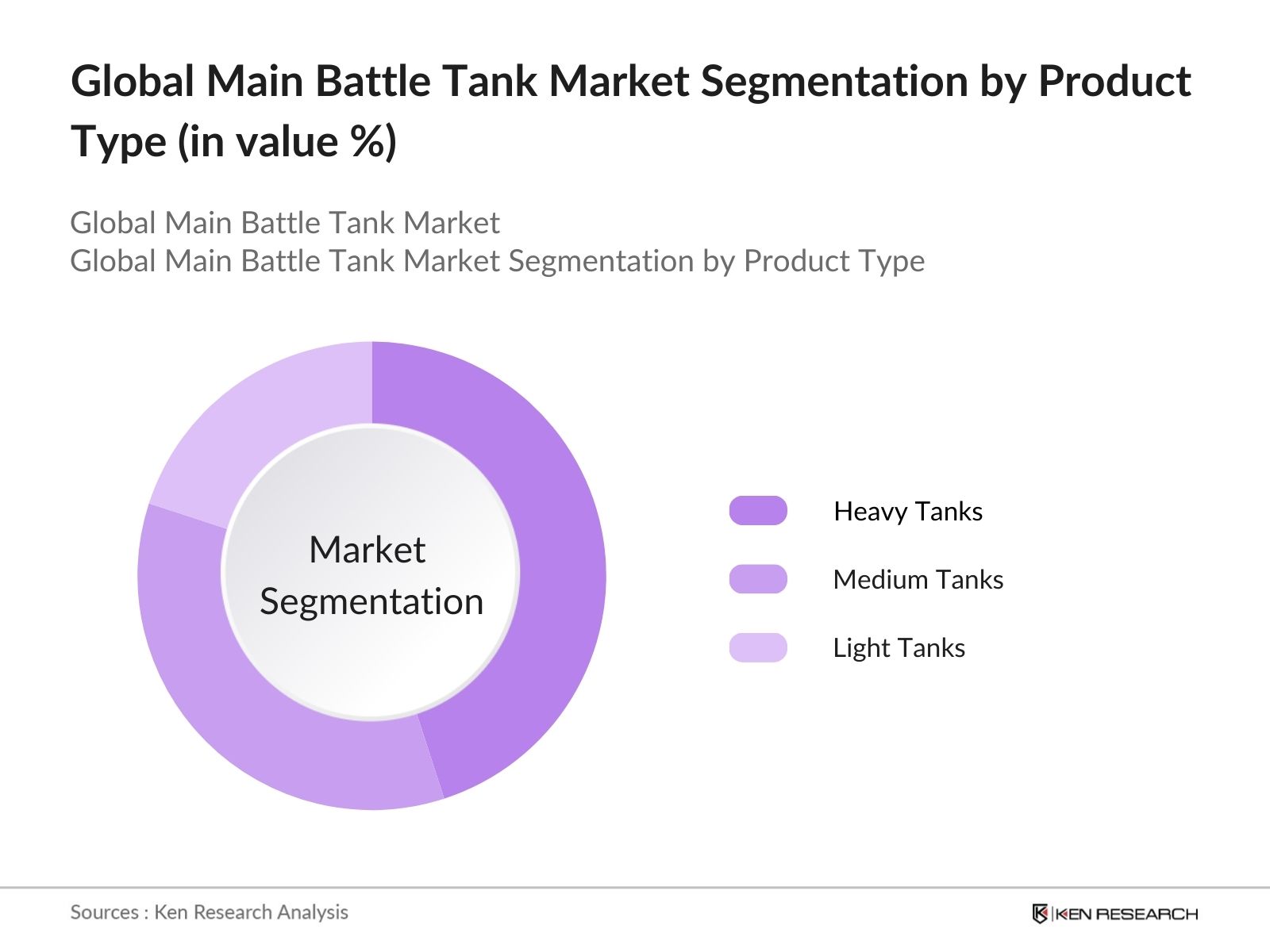
- By Product Type: The global main battle tank market is segmented by product type into light tanks, medium tanks, and heavy tanks. Recently, heavy tanks have held a dominant market share under this segmentation. The dominance of heavy tanks can be attributed to their superior firepower, enhanced protection systems, and their pivotal role in offensive military operations. These tanks are equipped with larger caliber main guns, advanced targeting systems, and robust armor, making them a preferred choice for modern land warfare, especially in high-intensity conflict zones.
- By Mobility Type: The market is further segmented by mobility type into wheeled and tracked tanks. Tracked tanks have consistently dominated the market due to their superior maneuverability and capability to operate across diverse terrains, including rough, uneven, and off-road conditions. Their stability and ability to carry heavier armaments make them indispensable in both defensive and offensive military strategies, particularly in scenarios that demand high endurance and mobility in varied environments.
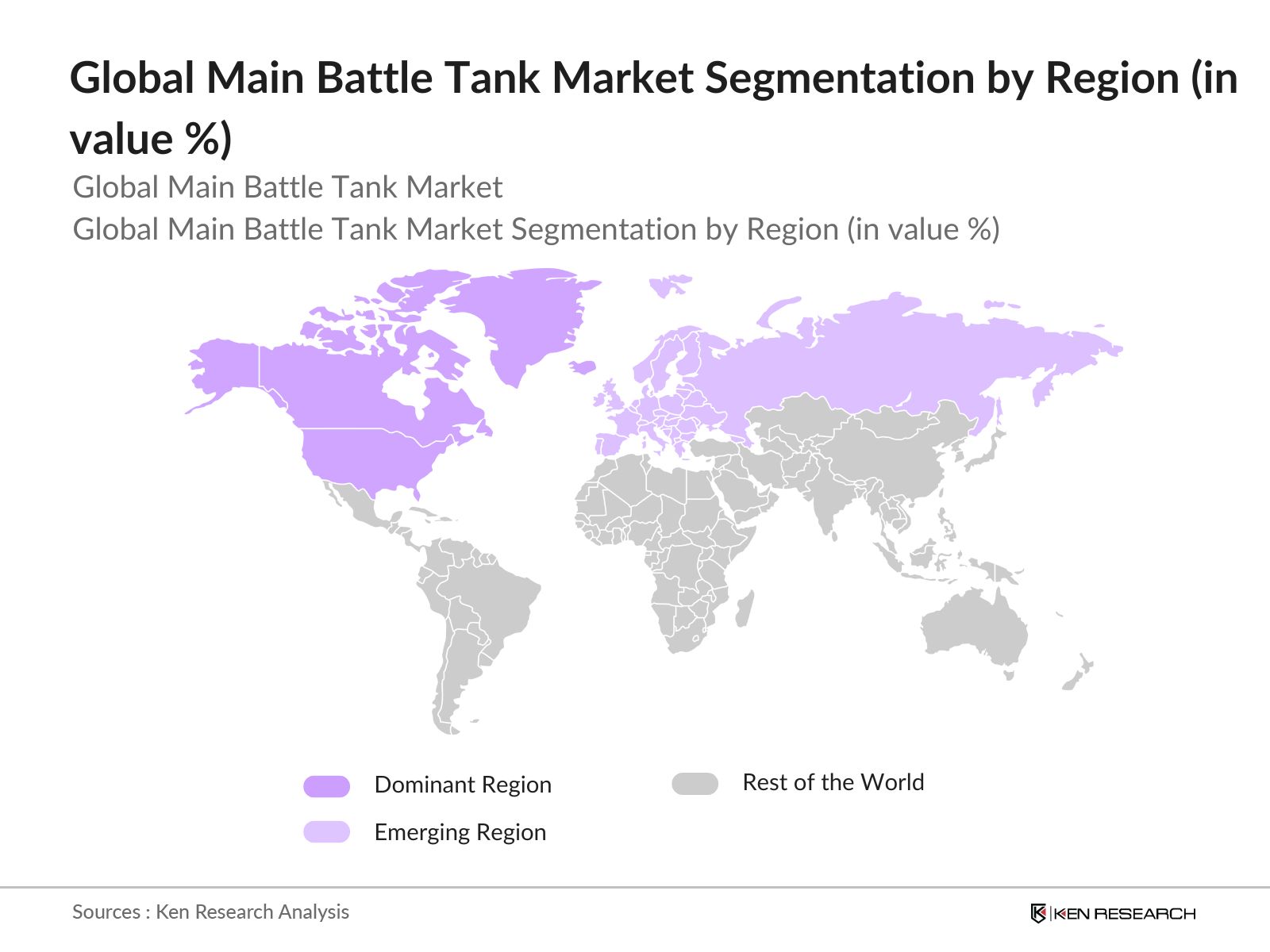
- By Region: The global main battle tank market is segmented by region into North America, Europe, Asia-Pacific, the Middle East & Africa, and Latin America. North America holds the largest market share due to the United States' investments in defence technology and modernization programs. The strong presence of leading defence contractors and continuous technological advancements in battle tank systems also drive the dominance of the region in the global market.
Global Main Battle Tank Market Competitive Landscape
The global main battle tank market is highly consolidated, with a few major defence contractors playing a major role in the development and manufacturing of advanced battle tanks. These companies focus on extensive R&D, technological advancements, and strategic collaborations with governments to enhance their capabilities. The competitive landscape is shaped by the need for continuous innovation, as defence contractors aim to meet the evolving demands of modern warfare.
|
Company |
Establishment Year |
Headquarters |
R&D Investment |
Global Presence |
Defence Contracts |
Product Innovations |
Strategic Collaborations |
|
General Dynamics Corp. |
1952 |
USA |
- |
- |
- |
- |
- |
|
BAE Systems |
1999 |
UK |
- |
- |
- |
- |
- |
|
Rheinmetall AG |
1889 |
Germany |
- |
- |
- |
- |
- |
|
Uralvagonzavod |
1936 |
Russia |
- |
- |
- |
- |
- |
|
Hyundai Rotem |
1977 |
South Korea |
- |
- |
- |
- |
- |
Global Main Battle Tank Market Analysis
Global Main Battle Tank Market Growth Drivers
- Increased Defence Expenditures: Global defence spending has seen a sharp rise, with worldwide military expenditures reaching approximately $2.24 trillion in 2023, as per the Stockholm International Peace Research Institute (SIPRI). Major economies, including the United States, China, and Russia, are allocating portions of their GDP to defence budgets, with the U.S. leading at $877 billion. Countries like India and Japan are also ramping up their defence spending, driven by geopolitical uncertainties and regional tensions. Increased funding allows governments to invest in advanced battle tanks, thus driving market growth.
- Geopolitical Tensions: Geopolitical conflicts are intensifying worldwide, with hotspots such as Eastern Europe, the Middle East, and Asia-Pacific driving the need for enhanced military capabilities. For example, Russia's conflict with Ukraine has prompted NATO to strengthen its eastern defences. In Asia, Chinas territorial disputes with India and other nations have led to military modernization. In 2023, India allocated approximately $76 billion for defence, with a notable focus on tank procurement for border security. Military modernization and the need for preparedness against threats are key growth drivers for the main battle tank market.
- Rising Demand for High Mobility & Firepower: Modern warfare demands high mobility and firepower, with countries investing in tanks capable of rapid deployment and powerful offensive capabilities. For instance, the U.S. Army is upgrading its M1 Abrams tanks to increase speed and firepower while reducing weight. In 2023, NATO members outlined plans to enhance tank mobility in line with the NATO Enhanced Forward Presence initiative. The global trend toward creating lighter, more maneuverable tanks with improved firepower aligns with modern military strategies that require swift operational mobility in combat zones.
Global Main Battle Tank Market Challenges
- High Manufacturing Costs: Manufacturing battle tanks involves high costs, primarily due to the complexity of integrating advanced technologies like active protection systems and next-gen armaments. For example, the U.S. M1A2 SEP tank, with its cutting-edge features, costs approximately $9 million per unit. Such high production costs put pressure on national defence budgets, especially in countries with lower military spending. These financial constraints often lead to limited procurement, affecting the broader tank market. Defence ministries, particularly in emerging economies, struggle to balance operational needs with budget limitations.
Source: U.S. Department of Defence Budget Report - Maintenance and Upgrade Costs: Maintenance and lifecycle costs for battle tanks are substantial, often matching or exceeding initial acquisition costs. The U.S. Armys operational cost for maintaining the Abrams tank fleet, for instance, averages $1.5 billion annually. These costs cover regular upgrades to electronics, armor, and weapon systems. Over time, the expense of keeping tanks operational becomes a financial strain for many nations. Tanks that are not regularly upgraded face obsolescence, further increasing defence budgets as militaries replace outdated units.
Global Main Battle Tank Market Future Outlook
Over the next five years, the global main battle tank market is expected to witness substantial growth, driven by continuous government defence funding, the rising geopolitical tensions in various regions, and increasing technological advancements in tank warfare. Furthermore, the demand for tanks equipped with advanced AI-driven systems and enhanced mobility for diverse terrain operations will continue to shape the future of the market. Countries with active military modernization programs and large defence budgets are expected to be the key contributors to the future expansion of this market.
Global Main Battle Tank Market Opportunities
- Development of Autonomous Battle Tanks: The integration of AI into military hardware has opened new opportunities in the development of autonomous battle tanks. Countries like the U.S. and Russia are investing heavily in research for autonomous tank technologies. The U.S. Department of Defence has allocated $1 billion for AI-driven autonomous vehicle programs, including tanks, by 2025. These vehicles are expected to operate with minimal human intervention, enhancing operational efficiency. The ability to deploy autonomous tanks in hazardous environments is expected to change future military strategies, creating new avenues for market expansion.
- Military Collaborations and Joint Ventures: Military collaborations, including joint ventures between countries, are offering growth opportunities for the battle tank market. The European Main Ground Combat System (MGCS), a collaboration between Germany and France, aims to develop next-generation tanks for deployment by 2035. Joint ventures like this allow nations to pool resources, share technology, and reduce individual R&D costs. These international alliances are not only fostering innovation but also providing smaller nations access to cutting-edge technology, further expanding the global battle tank market.
Scope of the Report
|
By Product Type |
Light Tanks Medium Tanks Heavy Tanks |
|
By Mobility Type |
Wheeled Tracked |
|
By Armament Type |
Main Gun (120mm, 125mm, 130mm) Secondary Armaments, APS |
|
By Application |
Offensive Operations Defensive Operations |
|
By Region |
North America Europe Asia-Pacific MEA Latin America |
Products
Key Target Audience
Defence Ministries and Military Procurement Agencies
Defence Contractors and Suppliers
Military Technology and R&D Institutions
Investor and Venture Capitalist Firms
Banks and Financial Institutions
Government and Regulatory Bodies (NATO, UN Arms Control)
Defence Industrial Base Manufacturers
Autonomous Warfare Technology Developers
Public and Private Defence Contractors
Companies
Global Main Battle Tank Market Major Players
General Dynamics Corporation
BAE Systems
Rheinmetall AG
Uralvagonzavod
Hyundai Rotem
Krauss-Maffei Wegmann
Leonardo S.p.A.
Otokar
Mitsubishi Heavy Industries
ST Kinetics
Nexter Systems
Oshkosh Defence
Denel Land Systems
IVECO Defence Vehicles
Elbit Systems
Table of Contents
1. Global Main Battle Tank Market Overview
1.1. Definition and Scope
1.2. Market Taxonomy
1.3. Market Growth Rate
1.4. Market Segmentation Overview
2. Global Main Battle Tank Market Size (In USD Bn)
2.1. Historical Market Size
2.2. Year-On-Year Growth Analysis
2.3. Key Market Developments and Milestones
3. Global Main Battle Tank Market Analysis
3.1. Growth Drivers
3.1.1. Increased Defence Expenditures (Global Defence Budgets)
3.1.2. Geopolitical Tensions (Border Conflicts, Military Modernization)
3.1.3. Technological Advancements in Armor Systems (Active Protection Systems, Composite Armor)
3.1.4. Rising Demand for High Mobility & Firepower (Strategic Military Maneuverability)
3.2. Market Challenges
3.2.1. High Manufacturing Costs (Production Costs, Procurement Budget Constraints)
3.2.2. Maintenance and Upgrade Costs (Lifecycle Maintenance Costs, Obsolescence)
3.2.3. Regulatory Challenges (Export Restrictions, Defence Contracts Compliance)
3.3. Opportunities
3.3.1. Development of Autonomous Battle Tanks (AI Integration, Autonomous Driving)
3.3.2. Military Collaborations and Joint Ventures (Defence Agreements, International Alliances)
3.3.3. Increasing Focus on Lighter and Faster Tanks (Rapid Deployment, Mobility-Oriented Designs)
3.4. Trends
3.4.1. Use of Hybrid-Electric Propulsion Systems (Fuel Efficiency, Reduced Carbon Footprint)
3.4.2. Modular Upgradability (Weapon Systems Modularity, Mission-Specific Customizations)
3.4.3. Enhanced Situational Awareness Systems (360-degree Cameras, Advanced Targeting)
3.5. Government Regulations
3.5.1. International Arms Trade Agreements (UN Arms Regulations, NATO Standards)
3.5.2. National Defence Acquisition Programs (Procurement Policies, Indigenous Manufacturing)
3.5.3. Offset Policies and Defence Industrial Participation (Local Manufacturing, Technology Transfer)
3.6. SWOT Analysis
3.7. Stakeholder Ecosystem
3.8. Porters Five Forces
3.9. Competition Ecosystem
4. Global Main Battle Tank Market Segmentation
4.1. By Product Type (In Value %)
4.1.1. Light Tanks
4.1.2. Medium Tanks
4.1.3. Heavy Tanks
4.2. By Mobility Type (In Value %)
4.2.1. Wheeled
4.2.2. Tracked
4.3. By Armament Type (In Value %)
4.3.1. Main Gun (120mm, 125mm, 130mm)
4.3.2. Secondary Armaments (Coaxial Machine Guns, Anti-Aircraft Guns)
4.3.3. Active Protection Systems (APS, Trophy, Iron Fist)
4.4. By Application (In Value %)
4.4.1. Offensive Operations
4.4.2. Defensive Operations
4.5. By Region (In Value %)
4.5.1. North America
4.5.2. Europe
4.5.3. Asia-Pacific
4.5.4. Middle East & Africa
4.5.5. Latin America
5. Global Main Battle Tank Market Competitive Analysis
5.1 Detailed Profiles of Major Companies
5.1.1. General Dynamics Corporation
5.1.2. BAE Systems
5.1.3. Rheinmetall AG
5.1.4. Uralvagonzavod
5.1.5. Elbit Systems
5.1.6. Leonardo S.p.A.
5.1.7. Nexter Systems
5.1.8. Hyundai Rotem
5.1.9. Krauss-Maffei Wegmann (KMW)
5.1.10. Oshkosh Defence
5.1.11. IVECO Defence Vehicles
5.1.12. Otokar
5.1.13. Denel Land Systems
5.1.14. Mitsubishi Heavy Industries
5.1.15. ST Kinetics
5.2 Cross Comparison Parameters (Headquarters, R&D Capabilities, Defence Contracts, Revenue, Employees, Global Presence, Product Innovation, Strategic Partnerships)
5.3. Market Share Analysis
5.4. Strategic Initiatives
5.5. Mergers and Acquisitions
5.6. Investment Analysis
5.7. Venture Capital Funding
5.8. Government Grants and Subsidies
5.9. Private Equity Investments
6. Global Main Battle Tank Market Regulatory Framework
6.1. Environmental Standards
6.2. Compliance Requirements
6.3. Certification Processes
7. Global Main Battle Tank Future Market Size (In USD Bn)
7.1. Future Market Size Projections
7.2. Key Factors Driving Future Market Growth
8. Global Main Battle Tank Future Market Segmentation
8.1. By Product Type (In Value %)
8.2. By Mobility Type (In Value %)
8.3. By Armament Type (In Value %)
8.4. By Application (In Value %)
8.5. By Region (In Value %)
9. Global Main Battle Tank Market Analysts Recommendations
9.1. TAM/SAM/SOM Analysis
9.2. Customer Cohort Analysis
9.3. Marketing Initiatives
9.4. White Space Opportunity Analysis
Research Methodology
Step 1: Identification of Key Variables
In this initial phase, an ecosystem map of the global main battle tank market was constructed. Desk research and proprietary databases were utilized to gather critical data on market dynamics, identifying the key variables influencing the markets growth, such as military budgets, geopolitical tensions, and technological innovations.
Step 2: Market Analysis and Construction
Historical market data was compiled, including insights on production numbers, tank development programs, and global defence expenditures. The collected data was assessed to identify market penetration, service-to-product ratios, and market revenue generated by major defence contractors.
Step 3: Hypothesis Validation and Expert Consultation
Key market hypotheses were validated through direct consultations with military professionals and defence industry experts via structured interviews. These interviews provided practical insights into operational and financial trends, helping to refine and corroborate the market data.
Step 4: Research Synthesis and Final Output
The final step involved engagement with leading defence contractors to acquire detailed insights on tank production, technological advancements, and customer preferences. The data was synthesized and verified using a combination of bottom-up and top-down approaches to ensure the accuracy of the market projections.
Frequently Asked Questions
01. How big is the Global Main Battle Tank Market?
The global main battle tank market was valued at USD 5.5 billion, driven by rising defence budgets, geopolitical tensions, and the need for modern warfare equipment.
02. What are the challenges in the Global Main Battle Tank Market?
Challenges in the global main battle tank market include high production costs, complex maintenance needs, and evolving regulatory frameworks. Additionally, the integration of advanced technologies can slow down production timelines.
03. Who are the major players in the Global Main Battle Tank Market?
Key players in the global main battle tank market include General Dynamics Corporation, BAE Systems, Rheinmetall AG, Uralvagonzavod, and Hyundai Rotem. These companies dominate due to their extensive R&D capabilities, defence contracts, and cutting-edge innovations in tank technology.
04. What are the growth drivers of the Global Main Battle Tank Market?
Global main battle tank market growth drivers include increasing geopolitical tensions, the need for military modernization, and advancements in tank protection systems. Additionally, the development of autonomous and AI-driven tanks is expected to fuel future demand.
Why Buy From Us?

What makes us stand out is that our consultants follows Robust, Refine and Result (RRR) methodology. i.e. Robust for clear definitions, approaches and sanity checking, Refine for differentiating respondents facts and opinions and Result for presenting data with story

We have set a benchmark in the industry by offering our clients with syndicated and customized market research reports featuring coverage of entire market as well as meticulous research and analyst insights.

While we don't replace traditional research, we flip the method upside down. Our dual approach of Top Bottom & Bottom Top ensures quality deliverable by not just verifying company fundamentals but also looking at the sector and macroeconomic factors.

With one step in the future, our research team constantly tries to show you the bigger picture. We help with some of the tough questions you may encounter along the way: How is the industry positioned? Best marketing channel? KPI's of competitors? By aligning every element, we help maximize success.

Our report gives you instant access to the answers and sources that other companies might choose to hide. We elaborate each steps of research methodology we have used and showcase you the sample size to earn your trust.

If you need any support, we are here! We pride ourselves on universe strength, data quality, and quick, friendly, and professional service.