















Global Men’s Underwear Market Outlook to 2030
Region:Global
Author(s):Sanjna Verma
Product Code:KROD5984
November 2024
90
About the Report
Global Men's Underwear Market Overview
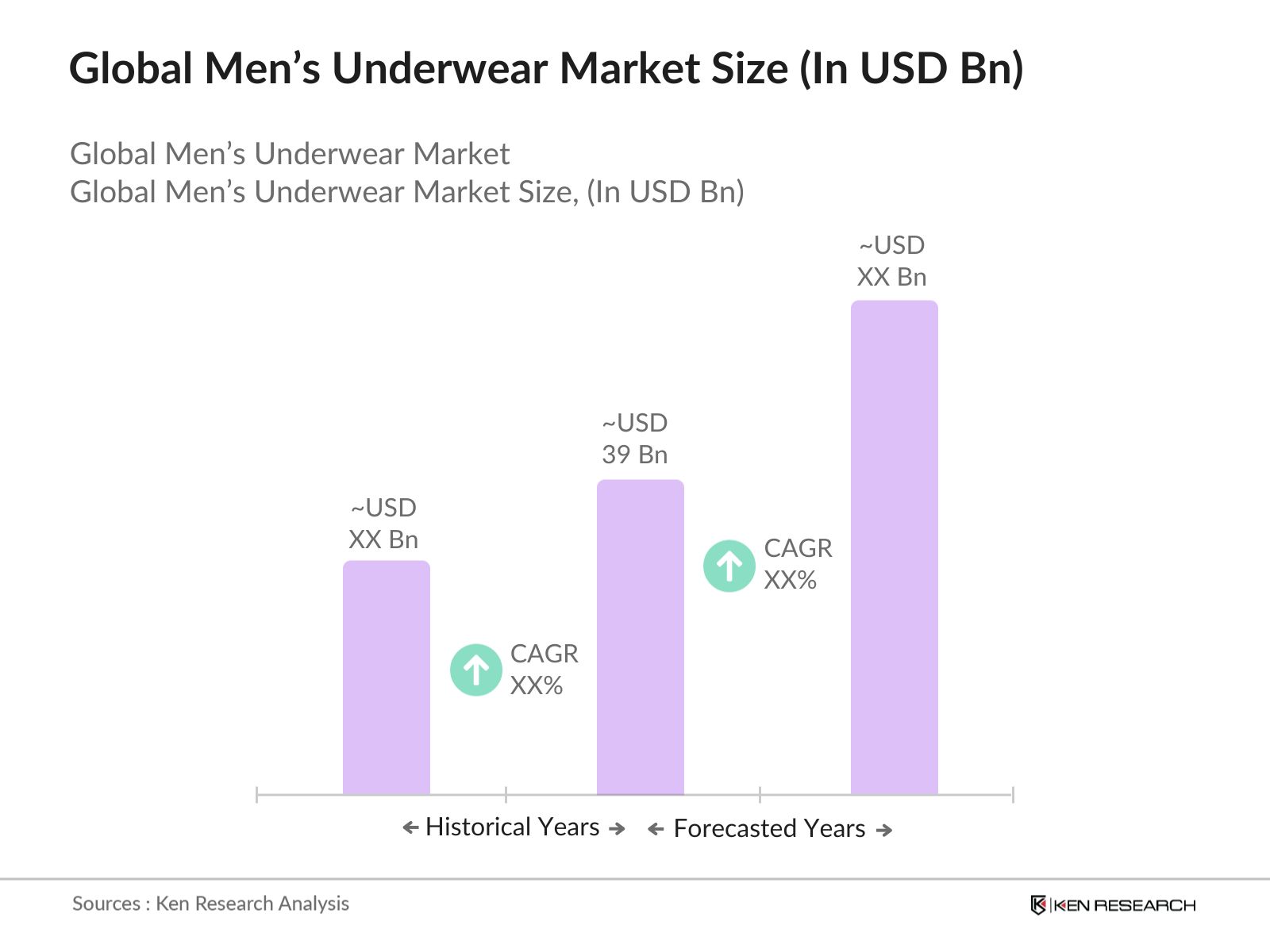
- The global men's underwear market is valued at USD 39 billion, based on a five-year historical analysis. The market is driven by increasing consumer demand for comfort, the use of sustainable and advanced fabrics, and the growing preference for branded products among men. Increasing disposable income and the expansion of e-commerce platforms are also playing pivotal roles in boosting sales across different product segments such as boxers, briefs, and trunks.
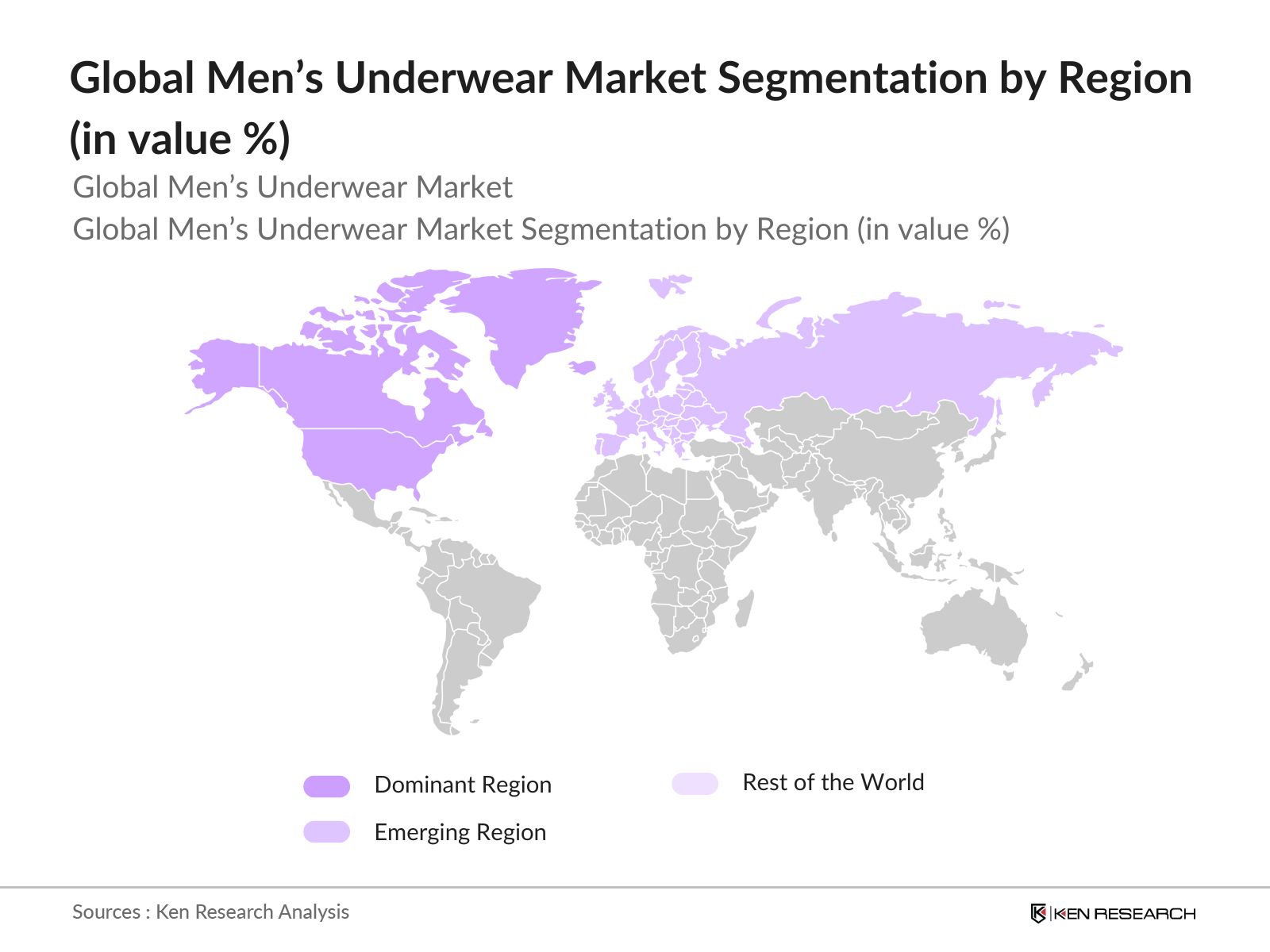
- Cities and regions such as North America and Europe dominate the mens underwear market. The primary reason for this dominance is the high purchasing power of consumers in these regions, combined with their preference for premium and luxury brands. The increasing awareness of personal hygiene and the growing influence of fitness culture have further bolstered demand in these regions. Moreover, strong retail infrastructure and the presence of global brands contribute to market dominance.
- Labor regulations play a pivotal role in the global men's underwear market, particularly in countries where textile production is a major industry. The International Labour Organization (ILO) reported in 2023 that countries like Bangladesh and Vietnam have implemented stricter labor standards in response to global scrutiny. These regulations include mandates on minimum wage, working hours, and safety conditions in textile factories.
Global Men's Underwear Market Segmentation
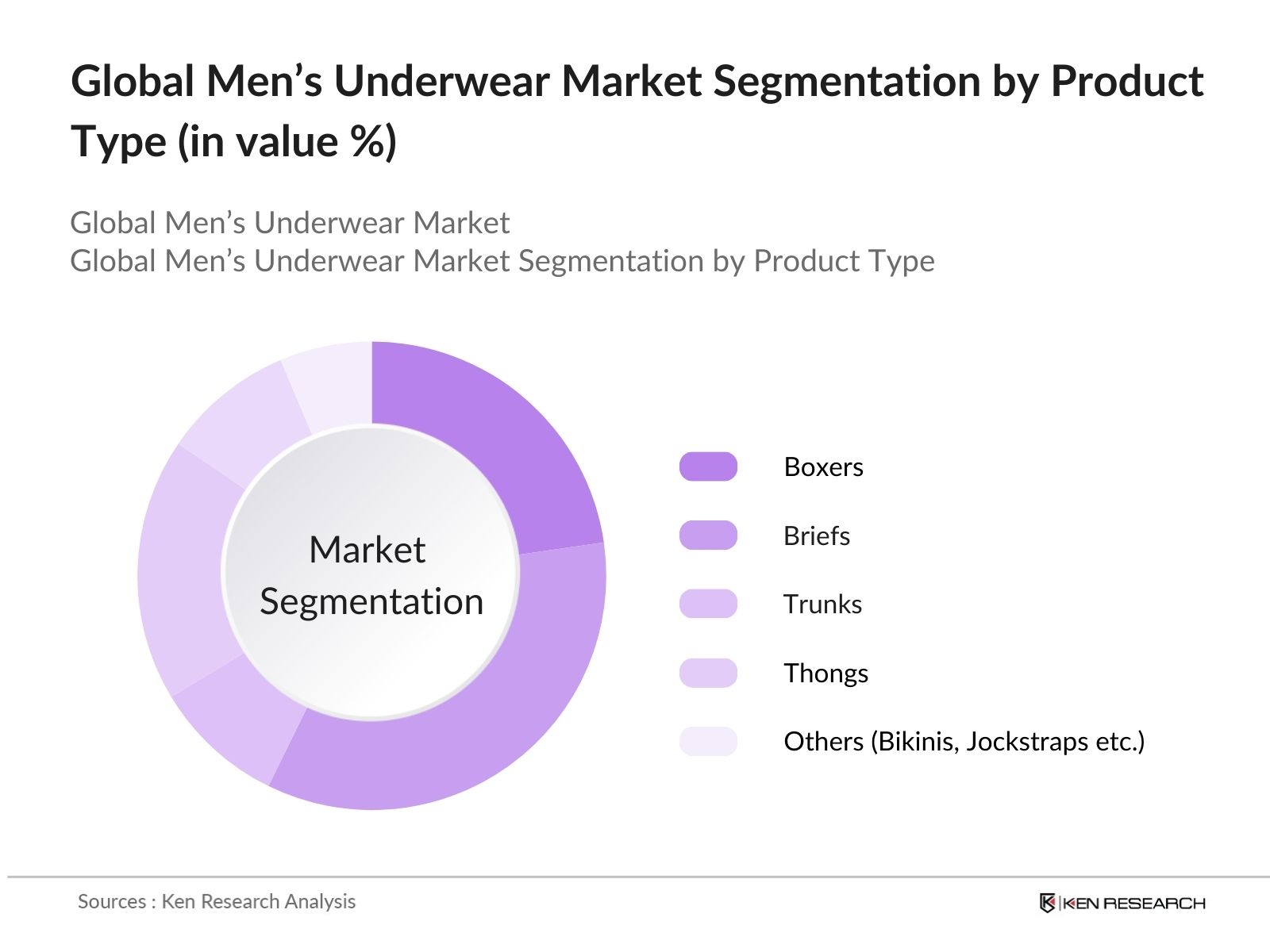
By Product Type: The global men's underwear market is segmented by product type into boxers, briefs, trunks, and thongs. Recently, briefs have held a dominant market share under the segmentation of product type due to their enduring popularity among men of all age groups. The compact and form-fitting nature of briefs makes them ideal for daily wear and athletic activities, contributing to their strong market presence. Additionally, the growing preference for sleek and minimalist designs aligns well with briefs' appeal, making them a versatile option for men.
By Region: The global men's underwear market is regionally segmented into North America, Europe, Asia Pacific, Latin America, and the Middle East and Africa. North America holds a dominant market share, driven by high consumer spending, increasing demand for premium and luxury underwear, and the widespread adoption of e-commerce. The growing awareness of men's personal care and grooming, combined with the region's robust retail infrastructure, further supports North America's leading position in the global market.
By Fabric Type: The men's underwear market is segmented by fabric type into cotton, synthetic (polyester, nylon, etc.), bamboo fabric, modal, and others (blends, organic fabrics, etc.). Cotton dominates the market, primarily due to its softness, breathability, and affordability. Cotton-based underwear remains the top choice for most consumers because of its comfort and suitability for everyday use. Additionally, cotton is a naturally hypoallergenic material, which enhances its appeal among consumers with sensitive skin. Despite competition from synthetic fabrics, cotton continues to be the most favored material.
Global Men's Underwear Market Competitive Landscape
The global men's underwear market is characterized by the presence of a few key players that hold significant market share. These companies dominate due to their strong brand presence, extensive product portfolios, and investment in innovative technologies. The market is also seeing increasing competition from new entrants focusing on eco-friendly and sustainable products, which further intensifies competition.
|
Company Name |
Established Year |
Headquarters |
No. of Employees |
Revenue (USD Bn) |
Product Range |
Brand Value |
Sustainability Initiatives |
R&D Investment |
Retail Network |
|
Calvin Klein |
1968 |
New York, USA |
- |
- |
- |
- |
- |
- |
- |
|
Hanesbrands Inc. |
1901 |
North Carolina, USA |
- |
- |
- |
- |
- |
- |
- |
|
Jockey International |
1876 |
Wisconsin, USA |
- |
- |
- |
- |
- |
- |
- |
|
Ralph Lauren Corporation |
1967 |
New York, USA |
- |
- |
- |
- |
- |
- |
- |
|
Tommy John |
2008 |
New York, USA |
- |
- |
- |
- |
- |
- |
- |
The global mens underwear market is competitive, with a few key players dominating the space. Companies like Calvin Klein, Hanesbrands Inc., and Ralph Lauren Corporation lead the market through innovation in product design, premium pricing strategies, and sustainability efforts. In recent years, the focus on eco-friendly materials and manufacturing processes has increased, creating opportunities for brands to differentiate themselves in an already saturated market.
Global Men's Underwear Market Analysis
Growth Drivers
- Shifting consumer preferences toward premium products: Shifts in consumer preferences towards premium mens underwear products are evident in high-income countries, where quality and comfort are prioritized. The global rise in disposable income has led to increasing adoption of premium underwear made from high-end materials such as silk and Pima cotton. In 2023, mens underwear sales in the premium segment surged, further reinforcing this shift in preferences.
- Expansion of e-commerce channels: The expansion of e-commerce has been instrumental in driving the mens underwear market, with increasing internet penetration and the convenience of online shopping attracting consumers. In 2024, 5.3 billion people are connected to the internet globally, enabling brands to reach new markets. E-commerce platforms provide a wide range of products, including personalized underwear shopping experiences.
- Growing awareness of mens personal care: Mens personal care has witnessed a surge in recent years, as modern consumers increasingly value grooming and hygiene. According to the World Bank, healthcare spending, particularly in developed economies, has seen consistent growth, reflecting a greater emphasis on personal care. This trend correlates with rising sales of mens personal care products, including high-quality underwear.
Challenges
- Counterfeit products: Counterfeit products pose a significant challenge in the global mens underwear market, affecting both manufacturers and consumers. According to the World Customs Organization, counterfeit goods accounted for over $500 billion in trade in 2022, with the fashion and textile industries being among the most impacted. The proliferation of counterfeit men's underwear not only diminishes brand reputation but also results in lost revenues for legitimate companies.
- Limited penetration in emerging markets: Despite the growing demand for mens underwear globally, penetration in emerging markets remains limited due to various socio-economic factors. According to the World Banks data on global income inequality (2023), low-income countries still face limited purchasing power, resulting in reduced demand for non-essential goods like premium mens underwear. In regions such as Sub-Saharan Africa and South Asia, consumer spending on apparel is relatively low, restricting market growth.
Global Men's Underwear Future Market Outlook
Global Men's Underwear Market is expected to show significant growth, driven by consumer demand for comfort, technological advancements in fabric development, and the increasing adoption of premium and sustainable products. As more consumers shift towards online shopping, e-commerce will continue to play a crucial role in the markets growth trajectory. Additionally, the rise of subscription-based services for underwear and personal care products is expected to further fuel market expansion.
Market Opportunities
- Increasing adoption of anti-bacterial and anti-microbial fabrics: Men's underwear made from anti-bacterial and anti-microbial fabrics has become increasingly popular due to the growing demand for hygiene and comfort. These fabrics offer added protection against odor and bacteria, making them attractive to health-conscious consumers. According to the World Health Organization (2023), global awareness of hygiene products has increased, driving demand for apparel with health benefits.
- Growth in the athleisure and performance underwear segment: The athleisure trend has extended into the men's underwear market, with increased demand for performance-focused underwear. These products, designed for sports and active lifestyles, are typically made from moisture-wicking and breathable materials. According to data from the U.S. Bureau of Labor Statistics (2023), consumer expenditure on sportswear has risen steadily, reflecting the growing popularity of fitness-oriented products.
Scope of the Report
|
Segments |
Sub-segments |
|
Product Type |
Boxers Briefs Trunks Thongs Others (Bikini, Jockstrap, etc.) |
|
Fabric Type |
Cotton Synthetic (Polyester, Nylon, etc.) Bamboo Fabric Modal Others (Blends, Organic Fabrics, etc.) |
|
Distribution Channel |
Online Offline (Supermarkets/Hypermarkets, Specialty Stores, etc.) |
|
Price Range |
Economy Mid-range Premium |
|
Region |
North America Europe Asia Pacific Latin America Middle East and Africa |
Products
Key Target Audience
Mens Underwear Manufacturers
Fashion and Apparel Companies
Supply Chain Companies
Diversified Consumer Goods Companies
E-commerce and Retail Software Developers
Investors and Venture Capitalist Firms
Government and Regulatory Bodies (e.g., Environmental Protection Agency, U.S. Federal Trade Commission)
Companies
Players Mentioned in the Report
Calvin Klein
Hanesbrands Inc.
Jockey International
Tommy John
Ralph Lauren Corporation
Hugo Boss
Fruit of the Loom
LVMH (Louis Vuitton)
Saxx Underwear
American Eagle Outfitters (Aerie)
Adidas AG
Nike, Inc.
Under Armour, Inc.
Puma SE
Uniqlo Co., Ltd.
Table of Contents
1. Global Mens Underwear Market Overview
1.1 Definition and Scope
1.2 Market Taxonomy
1.3 Market Growth Rate
1.4 Market Segmentation Overview
2. Global Mens Underwear Market Size (in USD Bn)
2.1 Historical Market Size
2.2 Year-On-Year Growth Analysis
2.3 Key Market Developments and Milestones
3. Global Mens Underwear Market Analysis
3.1 Growth Drivers
3.1.1 Shifting consumer preferences toward premium products
3.1.2 Expansion of e-commerce channels
3.1.3 Growing awareness of mens personal care
3.1.4 Impact of sustainability trends in textile manufacturing
3.2 Market Challenges
3.2.2 Limited penetration in emerging markets
3.2.3 Seasonal demand variability
3.3 Opportunities
3.3.1 Increasing adoption of anti-bacterial and anti-microbial fabrics
3.3.2 Growth in the athleisure and performance underwear segment
3.4 Trends
3.4.1 Focus on body-positive marketing campaigns
3.4.2 Use of smart fabrics for temperature control
3.5 Government Regulation
3.5.1 Labor regulations in textile production
3.5.2 Trade policies affecting import and export of apparel
3.5.3 Green certifications for eco-friendly products
3.6 SWOT Analysis
3.7 Stakeholder Ecosystem
3.8 Porters Five Forces Analysis
3.9 Competition Ecosystem
4. Global Mens Underwear Market Segmentation
4.1 By Product Type (in Value %)
4.1.1 Boxers
4.1.2 Briefs
4.1.3 Trunks
4.1.4 Thongs
4.1.5 Others (Bikini, Jockstrap, etc.)
4.2 By Fabric Type (in Value %)
4.2.1 Cotton
4.2.2 Synthetic (Polyester, Nylon, etc.)
4.2.3 Bamboo Fabric
4.2.4 Modal
4.2.5 Others (Blends, Organic Fabrics, etc.)
4.3 By Distribution Channel (in Value %)
4.3.1 Online
4.3.2 Offline (Supermarkets/Hypermarkets, Specialty Stores, etc.)
4.4 By Price Range (in Value %)
4.4.1 Economy
4.4.2 Mid-range
4.4.3 Premium
4.5 By Region (in Value %)
4.5.1 North America
4.5.2 Europe
4.5.3 Asia Pacific
4.5.4 Latin America
4.5.5 Middle East and Africa
5. Global Mens Underwear Market Competitive Analysis
5.1 Detailed Profiles of Major Competitors (in Value %)
5.1.1 Calvin Klein
5.1.2 Hanesbrands Inc.
5.1.3 Jockey International
5.1.4 Tommy John
5.1.5 Ralph Lauren Corporation
5.1.6 Fruit of the Loom
5.1.7 Hugo Boss
5.1.8 LVMH (Louis Vuitton)
5.1.9 Saxx Underwear
5.1.10 American Eagle Outfitters (Aerie)
5.1.11 Adidas AG
5.1.12 Nike, Inc.
5.1.13 Under Armour, Inc.
5.1.14 Puma SE
5.1.15 Uniqlo Co., Ltd.
5.2 Cross Comparison Parameters: Market specific: number of employees, revenue, headquarters, product range, brand value, R&D investment, sustainability initiatives, retail network
5.3 Market Share Analysis
5.4 Strategic Initiatives
5.5 Mergers and Acquisitions
5.6 Investment Analysis
5.7 Venture Capital Funding
5.8 Government Grants
5.9 Private Equity Investments
6. Global Mens Underwear Market Regulatory Framework
6.1 Textile and Apparel Industry Regulations
6.2 Compliance Requirements for Manufacturing
6.3 Certification Processes (e.g., OEKO-TEX, GOTS)
7. Global Mens Underwear Future Market Size (in USD Bn)
7.1 Future Market Size Projections
7.2 Key Factors Driving Future Market Growth
8. Global Mens Underwear Future Market Segmentation
8.1 By Product Type (in Value %)
8.2 By Fabric Type (in Value %)
8.3 By Distribution Channel (in Value %)
8.4 By Price Range (in Value %)
8.5 By Region (in Value %)
9. Global Mens Underwear Market Analysts Recommendations
9.1 TAM/SAM/SOM Analysis
9.2 Customer Cohort Analysis
9.3 Marketing Initiatives
9.4 White Space Opportunity Analysis
Research Methodology
Step 1: Identification of Key Variables
The initial phase involves constructing an ecosystem map encompassing all major stakeholders within the global mens underwear market. This step is underpinned by extensive desk research, utilizing a combination of secondary and proprietary databases to gather comprehensive industry-level information. The primary objective is to identify and define the critical variables that influence market dynamics.
Step 2: Market Analysis and Construction
In this phase, we compile and analyze historical data pertaining to the global mens underwear market. This includes assessing market penetration, the ratio of marketplaces to product providers, and the resultant revenue generation. Furthermore, an evaluation of service quality statistics is conducted to ensure the reliability and accuracy of the revenue estimates.
Step 3: Hypothesis Validation and Expert Consultation
Market hypotheses are developed and subsequently validated through computer-assisted telephone interviews (CATIs) with industry experts representing a diverse array of companies. These consultations provide valuable operational and financial insights directly from industry practitioners, which are instrumental in refining and corroborating the market data.
Step 4: Research Synthesis and Final Output
The final phase involves direct engagement with multiple underwear manufacturers to acquire detailed insights into product segments, sales performance, consumer preferences, and other pertinent factors. This interaction serves to verify and complement the statistics derived from the bottom-up approach, thereby ensuring a comprehensive, accurate, and validated analysis of the global mens underwear market.
Frequently Asked Questions
01. How big is the Global Mens Underwear Market?
The global mens underwear market is valued at USD 39 billion, driven by increasing consumer demand for comfort, advanced fabric innovations, and growing interest in premium products.
02. What are the challenges in the Global Mens Underwear Market?
Challenges in Global Mens Underwear Market include high manufacturing costs, competition from counterfeit products, and fluctuating prices of raw materials. Additionally, maintaining brand differentiation in a saturated market can be difficult.
03. Who are the major players in the Global Mens Underwear Market?
Key players in Global Mens Underwear Market include Calvin Klein, Hanesbrands Inc., Jockey International, Tommy John, and Ralph Lauren Corporation. These companies dominate due to strong brand presence and innovation in fabric technologies.
04. What are the growth drivers of the Global Mens Underwear Market?
Growth drivers of Global Mens Underwear Market include increasing consumer spending on personal care, rising awareness about men's hygiene, and the demand for eco-friendly products. E-commerce growth also plays a significant role in expanding market reach.
Why Buy From Us?

What makes us stand out is that our consultants follows Robust, Refine and Result (RRR) methodology. i.e. Robust for clear definitions, approaches and sanity checking, Refine for differentiating respondents facts and opinions and Result for presenting data with story

We have set a benchmark in the industry by offering our clients with syndicated and customized market research reports featuring coverage of entire market as well as meticulous research and analyst insights.

While we don't replace traditional research, we flip the method upside down. Our dual approach of Top Bottom & Bottom Top ensures quality deliverable by not just verifying company fundamentals but also looking at the sector and macroeconomic factors.

With one step in the future, our research team constantly tries to show you the bigger picture. We help with some of the tough questions you may encounter along the way: How is the industry positioned? Best marketing channel? KPI's of competitors? By aligning every element, we help maximize success.

Our report gives you instant access to the answers and sources that other companies might choose to hide. We elaborate each steps of research methodology we have used and showcase you the sample size to earn your trust.

If you need any support, we are here! We pride ourselves on universe strength, data quality, and quick, friendly, and professional service.