
Global Microcontrollers Market Outlook to 2030
Region:Global
Author(s):Shivani
Product Code:KROD6349
Region:Global
Author(s):Shivani
Product Code:KROD6349
October 2024
87
Listen to the audio summary
By Type: The global microcontrollers market is segmented by type into 8-bit, 16-bit, and 32-bit microcontrollers. The 32-bit segment holds the dominant share, driven by its superior processing power and efficiency in high-performance applications, such as automotive control systems and smart home devices. With the rising complexity of embedded systems, the demand for 32-bit MCUs continues to increase, particularly in regions where industrial automation and IoT adoption are on the rise.
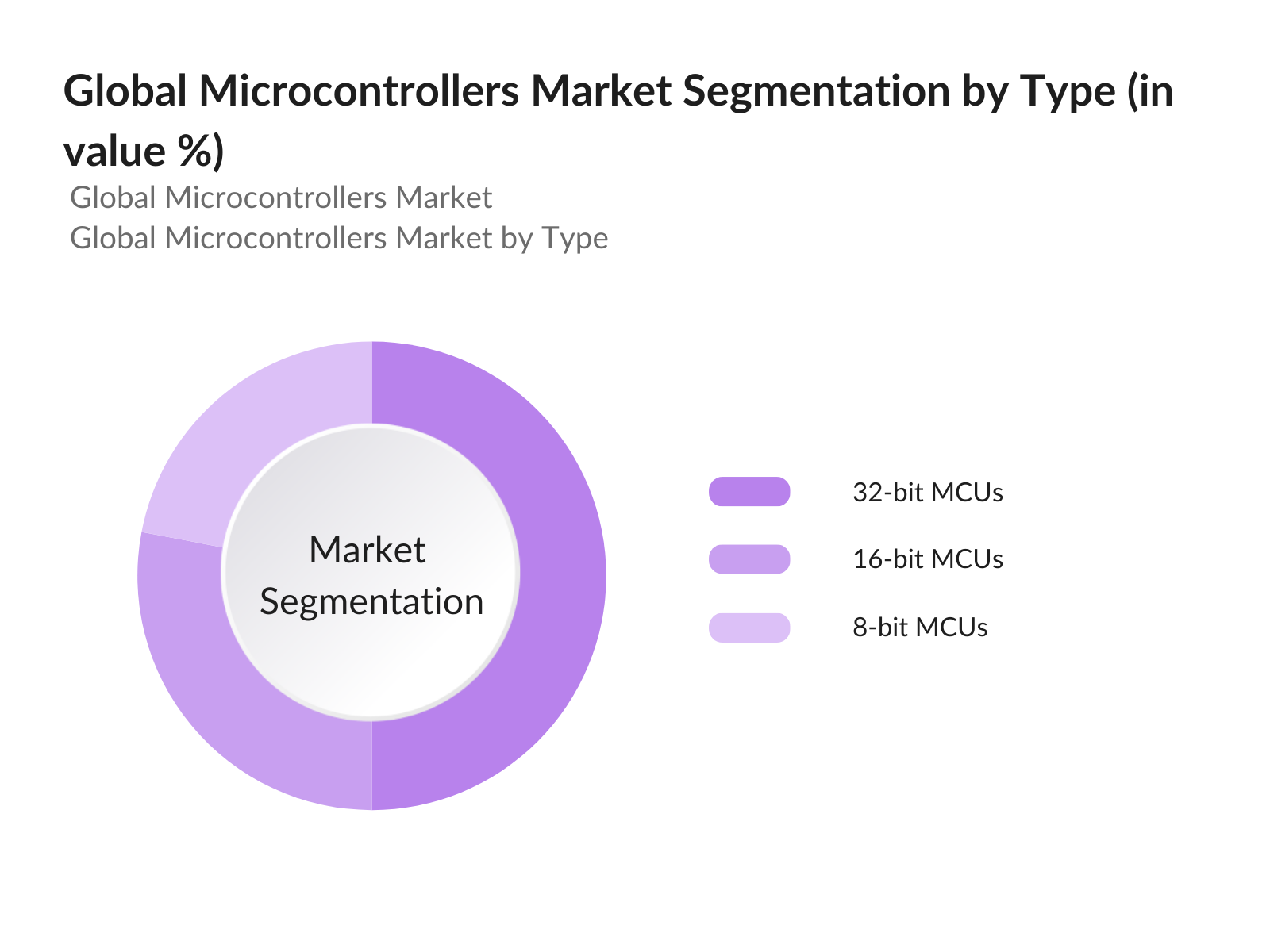
|
Type |
Market Share (2023) |
|---|---|
|
8-bit MCUs |
22% |
|
16-bit MCUs |
28% |
|
32-bit MCUs |
50% |
By Region: The global microcontrollers market is segmented by region into North America, Europe, Asia-Pacific, Middle East & Africa, and Latin America. Asia-Pacific holds the largest share, driven by the region's strong electronics manufacturing industry, particularly in China, Japan, and South Korea. The high demand for microcontrollers in consumer electronics and industrial automation in this region has made Asia-Pacific a dominant player in the global market.
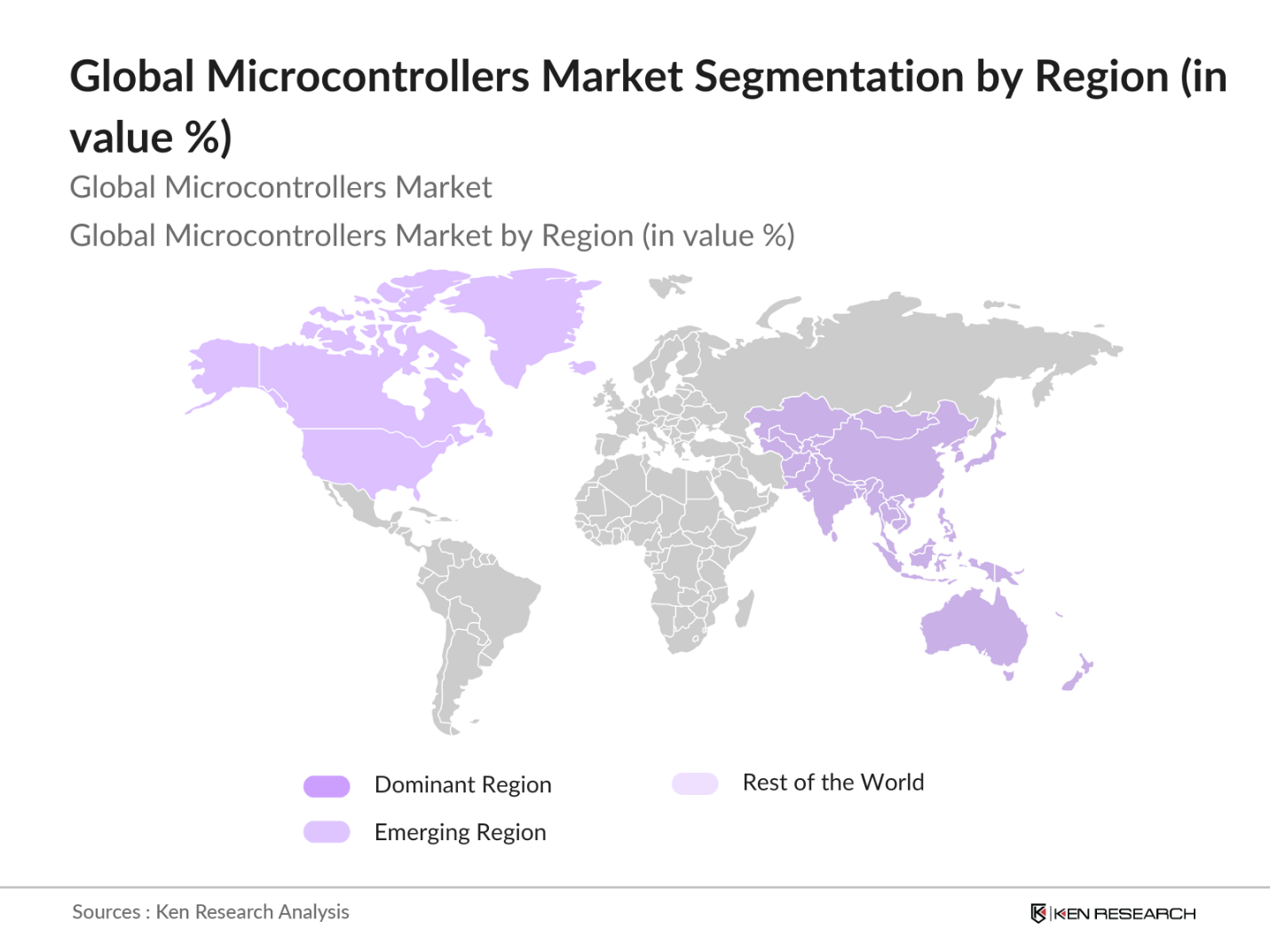
|
Region |
Market Share (2023) |
|---|---|
|
North America |
30% |
|
Europe |
20% |
|
Asia-Pacific |
35% |
|
Middle East & Africa |
10% |
|
Latin America |
5% |
The global microcontrollers market is dominated by key players that have a significant presence in the semiconductor industry. These companies are known for their continuous innovation, strong product portfolios, and investment in research and development (R&D). The competitive landscape is characterized by intense rivalry among these firms, with a focus on product differentiation, collaborations, and expansion into new markets.
|
Company |
Year Established |
Headquarters |
No. of Employees |
Annual Revenue (USD) |
Key Products |
R&D Investment |
Global Presence |
|
Microchip Technology Inc. |
1989 |
Chandler, Arizona, USA |
|||||
|
NXP Semiconductors |
2006 |
Eindhoven, Netherlands |
|||||
|
Renesas Electronics Corp. |
2010 |
Tokyo, Japan |
|||||
|
Texas Instruments |
1930 |
Dallas, Texas, USA |
|||||
|
STMicroelectronics |
1987 |
Geneva, Switzerland |
The global microcontrollers market is expected to witness significant growth in the coming years. Advancements in IoT, 5G, and AI will further fuel the demand for microcontrollers in smart devices and connected ecosystems. The automotive industrys shift towards electric and autonomous vehicles will remain a key driver, pushing for more powerful and efficient MCUs. Additionally, the growing importance of low-power consumption MCUs for wearable devices and medical applications will present new opportunities for market expansion.
|
By Type |
8-bit Microcontrollers 16-bit Microcontrollers 32-bit Microcontrollers |
|
By Application |
Automotive Consumer Electronics Industrial Automation Medical Devices |
|
By Technology |
Embedded Microcontrollers External Microcontrollers |
|
By Architecture |
Harvard Architecture Von Neumann Architecture |
|
By Region |
North America Europe Asia-Pacific Middle East & Africa Latin America |
Microchip Technology Inc.
1.1. Definition and Scope
1.2. Market Taxonomy
1.3. Market Growth Rate
1.4. Market Segmentation Overview
2.1. Historical Market Size
2.2. Year-On-Year Growth Analysis
2.3. Key Market Developments and Milestones
3.1. Growth Drivers (Microcontroller Unit Sales, Embedded Systems Adoption, Technological Advancements)
3.1.1. Rising Demand for Consumer Electronics
3.1.2. Increased Automation in Industrial Applications
3.1.3. Government Support for IoT Infrastructure
3.2. Market Challenges (Cost of High-Performance MCUs, Scalability Issues)
3.2.1. High Development Costs for Embedded Systems
3.2.2. Complex Design Processes
3.2.3. Security Vulnerabilities
3.3. Opportunities (Advancements in AI, IoT-Enabled Devices)
3.3.1. Smart Home Applications
3.3.2. Expansion in Automotive Sector
3.3.3. Emerging Markets Expansion
3.4. Trends (Integration of AI, Energy Efficiency in MCUs)
3.4.1. Rise of 32-bit Microcontrollers
3.4.2. Growing Demand for Low-Power MCUs
3.4.3. Adoption of Edge Computing
3.5. Government Regulations (Compliance with Environmental Standards)
3.5.1. National Microelectronics Policies
3.5.2. IoT Security Frameworks
3.6. SWOT Analysis
3.7. Stake Ecosystem
3.8. Porters Five Forces
3.9. Competitive Ecosystem
4.1. By Type (In Value %)
4.1.1. 8-bit Microcontrollers
4.1.2. 16-bit Microcontrollers
4.1.3. 32-bit Microcontrollers
4.2. By Application (In Value %)
4.2.1. Automotive
4.2.2. Consumer Electronics
4.2.3. Industrial Automation
4.2.4. Medical Devices
4.3. By Technology (In Value %)
4.3.1. Embedded Microcontrollers
4.3.2. External Microcontrollers
4.4. By Architecture (In Value %)
4.4.1. Harvard Architecture
4.4.2. Von Neumann Architecture
4.5. By Region (In Value %)
4.5.1. North America
4.5.2. Europe
4.5.3. Asia-Pacific
4.5.4. Middle East & Africa
4.5.5. Latin America
5.1. Detailed Profiles of Major Companies
5.1.1. Microchip Technology Inc.
5.1.2. NXP Semiconductors
5.1.3. Renesas Electronics Corporation
5.1.4. Texas Instruments
5.1.5. STMicroelectronics
5.1.6. Infineon Technologies
5.1.7. Analog Devices, Inc.
5.1.8. Cypress Semiconductor (Infineon)
5.1.9. Silicon Labs
5.1.10. Toshiba Corporation
5.1.11. Nordic Semiconductor
5.1.12. Maxim Integrated
5.1.13. Atmel Corporation (Microchip)
5.1.14. ON Semiconductor
5.1.15. Espressif Systems
5.2. Cross-Comparison Parameters (No. of Employees, Headquarters, Inception Year, Revenue, Market Share, Product Range, R&D Investment, Global Presence)
5.3. Market Share Analysis
5.4. Strategic Initiatives
5.5. Mergers and Acquisitions
5.6. Investment Analysis
5.7. Venture Capital Funding
5.8. Government Grants
5.9. Private Equity Investments
6.1. IoT Device Certification
6.2. Microcontroller Standards and Protocols
6.3. Environmental and Energy-Efficiency Regulations
7.1. Future Market Size Projections
7.2. Key Factors Driving Future Market Growth
8.1. By Type (In Value %)
8.2. By Application (In Value %)
8.3. By Technology (In Value %)
8.4. By Architecture (In Value %)
8.5. By Region (In Value %)
9.1. TAM/SAM/SOM Analysis
9.2. Customer Cohort Analysis
9.3. Marketing Initiatives
9.4. White Space Opportunity Analysis
In this initial step, we map the microcontrollers market's ecosystem, identifying major stakeholders, including semiconductor manufacturers, automotive companies, and consumer electronics producers. Extensive desk research and data from proprietary databases are used to identify the critical variables influencing market dynamics.
This step involves analyzing historical data on market trends, penetration rates, and revenue generation in the microcontrollers market. Various factors such as market maturity, technological advancements, and market penetration are evaluated to construct reliable revenue estimates.
Hypotheses about the market's growth drivers and challenges are validated through consultations with industry experts. These interviews provide insights into the operational and financial aspects of the market, complementing secondary research data.
Finally, a synthesis of all research inputs is conducted, including direct engagement with key manufacturers to gather data on product segments, sales performance, and consumer preferences. This ensures the final output is accurate and reflective of current market conditions.
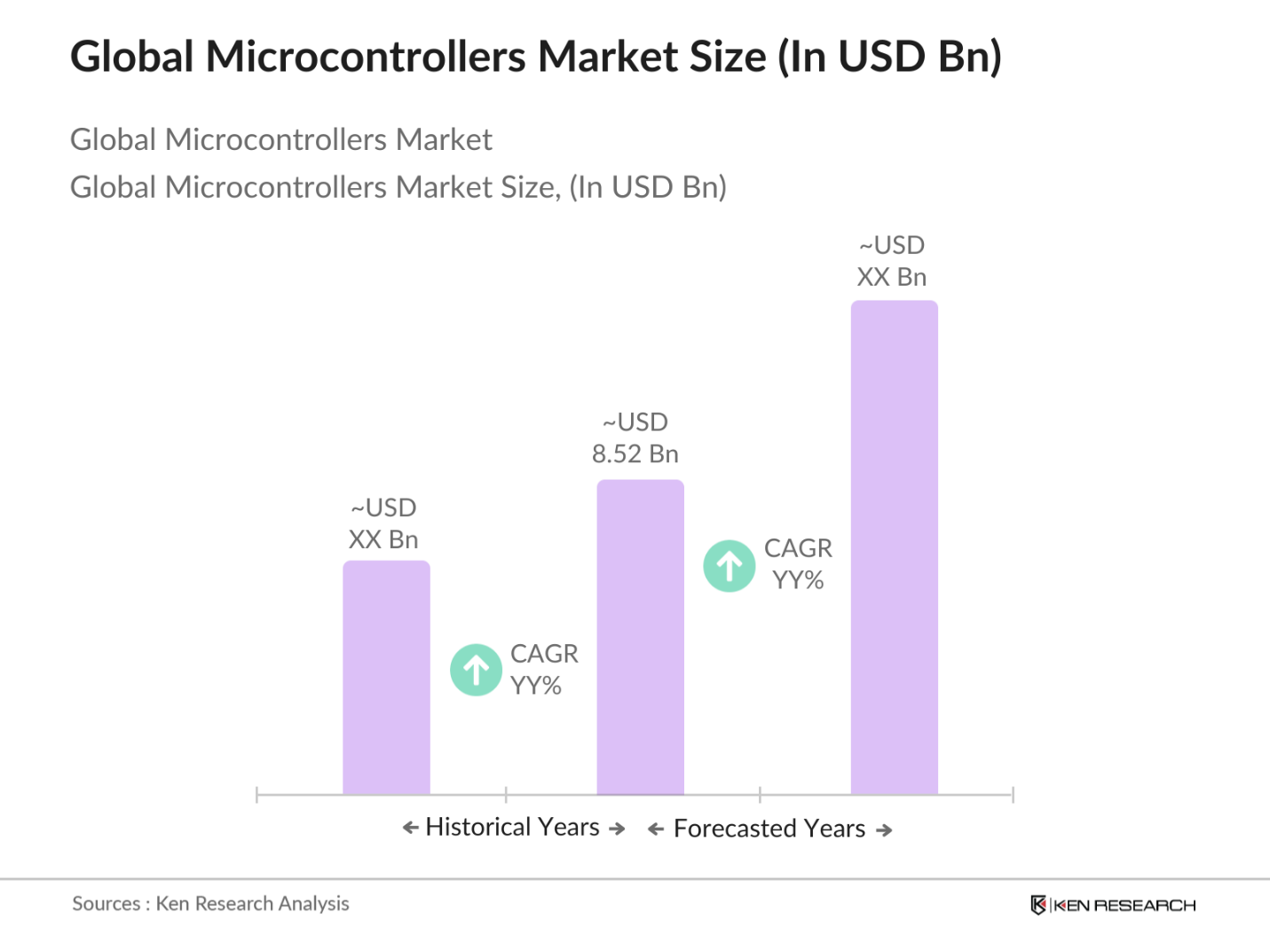
The global microcontrollers market is valued at USD 8.52 billion, driven by the rising adoption of embedded systems across industries such as automotive, consumer electronics, and industrial automation.
Challenges include the high cost of developing advanced MCUs, security vulnerabilities in IoT applications, and the complexity of designing microcontroller-based systems.
Key players include Microchip Technology Inc., NXP Semiconductors, Renesas Electronics Corporation, Texas Instruments, and STMicroelectronics, among others.
The market is driven by the rising demand for smart devices, connected ecosystems, and advanced automotive technologies like electric and autonomous vehicles.

What makes us stand out is that our consultants follows Robust, Refine and Result (RRR) methodology. i.e. Robust for clear definitions, approaches and sanity checking, Refine for differentiating respondents facts and opinions and Result for presenting data with story

We have set a benchmark in the industry by offering our clients with syndicated and customized market research reports featuring coverage of entire market as well as meticulous research and analyst insights.

While we don't replace traditional research, we flip the method upside down. Our dual approach of Top Bottom & Bottom Top ensures quality deliverable by not just verifying company fundamentals but also looking at the sector and macroeconomic factors.

With one step in the future, our research team constantly tries to show you the bigger picture. We help with some of the tough questions you may encounter along the way: How is the industry positioned? Best marketing channel? KPI's of competitors? By aligning every element, we help maximize success.

Our report gives you instant access to the answers and sources that other companies might choose to hide. We elaborate each steps of research methodology we have used and showcase you the sample size to earn your trust.

If you need any support, we are here! We pride ourselves on universe strength, data quality, and quick, friendly, and professional service.