
Global Military Night Vision Goggles Market Outlook to 2030
Region:Global
Author(s):Shambhavi
Product Code:KROD2228
December 2024
85
About the Report
Global Military Night Vision Goggles Market Overview
- In 2023, the global military night vision goggles (NVG) market reached a value of USD 5 billion, driven by increasing defense spending and the need for modernizing military equipment. This growth is attributed to rising geopolitical tensions and an increased demand for enhanced vision solutions in low-light conditions, further stimulated by technological advancements in night vision devices.
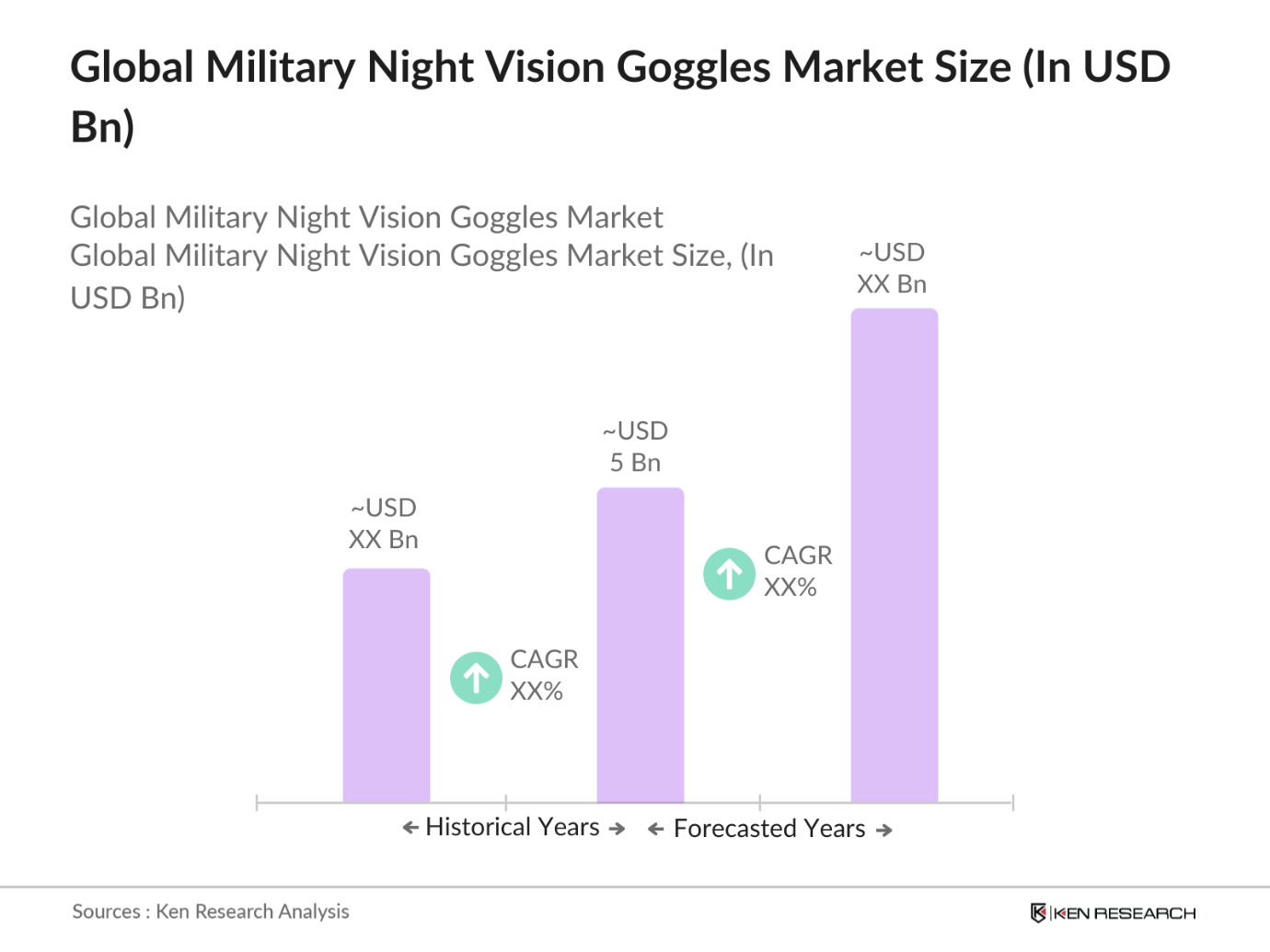
- Leading players in the military night vision goggles market include L3Harris Technologies, BAE Systems, Elbit Systems, FLIR Systems, and Thales Group. These companies dominate the market by offering advanced NVG products, many of which are integrated with features like thermal imaging, high-resolution optics, and enhanced durability. L3Harris, in particular, has maintained a significant market share due to its long-standing defense contracts and innovative product line, such as the ENVG-B (Enhanced Night Vision Goggle-Binocular).
- In June 2023, L3Harris Technologies announced a contract with the U.S. Army to supply next-generation ENVG-Bs to enhance the combat capabilities of U.S. soldiers. This development has increased L3Harris dominance in the military NVG market.
- In 2023, the European Defense Agency launched the Night Vision Enhancement Program (NVEP) with a 1.2 billion budget, aiming to equip military personnel across the European Union with state-of-the-art NVGs by 2025. Similarly, the U.S. Department of Defense's Night Vision Modernization Program, part of its 2024 defense spending bill, has allocated $800 million for R&D in next-generation night vision systems.
- The global military NVG market is dominated by cities with a strong defense manufacturing base, such as Huntsville (Alabama), Fort Worth (Texas), and Toulouse (France). These cities host key defense contractors, manufacturing plants, and research centers, contributing to their leadership in night vision technologies. The proximity to government defense agencies and military installations also facilitates collaboration and faster procurement cycles, reinforcing their dominance.
Global Military Night Vision Goggles Market Segmentation
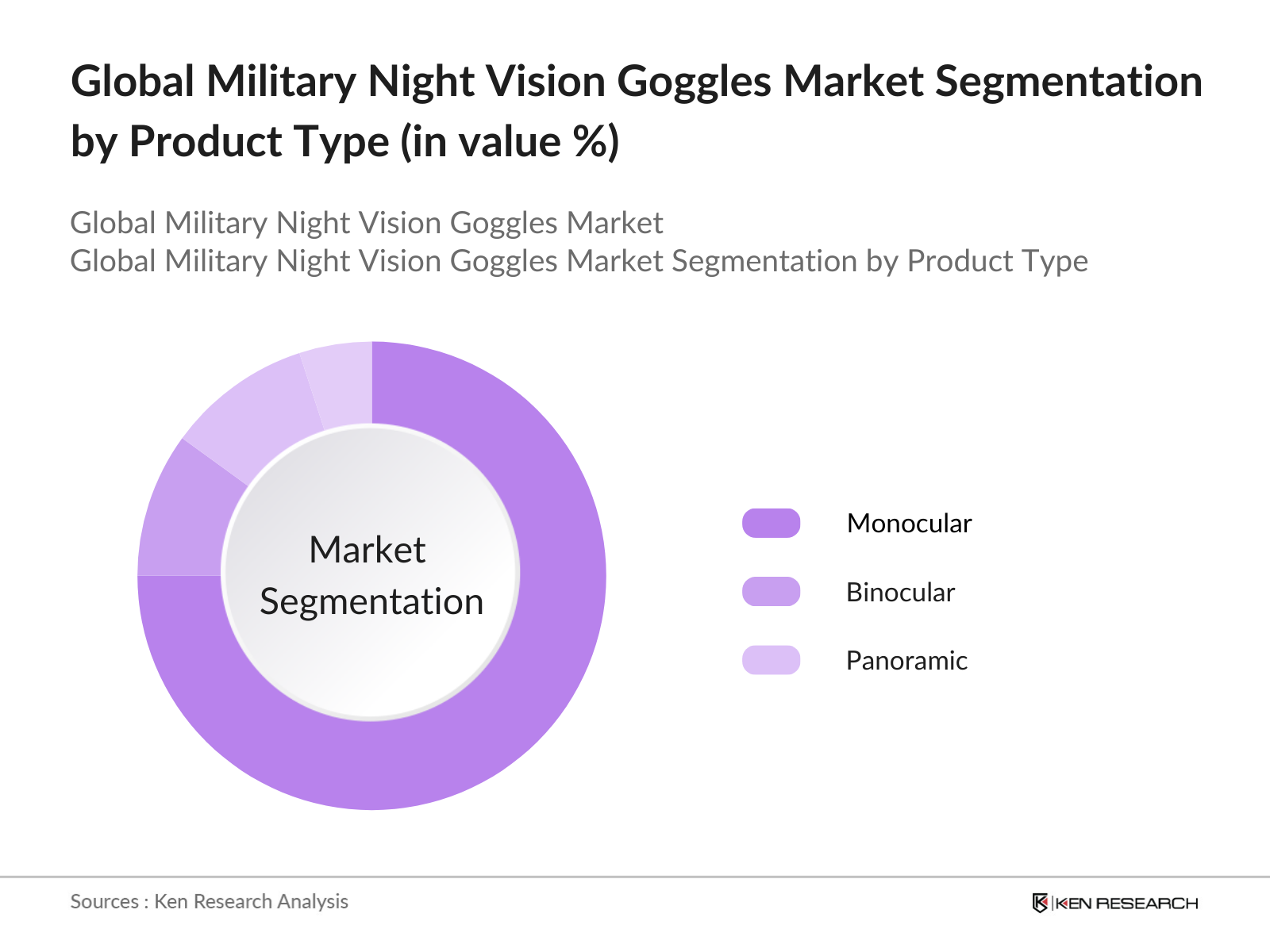
By Product Type: The military night vision goggles market is segmented by product type into monocular, binocular, and panoramic night vision goggles. In 2023, binocular NVGs held the largest market share, driven by their widespread use among military forces for tactical applications. Binocular NVGs provide enhanced depth perception and field of view, which are critical for ground combat operations. Additionally, their growing adoption in aviation has contributed to their dominance, particularly in countries with active air force programs.
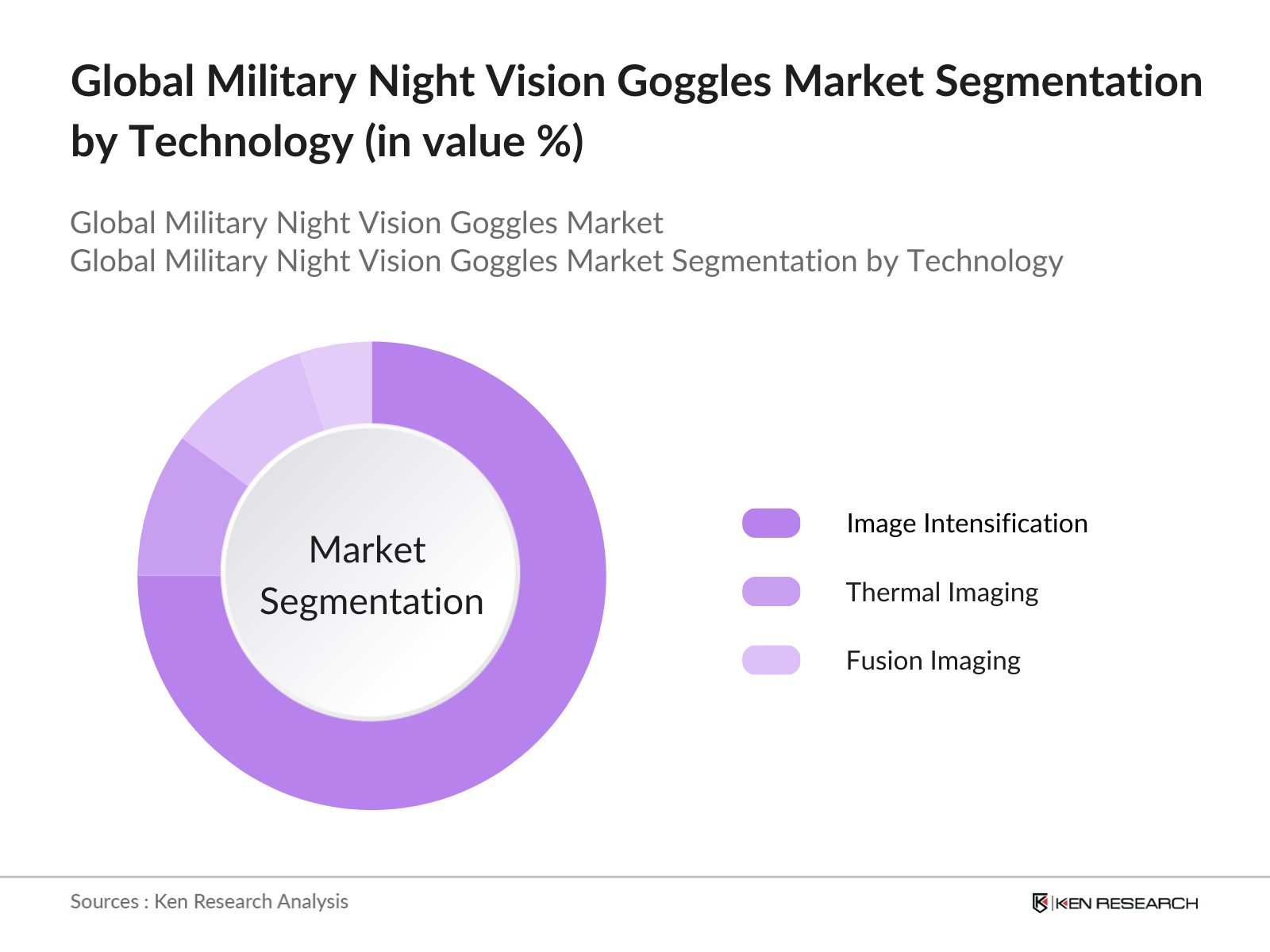
By Technology: The market is segmented by technology into image intensification, thermal imaging, and fusion imaging. In 2023, thermal imaging night vision goggles held the highest market share. Thermal imaging NVGs dominate due to their ability to detect heat signatures in complete darkness and adverse weather conditions. This capability is critical for modern warfare, where identifying hidden targets is essential for tactical advantage. Many countries have upgraded their NVGs to incorporate thermal technology for improved situational awareness.
By Region: The global military night vision goggles market is segmented into North America, Europe, Asia-Pacific (APAC), the Middle East & Africa (MEA), and Latin America. In 2023, North America accounted for the largest market share globally, led by the United States. The U.S. dominates the region due to its significant defense budget allocations and the rapid adoption of advanced night vision technologies. U.S. defense modernization programs, like the U.S. Armys ENVG-B procurement initiative, continue to drive the demand for next-generation night vision goggles. Canadas growing defense collaborations with NATO also contribute to regional market growth.
Global Military Night Vision Goggles Market Competitive Landscape
|
Company |
Establishment Year |
Headquarters |
|
L3Harris Technologies |
1895 |
Melbourne, Florida |
|
BAE Systems |
1999 |
London, United Kingdom |
|
Elbit Systems |
1966 |
Haifa, Israel |
|
FLIR Systems |
1978 |
Wilsonville, Oregon |
|
Thales Group |
1893 |
Paris, France |
L3Harris Technologies:
In 2024, L3Harris secured a $580 million contract with the U.S. Army for next-generation night vision goggles (ENVG-B), reinforcing its position as a market leader. The company also announced an expansion of its NVG production facility in Melbourne, Florida, to meet growing demand from the U.S. military and allied forces. In 2023, L3Harris increased its R&D spending by $250 million to accelerate the development of more advanced night vision technologies.
Elbit Systems:
In 2023, Elbit Systems won a 200 million contract from the European Defense Agency to supply advanced NVGs to several NATO countries. The company's innovative integration of augmented reality features into its night vision products has set it apart from competitors. Elbit Systems also announced a partnership with Leonardo in 2024 to co-develop a new generation of multi-functional NVGs, further consolidating its market leadership in Europe.
Growth Drivers
- Increased Defense Spending by Major Economies:
Global military budgets have surged significantly in recent years, driven by rising geopolitical tensions and the modernization of military equipment. In 2024, the U.S. Department of Defense allocated $858 billion to its defense budget, with a specific earmark of $1.5 billion for night vision technologies. Countries such as China and India have also increased their defense budgets, with Chinas 2024 budget reaching $229 billion. These substantial investments are fueling demand for advanced night vision systems, as modern warfare requires superior battlefield visibility in all lighting conditions. - Advancements in Thermal Imaging Technology:
The increasing integration of thermal imaging capabilities into night vision goggles is a key growth driver. In 2023, military procurement programs across Europe and North America prioritized the acquisition of thermal imaging-enabled NVGs. The U.S. Armys adoption of the ENVG-B (Enhanced Night Vision Goggle-Binocular), which integrates thermal imaging with standard night vision capabilities, is expected to boost demand. - Rising Geopolitical Tensions and Border Conflicts:
Increased border conflicts and geopolitical tensions have led to heightened demand for military night vision devices. Regions like the Middle East, where ongoing conflicts continue to drive defense procurements, are seeing increased purchases of NVGs. For example, in 2023, the Indian government announced the purchase of 50,000-night vision systems to secure its borders amid tensions with neighboring China. Similarly, NATO countries have accelerated their night vision procurement programs as part of a broader strategy to strengthen defence readiness.
Challenges
- High Costs of Advanced NVGs:
Military night vision goggles, especially those equipped with thermal imaging and augmented reality capabilities, remain expensive to produce. This high cost often limits procurement quantities, especially for countries with smaller defense budgets. In 2024, the average cost of a pair of advanced NVGs with integrated thermal imaging was estimated at $12,000, which creates financial challenges for some countries looking to modernize their night vision capabilities. For instance, in Southeast Asia, several defense ministries have cited budget constraints as a key hurdle in the procurement of modern NVGs . - Technological Limitations in Emerging Markets:
While advanced night vision technology is widely adopted in North America and Europe, emerging markets face technological limitations that hinder market growth. Many countries in Africa and South America still rely on older-generation NVGs due to lack of infrastructure and technological expertise. For example, in 2023, African military officials reported that their night vision capabilities lagged behind due to difficulties in accessing advanced manufacturing technologies required for modern NVGs. This technological gap continues to limit market penetration in these regions .
Government Initiatives
- European Defense Fund 2021-2027:
Launched by the European Union in 2021, the European Defense Fund (EDF) is a 8 billion initiative aimed at fostering collaborative defense research and development among EU member states. Part of this fund is allocated for the development of advanced night vision technologies. By 2023, the EDF had allocated 700 million specifically for next-generation NVGs, helping European defense industries remain competitive and technologically advanced . - U.S. Armys ENVG-B Procurement Program (2023):
In 2023, the U.S. Army announced the expansion of its Enhanced Night Vision Goggle-Binocular (ENVG-B) program, with plans to procure over 100,000 units by 2025. This procurement is part of the U.S. Armys broader modernization strategy, which includes a focus on improving soldier situational awareness and battlefield visibility. With a $1.5 billion budget earmarked for NVG technologies in 2024 alone, the program is expected to drive significant demand for advanced night vision systems .
Military Night Vision Goggles Market Future Outlook
The global military night vision goggles market is poised for significant growth over the next five years, driven by rising defense budgets, advancements in night vision technologies, and increasing demand from military forces worldwide. The market is expected to be shaped by the ongoing modernization programs in major economies, such as the United States, China, India, and several NATO countries. As these nations focus on upgrading their night vision capabilities, particularly in areas like thermal imaging and fusion technology, the demand for advanced NVGs will continue to rise. Additionally, geopolitical tensions and border conflicts are expected to further boost market demand.
Future Trends
- Augmented Reality Integration in NVGs:
The future of military night vision goggles will see a growing trend towards the integration of augmented reality (AR). AR will enable soldiers to access real-time battlefield information directly through their NVGs, enhancing situational awareness and decision-making in combat environments. This trend is expected to reshape how military personnel interact with their surroundings during nighttime operations. - Increased Adoption of Fusion Imaging:
Fusion imaging, which combines thermal imaging and traditional night vision capabilities, is anticipated to become more widespread in the coming years. This technology provides superior visibility in both low-light and no-light conditions, allowing soldiers to detect heat signatures and see through smoke or fog. The adoption of fusion imaging NVGs is likely to become standard for military forces worldwide by 2028.
Scope of the Report
|
By Product Type |
Monocular Binocular Panoramic |
|
By Technology |
Image Intensification Thermal Imaging Fusion Imaging |
|
By Region |
North America Europe Asia-Pacific (APAC) Middle East & Africa (MEA) Latin America |
Products
Key Target Audience Organizations and Entities Who Can Benefit by Subscribing This Report:
Military and Defense Contractors
Defense Ministries of Major Countries
Military Equipment Manufacturers
Night Vision Device Suppliers
Military Modernization Program Managers
Special Forces and Tactical Units
Aviation and Aerospace Defense Authorities
Ground Combat Vehicle Manufacturers
Homeland Security Departments
Border Patrol and Law Enforcement Agencies
Investors and Venture Capitalist Firms
Government and Regulatory Bodies (e.g., U.S. Department of Defense, European Defense Agency)
Time Period Captured in the Report:
Historical Period: 2018-2023
Base Year: 2023
Forecast Period: 2023-2028
Companies
Major Market Players
L3Harris Technologies
BAE Systems
Elbit Systems
FLIR Systems
Thales Group
Northrop Grumman
Leonardo
Rheinmetall AG
Collins Aerospace
Saab AB
Hensoldt AG
Raytheon Technologies
Safran Group
Harris Corporation
Bharat Electronics Limited
Table of Contents
1. Global Military Night Vision Goggles Market Overview
1.1. Definition and Scope
1.2. Market Taxonomy (Product Types, Technologies, Applications)
1.3. Market Growth Rate (Military Equipment Upgrades, Geopolitical Tensions)
1.4. Market Segmentation Overview (Product Type, Technology, Application, End-User, Region)
2. Global Military Night Vision Goggles Market Size (in USD)
2.1. Historical Market Size (Growth Analysis)
2.2. Year-on-Year Growth Analysis (2018-2023)
2.3. Key Market Milestones (Major Contracts, Military Upgrades, Global Defense Budgets)
3. Global Military Night Vision Goggles Market Analysis
3.1. Growth Drivers
3.1.1. Increasing Defense Budgets (Global Defense Spending by Country)
3.1.2. Technological Advancements in Night Vision (Thermal, Fusion, AI Integration)
3.1.3. Rising Geopolitical Tensions (Border Disputes, Global Conflicts)
3.2. Restraints
3.2.1. High Costs of Advanced NVGs (Financial Barriers for Smaller Nations)
3.2.2. Strict Export Regulations (ITAR, Global Trade Compliance)
3.2.3. Technological Gaps in Emerging Markets (Limited Adoption, Older Technology)
3.3. Opportunities
3.3.1. Expanding Military Modernization Programs (U.S., China, NATO)
3.3.2. Growing Demand from Law Enforcement and Border Patrol (Non-Military Applications)
3.3.3. International Collaborations and Defense Partnerships (Joint Ventures, R&D Programs)
3.4. Trends
3.4.1. Integration of Augmented Reality in NVGs
3.4.2. Adoption of Fusion Imaging for Advanced Tactical Awareness
3.4.3. Lightweight and Compact NVG Development for Enhanced Mobility
3.5. Government Regulations
3.5.1. U.S. ITAR and Night Vision Export Controls
3.5.2. European Union Defense Procurement Regulations
3.5.3. Regional NVG Acquisition Guidelines (Asia-Pacific, Middle East, Europe)
3.6. SWOT Analysis (Military Night Vision Goggles Market)
3.7. Stakeholder Ecosystem (Manufacturers, Governments, Military Contractors)
3.8. Competition Ecosystem (Key Market Competitors and Industry Players)
4. Global Military Night Vision Goggles Market Segmentation
4.1. By Product Type (in Value %)
4.1.1. Monocular Night Vision Goggles
4.1.2. Binocular Night Vision Goggles
4.1.3. Panoramic Night Vision Goggles
4.2. By Technology (in Value %)
4.2.1. Image Intensification
4.2.2. Thermal Imaging
4.2.3. Fusion Imaging (Multi-Sensor Capabilities)
4.3. By Application (in Value %)
4.3.1. Ground Forces
4.3.2. Aviation
4.3.3. Naval Operations
4.4. By End-User (in Value %)
4.4.1. Military (Army, Air Force, Navy)
4.4.2. Law Enforcement
4.4.3. Border Patrol and Homeland Security
4.5. By Region (in Value %)
4.5.1. North America
4.5.2. Europe (Germany, France, UK, Sweden, Italy, Rest of Europe)
4.5.3. Asia-Pacific (China, India, Japan, South Korea, Australia)
4.5.4. Middle East & Africa (Saudi Arabia, Israel, UAE, Egypt, South Africa)
4.5.5. Latin America (Brazil, Mexico, Argentina)
5. Competitive Landscape
5.1. Market Share Analysis (Leading Players Market Share by Value)
5.2. Strategic Initiatives (New Product Launches, Defense Contracts, Collaborations)
5.3. Mergers and Acquisitions (Major Deals, Defense Industry Consolidation)
5.4. Investment Analysis
5.4.1. Government Defense Funding (Grants, Contracts)
5.4.2. Venture Capital and Private Equity Investments in NVG Technologies
5.4.3. Public and Private Defense R&D Investments
5.5. Cross-Comparison of Competitors
5.5.1. L3Harris Technologies
5.5.2. BAE Systems
5.5.3. Elbit Systems
5.5.4. FLIR Systems
5.5.5. Thales Group
5.5.6. Leonardo S.p.A.
5.5.7. Rheinmetall AG
5.5.8. Northrop Grumman
5.5.9. Collins Aerospace
5.5.10. Hensoldt AG
5.5.11. Raytheon Technologies
5.5.12. Safran Group
5.5.13. Bharat Electronics Limited
5.5.14. Lockheed Martin
5.5.15. Saab AB
5.6. Cross-Comparison Parameters (No. of Employees, Headquarters, Revenue, Defense Contracts)
6. Global Military Night Vision Goggles Market Regulatory Framework
6.1. International Arms Export Regulations (ITAR, Wassenaar Agreement)
6.2. Military Procurement Standards (NATO Standards, National Defense Guidelines)
6.3. Certification Requirements (Safety, Performance, Compliance)
6.4. Government Policy Shifts Impacting Night Vision Devices (Defense Budgets, Procurement Policies)
6.5. Export Controls by Country (U.S., Europe, Asia-Pacific)
7. Future Market Size (Global Military Night Vision Goggles Market Projections)
7.1. Future Market Size Projections (2024-2028)
7.2. Key Factors Driving Future Market Growth (Defense Modernization, Geopolitical Tensions)
7.3. Future Market Developments (Technological Advancements, Strategic Contracts)
8. Future Market Segmentation
8.1. By Product Type (Future Market Share Projections)
8.1.1. Monocular NVGs
8.1.2. Binocular NVGs
8.1.3. Panoramic NVGs
8.2. By Technology (Future Market Share Projections)
8.2.1. Image Intensification
8.2.2. Thermal Imaging
8.2.3. Fusion Imaging
8.3. By Application (Future Market Share Projections)
8.3.1. Ground Forces
8.3.2. Aviation
8.3.3. Naval Operations
8.4. By Region (Future Market Share Projections)
8.4.1. North America
8.4.2. Europe
8.4.3. Asia-Pacific
8.4.4. Middle East & Africa
8.4.5. Latin America
9. Analysts Recommendations
9.1. Total Addressable Market (TAM), Serviceable Addressable Market (SAM), Serviceable Obtainable Market (SOM) Analysis
9.2. White Space Opportunity Analysis (Untapped Markets, Product Gaps)
9.3. Customer Cohort Analysis (Key Military, Law Enforcement, and Government Clients)
9.4. Key Marketing Initiatives (Branding, Market Penetration Strategies)
10. Disclaimer
11. Contact Us
Research Methodology
Step 1: Identifying Key Variables
Ecosystem creation for all major entities and referring to multiple secondary and proprietary databases to perform desk research around the market to collate market-level information.
Step 2: Market Building
Collating statistics on the Global military night vision goggles market over the years, analyzing the penetration of military night vision goggles technologies, and computing the revenue generated for the market. This step also involves reviewing technology adoption rates and application effectiveness to ensure accuracy behind the data points shared.
Step 3: Validating and Finalizing
Building market hypotheses and conducting CATIs with market experts belonging to different companies to validate statistics and seek operational and financial information from company representatives.
Step 4: Research Output
Our team will approach multiple military night vision goggles companies to understand the nature of technology segments, consumer preferences, and other parameters. this supports validating statistics derived through a bottom-to-top approach from these military night vision goggles Companies, ensuring accuracy and reliability in the report.
Frequently Asked Questions
01. How big is the global military night vision goggles market?
The global military night vision goggles market was valued at $5.8 billion in 2023, driven by increasing defense budgets, modernization of military equipment, and rising demand for enhanced vision systems in low-light conditions.
02. What are the challenges in the global military night vision goggles market?
Challenges in the global military night vision goggles market include high production costs of advanced NVGs, strict export regulations, and technological limitations in emerging markets, which restrict widespread adoption of modern night vision technologies.
03. Who are the major players in the global military night vision goggles market?
Key players in the global military night vision goggles market include L3Harris Technologies, BAE Systems, Elbit Systems, FLIR Systems, and Thales Group, with these companies dominating due to their cutting-edge products and longstanding defense contracts.
04. What are the growth drivers of the global military night vision goggles market?
Growth drivers include rising defense spending by major economies, advancements in thermal imaging technologies, and heightened demand from military forces due to geopolitical tensions and border conflicts across various regions.
05. What government initiatives are shaping the global military night vision goggles market?
Government initiatives such as the European Defense Fund 2021-2027 and the U.S. Armys ENVG-B Procurement Program are driving demand for next-generation night vision technologies by providing significant funding for modernization programs.
Why Buy From Us?

What makes us stand out is that our consultants follows Robust, Refine and Result (RRR) methodology. i.e. Robust for clear definitions, approaches and sanity checking, Refine for differentiating respondents facts and opinions and Result for presenting data with story

We have set a benchmark in the industry by offering our clients with syndicated and customized market research reports featuring coverage of entire market as well as meticulous research and analyst insights.

While we don't replace traditional research, we flip the method upside down. Our dual approach of Top Bottom & Bottom Top ensures quality deliverable by not just verifying company fundamentals but also looking at the sector and macroeconomic factors.

With one step in the future, our research team constantly tries to show you the bigger picture. We help with some of the tough questions you may encounter along the way: How is the industry positioned? Best marketing channel? KPI's of competitors? By aligning every element, we help maximize success.

Our report gives you instant access to the answers and sources that other companies might choose to hide. We elaborate each steps of research methodology we have used and showcase you the sample size to earn your trust.

If you need any support, we are here! We pride ourselves on universe strength, data quality, and quick, friendly, and professional service.