
Global Military Trucks Market Outlook to 2030
Region:Global
Author(s):Naman Rohilla
Product Code:KROD5374
December 2024
88
About the Report
Global Military Trucks Market Overview
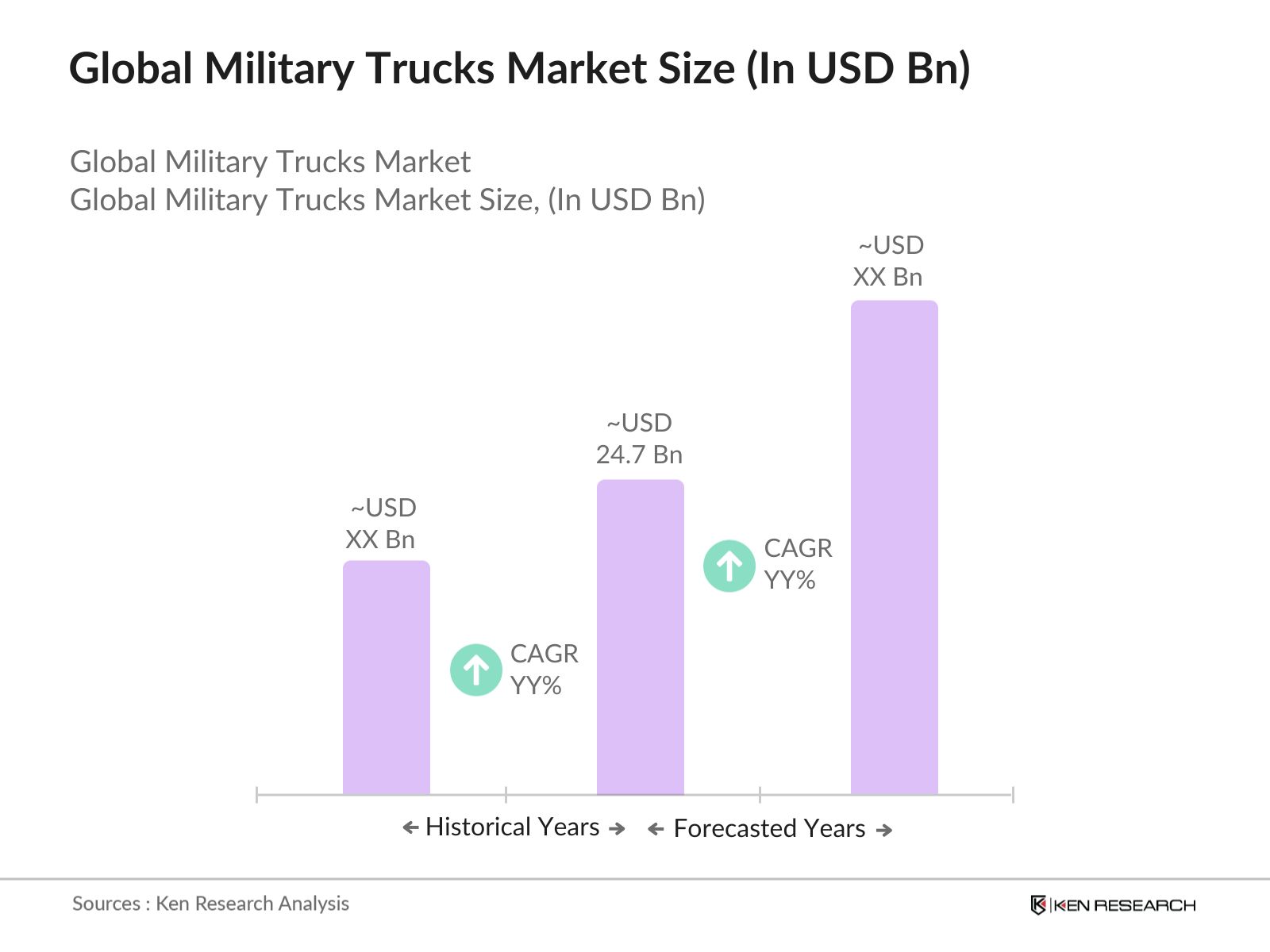
- The Global Military Trucks market, based on a detailed analysis of market conditions, was valued at USD 24.7 billion. This market has been primarily driven by increased defence spending across multiple regions, especially in North America and Europe, where geopolitical tensions have led to higher investments in modernizing military fleets. The rising need for fleet expansion, replacement programs, and technological advancements in military logistics are key driving factors. The adoption of armored vehicles with advanced features like enhanced mobility, survivability, and off-road capabilities is also contributing to market growth.
- The dominance of the Global Military Trucks market is led by countries such as the United States, China, and Russia due to their large defence budgets and continuous efforts to modernize their military forces. The United States, with its investments in the military, leads in innovations such as autonomous trucks and fuel-efficient hybrid models, while China and Russia focus on expanding their military presence and technological advancements. The robust defence industrial base in these countries allows them to maintain a stronghold in the global market.
- Government procurement policies are heavily influencing the military truck market. In 2024, the U.S. Congress passed the Defence Acquisition Act, which mandates that at least 50% of components for military trucks be sourced domestically. This regulation aims to strengthen national defence industries while ensuring compliance with military standards. Similarly, countries like India have introduced local content requirements for defence procurements, encouraging domestic production and reducing reliance on imports. These policies impacting manufacturers' supply chains and sourcing strategies.
Global Military Trucks Market Segmentation
- By Truck Type: The Global Military Trucks market is segmented by truck type into light military trucks, medium military trucks, and heavy military trucks. Among these, heavy military trucks hold the dominant market share due to their capability to transport heavy equipment and personnel across difficult terrains, making them essential for military logistics. Their high demand in large-scale military operations and defence missions has further solidified their position in the market. Additionally, heavy trucks are equipped with advanced communication systems, enhancing their operational efficiency and increasing their adoption globally.

- By Application: The military trucks market is also segmented by application into troop transport, cargo/logistics support, fuel transport, and armored/combat support. Cargo/logistics support is the leading application segment due to the increasing focus on enhancing supply chain resilience in military operations. Efficient logistics are essential for modern warfare, where timely supply and mobility are crucial for mission success. Military trucks used in logistics are equipped with the latest navigation and monitoring systems, further driving the segments growth.
- By Region: The Global Military Trucks market is segmented regionally into North America, Europe, Asia-Pacific, the Middle East and Africa, and Latin America. North America dominates the market, with the United States contributing due to its vast defence budget and ongoing investment in cutting-edge military technology. The North American region also benefits from a strong defence industrial base, capable of producing advanced military vehicles that meet modern warfare requirements. Furthermore, the focus on upgrading military infrastructure across Canada has also contributed to regional market growth.

Global Military Trucks Market Competitive Landscape
The Global Military Trucks market is dominated by several major players, ranging from defence contractors to commercial truck manufacturers with military divisions. These companies have built expertise in producing highly specialized vehicles that meet the rigorous requirements of modern military forces. The competitive landscape is shaped by technological innovations, strategic alliances, and acquisitions, which help companies maintain their market position.
|
Company |
Establishment Year |
Headquarters |
No. of Employees |
Military Contracts |
R&D Expenditure |
No. of Vehicles Delivered |
Geographical Reach |
Market Share |
|
Oshkosh Corporation |
1917 |
U.S. |
- |
- |
- |
- |
- |
- |
|
Rheinmetall AG |
1889 |
Germany |
- |
- |
- |
- |
- |
- |
|
Daimler AG |
1926 |
Germany |
- |
- |
- |
- |
- |
- |
|
Tata Motors |
1945 |
India |
- |
- |
- |
- |
- |
- |
|
Navistar Defence |
1982 |
U.S. |
- |
- |
- |
- |
- |
- |
Global Military Trucks Market Analysis
Global Military Trucks Market Growth Drivers
- Defence Modernization: Defence modernization continues to drive demand for military trucks. In 2024, the U.S. Department of Defence allocated $773 billion to its defence budget, with a substantial portion directed toward enhancing ground combat capabilities. Modernization programs, such as the Joint Light Tactical Vehicle (JLTV) project, emphasize replacing outdated trucks with advanced models featuring improved mobility and protection systems. Additionally, in response to the shift in military strategies, countries like China and India have increased defence spending to bolster their capabilities, reflecting the global trend toward more sophisticated military truck technology.
- Increased Defence Expenditure: Increased defence expenditure in major countries is a primary growth driver for the military truck market. The global defence spending reached $2.2 trillion in 2023, as reported by the Stockholm International Peace Research Institute (SIPRI). The rise in geopolitical tensions, especially in Eastern Europe and Asia-Pacific, has prompted countries like Germany to increase their defence budget by nearly 10%, contributing to the growing demand for advanced military trucks. These investments are not limited to combat vehicles but extend to logistics and transportation fleets, which are critical for operational mobility.
- Fleet Replacement Programs: Many nations are replacing aging military truck fleets to maintain operational readiness. For example, the United Kingdoms Ministry of Defence has initiated a 1.5 billion program to replace over 2,000 aging military trucks by 2025. Similarly, the U.S. Armys plan to replace over 10,000 High Mobility Multipurpose Wheeled Vehicles (HMMWVs) through the JLTV program is well underway, with deliveries projected to continue through 2024. These fleet replacement programs are driven by the need for more resilient, technologically advanced trucks capable of withstanding modern combat environments.
Global Military Trucks Market Challenges
- High Production and Maintenance Costs: The complexity of manufacturing and maintaining military trucks is a major challenge for defence forces. For example, the U.S. military spends $16 billion annually on vehicle maintenance and repairs, with a substantial portion allocated to military trucks. These vehicles often require specialized parts and services, driving up maintenance costs. Additionally, the development of advanced trucks, such as those with armored protection and autonomous capabilities, increases production costs, limiting procurement budgets for many nations.
- Stringent Military Specifications: Meeting stringent military specifications and performance requirements poses challenges for manufacturers. Trucks must comply with rigorous standards for armor, payload capacity, and off-road mobility. For instance, the U.S. militarys requirements for the JLTV include a payload of up to 5,100 pounds and the ability to operate in extreme weather conditions. This level of specification drives up costs and can delay production, especially as military forces worldwide adopt similar high-performance standards for their vehicles.
Global Military Trucks Market Future Outlook
The Global Military Trucks market is expected to experience sustained growth in the coming years, driven by increasing geopolitical tensions, the modernization of military fleets, and technological advancements such as the adoption of electric and autonomous military vehicles. Governments worldwide are expected to continue investing in military logistics infrastructure, which includes the procurement of next-generation trucks equipped with advanced communication systems and increased survivability.
Global Military Trucks Market Opportunities
- Rise in Unmanned Military Trucks: The development and deployment of unmanned military trucks represent a major growth opportunity. By 2024, the U.S. Army had successfully tested unmanned trucks equipped with autonomous driving systems, including advanced AI navigation capabilities. The potential for these trucks to reduce casualties in combat zones is driving global interest. Several other nations, including Israel and China, are investing heavily in unmanned vehicle programs, creating a burgeoning market for autonomous military logistics trucks.
- Collaboration with Defence: Public-private partnerships and joint ventures are unlocking opportunities in the military truck market. In 2024, Rheinmetall partnered with the Australian government in a $3 billion deal to develop and supply advanced military trucks. These collaborations are crucial in fostering innovation and ensuring that defence departments have access to cutting-edge technology. With more governments worldwide encouraging private sector involvement in defence projects, there is a growing potential for partnerships that can expedite the development and delivery of next-generation military trucks.
Scope of the Report
|
By Truck Type |
Light Military Trucks Medium Military Trucks Heavy Military Trucks |
|
By Application |
Troop Transport Cargo/Logistics Support Fuel Transport Armored/Combat Support |
|
By Drive Type |
4x4 6x6 8x8 |
|
By Fuel Type |
Diesel Hybrid/Electric Gasoline |
|
By Region |
North America Europe Asia-Pacific Middle East and Africa Latin America |
Products
Key Target Audience
Military Procurement Agencies (e.g., U.S. Department of Defence, Indian Ministry of Defence)
Vehicle Manufacturers and Suppliers
Investors and Venture Capitalist Firms
Banks and Financial Institutions
Government and Regulatory Bodies (e.g., NATO, European Defence Agency)
Logistics and Supply Chain Companies
Defence Contractors and Integrators
Armed Forces and Military Organizations
Fuel and Energy Providers for Military Fleets
Companies
Players Mentioned in the Report
Oshkosh Corporation
Rheinmetall AG
Daimler AG
Tata Motors
BAE Systems
Iveco Defence Vehicles
Navistar Defence
Scania AB
MAN Truck & Bus
General Dynamics
Table of Contents
1. Global Military Trucks Market Overview
1.1. Definition and Scope
1.2. Market Taxonomy
1.3. Market Growth Rate
1.4. Market Segmentation Overview
2. Global Military Trucks Market Size (In USD Bn)
2.1. Historical Market Size
2.2. Year-On-Year Growth Analysis
2.3. Key Market Developments and Milestones
3. Global Military Trucks Market Analysis
3.1. Growth Drivers
3.1.1. Defence Modernization (budget allocation, military strategy shifts)
3.1.2. Increased Defence Expenditure (military investments, geopolitical tensions)
3.1.3. Technological Advancements (armored vehicle innovations, autonomy in trucks)
3.1.4. Fleet Replacement Programs (aging fleet replacement demand)
3.2. Market Challenges
3.2.1. High Production and Maintenance Costs (complex manufacturing, serviceability)
3.2.2. Stringent Military Specifications (compliance to military standards, performance requirements)
3.2.3. Geopolitical Trade Restrictions (import-export limitations, sanctions)
3.3. Opportunities
3.3.1. Rise in Unmanned Military Trucks (integration of AI, autonomous driving systems)
3.3.2. Collaboration with Defence Departments (public-private partnerships, joint ventures)
3.3.3. Expansion in Emerging Markets (regional military strength growth, new defence alliances)
3.4. Trends
3.4.1. Adoption of Electric and Hybrid Military Trucks (decarbonization, fuel efficiency)
3.4.2. Smart Technology Integration (communication systems, surveillance, IoT)
3.4.3. Focus on Survivability and Armor Enhancements (composite materials, advanced protection systems)
3.5. Government Regulations
3.5.1. Defence Procurement Policies (local sourcing requirements, compliance regulations)
3.5.2. Import/Export Control Regulations (military truck trade restrictions)
3.5.3. Emission Standards for Military Vehicles (fuel efficiency targets, green military strategies)
3.6. SWOT Analysis
3.7. Stake Ecosystem
3.8. Porters Five Forces Analysis
3.9. Competition Ecosystem
4. Global Military Trucks Market Segmentation
4.1. By Truck Type (In Value %)
4.1.1. Light Military Trucks
4.1.2. Medium Military Trucks
4.1.3. Heavy Military Trucks
4.2. By Application (In Value %)
4.2.1. Troop Transport
4.2.2. Cargo/Logistics Support
4.2.3. Fuel Transport
4.2.4. Armored/Combat Support
4.3. By Drive Type (In Value %)
4.3.1. 4x4
4.3.2. 6x6
4.3.3. 8x8
4.4. By Fuel Type (In Value %)
4.4.1. Diesel
4.4.2. Hybrid/Electric
4.4.3. Gasoline
4.5. By Region (In Value %)
4.5.1. North America
4.5.2. Europe
4.5.3. Asia-Pacific
4.5.4. Middle East and Africa
4.5.5. Latin America
5. Global Military Trucks Market Competitive Analysis
5.1 Detailed Profiles of Major Competitors
5.1.1. Oshkosh Corporation
5.1.2. Rheinmetall AG
5.1.3. Daimler AG
5.1.4. Tata Motors
5.1.5. BAE Systems
5.1.6. Iveco Defence Vehicles
5.1.7. Navistar Defence
5.1.8. Scania AB
5.1.9. MAN Truck & Bus
5.1.10. General Dynamics
5.1.11. Volvo Trucks
5.1.12. Thales Group
5.1.13. Renault Trucks Defence
5.1.14. Mitsubishi Heavy Industries
5.1.15. Ashok Leyland
5.2 Cross Comparison Parameters (No. of Employees, Military Contracts, R&D Expenditure, Geographical Reach, No. of Military Units Delivered, Headquarters, Revenue, Market Share)
5.3 Market Share Analysis
5.4 Strategic Initiatives
5.5 Mergers And Acquisitions
5.6 Investment Analysis
5.7 Joint Ventures/Alliances
5.8 Defence Contracts Awarded
6. Global Military Trucks Market Regulatory Framework
6.1. Defence Acquisition Procedures
6.2. Certification and Compliance
6.3. Vehicle Armament and Armor Standards
7. Global Military Trucks Future Market Size (In USD Bn)
7.1. Future Market Size Projections
7.2. Key Factors Driving Future Market Growth
8. Global Military Trucks Future Market Segmentation
8.1. By Truck Type (In Value %)
8.2. By Application (In Value %)
8.3. By Drive Type (In Value %)
8.4. By Fuel Type (In Value %)
8.5. By Region (In Value %)
9. Global Military Trucks Market Analysts Recommendations
9.1. TAM/SAM/SOM Analysis
9.2. Customer Cohort Analysis
9.3. Strategic Marketing Initiatives
9.4. White Space Opportunity Analysis
Research Methodology
Step 1: Identification of Key Variables
The initial research phase includes the mapping of stakeholders within the Global Military Trucks Market, using a combination of desk research and proprietary databases. This ensures the identification of critical variables affecting the market, such as fleet modernization trends, defence budgets, and procurement policies.
Step 2: Market Analysis and Construction
Historical market data is compiled to assess the penetration of military trucks and the ratio of supply-demand within various regions. This analysis provides insights into market growth drivers and key challenges, facilitating the formulation of accurate market forecasts.
Step 3: Hypothesis Validation and Expert Consultation
Insights from industry experts are gathered through interviews to validate market hypotheses. These experts provide key operational and financial information, which is incorporated into the analysis to ensure data accuracy.
Step 4: Research Synthesis and Final Output
The final step synthesizes insights from both primary and secondary research, providing a holistic view of the market. This synthesis includes product segment analysis, regional performance, and competitive landscape assessment.
Frequently Asked Questions
01. How big is the Global Military Trucks Market?
The Global Military Trucks Market is valued at USD 24.7 billion, driven by defence investments and modernization programs across multiple regions.
02. What are the challenges in the Global Military Trucks Market?
Key challenges in the Global Military Trucks Market include high production and maintenance costs, as well as strict compliance with military standards. Geopolitical trade restrictions and sanctions also pose risks to market growth.
03. Who are the major players in the Global Military Trucks Market?
Major players in the Global Military Trucks Market include Oshkosh Corporation, Rheinmetall AG, Daimler AG, Tata Motors, and Navistar Defence. These companies dominate the market through extensive defence contracts and advanced R&D capabilities.
04. What are the growth drivers of the Global Military Trucks Market?
The Global Military Trucks Market Growth is propelled by increasing defence budgets, technological innovations such as autonomous vehicles, and the need for fleet modernization in response to evolving military needs.
Why Buy From Us?

What makes us stand out is that our consultants follows Robust, Refine and Result (RRR) methodology. i.e. Robust for clear definitions, approaches and sanity checking, Refine for differentiating respondents facts and opinions and Result for presenting data with story

We have set a benchmark in the industry by offering our clients with syndicated and customized market research reports featuring coverage of entire market as well as meticulous research and analyst insights.

While we don't replace traditional research, we flip the method upside down. Our dual approach of Top Bottom & Bottom Top ensures quality deliverable by not just verifying company fundamentals but also looking at the sector and macroeconomic factors.

With one step in the future, our research team constantly tries to show you the bigger picture. We help with some of the tough questions you may encounter along the way: How is the industry positioned? Best marketing channel? KPI's of competitors? By aligning every element, we help maximize success.

Our report gives you instant access to the answers and sources that other companies might choose to hide. We elaborate each steps of research methodology we have used and showcase you the sample size to earn your trust.

If you need any support, we are here! We pride ourselves on universe strength, data quality, and quick, friendly, and professional service.