















Global Motor Market Outlook to 2030
Region:Global
Author(s):Paribhasha Tiwari
Product Code:KROD3023
October 2024
84
About the Report
Global Motor Market Overview
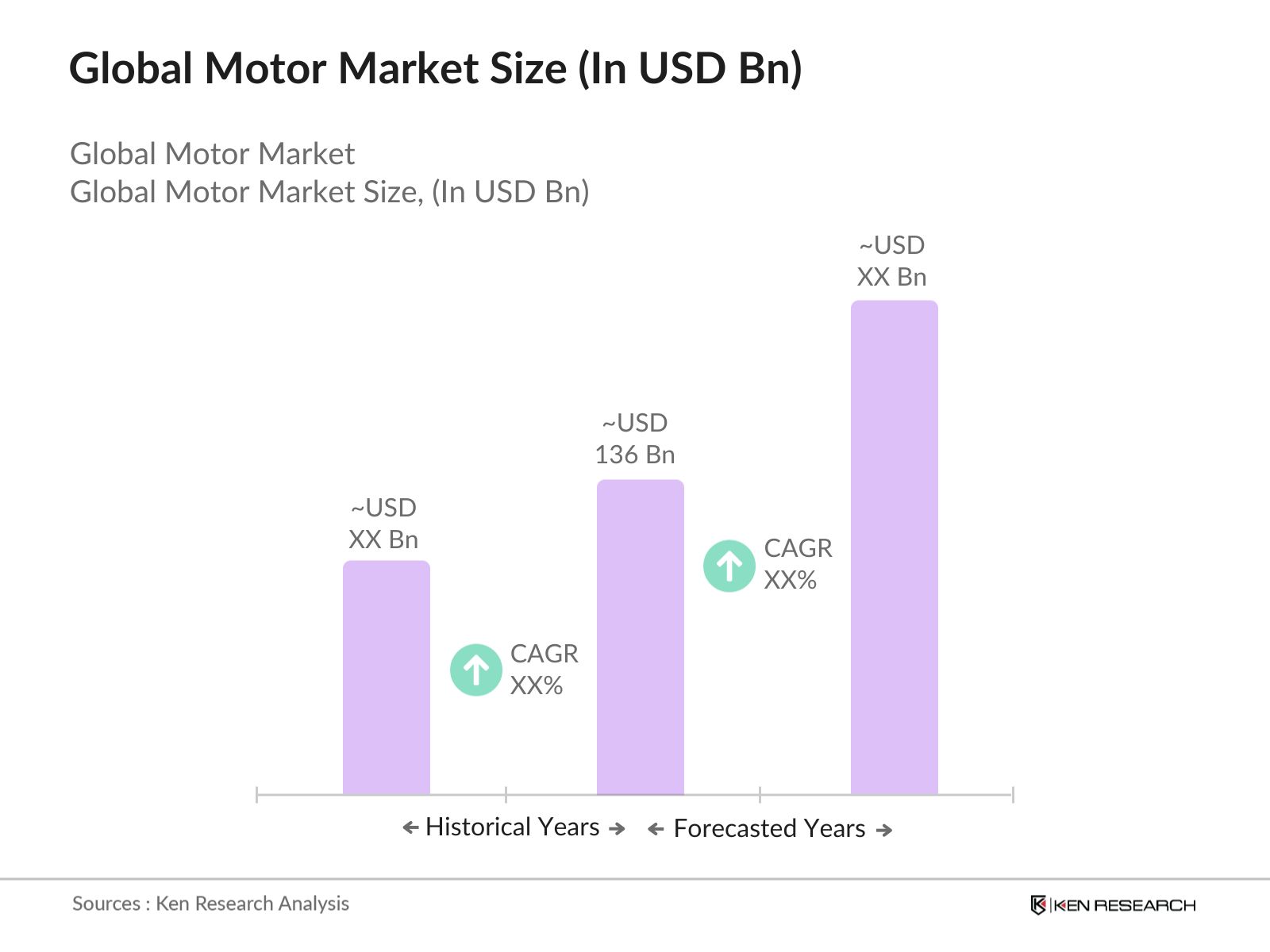
- The Global Motor Market is valued at USD 136 billion, driven by rapid industrial automation, growing electric vehicle (EV) demand, and expansion in renewable energy sectors. The increasing use of motors in automotive applications, especially electric vehicles, has significantly bolstered the market size. In the manufacturing sector, electric motors are used in industrial equipment, robotics, and automation, which are major growth drivers. Furthermore, demand from emerging markets like India and China has also supported the market's expansion.
- Countries such as China, Germany, and the United States dominate the global motor market due to their strong industrial base, advanced automotive manufacturing, and investments in renewable energy projects. China leads in electric vehicle production and industrial automation, while Germany's engineering and manufacturing capabilities make it a leader in precision motor applications. The U.S. dominates through innovation in energy-efficient motors, spurred by government regulations and initiatives promoting renewable energy adoption.
- Electric motors are seeing rising demand in industrial applications such as robotics and automation, further bolstered by global efforts toward energy efficiency. Governments worldwide are implementing policies to promote the adoption of energy-efficient electric motors, particularly in the industrial and automotive sectors. The electric motors are becoming a major contributing segment in the motor industry. For instance, Japan saw over 111,000 new non-residential buildings in 2023, significantly boosting the demand for motors in industrial and commercial applications.
Global Motor Market Segmentation
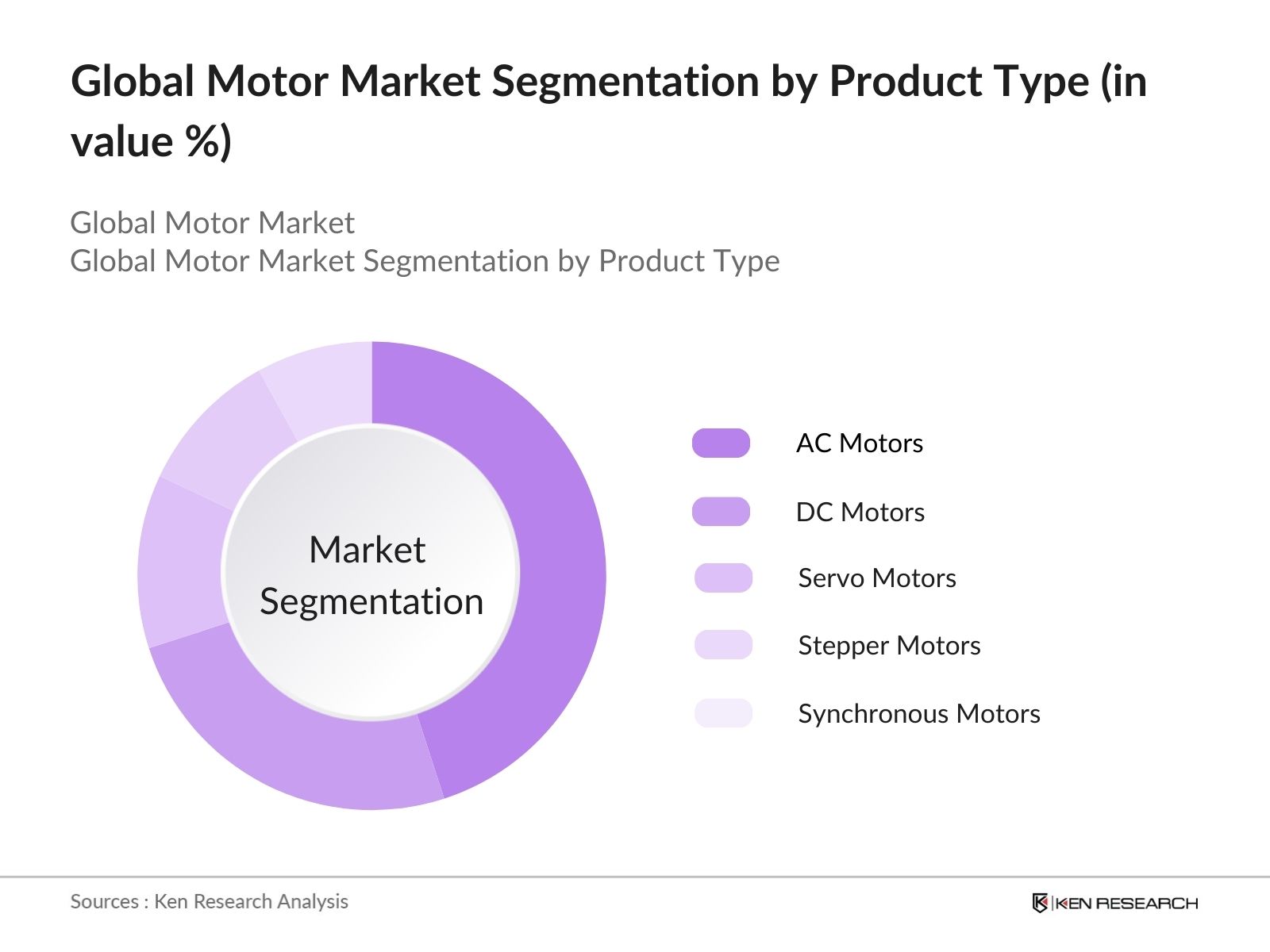
By Product Type: The Global Motor Market is segmented by product type into AC Motors, DC Motors, Servo Motors, Stepper Motors, and Synchronous Motors. Among these, AC Motors hold the dominant share in the market due to their widespread use in industrial and domestic applications. AC Motors are preferred for their reliability, low maintenance, and ease of use in high-power applications, especially in manufacturing and power generation sectors. DC Motors, while crucial for specific applications like EVs, trail AC Motors in market share due to their higher complexity and maintenance requirements.
By Region: The market is segmented into North America, Europe, Asia-Pacific, Latin America, and the Middle East & Africa. The Asia-Pacific region leads due to its growing industrial base and the rising production of electric vehicles, especially in China and Japan. The region's dominance is also attributed to the availability of raw materials, the presence of large manufacturers, and the expansion of industries like manufacturing, infrastructure, and renewable energy. Europe follows closely, driven by strict environmental regulations and the adoption of advanced motor technologies in automotive and industrial applications.

Global Motor Market Competitive Landscape
The Global Motor Market is dominated by several key players, many of whom have long-established operations. The market is characterized by high consolidation, with these major companies controlling a significant share of the market due to their technological advancements, strong distribution networks, and large production capacities.
Competitive Landscape Table
|
Company |
Establishment Year |
Headquarters |
Revenue |
R&D Expenditure |
Global Footprint |
Power Output Range |
Industry Focus |
Technology Adoption |
|
Siemens AG |
1847 |
Germany |
||||||
|
ABB Ltd. |
1988 |
Switzerland |
||||||
|
Nidec Corporation |
1973 |
Japan |
||||||
|
General Electric |
1892 |
USA |
||||||
|
Toshiba International |
1875 |
Japan |
Global Motor Market Analysis
Growth Drivers
- Increasing Demand from Electric Vehicle Sector: The electric vehicle (EV) sector continues to drive demand for high-efficiency motors. In 2024, it is estimated that the global electric vehicle stock will surpass 30 million units, up from 10 million units in 2020. Electric vehicles are predominantly powered by electric motors, with each car requiring multiple motors. The shift to cleaner energy in major automotive markets like the USA, China, and Europe, alongside governmental incentives, further accelerates this demand. In the USA alone, the EV adoption rate reached 4.6 million units by 2023, creating increased demand for high-performance motors required in both propulsion and auxiliary systems rail Automation.
- Renewable Energy Integration: The global shift toward renewable energy sources, particularly wind and solar, has significantly increased the demand for motors in energy conversion systems. According to the International Energy Agency (IEA), wind turbines, which heavily rely on motors for power generation, contributed 13% to global electricity generation in 2023. This trend is being supported by governmental policies aimed at decarbonization. The EUs push for net-zero emissions and the USAs Inflation Reduction Act provides subsidies and tax credits for renewable projects. Motors are essential for controlling wind turbine rotors and solar tracking systems.
- Industrial Automation: Industrial automation is expanding rapidly as industries seek to enhance efficiency and output through robotics and automated systems. By 2023, over 3 million industrial robots were operational worldwide, with motors playing a key role in these systems. The demand for high-efficiency motors in robotics and conveyor systems is driven by the need for precision and power control. In countries like Germany, Japan, and the USA, the push for automation has been further accelerated by labor shortages and productivity challenges. For instance, in the USA, the manufacturing sector added over 12.9 million robots, driving significant growth for motors in automated machinery.
Challenges
- Supply Chain Disruptions: The global supply chain has faced significant disruptions since 2020, affecting the production and distribution of motors. Semiconductor shortages, a critical component in motor controllers, delayed production in 2023, with automotive and industrial sectors hardest hit. Data from the IMF highlighted that global supply chain bottlenecks reduced motor production by 12% globally in 2022. Recovery remains slow as the geopolitical tensions between major suppliers and manufacturers persist, particularly in Asia, where 70% of motor components are sourced.
- High Cost of Advanced Motors: The cost of advanced, energy-efficient motors remains a barrier, especially for small and medium-sized enterprises (SMEs). Motors designed for EVs and renewable energy systems can be up to 30% more expensive than standard models, as noted in 2023 by the U.S. Department of Energy. As industries increasingly focus on energy efficiency to meet regulatory requirements, the capital investment required for these motors poses challenges for businesses, particularly in emerging markets. For example, a high-performance motor used in renewable energy systems can cost over $10,000 per unit.
Global Motor Market Future Outlook
Over the next few years, the Global Motor Market is expected to experience robust growth driven by continuous advancements in motor technologies, increased electrification of transportation, and the rise of smart manufacturing systems. As industries globally move toward energy-efficient solutions, electric motors will play a pivotal role in reducing energy consumption and emissions. The automotive sector, especially the EV market, will continue to provide significant opportunities for motor manufacturers. Emerging economies in the Asia-Pacific region, such as India and China, will likely lead market growth due to their industrial expansion and increasing demand for electric motors.
Market Opportunities
- Technological Advancements in Motor Efficiency: The development of more efficient electric motors presents a significant opportunity. Technological innovations such as permanent magnet motors, which offer higher torque density and energy efficiency, are gaining traction. In 2023, approximately 60% of electric motors produced globally incorporated such advanced designs, offering energy savings of up to 20%. The U.S. Department of Energy is promoting the adoption of these motors through grants and subsidies for energy-efficient technologies. These motors are particularly useful in industries like automotive, industrial automation, and aerospace.
- Growth in Emerging Markets: Emerging markets in Asia and Africa are experiencing a surge in industrialization, increasing the demand for electric motors. In 2023, India, for example, saw industrial output increase by 9%, driving demand for motors in sectors like manufacturing, energy, and transportation. With investments in infrastructure in countries like India and Nigeria, the World Bank projects significant growth in these regions' motor markets. Industrial machinery, which heavily depends on motors, accounted for 35% of all new equipment investments in these regions.
Scope of the Report
|
Segment |
Sub-Segment |
|
Product Type |
AC Motors DC Motors Servo Motors Stepper Motors Synchronous Motors |
|
Application |
Automotive Aerospace Industrial Equipment Renewable Energy Healthcare |
|
End-User Industry |
Manufacturing Transportation Construction Oil & Gas Utilities |
|
Power Output |
Low Power (Below 1 kW) Medium Power (1 kW to 10 kW) High Power (Above 10 kW) |
|
Region |
North America Europe Asia-Pacific Latin America Middle East & Africa |
Products
Key Target Audience
Motor Manufacturers
Automotive OEMs
Industrial Equipment Manufacturers
Renewable Energy Solution Providers
Utilities
Investments and Venture Capitalist Firms
Transport and Infrastructure Companies
Government and Regulatory Bodies (e.g., U.S. Department of Energy, European Commission)
Companies
Players mentioned in the report:
Siemens AG
ABB Ltd.
Nidec Corporation
General Electric
Toshiba International Corporation
WEG Industries
Mitsubishi Electric Corporation
Rockwell Automation
Johnson Electric
Hitachi, Ltd.
Table of Contents
1. Global Motor Market Overview
1.1. Definition and Scope
1.2. Market Taxonomy
1.3. Market Growth Rate
1.4. Market Segmentation Overview
2. Global Motor Market Size (In USD Bn)
2.1. Historical Market Size
2.2. Year-On-Year Growth Analysis
2.3. Key Market Developments and Milestones
3. Global Motor Market Analysis
3.1. Growth Drivers
3.1.1. Increasing Demand from Electric Vehicle Sector
3.1.2. Industrial Automation
3.1.3. Renewable Energy Integration
3.1.4. Infrastructure Expansion
3.2. Market Challenges
3.2.1. Supply Chain Disruptions
3.2.2. High Cost of Advanced Motors
3.2.3. Energy Efficiency Regulations
3.3. Opportunities
3.3.1. Technological Advancements in Motor Efficiency
3.3.2. Growth in Emerging Markets
3.3.3. Collaboration between Motor Manufacturers and Tech Giants
3.4. Trends
3.4.1. Electrification of Transportation
3.4.2. Integration of Smart Technologies
3.4.3. Customization of Motors for Industry-Specific Needs
3.5. Government Regulations
3.5.1. Energy Efficiency Standards
3.5.2. Incentives for Electrification
3.5.3. Environmental Regulations
3.5.4. Trade Policies Affecting Motor Imports/Exports
3.6. SWOT Analysis
3.7. Stakeholder Ecosystem
3.8. Porters Five Forces
3.9. Competitive Ecosystem
4. Global Motor Market Segmentation
4.1. By Product Type (In Value %)
4.1.1. AC Motors
4.1.2. DC Motors
4.1.3. Servo Motors
4.1.4. Stepper Motors
4.1.5. Synchronous Motors
4.2. By Application (In Value %)
4.2.1. Automotive
4.2.2. Aerospace
4.2.3. Industrial Equipment
4.2.4. Renewable Energy
4.2.5. Healthcare
4.3. By End-User Industry (In Value %)
4.3.1. Manufacturing
4.3.2. Transportation
4.3.3. Construction
4.3.4. Oil & Gas
4.3.5. Utilities
4.4. By Power Output (In Value %)
4.4.1. Low Power (Below 1 kW)
4.4.2. Medium Power (1 kW to 10 kW)
4.4.3. High Power (Above 10 kW)
4.5. By Region (In Value %)
4.5.1. North America
4.5.2. Europe
4.5.3. Asia-Pacific
4.5.4. Latin America
4.5.5. Middle East & Africa
5. Global Motor Market Competitive Analysis
Revenue, Headquarters, Global Footprint, Power Output Range, Industry Focus, Product Portfolio, Technology Adoption, R&D Expenditure
6. Global Motor Market Regulatory Framework
6.1. Energy Efficiency Standards
6.2. Compliance Requirements
6.3. Certification Processes
7. Global Motor Market Future Size (In USD Bn)
7.1. Future Market Size Projections
7.2. Key Factors Driving Future Market Growth
8. Global Motor Market Future Segmentation
8.1. By Product Type (In Value %)
8.2. By Application (In Value %)
8.3. By Power Output (In Value %)
8.4. By End-User Industry (In Value %)
8.5. By Region (In Value %)
9. Global Motor Market Analysts Recommendations
9.1. TAM/SAM/SOM Analysis
9.2. Customer Cohort Analysis
9.3. Marketing Initiatives
9.4. White Space Opportunity Analysis
Disclaimer
Contact Us
Research Methodology
Step 1: Identification of Key Variables
We began by mapping the entire motor market ecosystem to identify key stakeholders such as manufacturers, distributors, and end-users. This step involved an extensive desk review using both secondary data from industry reports and proprietary databases to pinpoint critical market variables such as motor type, application, and region.
Step 2: Market Analysis and Construction
This step focused on gathering historical data and identifying trends that shape the motor market. We analyzed the market penetration of various motor types and applications, while also estimating the revenue contribution of major regions and sectors.
Step 3: Hypothesis Validation and Expert Consultation
To validate the data, we engaged with industry experts from major motor manufacturing firms through interviews and surveys. These insights helped fine-tune the data and ensured the reports accuracy.
Step 4: Research Synthesis and Final Output
In the final stage, we synthesized the data and insights into a comprehensive report. The data were cross-verified with industry players to ensure the most accurate and up-to-date information, giving our clients a reliable overview of the market.
Frequently Asked Questions
01. How big is the Global Motor Market?
The global motor market is valued at USD 136 billion, driven by increasing demand for industrial automation, electric vehicles, and renewable energy applications.
02. What are the challenges in the Global Motor Market?
Key challenges in the global motor market include supply chain disruptions, high costs associated with advanced motor technologies, and stringent energy efficiency regulations.
03. Who are the major players in the Global Motor Market?
Major players in the global motor market include Siemens AG, ABB Ltd., Nidec Corporation, General Electric, and Toshiba International Corporation, known for their technological advancements and strong global presence.
04. What are the growth drivers of the Global Motor Market?
Growth of the global motor market is driven by increased adoption of electric vehicles, industrial automation, and renewable energy projects, along with technological advancements in motor efficiency.
Why Buy From Us?

What makes us stand out is that our consultants follows Robust, Refine and Result (RRR) methodology. i.e. Robust for clear definitions, approaches and sanity checking, Refine for differentiating respondents facts and opinions and Result for presenting data with story

We have set a benchmark in the industry by offering our clients with syndicated and customized market research reports featuring coverage of entire market as well as meticulous research and analyst insights.

While we don't replace traditional research, we flip the method upside down. Our dual approach of Top Bottom & Bottom Top ensures quality deliverable by not just verifying company fundamentals but also looking at the sector and macroeconomic factors.

With one step in the future, our research team constantly tries to show you the bigger picture. We help with some of the tough questions you may encounter along the way: How is the industry positioned? Best marketing channel? KPI's of competitors? By aligning every element, we help maximize success.

Our report gives you instant access to the answers and sources that other companies might choose to hide. We elaborate each steps of research methodology we have used and showcase you the sample size to earn your trust.

If you need any support, we are here! We pride ourselves on universe strength, data quality, and quick, friendly, and professional service.