Ken Research Logo

Global Motorcycle Helmet Market Outlook 2030

Region:Global

Author(s):Shivani Mehra

Product Code:KROD2136

Published On

December 2024

Total pages

96

About the Report

Global Motorcycle Helmet Market Overview

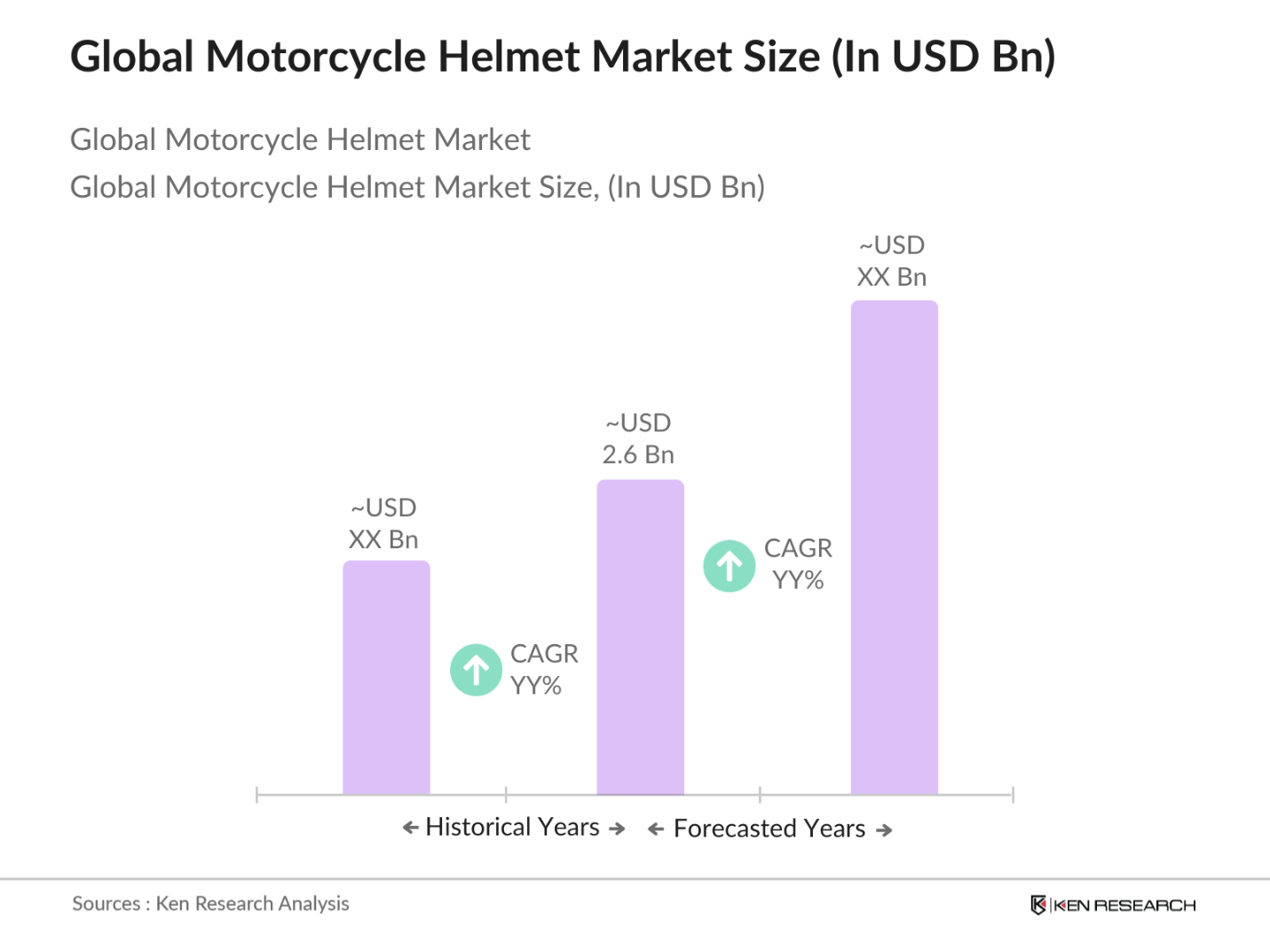
  • The global motorcycle helmet market, valued at USD 2.6 billion, continues to grow due to increasing awareness around road safety and government regulations mandating helmet usage across several countries. Rising adoption of motorbikes, particularly in countries like India and Indonesia, is driving the demand for helmets. Technological advancements, such as the integration of Bluetooth connectivity, GPS, and emergency response features, have also fueled consumer interest, especially in premium helmet segments.

market overviews

  • The market is dominated by countries in the Asia-Pacific region, particularly India and China, due to their large populations and extensive use of two-wheelers as primary modes of transportation. In India, for example, the government's stringent enforcement of helmet laws and the country's expanding middle class have bolstered the market. China's growing electric bike segment and increasing urbanization also play significant roles in the market's dominance.
  • Governments around the world have implemented stringent helmet safety laws and certification requirements to reduce fatalities from road accidents. In countries like the United States, helmets must meet the Department of Transportation (DOT) standards, while in Europe, helmets must comply with the Economic Commission for Europe (ECE) regulations. In India, the Bureau of Indian Standards (BIS) has enforced mandatory certification for helmets sold in the country. These initiatives push manufacturers to meet higher safety standards, thereby increasing the demand for quality helmets. The National Highway Traffic Safety Administration (NHTSA) reported a rise in certified helmet sales due to these regulations.

Global Motorcycle Helmet Market Segmentation

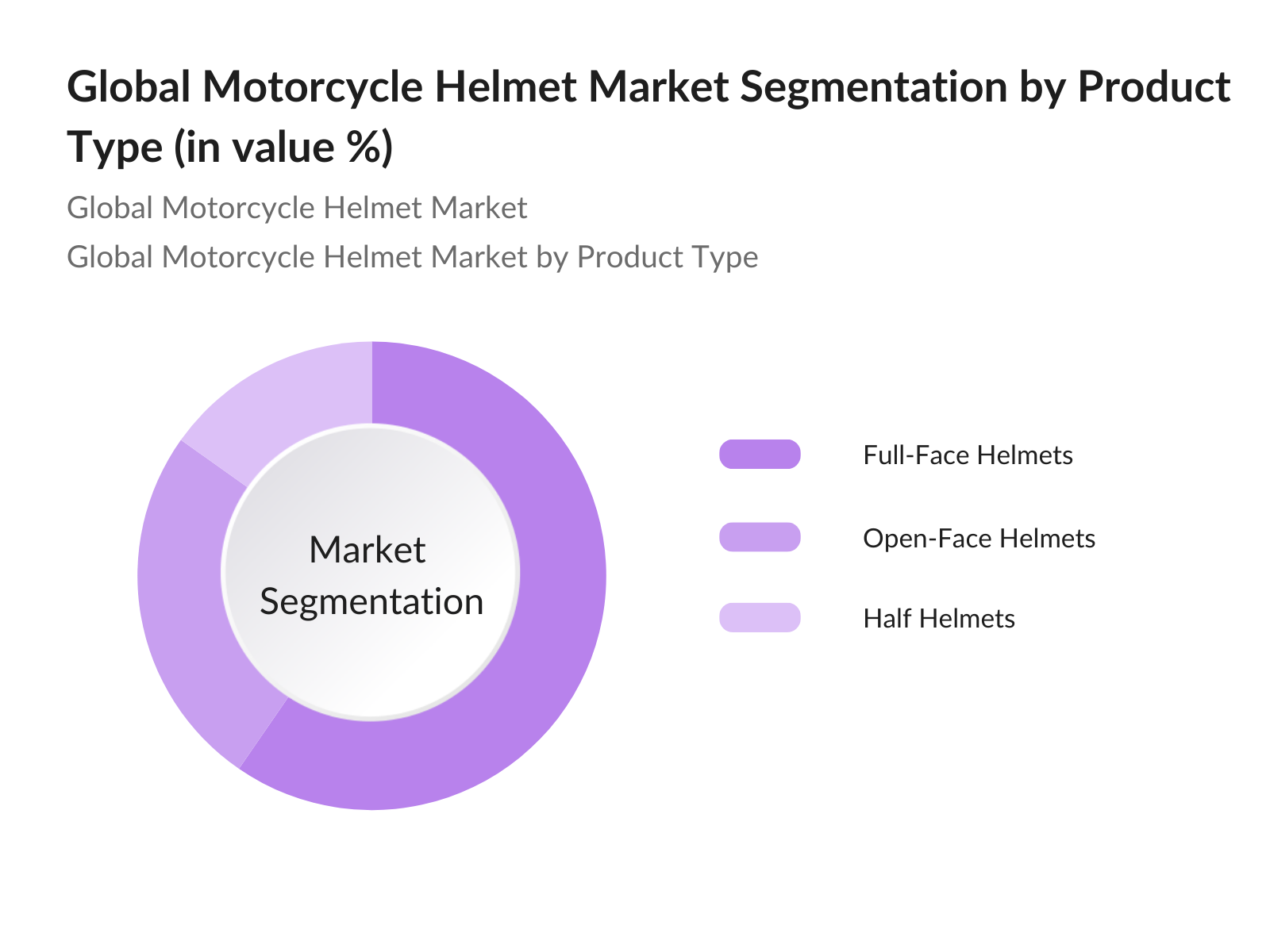
By Product Type: The motorcycle helmet market is segmented into full-face helmets, open-face helmets, and half-helmets. Full-face helmets have the largest market share, driven by their superior protection features. These helmets cover the entire head and chin, making them ideal for high-speed riding and racing. Manufacturers have focused on improving the design to make them lighter, more aerodynamic, and comfortable, which has also contributed to their rising popularity among both casual and professional riders.
market overviews

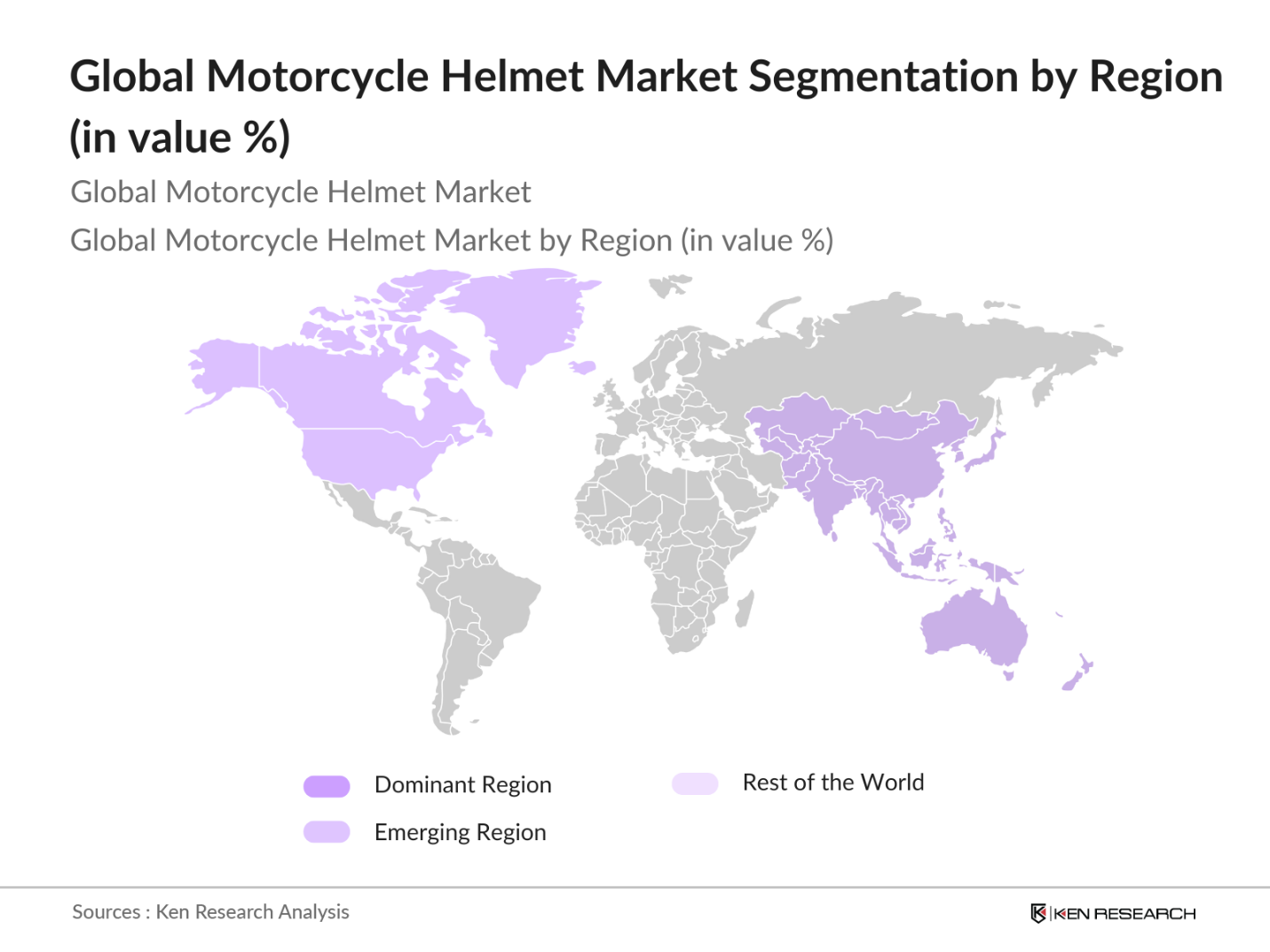
By Region Asia-Pacific is the dominant region, accounting for 65.1% of the market. Countries such as India, China, Indonesia, and Vietnam are the primary drivers due to the high rate of motorcycle ownership. In India, for example, the high population and lack of efficient public transportation have made motorcycles a necessity, significantly increasing helmet usage. Additionally, government initiatives promoting road safety have further driven market demand.
market overviews

Global Motorcycle Helmet Market Competitive Landscape

The global motorcycle helmet market is characterized by a mix of local and international players. The market is relatively consolidated, with key players dominating the premium segment through technological advancements, while smaller regional players focus on affordability and accessibility.

Company

Establishment Year

Headquarters

Employees

Revenue

Technology Integration

Certifications

Product Range

Distribution Network

Strategic Partnerships

AGV (Dainese S.p.A)

1947

Italy

500+

-

-

-

-

-

-

HJC Helmets

1971

South Korea

1000+

-

-

-

-

-

-

Shoei Co. Ltd

1958

Japan

700+

-

-

-

-

-

-

Arai Helmet Ltd

1937

Japan

600+

-

-

-

-

-

-

Schuberth GmbH

1922

Germany

1200+

-

-

-

-

-

-

Global Motorcycle Helmet Market Analysis

Market Growth Drivers

  • Rising Road Safety Awareness: Road safety awareness has significantly increased, driven by global initiatives like the United Nations Decade of Action for Road Safety. According to the World Health Organization, nearly 1.3 million people die annually due to road accidents, with 50 million more injured, most of them in developing regions where motorcycles are prevalent. Governments worldwide have introduced campaigns promoting helmet use to reduce the risk of fatal injuries. Countries like India, Indonesia, and Brazil have mandated helmet use, leading to higher demand for quality helmets.
  • Increased Adoption of Two-Wheelers: The adoption of two-wheelers continues to rise globally, particularly in emerging markets like India, Southeast Asia, and Africa, where economic constraints and traffic congestion make motorcycles the preferred mode of transport. As of 2023, India alone recorded over 220 million registered two-wheelers, making it the worlds largest two-wheeler market. Economic factors such as rising fuel costs and the need for affordable transportation options have further propelled the sales of motorcycles, directly impacting the demand for helmets.
  • Demand for Smart Helmets (GPS, Bluetooth, Emergency Features): The demand for smart helmets equipped with GPS, Bluetooth, and emergency response features has grown due to technological advancements and consumer preferences for enhanced safety and connectivity. According to a 2024 report by the International Telecommunications Union (ITU), the global penetration of mobile devices has reached 112 devices per 100 people, supporting the integration of these technologies into helmets. Countries with advanced telecommunications infrastructure, like Japan, South Korea, and the US, have seen an increased demand for helmets that enhance user experience and road safety.

Market Challenges:

  • Prevalence of Counterfeit Helmets: One of the major challenges in the motorcycle helmet market is the prevalence of counterfeit helmets. According to the World Customs Organization, counterfeit goods are a significant issue in global trade, and unsafe counterfeit helmets remain a concern, especially in developing markets. The Indian transport ministry recently confiscated over 12 million substandard helmets. These fake products do not meet safety standards, putting riders at greater risk and undercutting legitimate manufacturers who adhere to international safety guidelines.
  • High Costs of Premium Helmets: Premium helmets with advanced safety features, such as carbon fiber materials and built-in technology, remain out of reach for a significant portion of consumers in price-sensitive markets. In high-income regions like the US and Europe, premium helmets make up a smaller share of total helmet sales, as their high costs limit adoption. For example, the US Census Bureau reported that while overall helmet sales have increased, sales of helmets priced above $300 have remained stagnant due to the cost barrier.

Global Motorcycle Helmet Market Future Outlook

Over the next five years, the global motorcycle helmet market is expected to experience substantial growth driven by rising road safety awareness, technological innovations in helmet design, and stricter government regulations. The introduction of smart helmets with integrated GPS and communication systems, coupled with growing motorcycle sales, especially in Asia-Pacific, is set to drive further market expansion. Companies focusing on product innovation and compliance with global safety standards are expected to remain competitive.

Market Opportunities:

  • Technological Advancements (Augmented Reality, Integrated Lights): Technological advancements are creating new opportunities in the motorcycle helmet market, particularly with the integration of features like augmented reality (AR) displays, integrated lighting, and communication systems. AR helmets are gaining traction, especially in developed markets such as North America and Europe, where consumers are looking for enhanced safety and convenience. The International Federation of Robotics reports increased applications of AR in consumer products, with helmets being a prominent category. This presents opportunities for manufacturers to develop and market premium helmets with cutting-edge technology to meet evolving consumer expectations.
  • Expansion of E-commerce and Online Sales: E-commerce is revolutionizing the way motorcycle helmets are sold, providing direct-to-consumer channels that are particularly beneficial in emerging markets where retail distribution may be limited. The increasing penetration of smartphones and internet access in regions like Southeast Asia and Africa has made online shopping more accessible. For instance, Indias e-commerce sector continues to grow rapidly, enabling helmet manufacturers to reach a broader audience without relying on traditional brick-and-mortar stores. This trend offers helmet makers the opportunity to scale their operations through digital platforms and tap into previously underserved markets.

Scope of the Report

By Product Type

Full-Face Helmets

Open-Face Helmets

Half Helmets

Off-Road/Racing Helmets

By End-User

Rider

Passenger (Pillion Rider)

By Distribution Channel

Online

Offline

By End-User

Bluetooth Connectivity

GPS Navigation

Smart Helmets

Integrated Cameras

Augmented Reality (AR)

Emergency Communication Systems

By Region

North America

Europe

Asia Pacific

Latin America

Middle East & Africa

Products

Key Target Audience

  • Motorcycle Helmet Manufacturers

  • Motorcycle and Two-Wheeler Manufacturers

  • Online Retailers and E-Commerce Platforms

  • Safety Equipment Distributors

  • Government and Regulatory Bodies (e.g., U.S. Department of Transportation, European Economic Community)

  • Investment and Venture Capital Firms

  • Motorsport Organizations (e.g., MotoGP, Fdration Internationale de l'Automobile)

  • Insurance Companies

Companies

Players Mention in the Report 

  • AGV (Dainese S.p.A)

  • HJC Helmets

  • Shoei Co. Ltd

  • Arai Helmet Ltd

  • Schuberth GmbH

  • Shark Helmets

  • Bell Helmets

  • LS2 Helmets

  • Nolan Helmets

  • NEXX Helmets

  • Torc Helmets

  • Caberg Helmets

  • X-Lite (Nolan Group)

  • Scorpion Sports

  • Sena Technologies

Table of Contents

01. Global Motorcycle Helmet Market Overview

1.1. Definition and Scope

1.2. Market Taxonomy

1.3. Market Segmentation Overview

1.4. Key Market Developments and Innovations

02. Global Motorcycle Helmet Market Size (In USD Mn)

2.1. Historical Market Size

2.2. Year-on-Year Growth Analysis

2.3. Key Market Milestones

03. Global Motorcycle Helmet Market Dynamics

3.1. Growth Drivers

Rising road safety awareness

Increased adoption of two-wheelers

Demand for smart helmets (GPS, Bluetooth, Emergency features)

3.2. Market Challenges

Prevalence of counterfeit helmets

High costs of premium helmets

3.3. Market Opportunities

Technological advancements (Augmented Reality, integrated lights)

Expansion of e-commerce and online sales

3.4. Key Market Trends

Increasing popularity of full-face helmets

Adoption of theme-based and designer helmets

3.5. Government Regulations and Safety Standards

Helmet safety laws and certifications

Enforcement of helmet usage mandates

04. Global Motorcycle Helmet Market Segmentation

4.1. By Product Type (in Value %)

Full-Face Helmets

Open-Face Helmets

Half Helmets

Off-Road/Racing Helmets

4.2. By End-User (in Value %)

Rider

Passenger (Pillion Rider)

4.3. By Distribution Channel (in Value %)

Online

Offline

4.4. By Region (in Value %)

North America

Europe

Asia Pacific

Latin America

Middle East & Africa

05. Global Motorcycle Helmet Market Competitive Landscape

5.1. Detailed Profiles of Major Companies

AGV (Dainese S.p.A)

HJC Helmets

Shoei Co. Ltd

Arai Helmet Ltd

Schuberth GmbH

Shark Helmets

Bell Helmets

LS2 Helmets

Nolan Helmets

NEXX Helmets

Torc Helmets

Caberg Helmets

X-Lite (Nolan Group)

Scorpion Sports

Sena Technologies

5.2. Cross-Comparison Parameters (Headquarters, Market Share, Revenue, No. of Employees, Inception Year, Distribution Channels, Certifications, Technological Advancements)

5.3. Market Share Analysis

5.4. Strategic Initiatives (Product launches, partnerships, collaborations)

5.5. Mergers and Acquisitions

5.6. Venture Capital Funding and Private Equity Investments

06. Global Motorcycle Helmet Regulatory Framework

6.1. Global Helmet Safety Standards (ECE, DOT, Snell)

6.2. Compliance Requirements in Major Regions

6.3. Certification Processes for Helmet Manufacturers

07. Global Motorcycle Helmet Future Market Size (In USD Mn)

7.1. Future Market Size Projections

7.2. Key Factors Driving Future Growth

08. Global Motorcycle Helmet Future Market Segmentation

8.1. By Product Type

8.2. By End-User

8.3. By Distribution Channel

8.4. By Region

09. Global Motorcycle Helmet Market Analysts Recommendations

9.1. TAM/SAM/SOM Analysis

9.2. White Space Opportunity Analysis

9.3. Customer Cohort Analysis

Disclaimer
Contact Us

Research Methodology

Step 1: Identification of Key Variables

The first step involves mapping the ecosystem of the global motorcycle helmet market. This stage includes gathering secondary data from proprietary databases and public sources to outline the market's key players, revenue drivers, and growth indicators.

Step 2: Market Analysis and Construction

Here, historical data for the motorcycle helmet market is compiled and analyzed to assess market penetration, product adoption rates, and regional trends. A thorough analysis of these factors is conducted to construct a reliable growth model.

Step 3: Hypothesis Validation and Expert Consultation

The formulated market hypotheses are validated through structured interviews with industry experts, such as helmet manufacturers, distributors, and regulatory bodies. This ensures data accuracy and a thorough understanding of the market dynamics.

Step 4: Research Synthesis and Final Output

The final step integrates insights from interviews, proprietary data analysis, and desk research. This information is synthesized to produce a comprehensive report, with final validations made against current market conditions to ensure the reliability of the data.

Frequently Asked Questions

01. How big is the global motorcycle helmet market?

The global motorcycle helmet market is valued at USD 2.6 billion, driven by rising awareness around road safety and the adoption of advanced helmet technologies such as Bluetooth and GPS connectivity.

02. What are the key growth drivers for the motorcycle helmet market?

The market is propelled by increasing government regulations enforcing helmet usage, technological advancements in smart helmets, and the rise of two-wheeler vehicles, especially in Asia-Pacific.

03. Who are the major players in the global motorcycle helmet market?

Leading players include AGV (Dainese S.p.A), HJC Helmets, Shoei Co. Ltd, Arai Helmet Ltd, and Schuberth GmbH, all of which have a significant presence in both premium and general helmet segments.

04. What challenges does the motorcycle helmet market face?

One major challenge is the prevalence of counterfeit helmets, particularly in Asia, which undermines consumer trust and hinders market growth. High costs of premium helmets also limit their accessibility.

Why Buy From Us?

RRR
Refine Robust Result (RRR) Framework

What makes us stand out is that our consultants follows Robust, Refine and Result (RRR) methodology. i.e. Robust for clear definitions, approaches and sanity checking, Refine for differentiating respondents facts and opinions and Result for presenting data with story

Our Reach Is Unmatched

We have set a benchmark in the industry by offering our clients with syndicated and customized market research reports featuring coverage of entire market as well as meticulous research and analyst insights.

Research
Shifting the Research Paradigm

While we don't replace traditional research, we flip the method upside down. Our dual approach of Top Bottom & Bottom Top ensures quality deliverable by not just verifying company fundamentals but also looking at the sector and macroeconomic factors.

Insite
More Insights-Better Decisions

With one step in the future, our research team constantly tries to show you the bigger picture. We help with some of the tough questions you may encounter along the way: How is the industry positioned? Best marketing channel? KPI's of competitors? By aligning every element, we help maximize success.

Trust
Transparency and Trust

Our report gives you instant access to the answers and sources that other companies might choose to hide. We elaborate each steps of research methodology we have used and showcase you the sample size to earn your trust.

support
Round the Clock Support

If you need any support, we are here! We pride ourselves on universe strength, data quality, and quick, friendly, and professional service.

Why Client Choose Us?

400000+ Reports in repository
150+ Consulting project a year
100+ Analysts
8000+ Client Queries in 2022