















Global Naval Ship Propeller Market Outlook to 2030
Region:Global
Author(s):Naman Rohilla
Product Code:KROD5078
December 2024
88
About the Report
Global Naval Ship Propeller Market Overview
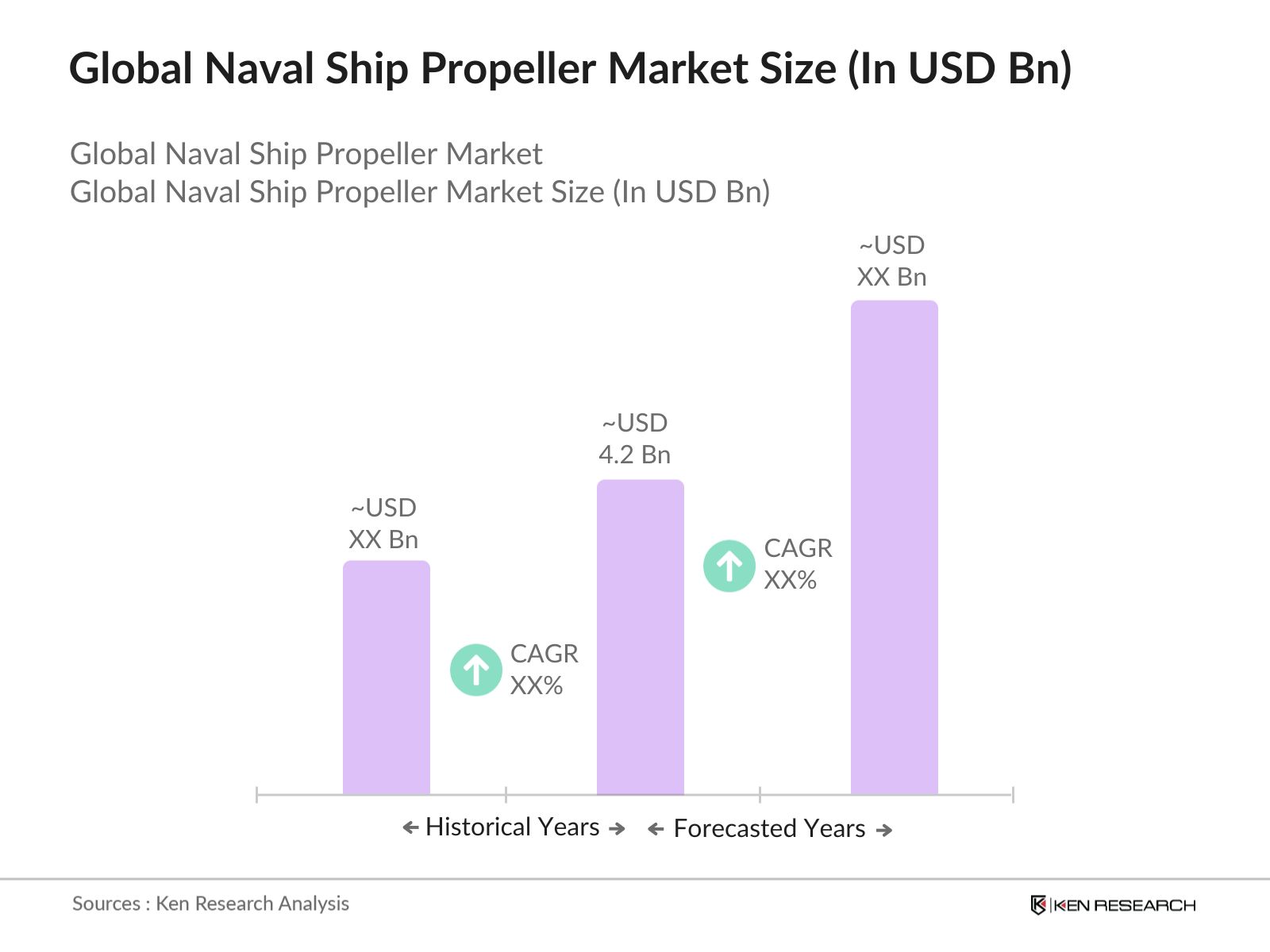
- The global naval ship propeller market is valued at USD 4.2 billion, based on a five-year historical analysis. The market's growth is driven by rising investments in naval defence modernization and technological innovations in propulsion systems. Increasing government spending on enhancing naval capabilities, especially in large economies such as the United States, China, and India, has propelled the demand for advanced, fuel-efficient, and low-noise propellers, pushing the market to its current valuation.
- Dominant countries in the market include the United States, China, and Russia, which lead due to their significant naval defence budgets, extensive shipbuilding industries, and strong emphasis on modernizing naval fleets. These countries have large-scale shipyards and collaborations with key naval propulsion technology providers, contributing to their dominance in the market.
- Defence contracts often include stringent regulatory requirements for naval equipment manufacturers, including compliance with national defence standards. In 2024, the U.S. Department of Defence awarded $25 billion in contracts, with specific compliance requirements related to the production of naval propellers. These contracts mandate adherence to safety, environmental, and operational standards, making compliance a critical aspect of the naval propeller manufacturing process. The emphasis on regulatory compliance ensures that propeller manufacturers deliver high-quality, durable products for naval applications.
Global Naval Ship Propeller Market Segmentation
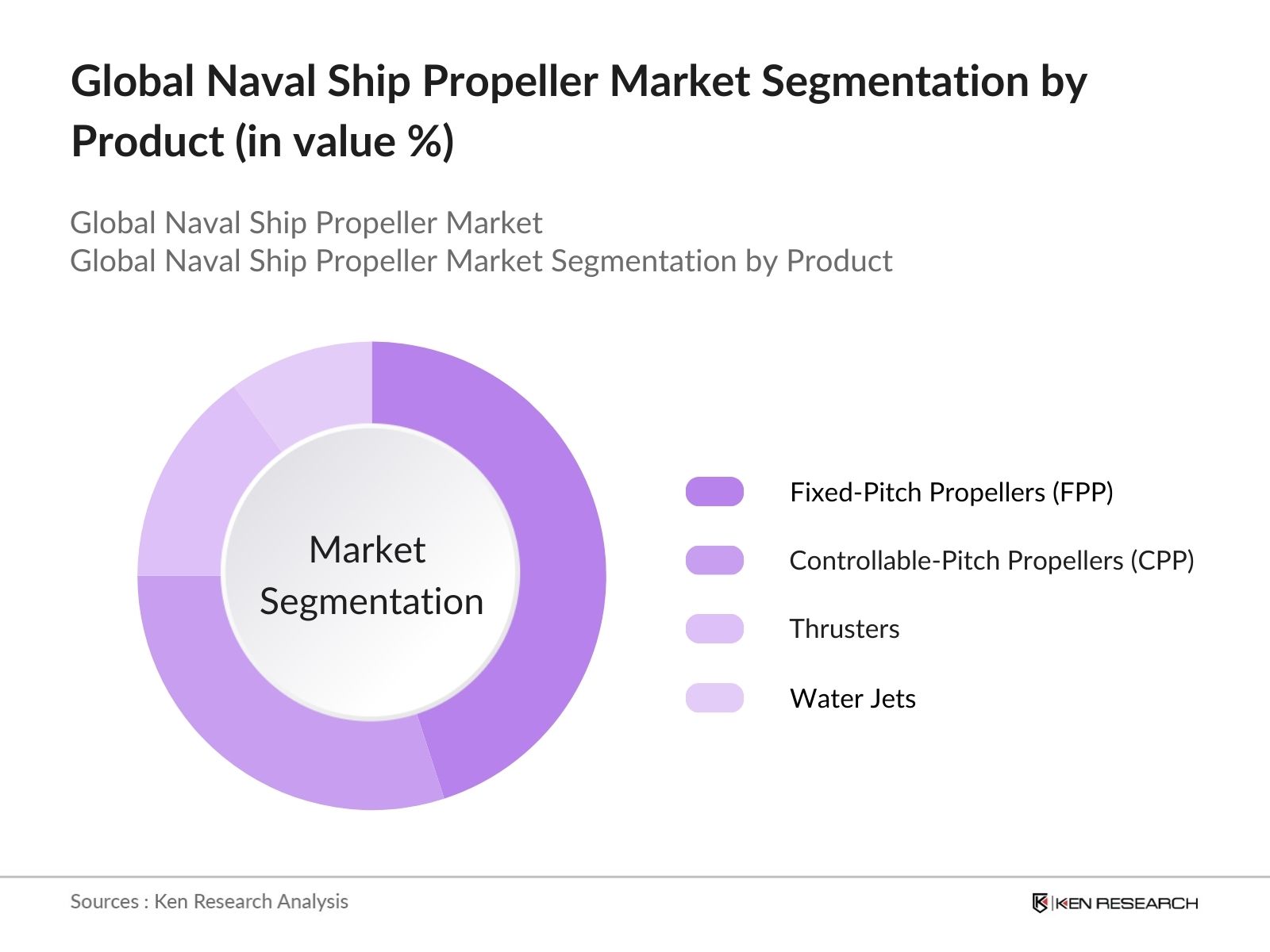
- By Product Type: The global naval ship propeller market is segmented by product type into Fixed-Pitch Propellers (FPP), Controllable-Pitch Propellers (CPP), Thrusters, and Water Jets. Among these, Fixed-Pitch Propellers (FPP) hold a dominant market share due to their widespread usage in smaller and medium-sized naval vessels. FPPs are favored for their durability, lower cost, and ease of maintenance, making them a popular choice among navies with diverse fleets. Their simplicity in design compared to CPPs allows for effective performance, particularly in less complex propulsion systems.
- By Material Type: The naval ship propeller market is segmented by material type into Stainless Steel, Aluminum, Nickel-Aluminum Bronze, and Composite Materials. Nickel-Aluminum Bronze dominates the market due to its superior resistance to corrosion and biofouling, as well as its strength, which is crucial for naval operations in harsh marine environments. This material's reliability and proven performance in military applications contribute to its significant usage in propeller manufacturing for naval vessels worldwide.
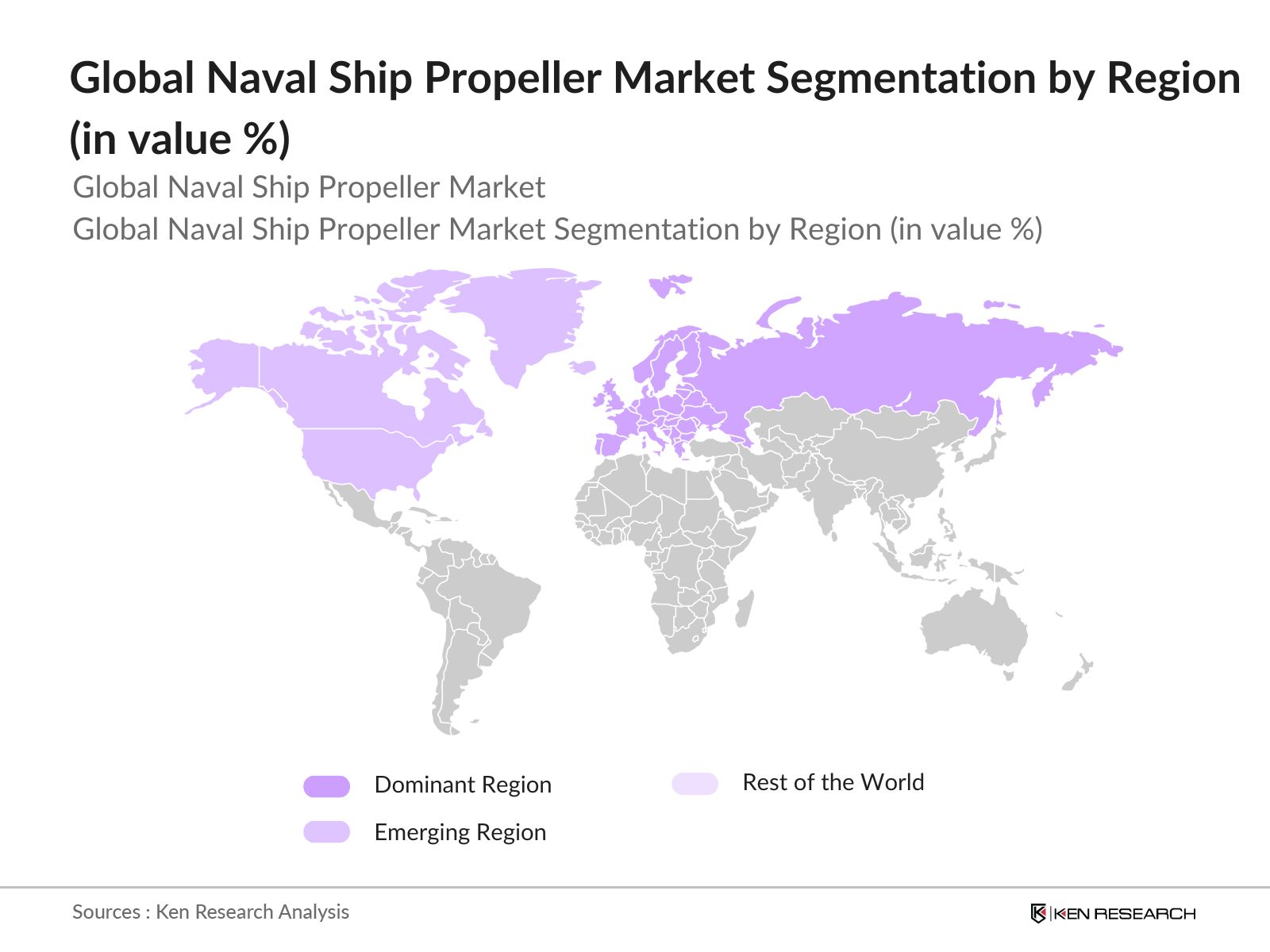
- By Region: The market is regionally segmented into North America, Europe, Asia-Pacific, Middle East & Africa, and Latin America. North America holds the largest market share, primarily due to the substantial investments made by the U.S. government in its naval defence sector. The U.S. Navys initiatives to modernize its fleet and maintain a strong global naval presence have bolstered the regions demand for advanced propeller systems. Additionally, the presence of major shipbuilders and propulsion system manufacturers further strengthens North America's market dominance.
Global Naval Ship Propeller Market Competitive Landscape
The global naval ship propeller market is characterized by a mix of well-established companies and emerging players, with a few key firms holding a significant share of the market. The competition in the market revolves around innovations in propulsion technologies, strategic partnerships, and government defence contracts.
|
Company |
Established |
Headquarters |
No. of Employees |
Revenue (USD Bn) |
Naval Contracts |
R&D Investments |
Key Clients |
Global Presence |
Production Facilities |
|
Rolls-Royce Holdings |
1906 |
London, UK |
- |
- |
- |
- |
- |
- |
- |
|
Wrtsil Corporation |
1834 |
Helsinki, Finland |
- |
- |
- |
- |
- |
- |
- |
|
MAN Energy Solutions |
1758 |
Augsburg, Germany |
- |
- |
- |
- |
- |
- |
- |
|
Schottel GmbH |
1921 |
Spay, Germany |
- |
- |
- |
- |
- |
- |
- |
|
Nakashima Propeller Co., Ltd. |
1926 |
Okayama, Japan |
- |
- |
- |
- |
- |
- |
- |
Global Naval Ship Propeller Market Analysis
Global Naval Ship Propeller Market Growth Drivers
Increasing Demand for Advanced Propellers in Naval Defence: The global defence sector is increasingly investing in advanced naval propellers to meet growing threats in the maritime domain. In 2024, countries like the United States, China, and Russia have significantly increased their naval budgets, focusing on enhancing their fleets with modern propulsion systems. The U.S. Naval budget alone is set at $244 billion in 2024, driven by advancements in naval ship propulsion. The rise in global defence spending, particularly by Asia-Pacific nations such as China, with a defence budget of approximately $230 billion in 2024, underpins the growing demand for cutting-edge propellers for next-generation naval vessels.
Development of Propeller Noise Reduction Technologies: Reducing noise signatures in naval propellers is a top priority for modern navies to avoid detection in critical missions. The U.S. Navy has allocated $2.6 billion in 2024 to research and development efforts focused on minimizing acoustic signatures in naval vessels. Noise-reduction technologies in propeller design are gaining traction, particularly in submarines and advanced surface combatants. This technology is crucial for enhancing stealth capabilities in naval operations. Propeller noise reduction has become a competitive advantage as geopolitical tensions escalate in regions like the South China Sea and the Arctic.
Rise in Global Naval Fleet Expansion: The global naval fleet size has expanded in recent years, driven by heightened security concerns in key regions. For instance, China added over 50 ships to its fleet from 2020 to 2023, growing its navy to over 350 vessels. Similarly, India has increased its naval assets, focusing on aircraft carriers and submarines. Fleet modernization in these nations reflects increased defence budgets aimed at naval superiority. This surge in fleet size drives demand for efficient, durable propellers capable of handling the speed and maneuverability required by modern naval warfare.
Global Naval Ship Propeller Market Challenges
- High Costs of Custom-Built Propellers: Custom-built naval propellers are expensive, with development and manufacturing costs often exceeding $1 million per unit, particularly for advanced vessels like submarines. The complexity in design, coupled with the need for high-performance materials, contributes to these high costs. Additionally, the operational and maintenance costs associated with these propellers can escalate over the ship's lifetime. Countries like the United States and France have acknowledged the financial challenges of sustaining custom-built naval assets, affecting smaller economies with limited defence budgets.
- Technical Complexities in Propeller Design for Large Naval Vessels: Propeller design for large naval vessels, especially aircraft carriers and destroyers, presents several technical challenges. These vessels require propellers that can handle immense thrust while maintaining structural integrity under stress. Research has shown that propellers for ships over 10,000 tons require extensive computational modeling, costing millions in R&D. In 2024, the U.S. Navy invested $750 million in overcoming design complexities related to cavitation, thrust load, and hydrodynamic efficiency. The technical constraints in propeller design often delay production timelines, impacting fleet modernization.
Global Naval Ship Propeller Market Future Outlook
Over the next five years, the global naval ship propeller market is expected to see robust growth driven by increasing government defence budgets, advancements in propulsion technologies such as hybrid and electric systems, and the rising demand for eco-friendly and fuel-efficient naval vessels. The growing focus on noise reduction technologies and the shift towards modular, lightweight propellers is likely to further enhance market expansion.
Global Naval Ship Propeller Market Opportunities
- Opportunities in Lightweight Propeller Materials: The global naval industry is witnessing a shift toward lightweight materials in propeller manufacturing, driven by advancements in composites like carbon fiber. In 2024, the market for lightweight naval propeller materials reached $800 million, driven by demand from emerging markets in Asia and South America. These materials offer superior fuel efficiency and reduced operational noise, making them ideal for stealth naval missions. Countries like India, which is expanding its naval capabilities, are expected to adopt these materials extensively in the coming years.
- Advancements in 3D Printing Technologies for Custom Propellers: 3D printing is revolutionizing the naval propeller manufacturing process by enabling rapid prototyping and customization. In 2024, the U.S. Navy reported that it had successfully tested 3D-printed propellers for smaller naval vessels, significantly reducing production lead times. The global naval industry has invested over $1 billion in 3D printing technologies to develop custom-built propellers that enhance operational efficiency and reduce costs. These advancements present significant opportunities for nations looking to modernize their fleets while minimizing production delays.
Scope of the Report
|
By Product Type |
Fixed-Pitch Propellers (FPP) Controllable-Pitch Propellers (CPP) Thrusters Water Jets |
|
By Material Type |
Stainless Steel Aluminum Nickel-Aluminum Bronze Composite Materials |
|
By Application |
Military Vessels Submarines Aircraft Carriers Destroyers and Frigates |
|
By End-User |
Navy Coast Guard Shipbuilders Commercial Shipyards |
|
By Region |
North America Europe Asia-Pacific Middle East and Africa Latin America |
Products
Key Target Audience
Naval Defence Contractors
Government and Regulatory Bodies (U.S. Department of Defence, European Naval Authorities)
Shipbuilders and Shipyards
Propeller Manufacturers and Suppliers
Naval Fleet Maintenance and Repair Companies
Investor and Venture Capitalist Firms
Maritime Environmental Agencies
Naval Technology and R&D Companies
Companies
Global Naval Ship Propeller Market Major Players
Rolls-Royce Holdings
Wrtsil Corporation
MAN Energy Solutions
Schottel GmbH
Nakashima Propeller Co., Ltd.
Thrustmaster of Texas, Inc.
Hyundai Heavy Industries
Berg Propulsion
Kawasaki Heavy Industries
ABB Marine & Ports
Mecklenburger Metallguss GmbH (MMG)
Michigan Wheel Marine
Schaffran Propeller & Turbinenbau GmbH
VEEM Propellers
Helices y Suministros Navales S.A. (HELISUR)
Table of Contents
1. Global Naval Ship Propeller Market Overview
1.1 Definition and Scope
1.2 Market Taxonomy
1.3 Market Growth Rate
1.4 Market Segmentation Overview
2. Global Naval Ship Propeller Market Size (In USD Bn)
2.1 Historical Market Size
2.2 Year-on-Year Growth Analysis
2.3 Key Market Developments and Milestones
3. Global Naval Ship Propeller Market Analysis
3.1 Growth Drivers (Technological Advancements in Propeller Materials, Naval Defence Upgrades)
3.1.1 Increasing Demand for Advanced Propellers in Naval Defence
3.1.2 Development of Propeller Noise Reduction Technologies
3.1.3 Rise in Global Naval Fleet Expansion
3.1.4 Government Investments in Naval Defence Modernization
3.2 Market Challenges (Technical, Economic, and Operational Barriers)
3.2.1 High Costs of Custom-Built Propellers
3.2.2 Technical Complexities in Propeller Design for Large Naval Vessels
3.2.3 Supply Chain Constraints for Critical Raw Materials
3.2.4 Impact of Regulatory and Environmental Compliance
3.3 Opportunities (Emerging Markets and Technological Innovations)
3.3.1 Opportunities in Lightweight Propeller Materials
3.3.2 Advancements in 3D Printing Technologies for Custom Propellers
3.3.3 Partnerships for Hybrid and Electric Propulsion Systems
3.3.4 Expansion in Emerging Markets (Asia-Pacific Naval Expansion)
3.4 Trends (Key Innovations in Naval Propulsion Systems)
3.4.1 Introduction of Modular Propeller Systems
3.4.2 Integration with Smart Propulsion Technologies
3.4.3 Increased Focus on Fuel Efficiency and Emission Control
3.5 Government Regulation (Regulations Impacting Naval Propeller Manufacturing)
3.5.1 Defence Contracts and Regulatory Compliance
3.5.2 Naval Equipment Standards (ISO/IMO)
3.5.3 Maritime Environmental Regulations (MARPOL and Propeller Efficiency Standards)
3.5.4 National Naval Development Programs
3.6 SWOT Analysis
3.7 Stakeholder Ecosystem (Shipbuilders, Naval Authorities, Propeller Manufacturers)
3.8 Porters Five Forces
3.9 Competitive Ecosystem (Innovation, Strategic Collaborations, Regional Presence)
4. Global Naval Ship Propeller Market Segmentation
4.1 By Product Type (In Value %)
4.1.1 Fixed-Pitch Propellers (FPP)
4.1.2 Controllable-Pitch Propellers (CPP)
4.1.3 Thrusters
4.1.4 Water Jets
4.2 By Material Type (In Value %)
4.2.1 Stainless Steel
4.2.2 Aluminum
4.2.3 Nickel-Aluminum Bronze
4.2.4 Composite Materials
4.3 By Application (In Value %)
4.3.1 Military Vessels
4.3.2 Submarines
4.3.3 Aircraft Carriers
4.3.4 Destroyers and Frigates
4.4 By End-User (In Value %)
4.4.1 Navy
4.4.2 Coast Guard
4.4.3 Shipbuilders
4.4.4 Commercial Shipyards
4.5 By Region (In Value %)
4.5.1 North America
4.5.2 Europe
4.5.3 Asia-Pacific
4.5.4 Middle East and Africa
4.5.5 Latin America
5. Global Naval Ship Propeller Market Competitive Analysis
5.1 Detailed Profiles of Major Companies
5.1.1 Rolls-Royce Holdings
5.1.2 Wrtsil Corporation
5.1.3 MAN Energy Solutions
5.1.4 Schottel GmbH
5.1.5 Kawasaki Heavy Industries
5.1.6 Hyundai Heavy Industries
5.1.7 ABB Marine & Ports
5.1.8 Mecklenburger Metallguss GmbH (MMG)
5.1.9 Nakashima Propeller Co., Ltd.
5.1.10 Berg Propulsion
5.1.11 Thrustmaster of Texas, Inc.
5.1.12 VEEM Propellers
5.1.13 Schaffran Propeller & Turbinenbau GmbH
5.1.14 Helices y Suministros Navales S.A. (HELISUR)
5.1.15 Michigan Wheel Marine
5.2 Cross Comparison Parameters (No. of Employees, Headquarters, Revenue, Manufacturing Capabilities, Global Presence, Key Clients, R&D Investments, Naval Contracts)
5.3 Market Share Analysis
5.4 Strategic Initiatives
5.5 Mergers and Acquisitions
5.6 Investment Analysis
5.7 Venture Capital Funding
5.8 Government Grants
5.9 Private Equity Investments
6. Global Naval Ship Propeller Market Regulatory Framework
6.1 Environmental Standards and Propeller Efficiency Compliance
6.2 Certification Processes for Naval Propulsion Equipment
6.3 Naval Defence Contracting Regulations
7. Global Naval Ship Propeller Future Market Size (In USD Bn)
7.1 Future Market Size Projections
7.2 Key Factors Driving Future Market Growth (Fleet Expansion, Technological Innovations)
8. Global Naval Ship Propeller Future Market Segmentation
8.1 By Product Type (In Value %)
8.2 By Material Type (In Value %)
8.3 By Application (In Value %)
8.4 By End-User (In Value %)
8.5 By Region (In Value %)
9. Global Naval Ship Propeller Market Analysts Recommendations
9.1 TAM/SAM/SOM Analysis
9.2 Customer Cohort Analysis (Naval Authorities, Shipbuilders)
9.3 White Space Opportunity Analysis
9.4 Marketing Initiatives for Naval Contracts
Disclaimer Contact UsResearch Methodology
Step 1: Identification of Key Variables
The first step involves mapping all significant stakeholders in the global naval ship propeller market, including naval authorities, shipbuilders, and technology providers. Extensive desk research is employed to gather critical data from proprietary and publicly available sources.
Step 2: Market Analysis and Construction
During this phase, we analyze historical data on market penetration and revenue generation across key regions. Various datasets are compiled to ensure the accurate projection of revenue growth and market expansion trends.
Step 3: Hypothesis Validation and Expert Consultation
Market assumptions are validated through expert consultations with professionals in naval shipbuilding and propulsion systems. Telephone interviews (CATIs) are conducted to derive insights into market operations, technological advancements, and procurement processes.
Step 4: Research Synthesis and Final Output
The final step involves compiling insights from various stakeholders to develop a comprehensive understanding of market dynamics. Both bottom-up and top-down methodologies are applied to provide a detailed and validated analysis of the global naval ship propeller market.
Frequently Asked Questions
01. How big is the Global Naval Ship Propeller Market?
The global naval ship propeller market was valued at USD 4.2 billion, driven by increasing government investments in naval defence and advancements in propulsion technologies.
02. What are the challenges in the Global Naval Ship Propeller Market?
Challenges in the global naval ship propeller market include high costs of custom-built propellers, regulatory and environmental compliance, and supply chain constraints for raw materials.
03. Who are the major players in the Global Naval Ship Propeller Market?
Key players in the global naval ship propeller market include Rolls-Royce Holdings, Wrtsil Corporation, MAN Energy Solutions, Schottel GmbH, and Nakashima Propeller Co., Ltd.
04. What are the growth drivers of the Global Naval Ship Propeller Market?
Key drivers in the global naval ship propeller market include the rising demand for advanced, fuel-efficient, and low-noise propellers in modern naval vessels, along with growing government investments in defence modernization.
Why Buy From Us?

What makes us stand out is that our consultants follows Robust, Refine and Result (RRR) methodology. i.e. Robust for clear definitions, approaches and sanity checking, Refine for differentiating respondents facts and opinions and Result for presenting data with story

We have set a benchmark in the industry by offering our clients with syndicated and customized market research reports featuring coverage of entire market as well as meticulous research and analyst insights.

While we don't replace traditional research, we flip the method upside down. Our dual approach of Top Bottom & Bottom Top ensures quality deliverable by not just verifying company fundamentals but also looking at the sector and macroeconomic factors.

With one step in the future, our research team constantly tries to show you the bigger picture. We help with some of the tough questions you may encounter along the way: How is the industry positioned? Best marketing channel? KPI's of competitors? By aligning every element, we help maximize success.

Our report gives you instant access to the answers and sources that other companies might choose to hide. We elaborate each steps of research methodology we have used and showcase you the sample size to earn your trust.

If you need any support, we are here! We pride ourselves on universe strength, data quality, and quick, friendly, and professional service.