
Global Office Furniture Market Outlook 2030
Region:Global
Author(s):Shivani Mehra
Product Code:KROD1488
Region:Global
Author(s):Shivani Mehra
Product Code:KROD1488
December 2024
83
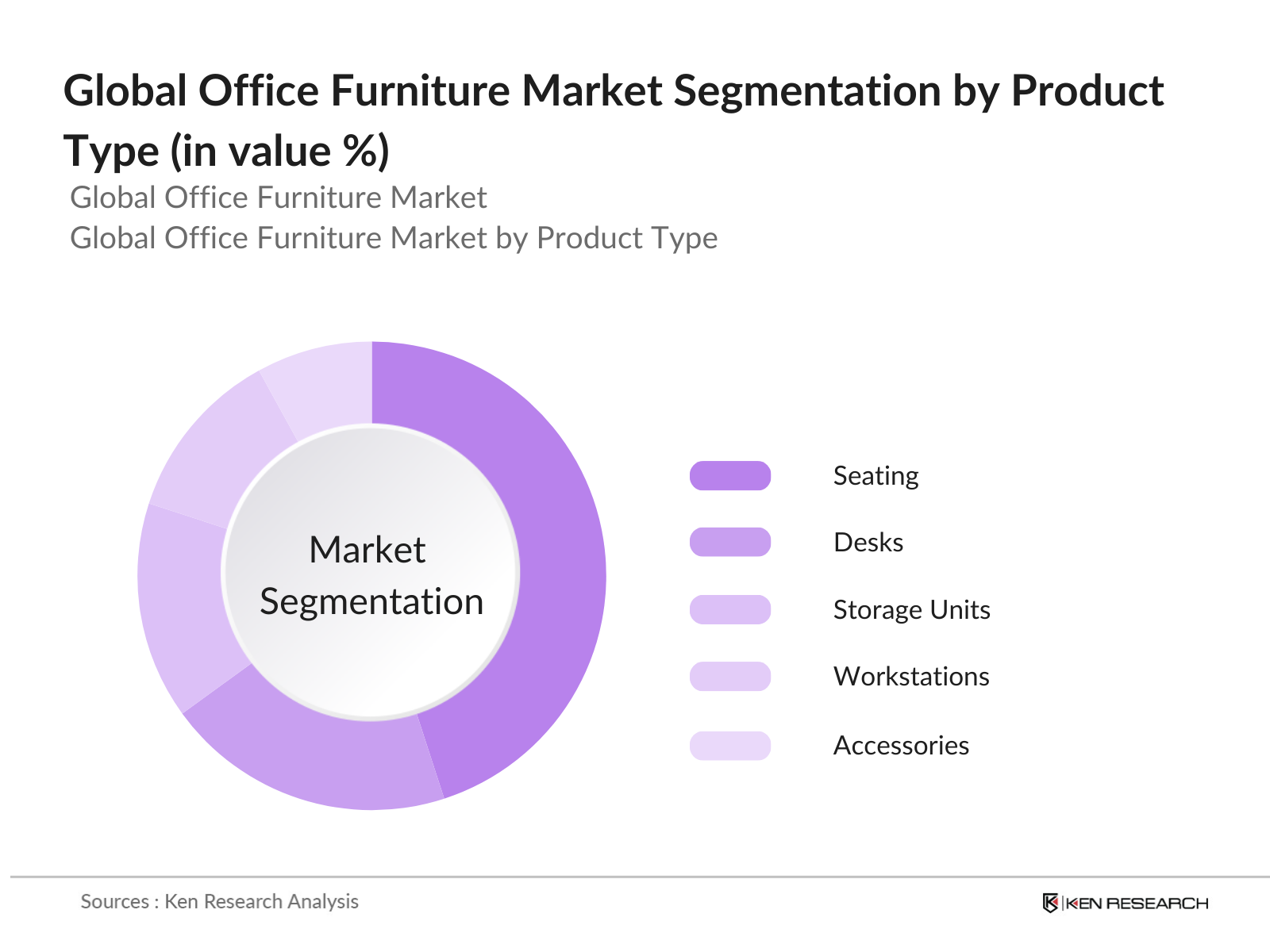
By Product Type: The global office furniture market is segmented by product type into seating, desks, storage units, workstations, and accessories. Recently, ergonomic seating has a dominant market share within this segment due to the increasing awareness of employee health and productivity. Ergonomically designed chairs, such as those offered by companies like Steelcase and Herman Miller, have become indispensable in modern workspaces as organizations focus on reducing work-related injuries and improving posture. This focus on ergonomics has resulted in higher sales of ergonomic chairs.
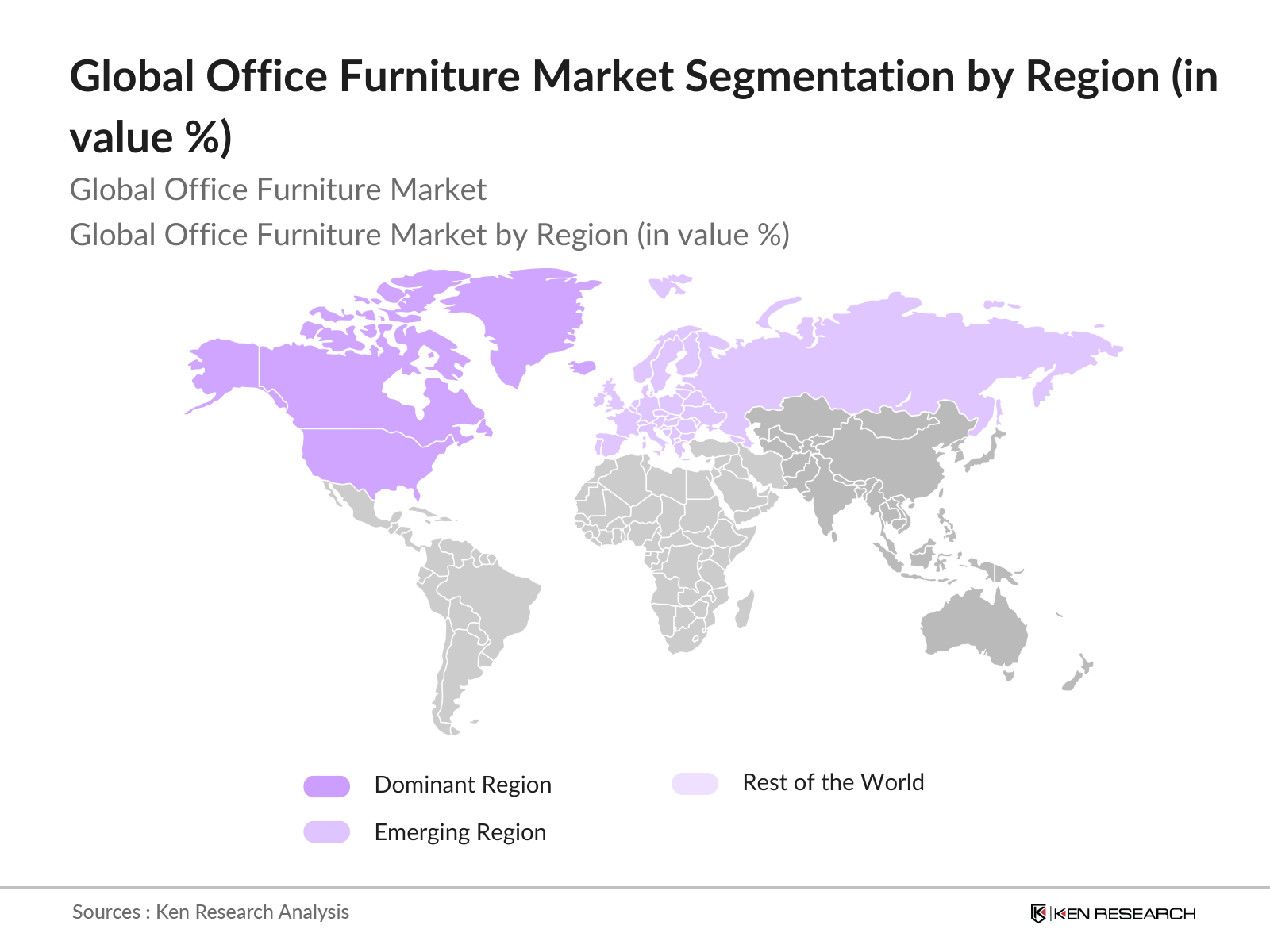
 By Region: The global office furniture market is segmented by region into North America, Europe, Asia-Pacific, the Middle East & Africa, and Latin America. North America leads the market, owing to its highly developed corporate sector and a strong culture of adopting cutting-edge office designs. With a focus on ergonomics, productivity, and employee well-being, the demand for modern, flexible office furniture remains high in this region. In addition, the presence of major industry players further strengthens North America's dominant position in the market.
 Global Office Furniture Market Competitive Landscape
The global office furniture market is consolidated, with a few key players dominating the industry. Major companies are continuously investing in research and development, sustainability initiatives, and expanding their product portfolios to cater to the evolving needs of modern workspaces.
|
Company Name |
Establishment Year |
Headquarters |
Revenue (USD Bn) |
Sustainability Initiatives |
Global Footprint |
Employee Count |
Product Range |
R&D Investment |
Market Strategy |
|
Steelcase Inc. |
1912 |
Grand Rapids, USA |
|||||||
|
Herman Miller Inc. |
1923 |
Zeeland, USA |
|||||||
|
Haworth Inc. |
1948 |
Holland, USA |
|||||||
|
HNI Corporation |
1944 |
Muscatine, USA |
|||||||
|
Okamura Corporation |
1945 |
Yokohama, Japan |
Market Growth Drivers
Market Challenges
The global office furniture market is expected to experience significant growth over the next five years, driven by the increasing adoption of hybrid work models, the rise in corporate real estate investments, and the growing emphasis on employee well-being. Organizations are increasingly recognizing the importance of ergonomically designed furniture and flexible workspace solutions to enhance productivity. Additionally, the integration of smart technology into office furniture is expected to open new avenues for growth as companies focus on creating tech-enabled, connected office environments.
Market Opportunities:
|
By Product Type |
Seating Desks Storage Units Workstations Accessories |
|
By Material Type |
Wood Metal Plastic Fabric Glass |
|
By Distribution Channel |
Offline Stores Online Platform |
|
By End-User |
SMEs Large Corporates Government Institutions Co-Working Spaces Educational Institutions |
|
By Region |
North America Europe Asia-Pacific Middle East & Africa Latin America |
1.1. Definition and Scope
1.2. Market Taxonomy
1.3. Market Growth Rate
1.4. Market Segmentation Overview
2.1. Historical Market Size
2.2. Year-On-Year Growth Analysis
2.3. Key Market Developments and Milestones
3.1. Growth Drivers (Ergonomics Adoption, Smart Furniture Integration, Sustainability Initiatives)
3.1.1. Demand for Ergonomic Solutions
3.1.2. Shift Towards Sustainable Materials
3.1.3. Integration of Smart Technology in Furniture
3.1.4. Evolving Workplace Culture
3.2. Market Challenges (Rising Raw Material Costs, Supply Chain Disruptions, Competition from Low-Cost Manufacturers)
3.2.1. Volatility in Material Prices
3.2.2. Supply Chain Disruptions Due to Global Events
3.2.3. Competition from Low-Cost Regions
3.3. Opportunities (Innovations in Office Layouts, Remote Working Trends, Eco-Friendly Furniture Development)
3.3.1. Expansion into Co-working and Remote Working Setups
3.3.2. Growing Demand for Customizable and Modular Furniture
3.3.3. Opportunities in Green Certifications and Eco-friendly Designs
3.4. Trends (Hybrid Office Models, Circular Economy, Customization & Personalization)
3.4.1. Rise of Hybrid Workspaces
3.4.2. Circular Economy Influence in Furniture Manufacturing
3.4.3. Personalization of Workspaces
3.5. Government Regulations (Furniture Industry Standards, Sustainability Regulations)
3.5.1. Adherence to Global and Regional Standards
3.5.2. Green Building Certifications and Sustainability Compliance
3.5.3. Recycling and Waste Management Regulations
3.6. SWOT Analysis
3.7. Stakeholder Ecosystem (Manufacturers, Suppliers, Designers, Office Planners)
3.8. Porters Five Forces (Supplier Power, Buyer Power, Competitive Rivalry, Threat of Substitutes, Barriers to Entry)
3.9. Competition Ecosystem
4.1. By Product Type (In Value %)
4.1.1. Seating (Ergonomic Chairs, Executive Chairs, Guest Chairs, Stools)
4.1.2. Desks (Standing Desks, Conference Tables, Executive Desks)
4.1.3. Storage Units (Cabinets, Filing Cabinets, Shelves)
4.1.4. Workstations (Modular, Cubicles, Open Office Systems)
4.1.5. Accessories (Partitions, Lighting, Computer Holders)
4.2. By Material Type (In Value %)
4.2.1. Wood
4.2.2. Metal
4.2.3. Plastic
4.2.4. Fabric
4.2.5. Glass
4.3. By Distribution Channel (In Value %)
4.3.1. Offline Stores (Retailers, Specialized Stores, Distributors)
4.3.2. Online Platforms (E-commerce, Direct Sales Channels)
4.4. By End-User (In Value %)
4.4.1. Small and Medium Enterprises (SMEs)
4.4.2. Large Corporates
4.4.3. Government Institutions
4.4.4. Co-Working Spaces
4.4.5. Educational Institutions
4.5. By Region (In Value %)
4.5.1. North America
4.5.2. Europe
4.5.3. Asia-Pacific
4.5.4. Middle East & Africa
4.5.5. Latin America
5.1. Detailed Profiles of Major Companies
5.1.1. Steelcase Inc.
5.1.2. Herman Miller Inc.
5.1.3. Haworth Inc.
5.1.4. HNI Corporation
5.1.5. Knoll Inc.
5.1.6. Teknion Corporation
5.1.7. Kimball International
5.1.8. Okamura Corporation
5.1.9. Global Furniture Group
5.1.10. KI (Krueger International)
5.1.11. Kinnarps AB
5.1.12. Itoki Corporation
5.1.13. TopStar GmbH
5.1.14. Vitra International AG
5.1.15. Bene GmbH
5.2. Cross Comparison Parameters (No. of Employees, Headquarters, Revenue, Product Portfolio, Sustainability Initiatives, Market Presence, R&D Investment, Global Footprint)
5.3. Market Share Analysis
5.4. Strategic Initiatives
5.5. Mergers and Acquisitions
5.6. Investment Analysis
5.7. Venture Capital Funding
5.8. Government Grants
5.9. Private Equity Investments
6.1. Compliance to Environmental Standards
6.2. Certification Requirements for Sustainability
6.3. Occupational Safety and Health Standards (OSHA Compliance)
7.1. Market Size Projections
7.2. Factors Driving Future Market Growth
8.1. By Product Type (In Value %)
8.2. By Material Type (In Value %)
8.3. By Distribution Channel (In Value %)
8.4. By End-User (In Value %)
8.5. By Region (In Value %)
9.1. TAM/SAM/SOM Analysis
9.2. Customer Cohort Analysis
9.3. Marketing Initiatives
9.4. White Space Opportunity Analysis
Disclaimer
Contact Us
In the initial stage, we identified the key drivers, challenges, and opportunities influencing the global office furniture market. This was accomplished through extensive desk research, leveraging secondary data from proprietary databases and government publications to gain a comprehensive understanding of the market dynamics.
In this phase, historical data from the global office furniture market was compiled and analyzed. We assessed revenue trends, the impact of ergonomic furniture on sales, and how supply chain disruptions affected the market. Data was corroborated by analyzing reports from trade associations and industry reports to ensure accuracy.
To validate our hypotheses, we conducted telephonic interviews with industry professionals representing manufacturers, suppliers, and corporate buyers. These consultations provided insight into the operational strategies of key market players and helped refine our analysis by incorporating on-the-ground expertise.
The final phase involved synthesizing the collected data and insights into a cohesive report. This included engaging with leading manufacturers to verify sales trends, product performance, and consumer preferences, ensuring the reliability and comprehensiveness of the market analysis.
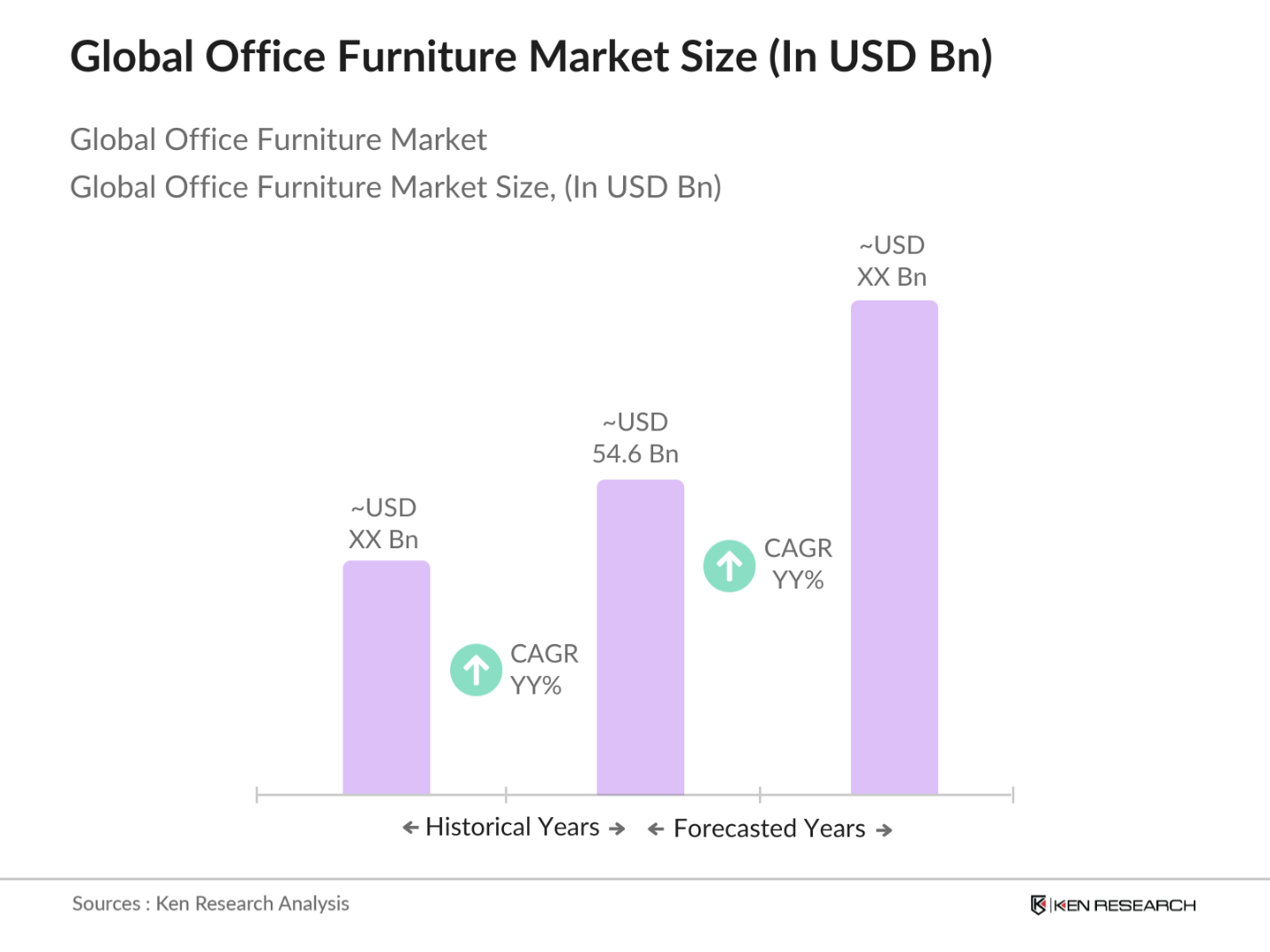
The global office furniture market, valued at USD 54.6 billion, is driven by rising corporate expansions, hybrid work environments, and a growing emphasis on employee well-being and ergonomics.
Challenges in the market include volatility in raw material prices, global supply chain disruptions, and intense competition from low-cost manufacturers, which pose profitability threats for established players.
Key players in the market include Steelcase Inc., Herman Miller Inc., Haworth Inc., HNI Corporation, and Okamura Corporation. These companies maintain a dominant presence due to their focus on innovation, sustainability, and ergonomic solutions.
The market is propelled by factors such as increasing corporate investments in ergonomic furniture, the rise of hybrid and flexible workspaces, and growing environmental consciousness driving demand for sustainable office solutions.

What makes us stand out is that our consultants follows Robust, Refine and Result (RRR) methodology. i.e. Robust for clear definitions, approaches and sanity checking, Refine for differentiating respondents facts and opinions and Result for presenting data with story

We have set a benchmark in the industry by offering our clients with syndicated and customized market research reports featuring coverage of entire market as well as meticulous research and analyst insights.

While we don't replace traditional research, we flip the method upside down. Our dual approach of Top Bottom & Bottom Top ensures quality deliverable by not just verifying company fundamentals but also looking at the sector and macroeconomic factors.

With one step in the future, our research team constantly tries to show you the bigger picture. We help with some of the tough questions you may encounter along the way: How is the industry positioned? Best marketing channel? KPI's of competitors? By aligning every element, we help maximize success.

Our report gives you instant access to the answers and sources that other companies might choose to hide. We elaborate each steps of research methodology we have used and showcase you the sample size to earn your trust.

If you need any support, we are here! We pride ourselves on universe strength, data quality, and quick, friendly, and professional service.