
Global Paving Stones Market Outlook to 2030
Region:Global
Author(s):Shivani
Product Code:KROD6391
Region:Global
Author(s):Shivani
Product Code:KROD6391
October 2024
97
Global Paving Stones Market Segmentation
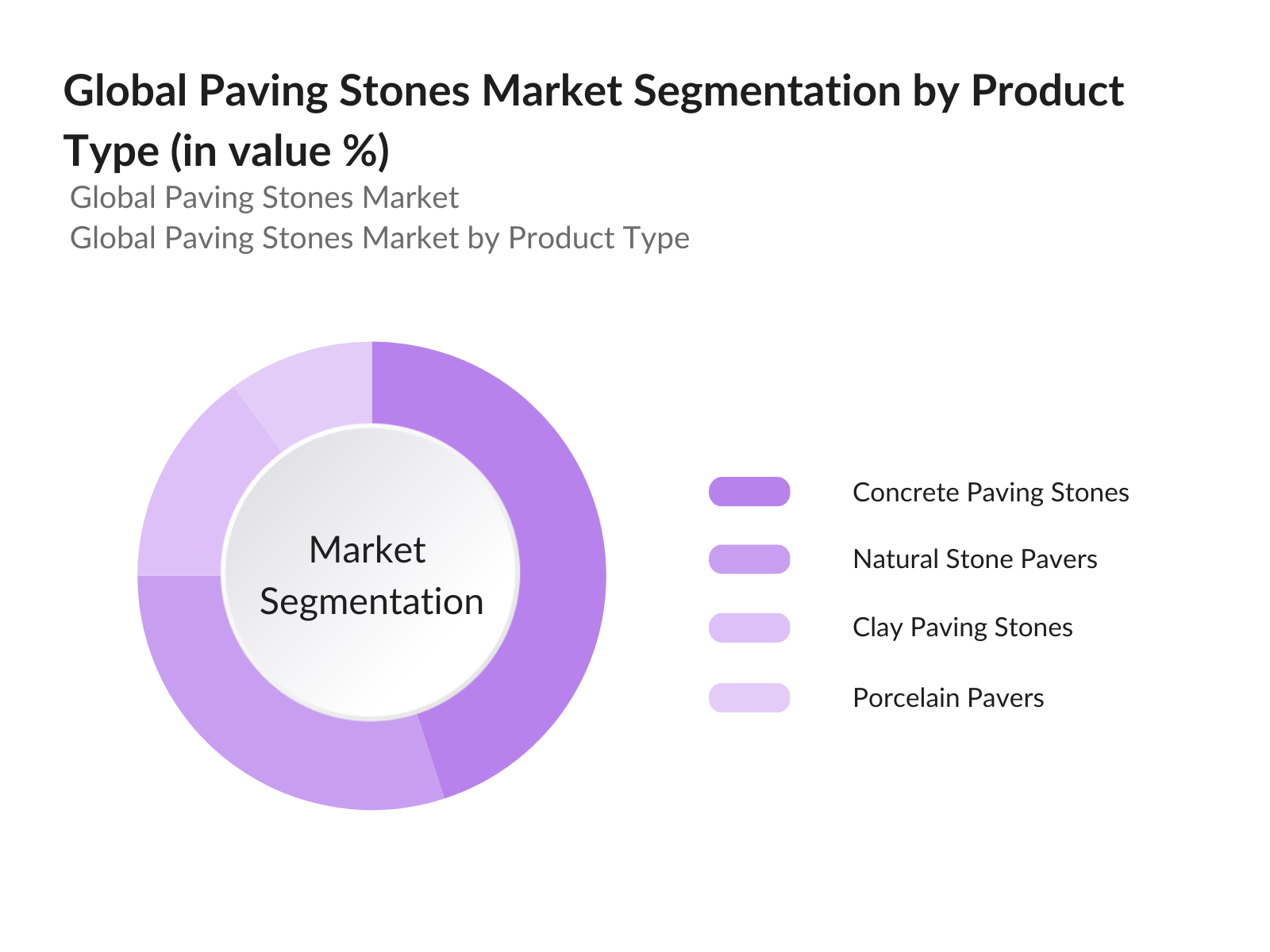
By Product Type: The global paving stones market is segmented by product type into concrete paving stones, natural stone pavers, clay paving stones, and porcelain pavers. Among these, concrete paving stones hold a dominant market share, driven by their cost-effectiveness, versatility, and high durability. These stones are widely used in commercial spaces and public infrastructure due to their ability to withstand heavy traffic and extreme weather conditions. Additionally, concrete pavers are preferred due to their wide availability and lower installation costs.
|
Product Type |
Market Share (%) |
|---|---|
|
Concrete Paving Stones |
45% |
|
Natural Stone Pavers |
30% |
|
Clay Paving Stones |
15% |
|
Porcelain Pavers |
10% |
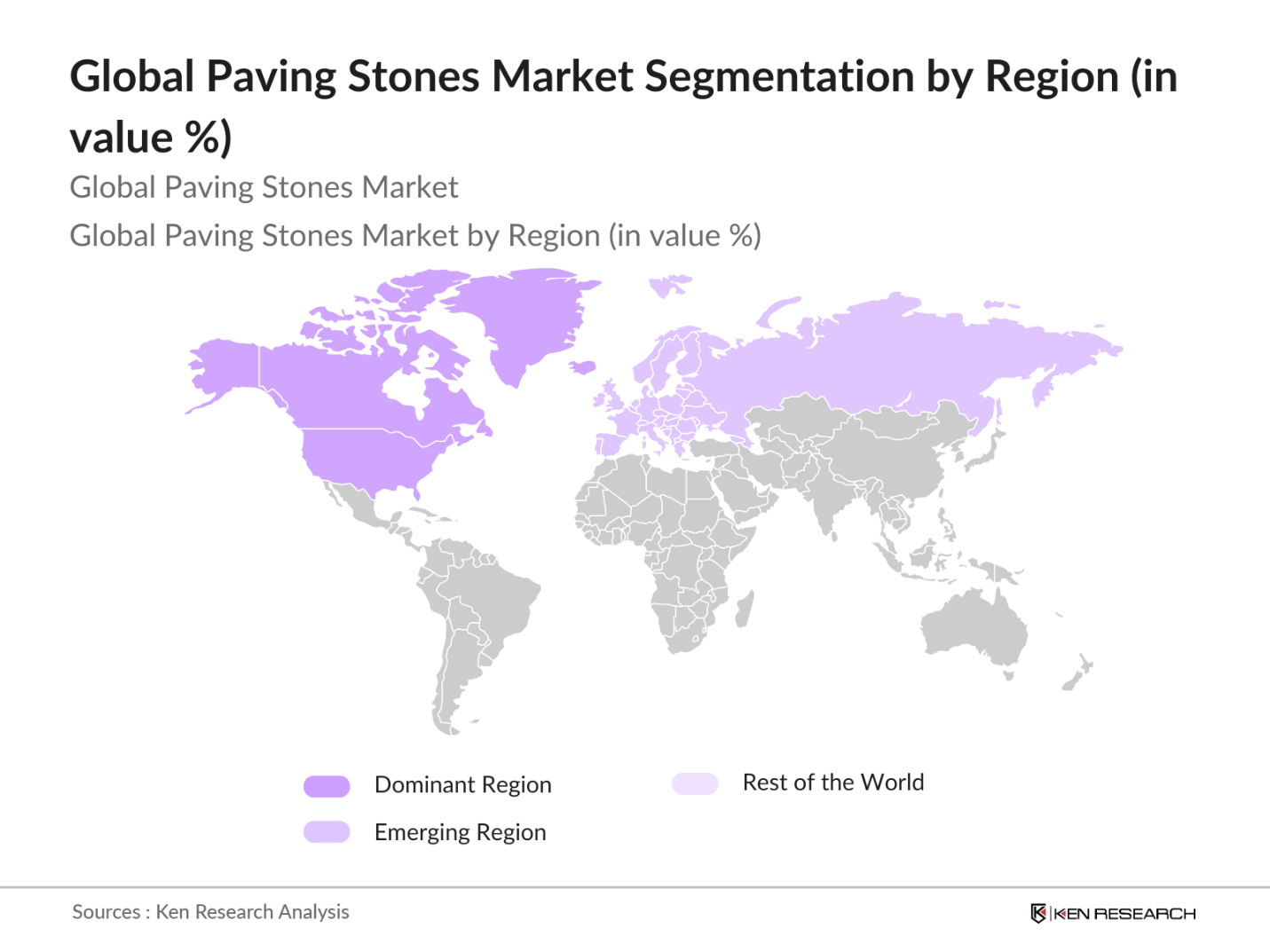
By Region: The global paving stones market is segmented into North America, Europe, Asia-Pacific, Middle East & Africa, and Latin America. North America dominates the market, with a large portion of demand coming from the U.S. due to major investments in public infrastructure projects. Europe follows closely, with countries like Germany leading the way in sustainable construction practices, including the use of eco-friendly paving materials.
|
Region |
Market Share (%) |
|---|---|
|
North America |
40% |
|
Europe |
30% |
|
Asia-Pacific |
20% |
|
Middle East & Africa |
5% |
|
Latin America |
5% |
Global Paving Stones Market Competitive Landscape
The global paving stones market is dominated by both established international corporations and local players. These companies are engaging in mergers, acquisitions, and product innovation to maintain their market presence.
|
Company Name |
Year Established |
Headquarters |
Revenue (USD Bn) |
No. of Employees |
Product Customization |
Sustainability Initiatives |
R&D Investments |
Market Presence |
Major Projects |
|
Pavestone |
1980 |
U.S. |
2.1 |
||||||
|
Belgard |
1955 |
U.S. |
1.8 |
||||||
|
Marshalls Plc |
1880 |
UK |
3.5 |
||||||
|
Wienerberger AG |
1819 |
Austria |
4.2 |
||||||
|
Unilock |
1972 |
Canada |
1.3 |
Global Paving Stones Market Analysis
Market Growth Drivers
Market Challenges:
Global Paving Stones Market Future Outlook
Over the next five years, the global paving stones market is expected to experience substantial growth driven by increasing urbanization, the rise of smart city projects, and government initiatives for sustainable infrastructure. The demand for eco-friendly and permeable paving stones is projected to grow, particularly in regions like North America and Europe, where stringent environmental regulations are being implemented.
Market Opportunities:
|
By Product Type |
Concrete Paving Stones Clay Paving Stones Natural Stone Pavers Porcelain Pavers |
|
By Application |
Residential Construction Commercial Construction Public Infrastructure |
|
By Material |
Concrete Natural Stone Rubber |
|
By Installation Method |
Mortar Set Dry-Laid Resin Bound |
|
By Region |
North America Europe Asia-Pacific Middle East & Africa Latin America |
Pavestone
1.1. Definition and Scope
1.2. Market Taxonomy
1.3. Key Market Drivers
1.4. Market Growth Rate and Trends
1.5. Market Segmentation Overview
2.1. Historical Market Size
2.2. Year-On-Year Growth Analysis
2.3. Key Market Developments and Milestones
3.1. Growth Drivers
3.1.1. Urban Infrastructure Development
3.1.2. Government Initiatives in Public Spaces
3.1.3. Eco-friendly and Sustainable Construction Trends
3.2. Market Challenges
3.2.1. High Cost of Raw Materials
3.2.2. Seasonal Demand and Volatility
3.2.3. Competition from Alternative Materials
3.3. Opportunities
3.3.1. Expansion in Emerging Markets
3.3.2. Technological Advancements in Production Techniques
3.3.3. Customization and Aesthetic Appeal in Landscaping
3.4. Market Trends
3.4.1. Adoption of Permeable Paving Stones for Water Management
3.4.2. Integration with Smart City Infrastructure
3.4.3. Increased Use in Residential Landscaping
3.5. Government Regulations
3.5.1. Environmental Sustainability Standards
3.5.2. Certification for Green Building Materials
3.5.3. Public-Private Partnerships in Urban Development
3.6. SWOT Analysis
3.7. Stakeholder Ecosystem [Material Suppliers, Distributors, End-Users, Contractors]
3.8. Porters Five Forces Analysis
3.9. Competition Ecosystem
4.1. By Product Type (In Value %)
4.1.1. Concrete Paving Stones
4.1.2. Clay Paving Stones
4.1.3. Natural Stone Pavers
4.1.4. Porcelain Pavers
4.2. By Application (In Value %)
4.2.1. Residential Construction
4.2.2. Commercial Construction
4.2.3. Public Infrastructure
4.3. By Material (In Value %)
4.3.1. Concrete
4.3.2. Natural Stone
4.3.3. Rubber
4.4. By Installation Method (In Value %)
4.4.1. Mortar Set
4.4.2. Dry-Laid
4.4.3. Resin Bound
4.5. By Region (In Value %)
4.5.1. North America
4.5.2. Europe
4.5.3. Asia-Pacific
4.5.4. Middle East & Africa
4.5.5. Latin America
5.1. Detailed Profiles of Major Companies
5.1.1. Pavestone
5.1.2. Belgard
5.1.3. Unilock
5.1.4. RCP Block & Brick
5.1.5. Marshalls Plc
5.1.6. Wienerberger AG
5.1.7. LafargeHolcim
5.1.8. Nitterhouse Masonry Products
5.1.9. Shaw Brick
5.1.10. Anchor Block Company
5.1.11. Brampton Brick Limited
5.1.12. Tobermore
5.1.13. McNear Brick & Block
5.1.14. Island Block & Paving
5.1.15. Abbotsford Concrete Products
5.2. Cross Comparison Parameters
Revenue, Headquarters, Product Portfolio, Manufacturing Facilities, R&D Investments, Sustainability Initiatives, Market Presence, Product Customization
5.3. Market Share Analysis
5.4. Strategic Initiatives
5.5. Mergers And Acquisitions
5.6. Investment Analysis
5.7. Venture Capital Funding
5.8. Government Grants
5.9. Private Equity Investments
6.1. Construction Material Standards
6.2. Environmental Compliance Requirements
6.3. Green Building Certifications
7.1. Future Market Size Projections
7.2. Key Factors Driving Future Market Growth
8.1. By Product Type (In Value %)
8.2. By Application (In Value %)
8.3. By Material (In Value %)
8.4. By Installation Method (In Value %)
8.5. By Region (In Value %)
9.1. TAM/SAM/SOM Analysis
9.2. Market Entry Strategies
9.3. Product Differentiation Strategies
9.4. Distribution Channel Optimization
Disclaimer Contact UsIn this phase, our team constructed an ecosystem map of the global paving stones market, identifying key stakeholders such as construction companies, public infrastructure agencies, and landscaping firms. Extensive desk research was conducted to gather reliable data from secondary and proprietary sources.
We collected and analyzed historical data to evaluate market penetration across various segments. Special emphasis was placed on the assessment of revenue generation from major public infrastructure projects and residential developments globally.
Our research hypotheses were validated through interviews with industry experts, including representatives from leading paving stone manufacturers. These consultations provided critical insights into product demand trends, consumer preferences, and technological advancements within the industry.
The final phase involved integrating feedback from key industry participants, including paving stone manufacturers and distributors. This bottom-up approach ensured the accuracy of our market forecasts, as well as validation of market trends across different regions and segments.
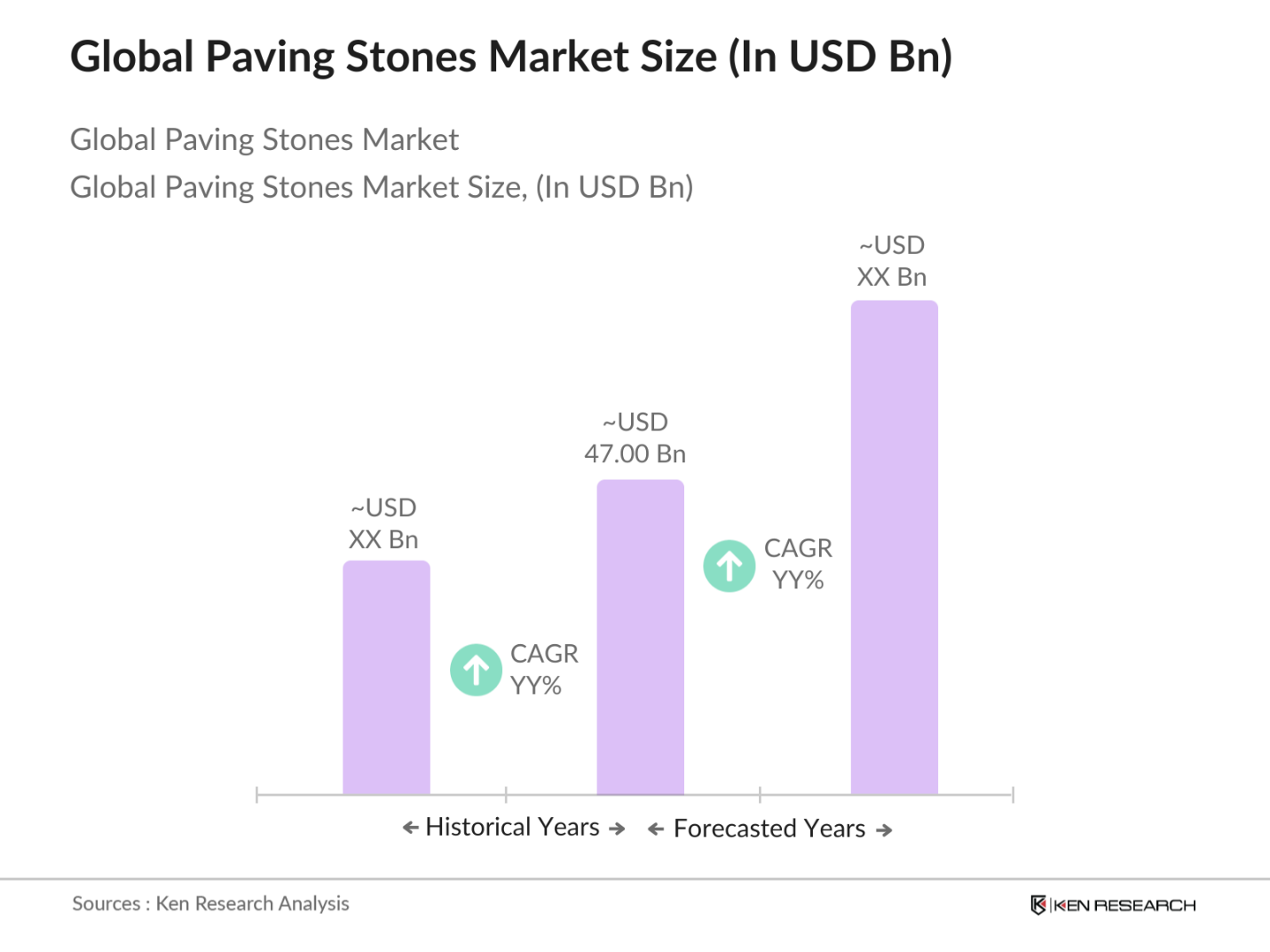
The global paving stones market was valued at USD 47.00 billion, driven by urban infrastructure development and residential landscaping projects.
Challenges include fluctuating raw material prices, competition from alternative materials, and environmental regulations that impose stricter manufacturing standards.
Key players include Pavestone, Belgard, Unilock, Marshalls Plc, and Wienerberger AG, who dominate through product innovation and sustainability initiatives.
The market is primarily driven by urbanization, government investments in infrastructure, and the rising trend of sustainable construction materials, including permeable and eco-friendly paving stones.

What makes us stand out is that our consultants follows Robust, Refine and Result (RRR) methodology. i.e. Robust for clear definitions, approaches and sanity checking, Refine for differentiating respondents facts and opinions and Result for presenting data with story

We have set a benchmark in the industry by offering our clients with syndicated and customized market research reports featuring coverage of entire market as well as meticulous research and analyst insights.

While we don't replace traditional research, we flip the method upside down. Our dual approach of Top Bottom & Bottom Top ensures quality deliverable by not just verifying company fundamentals but also looking at the sector and macroeconomic factors.

With one step in the future, our research team constantly tries to show you the bigger picture. We help with some of the tough questions you may encounter along the way: How is the industry positioned? Best marketing channel? KPI's of competitors? By aligning every element, we help maximize success.

Our report gives you instant access to the answers and sources that other companies might choose to hide. We elaborate each steps of research methodology we have used and showcase you the sample size to earn your trust.

If you need any support, we are here! We pride ourselves on universe strength, data quality, and quick, friendly, and professional service.