















Global Payload in Satellite Market Outlook to 2030
Region:Global
Author(s):Shambhavi
Product Code:KROD2410
December 2024
97
About the Report
Global Payload in Satellite Market Overview
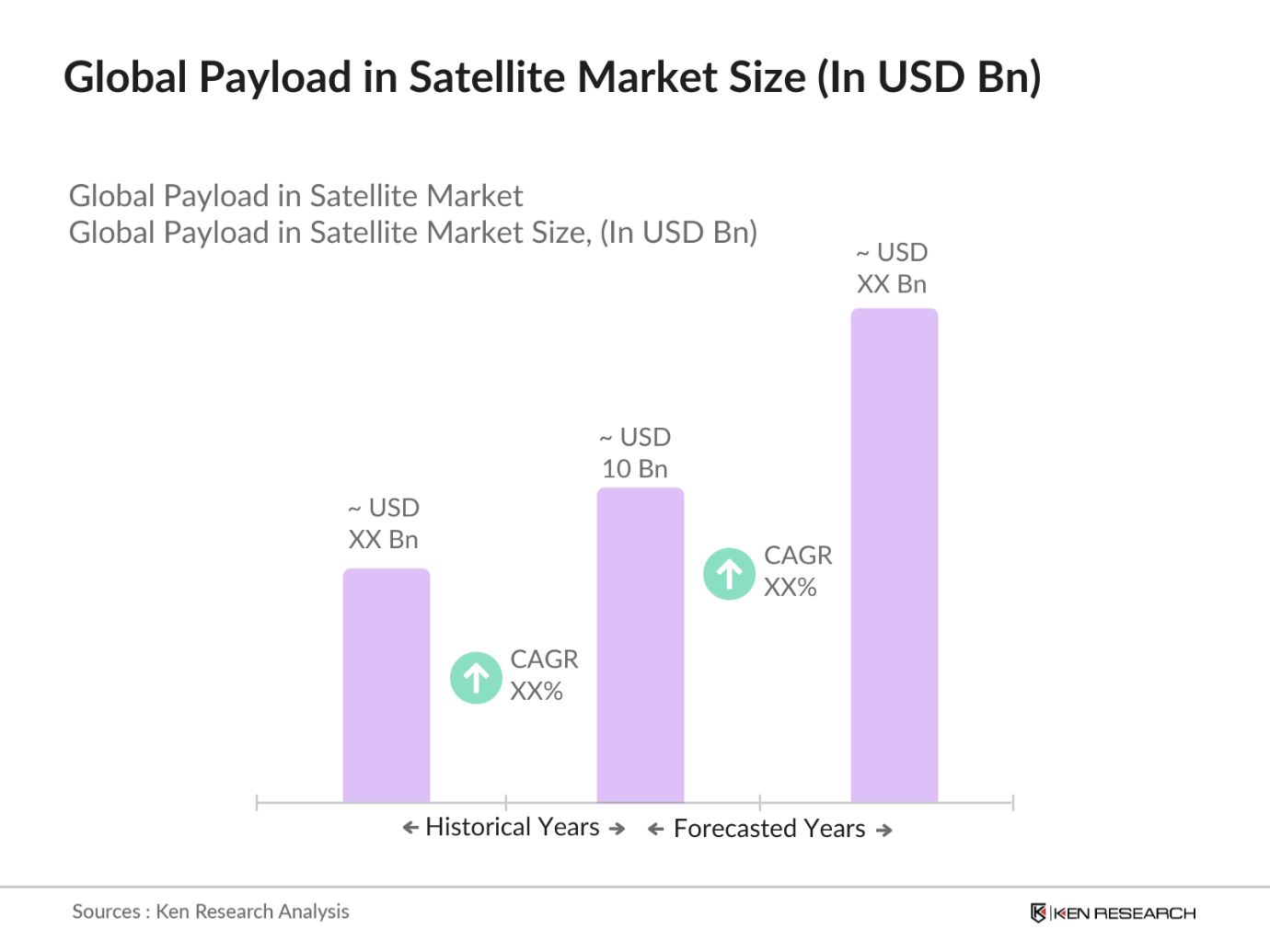
- The Global Payload in Satellite Market reached a valuation of USD 10 billion in 2023. The market's growth is fueled by increased demand for satellite communication and earth observation, driven by technological advancements and expanding space exploration. The deployment of commercial satellites, backed by government initiatives and private sector investments, contributes to the rise in satellite payloads.
- Prominent companies in the payload sector include SpaceX, Airbus, Northrop Grumman, Lockheed Martin, and Thales Alenia Space. These organizations dominate the market with their innovative satellite systems and payload technologies. SpaceX, in particular, has revolutionized the commercial satellite industry with its reusable rocket technologies, significantly reducing launch costs and accelerating deployment cycles. Each player maintains a focus on enhancing payload capacity and operational efficiency through strategic partnerships and research initiatives.
- In early 2023, SpaceX successfully launched 60 Starlink satellites, marking a major milestone in its effort to provide global broadband internet service via satellite constellations. These satellites, carrying advanced communication payloads, were launched from Cape Canaveral using Falcon 9 rockets. This development illustrates how the growing commercial demand for high-speed, global internet services is accelerating innovation in satellite payloads, with other companies following similar trajectories in this competitive market.
- The market dominance in North America, especially in the U.S., is driven by cities like Los Angeles and Cape Canaveral, which are hubs of aerospace innovation. Los Angeles, home to leading space technology firms like SpaceX and Northrop Grumman, continues to drive advancements in payload technologies. Cape Canaveral, known for its extensive launch facilities, also plays a vital role in the deployment of commercial and defense-related payloads.
Global Payload in Satellite Market Segmentation
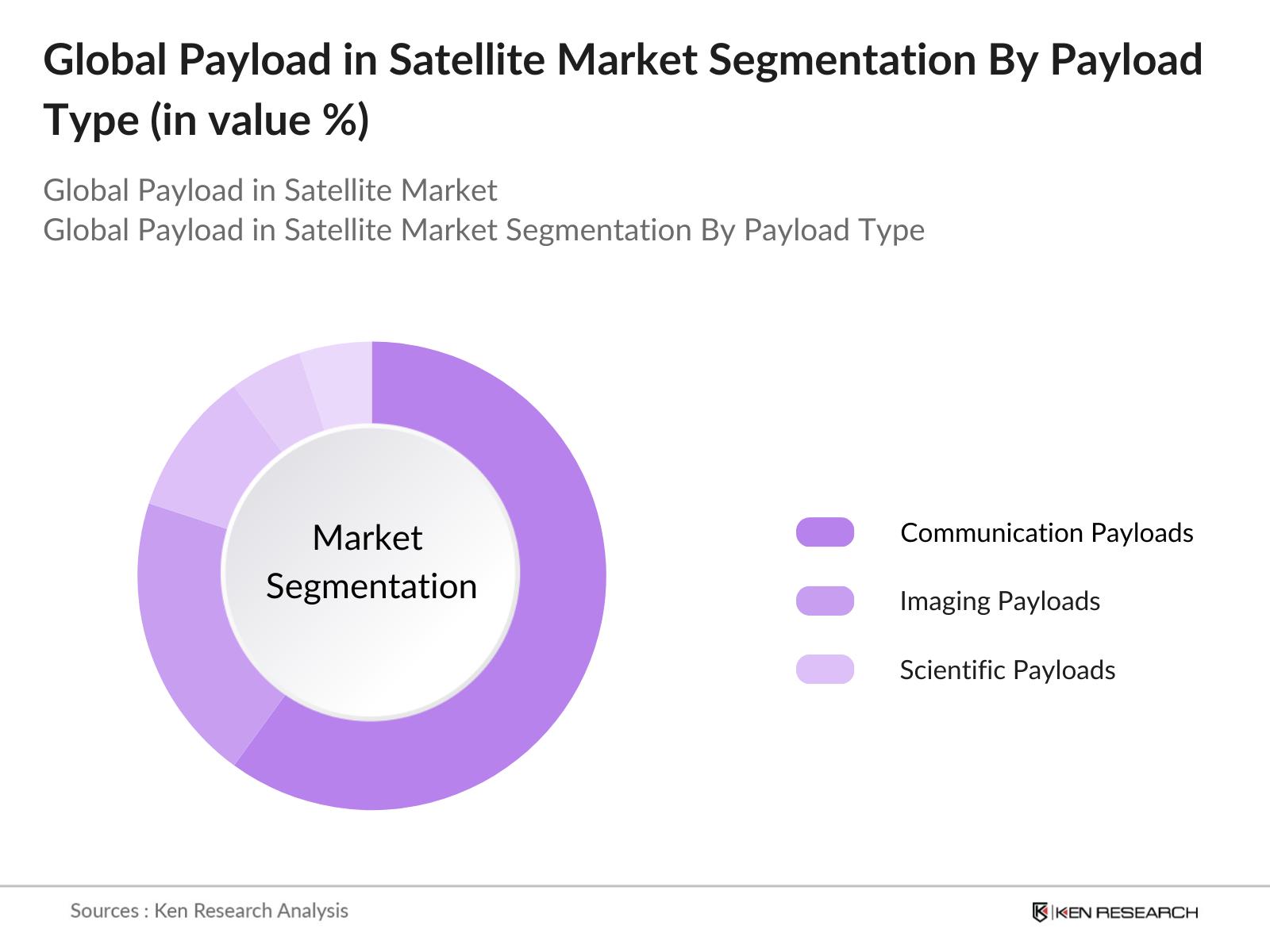
By Payload Type: The Global Payload in Satellite Market is segmented by payload type into communication payloads, imaging payloads, and scientific payloads. In 2023, communication payloads dominate the market due to the increasing demand for high-speed data transfer and satellite-based internet services. Companies like SpaceX and Amazon (with their Kuiper project) are heavily investing in satellite constellations aimed at providing global internet coverage, further driving the demand for communication payloads. The trend of expanding satellite communication networks continues to propel this segment's growth.
By End-User: The market is segmented by end-users into commercial, defense, and civil sectors. The defense sector holds the largest share in 2023, primarily due to the heightened investment in satellite reconnaissance and intelligence payloads. Governments are increasingly deploying defense satellites for secure communication and real-time surveillance. The commercial segment is also witnessing growth, with the private sector's interest in broadband satellite services pushing payload demand higher.
|
End-User |
Market Share (2023) |
|
Defense |
45% |
|
Commercial |
35% |
|
Civil |
20% |
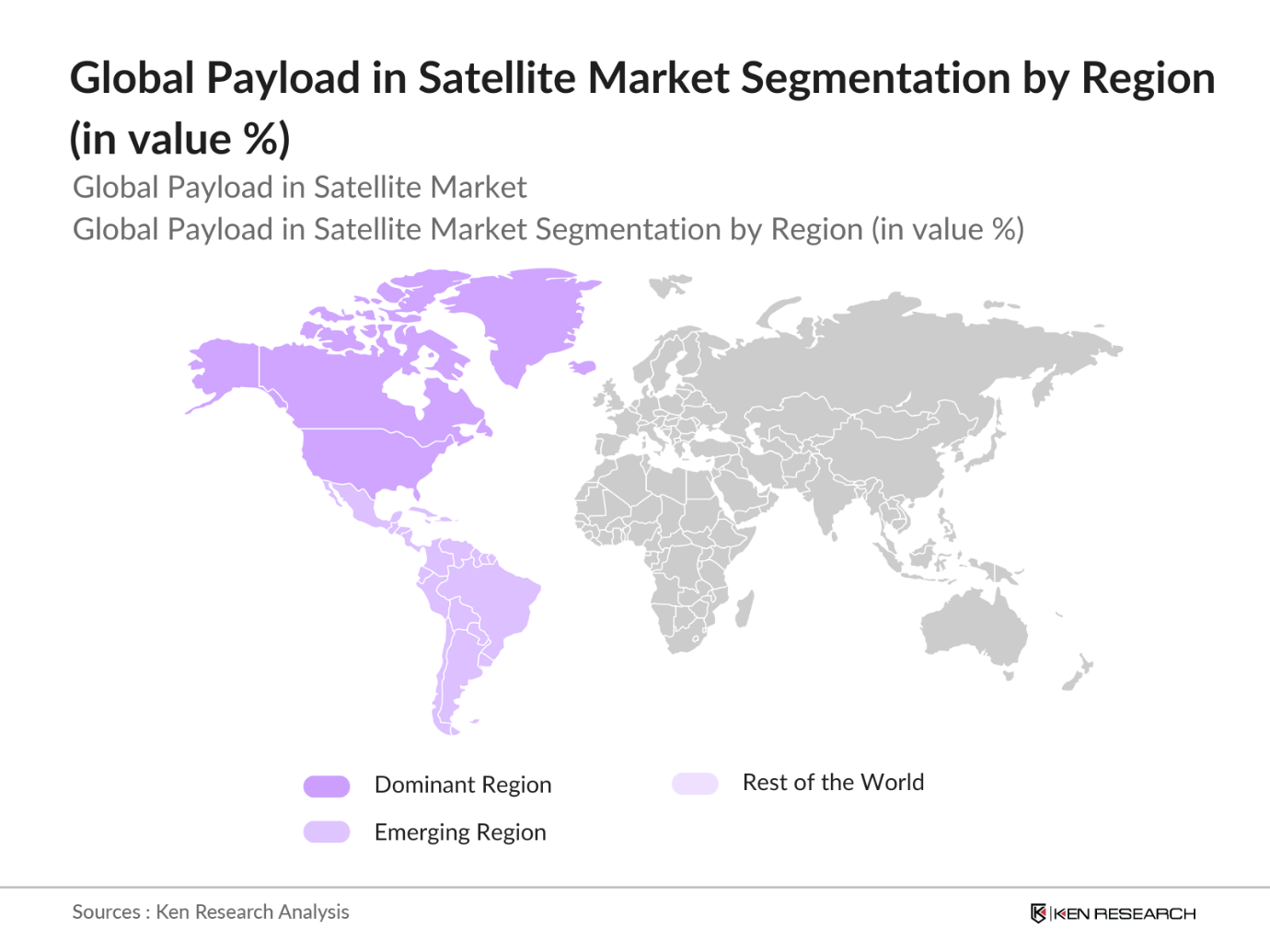
By Region: Geographically, the Global Payload in Satellite Market is segmented into North America, Europe, Asia-Pacific, Latin America and the Rest of the World. North America dominates the market in 2023, largely due to significant investments from both government and private sectors in satellite technologies. The U.S., in particular, leads in payload development, driven by the activities of NASA, the U.S. Department of Defense, and leading aerospace companies. The Latin America market follows closely, with a focus on scientific payloads and earth observation, supported by agencies.
Global Payload in Satellite Market Competitive Landscape
|
Company |
Establishment Year |
Headquarters |
|
SpaceX |
2002 |
Hawthorne, USA |
|
Airbus |
1970 |
Leiden, Netherlands |
|
Northrop Grumman |
1994 |
Falls Church, USA |
|
Lockheed Martin |
1995 |
Bethesda, USA |
|
Thales Alenia Space |
2005 |
Cannes, France |
- SpaceX: In 2024, SpaceX announced the development of new, advanced payload deployment systems designed for its Starship program, aiming to carry heavier payloads for future missions to Mars. The company also completed the 18th batch of Starlink launches in 2023, strengthening its commercial satellite internet offerings globally. With these initiatives, SpaceX continues to innovate within the commercial satellite payload sector .
- Northrop Grumman: Northrop Grumman launched a new payload processing facility in Virginia in 2023, designed to enhance the companys ability to develop defense and commercial satellite payloads. Additionally, the company secured a USD 1 billion contract from the U.S. Department of Defense to develop payloads for satellite-based missile detection systems, with expected launches slated for 2024.
Global Payload in Satellite Market Analysis
Growth Drivers
- Increasing Demand for High-Speed Global Internet via Satellite Constellations: The demand for satellite-based global internet servicescontinues to rise in 2024, driven by companies like SpaceX's Starlink, Amazon's Project Kuiper, and OneWeb. As of March 2024, SpaceX has deployed over 4,500 satellites into low-Earth orbit (LEO), supporting high-speed internet infrastructure.The U.S. government is projected to invest over $10 billion by 2025 in satellite broadband services for rural areas.
- Rising Investments in National Security and Defense Satellites: National defense programsare increasingly dependent on satellite payloads for intelligence, surveillance, and reconnaissance (ISR) missions. In 2023, the U.S. Department of Defense allocated $4.2 billion for the development of payloads aimed at missile detection, military communication, and real-time data transmission. China's People's Liberation Army (PLA) launched 14 satellites equipped with ISR payloads in 2023
- Expansion of Earth Observation Payloads for Climate Monitoring
Global environmental monitoring initiativesare driving demand for earth observation payloads. In 2023, the European Space Agency (ESA) launched the Sentinel-6 satellite, part of the Copernicus program, with payloads designed to measure sea-level rise, ocean dynamics, and atmospheric conditions. The ESA has committed over 2 billion for similar payloads between 2023 and 2025
Challenges
- High Costs Associated with Satellite Payload Manufacturing and Launch
Developing, manufacturing, and launching satellite payloadsremains an expensive endeavor. In 2024, the average cost of manufacturing a medium-sized communication payload ranged between $150 million and $200 million. Launch costs vary from $62 million for a Falcon 9 launch to $97 million for Falcon Heavy. - Satellite Congestion and Risk of Collisions: The increasing number of satellites in LEOhas led to concerns over congestion and potential collisions. As of 2024, over 10,000 satellites have been deployed into LEO, with projections indicating this number could double by 2028. Recent incidents, such as the near collision between Starlink satellites and a European Space Agency satellite in 2023, highlight the growing risk
Government Initiatives
- U.S. National Defense Space Architecture (2023)
In 2023, the U.S. Department of Defense launched the National Defense Space Architecture (NDSA) initiative to enhance satellite-based ISR and communication systems. The project includes the development of new defense payloads for missile tracking and secure data transmission, with an allocated budget of USD 2.1 billion. This initiative focuses on creating a resilient satellite architecture to strengthen national security and counter global threats. - European Space Agency's Earth Observation Payload Initiative (2023)
The European Space Agency launched the Earth Observation Payload Initiative in 2023, aiming to deploy advanced payloads that monitor climate change, track deforestation, and assess global environmental changes. With a total budget of EUR 1.5 billion, the program emphasizes cooperation between European nations to ensure the continuous flow of earth observation data from space.
Global Payload in Satellite Market Future Outlook
The Global Payload in Satellite Market is poised for significant growth through 2028, driven by the rapid deployment of satellite constellations, increasing defense budgets, and the rising demand for earth observation technologies. The expansion of broadband internet services via satellite, especially in underserved and remote regions, is expected to play a pivotal role in shaping the market. Government support, along with private investments in space infrastructure, will continue to stimulate growth across various segments. Key markets such as North America, Europe, and Asia-Pacific will dominate due to their extensive space programs and technological advancements.
Future Trends
- Proliferation of IoT and Smart Device Payloads
The integration of satellite payloads with IoT infrastructure will expand, providing connectivity for smart devices worldwide. Industries such as agriculture, logistics, and healthcare will benefit from the ability to track and manage assets in real-time via satellite payloads, with IoT-driven payloads being at the forefront of technological innovation. - Expansion of CubeSat Payloads for Scientific Research
The use of CubeSats, small satellites with compact payloads, will increase for scientific research and educational purposes. Their cost-effectiveness and the ability to carry miniaturized payloads will encourage more universities and research institutions to engage in space-based experiments and climate monitoring activities.
Scope of the Report
|
By Payload Type |
Communication Earth Observation Scientific ISR Navigation |
|
By Satellite Type |
LEO MEO GEO CubeSats Smallsats |
|
By Application |
Defense Commercial Scientific IoT Weather Monitoring |
|
By Region |
North America Europe Asia-Pacific Latin America Middle East & Africa |
|
By Technology |
Optical Microwave X-band, Infrared |
Products
Key Target Audience Organizations and Entities Who Can Benefit by Subscribing This Report:
Satellite Manufacturers
Aerospace Companies
Telecommunication Companies
Internet Service Providers
Defense Contractors
Space Research Organizations
Private Space Companies
Satellite Launch Providers
Investors and VC Firms
Government and Regulatory Bodies (e.g., U.S. Department of Defence, European Space Agency)
Time Period Captured in the Report:
Historical Period: 2018-2023
Base Year: 2023
Forecast Period: 2023-2028
Companies
Players Mentioned in the Report:
SpaceX
Airbus
Northrop Grumman
Lockheed Martin
Thales Alenia Space
Boeing
L3Harris Technologies
Maxar Technologies
Blue Origin
Raytheon Technologies
Planet Labs
Viasat
OneWeb
Amazon (Kuiper)
Rocket Lab
Table of Contents
1. Global Payload in Satellite Market Overview
1.1. Definition and Scope
1.2. Market Taxonomy (Satellite types, payload types, applications)
1.3. Market Growth Rate (YoY, Satellite Deployments)
1.4. Global Market Segmentation Overview
2. Global Payload in Satellite Market Size (in USD)
2.1. Historical Market Size (By Payload Type, Satellite Type)
2.2. YoY Growth Analysis (By Region, By Technology)
2.3. Key Market Developments and Milestones (Communication Satellites, ISR, IoT Satellites)
3. Global Payload in Satellite Market Analysis
3.1. Growth Drivers
3.1.1. Increasing Satellite Deployments for Global Internet Connectivity
3.1.2. Rising Investments in Defense and Surveillance Satellites
3.1.3. Expanding Applications of Earth Observation Payloads
3.2. Restraints
3.2.1. High Cost of Payload Development and Launch
3.2.2. Regulatory Challenges in Licensing and Orbital Traffic Management
3.2.3. Risks of Satellite Collisions in Crowded Orbits
3.3. Opportunities
3.3.1. Integration of IoT with Satellite Payloads
3.3.2. Expansion of CubeSats for Academic and Research Payloads
3.3.3. Emerging Markets for Satellite-Based Services in Developing Regions
3.4. Trends
3.4.1. Rise of Low-Cost Small Satellite Launch Systems
3.4.2. Growing Use of AI and Machine Learning in Satellite Data Processing
3.4.3. Increased Adoption of 5G-Powered Communication Payloads
3.5. Government Regulation
3.5.1. U.S. National Defense Space Architecture
3.5.2. European Space Agencys Environmental Monitoring Initiatives
3.5.3. Indian Space Communication Policy
3.6. SWOT Analysis (Strengths, Weaknesses, Opportunities, Threats)
3.7. Stakeholder Ecosystem (Government Bodies, Private Companies, Research Institutes)
3.8. Competition Ecosystem (Launch Providers, Payload Developers, Satellite Manufacturers)
4. Global Payload in Satellite Market Segmentation
4.1. By Payload Type (Communication, Earth Observation, Scientific, ISR, Navigation)
4.2. By Satellite Type (LEO, MEO, GEO, CubeSats, Smallsats)
4.3. By Application (Defense, Commercial, Scientific, IoT, Weather Monitoring)
4.4. By Region (North America, Europe, Asia-Pacific, Latin America, Middle East & Africa)
4.5. By Technology (Optical, Microwave, X-band, Infrared)
5. Global Payload in Satellite Market Cross Comparison
5.1. Detailed Profiles of Major Companies
5.1.1. Lockheed Martin
5.1.2. Boeing
5.1.3. Northrop Grumman
5.1.4. Airbus Defence and Space
5.1.5. SpaceX
5.1.6. Thales Alenia Space
5.1.7. Maxar Technologies
5.1.8. Sierra Nevada Corporation
5.1.9. Ball Aerospace & Technologies
5.1.10. L3Harris Technologies
5.1.11. Planet Labs
5.1.12. OHB SE
5.1.13. SATCOM Technologies
5.1.14. Viasat Inc.
5.1.15. Surrey Satellite Technology
5.2. Cross Comparison Parameters (No. of Employees, Headquarters, Revenue, Inception Year, Product Focus)
6. Global Payload in Satellite Market Competitive Landscape
6.1. Market Share Analysis (By Payload Type, By Region)
6.2. Strategic Initiatives (Mergers, Partnerships, Collaborations)
6.3. Investment Analysis (Private Equity, Government Grants, VC Funding)
6.4. Competitive Benchmarking (Operational Performance, Technological Capabilities)
7. Global Payload in Satellite Market Regulatory Framework
7.1. International Telecommunication Union (ITU) Regulations
7.2. Spectrum Licensing Requirements (By Country)
7.3. Satellite Decommissioning and Orbital Debris Management
8. Global Payload in Satellite Market Future Size (in USD)
8.1. Future Market Size Projections (By Satellite Type, By Payload Type)
8.2. Key Factors Driving Future Growth (New Technologies, Market Expansion)
9. Global Payload in Satellite Market Future Segmentation
9.1. By Payload Type (Communication, ISR, Earth Observation, Navigation, Scientific)
9.2. By Satellite Type (LEO, MEO, GEO, Smallsats, CubeSats)
9.3. By Application (Defense, IoT, Weather Monitoring, Earth Observation, Communication)
9.4. By Region (North America, Europe, Asia-Pacific, Latin America, Middle East & Africa)
9.5. By Technology (Optical, Microwave, Infrared, X-band)
10. Global Payload in Satellite Market Analysts' Recommendations
10.1. TAM/SAM/SOM Analysis
10.2. Investment Opportunities Analysis (White Space, Emerging Markets)
10.3. Customer Cohort Analysis
10.4. Strategic Partnerships and Collaborations
11. Contact Us
Research Methodology
Step 1: Identifying Key Variables
Ecosystem creation for all major entities and referring to multiple secondary and proprietary databases to perform desk research around the market to collate market-level information.
Step 2: Market Building
Collating statistics on the Global PAYLOAD IN SATELLITE Market over the years, analyzing the penetration of PAYLOAD IN SATELLITE technologies, and computing the revenue generated for the market. This step also involves reviewing technology adoption rates and application effectiveness to ensure accuracy behind the data points shared.
Step 3: Validating and Finalizing
Building market hypotheses and conducting CATIs with market experts belonging to different companies to validate statistics and seek operational and financial information from company representatives.
Step 4: Research Output
Our team will approach multiple PAYLOAD IN SATELLITE companies to understand the nature of technology segments, consumer preferences, and other parameters. This supports validating statistics derived through a bottom-to-top approach from these PAYLOAD IN SATELLITE companies, ensuring accuracy and reliability in the report.
Frequently Asked Questions
01. How big is the Global Payload in Satellite Market?
The global payload in satellite market, valued at USD 10 billion, is driven by increasing satellite deployments, growing defense expenditures, and the expansion of broadband internet services via satellite constellations.
02. What are the challenges in the Global Payload in Satellite Market?
The market faces challenges such as high costs associated with payload manufacturing and satellite launches, regulatory hurdles in securing licenses, and congestion in low-Earth orbit that increases the risk of satellite collisions.
03. Who are the major players in the Global Payload in Satellite Market?
Key players include Lockheed Martin, Boeing, SpaceX, Airbus Defence and Space, and Northrop Grumman. These companies dominate due to their extensive R&D capabilities, large-scale manufacturing, and strong government contracts.
04. What are the growth drivers of the Global Payload in Satellite Market?
Growth drivers include rising investments in defense and surveillance satellites, increasing demand for satellite-based global internet services, and the expansion of earth observation payloads for climate monitoring and research purposes.
Why Buy From Us?

What makes us stand out is that our consultants follows Robust, Refine and Result (RRR) methodology. i.e. Robust for clear definitions, approaches and sanity checking, Refine for differentiating respondents facts and opinions and Result for presenting data with story

We have set a benchmark in the industry by offering our clients with syndicated and customized market research reports featuring coverage of entire market as well as meticulous research and analyst insights.

While we don't replace traditional research, we flip the method upside down. Our dual approach of Top Bottom & Bottom Top ensures quality deliverable by not just verifying company fundamentals but also looking at the sector and macroeconomic factors.

With one step in the future, our research team constantly tries to show you the bigger picture. We help with some of the tough questions you may encounter along the way: How is the industry positioned? Best marketing channel? KPI's of competitors? By aligning every element, we help maximize success.

Our report gives you instant access to the answers and sources that other companies might choose to hide. We elaborate each steps of research methodology we have used and showcase you the sample size to earn your trust.

If you need any support, we are here! We pride ourselves on universe strength, data quality, and quick, friendly, and professional service.