















Global Personal Money Management Software Market Outlook to 2030
Region:Global
Author(s):Sanjna
Product Code:KROD5816
November 2024
86
About the Report
Global Personal Money Management Software Market Overview
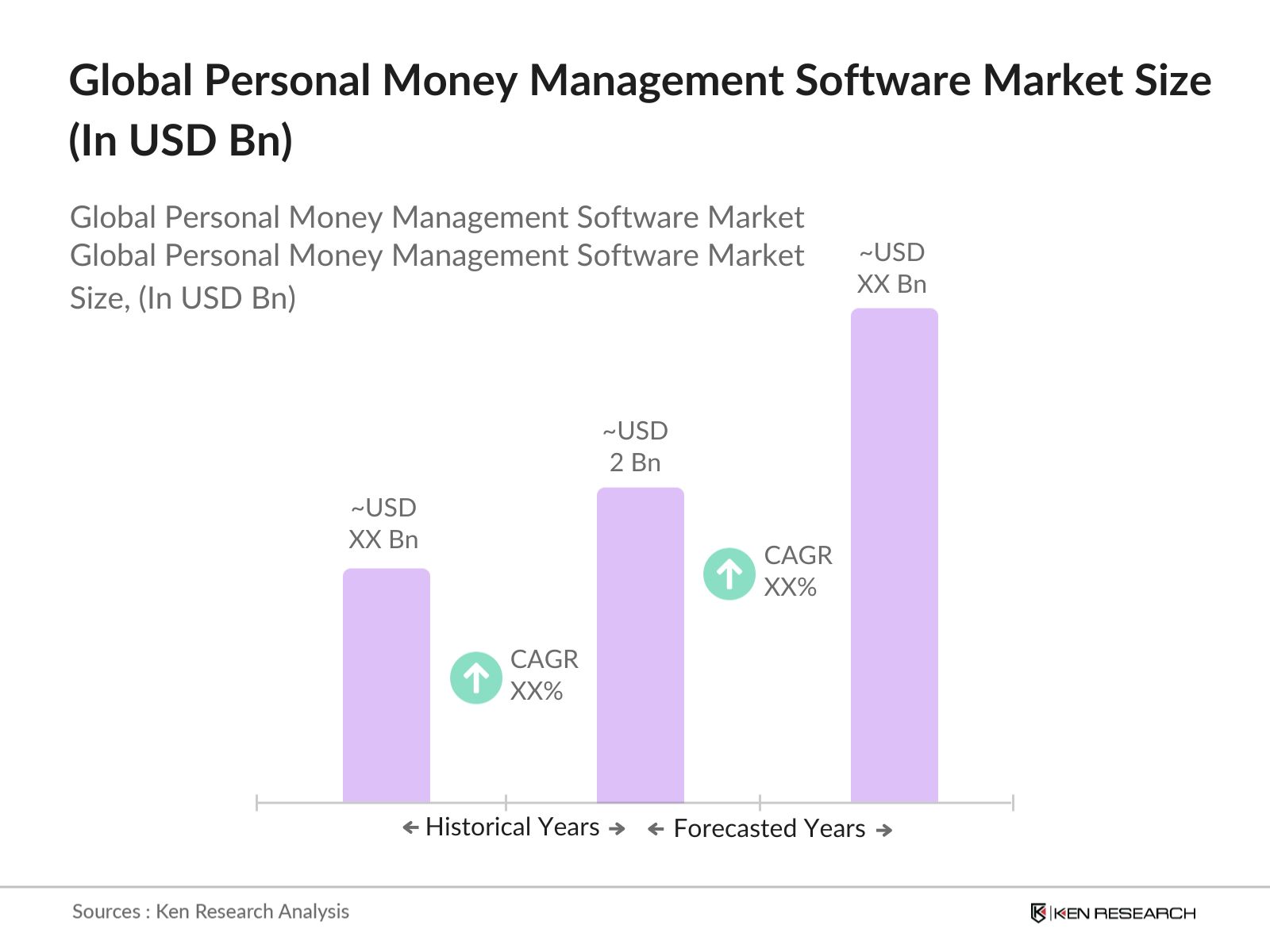
- The global personal money management software market is valued at USD 2 billion, driven by increasing consumer awareness regarding personal finance management and the rising adoption of digital financial tools. The market has been bolstered by the integration of artificial intelligence and machine learning, providing users with personalized insights to optimize their financial decisions.
- Countries such as the United States, Canada, and Germany dominate the personal money management software market due to their high financial literacy rates, extensive internet penetration, and widespread usage of digital tools. The dominance of these regions can be attributed to the presence of strong fintech ecosystems, a tech-savvy population, and early adoption of financial technologies.
- The General Data Protection Regulation (GDPR) continues to impact how personal finance software handles user data. In 2024, software providers in the EU are required to comply with stringent data protection measures, ensuring the security of over 500 million users financial data. Non-compliance can result in penalties of up to USD 21.4 million, which drives companies to adopt more secure data management practices.
Global Personal Money Management Software Market Segmentation
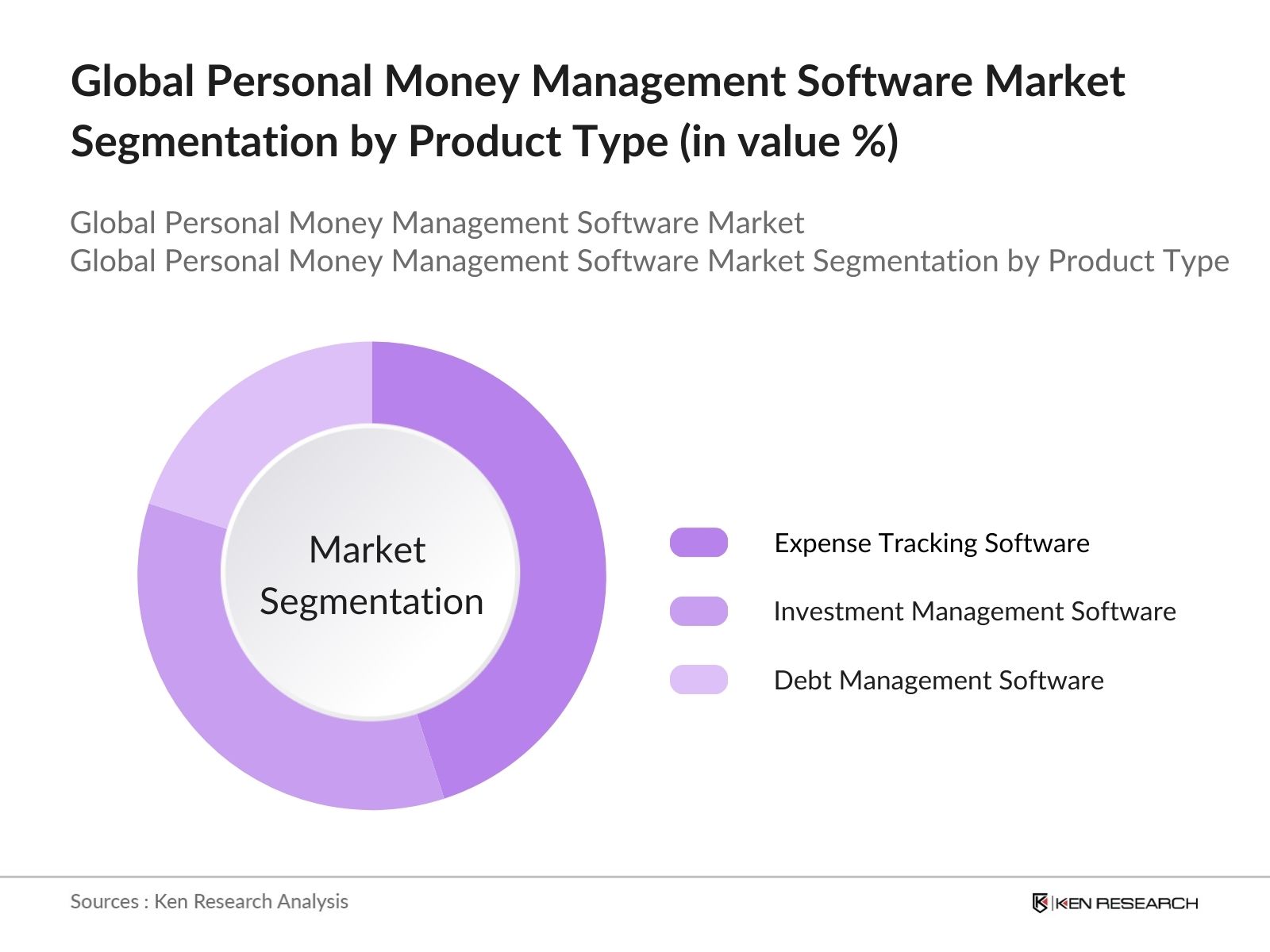
By Product Type: The personal money management software market is segmented by product type into expense tracking software, investment management software, and debt management software. Among these, expense tracking software holds the dominant market share due to its widespread usage among individuals seeking to manage their day-to-day financial transactions. This software is popular for its easy integration with bank accounts and its ability to offer real-time expense tracking, which has made it a must-have tool for many consumers.
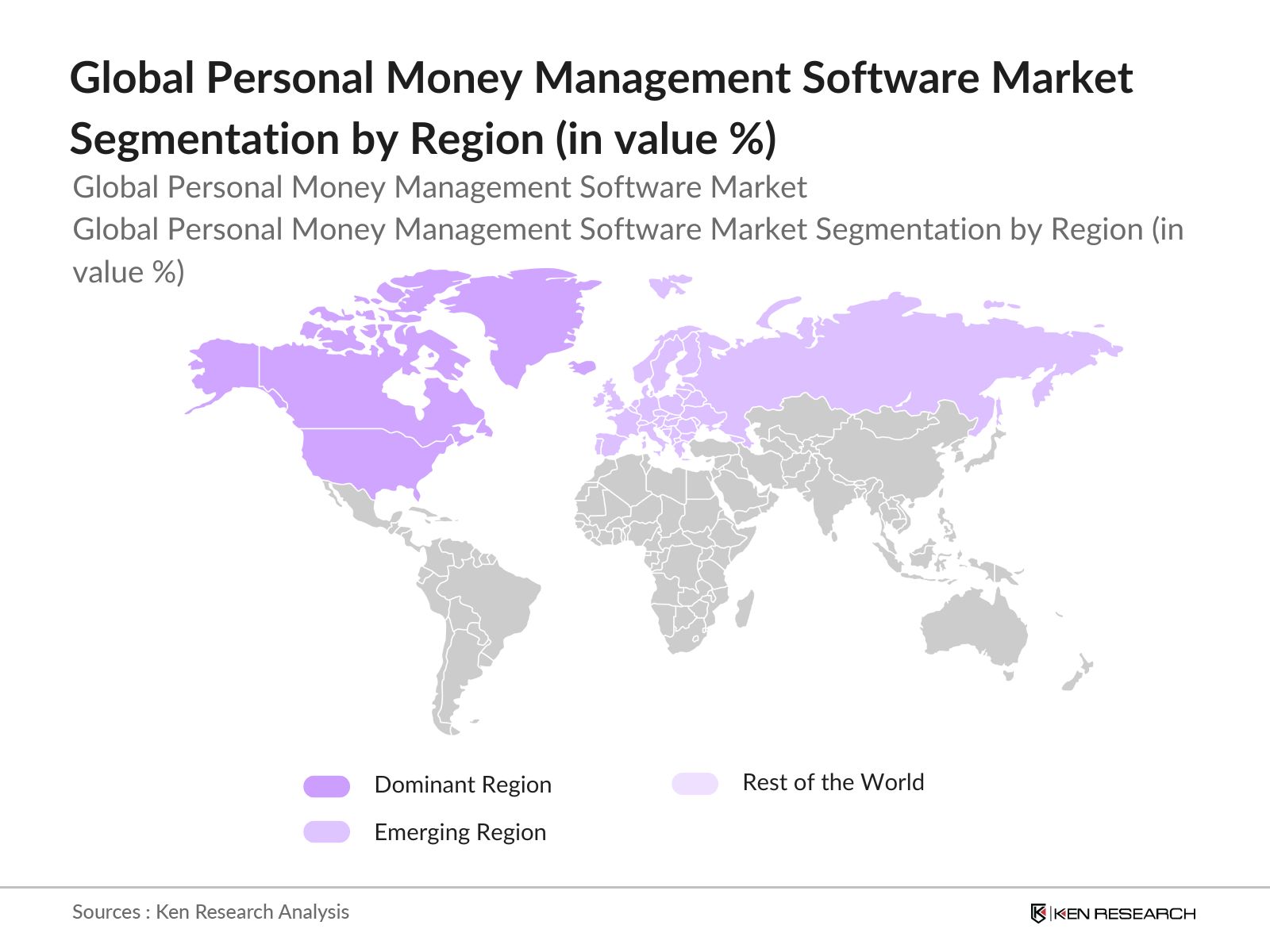
 By Region: The personal money management software market is geographically segmented into North America, Europe, Asia-Pacific, Latin America, and Middle East & Africa. North America leads the market with the highest share due to its advanced financial infrastructure, early adoption of digital financial technologies, and the growing emphasis on financial literacy. The presence of leading financial technology companies in the United States further bolsters North America's market position.
 By Application: The global personal money management software market is segmented by application into individual users, small and medium-sized enterprises (SMEs), and large enterprises. Individual users dominate this segment, as personal finance tools are most commonly utilized by individuals seeking to manage their budgets, investments, and debts. The increasing availability of low-cost and freemium versions of these software tools has made them accessible to a wider audience, further solidifying the dominance of this segment.
Global Personal Money Management Software Market Competitive Landscape
The global personal money management software market is dominated by both established players and new entrants providing innovative solutions. The market sees competition based on factors such as features, ease of integration, pricing models, and user experience.
The competitive landscape is characterized by major players like Intuit, Microsoft, and Quicken, which have established themselves by offering robust platforms with integrated AI and machine learning capabilities. These companies invest heavily in research and development, aiming to stay ahead by offering cutting-edge technology in personal finance management.
|
Company Name |
Establishment Year |
Headquarters |
Market Presence |
Revenue |
User Base |
Pricing Model |
AI Integration |
Mobile Compatibility |
Freemium Options |
|
Intuit Inc. |
1983 |
Mountain View, CA |
- |
- |
- |
- |
- |
- |
- |
|
Microsoft Corporation |
1975 |
Redmond, WA |
- |
- |
- |
- |
- |
- |
- |
|
Quicken Inc. |
1983 |
Menlo Park, CA |
- |
- |
- |
- |
- |
- |
- |
|
Mint |
2006 |
Mountain View, CA |
- |
- |
- |
- |
- |
- |
- |
|
Personal Capital Corp |
2009 |
Redwood City, CA |
- |
- |
- |
- |
- |
- |
- |
Global Personal Money Management Software Market Analysis
Growth Drivers
- Adoption of Cloud-Based Platforms: The increasing shift to cloud-based platforms for personal finance management is a key driver of market growth. As of 2024, nearly 85% of personal finance software providers are utilizing cloud-based infrastructure, enabling real-time synchronization of financial data across devices. This is crucial in regions like North America and Europe, where the digital banking sector is expanding rapidly. According to the IMF, the global cloud services market is valued at $450 billion, which plays a significant role in streamlining financial planning and management platforms.
- Increasing Demand for Budgeting and Expense Management Tools: The demand for budgeting and expense management tools has been rising, especially in developed economies. In 2024, over 60 million consumers in the U.S. alone are using software to manage their personal finances. The World Bank reports that household debt levels in countries like the United States ($17 trillion) and the UK ($2.5 trillion) highlight the need for effective financial management solutions. Personal money management software plays an essential role in helping individuals plan their budgets and manage rising debt burdens.
- Rising Adoption of AI and Machine Learning in Financial Planning: Artificial intelligence (AI) and machine learning (ML) are increasingly being integrated into financial planning tools. By 2024, over 70% of software providers are utilizing AI-driven analytics to offer personalized financial advice. The World Bank estimates that the global adoption of AI technologies will contribute $13 trillion to global GDP by 2025. This innovation allows individuals to receive personalized recommendations based on real-time financial data, improving financial decision-making and planning capabilities.
Challenges
- Data Security and Privacy Concerns: Data security is one of the most significant barriers to the widespread adoption of personal money management software. In 2024, there have been over 2,000 reported cases of financial data breaches globally, according to the IMF. This heightened risk of breaches discourages users from adopting such software. The increasing frequency of cyber-attacks, costing the global economy approximately $6 trillion annually, presents a major obstacle for software developers in ensuring the safety and privacy of financial data.
- High Costs of Software Subscription and Maintenance: Subscription-based models for personal finance management software can be expensive, limiting their adoption in some regions. In countries like Canada and the U.S., the average annual cost of a premium personal finance software subscription can range from $50 to $120, while in emerging markets, even lower-priced models can be unaffordable for the average user. These high costs deter consumers, especially in price-sensitive regions, contributing to slow growth in adoption.
Global Personal Money Management Software Market Future Outlook
Global personal money management software market is expected to experience significant growth due to the increasing demand for personalized financial advice and budgeting tools. The rise in the adoption of artificial intelligence and machine learning is set to drive further advancements, helping consumers make better financial decisions. Additionally, the growing awareness about financial planning and budgeting, particularly in developing economies, is expected to open new opportunities for market players.
Market Opportunities
- Expansion into Emerging Markets: There is significant opportunity for the expansion of personal money management software in emerging markets. The World Bank projects that over 1 billion people in Asia and Africa will gain access to mobile internet by 2025, providing a platform for the widespread adoption of digital financial tools. Companies focusing on localized financial literacy efforts and simplified user interfaces for underserved regions can tap into this growing market.
- Integration with Mobile Payment Platforms: The integration of personal finance software with mobile payment platforms presents a strong growth opportunity. In 2024, there were 2.5 billion mobile payment users globally, according to the IMF. Software providers that can integrate seamlessly with platforms like Alipay, PayPal, or Google Pay are well-positioned to capitalize on this trend. Mobile payment adoption is particularly strong in regions like Southeast Asia and Latin America, where over 60% of transactions are completed digitally.
Scope of the Report
|
Segments |
Sub-Segments |
|
Product Type |
Expense Tracking Software |
|
Investment Management Software |
|
|
Debt Management Software |
|
|
Multi-Account Management Software |
|
|
Application |
Individual |
|
Small and Medium-Sized Enterprises (SMEs) |
|
|
Large Enterprises |
|
|
Deployment Model |
Cloud-Based |
|
On-Premise |
|
|
End-User |
Millennial Users |
|
Generation X Users |
|
|
Baby Boomers |
|
|
Region |
North America |
|
Europe |
|
|
Asia-Pacific |
|
|
Latin America |
|
|
Middle East & Africa |
Products
Key Target Audience
Fintech Companies
Banking Institutions
Software Developers and Service Providers
Retail and Commercial Banks
Personal Finance Advisors
Mobile App Development Firms
Investors and Venture Capitalist Firms
Government and Regulatory Bodies (e.g., Federal Reserve, Financial Conduct Authority)
Companies
Players Mentioned in the Report
Intuit Inc.
Microsoft Corporation
Quicken Inc.
Mint
Personal Capital Corporation
YNAB (You Need A Budget)
Mvelopes
Tiller Money
Moneydance
PocketSmith
Table of Contents
1. Global Personal Money Management Software Market Overview
1.1 Definition and Scope
1.2 Market Taxonomy
1.3 Market Growth Rate
1.4 Market Segmentation Overview
2. Global Personal Money Management Software Market Size (In USD Bn)
2.1 Historical Market Size
2.2 Year-on-Year Growth Analysis
2.3 Key Market Developments and Milestones
3. Global Personal Money Management Software Market Analysis
3.1 Growth Drivers
3.1.1 Adoption of Cloud-Based Platforms
3.1.2 Increasing Demand for Budgeting and Expense Management Tools
3.1.3 Rising Adoption of AI and Machine Learning in Financial Planning
3.1.4 Growing Focus on Financial Literacy
3.2 Market Challenges
3.2.1 Data Security and Privacy Concerns
3.2.2 High Costs of Software Subscription and Maintenance
3.2.3 Limited Adoption in Developing Regions
3.2.4 Lack of Integration with Traditional Banking Systems
3.3 Opportunities
3.3.1 Expansion into Emerging Markets
3.3.2 Integration with Mobile Payment Platforms
3.3.3 Personalized Financial Recommendations Using AI
3.3.4 Development of Freemium Models
3.4 Trends
3.4.1 Rise of Mobile-First Personal Finance Solutions
3.4.2 Increasing Use of Blockchain for Financial Security
3.4.3 Growing Demand for Real-Time Financial Analytics
3.4.4 Collaboration with Fintech Companies for Enhanced Features
3.5 Government Regulation
3.5.1 GDPR and Its Impact on Data Protection
3.5.2 Regulatory Requirements for Financial Software Solutions
3.5.3 Consumer Protection Regulations for Financial Management Apps
3.5.4 Role of Central Banks in Financial Technology Regulation
3.6 SWOT Analysis
3.7 Stakeholder Ecosystem
3.8 Porters Five Forces Analysis
3.9 Competition Ecosystem
4. Global Personal Money Management Software Market Segmentation
4.1 By Product Type (In Value %)
4.1.1 Expense Tracking Software
4.1.2 Investment Management Software
4.1.3 Debt Management Software
4.1.4 Multi-Account Management Software
4.2 By Application (In Value %)
4.2.1 Individual
4.2.2 Small and Medium-Sized Enterprises (SMEs)
4.2.3 Large Enterprises
4.3 By Deployment Model (In Value %)
4.3.1 Cloud-Based
4.3.2 On-Premise
4.4 By End-User (In Value %)
4.4.1 Millennial Users
4.4.2 Generation X Users
4.4.3 Baby Boomers
4.5 By Region (In Value %)
4.5.1 North America
4.5.2 Europe
4.5.3 Asia-Pacific
4.5.4 Latin America
4.5.5 Middle East & Africa
5. Global Personal Money Management Software Competitive Analysis
5.1 Detailed Profiles of Major Competitors
5.1.1 Intuit Inc.
5.1.2 Microsoft Corporation
5.1.3 Quicken Inc.
5.1.4 Mint
5.1.5 Personal Capital Corporation
5.1.6 YNAB (You Need A Budget)
5.1.7 Mvelopes
5.1.8 Tiller Money
5.1.9 Moneydance
5.1.10 PocketSmith
5.2 Cross Comparison Parameters (Revenue, Number of Active Users, Headquarters, Inception Year, Software Features, Pricing Model, Market Share, Product Portfolio)
5.3 Market Share Analysis
5.4 Strategic Initiatives by Competitors
5.5 Mergers and Acquisitions in the Market
5.6 Investment Analysis
5.7 Venture Capital Funding
5.8 Government Grants and Support for Fintech Innovations
5.9 Private Equity Investments
6. Global Personal Money Management Software Market Regulatory Framework
6.1 Data Privacy Regulations Impacting Software Development
6.2 Compliance with Financial Industry Standards
6.3 Certification and Compliance Requirements for Fintech Solutions
7. Global Personal Money Management Software Future Market Size (In USD Bn)
7.1 Future Market Size Projections
7.2 Key Factors Driving Future Market Growth
8. Global Personal Money Management Software Future Market Segmentation
8.1 By Product Type (In Value %)
8.2 By Application (In Value %)
8.3 By Deployment Model (In Value %)
8.4 By End-User (In Value %)
8.5 By Region (In Value %)
9. Global Personal Money Management Software Market Analysts Recommendations
9.1 TAM/SAM/SOM Analysis
9.2 Customer Cohort Analysis for Software Adoption
9.3 Marketing Initiatives for Enhanced Market Penetration
9.4 White Space Opportunity Analysis
Research Methodology
Step 1: Identification of Key Variables
The research process began by identifying key market variables for the global personal money management software market. This involved comprehensive desk research across multiple credible sources, including financial reports, industry databases, and secondary research platforms, to build an understanding of market dynamics.
Step 2: Market Analysis and Construction
The next step included a thorough analysis of historical market trends, including the growth rate of the market, consumer adoption rates, and the integration of technology in personal finance tools. Data was compiled and analyzed to understand the competitive landscape and consumer behavior patterns.
Step 3: Hypothesis Validation and Expert Consultation
A set of hypotheses regarding market growth, challenges, and opportunities was developed. These were validated through interviews and consultations with industry experts, personal finance advisors, and software developers, providing critical insights into the operational and technological factors shaping the market.
Step 4: Research Synthesis and Final Output
Finally, the research findings were synthesized into a comprehensive report, incorporating both top-down and bottom-up approaches to verify market size, segmentation, and competitive landscape. The report includes validated data points, key trends, and actionable insights for stakeholders.
Frequently Asked Questions
01. How big is the Global Personal Money Management Software Market?
The global personal money management software market is valued at USD 2 billion. The market has seen significant growth due to the increasing use of digital tools for managing personal finances and budgeting.
02. What are the major challenges in the Global Personal Money Management Software Market?
The global personal money management software market faces challenges such as concerns over data privacy, high subscription and maintenance costs, and a lack of integration with traditional banking systems in certain regions, which can slow adoption rates.
03. Who are the major players in the Global Personal Money Management Software Market?
Key players in the global personal money management software market include Intuit Inc., Microsoft Corporation, Quicken Inc., Mint, and Personal Capital Corporation, who have strong market presence due to their innovative product offerings and extensive user bases.
04. What are the growth drivers of the Global Personal Money Management Software Market?
Global personal money management software market is driven by the rising need for personal financial management tools, the increasing use of AI and machine learning in financial planning, and a growing focus on financial literacy across regions.
Why Buy From Us?

What makes us stand out is that our consultants follows Robust, Refine and Result (RRR) methodology. i.e. Robust for clear definitions, approaches and sanity checking, Refine for differentiating respondents facts and opinions and Result for presenting data with story

We have set a benchmark in the industry by offering our clients with syndicated and customized market research reports featuring coverage of entire market as well as meticulous research and analyst insights.

While we don't replace traditional research, we flip the method upside down. Our dual approach of Top Bottom & Bottom Top ensures quality deliverable by not just verifying company fundamentals but also looking at the sector and macroeconomic factors.

With one step in the future, our research team constantly tries to show you the bigger picture. We help with some of the tough questions you may encounter along the way: How is the industry positioned? Best marketing channel? KPI's of competitors? By aligning every element, we help maximize success.

Our report gives you instant access to the answers and sources that other companies might choose to hide. We elaborate each steps of research methodology we have used and showcase you the sample size to earn your trust.

If you need any support, we are here! We pride ourselves on universe strength, data quality, and quick, friendly, and professional service.