
Global Pisco Market Outlook to 2030
Region:Global
Author(s):Abhinav kumar
Product Code:KROD6402
Region:Global
Author(s):Abhinav kumar
Product Code:KROD6402
November 2024
91
By Type: The Global Pisco Market is segmented by type into Pure Pisco, Aromatic Pisco, Mosto Verde, and Acholado. Currently, Pure Pisco holds the dominant market share within this segment. Its popularity is driven by its purity and traditional production process, which emphasizes the unique taste profiles of the grape varieties used. As a result, Pure Pisco is highly favored among connoisseurs and premium spirits consumers, supporting its dominance in the type segmentation.

By Region: The Global Pisco Market is segmented by region into North America, Latin America, Europe, Asia-Pacific, and the Middle East & Africa. Latin America, comprising Peru and Chile, commands the majority share due to historical significance and established production facilities. The segments dominance is further amplified by the increasing demand for export to markets such as North America and Europe, where consumers are actively seeking exotic and premium spirits, thus driving Latin America's lead in the regional segmentation.

By Source: The market is segmented by source into Single Grape Varieties and Blended Grape Sources. The Single Grape Varieties segment leads in market share, benefiting from a focused flavor profile that highlights the characteristics of individual grape types like Quebranta and Negra Criolla. This segments prominence is further bolstered by brand loyalty, as consumers develop preferences based on specific grape varieties, particularly in markets with high consumer knowledge of Pisco.
The Global Pisco Market is dominated by key players who have established a substantial market presence, including a mix of local and international companies. The competitive landscape reveals a concentrated market structure where established brands emphasize quality, heritage, and authenticity in marketing and product offerings. The competitive landscape reveals a market centered around heritage brands with expertise in traditional and hybrid production techniques, brand partnerships, and a global export-oriented strategy that strengthens the markets premium appeal.

The Global Pisco Market is anticipated to witness substantial growth in the next five years, driven by increased demand for premium spirits, heightened consumer interest in cultural and traditional products, and the expansion of e-commerce channels facilitating direct-to-consumer sales. Furthermore, the introduction of flavored and innovative Pisco variants is likely to appeal to younger demographics, sustaining market interest and fostering wider acceptance of the spirit in international markets.
|
Type |
Pure Pisco Aromatic Pisco Mosto Verde Acholado |
|
Source |
Grape Varieties Blended Grape Sources |
|
Distribution Channel |
Specialty Stores E-commerce On-trade Off-trade |
|
Region |
North America Latin America Europe Asia-Pacific Middle East & Africa |
|
Price Range |
Economy Mid-range Premium |
1.1. Definition and Scope
1.2. Market Taxonomy
1.3. Market Growth Rate
1.4. Market Segmentation Overview
2.1. Historical Market Size
2.2. Year-On-Year Growth Analysis
2.3. Key Market Developments and Milestones
3.1. Growth Drivers
3.1.1. Increasing Demand for Premium Alcoholic Beverages
3.1.2. Cultural Promotion and Tourism Influence
3.1.3. Rising Export Activities
3.1.4. Consumer Preference for Natural Spirits
3.2. Market Challenges
3.2.1. Regulatory Compliance in Key Regions
3.2.2. High Cost of Premium Pisco
3.2.3. Limited Market Penetration Outside Latin America
3.3. Opportunities
3.3.1. Expansion into New Markets
3.3.2. Product Innovation and Diversification
3.3.3. Growth in E-commerce Channels
3.4. Trends
3.4.1. Rising Popularity of Craft Spirits
3.4.2. Sustainable and Organic Product Demand
3.4.3. Shift Towards Smaller, Artisanal Distilleries
3.5. Government Regulations
3.5.1. Geographic Indication Requirements
3.5.2. Import-Export Policies
3.5.3. Health and Labeling Standards
3.5.4. Alcohol Content Regulations
3.6. SWOT Analysis
3.7. Stake Ecosystem (Distilleries, Exporters, Importers, and Retailers)
3.8. Porters Five Forces
3.9. Competition Ecosystem
4.1. By Type (In Value %)
4.1.1. Pure Pisco
4.1.2. Aromatic Pisco
4.1.3. Mosto Verde
4.1.4. Acholado
4.2. By Source (In Value %)
4.2.1. Grape Varieties
4.2.2. Blended Grape Sources
4.3. By Distribution Channel (In Value %)
4.3.1. Specialty Stores
4.3.2. E-commerce
4.3.3. On-trade (Bars, Restaurants)
4.3.4. Off-trade (Liquor Stores, Supermarkets)
4.4. By Region (In Value %)
4.4.1. North America
4.4.2. Latin America
4.4.3. Europe
4.4.4. Asia-Pacific
4.4.5. Middle East & Africa
4.5. By Price Range (In Value %)
4.5.1. Economy
4.5.2. Mid-range
4.5.3. Premium
5.1. Detailed Profiles of Major Companies
5.1.1. Bodega San Isidro
5.1.2. Pisco Portn
5.1.3. Via Tacama
5.1.4. Barsol Pisco
5.1.5. La Diablada
5.1.6. Santiago Queirolo
5.1.7. Pisco 1615
5.1.8. Macchu Pisco
5.1.9. Ocucaje
5.1.10. Tabernero
5.1.11. Pisco Capel
5.1.12. Pisco Mistral
5.1.13. Bauz
5.1.14. El Gobernador
5.1.15. Pisco Viejo Tonel
5.2. Cross Comparison Parameters (Revenue, Production Capacity, Geographic Presence, Product Portfolio, Grape Varieties Used, Aging Process, Market Penetration Rate, Brand Positioning)
5.3. Market Share Analysis
5.4. Strategic Initiatives
5.5. Mergers and Acquisitions
5.6. Investment Analysis
5.7. Venture Capital Funding
5.8. Government Grants
5.9. Private Equity Investments
6.1. Geographic Indication Regulations
6.2. Import Duties and Trade Agreements
6.3. Certification and Quality Standards
6.4. Labeling and Packaging Norms
7.1. Future Market Size Projections
7.2. Key Factors Driving Future Market Growth
8.1. By Type (In Value %)
8.2. By Source (In Value %)
8.3. By Distribution Channel (In Value %)
8.4. By Region (In Value %)
8.5. By Price Range (In Value %)
9.1. TAM/SAM/SOM Analysis
9.2. Consumer Cohort Analysis
9.3. Marketing Initiatives
9.4. White Space Opportunity Analysis
Disclaimer Contact UsThe first step involves mapping the ecosystem of stakeholders, including Pisco producers, exporters, and regulatory bodies, alongside a detailed desk study utilizing both secondary and proprietary databases. The aim is to isolate critical market dynamics, such as export trends and consumer preferences, for an in-depth understanding of market forces.
Historical data, combined with analyses on market penetration and product consumption, are examined to estimate revenue growth trends and identify influential market drivers and challenges. An evaluation of consumption patterns in dominant regions, such as Latin America, further supports robust market estimations.
Key assumptions about market growth, emerging trends, and consumer behavior are refined through consultations with industry experts via telephone interviews and digital surveys. Feedback from these interviews enhances the reliability of revenue estimates and validates identified growth drivers.
The final phase entails engagement with key stakeholders to gather insights on product demand, regional preferences, and distribution channels, which are then synthesized to provide a comprehensive and validated analysis of the Global Pisco Market.
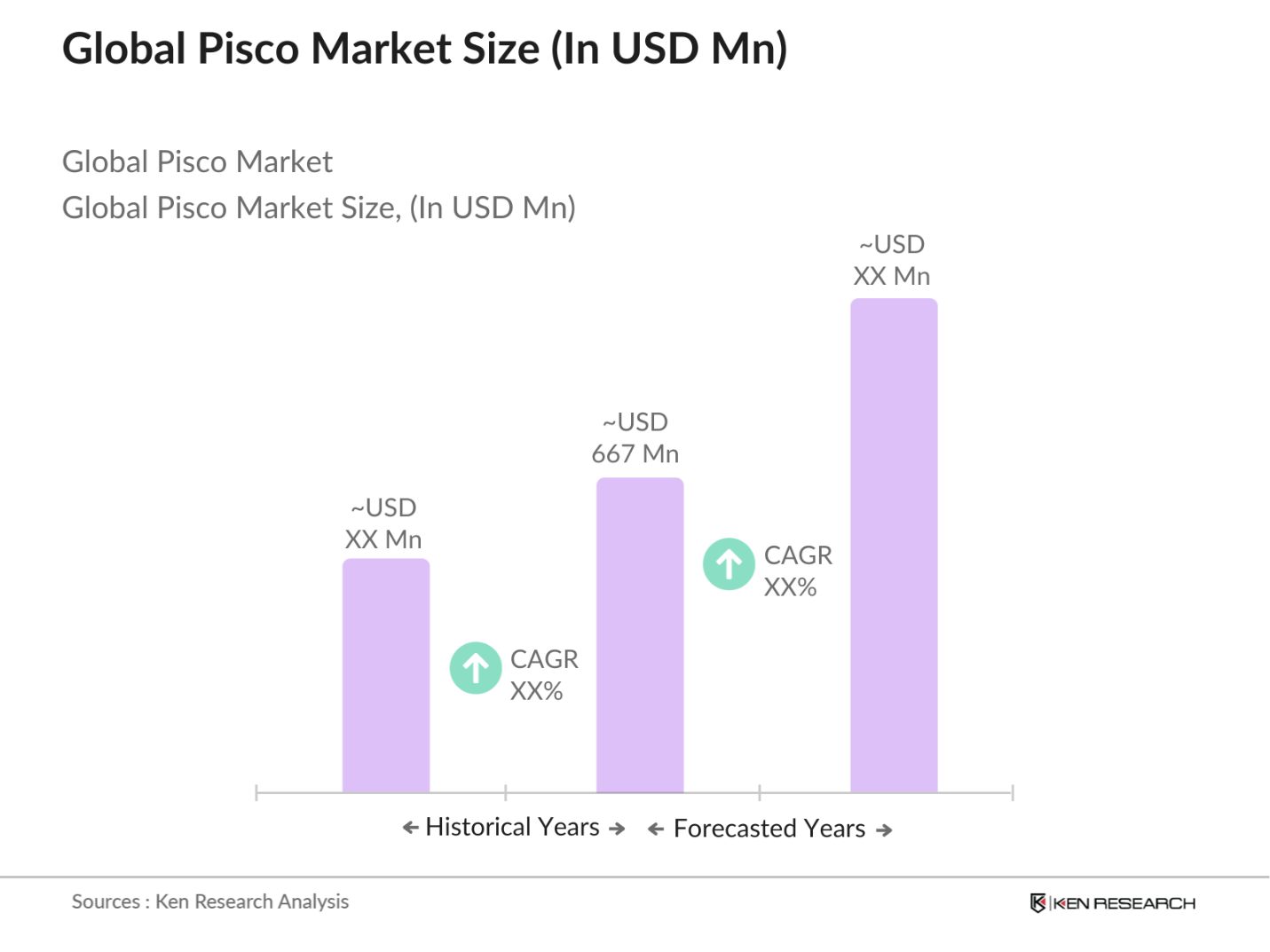
The Global Pisco Market was valued at approximately USD 667 million, driven by consumer interest in premium spirits and authentic, cultural alcoholic beverages. Increasing exports to North America and Europe also contribute to this valuation.
The primary challenges include regulatory hurdles associated with geographic indication, high production costs for premium Pisco, and limited brand recognition outside Latin America, impacting market penetration.
Key players include Bodega San Isidro, Pisco Portn, Via Tacama, and Santiago Queirolo, leveraging their historical legacy and GI recognition to capture a substantial share in both domestic and international markets.
Growth is fueled by rising consumer interest in premium and artisanal spirits, an increase in export activities, and growing consumer awareness regarding the cultural heritage associated with Pisco production.

What makes us stand out is that our consultants follows Robust, Refine and Result (RRR) methodology. i.e. Robust for clear definitions, approaches and sanity checking, Refine for differentiating respondents facts and opinions and Result for presenting data with story

We have set a benchmark in the industry by offering our clients with syndicated and customized market research reports featuring coverage of entire market as well as meticulous research and analyst insights.

While we don't replace traditional research, we flip the method upside down. Our dual approach of Top Bottom & Bottom Top ensures quality deliverable by not just verifying company fundamentals but also looking at the sector and macroeconomic factors.

With one step in the future, our research team constantly tries to show you the bigger picture. We help with some of the tough questions you may encounter along the way: How is the industry positioned? Best marketing channel? KPI's of competitors? By aligning every element, we help maximize success.

Our report gives you instant access to the answers and sources that other companies might choose to hide. We elaborate each steps of research methodology we have used and showcase you the sample size to earn your trust.

If you need any support, we are here! We pride ourselves on universe strength, data quality, and quick, friendly, and professional service.