
Global Polyol Market Outlook to 2030
Region:Global
Author(s):Mukul Soni
Product Code:KROD7494
December 2024
84
About the Report
Global Polyol Market Overview
- The global polyol market is valued at USD 38 billion. The market's growth is primarily driven by the expanding demand for polyurethane foams, which are extensively used in construction, automotive, and furniture sectors. Polyols, as key raw materials for polyurethane production, have experienced strong demand due to their versatility and functionality. The rise in eco-friendly and bio-based polyol solutions has further fueled market growth, particularly in developed economies that are increasingly adopting sustainable practices.

- Countries like the United States, China, and Germany dominate the polyol market. Their dominance can be attributed to the presence of well-established automotive, construction, and consumer goods industries. These countries also invest heavily in research and development, and their governments have implemented favorable policies for adopting bio-based polyols, further strengthening their position in the market.
- Government regulations surrounding volatile organic compounds (VOCs) are becoming stricter, impacting polyol manufacturers globally. In 2023, the U.S. Environmental Protection Agency (EPA) implemented tighter VOC emission standards, requiring polyol producers to reduce emissions by 20%. These standards are aimed at reducing air pollution and improving public health. Similarly, the European Union introduced new VOC limits under its Industrial Emissions Directive, further pressuring polyol manufacturers to adopt cleaner production processes.
Global Polyol Market Segmentation
By Type: The global polyol market is segmented by type into polyether polyols, polyester polyols, and natural oil polyols (NOPs). Among these, polyether polyols hold the dominant market share. This dominance can be attributed to their widespread use in producing flexible foams, which find applications in furniture, automotive seats, and packaging materials. Polyether polyols are preferred for their superior reactivity, cost-effectiveness, and ease of production, making them the go-to choice for flexible foam manufacturers.

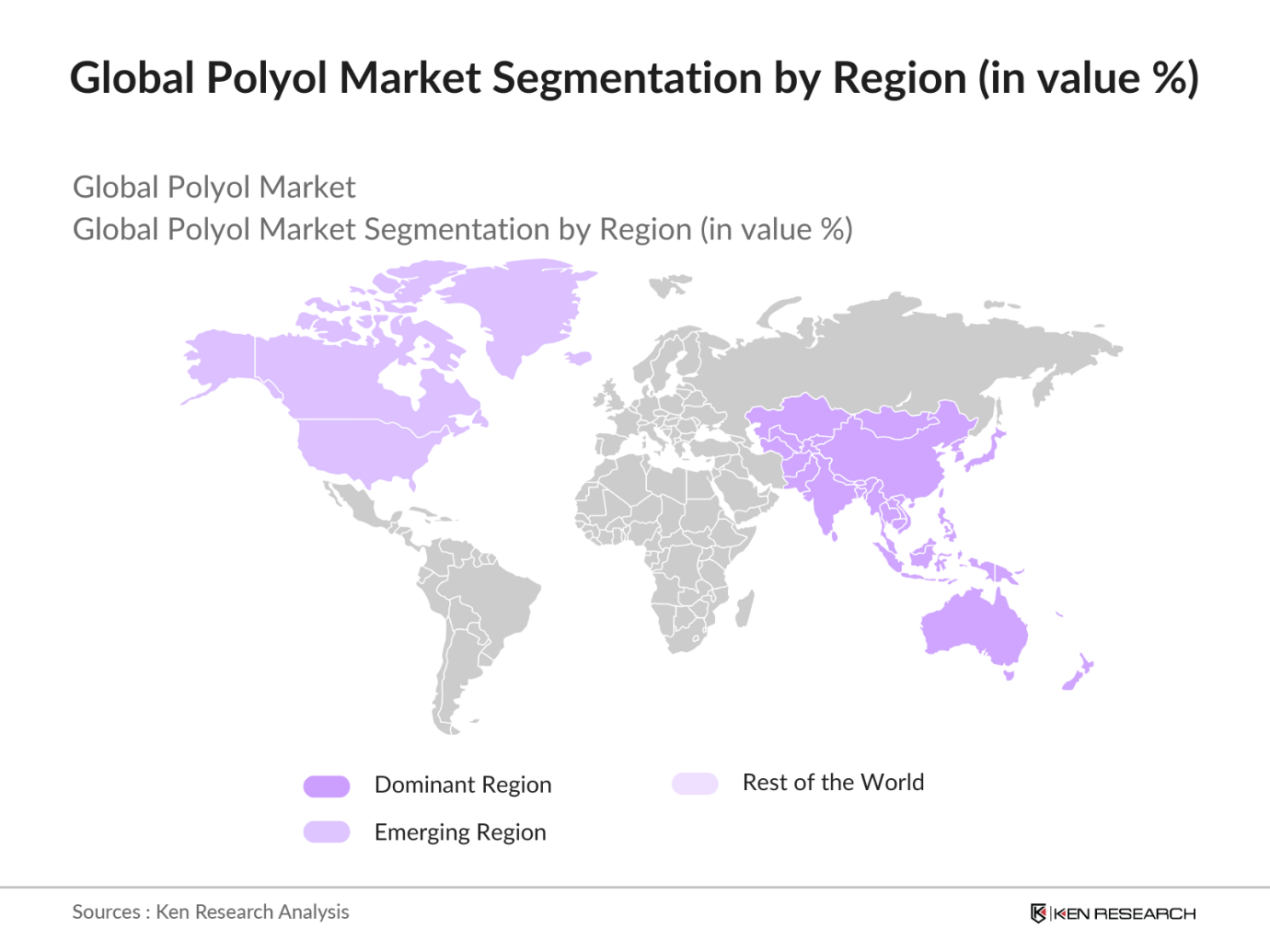
By Region: The polyol market is segmented by region into North America, Europe, Asia-Pacific, Latin America, and Middle East & Africa. Asia-Pacific is the largest regional market, driven by rapid industrialization, increasing urbanization, and the growth of end-use industries such as construction and automotive. The presence of major economies like China, Japan, and India, along with rising consumer disposable incomes, further fuels the growth of the polyol market in this region.
By Application: The polyol market is segmented by application into flexible foams, rigid foams, coatings, adhesives, sealants, and elastomers (CASE), and others. Flexible foams dominate the market share under this segmentation due to their extensive use in the furniture and bedding industry. The increasing demand for comfort in mattresses and automotive seating systems, combined with advancements in foam technology, has driven the growth of this sub-segment.
Global Polyol Market Competitive Landscape
The global polyol market is characterized by intense competition, with key players focusing on capacity expansion, product innovation, and strategic mergers and acquisitions to gain a competitive edge. The market is dominated by a mix of global chemical giants and niche players who specialize in bio-based polyols. This consolidation highlights the significant influence of these companies on the market dynamics, driven by their scale of operations, R&D capabilities, and established customer base.
|
Company Name |
Establishment Year |
Headquarters |
Production Capacity |
Global Presence |
R&D Investment |
Sustainability Initiatives |
Strategic Partnerships |
Product Innovation |
Revenue |
|
BASF SE |
1865 |
Ludwigshafen, Germany |
- |
- |
- |
- |
- |
- |
- |
|
Covestro AG |
2015 |
Leverkusen, Germany |
- |
- |
- |
- |
- |
- |
- |
|
Dow Inc. |
1897 |
Midland, USA |
- |
- |
- |
- |
- |
- |
- |
|
Huntsman Corporation |
1970 |
The Woodlands, USA |
- |
- |
- |
- |
- |
- |
- |
|
Wanhua Chemical Group |
1998 |
Yantai, China |
- |
- |
- |
- |
- |
- |
- |
Global Polyol Industry Analysis
Growth Drivers
- Increased Demand from the Polyurethane Industry: The polyurethane industry remains the largest consumer of polyols, driven by its widespread applications in foams, coatings, adhesives, and elastomers. Global production of polyurethane exceeded 25 million metric tons in 2023, with polyols being a crucial feedstock. In the U.S. alone, the chemical industry's output reached $800 billion in 2022, with polyurethanes accounting for a significant portion. The continued growth of polyurethane products, especially in insulation and furniture manufacturing, is expected to drive polyol consumption, which has already seen increased demand by over 12% between 2022 and 2024, according to the U.S. Bureau of Economic Analysis.
- Growth in Construction and Automotive Sectors: The construction and automotive sectors are two major consumers of polyols. In 2023, global construction output reached $12 trillion, and automotive manufacturing crossed 85 million vehicles globally. Both sectors utilize polyurethanes for insulation, seating, and coatings, boosting polyol demand. The construction sector in emerging economies, particularly in the Asia-Pacific region, has grown by 8% in the past two years, further driving demand for polyols. Similarly, automotive production, driven by electric vehicle (EV) manufacturing, has seen an uptick, with China leading the world in EV production at 7 million units in 2023.
- Rising Adoption of Bio-based Polyols: The shift toward sustainable materials has fueled the adoption of bio-based polyols, with many manufacturers now focusing on greener alternatives. Bio-based polyol production reached 2.5 million metric tons globally in 2023, supported by government incentives. The European Union and North American regions have been at the forefront of this shift, with over 25% of polyol production being bio-based by 2023. The U.S. Department of Agriculture reports an increase in the availability of plant-based raw materials like soybean and castor oil, further supporting bio-based polyol manufacturing.
Market Restraints
- Volatility in Raw Material Prices (Crude Oil, Glycerin): The polyol industry is highly sensitive to fluctuations in raw material prices, especially crude oil and glycerin. Between 2022 and 2024, crude oil prices experienced significant volatility, fluctuating between $70 and $100 per barrel. Glycerin, a key raw material for polyol production, also saw price hikes due to increased demand in biofuel production. These price fluctuations have directly impacted the cost of producing synthetic polyols, increasing production costs by an estimated 15% during this period. The World Bank reported these trends in their 2023 global commodity prices update.
- Environmental Impact of Synthetic Polyols: Synthetic polyols, primarily derived from petrochemicals, have come under scrutiny due to their environmental impact. The production of synthetic polyols contributes to greenhouse gas emissions, with the chemical industry accounting for 18% of global industrial CO2 emissions in 2023. Stricter environmental regulations in the European Union, such as the REACH Regulation, have imposed limitations on the use of certain petrochemical derivatives in polyol production. In 2023, these regulations resulted in a 10% reduction in synthetic polyol production capacity across Europe.
Global Polyol Market Future Outlook
Over the next five years, the global polyol market is expected to witness significant growth, driven by the increasing demand for polyurethane applications in end-use sectors such as construction, automotive, and consumer goods. The growing adoption of bio-based polyols, combined with stringent environmental regulations, will shape the future of the market. Technological advancements in foam formulations and a shift towards sustainability will further drive innovation and expansion in this sector.
Market Opportunities
- Technological Advancements in Polyol Formulations: Recent technological advancements in polyol formulations have opened new opportunities for manufacturers. Innovations in polymer science have led to the development of more efficient catalysts and processes that reduce energy consumption during polyol production. In 2023, the U.S. chemical industry invested $15 billion in R&D, leading to breakthroughs in the synthesis of high-performance polyols with enhanced properties. This has allowed manufacturers to produce polyols with improved durability and recyclability, catering to industries focused on sustainability.
- Expansion in Developing Markets (Latin America, Asia-Pacific): Developing markets in Latin America and the Asia-Pacific region present significant growth opportunities for the polyol industry. In 2023, the Asia-Pacific region accounted for 45% of global polyurethane production, driven by rapid industrialization and urbanization in countries like China and India. Latin America also saw increased polyol demand, particularly in Brazil, where the construction sector expanded by 5% in 2023. These regions are expected to remain key growth areas for polyol manufacturers, as rising disposable incomes and government infrastructure projects continue to drive demand for polyurethanes.
Scope of the Report
|
Type |
Polyether Polyols Polyester Polyols NOPs |
|
Application |
Flexible Foams Rigid Foams CASE Others |
|
End-User |
Construction Automotive Furniture Packaging Consumer Goods |
|
Region |
North America Europe Asia-Pacific Latin America Middle East & Africa |
Products
Key Target Audience
Polyurethane manufacturers
Automotive manufacturers
Construction companies
Furniture manufacturers
Government and regulatory bodies (EU REACH, US EPA)
Investor and venture capitalist firms
Bio-based product developers
Chemical industry suppliers
Companies
Players Mentioned in the Report:
BASF SE
Covestro AG
Dow Inc.
Huntsman Corporation
Mitsui Chemicals, Inc.
Wanhua Chemical Group
Royal Dutch Shell
Cargill, Inc.
Stepan Company
Evonik Industries AG
Repsol
Emery Oleochemicals
Perstorp Group
Manali Petrochemicals Limited
PCC Rokita SA
Table of Contents
1. Global Polyol Market Overview
1.1. Definition and Scope
1.2. Market Taxonomy
1.3. Market Growth Rate
1.4. Market Segmentation Overview
2. Global Polyol Market Size (In USD Bn)
2.1. Historical Market Size
2.2. Year-On-Year Growth Analysis
2.3. Key Market Developments and Milestones
3. Global Polyol Market Analysis
3.1. Growth Drivers
3.1.1. Increased demand from the polyurethane industry
3.1.2. Growth in construction and automotive sectors
3.1.3. Rising adoption of bio-based polyols
3.1.4. Government regulations supporting eco-friendly materials
3.2. Market Challenges
3.2.1. Volatility in raw material prices (Crude Oil, Glycerin)
3.2.2. Environmental impact of synthetic polyols
3.2.3. Limited availability of bio-based polyols
3.3. Opportunities
3.3.1. Technological advancements in polyol formulations
3.3.2. Expansion in developing markets (Latin America, Asia-Pacific)
3.3.3. Rise in demand for eco-friendly and recyclable products
3.4. Trends
3.4.1. Growth of bio-based polyols and green polyurethanes
3.4.2. Increasing use in medical devices and adhesives
3.4.3. Collaborations between key players for R&D initiatives
3.5. Government Regulation
3.5.1. Regulatory standards for Volatile Organic Compounds (VOCs)
3.5.2. EUs REACH Regulation (for synthetic polyols)
3.5.3. US EPA regulations on the chemical industry
3.6. SWOT Analysis
3.7. Stake Ecosystem
3.8. Porters Five Forces
3.9. Competition Ecosystem
4. Global Polyol Market Segmentation
4.1. By Type (In Value %)
4.1.1. Polyether Polyols
4.1.2. Polyester Polyols
4.1.3. Natural Oil Polyols (NOPs)
4.2. By Application (In Value %)
4.2.1. Flexible Foams
4.2.2. Rigid Foams
4.2.3. Coatings, Adhesives, Sealants, and Elastomers (CASE)
4.2.4. Others (Polycarbonate Diols, Surfactants)
4.3. By End-User (In Value %)
4.3.1. Construction
4.3.2. Automotive
4.3.3. Furniture and Bedding
4.3.4. Packaging
4.3.5. Consumer Goods
4.4. By Region (In Value %)
4.4.1. North America
4.4.2. Europe
4.4.3. Asia-Pacific
4.4.4. Latin America
4.4.5. Middle East & Africa
5. Global Polyol Market Competitive Analysis
5.1. Detailed Profiles of Major Companies
5.1.1. BASF SE
5.1.2. Covestro AG
5.1.3. Dow Inc.
5.1.4. Huntsman Corporation
5.1.5. Mitsui Chemicals, Inc.
5.1.6. Wanhua Chemical Group Co., Ltd.
5.1.7. Royal Dutch Shell
5.1.8. Cargill, Inc.
5.1.9. Stepan Company
5.1.10. Evonik Industries AG
5.1.11. Repsol
5.1.12. Emery Oleochemicals
5.1.13. Perstorp Group
5.1.14. Manali Petrochemicals Limited
5.1.15. PCC Rokita SA
5.2. Cross Comparison Parameters (Production Capacity, Geographic Presence, Revenue, Product Offerings, Strategic Partnerships, Sustainability Initiatives, R&D Investment, Market Penetration)
5.3. Market Share Analysis
5.4. Strategic Initiatives
5.5. Mergers and Acquisitions
5.6. Investment Analysis
5.7. Venture Capital Funding
5.8. Government Grants
5.9. Private Equity Investments
6. Global Polyol Market Regulatory Framework
6.1. Environmental Standards
6.2. Compliance Requirements
6.3. Certification Processes
7. Global Polyol Future Market Size (In USD Bn)
7.1. Future Market Size Projections
7.2. Key Factors Driving Future Market Growth
8. Global Polyol Future Market Segmentation
8.1. By Type (In Value %)
8.2. By Application (In Value %)
8.3. By End-User (In Value %)
8.4. By Region (In Value %)
9. Global Polyol Market Analyst's Recommendations
9.1. TAM/SAM/SOM Analysis
9.2. Customer Cohort Analysis
9.3. Marketing Initiatives
9.4. White Space Opportunity Analysis
Research Methodology
Step 1: Identification of Key Variables
The first step involves mapping out the ecosystem of the global polyol market. Key stakeholders, including manufacturers, suppliers, and end-users, are identified using secondary research from industry reports, trade journals, and proprietary databases. This step helps define critical market variables such as production capacity, product innovation, and supply chain dynamics.
Step 2: Market Analysis and Construction
Historical data on market growth, application trends, and technological advancements are analyzed to construct a reliable market forecast. Data from industry bodies and financial reports provide insights into market penetration and revenue streams. This helps in building a bottom-up approach to estimate market size and share.
Step 3: Hypothesis Validation and Expert Consultation
Market assumptions are validated through interviews with industry experts, including polyol manufacturers and polyurethane suppliers. These consultations provide operational insights that refine the collected data, ensuring a comprehensive market analysis.
Step 4: Research Synthesis and Final Output
The final step involves consolidating all data points into a coherent market analysis report. Cross-verification with key market players ensures the reliability of projections. The final output includes detailed insights on market segmentation, competitive landscape, and future growth drivers, ensuring an actionable report for business professionals.
Frequently Asked Questions
01. How big is the global polyol market?
The global polyol market is valued at USD 38 billion, driven by increasing demand from the polyurethane industry and the rise in bio-based alternatives.
02. What are the challenges in the global polyol market?
Challenges include the volatility of raw material prices, particularly crude oil, environmental concerns associated with synthetic polyols, and the limited availability of bio-based options.
03. Who are the major players in the global polyol market?
Key players include BASF SE, Covestro AG, Dow Inc., Huntsman Corporation, and Wanhua Chemical Group. These companies dominate due to their extensive production capacity, global presence, and investment in research and development.
04. What are the growth drivers of the global polyol market?
The market is driven by increasing demand for polyurethane in construction, automotive, and consumer goods industries. Additionally, the shift towards eco-friendly bio-based polyols is bolstering market growth.
Why Buy From Us?

What makes us stand out is that our consultants follows Robust, Refine and Result (RRR) methodology. i.e. Robust for clear definitions, approaches and sanity checking, Refine for differentiating respondents facts and opinions and Result for presenting data with story

We have set a benchmark in the industry by offering our clients with syndicated and customized market research reports featuring coverage of entire market as well as meticulous research and analyst insights.

While we don't replace traditional research, we flip the method upside down. Our dual approach of Top Bottom & Bottom Top ensures quality deliverable by not just verifying company fundamentals but also looking at the sector and macroeconomic factors.

With one step in the future, our research team constantly tries to show you the bigger picture. We help with some of the tough questions you may encounter along the way: How is the industry positioned? Best marketing channel? KPI's of competitors? By aligning every element, we help maximize success.

Our report gives you instant access to the answers and sources that other companies might choose to hide. We elaborate each steps of research methodology we have used and showcase you the sample size to earn your trust.

If you need any support, we are here! We pride ourselves on universe strength, data quality, and quick, friendly, and professional service.