















Global Poppyseed Market Outlook to 2030
Region:Global
Author(s):Sanjna Verma
Product Code:KROD5830
November 2024
99
About the Report
Global Poppyseed Market Overview
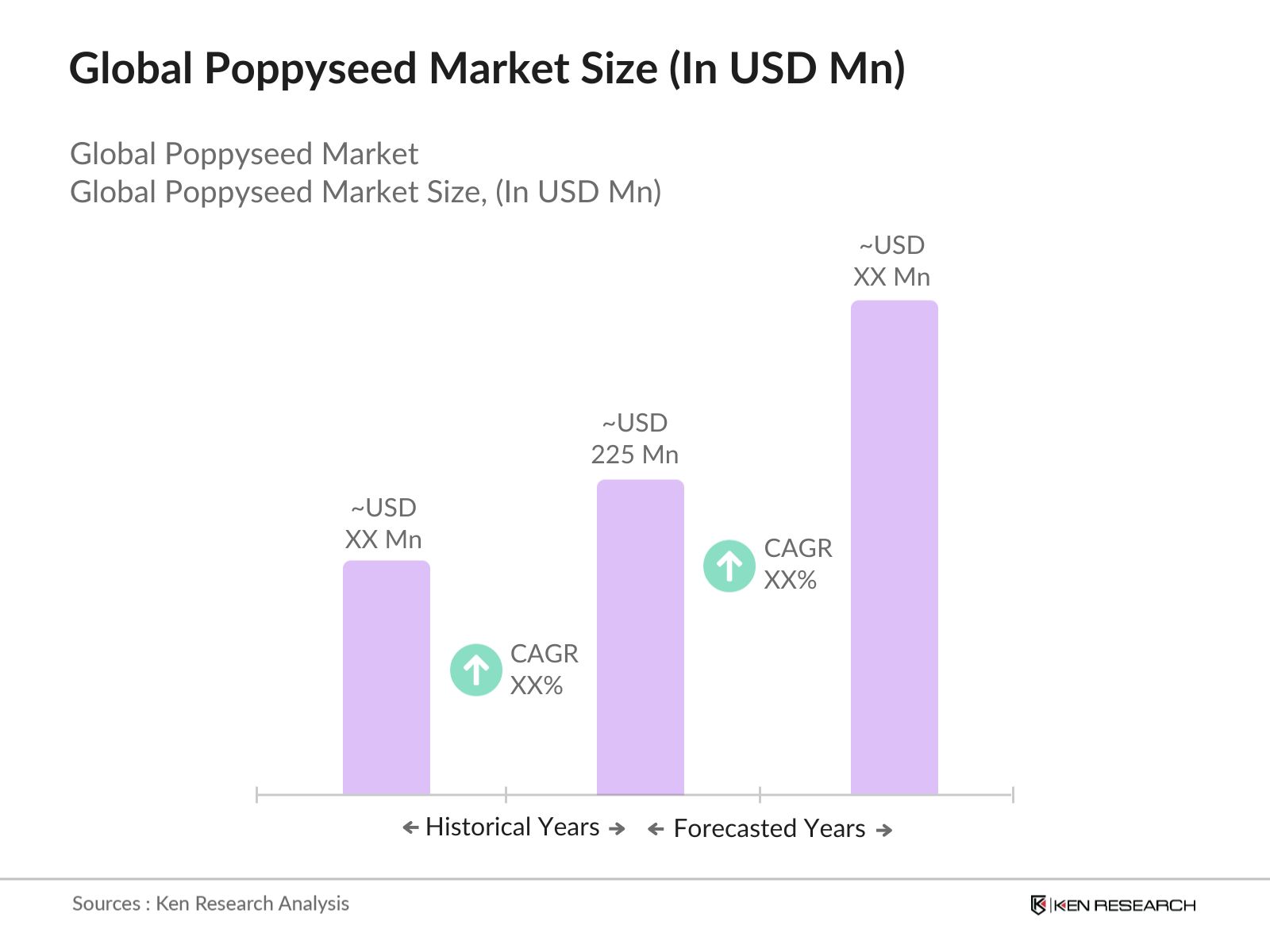
- Global Poppyseed Market is valued at USD 225 million, driven primarily by the rising demand for natural and organic ingredients in food products, as well as the growing popularity of health-conscious products in the bakery and confectionery industries. This markets expansion is fueled by the increasing use of poppyseeds in oils and personal care products.
- The dominant regions in the poppyseed market are Europe and North America, with countries like Hungary, Turkey, and the United States leading in cultivation and consumption. Hungary and Turkey benefit from favorable climatic conditions, well-established agricultural practices, and historical expertise in the cultivation of poppyseeds. The U.S. dominates the market due to high demand from the food and pharmaceutical industries, alongside an increasing consumer preference for organic and non-GMO food products.
- Global food safety standards govern the poppyseed market, particularly regarding permissible levels of opioid content. In 2023, the European Union implemented stringent guidelines for morphine levels in poppyseeds used for food, setting a maximum limit of 10 mg/kg. Similar regulations exist in countries like Canada and the United States, where poppyseed imports are subject to rigorous testing. These regulations ensure that poppyseeds entering the food chain meet safety standards to protect consumer health.
Global Poppyseed Market Segmentation
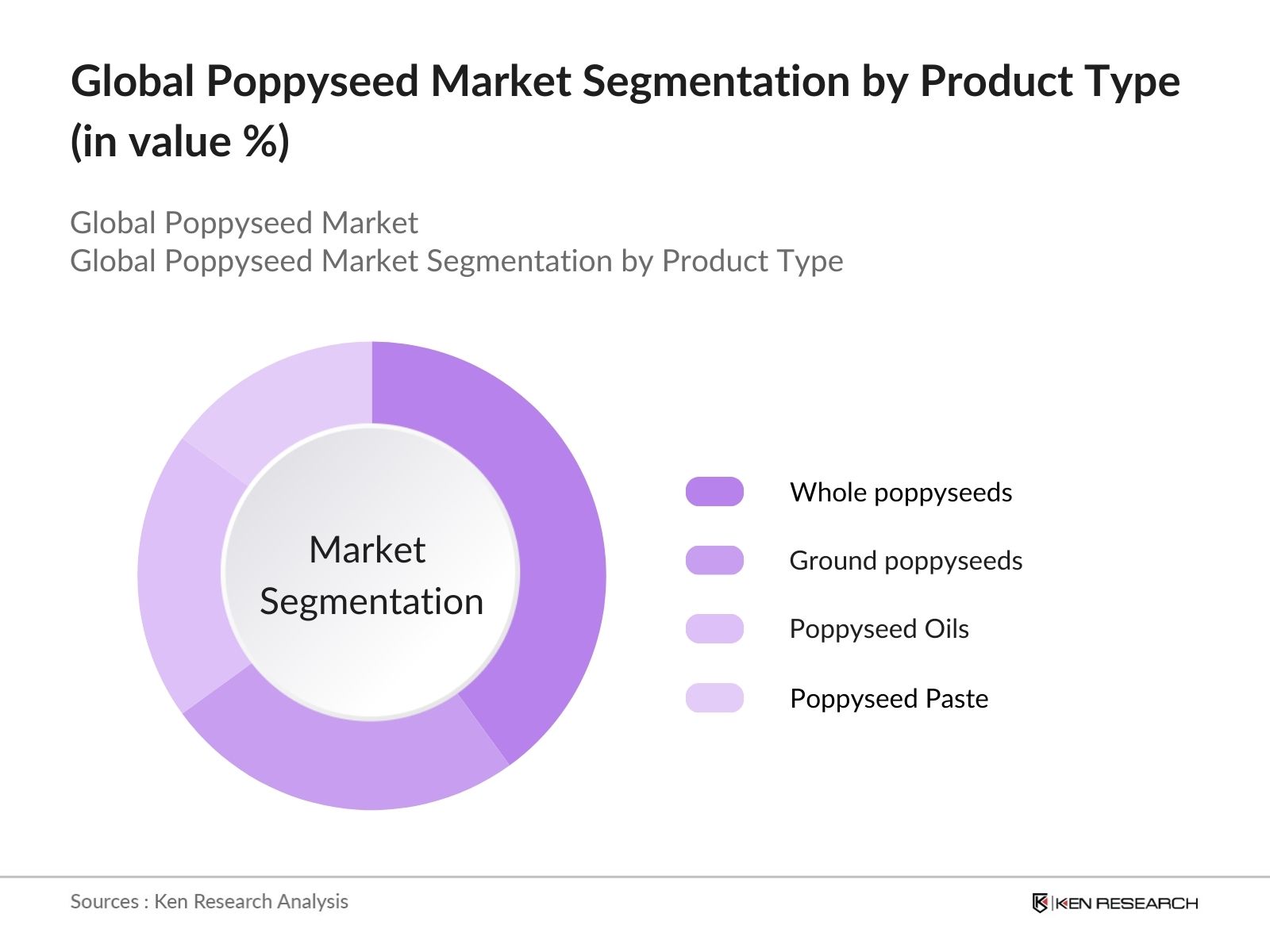
By Product Type: The global poppyseed market is segmented by product type into whole poppyseeds, ground poppyseeds, poppyseed oil, and poppyseed paste. Whole poppyseeds hold the dominant market share due to their widespread use in bakery and confectionery products. The versatility of whole poppyseeds, combined with their long shelf life and ease of processing, has contributed to their dominance in this segment. Consumers and manufacturers alike prefer whole seeds for their texture, flavor, and ease of use in a variety of food applications.
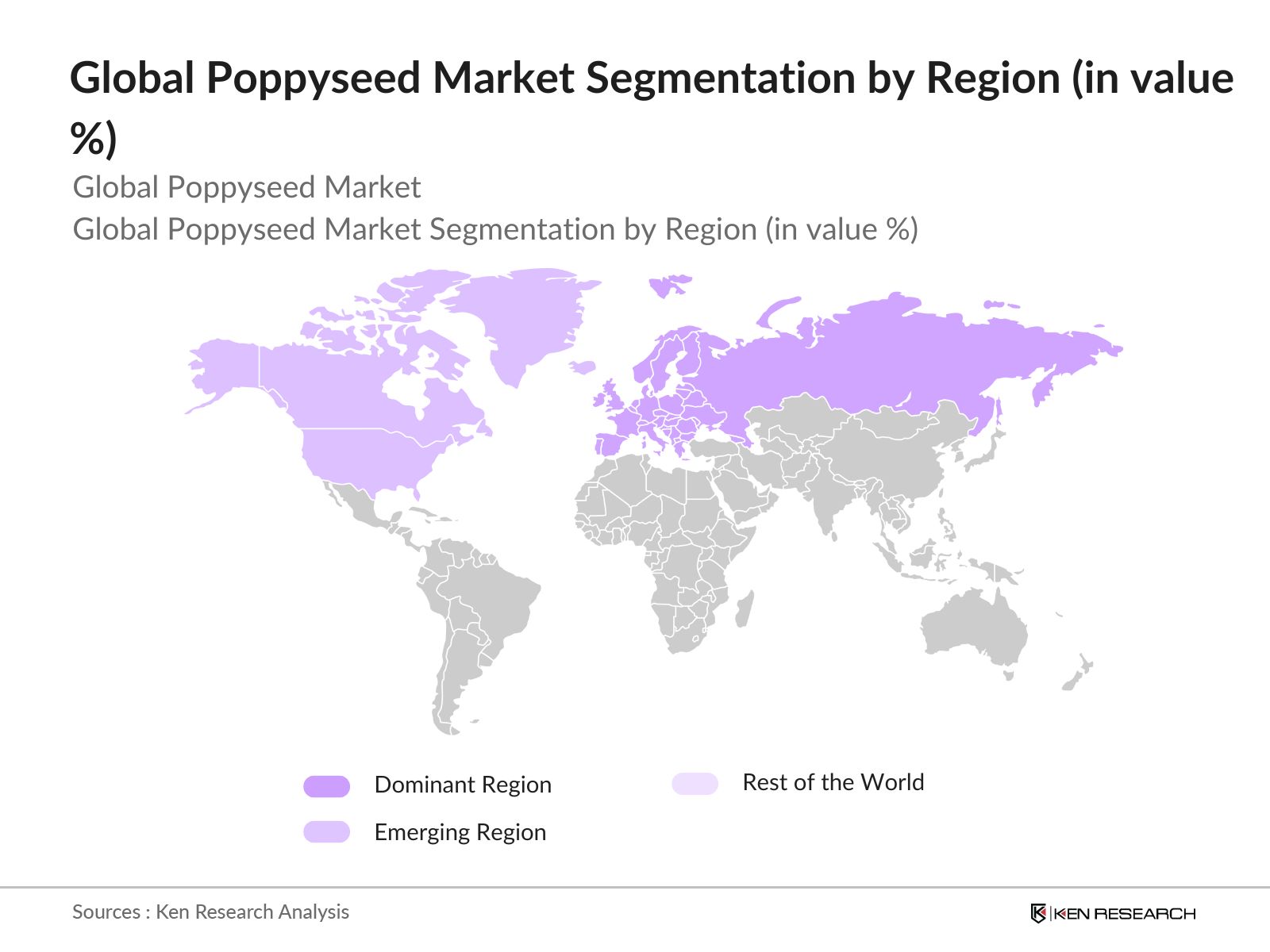
By Region: Regionally, the global poppyseed market is segmented into North America, Europe, Asia-Pacific, the Middle East & Africa, and Latin America. Europe leads the market due to its historical significance in poppyseed cultivation and consumption. Countries like Hungary and Turkey contribute significantly to the region's dominance, as they have ideal growing conditions and a well-established supply chain. Additionally, North America is rapidly growing due to the increased usage of poppyseeds in the pharmaceutical and nutraceutical industries, driven by health-conscious consumer trends.
By Application: The poppyseed market is also segmented by application into bakery & confectionery, pharmaceuticals, cosmetics, nutraceuticals, and personal care products. Bakery & confectionery dominate the market due to the strong demand for poppyseed-based products such as breads, cakes, and pastries, especially in Europe and North America. These applications require large volumes of poppyseeds, and the ingredient's high nutritional content and unique flavor profile further solidify its dominant market position in this segment.
Global Poppyseed Market Competitive Landscape
The global poppyseed market is characterized by both local and international players with extensive supply chains. The competitive landscape is dominated by established firms that have strong sourcing and distribution capabilities. Players in the market focus on product quality, certifications, and sustainable farming practices to maintain competitive advantage. The poppyseed market is also marked by vertical integration strategies, where companies manage their supply chain, from farming to packaging and retail. Additionally, market players leverage online retail channels to expand their consumer base and invest in R&D to innovate in areas such as cold-pressed oils and organic production methods.
|
Company |
Established |
Headquarters |
Sourcing Capability |
Product Portfolio |
Certifications |
Revenue (2023) |
Sustainability Initiatives |
Distribution Network |
|
Biorigin S.A. |
1999 |
So Paulo, Brazil |
- |
- |
- |
- |
- |
- |
|
Organic Herb Trading Co. |
1988 |
UK |
- |
- |
- |
- |
- |
- |
|
Frontier Co-op |
1976 |
Iowa, USA |
- |
- |
- |
- |
- |
- |
|
Bob's Red Mill Natural Foods |
1978 |
Oregon, USA |
- |
- |
- |
- |
- |
- |
|
Shiloh Farms |
1942 |
Pennsylvania, USA |
- |
- |
- |
- |
- |
- |
Global Poppyseed Market Analysis
Growth Drivers
- Rising Demand for Natural and Organic Ingredients: The demand for natural and organic ingredients, such as poppyseeds, is driven by a global shift towards health-conscious eating habits. As of the end of2022, the global organic farming area had actually increased to approximately96.4 million hectares, marking a significant increase of over20 million hectaresfrom the previous year. The global adoption of clean-label foods, which advocate minimal processing and no artificial additives, further boosts demand for organic ingredients like poppyseeds.
- Increasing Popularity of Health-Conscious Foods: The global population's awareness of nutrition is growing rapidly, with many seeking high-fiber and nutrient-dense foods, like poppyseeds, which are rich in essential minerals such as calcium and magnesium. As of 2024, over 39% of consumers in the USA reported switching to healthier food options, according to the FDA. Additionally, the trend for incorporating seeds, including poppyseeds, in various diets (like vegan, paleo, and keto) is expanding globally, especially in markets like Europe and North America.
- Expanding Use in Bakery and Confectionery Products: Poppyseeds are increasingly used in the bakery and confectionery sector, which has witnessed significant growth in recent years. In 2023, the Czech Republic, which is the largest producer of blue poppy seeds in Europe, is expected to produce approximately19,000 tonsof poppy seeds. This figure represents a20% decreasecompared to the five-year average and a14% declinefrom the previous year.
Challenges
- Supply Chain Constraints: Poppyseed cultivation faces several supply chain challenges, including labor shortages, extreme weather conditions, and geopolitical restrictions. For example, poppy cultivation in countries like Turkey and India is tightly regulated due to the plants dual use (both culinary and for opioids). This often leads to bottlenecks in global supply.
- Stringent Regulatory Environment: Poppyseeds are subject to strict food safety regulations due to concerns over opioid contamination. In the European Union, the allowable morphine content in poppyseeds for food consumption has been strictly capped, following a 2023 report from the European Food Safety Authority (EFSA), which highlighted health risks associated with high morphine content in seeds. Many countries have introduced new testing requirements for imported seeds, creating barriers for international trade and causing delays in distribution.
Global Poppyseed Future Market Outlook
The global poppyseed market is expected to witness steady growth over the next five years, driven by increasing consumer interest in natural and organic food products. With rising demand from industries such as bakery, pharmaceuticals, and personal care, the market is poised to expand. Additionally, sustainability and ethical sourcing practices are becoming key market differentiators, as consumers prioritize eco-friendly and socially responsible products.
Market Opportunities
- Growth of Emerging Markets: Asia-Pacific and the Middle East present significant growth opportunities for the poppyseed market, driven by increasing consumer demand for natural and organic foods. According to data from the World Bank, the Asia-Pacific region's middle-class population grew to over 2.5 billion people in 2023, many of whom are adopting Western food trends. Poppyseed-based products, including bakery items and cold-pressed oils, have gained popularity in these regions, offering potential for market expansion.
- Product Diversification in Cosmetics and Pharmaceuticals: Poppyseeds and poppyseed oil are increasingly used in cosmetic formulations due to their moisturizing and antioxidant properties, with a notable rise in the use of natural ingredients, including poppyseed oil. Additionally, the pharmaceutical sector is exploring the analgesic properties of poppyseed-derived compounds, particularly in emerging markets where demand for natural wellness products is growing.
Scope of the Report
|
Segment |
Sub-Segment |
|
By Product Type |
Whole Poppyseeds |
|
By Application |
Bakery & Confectionery |
|
By Distribution Channel |
Offline Retail |
|
By End-User Industry |
Food & Beverage |
|
By Region |
North America |
Products
Key Target Audience
Food & Beverage Manufacturers
Pharmaceutical Companies
Cosmetic Product Manufacturers
Nutraceutical Companies
Personal Care Product Manufacturers
Investors and Venture Capitalist Firms
Government and Regulatory Bodies (FDA, EFSA)
Companies
Players Mentioned in the Report
Biorigin S.A.
Organic Herb Trading Co.
Frontier Co-op
Bob's Red Mill Natural Foods
Shiloh Farms
KTC Edibles Ltd.
McCormick & Company, Inc.
Britannia Industries Limited
Archer Daniels Midland Company
Richardson International Limited
Blue Lake Milling Pty Ltd
Tata Consumer Products
DMH Ingredients, Inc.
Poppyseed Spice Co.
Highwood Crossing Foods Ltd.
Table of Contents
1. Global Poppyseed Market Overview
1.1. Definition and Scope
1.2. Market Taxonomy
1.3. Market Growth Rate
1.4. Market Segmentation Overview
2. Global Poppyseed Market Size (In USD Mn)
2.1. Historical Market Size
2.2. Year-On-Year Growth Analysis
2.3. Key Market Developments and Milestones
3. Global Poppyseed Market Analysis
3.1. Growth Drivers
3.1.1. Rising Demand for Natural and Organic Ingredients
3.1.2. Increasing Popularity of Health-Conscious Foods
3.1.3. Expanding Use in Bakery and Confectionery Products
3.1.4. Growth of Specialty Oil Segment
3.2. Market Challenges
3.2.1. Supply Chain Constraints (Cultivation, Harvesting, Export)
3.2.2. Stringent Regulatory Environment (Food Safety, Opioid Content Regulation)
3.2.3. Fluctuating Raw Material Prices
3.3. Opportunities
3.3.1. Growth of Emerging Markets (Asia-Pacific, Middle East)
3.3.2. Product Diversification in Cosmetics and Pharmaceuticals
3.3.3. Expanding Applications in Nutraceuticals
3.4. Trends
3.4.1. Rise in Sustainable Farming Practices
3.4.2. Growth of Online Retail Channels
3.4.3. Increasing Preference for Cold-Pressed Oils
3.5. Government Regulation
3.5.1. Food Safety and Standard Regulations
3.5.2. Trade Tariffs and Quotas
3.5.3. Opium Poppy Licensing and Export Rules
3.5.4. Import/Export Compliance Policies
3.6. SWOT Analysis
3.7. Stakeholder Ecosystem
3.8. Porters Five Forces
3.9. Competition Ecosystem
4. Global Poppyseed Market Segmentation
4.1. By Product Type (In Value %)
4.1.1. Whole Poppyseeds
4.1.2. Ground Poppyseeds
4.1.3. Poppyseed Oil
4.1.4. Poppyseed Paste
4.2. By Application (In Value %)
4.2.1. Bakery & Confectionery
4.2.2. Pharmaceuticals
4.2.3. Cosmetics
4.2.4. Nutraceuticals
4.2.5. Personal Care Products
4.3. By Distribution Channel (In Value %)
4.3.1. Offline Retail
4.3.2. Online Retail
4.4. By End-User Industry (In Value %)
4.4.1. Food & Beverage
4.4.2. Healthcare
4.4.3. Cosmetics
4.4.4. Personal Care
4.5. By Region (In Value %)
4.5.1. North America
4.5.2. Europe
4.5.3. Asia-Pacific
4.5.4. Middle East & Africa
4.5.5. Latin America
5. Global Poppyseed Market Competitive Analysis
5.1. Detailed Profiles of Major Companies
5.1.1. Biorigin S.A.
5.1.2. Organic Herb Trading Co.
5.1.3. Frontier Co-op
5.1.4. Shiloh Farms
5.1.5. Bob's Red Mill Natural Foods
5.1.6. Poppyseed Spice Co.
5.1.7. Highwood Crossing Foods Ltd.
5.1.8. KTC Edibles Ltd.
5.1.9. McCormick & Company, Inc.
5.1.10. Britannia Industries Limited
5.1.11. Archer Daniels Midland Company
5.1.12. Richardson International Limited
5.1.13. Blue Lake Milling Pty Ltd
5.1.14. Tata Consumer Products
5.1.15. DMH Ingredients, Inc.
5.2. Cross Comparison Parameters (Annual Revenue, Market Share, Production Capacity, Global Presence, Product Portfolio, Certifications, Mergers and Acquisitions, Key Strategic Initiatives)
5.3. Market Share Analysis
5.4. Strategic Initiatives
5.5. Mergers And Acquisitions
5.6. Investment Analysis
5.7. Venture Capital Funding
5.8. Government Grants
5.9. Private Equity Investments
6. Global Poppyseed Market Regulatory Framework
6.1. Food Safety Regulations
6.2. International Trade Policies
6.3. Certification Processes
6.4. Licensing Regulations
7. Global Poppyseed Future Market Size (In USD Mn)
7.1. Future Market Size Projections
7.2. Key Factors Driving Future Market Growth
8. Global Poppyseed Future Market Segmentation
8.1. By Product Type (In Value %)
8.2. By Application (In Value %)
8.3. By Distribution Channel (In Value %)
8.4. By End-User Industry (In Value %)
8.5. By Region (In Value %)
9. Global Poppyseed Market Analysts' Recommendations
9.1. TAM/SAM/SOM Analysis
9.2. Customer Cohort Analysis
9.3. Marketing Initiatives
9.4. White Space Opportunity Analysis
Research Methodology
Step 1: Identification of Key Variables
The initial phase involved constructing an ecosystem map encompassing all major stakeholders within the global poppyseed market. This step was underpinned by extensive desk research, utilizing a combination of secondary and proprietary databases to gather comprehensive industry-level information. The primary objective was to identify and define the critical variables influencing market dynamics.
Step 2: Market Analysis and Construction
In this phase, we compiled and analyzed historical data pertaining to the poppyseed market. This included assessing market penetration, the ratio of marketplaces to service providers, and the resultant revenue generation. Furthermore, an evaluation of product quality statistics was conducted to ensure the reliability and accuracy of the revenue estimates.
Step 3: Hypothesis Validation and Expert Consultation
Market hypotheses were developed and subsequently validated through computer-assisted telephone interviews (CATI) with industry experts representing a diverse array of companies. These consultations provided valuable operational and financial insights directly from industry practitioners, which were instrumental in refining and corroborating the market data.
Step 4: Research Synthesis and Final Output
The final phase involved direct engagement with multiple poppyseed manufacturers to acquire detailed insights into product segments, sales performance, consumer preferences, and other pertinent factors. This interaction served to verify and complement the statistics derived from the bottom-up approach, thereby ensuring a comprehensive, accurate, and validated analysis of the poppyseed market.
Frequently Asked Questions
01. How big is the Global Poppyseed Market?
The global poppyseed market is valued at USD 225 million, driven by rising demand for natural and organic ingredients in the food and cosmetics industries.
02. What are the challenges in the Global Poppyseed Market?
Challenges of Global Poppyseed Market include supply chain constraints, strict government regulations on poppy cultivation, and fluctuating raw material prices that impact profitability.
03. Who are the major players in the Global Poppyseed Market?
Key players in Global Poppyseed Market include Biorigin S.A., Organic Herb Trading Co., Frontier Co-op, Bob's Red Mill Natural Foods, and Shiloh Farms, known for their extensive distribution networks and sustainable sourcing practices.
04. What are the growth drivers of the Global Poppyseed Market?
Global Poppyseed Market is driven by increasing consumer interest in natural food products, expanding applications in nutraceuticals, and a growing trend toward sustainable farming practices.
Why Buy From Us?

What makes us stand out is that our consultants follows Robust, Refine and Result (RRR) methodology. i.e. Robust for clear definitions, approaches and sanity checking, Refine for differentiating respondents facts and opinions and Result for presenting data with story

We have set a benchmark in the industry by offering our clients with syndicated and customized market research reports featuring coverage of entire market as well as meticulous research and analyst insights.

While we don't replace traditional research, we flip the method upside down. Our dual approach of Top Bottom & Bottom Top ensures quality deliverable by not just verifying company fundamentals but also looking at the sector and macroeconomic factors.

With one step in the future, our research team constantly tries to show you the bigger picture. We help with some of the tough questions you may encounter along the way: How is the industry positioned? Best marketing channel? KPI's of competitors? By aligning every element, we help maximize success.

Our report gives you instant access to the answers and sources that other companies might choose to hide. We elaborate each steps of research methodology we have used and showcase you the sample size to earn your trust.

If you need any support, we are here! We pride ourselves on universe strength, data quality, and quick, friendly, and professional service.