















Global Positive Crankcase Ventilation (PCV) Valve Market Outlook to 2030
Region:Global
Author(s):Paribhasha Tiwari
Product Code:KROD8415
November 2024
83
About the Report
Global Positive Crankcase Ventilation (PCV) Valve Market Overview
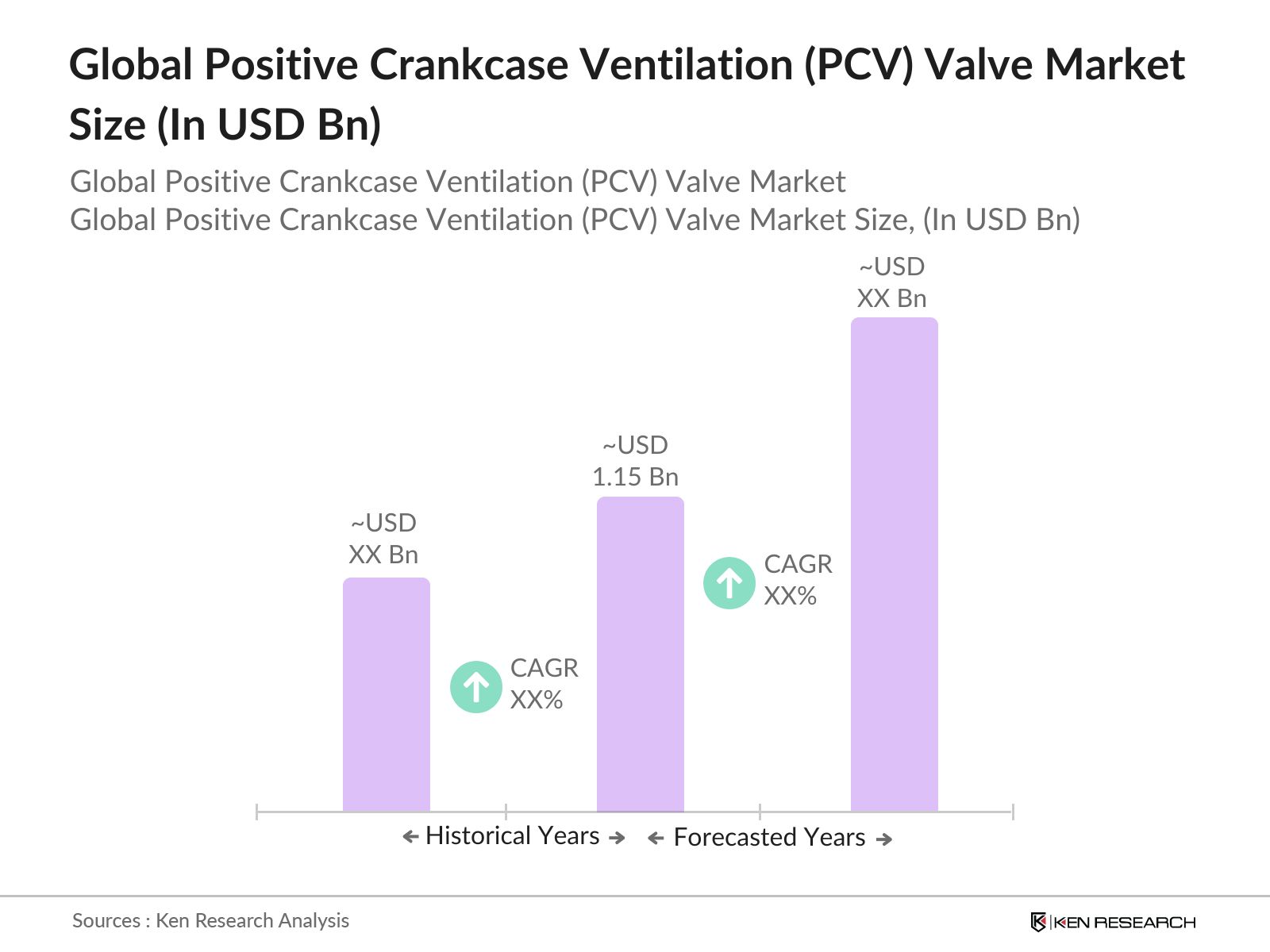
- The Global Positive Crankcase Ventilation (PCV) Valve market is valued at USD 1.15 billion based on a five-year historical analysis. This market is primarily driven by the increasing emphasis on engine emission control, as regulatory bodies worldwide continue to impose stringent standards for reducing harmful emissions. Additionally, the rising production of automobiles, particularly passenger cars and commercial vehicles with internal combustion engines, further bolsters the demand for PCV valves. The need for enhanced fuel efficiency and engine performance is also contributing to market growth.
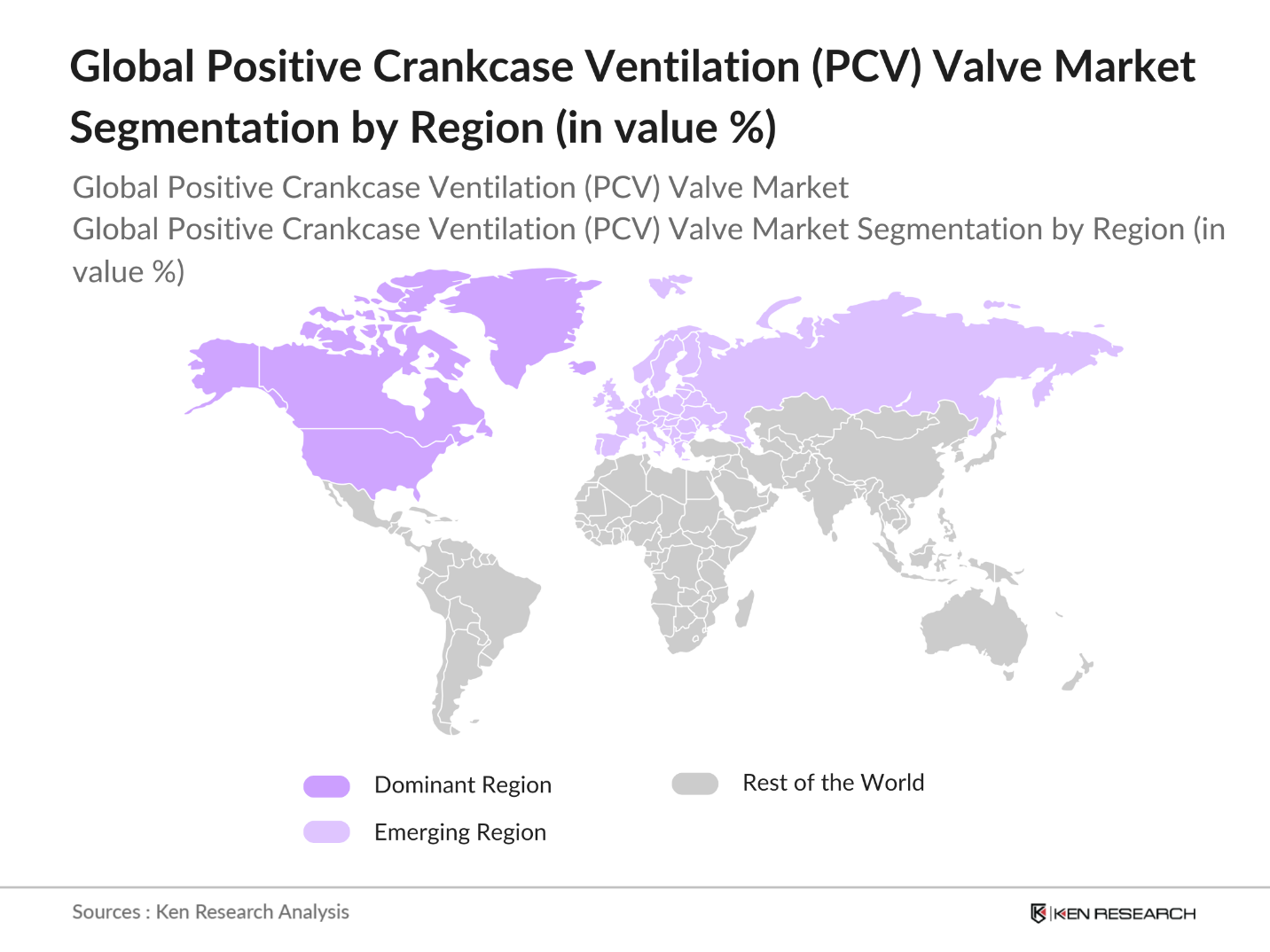
- North America and Europe are dominant regions in the PCV Valve market due to their stringent emission standards and widespread adoption of emission control technologies. The United States leads in vehicle production, which directly correlates with PCV valve demand. Similarly, countries in Europe, like Germany and France, exhibit high market penetration due to strong automotive manufacturing hubs and regulatory enforcement of emission control norms. In contrast, emerging economies in Asia-Pacific show substantial potential due to growing vehicle production.
- Several countries, including the USA and Germany, are offering tax incentives for companies that comply with emissions regulations. These incentives are aimed at reducing overall emissions, pushing manufacturers to adopt advanced PCV systems. In 2024, these initiatives are expected to reduce the financial burden on companies adapting to new environmental standards.
Global Positive Crankcase Ventilation (PCV) Valve Market Segmentation
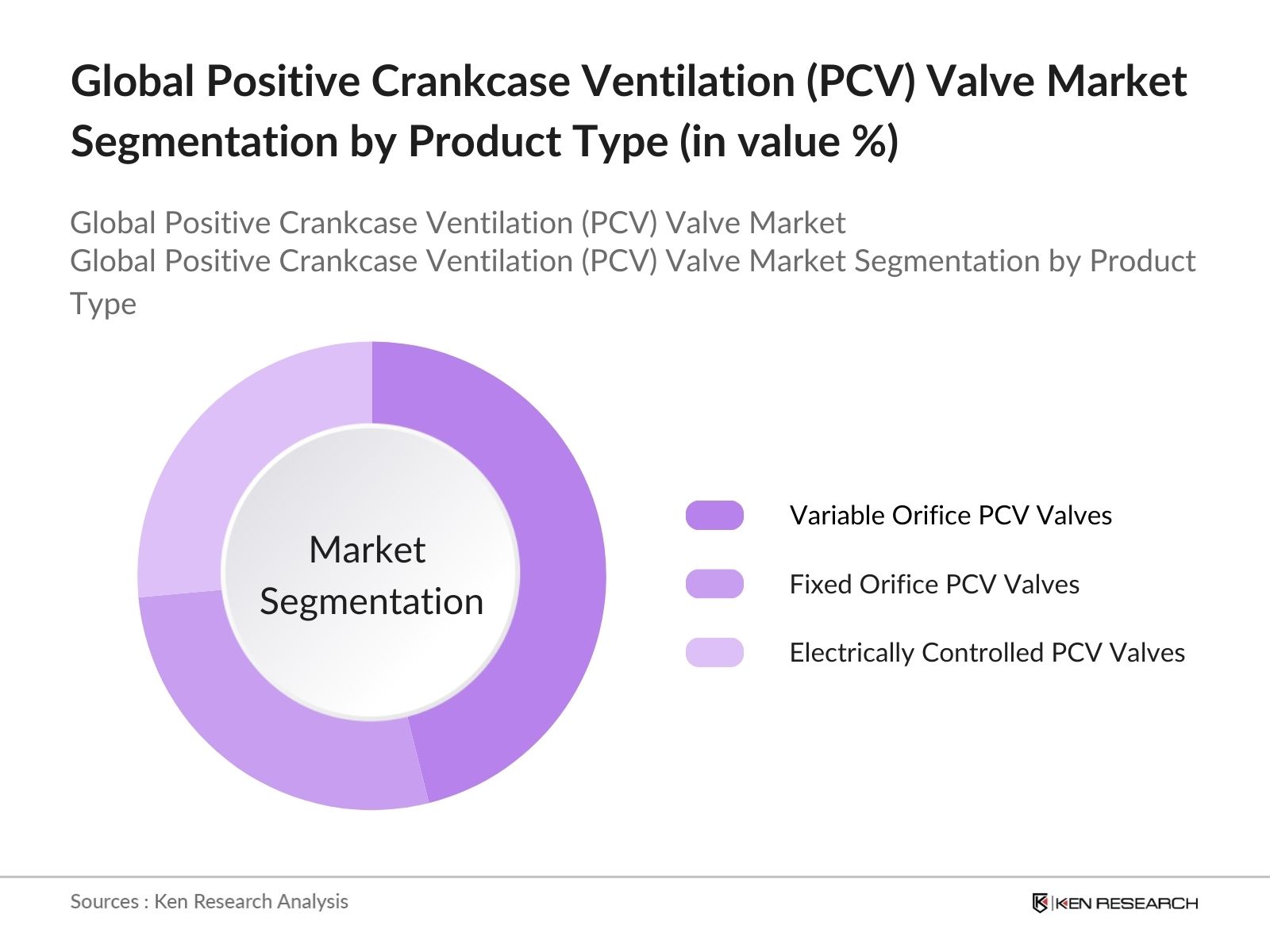
By Product Type: The Global PCV Valve market is segmented by product type into fixed orifice PCV valves, variable orifice PCV valves, and electrically controlled PCV valves. Recently, variable orifice PCV valves have gained a dominant market share. This is due to their ability to adjust the flow of gases based on the engine's operating conditions, providing enhanced engine performance and better control of emissions. With automotive manufacturers increasingly incorporating advanced technologies, variable orifice PCV valves offer greater flexibility in various engine configurations, including turbocharged engines.
By Region: The PCV Valve market is segmented into North America, Europe, Asia Pacific, Latin America, and the Middle East & Africa. North America holds the dominant market share due to its robust automotive industry and strict regulatory policies on emissions. The United States, in particular, has a significant influence on market trends as automotive manufacturers focus on integrating advanced emission control components. Additionally, government initiatives aimed at reducing vehicle emissions and increasing the efficiency of internal combustion engines drive market growth in the region.
By Material Type: The Global PCV Valve market is segmented by material type into plastic-based PCV valves and metal-based PCV valves. Plastic-based PCV valves dominate the market due to their lightweight and cost-effective nature, which aligns with the automotive industry's trend toward vehicle weight reduction and fuel efficiency. Manufacturers are also opting for plastic-based components for their corrosion resistance and ease of mass production, leading to their widespread adoption in modern engines.
Global Positive Crankcase Ventilation (PCV) Valve Market Competitive Landscape
The Global PCV Valve market is highly competitive, with key players focusing on innovation and adherence to regulatory standards. The market is dominated by a few established players, each vying for a larger share by investing in R&D, enhancing product offerings, and expanding their global footprint. The consolidation among the major players highlights the significant influence of these companies in shaping market trends.
|
Company Name |
Established Year |
Headquarters |
Revenue |
Product Portfolio |
R&D Investment |
Global Reach |
Emission Control Focus |
Supply Chain |
Recent Developments |
|---|---|---|---|---|---|---|---|---|---|
|
Mahle GmbH |
1920 |
Stuttgart, Germany |
- |
- |
- |
- |
- |
- |
- |
|
Standard Motor Products |
1919 |
Long Island City, USA |
- |
- |
- |
- |
- |
- |
- |
|
Dorman Products, Inc. |
1918 |
Colmar, USA |
- |
- |
- |
- |
- |
- |
- |
|
Continental AG |
1871 |
Hanover, Germany |
- |
- |
- |
- |
- |
- |
- |
|
ACDelco (General Motors) |
1916 |
Michigan, USA |
- |
- |
- |
- |
- |
- |
- |
Global Positive Crankcase Ventilation Valve Market Analysis
Growth Drivers
- Engine Emissions Regulations: Stricter engine emissions regulations, especially in North America and Europe, are driving the demand for high-performance PCV valves. Governments are implementing stringent vehicle emissions laws (e.g., Euro 7 standards in the EU and CAF standards in the USA) that require enhanced emissions control systems. This directly impacts the PCV valve market, as these components are essential in reducing engine emissions by recirculating blow-by gases. The adoption of updated emissions standards in 2024 will enforce compliance across automotive manufacturers.
- Vehicle Electrification Impact: While electric vehicles (EVs) dont require PCV valves, hybrid electric vehicles (HEVs) still rely on them for emissions control in combustion engines. The global hybrid vehicle market, forecasted to grow significantly, will sustain the demand for PCV valves. According to 2024 vehicle production forecasts, over 6 million hybrid vehicles are expected to be manufactured globally, maintaining demand for PCV systems within HEVs.
- PCV Valve Durability: The push towards long-lasting automotive components has increased the focus on improving the durability of PCV valves. These valves must withstand higher engine temperatures and pressures, especially in advanced gasoline direct injection (GDI) engines. In 2024, global automotive manufacturers have started introducing more durable materials, such as reinforced composites, to increase the lifespan of PCV valves, making them an essential component in vehicle reliability.
Market Challenges
- Adoption of Alternative Technologies: The shift towards alternative engine technologies, such as electric propulsion, reduces the demand for traditional PCV valves. As full electric vehicle (EV) production accelerates, especially in regions like China, where the production of over 8 million electric vehicles is expected by 2024, the demand for PCV valves in conventional internal combustion engines may slow down, limiting market growth.
- PCV System Complexity: The increasing complexity of modern PCV systems, especially with integrated emissions control systems, raises the costs and challenges associated with their installation and maintenance. In markets like the USA, where over 17 million light vehicles are produced annually, automakers are focusing on simplifying designs to minimize maintenance needs, which may hinder the adoption of more advanced PCV technologies.
Global Positive Crankcase Ventilation Valve Market Future Outlook
Over the next five years, the Global PCV Valve market is expected to experience steady growth driven by increased vehicle production, rising environmental regulations, and technological advancements in emission control systems. The shift toward electric vehicles (EVs) is anticipated to create new opportunities for innovation within the market, with companies focusing on integrating PCV valves into hybrid and EV systems for better performance. Additionally, the development of lightweight and corrosion-resistant materials will continue to shape the market's evolution as manufacturers seek to improve vehicle efficiency and emissions.
Market Opportunities
- Increasing Vehicle Production: With global vehicle production forecasted to reach 85 million units by 2024, driven by demand from Asia-Pacific and North American markets, the demand for PCV valves in both conventional internal combustion engines and hybrid electric vehicles remains significant. Countries such as India, which is ramping up production to over 5 million vehicles annually, are key drivers of this demand.
- Aftermarket Opportunities: As vehicle longevity increases, the aftermarket sector for PCV valve replacements is expanding. The average vehicle lifespan is projected to surpass 13 years by 2024 in key markets like the USA, creating sustained demand for high-quality replacement PCV valves as part of routine vehicle maintenance, particularly in regions with strict emissions regulations.
Scope of the Report
|
By Product Type |
Fixed Orifice PCV Valves Variable Orifice PCV Valves Electrically Controlled PCV Valves |
|
By Material Type |
Plastic-based PCV Valves Metal-based PCV Valves |
|
By Application |
Passenger Car Commercial Vehicles Electric Vehicles (EV) |
|
By Distribution Channel |
OEM Sales Aftermarket Sales |
|
By Region |
North America Europe Asia Pacific Latin America Middle East & Africa |
Products
Key Target Audience
Automotive OEMs
Aftermarket Component Manufacturers
Emission Control Technology Providers
Investors and Venture Capitalist Firms
Government and Regulatory Bodies (EPA, European Commission)
Engine Manufacturers
Automotive Component Distributors
Automotive Associations and Trade Bodies
Companies
Players mentioned in the report:
Mahle GmbH
Standard Motor Products
Dorman Products, Inc.
Continental AG
ACDelco (General Motors)
Pierburg GmbH (Rheinmetall Automotive)
BorgWarner Inc.
Federal-Mogul Corporation
SOGEFI Group
Toyota Industries Corporation
Table of Contents
1. Global PCV Valve Market Overview
1.1. Definition and Scope
1.2. Market Taxonomy (Types of PCV Valves, Material Types, Applications, Distribution Channels)
1.3. Market Growth Rate
1.4. Market Segmentation Overview
2. Global PCV Valve Market Size (In USD Billion)
2.1. Historical Market Size
2.2. Year-On-Year Growth Analysis
2.3. Key Market Developments and Milestones
3. Global PCV Valve Market Analysis
3.1. Growth Drivers (Engine Emissions Regulations, Vehicle Electrification Impact, PCV Valve Durability, Engine Performance Improvement)
3.2. Market Challenges (Adoption of Alternative Technologies, PCV System Complexity, Durability Concerns in High-Performance Engines)
3.3. Opportunities (Increasing Vehicle Production, Aftermarket Opportunities, Emerging Markets for PCV Valves, New Material Innovations)
3.4. Trends (Integration with EVs, Material Shifts to Eco-Friendly Alternatives, Lightweight Component Usage, Real-time Monitoring for PCV Systems)
3.5. Government Regulation (Emission Norms Enforcement, Euro 6/7 Standards, CAFE Regulations, Regional Mandates for EV Transitions)
3.6. SWOT Analysis
3.7. Stakeholder Ecosystem (OEMs, Tier 1/2 Suppliers, Regulatory Bodies, Independent Aftermarket Distributors)
3.8. Porters Five Forces
3.9. Competition Ecosystem
4. Global PCV Valve Market Segmentation
4.1. By Product Type (In Value %)
4.1.1. Fixed Orifice PCV Valves
4.1.2. Variable Orifice PCV Valves
4.1.3. Electrically Controlled PCV Valves
4.2. By Material Type (In Value %)
4.2.1. Plastic-based PCV Valves
4.2.2. Metal-based PCV Valves
4.3. By Application (In Value %)
4.3.1. Passenger Cars
4.3.2. Commercial Vehicles
4.3.3. Electric Vehicles (EV)
4.4. By Distribution Channel (In Value %)
4.4.1. OEM Sales
4.4.2. Aftermarket Sales
4.5. By Region (In Value %)
4.5.1. North America
4.5.2. Europe
4.5.3. Asia Pacific
4.5.4. Latin America
4.5.5. Middle East & Africa
5. Global PCV Valve Market Competitive Analysis
5.1 Detailed Profiles of Major Companies
5.1.1. Mahle GmbH
5.1.2. Standard Motor Products
5.1.3. Continental AG
5.1.4. Dorman Products, Inc.
5.1.5. ACDelco (General Motors)
5.1.6. SOGEFI Group
5.1.7. Aisin Seiki Co., Ltd.
5.1.8. BorgWarner Inc.
5.1.9. Ford Motor Company
5.1.10. Pierburg GmbH (Rheinmetall Automotive)
5.1.11. Federal-Mogul Corporation
5.1.12. Toyota Industries Corporation
5.1.13. Delphi Automotive PLC
5.1.14. Valeo SA
5.1.15. ZF Friedrichshafen AG
5.2 Cross Comparison Parameters (Revenue, No. of Employees, Manufacturing Footprint, Product Portfolio, Innovation Focus, Market Share)
5.3. Market Share Analysis (By Company)
5.4. Strategic Initiatives (Partnerships, R&D Investments, Product Development)
5.5. Mergers and Acquisitions (PCV Valve Market)
5.6. Investment Analysis (Private and Public Investments)
5.7. Venture Capital Funding (PCV Valve Startups)
5.8. Government Grants and Support for Emissions Reduction Technologies
5.9. Private Equity Investments
6. Global PCV Valve Market Regulatory Framework
6.1. Global Emission Standards (Euro 6/7, US EPA Regulations, China 6)
6.2. Compliance Requirements for Automotive Components
6.3. Certification Processes (ISO, TS)
7. Global PCV Valve Future Market Size (In USD Billion)
7.1. Future Market Size Projections
7.2. Key Factors Driving Future Market Growth
8. Global PCV Valve Future Market Segmentation
8.1. By Product Type (In Value %)
8.2. By Material Type (In Value %)
8.3. By Application (In Value %)
8.4. By Distribution Channel (In Value %)
8.5. By Region (In Value %)
9. Global PCV Valve Market Analysts Recommendations
9.1. TAM/SAM/SOM Analysis
9.2. Customer Segment Analysis (OEM, Aftermarket)
9.3. Sales and Marketing Strategies for Key Segments
9.4. White Space Opportunity Analysis
Research Methodology
Step 1: Identification of Key Variables
The initial phase involves constructing an ecosystem map encompassing all major stakeholders within the Global PCV Valve Market. This includes extensive desk research and utilization of proprietary databases to gather comprehensive industry-level information. The goal is to identify and define the critical variables that influence market dynamics, including regulatory policies, technological advancements, and consumer behavior.
Step 2: Market Analysis and Construction
In this phase, we compile and analyze historical data on the Global PCV Valve Market. This includes assessing market penetration, market growth drivers, and challenges to revenue generation. Moreover, an evaluation of technological innovation and regulatory impact ensures the reliability and accuracy of revenue forecasts.
Step 3: Hypothesis Validation and Expert Consultation
Market hypotheses are developed and subsequently validated through direct interviews with industry experts, including engineers and managers from key PCV valve manufacturers. These consultations provide valuable operational and financial insights directly from industry practitioners, refining the accuracy of market projections.
Step 4: Research Synthesis and Final Output
The final phase involves synthesizing all gathered data into a comprehensive report. This phase includes engaging with multiple automotive OEMs and component manufacturers to validate statistics derived from the bottom-up approach. This ensures a well-rounded and accurate analysis of the Global PCV Valve Market.
Frequently Asked Questions
01. How big is the Global PCV Valve Market?
The Global PCV Valve market is valued at USD 1.15 billion, driven by the growing demand for enhanced engine performance and stringent emissions control regulations.
02. What are the challenges in the Global PCV Valve Market?
Challenges in the Global PCV Valve market include the adoption of alternative emissions control technologies, complex integration into hybrid vehicles, and the need for durability in high-performance engines.
03. Who are the major players in the Global PCV Valve Market?
Key players in the Global PCV Valve market include Mahle GmbH, Standard Motor Products, Continental AG, Dorman Products, and ACDelco (General Motors).
04. What are the growth drivers of the Global PCV Valve Market?
Growth drivers in the Global PCV Valve marke tinclude increased vehicle production, stricter emission regulations, and advancements in valve materials for enhanced durability and lightweight characteristics.
Why Buy From Us?

What makes us stand out is that our consultants follows Robust, Refine and Result (RRR) methodology. i.e. Robust for clear definitions, approaches and sanity checking, Refine for differentiating respondents facts and opinions and Result for presenting data with story

We have set a benchmark in the industry by offering our clients with syndicated and customized market research reports featuring coverage of entire market as well as meticulous research and analyst insights.

While we don't replace traditional research, we flip the method upside down. Our dual approach of Top Bottom & Bottom Top ensures quality deliverable by not just verifying company fundamentals but also looking at the sector and macroeconomic factors.

With one step in the future, our research team constantly tries to show you the bigger picture. We help with some of the tough questions you may encounter along the way: How is the industry positioned? Best marketing channel? KPI's of competitors? By aligning every element, we help maximize success.

Our report gives you instant access to the answers and sources that other companies might choose to hide. We elaborate each steps of research methodology we have used and showcase you the sample size to earn your trust.

If you need any support, we are here! We pride ourselves on universe strength, data quality, and quick, friendly, and professional service.