















Global Propane Market Outlook to 2030
Region:Global
Author(s):Mukul Soni
Product Code:KROD4378
December 2024
98
About the Report
Global Propane Market Overview
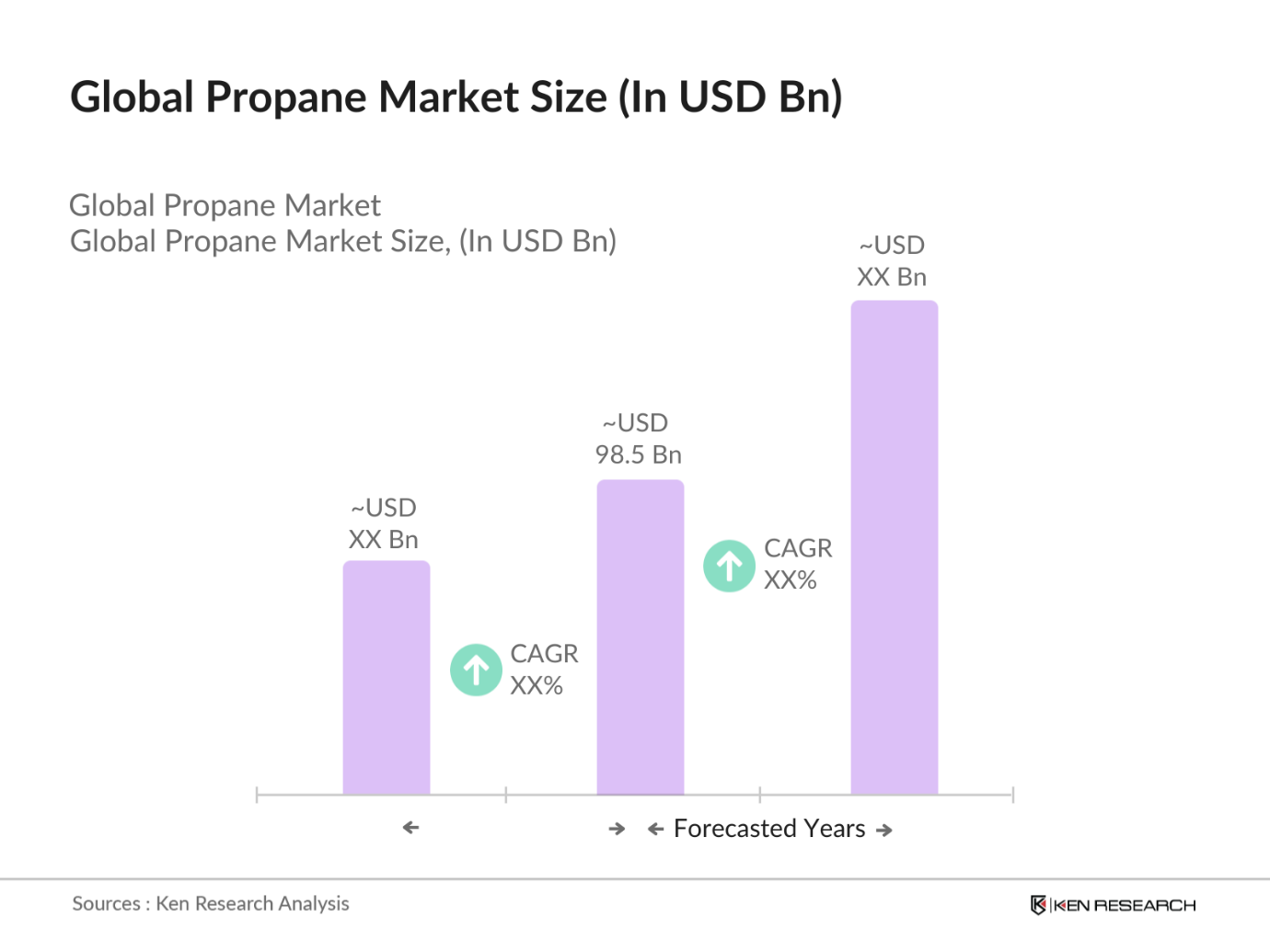
- The global propane market is valued at USD 98.5 billion. This valuation is driven by its widespread use across residential, commercial, and industrial applications, with robust demand from petrochemical feedstock industries. Infrastructure advancements, government incentives for clean energy alternatives, and increased usage in emerging markets contribute to the sustained growth of this market.
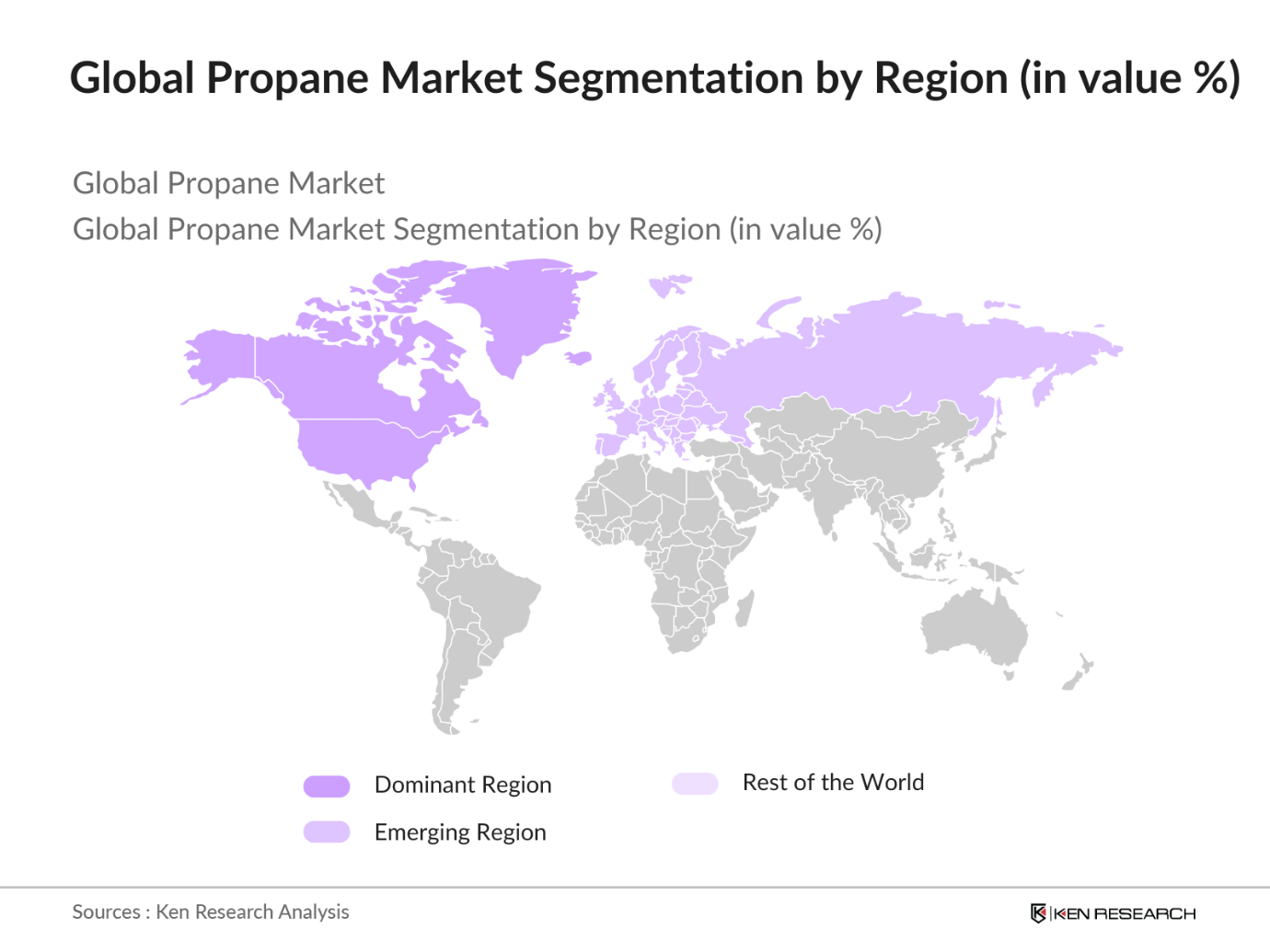
- The market is primarily dominated by North America, especially the United States, due to significant shale gas production and large-scale propane processing facilities. The Asia-Pacific region, particularly China and India, is experiencing growing propane demand driven by expanding industrial and residential applications, supported by infrastructural enhancements and urbanization trends.
- Government mandates aimed at reducing nitrogen oxide (NOx) and carbon dioxide (CO2) emissions are impacting the propane industrys operational standards. In the EU, as of 2024, emission standards cap NOx emissions at 40 mg/m for industrial fuel combustion, prompting companies to adopt cleaner propane combustion technologies. Compliance with such regulations incurs costs, but it also aligns the propane industry with broader sustainability targets, positioning propane favorably as a lower-emission fuel option.
Global Propane Market Segmentation
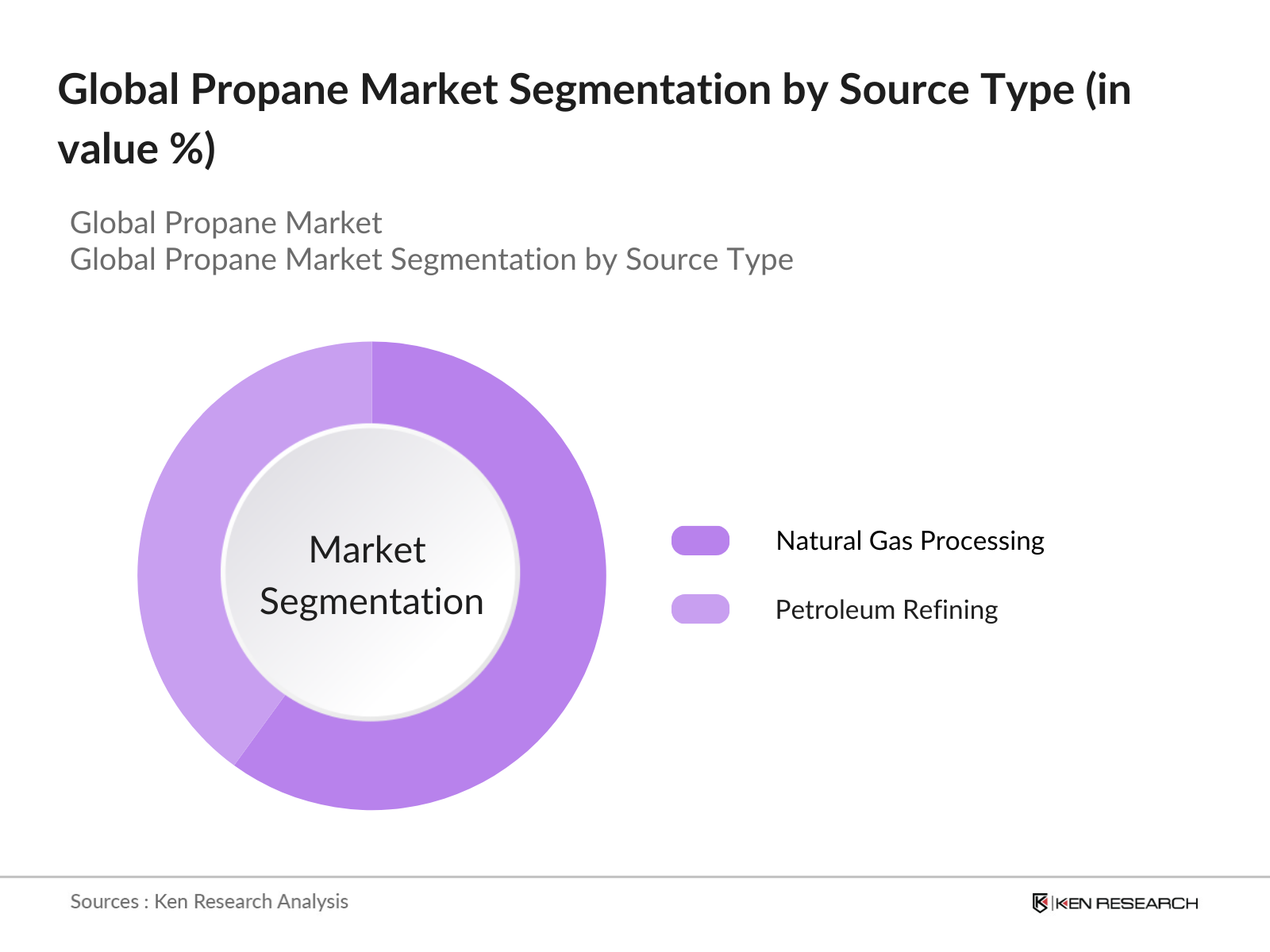
By Source Type: The propane market is segmented by source type into natural gas processing and petroleum refining. Natural gas processing is a dominant segment due to advancements in gas extraction and processing techniques, enabling more efficient propane recovery and production. This source supports the increasing demand for clean fuel alternatives, especially in regions with substantial natural gas reserves.
By Region: The global propane market is segmented regionally into North America, Europe, Asia-Pacific, Latin America, and Middle East & Africa. North America leads the market due to its advanced extraction infrastructure and significant shale production capabilities, meeting both domestic and export demands.
By Application: In terms of application, the propane market is segmented into residential heating, industrial use, transportation (AutoGas), and petrochemical feedstock. The industrial use segment holds the largest share due to its vital role in manufacturing and processing industries, which rely on propane for its efficiency and low emissions, aligning with sustainability goals.
Global Propane Market Competitive Landscape
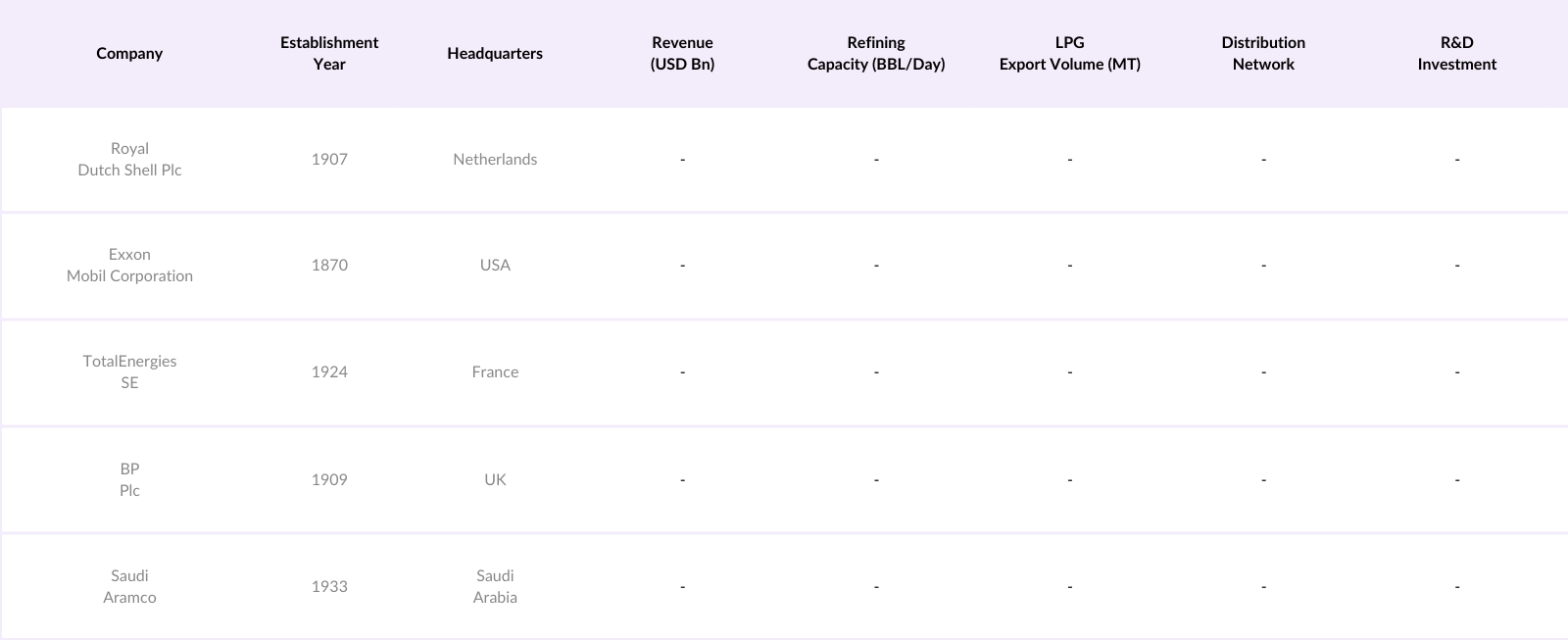
The propane market is led by both global energy giants and specialized gas companies. The consolidation of these key players drives efficiency, with large-scale operations that benefit from economies of scale and established distribution networks.
Global Propane Industry Analysis
Growth Drivers
- Industrial Expansion (Chemical, Manufacturing, etc.): Industrial growth, particularly in the chemical and manufacturing sectors, is a major driver for propane demand. In 2024, propane is widely used as a feedstock in petrochemical production, particularly in ethylene manufacturing, which is essential for plastic production. Global production of ethylene surpassed 190 million metric tons in 2023, largely supported by propane as a primary input due to its availability and energy efficiency. The chemical industry alone accounted for 37% of propane consumption in industrial sectors worldwide, with increasing adoption driven by expanding industrial production capacities in regions like North America and Asia.
- Rising Demand for Clean Fuel in Residential Sector: Propane’s clean combustion makes it a preferred fuel choice in the residential sector, especially for heating and cooking applications in regions lacking natural gas infrastructure. In 2024, approximately 1.2 billion people globally relied on propane for their daily energy needs, with demand growing as rural electrification efforts slow in some regions. For example, in India, 55 million households use propane as a primary energy source, according to government statistics. The low emissions profile compared to coal and kerosene has positioned propane as a cleaner option, with up to 60% fewer CO2 emissions per unit compared to coal
- Government Support for Clean Fuel Adoption: Several governments have implemented subsidies and incentive programs promoting propane as a cleaner energy alternative to traditional fossil fuels, particularly in rural and remote areas. The U.S. government, for instance, has allocated nearly $3 billion in tax incentives to households transitioning to cleaner fuels like propane. In 2024, federal policies in regions like the EU and North America encourage propane use in households through incentives, tax credits, and grants, reducing greenhouse gas emissions and dependency on high-pollution fuels such as coal.
Market Restraints
- Price Volatility Due to Crude Oil Linkage: Propane prices are highly sensitive to fluctuations in crude oil prices, given that propane is often a byproduct of petroleum refining. In 2024, the average propane price in the U.S. fluctuated between $1.00 and $1.25 per gallon, directly impacted by global oil market volatility. The link between crude oil and propane prices adds risk to end-users, particularly for those with limited access to alternative energy sources. For instance, households in Europe saw a 15% increase in propane costs due to global crude oil price increases.
- Geopolitical Instability in Major Exporting Nations: Geopolitical instability in key propane-exporting nations, like Qatar and the United Arab Emirates, impacts global supply chains. The Middle East accounted for nearly 40% of global propane exports in 2023, making supply vulnerable to regional tensions. In 2024, trade interruptions due to political dynamics affected over 8 million barrels of propane exports from the Middle East, leading to increased costs and limited supply for importing countries like Japan and South Korea, impacting their domestic markets significantly.
Global Propane Market Future Outlook
The global propane market is set for significant growth, driven by increased applications across residential, commercial, and industrial sectors. Factors such as government incentives for clean energy adoption, technological advancements in propane distribution, and the rising demand in emerging markets will shape the future of this market. The expansion of propane's role as an alternative energy source for both developed and developing economies is expected to further sustain this growth trajectory.
Market Opportunities
- Technological Advancements in Storage & Transportation: Innovations in storage and transport technologies have improved propane handling and safety, reducing distribution costs. In 2024, advancements in cryogenic storage, allowing propane to be stored at lower temperatures, have boosted storage capacity by 20% in the U.S. and Europe. Enhanced transport technologies, such as composite tankers, reduce spillage and evaporation losses by 5%, improving efficiency and minimizing environmental impact. These advancements create an opportunity for expanding propane accessibility in remote and underserved regions.
- Expanding Use in Petrochemical Industries: Propane’s utility in producing petrochemicals, especially in emerging markets, is an opportunity for growth. In 2024, demand for propane in the petrochemical industry reached 15 million metric tons in the Asia-Pacific region, with countries like China and India driving expansion. The ongoing establishment of petrochemical plants across these regions positions propane as an essential feedstock, supported by its cost-effectiveness and availability. Enhanced infrastructure in Asia-Pacific has facilitated propane integration into large-scale manufacturing operations.
Scope of the Report
|
By Source Type |
Natural Gas Processing |
|
By Application |
Residential Heating |
|
By End-Use Industry |
Agriculture |
|
By Distribution Channel |
Wholesale |
|
By Region |
North America |
Products
Key Target Audience
Propane Distributors and Suppliers
Residential and Commercial Heating Solution Providers
Petrochemical and Manufacturing Industries
Transportation Fleet Managers (AutoGas Sector)
Government and Regulatory Bodies (U.S. Department of Energy, European Commission)
Investor and Venture Capitalist Firms
Industrial Equipment Manufacturers
Clean Energy Advocates and Environmental Agencies
Companies
Players Mentioned in the Report:
Royal Dutch Shell Plc
Exxon Mobil Corporation
TotalEnergies SE
BP Plc
Saudi Aramco
China Petroleum & Chemical Corporation
ConocoPhillips
Chevron Corporation
Gazprom
Kinder Morgan Inc.
Enterprise Products Partners L.P.
DCC Plc
Suburban Propane Partners, L.P.
AmeriGas Partners, L.P.
UGI Corporation
Table of Contents
1. Global Propane Market Overview
1.1 Definition and Scope
1.2 Market Taxonomy
1.3 Demand and Supply Trends
1.4 Key Market Developments and Milestones
2. Global Propane Market Size (In USD Mn)
2.1 Historical Market Size
2.2 Year-On-Year Growth Analysis
2.3 Production Volume by Key Regions
2.4 Consumption Volume by Key End-User Sectors
3. Global Propane Market Analysis
3.1 Growth Drivers
3.1.1 Industrial Expansion (Chemical, Manufacturing, etc.)
3.1.2 Rising Demand for Clean Fuel in Residential Sector
3.1.3 Government Support for Clean Fuel Adoption
3.1.4 Infrastructure Investments (Storage & Distribution)
3.2 Market Challenges
3.2.1 Price Volatility Due to Crude Oil Linkage
3.2.2 Geopolitical Instability in Major Exporting Nations
3.2.3 Environmental Regulations and Emission Standards
3.3 Opportunities
3.3.1 Technological Advancements in Storage & Transportation
3.3.2 Expanding Use in Petrochemical Industries
3.3.3 Increased Adoption in Rural and Off-Grid Areas
3.4 Trends
3.4.1 Rise of Renewable Propane Production
3.4.2 Advanced Distribution and Fleet Management Solutions
3.4.3 Growing Preference for AutoGas in Transport
3.5 Government Regulation
3.5.1 Environmental Emission Standards (NOx, CO2)
3.5.2 Tax Incentives and Subsidies
3.5.3 Transportation and Storage Compliance
3.6 SWOT Analysis
3.7 Stakeholder Ecosystem
3.8 Porters Five Forces
3.9 Competition Ecosystem
4. Global Propane Market Segmentation
4.1 By Source Type (In Value %)
4.1.1 Natural Gas Processing
4.1.2 Petroleum Refining
4.2 By Application (In Value %)
4.2.1 Residential Heating
4.2.2 Industrial Use
4.2.3 Transportation (AutoGas)
4.2.4 Petrochemical Feedstock
4.3 By End-Use Industry (In Value %)
4.3.1 Agriculture
4.3.2 Power Generation
4.3.3 Manufacturing
4.4 By Distribution Channel (In Value %)
4.4.1 Wholesale
4.4.2 Retail Distribution
4.4.3 Online Sales
4.5 By Region (In Value %)
4.5.1 North America
4.5.2 Europe
4.5.3 Asia-Pacific
4.5.4 Latin America
4.5.5 Middle East & Africa
5. Global Propane Market Competitive Analysis
5.1 Detailed Profiles of Major Companies
5.1.1 Royal Dutch Shell Plc
5.1.2 Exxon Mobil Corporation
5.1.3 TotalEnergies SE
5.1.4 BP Plc
5.1.5 Chevron Corporation
5.1.6 ConocoPhillips
5.1.7 China Petroleum & Chemical Corporation
5.1.8 Saudi Aramco
5.1.9 Gazprom
5.1.10 Kinder Morgan Inc.
5.1.11 Enterprise Products Partners L.P.
5.1.12 DCC Plc
5.1.13 Suburban Propane Partners, L.P.
5.1.14 AmeriGas Partners, L.P.
5.1.15 UGI Corporation
5.2 Cross-Comparison Parameters (Revenue, Market Reach, Refining Capacity, LPG Export Volume, Distribution Networks, Regional Footprint, R&D Spending, Sustainability Initiatives)
5.3 Market Share Analysis
5.4 Strategic Initiatives
5.5 Mergers and Acquisitions
5.6 Investment Analysis
5.7 Venture Capital Funding
5.8 Government Grants
5.9 Private Equity Investments
6. Global Propane Market Regulatory Framework
6.1 International Standards Compliance
6.2 Country-Specific Safety Protocols
6.3 Certification Processes
6.4 Permits and Licensing
7. Global Propane Future Market Size (In USD Mn)
7.1 Future Market Size Projections
7.2 Key Factors Driving Future Market Growth
8. Global Propane Future Market Segmentation
8.1 By Source Type (In Value %)
8.2 By Application (In Value %)
8.3 By End-Use Industry (In Value %)
8.4 By Distribution Channel (In Value %)
8.5 By Region (In Value %)
9. Global Propane Market Analysts Recommendations
9.1 TAM/SAM/SOM Analysis
9.2 Target Market Analysis
9.3 Customer Cohort Analysis
9.4 Marketing Initiatives
9.5 White Space Opportunity Analysis
Research Methodology
Step 1: Identification of Key Variables
An initial ecosystem analysis was conducted to identify key stakeholders and influencers in the global propane market. Primary and secondary data sources were reviewed to define the variables impacting market dynamics, including production volumes, distribution channels, and technological advancements.
Step 2: Market Analysis and Construction
Historical data was gathered on propane production and consumption trends, with particular focus on segmentation metrics such as application, region, and distribution. This analysis ensured accurate revenue estimates and market share calculations for 2023.
Step 3: Hypothesis Validation and Expert Consultation
Hypotheses related to market growth, regional demand variations, and competitive positioning were validated through consultations with propane industry experts. These insights refined the research scope and provided operational and financial perspectives crucial for data verification.
Step 4: Research Synthesis and Final Output
The final synthesis involved consolidating data from both quantitative and qualitative research. This comprehensive approach confirmed key findings, ensuring that the final report presents an accurate, data-backed overview of the propane market landscape.
Frequently Asked Questions
01. How big is the Global Propane Market?
The global propane market is valued at USD 98.5 billion, primarily driven by demand across residential, industrial, and transportation sectors.
02. What are the growth drivers in the Global Propane Market?
Growth in the propane market is propelled by clean fuel demand, infrastructure developments, and government incentives that encourage clean energy adoption in both developed and developing regions.
03. What challenges does the Global Propane Market face?
Key challenges include price volatility tied to crude oil markets, environmental regulations, and geopolitical issues impacting supply chains from major producing regions.
04. Who are the major players in the Global Propane Market?
Leading players include Royal Dutch Shell, Exxon Mobil, TotalEnergies, BP, and Saudi Aramco, dominating due to their extensive distribution networks and established production capacities.
Why Buy From Us?

What makes us stand out is that our consultants follows Robust, Refine and Result (RRR) methodology. i.e. Robust for clear definitions, approaches and sanity checking, Refine for differentiating respondents facts and opinions and Result for presenting data with story

We have set a benchmark in the industry by offering our clients with syndicated and customized market research reports featuring coverage of entire market as well as meticulous research and analyst insights.

While we don't replace traditional research, we flip the method upside down. Our dual approach of Top Bottom & Bottom Top ensures quality deliverable by not just verifying company fundamentals but also looking at the sector and macroeconomic factors.

With one step in the future, our research team constantly tries to show you the bigger picture. We help with some of the tough questions you may encounter along the way: How is the industry positioned? Best marketing channel? KPI's of competitors? By aligning every element, we help maximize success.

Our report gives you instant access to the answers and sources that other companies might choose to hide. We elaborate each steps of research methodology we have used and showcase you the sample size to earn your trust.

If you need any support, we are here! We pride ourselves on universe strength, data quality, and quick, friendly, and professional service.