Ken Research Logo

Global Radio Frequency Components Market Outlook to 2030

Region:Global

Author(s):Naman Rohilla

Product Code:KROD10772

Published On

December 2024

Total pages

93

About the Report

Global Radio Frequency Components Market Overview

  • The global radio frequency (RF) components market is valued at USD 37 billion, based on a five-year historical analysis. This substantial valuation is driven by the increasing adoption of wireless communication technologies, advancements in RF technology, and the launch of fifth-generation (5G) networks. The expanding use of RF components across various industries, including aerospace, military, and automotive, further propels market growth.

Global Radio Frequency Components Market Size

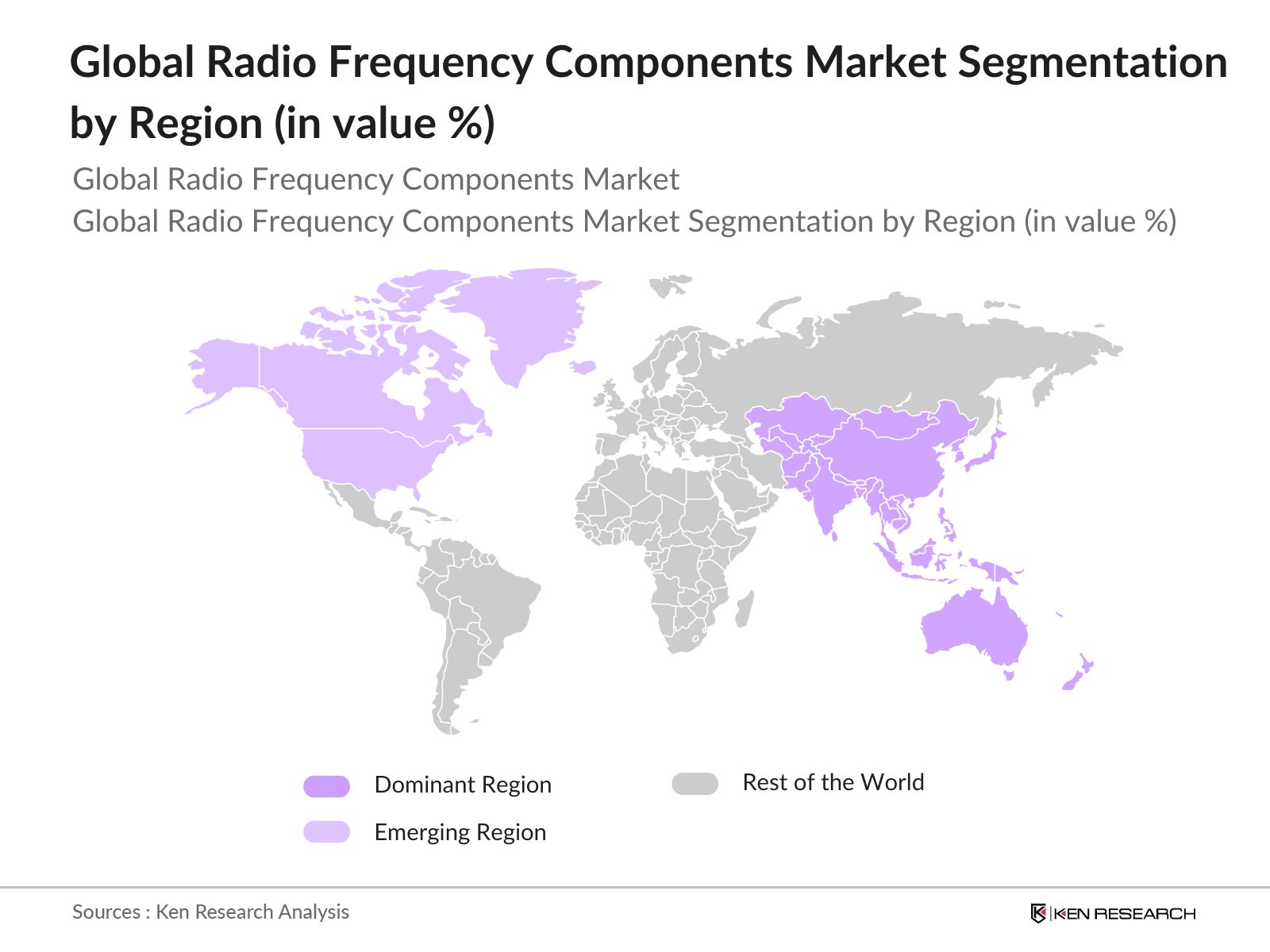
  • Asia-Pacific countries, notably China and India, dominate the RF components market. This dominance is attributed to the vast supply chain, growing electronics sector, and rapid technological advancements in these regions. The proliferation of consumer electronics and the swift deployment of 5G networks contribute to their leading positions in the market.
  • Government regulations on spectrum allocation play a pivotal role in shaping the RF components market. The Federal Communications Commission (FCC) and the International Telecommunication Union (ITU) have continued to allocate specific frequency bands for commercial use, particularly for 5G applications, to optimize network capacity. In 2023, the ITU allocated additional millimeter-wave bands globally to support higher-frequency operations, which requires highly specialized RF components to manage and transmit data effectively. These regulations guide the design and production of RF components and impact manufacturers' capabilities to meet compliance standards.

Global Radio Frequency Components Market Segmentation

  • By Component Type: The market is segmented by component type into filters, duplexers, power amplifiers, antenna switches, modulators and demodulators, and others. Filters hold a dominant market share due to their critical role in shaping and selecting desired frequencies, essential for efficient wireless communication.

Global Radio Frequency Components Market Share

  • By Application: The market is segmented by application into consumer electronics, automotive, military, wireless communication, and others. Consumer electronics dominate the market, driven by the increasing demand for smartphones, tablets, and other wireless devices that rely heavily on RF components for connectivity.
  • By Region: The market is segmented by region into North America, Europe, Asia-Pacific, Latin America, and the Middle East and Africa. Asia-Pacific leads the market, supported by a vast supply chain and a growing electronics sector, making it a dominant force in the global RF components market.

Global Radio Frequency Components Market

Global Radio Frequency Components Market Competitive Landscape

The global RF components market is characterized by the presence of several key players who drive innovation and competition. Major companies include:

market overviews

Global Radio Frequency Components Market Analysis

Market Growth Drivers

  • Proliferation of IoT Devices: The rapid expansion of the Internet of Things (IoT) is boosting the demand for radio frequency (RF) components. According to the International Telecommunication Union (ITU), the number of IoT devices worldwide reached 12.3 billion in 2023, up from 10 billion in 2022. This surge necessitates advanced RF components to facilitate seamless wireless communication across diverse applications, including smart homes, industrial automation, and healthcare systems. The increasing connectivity requirements of these devices underscore the critical role of RF components in the evolving IoT landscape.
  • Expansion of 5G Networks: The global rollout of 5G networks is a major driver for the RF components market. The International Telecommunication Union (ITU) reported that by the end of 2023, over 1.5 billion people had access to 5G services, a increase from 1 billion in 2022. This expansion requires sophisticated RF components capable of handling higher frequencies and bandwidths to support enhanced data rates and connectivity. The deployment of 5G infrastructure is thus propelling the demand for advanced RF components essential for optimal network performance.
  • Increasing Demand in Automotive Applications: The automotive industry's shift towards connected and autonomous vehicles is escalating the need for RF components. According to the International Organization of Motor Vehicle Manufacturers (OICA), global production of vehicles equipped with advanced driver-assistance systems (ADAS) reached 25 million units in 2023, up from 20 million in 2022. These systems rely heavily on RF components for functionalities such as radar, LiDAR, and vehicle-to-everything (V2X) communication, underscoring the critical role of RF technology in modern automotive applications.

Market Challenges

  • High Development Costs: Developing advanced RF components involves substantial investment in research and development (R&D). The Semiconductor Industry Association (SIA) reported that in 2023, the global semiconductor industry's R&D expenditure reached $70 billion, reflecting the financial commitment required for innovation. These high development costs can be a barrier for new entrants and may limit the pace of technological advancements in the RF components market.
  • Technological Complexity: The design and manufacturing of RF components are inherently complex, requiring specialized knowledge and precision. The International Electrotechnical Commission (IEC) highlights that achieving optimal performance in RF components necessitates meticulous attention to factors such as signal integrity, electromagnetic interference, and thermal management. This complexity can lead to longer development cycles and increased production costs, posing challenges for manufacturers striving to meet market demands.

Global Radio Frequency Components Market Future Outlook

Over the next five years, the global RF components market is expected to show growth, driven by continuous advancements in wireless communication technologies, the expansion of 5G networks, and the increasing demand for connected devices across various industries. The integration of RF components in emerging applications such as the Internet of Things (IoT) and autonomous vehicles is anticipated to further propel market expansion.

Market Opportunities

  • Emerging Markets: Emerging markets present growth opportunities for RF components. The World Bank reported that in 2023, mobile phone penetration in Sub-Saharan Africa reached 50%, up from 45% in 2022, indicating a growing demand for wireless communication infrastructure. Similarly, Southeast Asia saw internet penetration rise to 75% in 2023, creating a burgeoning market for RF components to support expanding connectivity needs.
  • Integration with AI and Machine Learning: The integration of RF components with artificial intelligence (AI) and machine learning (ML) technologies is opening new avenues for innovation. The International Data Corporation (IDC) reported that global spending on AI systems reached $97.9 billion in 2023, reflecting a growing emphasis on intelligent systems. Incorporating AI and ML can enhance the performance and efficiency of RF components, enabling applications such as cognitive radio systems and adaptive signal processing, thereby creating new market opportunities.

Scope of the Report

Segment

Sub-Segments

Component Type

Filters
Duplexers
Power Amplifiers
Antenna Switches
Modulators and Demodulators
Others

Material

Silicon
Gallium Arsenide
Indium Phosphide
Gallium Nitride
Silicon-Germanium

Application

Consumer Electronics
Automotive
Military
Wireless Communication
Others

Frequency Range

Low Frequency (3 kHz to 30 MHz)
Medium Frequency (30 MHz to 300 MHz)
High Frequency (300 MHz to 3 GHz)
Very High Frequency (3 GHz to 30 GHz)
Ultra High Frequency (30 GHz to 300 GHz)

Region

North America
Europe
Asia-Pacific
Latin America
Middle East and Africa

Products

Key Target Audience

  • RF Component Manufacturers

  • Consumer Electronics Companies

  • Automotive Electronics Manufacturers

  • Military and Defense Contractors

  • Wireless Communication Service Providers

  • Government and Regulatory Bodies (e.g., Federal Communications Commission)

  • Investors and Venture Capitalist Firms

  • Research and Development Institutions

Companies

Players Mentioned in the Report

  • Broadcom Inc.

  • Skyworks Solutions, Inc.

  • Qorvo, Inc.

  • Murata Manufacturing Co., Ltd.

  • NXP Semiconductors N.V.

  • Analog Devices, Inc.

  • Texas Instruments Incorporated

  • Infineon Technologies AG

  • TDK Corporation

  • STMicroelectronics N.V.

Table of Contents

1. Global Radio Frequency Components Market Overview

1.1. Definition and Scope

1.2. Market Taxonomy

1.3. Market Growth Rate

1.4. Market Segmentation Overview

2. Global Radio Frequency Components Market Size (In USD Bn)

2.1. Historical Market Size

2.2. Year-On-Year Growth Analysis

2.3. Key Market Developments and Milestones

3. Global Radio Frequency Components Market Analysis

3.1. Growth Drivers

3.1.1. Proliferation of IoT Devices

3.1.2. Expansion of 5G Networks

3.1.3. Advancements in Consumer Electronics

3.1.4. Increasing Demand in Automotive Applications

3.2. Market Challenges

3.2.1. High Development Costs

3.2.2. Technological Complexity

3.2.3. Regulatory Compliance

3.3. Opportunities

3.3.1. Emerging Markets

3.3.2. Integration with AI and Machine Learning

3.3.3. Development of Advanced Materials

3.4. Trends

3.4.1. Miniaturization of Components

3.4.2. Adoption of GaN and SiC Technologies

3.4.3. Increased Focus on Energy Efficiency

3.5. Government Regulations

3.5.1. Spectrum Allocation Policies

3.5.2. Emission Standards

3.5.3. Trade Policies Affecting Component Supply Chains

3.6. SWOT Analysis

3.7. Stakeholder Ecosystem

3.8. Porters Five Forces Analysis

3.9. Competitive Landscape

4. Global Radio Frequency Components Market Segmentation

4.1. By Component Type (In Value %)

4.1.1. Filters

4.1.2. Duplexers

4.1.3. Power Amplifiers

4.1.4. Antenna Switches

4.1.5. Modulators and Demodulators

4.1.6. Others

4.2. By Material (In Value %)

4.2.1. Silicon

4.2.2. Gallium Arsenide

4.2.3. Indium Phosphide

4.2.4. Gallium Nitride

4.2.5. Silicon-Germanium

4.3. By Application (In Value %)

4.3.1. Consumer Electronics

4.3.2. Automotive

4.3.3. Military

4.3.4. Wireless Communication

4.3.5. Others

4.4. By Frequency Range (In Value %)

4.4.1. Low Frequency (3 kHz to 30 MHz)

4.4.2. Medium Frequency (30 MHz to 300 MHz)

4.4.3. High Frequency (300 MHz to 3 GHz)

4.4.4. Very High Frequency (3 GHz to 30 GHz)

4.4.5. Ultra High Frequency (30 GHz to 300 GHz)

4.5. By Region (In Value %)

4.5.1. North America

4.5.2. Europe

4.5.3. Asia-Pacific

4.5.4. Latin America

4.5.5. Middle East and Africa

5. Global Radio Frequency Components Market Competitive Analysis

5.1. Detailed Profiles of Major Companies

5.1.1. Broadcom Inc.

5.1.2. Skyworks Solutions, Inc.

5.1.3. Qorvo, Inc.

5.1.4. Murata Manufacturing Co., Ltd.

5.1.5. NXP Semiconductors N.V.

5.1.6. Analog Devices, Inc.

5.1.7. Texas Instruments Incorporated

5.1.8. Infineon Technologies AG

5.1.9. TDK Corporation

5.1.10. STMicroelectronics N.V.

5.1.11. Mitsubishi Electric Corporation

5.1.12. MACOM Technology Solutions Holdings, Inc.

5.1.13. Renesas Electronics Corporation

5.1.14. ROHM Co., Ltd.

5.1.15. API Technologies Corp.

5.2. Cross Comparison Parameters (Revenue, Market Share, Product Portfolio, R&D Investment, Regional Presence, Strategic Initiatives, Technological Innovations, Supply Chain Partnerships)

5.3. Market Share Analysis

5.4. Strategic Initiatives

5.5. Mergers and Acquisitions

5.6. Investment Analysis

5.7. Venture Capital Funding

5.8. Government Grants

5.9. Private Equity Investments

6. Global Radio Frequency Components Market Regulatory Framework

6.1. International Standards and Certifications

6.2. Compliance Requirements

6.3. Certification Processes

7. Global Radio Frequency Components Future Market Size (In USD Bn)

7.1. Future Market Size Projections

7.2. Key Factors Driving Future Market Growth

8. Global Radio Frequency Components Future Market Segmentation

8.1. By Component Type (In Value %)

8.2. By Material (In Value %)

8.3. By Application (In Value %)

8.4. By Frequency Range (In Value %)

8.5. By Region (In Value %)

9. Global Radio Frequency Components Market Analysts Recommendations

9.1. Total Addressable Market (TAM), Serviceable Available Market (SAM), and Serviceable Obtainable Market (SOM) Analysis

9.2. Customer Cohort Analysis

9.3. Marketing Initiatives

9.4. White Space Opportunity Analysis

Disclaimer Contact Us

Research Methodology

Step 1: Identification of Key Variables

The initial phase involves constructing an ecosystem map encompassing all major stakeholders within the global RF components market. This step is underpinned by extensive desk research, utilizing a combination of secondary and proprietary databases to gather comprehensive industry-level information. The primary objective is to identify and define the critical variables that influence market dynamics.

Step 2: Market Analysis and Construction

In this phase, we compile and analyze historical data about the global RF components market. This includes assessing market penetration, the ratio of marketplaces to service providers, and the resultant revenue generation. Furthermore, an evaluation of service quality statistics is conducted to ensure the reliability and accuracy of the revenue estimates.

Step 3: Hypothesis Validation and Expert Consultation

Market hypotheses are developed and subsequently validated through computer-assisted telephone interviews (CATIs) with industry experts representing a diverse array of companies. These consultations provide valuable operational and financial insights directly from industry practitioners, which are instrumental in refining and corroborating the market data.

Step 4: Research Synthesis and Final Output

The final phase involves direct engagement with multiple RF component manufacturers to acquire detailed insights into product segments, sales performance, consumer preferences, and other pertinent factors. This interaction serves to verify and complement the statistics derived from the bottom-up approach, thereby ensuring a comprehensive, accurate, and validated analysis of the global RF components market.

Frequently Asked Questions

1. How big is the global RF components market?

The global RF components market is valued at USD 37 billion, based on a five-year historical analysis.

2. What are the challenges in the global RF components market?

Challenges include high development costs, technological complexity, and stringent regulatory compliance requirements, which can hinder market growth and innovation.

3. Who are the major players in the global RF components market?

Key players in the market include Broadcom Inc., Skyworks Solutions, Inc., Qorvo, Inc., Murata Manufacturing Co., Ltd., and NXP Semiconductors N.V.

4. What are the growth drivers of the global RF components market?

The market is propelled by the proliferation of IoT devices, expansion of 5G networks, advancements in consumer electronics, and increasing demand in automotive applications.

Why Buy From Us?

RRR
Refine Robust Result (RRR) Framework

What makes us stand out is that our consultants follows Robust, Refine and Result (RRR) methodology. i.e. Robust for clear definitions, approaches and sanity checking, Refine for differentiating respondents facts and opinions and Result for presenting data with story

Our Reach Is Unmatched

We have set a benchmark in the industry by offering our clients with syndicated and customized market research reports featuring coverage of entire market as well as meticulous research and analyst insights.

Research
Shifting the Research Paradigm

While we don't replace traditional research, we flip the method upside down. Our dual approach of Top Bottom & Bottom Top ensures quality deliverable by not just verifying company fundamentals but also looking at the sector and macroeconomic factors.

Insite
More Insights-Better Decisions

With one step in the future, our research team constantly tries to show you the bigger picture. We help with some of the tough questions you may encounter along the way: How is the industry positioned? Best marketing channel? KPI's of competitors? By aligning every element, we help maximize success.

Trust
Transparency and Trust

Our report gives you instant access to the answers and sources that other companies might choose to hide. We elaborate each steps of research methodology we have used and showcase you the sample size to earn your trust.

support
Round the Clock Support

If you need any support, we are here! We pride ourselves on universe strength, data quality, and quick, friendly, and professional service.

Why Client Choose Us?

400000+ Reports in repository
150+ Consulting project a year
100+ Analysts
8000+ Client Queries in 2022