















Global ServiceNow Store Market Outlook to 2030
Region:Global
Author(s):Yogita Sahu
Product Code:KROD5429
November 2024
83
About the Report
Global ServiceNow Store Market Overview
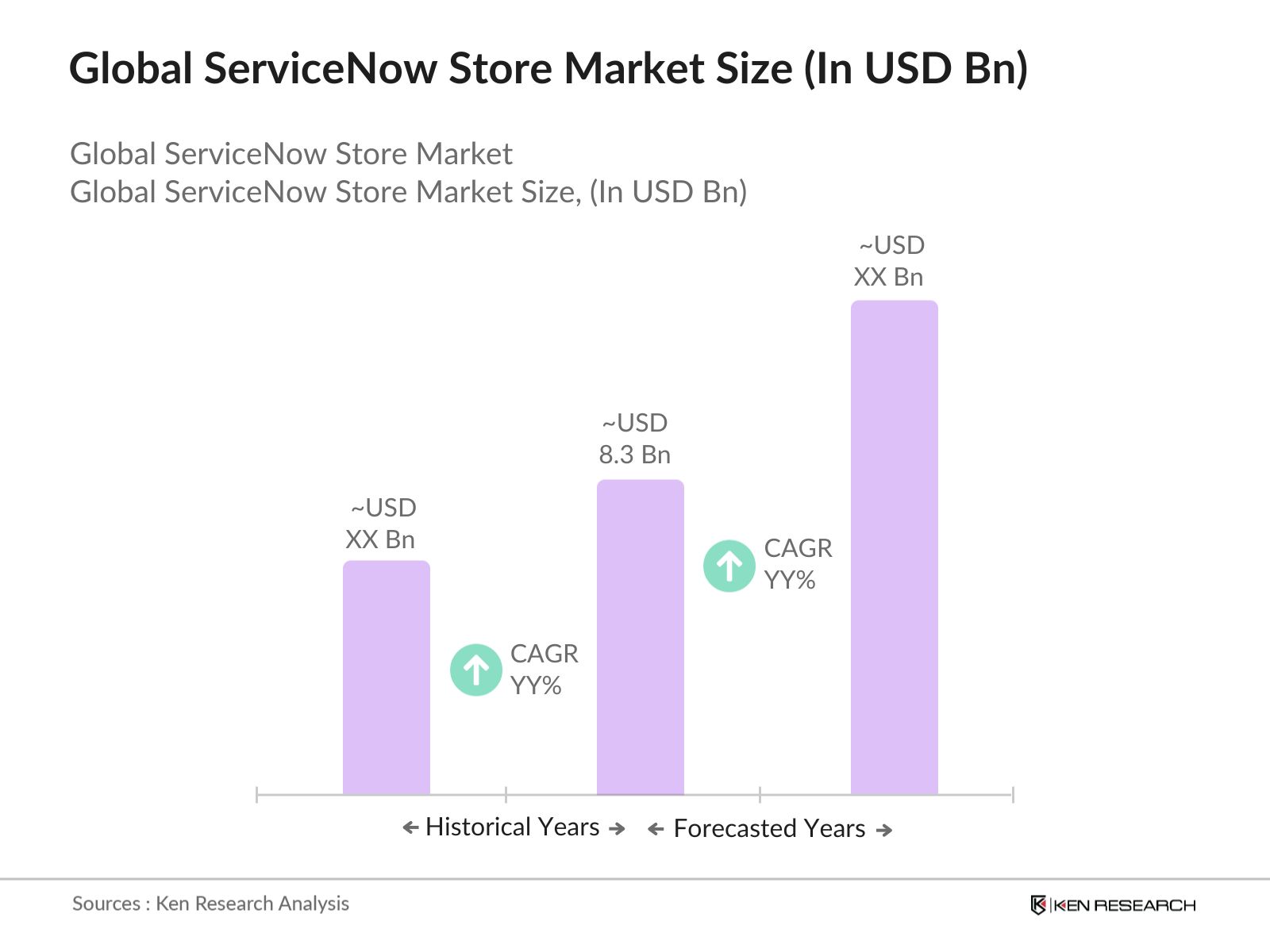
- The Global ServiceNow Store Market is valued at USD 8.3 billion, driven by the increasing demand for cloud-based platforms that support digital transformation in enterprises. The market growth is primarily influenced by the need for efficient IT service management (ITSM), customer service management, and automation of business workflows.
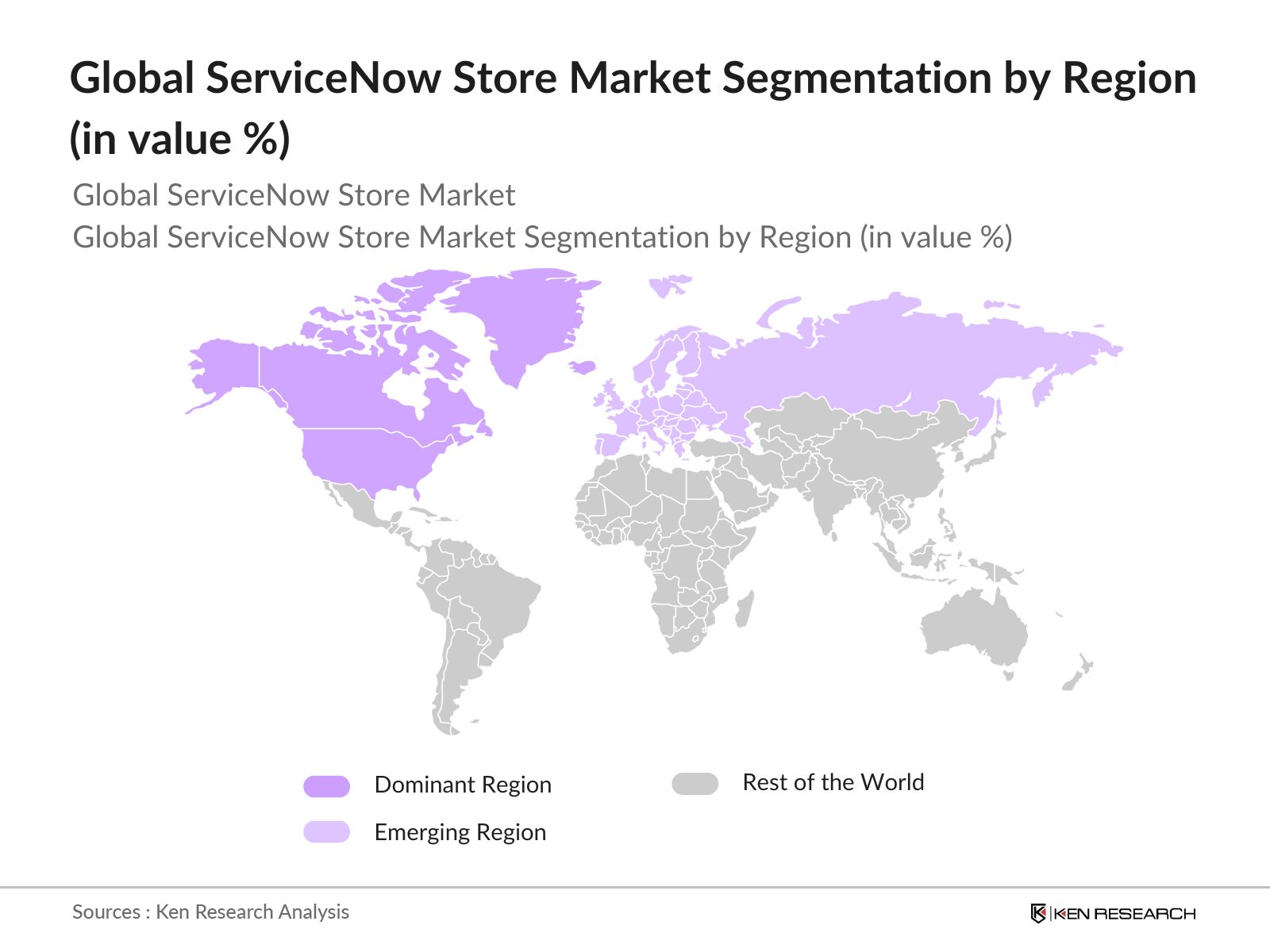
- Dominant regions such as North America and Europe lead the market due to their strong digital infrastructure and the presence of major industry players. North America, particularly the United States, dominates because of a robust IT ecosystem, high cloud adoption rates, and substantial investments in workflow automation solutions.
- Singapores government, under the Smart Nation initiative, has allocated $15 billion towards digital transformation, focusing on cloud and AI technologies. In 2024, more than 1,000 public sector organizations in Singapore have integrated ServiceNow to enhance operational efficiencies, and they are investing heavily in applications from the ServiceNow Store to streamline their processes.
Global ServiceNow Store Market Segmentation
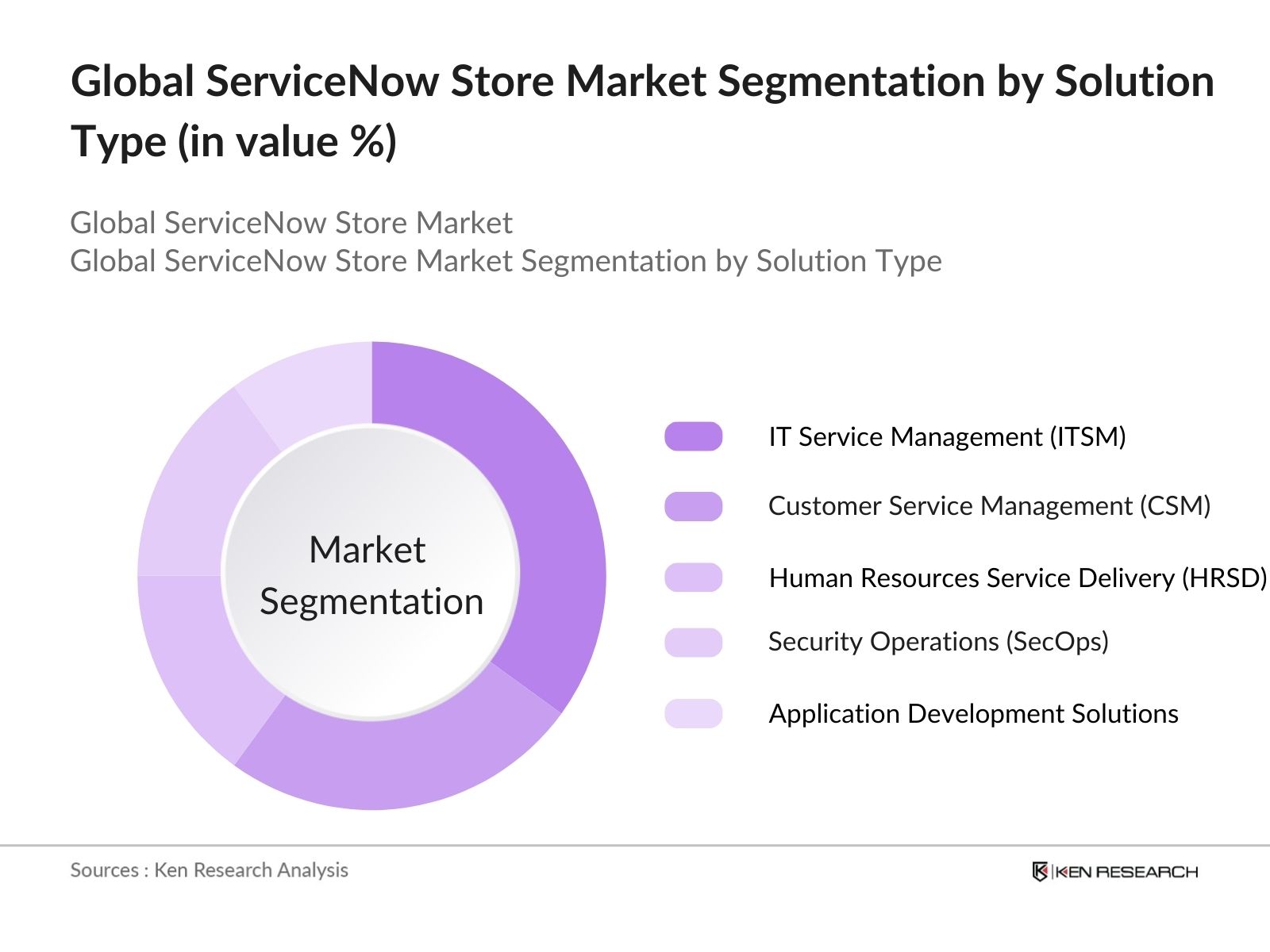
By Solution Type: The market is segmented by solution type into IT Service Management (ITSM), Customer Service Management (CSM), Human Resources Service Delivery (HRSD), Security Operations (SecOps), and Application Development Solutions. Among these, IT Service Management holds a dominant market share due to the growing need for automated IT service workflows. Organizations prioritize ITSM solutions to handle large-scale IT operations efficiently, enabling smooth digital transformation.
By Deployment Type: The market is divided into on-premise and cloud solutions. Cloud deployment dominates the market share, owing to the flexibility, scalability, and cost-effectiveness it offers to enterprises. With the global shift towards cloud-based infrastructure, especially post-pandemic, cloud-based ServiceNow solutions have witnessed a significant surge. Enterprises prefer cloud platforms as they reduce the need for physical hardware and offer enhanced security features, ensuring compliance with data regulations.
By Region: The market is segmented regionally into North America, Europe, Asia Pacific, the Middle East & Africa, and Latin America. North America leads with the highest market share due to its advanced IT infrastructure and widespread adoption of cloud solutions across various industries. The growing emphasis on automation and digitalization in the U.S. plays a critical role in sustaining this regional dominance.
Global ServiceNow Store Market Competitive Landscape
The competitive landscape of the market is shaped by both global IT service companies and specialized service providers offering tailored ServiceNow solutions. The market is characterized by partnerships, acquisitions, and significant investments in expanding product portfolios. Major players are focusing on enhancing their application offerings on the ServiceNow platform to gain competitive advantages.
|
Company Name |
Establishment Year |
Headquarters |
No. of Employees |
Revenue (2023) |
Core Solutions |
Geographical Presence |
Partnerships |
Product Innovation |
Market Position |
|
ServiceNow, Inc. |
2004 |
Santa Clara, USA |
|||||||
|
Accenture |
1989 |
Dublin, Ireland |
|||||||
|
DXC Technology |
2017 |
Ashburn, USA |
|||||||
|
Cognizant |
1994 |
Teaneck, USA |
|||||||
|
IBM |
1911 |
Armonk, USA |
Global ServiceNow Store Market Analysis
Market Growth Drivers
- Increasing Demand for Third-Party Applications Integration: The market is experiencing growth due to the rising demand for third-party application integration with ServiceNows platform. In 2024, over 100,000 businesses globally are adopting ServiceNow for enterprise operations, making it essential to have robust integration solutions for seamless data management. Businesses are seeking third-party applications through the ServiceNow Store to enhance workflows across different industries, including finance, healthcare, and retail.
- Rapid Adoption of ServiceNow Solutions in Healthcare and Public Sector: Healthcare providers and government agencies are increasingly leveraging the ServiceNow Store to streamline operations. By 2024, nearly 15,000 healthcare organizations globally have adopted ServiceNow solutions to improve their workflow and data management. Moreover, public sector agencies in over 30 countries have turned to ServiceNow for digitizing legacy systems.
- Workforce Management Solutions Driving Adoption: The global workforce of over 3.5 billion individuals is driving the demand for workforce management solutions from the ServiceNow Store. In 2024, companies are investing heavily in applications that manage employee lifecycle, from recruitment to retirement. Organizations in the Asia-Pacific region have reported a 25% improvement in HR efficiency by adopting applications through the ServiceNow Store, reflecting a growing trend of digitizing human resource functions to enhance productivity and reduce manual labor costs by several billion dollars annually.
Market Challenges
- High Cost of Application Deployment: The cost associated with deploying applications from the ServiceNow Store is another challenge for small and medium-sized enterprises (SMEs). In 2024, SMEs represent around 40 million businesses globally, yet many report spending between $100,000 and $1 million annually to deploy ServiceNow applications. These costs, compounded by high customization fees, prevent many smaller organizations from fully leveraging the ServiceNow ecosystem, leading to a slower market expansion among this segment.
- Security and Compliance Concerns: In 2024, with the rise of cyber-attacks globally, security and compliance concerns pose a challenge for ServiceNow users, especially in regulated industries like finance and healthcare. Businesses report that $10 billion annually is being spent on securing ServiceNow applications and ensuring compliance with regional and global regulations such as GDPR in Europe and HIPAA in the United States.
Global ServiceNow Store Market Future Outlook
Over the next five years, the Global ServiceNow Store industry is expected to exhibit growth driven by the rapid adoption of cloud infrastructure, increasing demand for automated workflows, and advancements in AI-driven solutions.
Future Market Opportunities
- Growth in Subscription-Based Models: By 2029, subscription-based models for ServiceNow Store applications will become the norm, with more than 80% of businesses opting for recurring subscriptions over one-time purchases. This transition is driven by cost efficiency and the need for ongoing updates and support. As a result, companies are expected to spend billions of dollars annually on subscription services, boosting the Stores recurring revenue streams.
- Greater Focus on Sustainability and ESG-Compliant Applications: Over the next five years, there will be a rising demand for applications that support Environmental, Social, and Governance (ESG) compliance. By 2029, more than 100,000 companies will be using applications from the ServiceNow Store that help them meet ESG targets, such as carbon tracking and waste reduction. This trend is being driven by stricter regulations and the increasing pressure on businesses to adopt sustainable practices.
Scope of the Report
|
Solution Type |
IT Service Management (ITSM) Customer Service Management (CSM) Human Resources Service Delivery (HRSD) Security Operations (SecOps) Application Development Solutions |
|
Deployment Type |
On-Premise Cloud |
|
Enterprise Size |
Small and Medium Enterprises (SMEs) Large Enterprises |
|
Industry Vertical |
BFSI Healthcare IT and Telecom Manufacturing Government and Public Sector |
|
Region |
North America Europe Asia Pacific Middle East & Africa Latin America |
Products
Key Target Audience Organizations and Entities Who Can Benefit by Subscribing This Report:
IT Service Providers
Managed Service Providers (MSPs)
Large Enterprises (Fortune 500 companies)
Government and Regulatory Bodies (e.g., U.S. Department of Homeland Security, European Union Data Protection Agency)
Cloud Solution Providers
Banks and Financial Institution
Investment and Venture Capitalist Firms
Companies
Players Mentioned in the Report:
ServiceNow, Inc.
Accenture
DXC Technology
IBM
Cognizant
Wipro
TCS
Capgemini
Deloitte
KPMG
NTT Data
Atos
PwC
Infosys
HCL Technologies
Table of Contents
1. Global ServiceNow Store Market Overview
1.1 Definition and Scope
1.2 Market Taxonomy
1.3 Market Growth Rate
1.4 Market Segmentation Overview
2. Global ServiceNow Store Market Size (In USD Bn)
2.1 Historical Market Size
2.2 Year-On-Year Growth Analysis
2.3 Key Market Developments and Milestones
3. Global ServiceNow Store Market Analysis
3.1 Growth Drivers (Demand for Cloud Integration, Workflow Automation, Enterprise Digitization)
3.1.1 Cloud Adoption in Enterprises
3.1.2 Increasing Focus on Workflow Automation
3.1.3 Expansion of Digital Platforms and IT Services
3.1.4 Increasing Use of Custom-Built Applications
3.2 Market Challenges (Customization Complexity, Data Security, ROI Concerns)
3.2.1 High Initial Setup and Customization Costs
3.2.2 Security and Compliance Concerns in SaaS Solutions
3.2.3 Integration Complexity with Legacy Systems
3.2.4 Skilled Workforce Shortage
3.3 Opportunities (AI/ML Integration, Industry-Specific Solutions, ITSM Automation)
3.3.1 ServiceNows Expansion into New Industries
3.3.2 Growth of AI/ML Applications in Workflow Management
3.3.3 Increased Demand for Remote IT Support Solutions
3.3.4 Automation and Self-Service in IT Operations
3.4 Trends (Integration with DevOps, No-Code/Low-Code Platforms, Partner Ecosystem Expansion)
3.4.1 Shift Towards DevOps in Application Deployment
3.4.2 Growing Popularity of No-Code/Low-Code Solutions
3.4.3 Growth of Managed Service Providers (MSPs) in ServiceNow Market
3.4.4 Expansion of ServiceNows Partner Ecosystem
3.5 Government Regulations (Data Privacy Laws, Compliance Standards)
3.5.1 Data Privacy and Localization Regulations
3.5.2 Compliance with ITIL and ISO Standards
3.5.3 Certifications and Regulatory Approvals for SaaS Platforms
4. Global ServiceNow Store Market Segmentation
4.1 By Solution Type (In Value %)
4.1.1 IT Service Management (ITSM)
4.1.2 Customer Service Management (CSM)
4.1.3 Human Resources Service Delivery (HRSD)
4.1.4 Security Operations (SecOps)
4.1.5 Application Development Solutions
4.2 By Deployment Type (In Value %)
4.2.1 On-Premise
4.2.2 Cloud
4.3 By Enterprise Size (In Value %)
4.3.1 Small and Medium Enterprises (SMEs)
4.3.2 Large Enterprises
4.4 By Industry Vertical (In Value %)
4.4.1 BFSI
4.4.2 Healthcare
4.4.3 IT and Telecom
4.4.4 Manufacturing
4.4.5 Government and Public Sector
4.5 By Region (In Value %)
4.5.1 North America
4.5.2 Europe
4.5.3 Asia Pacific
4.5.4 Middle East & Africa
4.5.5 Latin America
5. Global ServiceNow Store Market Competitive Analysis
5.1 Detailed Profiles of Major Companies
5.1.1 ServiceNow, Inc.
5.1.2 DXC Technology
5.1.3 Accenture
5.1.4 Deloitte
5.1.5 Infosys
5.1.6 Cognizant
5.1.7 Wipro
5.1.8 Capgemini
5.1.9 IBM
5.1.10 KPMG
5.1.11 Atos
5.1.12 NTT Data
5.1.13 HCL Technologies
5.1.14 TCS
5.1.15 PwC
5.2 Cross Comparison Parameters (No. of Employees, Headquarters, Revenue, Global Presence, Client Base, Services Offered, Market Position, Specialization Areas)
5.3 Market Share Analysis
5.4 Strategic Initiatives
5.5 Mergers and Acquisitions
5.6 Investment Analysis
5.7 Venture Capital Funding
5.8 Government Grants and Partnerships
5.9 Private Equity Investments
6. Global ServiceNow Store Market Regulatory Framework
6.1 Data Privacy and Protection Standards
6.2 Global Compliance Requirements
6.3 Certification and Audit Standards
7. Global ServiceNow Store Future Market Size (In USD Bn)
7.1 Future Market Size Projections
7.2 Key Factors Driving Future Market Growth
8. Global ServiceNow Store Future Market Segmentation
8.1 By Solution Type (In Value %)
8.2 By Deployment Type (In Value %)
8.3 By Enterprise Size (In Value %)
8.4 By Industry Vertical (In Value %)
8.5 By Region (In Value %)
9. Global ServiceNow Store Market Analysts Recommendations
9.1 TAM/SAM/SOM Analysis
9.2 White Space Opportunity Analysis
9.3 Customer Cohort Analysis
9.4 Marketing Strategies
Disclaimer Contact UsResearch Methodology
Step 1: Identification of Key Variables
The initial step involves mapping the ecosystem, identifying major stakeholders within the Global ServiceNow Store Market. This includes extensive research from secondary databases and proprietary tools to gather market-specific data.
Step 2: Market Analysis and Construction
Historical data related to market penetration, deployment ratios, and application performance are assessed. Service quality and deployment statistics are considered to provide an accurate view of the market structure.
Step 3: Hypothesis Validation and Expert Consultation
Interviews with industry experts and ServiceNow practitioners help in validating key market assumptions. These consultations provide insights into current market dynamics and future trends.
Step 4: Research Synthesis and Final Output
This phase involves combining insights from stakeholders and integrating the bottom-up market analysis approach to provide a comprehensive view of the ServiceNow Store Market.
Frequently Asked Questions
01. How big is the Global ServiceNow Store Market?
The Global ServiceNow Store Market is valued at USD 8.3 billion, driven by increasing demand for IT service management and workflow automation solutions.
02. What are the key challenges in the Global ServiceNow Store Market?
Challenges in the Global ServiceNow Store Market include data security concerns, customization complexities, and integration issues with legacy systems, which can affect implementation and scalability.
03. Who are the major players in the Global ServiceNow Store Market?
Major players in the Global ServiceNow Store Market include ServiceNow, Accenture, DXC Technology, Cognizant, and IBM, which dominate the market due to their extensive portfolios and global reach.
04. What are the growth drivers of the Global ServiceNow Store Market?
Growth drivers in the Global ServiceNow Store Market include the rising adoption of cloud infrastructure, the demand for integrated workflow solutions, and advancements in AI and machine learning technologies.
05. What is the future outlook of the Global ServiceNow Store Market?
The Global ServiceNow Store Market is expected to witness growth over the next five years, driven by AI-driven solutions, cloud adoption, and increasing digital transformation initiatives.
Why Buy From Us?

What makes us stand out is that our consultants follows Robust, Refine and Result (RRR) methodology. i.e. Robust for clear definitions, approaches and sanity checking, Refine for differentiating respondents facts and opinions and Result for presenting data with story

We have set a benchmark in the industry by offering our clients with syndicated and customized market research reports featuring coverage of entire market as well as meticulous research and analyst insights.

While we don't replace traditional research, we flip the method upside down. Our dual approach of Top Bottom & Bottom Top ensures quality deliverable by not just verifying company fundamentals but also looking at the sector and macroeconomic factors.

With one step in the future, our research team constantly tries to show you the bigger picture. We help with some of the tough questions you may encounter along the way: How is the industry positioned? Best marketing channel? KPI's of competitors? By aligning every element, we help maximize success.

Our report gives you instant access to the answers and sources that other companies might choose to hide. We elaborate each steps of research methodology we have used and showcase you the sample size to earn your trust.

If you need any support, we are here! We pride ourselves on universe strength, data quality, and quick, friendly, and professional service.