Ken Research Logo

Global Smart Airport Market Outlook to 2030

Region:Global

Author(s):Rohit and Nishika

Product Code:KENGR044

Published On

October 2024

Total pages

87

About the Report

Global Smart Airport Market Overview

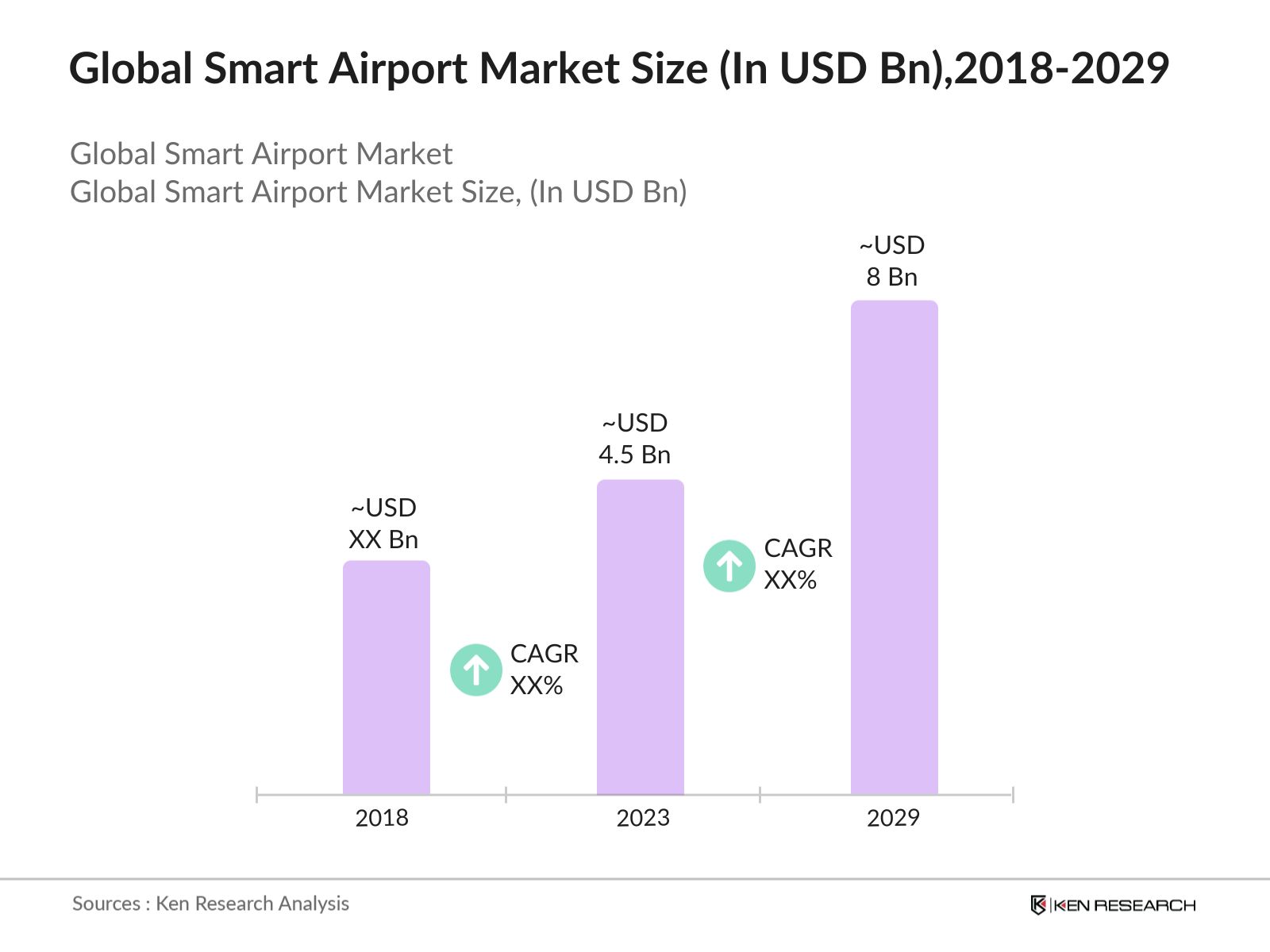
  • Global smart airport market was valued at USD 4.5 billion in 2023. The market's growth is driven by increasing investments in airport modernization, particularly in the adoption of advanced technologies like AI, IoT, and biometrics to enhance passenger experience and operational efficiency.market overviews
  • Leading companies in the smart airport sector include SITA, Amadeus IT Group, Honeywell, Siemens AG and Cisco to name a few. These companies have pioneered the integration of advanced technologies in airports, driving innovations in areas such as automated check-in systems, baggage handling, and passenger management.
  • In 2023, SITA and Indicio have announced a co-innovation agreement aimed at accelerating the development and deployment of digital identities for travel. This partnership leverages Indicio's expertise in open-source verifiable data technology to create a more seamless, secure, and privacy-preserving travel experience.

Global Digital Transformation Current Market Analysis

market overviews

  • Europe as dominant region: Europe dominates the market, driven by advanced infrastructure, innovation, and strong sustainability goals. The UK leads with airports like London Heathrow adopting AI to streamline security. In 2020, British Airways and EasyJet carried 11.66 million and 11.42 million passengers, respectively, with British Airways flying 262.1 million kilometers more. The EU's SESAR program and 2050 climate neutrality targets further boost smart airport adoption, ensuring Europe remains a key global hub in aviation.
  • North America as emerging region: North America is rapidly emerging as a key player in the market, driven by substantial investments in advanced technologies and sustainable infrastructure. The United States leads with major airports like Los Angeles International (LAX) and Hartsfield-Jackson Atlanta International adopting AI, IoT, and biometric systems to enhance passenger experience and operational efficiency. Innovations in sustainable aviation, such as Lufthansa Technik's AeroFLAX for lighter aircraft interiors and the Commercial Aviation Alternative Fuels Initiative (CAAFI), support the region's commitment to reducing carbon emissions. This focus on modernization and sustainability positions North America as a growing hub for smart airport development.
  • UK as dominant country: The UK leads the global smart airports market, driven by its advanced infrastructure, robust aviation industry, and early tech adoption. With over 70 airports and $180.4 billion planned for public and private infrastructure projects between 2023 and 2025, the UK ensures connectivity and economic growth. Major hubs like Heathrow are pioneers in AI, IoT, and biometric systems, enhancing operations and passenger experiences. The UK's Net Zero Strategy and Sustainable Aviation initiatives further cement its leadership in smart airport advancements.

Global Smart Airport Market Segmentation

The Global Smart Airport Market can be segmented based on several factors:

By Technology: Global Smart Airport Market is segmented by technology into Passenger, Baggage and Cargo Handling, Air & Ground Traffic Control, Security Systems, Communication Systems & others. In 2023, Passenger, Baggage and Cargo Handlings dominated this market due to the increasing adoption of advanced technologies like biometrics, AI-driven baggage handling systems, and automated cargo management, which significantly enhance operational efficiency, reduce wait times, and improve overall passenger experience at airports worldwide.

market overviews

By Type of Operation: Global Smart Airport Market is segmented by type of operation into Aeronautical and Non-Aeronautical. In 2023, Aeronautical operations dominate ue to the growing demand for efficient air traffic management, enhanced safety protocols, and the integration of advanced technologies like AI and IoT in flight operations, leading to improved aircraft handling, navigation, and communication systems.

market overviews

Global Smart Airport Market Competitive Landscape

Company

Establishment Year

Headquarters

Geographical Presence (by Number of Countries)

SITA

1949

Geneva, Switzerland

200+

Amadeus IT Group SA

1987

Madrid, Spain

190

Honeywell

1985

Charlotte, North Carolina, United States

79

Raytheon Technologies

1801

Arlington County, Virginia, United States

10

Siemens AG

1847

Berlin, Germany

190+

  • Amadeus Acquires Vision Box: In 2024, Amadeus has completed the acquisition of Vision-Box, a leading provider of biometric solutions for airports, airlines, and border control customers, for an agreed price (EV) of 320 million. The combined offering will allow Amadeus to deliver a fully integrated traveler journey, from booking to arrival at the airport, including border control and boarding.
  • SITA and Alstef Group: In 2022, SITA has partnered with Alstef Group to introduce Swift Drop, a self-bag drop solution designed to streamline the baggage check-in process at airports. This innovative system significantly reduces the time passengers spend checking their bags, enhancing the overall travel experience. Swift Drop is part of SITAs Smart Path passenger processing portfolio, which includes the TS6 kiosk.
  • Honeywells MoU with New Space: In 2022, Honeywell and New Space Research and Technologies, an India-based developer of unmanned platforms, have signed a memorandum of understanding (MoU) to collaborate on navigation systems for unmanned aerial systems. The collaboration aims to bring enhanced operational capabilities to unmanned platforms for military use, leveraging Honeywell's advanced navigation technologies

Global Smart Airport Industry Analysis

Global Smart Airport Market Growth Drivers:

  • Technological Advancements: The implementation of biometric technologies, such as facial recognition and fingerprint scanning, is revolutionizing security and passenger processing. These systems significantly reduce waiting times at security checkpoints and streamline the boarding process. Rapid advancements in IoT, AI, Big Data analytics, and cloud computing have paved the way for smart airport solutions. These technologies are vital in improving operational efficiency, passenger experience, security, and sustainability.
  • Increasing Air Passenger Traffic: India is emerging as a key player in the global aviation market, with local airlines carrying over 112 million passengers in the first nine months of 2023, marking a 29.1% increase from the previous year. Many airports are physically constrained, unable to support the growing traffic flow. Digitalization aids in efficient flow management, optimizing resource utilization, and minimizing congestion.
  • Need of Attracting Global Airlines: Smaller regional airports, facing competition from larger hubs, view digitalization as essential for attracting and retaining global airlines. This is critical for their economic sustainability, as these airports contribute largely towards the economy in smaller regions. The adoption of digital strategies is forecasted to boost airline retention, supporting regional economic growth.

Global Smart Airport Market Challenges:

  • Integration Complexity: Integrating smart technologies into existing airport infrastructure involves significant challenges. Ensuring seamless interoperability among diverse systems like baggage handling, security, and passenger management requires meticulous planning. The complexity arises from aligning various technologies, which often have different communication protocols and data formats, demanding careful coordination to achieve a cohesive and functional airport environment.
  • User Acceptance & Adoption: Cultural and organizational resistance can significantly hinder the adoption of new technologies at airports. Overcoming resistance to change is often more challenging than managing costs. Airports may struggle with internal pushback and reluctance, making the integration of new technologies less effective despite having sufficient resources.

Global Smart Airport Market Government Initiatives:

  • FAAs Airport Improvement Program: The U.S. Federal Aviation Administration (FAA) significantly expanded its Airport Improvement Program in 2023. In FY 2023, the FAA announced approximately $269 million in Supplemental Discretionary Grants under the AIP. This initiative aims to enhance safety, capacity, and environmental concerns to create a more efficient and secure travel experience.
  • European Unions Smart Airports 2030 Initiative: The EU's 'Sustainable and Smart Mobility Strategy' aims to reduce transport emissions by 90% by 2050. This initiative supports the implementation of smart technologies such as energy-efficient systems, automated baggage handling, and biometric security checks, setting a roadmap for the future of European airports

Global Smart Airport Future Market Outlook

market overviews

The market is expected to reach USD 8 Bn by 2029 driven by the increasing need for enhanced operational efficiency and improved passenger experience. Governments and airport authorities worldwide are investing heavily in smart technologies such as AI, IoT, and biometrics to streamline airport operations and ensure a seamless travel experience.

Future Market Trends

  • Expansion of Digital Twin Technology: Over the next five years, digital twin technology will become a cornerstone of smart airport operations. Airports will increasingly adopt this technology to simulate and optimize various processes, from passenger flow to baggage handling, allowing them to predict and mitigate potential issues before they occur. This will result in more efficient airport operations and a smoother travel experience for passengers.
  • Increased Adoption of Biometrics and AI in Passenger Processing: Biometrics and AI will become ubiquitous in smart airports, with facial recognition and AI-driven systems handling everything from check-in to boarding. This trend will not only speed up the passenger processing but also enhance security by reducing the reliance on manual checks. By 2028, the majority of major airports will have fully integrated biometric systems, significantly improving passenger throughput and satisfaction.

Scope of the Report

By Region

North America

Europe

APAC

Latin America

MEA

By Airport Type

Tier 1

Tier 2

Tier 3

Tier 4

Tier 5

By Technology

Passenger

Baggage and Cargo Handling

Air & Ground Traffic Control

Security Systems

Communication Systems

Others

By Type of Operation

Aeronautical

Non-Aeronautical

By Airport Operations

Airside

Terminal Side

Landslide

Products

Key Target Audience Organizations and Entities Who Can Benefit by Subscribing This Report:

  • Airport Infrastructure Providers

  • Security System Providers

  • Airport Maintenance Companies

  • Passenger Experience Management Companies

  • Travel and Tourism Companies

  • Telecommunications Companies

  • Investment & Venture Capitalist Firms

  • Government and Regulatory Bodies (Federal Aviation Administration, European Union Aviation Safety Agency)

Time Period Captured in the Report:

  • Historical Period: 2018-2023

  • Base Year: 2023

  • Forecast Period: 2023-2029

Companies

Players Mentioned in the Report:

  • SITA

  • Amadeus IT Group SA

  • Honeywell

  • Raytheon Technologies

  • Siemens AG

  • Cisco Systems Inc.

  • Thales Group

  • NATS Limited

  • IBM Corporation

  • Wipro

  • Vanderlande Industries B.V

  • Leidos, Inc

Table of Contents

1. Executive Summary

1.1 Global Aviation Market

1.2 Global Smart Airport Market

2. Global Overview

2.1 Overview of Global Economics

2.2 Overview of Global Aviation Industry

2.3 Global Aviation (Airport Management Systems, Air Traffic Management Systems and Passenger Experience Enhancement) Revenue

2.4 Global Smart Airport Infrastructure

3. Global Smart Airport Market Overview

3.1 Taxonomy

3.2 Ecosystem

3.3 Value Chain

4. Global Smart Airport Market Size (in USD Bn), 2018-2023

5. Global Smart Airport Market Segmentation (in value %), 2018-2023

5.1 By Region (North America, Europe, APAC, Latin America and MEA) in value %, 2018-2023

5.2 By Airport Type (Tier 1, Tier 2, Tier 3, Tier 4 and Tier 5) in value %, 2018-2023

5.3 By Technology (Passenger, Baggage and Cargo Handling, Air & Ground Traffic Control, Security Systems, Communication Systems & Others) in value%, 2018-2023

5.4 By Type of Operations (Aeronautical & Non-Aeronautical) in value %, 2018-2023

5.5 By Airport Operations (Airside, Terminal Side & Landslide) in value %, 2018-2023

6. Global Smart Airport Market Competition Landscape

6.1 Competition Framework of Major Players

6.2 Cross Comparison

6.3 Heat Map Analysis

6.4 Comparison Matrix

6.5 Investment Landscape

7. Global Smart Airport Market Dynamics

7.1 Growth Drivers

7.2 Challenges

7.3 Trends

8. Global Smart Airport Future Market Size (in USD Bn), 2023-2029

9. Global Smart Airport Future Market Segmentation (in value %), 2023-2029

9.1 By Region (North America, Europe, APAC, Latin America and MEA) in value %, 2023-2029

9.2 By Airport Type (Tier 1, Tier 2, Tier 3, Tier 4 and Tier 5) in value %, 2018-2023

9.3 By Technology (Passenger, Baggage and Cargo Handling, Air & Ground Traffic Control, Security Systems, Communication Systems & Others) in value%, 2023-2029

9.4 By Type of Operations (Aeronautical & Non-Aeronautical) in value %, 2023-2029

9.5 By Airport Operations (Airside, Terminal Side & Landslide) in value %, 2023-2029

10. Analyst Recommendations

Research Methodology

Step: 1 Secondary Sources:

  • Government Reports- Federal Aviation Administration, European Aviation Safety Agency, International Civil Aviation Organization
  • Official Company Reports and Press Releases - Annual reports, investor presentations, and press releases from major Smart Airport Solutions Manufacturers for Product Offerings, Financial Performance & Market Strategies.
  • Public and Proprietary Database Airport Council International, F&S, Euromonitor, Statista, McKinsey for Market Sizing, Industry Analysis & Forecasts.

Step: 2 Validate via Trade Desk Interviews:

Confirming market revenue, margins, segmentations, Distribution and future projections to gauge insights in the current market trends.

Step: 3 Proxy Modeling & Outcomes:

  • Bottom-Top Approach- Calculating Revenue of Major Players by analyzing their sales and pricing for different products.
  • Disguised interviews with multiple managers to get their viewpoint on their operational and financial performance. This approach has supported our team to validate the information that was shared by their top management to ensure data accuracy.

Frequently Asked Questions

01 How big is Global Smart Airport Market?

Global Smart Airport Market was valued at USD 4.5 billion in 2023. The market's growth is driven by increasing investments in airport modernization, particularly in the adoption of advanced technologies like AI, IoT, and biometrics to enhance passenger experience and operational efficiency.

02 What are the challenges in Global Smart Airport Market?

Challenges in the Global Smart Airport market include integration complexity, user acceptance & domination and sustainability & environmental impact. Ensuring seamless interoperability among diverse systems like baggage handling, security, and passenger management requires meticulous planning.

03 Who are the major players in Global Smart Airport Market?

Leading companies in the smart airport sector include SITA, Amadeus IT Group, Honeywell, Siemens AG and Cisco to name a few. These companies have pioneered the integration of advanced technologies in airports, driving innovations in areas such as automated check-in systems, baggage handling, and passenger management.

04 What are the growth drivers of the Global Smart Airport Market?

Global Smart Airport Market is propelled by technological advancement, increasing air traffic and attracting global airlines. The implementation of biometric technologies, such as facial recognition and fingerprint scanning, is revolutionizing security and passenger processing.

Why Buy From Us?

RRR
Refine Robust Result (RRR) Framework

What makes us stand out is that our consultants follows Robust, Refine and Result (RRR) methodology. i.e. Robust for clear definitions, approaches and sanity checking, Refine for differentiating respondents facts and opinions and Result for presenting data with story

Our Reach Is Unmatched

We have set a benchmark in the industry by offering our clients with syndicated and customized market research reports featuring coverage of entire market as well as meticulous research and analyst insights.

Research
Shifting the Research Paradigm

While we don't replace traditional research, we flip the method upside down. Our dual approach of Top Bottom & Bottom Top ensures quality deliverable by not just verifying company fundamentals but also looking at the sector and macroeconomic factors.

Insite
More Insights-Better Decisions

With one step in the future, our research team constantly tries to show you the bigger picture. We help with some of the tough questions you may encounter along the way: How is the industry positioned? Best marketing channel? KPI's of competitors? By aligning every element, we help maximize success.

Trust
Transparency and Trust

Our report gives you instant access to the answers and sources that other companies might choose to hide. We elaborate each steps of research methodology we have used and showcase you the sample size to earn your trust.

support
Round the Clock Support

If you need any support, we are here! We pride ourselves on universe strength, data quality, and quick, friendly, and professional service.

Why Client Choose Us?

400000+ Reports in repository
150+ Consulting project a year
100+ Analysts
8000+ Client Queries in 2022