
Global Smart Pole Market Outlook to 2030
Region:Global
Author(s):Shivani Mehra
Product Code:KROD3240
December 2024
93
About the Report
Global Smart Pole Market Overview
- The global smart pole market is valued at USD 16.64 billion based on a five-year historical analysis. This market is driven by the increasing integration of smart technologies in urban infrastructure, particularly in smart cities. The demand for energy-efficient lighting solutions, combined with government initiatives promoting sustainable urbanization, significantly propels the market.
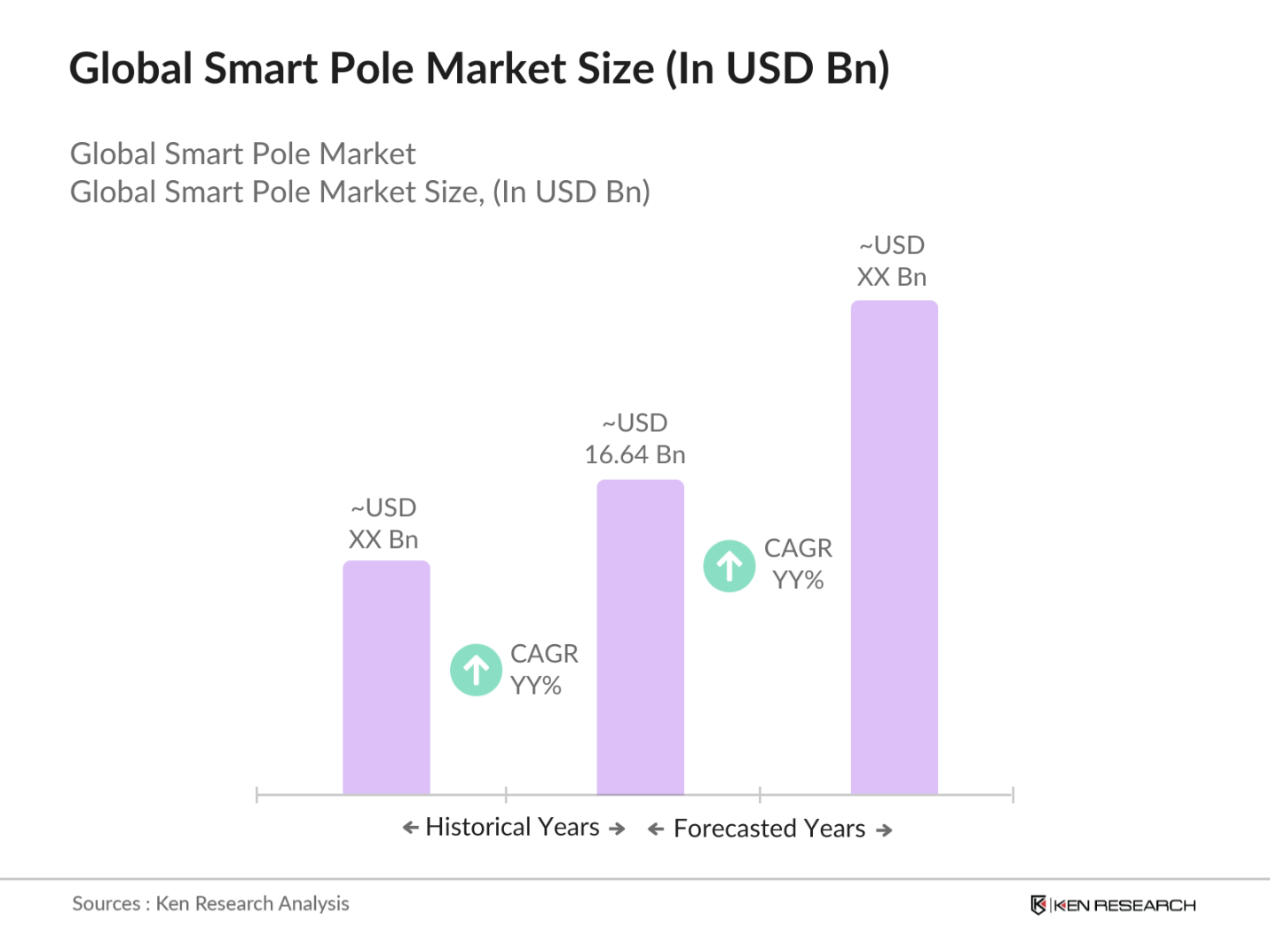
- The market is dominated by cities in the USA, China, and India, which are at the forefront of adopting smart city projects. These countries lead due to their robust urban development policies and increased investment in technology-driven public infrastructure. For example, in the USA, cities like New York and San Francisco are prominent in smart pole deployment, while India and China are rapidly upgrading urban environments to enhance public safety, lighting, and connectivity through smart poles.
- The EU's Horizon Europe program has introduced new funding initiatives to promote the deployment of smart poles in urban areas, aimed at supporting 5G networks and IoT infrastructure. In 2023, Horizon Europe has a total budget of 93.5 billion for research and innovation, with a specific work program for 2023-2024 allocating approximately 13.5 billion to various initiatives, including climate action, digital technologies, and mobility.
Global Smart Pole Market Segmentation
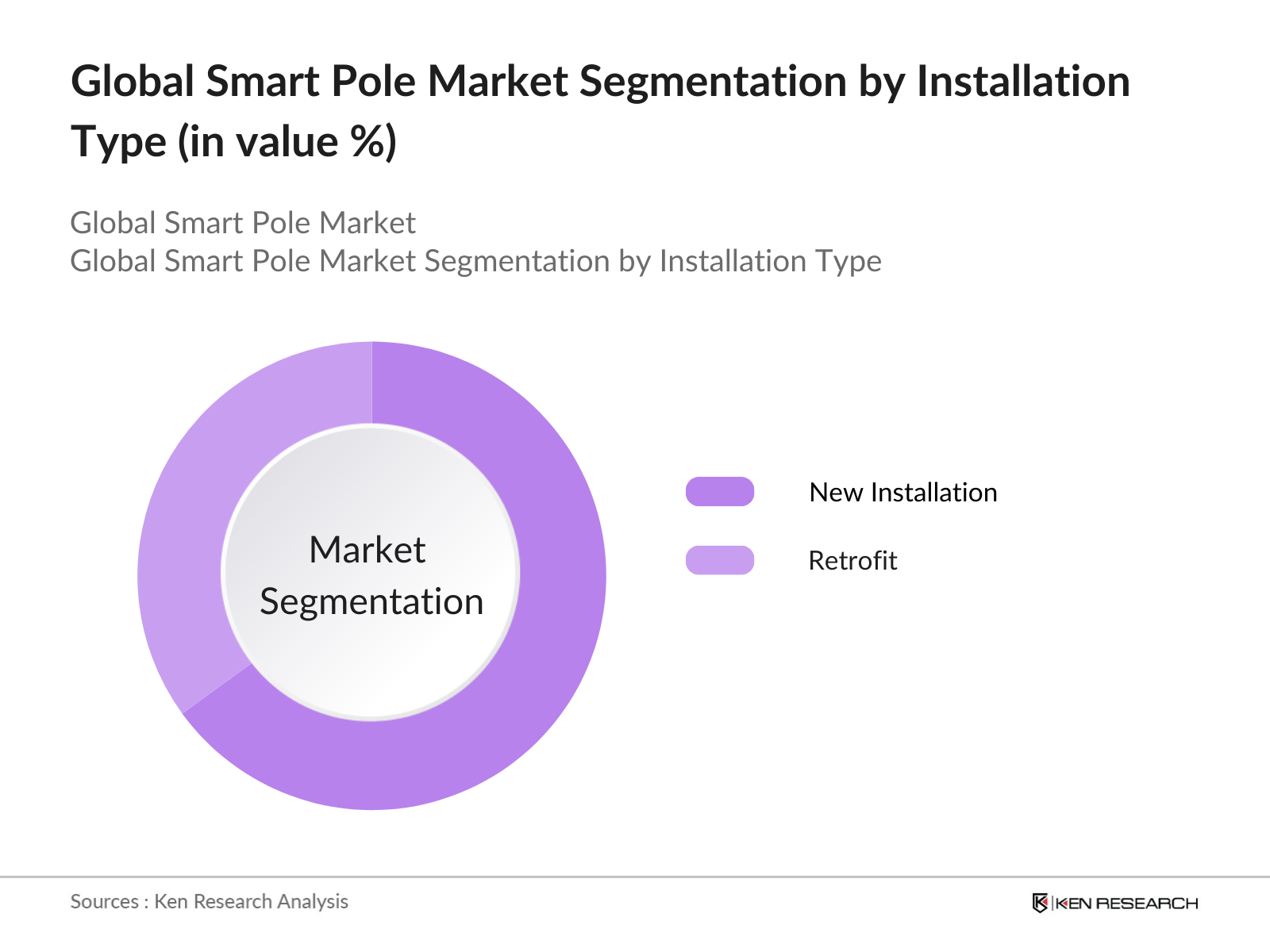
- By Installation Type: The smart pole market is segmented by installation type into new installations and retrofits. New installations currently hold the dominant market share due to increased smart city initiatives across urban regions. Cities are prioritizing new infrastructure developments to ensure seamless integration with IoT, 5G, and other smart city technologies. Furthermore, new installations come with advanced features, making them more attractive for emerging smart cities. Retrofit installations are growing but face challenges in compatibility with existing infrastructure, which limits their adoption.
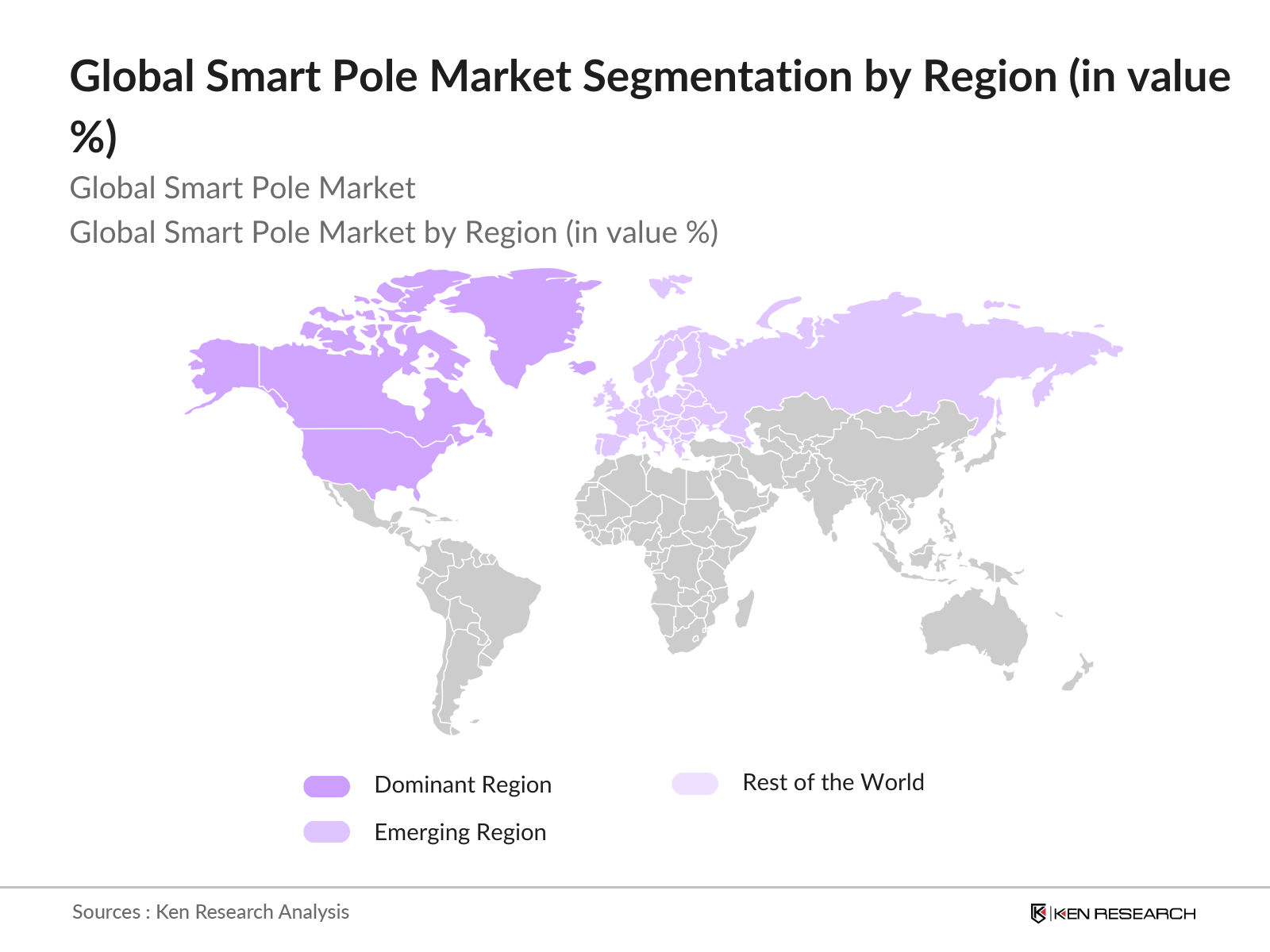
- By Region: The smart pole market is segmented by region into North America, Europe, Asia Pacific, Middle East & Africa, and Latin America. North America currently holds the largest market share, driven by substantial investments in smart city initiatives across the USA and Canada. This region benefits from advanced technology infrastructure and supportive government policies, boosting its leadership position. Europe and Asia Pacific are also witnessing rapid growth, fueled by increased urbanization and government efforts focused on energy-efficient infrastructure.
Global Smart Pole Market Competitive Landscape
The global smart pole market is dominated by key players who control significant portions of the market through their strong brand presence, innovative product offerings, and technological advancements. These companies have been focusing on strategic partnerships, product innovations, and smart city initiatives to expand their market presence.
|
Company |
Established |
Headquarters |
No. of Employees |
Revenue |
Key Innovation |
Global Reach |
Smart City Projects |
|
Signify N.V. |
1891 |
Netherlands |
|||||
|
General Electric Company |
1892 |
USA |
|||||
|
Siemens AG |
1847 |
Germany |
|||||
|
Telensa Ltd. |
2005 |
UK |
|||||
|
Acuity Brands, Inc. |
2001 |
USA |
Global Smart Pole Market Analysis
Market Growth Drivers
- Integration with Smart City Projects: Smart poles are becoming integral components of smart city projects globally. In 2023, over 100 cities in the European Union have launched smart city initiatives, integrating smart poles for enhanced connectivity and data collection. These poles offer advanced functionalities like air quality monitoring, Wi-Fi hotspots, and traffic management. In India, the governments Smart Cities Mission aims to develop 100 cities with integrated technologies, including smart poles, by 2025.
- Expansion of IoT and 5G Technologies: With 5G rollouts accelerating globally, smart poles equipped with IoT sensors are helping cities manage real-time data. As of 2023, more than 250,000 5G base stations were installed across China, a key market for smart pole technologies. The poles are increasingly used as hubs for 5G small cells, enabling faster communication speeds. According to the International Telecommunication Union (ITU), global IoT connections are expected to surpass 25 billion by 2025, further increasing demand for smart poles as infrastructure hubs.
- Government Initiatives and Smart Infrastructure Investments: Governments worldwide are heavily investing in smart infrastructure. The USA has committed $500 million to smart city projects as part of its "Smart Cities Initiative," which includes the implementation of smart poles in urban areas. In the Middle East, Saudi Arabia is allocating substantial funding toward smart infrastructure, including smart lighting systems and IoT-enabled smart poles. These initiatives aim to improve urban living conditions, energy efficiency, and data management across cities.
Market Challenges
- High Initial Installation Costs: Smart pole installation requires significant upfront investment, ranging between $8,000 to $15,000 per unit, depending on the technology integrated. Cities in developing countries often face financial constraints, limiting the scalability of such projects. For example, in 2023, Mexico City's smart pole initiative faced delays due to high installation costs, leading to fewer installations than initially planned. The World Bank indicates that infrastructure funding gaps are a critical barrier, especially in regions like Latin America and Southeast Asia.
- Technical Compatibility and Integration Issues: Smart poles require seamless integration with existing infrastructure, but compatibility issues often arise due to outdated technology in older urban areas. For example, in 2022, a smart pole deployment in New York City faced delays because the poles IoT sensors were incompatible with the city's existing traffic management system. Additionally, the lack of skilled technicians in certain regions hampers the ability to install and maintain these poles, with the World Economic Forum reporting that many smart city projects face delays due to technical challenges.
Global Smart Pole Market Future Outlook
Over the next five years, the global smart pole market is projected to experience steady growth driven by continuous government support, advancements in IoT and AI technologies, and increased focus on energy-efficient urban lighting solutions. Expansion in developing regions such as Asia Pacific and Latin America is expected to be substantial due to emerging smart city projects and the need for sustainable public infrastructure.
Market Opportunities:
- Use of Renewable Energy in Smart Poles: Smart poles powered by renewable energy sources, such as solar, are gaining traction as cities focus on reducing carbon emissions. In 2023, Dubai indeed installed over 1,000 solar-powered smart poles as part of its Clean Energy Strategy. These smart poles are designed with energy-efficient LED lights and integrated communication systems, which contribute to reduced electricity consumption. The International Renewable Energy Agency (IRENA) has recognized solar-powered smart poles as a significant solution for cities aiming to enhance energy efficiency and reduce carbon emissions.
- Integration of EV Charging Stations: With the rise of electric vehicles (EVs), smart poles are increasingly being integrated with EV charging stations. In 2023, California announced plans to install 500 smart poles equipped with EV chargers as part of its push toward sustainable urban mobility. These poles serve dual purposes: energy-efficient lighting and providing charging infrastructure for EVs. According to the U.S. Department of Energy, the number of publicly available EV charging stations is expected to increase to 180,000 by the end of 2025, many of which will be integrated with smart poles.
Scope of the Report
|
By Installation Type |
New Installation Retrofit |
|
By Application |
Highways and Roadways Public Spaces and Parks Residential Areas Commercial and Industrial Zones |
|
By Application |
Medical Imaging AR/VR Advertising and Marketing Engineering and Design |
|
By End-User |
Healthcare, Automotive, Aerospace & Defense Entertainment and Media Education |
|
By Region |
North-East Midwest West Coast Southern States |
Products
Key Target Audience
Urban Planning Authorities (City and Local Government)
Smart City Project Developers
Technology Providers (IoT, AI)
Public Utility Service Providers
Transportation and Infrastructure Authorities
Renewable Energy Providers
Investments and Venture Capitalist Firms
Government and Regulatory Bodies (EU Smart City Program, USA Smart Cities Initiative)
Table of Contents
01. Global Smart Pole Market Overview
Definition and Scope
Market Taxonomy
Market Growth Rate
Market Segmentation Overview
02. Global Smart Pole Market Size (In USD Bn)
Historical Market Size
Year-On-Year Growth Analysis
Key Market Developments and Milestones
03. Global Smart Pole Market Analysis
Growth Drivers
Integration with Smart City Projects
Expansion of IoT and 5G Technologies
Government Initiatives and Smart Infrastructure Investments
Increasing Demand for Energy-Efficient Lighting Solutions
Market Challenges
High Initial Installation Costs
Technical Compatibility and Integration Issues
Lack of Standardization
Opportunities
Rise in Public-Private Partnerships (PPP)
Increasing Adoption in Developing Economies
Technological Innovations in Smart Poles (Sensor, AI Integration)
Trends
Use of Renewable Energy in Smart Poles
Integration of EV Charging Stations
Increased Deployment of Surveillance Cameras and Environmental Sensors
Government Regulations
Smart City Frameworks (e.g., EU Smart City Program, USA Smart Cities Initiative)
Energy Efficiency Standards (Local & International)
Public Lighting Regulations and Standards
SWOT Analysis
Stake Ecosystem
Porters Five Forces
Competition Ecosystem
04. Global Smart Pole Market Segmentation
4.1 By Installation Type (In Value %)
New Installation
Retrofit
4.2 By Application (In Value %)
Highways and Roadways
Public Spaces and Parks
Residential Areas
Commercial and Industrial Zones
4.3 By Component (In Value %)
Hardware (Poles, Sensors, Cameras, Lights, etc.)
Software (IoT Platforms, Data Analytics, AI Systems)
Services (Installation, Maintenance, Upgrades)
4.4 By Connectivity Technology (In Value %)
4G LTE
5G
Wi-Fi
Zigbee
LoRaWAN
4.5 By Region (In Value %)
North America
Europe
Asia Pacific
Middle East & Africa
Latin America
05. Global Smart Pole Market Competitive Analysis 5.1 Detailed Profiles of Major Companies
Signify N.V.
Philips Lighting
General Electric Company
Ericsson
Siemens AG
Telensa Ltd.
Acuity Brands, Inc.
Itron, Inc.
Zumtobel Group AG
Cree, Inc.
Echelon Corporation
Lumca Inc.
Hubbell Incorporated
Oracle Corporation
Shanghai Sansi Technology Co., Ltd.
5.2 Cross Comparison Parameters (Revenue, Inception Year, Number of Employees, Headquarters, Market Presence, Smart Pole Deployments, Technology Partnerships, Key Innovations)
5.3 Market Share Analysis
5.4 Strategic Initiatives
5.5 Mergers and Acquisitions
5.6 Investment Analysis
5.7 Venture Capital Funding
5.8 Government Grants
5.9 Private Equity Investments
06. Global Smart Pole Market Regulatory Framework
6.1 Compliance with Energy Efficiency Standards
6.2 Certification Processes for Smart Poles (Regional and International)
6.3 Urban Infrastructure Planning Guidelines (City/Local Government Initiatives)
07. Global Smart Pole Future Market Size (In USD Bn)
7.1 Future Market Size Projections
7.2 Key Factors Driving Future Market Growth
08. Global Smart Pole Future Market Segmentation
8.1 By Installation Type (In Value %)
8.2 By Application (In Value %)
8.3 By Component (In Value %)
8.4 By Connectivity Technology (In Value %)
8.5 By Region (In Value %)
09. Global Smart Pole Market Analysts' Recommendations
9.1 TAM/SAM/SOM Analysis
9.2 Customer Cohort Analysis
9.3 Marketing Initiatives
9.4 White Space Opportunity Analysis
Disclaimer Contact UsResearch Methodology
Step 1: Identification of Key Variables
The research begins with mapping the ecosystem of the global smart pole market, identifying major stakeholders such as urban planners, smart city developers, and technology providers. Secondary research involving industry reports and proprietary databases helps define the key variables affecting market growth.
Step 2: Market Analysis and Construction
The next step involves analyzing historical market data, focusing on market penetration, technology integration, and city-level adoption of smart poles. This helps in estimating the market's growth trajectory and potential revenue streams.
Step 3: Hypothesis Validation and Expert Consultation
Hypotheses derived from secondary data are validated through consultations with industry experts. These include smart city planners, technology providers, and public sector officials involved in infrastructure development. Expert insights help refine market estimates.
Step 4: Research Synthesis and Final Output
Finally, the data gathered is synthesized and cross-verified through interactions with major smart pole manufacturers. This ensures a comprehensive and accurate market analysis, providing valuable insights into future market trends and opportunities.
Frequently Asked Questions
01. How big is the Global Smart Pole Market?
The global smart pole market is valued at USD 16.64 billion, driven by increasing smart city initiatives and government support for energy-efficient public infrastructure.
02. What are the challenges in the Global Smart Pole Market?
Challenges include high initial installation costs, technical compatibility issues, and lack of standardization across regions, which slow down the widespread adoption of smart poles.
03. Who are the major players in the Global Smart Pole Market?
Key players in the market include Signify N.V., General Electric Company, Siemens AG, Telensa Ltd., and Acuity Brands, Inc. These companies have a global presence and offer innovative solutions for smart city projects.
04. What are the growth drivers of the Global Smart Pole Market?
Growth is driven by the rising adoption of IoT and AI technologies, government initiatives promoting smart city infrastructure, and increasing demand for sustainable and energy-efficient lighting solutions.
Why Buy From Us?

What makes us stand out is that our consultants follows Robust, Refine and Result (RRR) methodology. i.e. Robust for clear definitions, approaches and sanity checking, Refine for differentiating respondents facts and opinions and Result for presenting data with story

We have set a benchmark in the industry by offering our clients with syndicated and customized market research reports featuring coverage of entire market as well as meticulous research and analyst insights.

While we don't replace traditional research, we flip the method upside down. Our dual approach of Top Bottom & Bottom Top ensures quality deliverable by not just verifying company fundamentals but also looking at the sector and macroeconomic factors.

With one step in the future, our research team constantly tries to show you the bigger picture. We help with some of the tough questions you may encounter along the way: How is the industry positioned? Best marketing channel? KPI's of competitors? By aligning every element, we help maximize success.

Our report gives you instant access to the answers and sources that other companies might choose to hide. We elaborate each steps of research methodology we have used and showcase you the sample size to earn your trust.

If you need any support, we are here! We pride ourselves on universe strength, data quality, and quick, friendly, and professional service.