Global Smartphones Chipset Market Outlook to 2030

Region:Global

Author(s):Naman Rohilla

Product Code:KROD2051

Published On

November 2024

Total pages

82

About the Report

Global Smartphones Chipset Market Overview

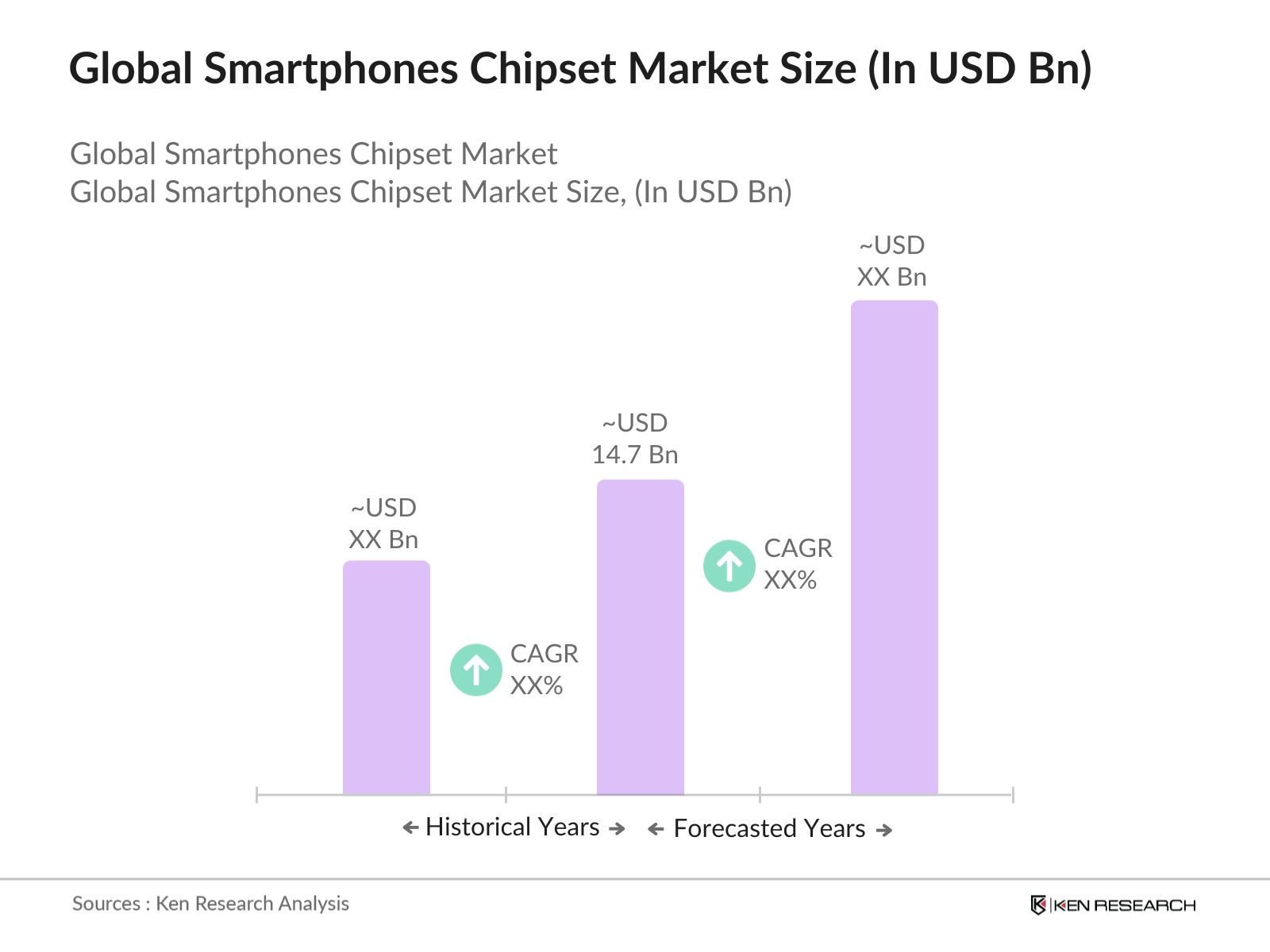
  • The Global Smartphone Chipset Market was valued at USD 14.7 billion in 2023. The market is primarily driven by the increasing adoption of 5G technology, the proliferation of artificial intelligence (AI)- driven applications, and rising demand for high-performance, energy-efficient smartphones.
  • Major players in the smartphone chipset market include Qualcomm Technologies, MediaTek, Apple Inc., Samsung Electronics, and HiSilicon Technologies. These companies are at the forefront of developing innovative chipsets with advanced AI capabilities and 5G connectivity, helping to meet the growing demand for faster, more efficient smartphones.
  • Qualcomm Technologies launched the Snapdragon 8 Gen 2 chipset in 2023, designed for premium smartphones with enhanced AI-driven performance and gaming experiences. Apple Inc. introduced the A17 Bionic chip, setting a new standard for AI integration and power efficiency in mobile devices.
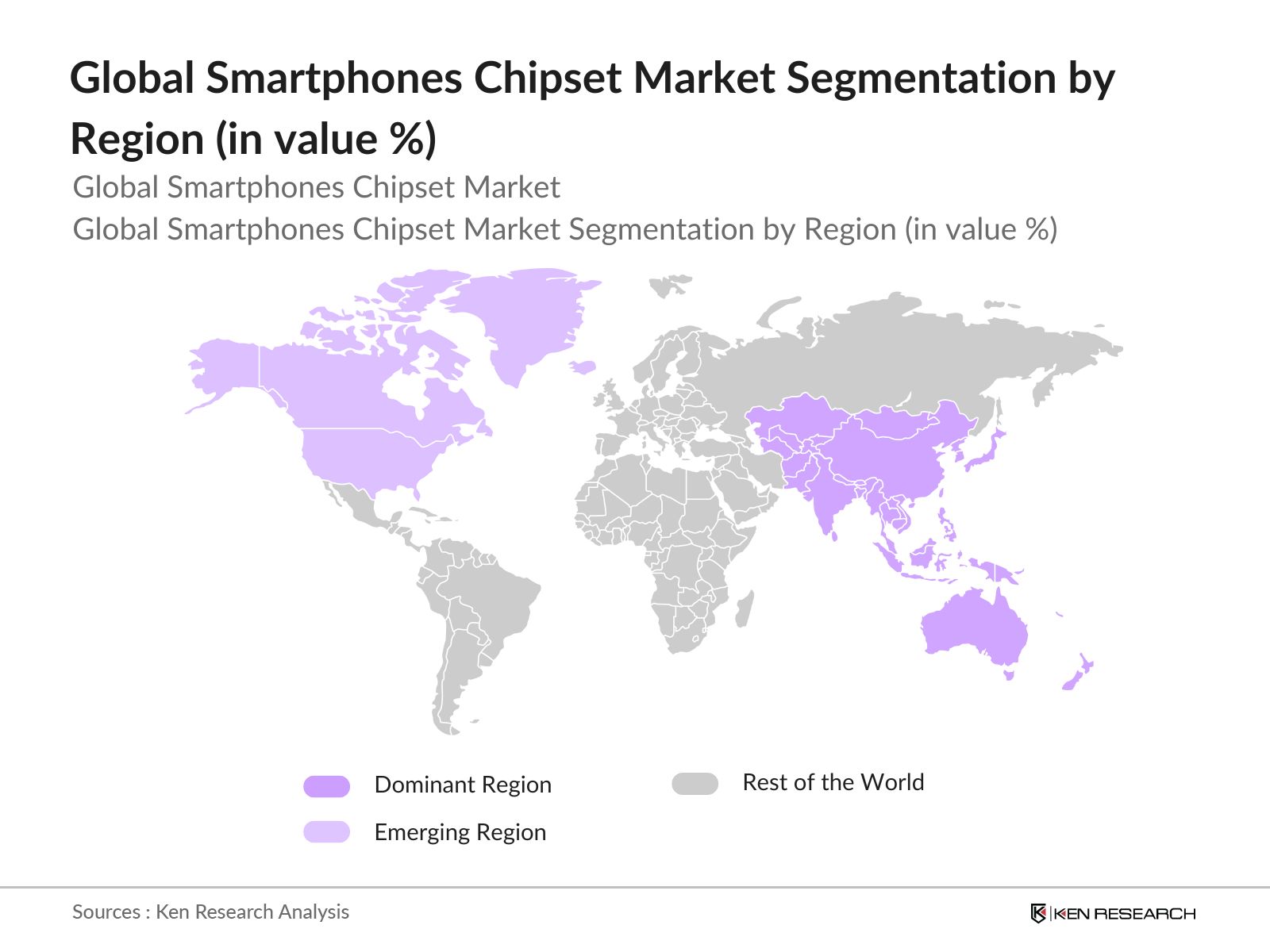
  • In 2023, Asia-Pacific dominated the global smartphone chipset market, driven by its position as the largest manufacturer of smartphones, especially in China, South Korea, and Taiwan. North America followed, with high consumer demand for premium smartphones and advancements in 5G technology fueling growth.

Global Smartphones Chipset Market Size

Global Smartphones Chipset Market Segmentation

The Global Smartphones Chipset Market is segmented by chipset type, application, technology, and region.
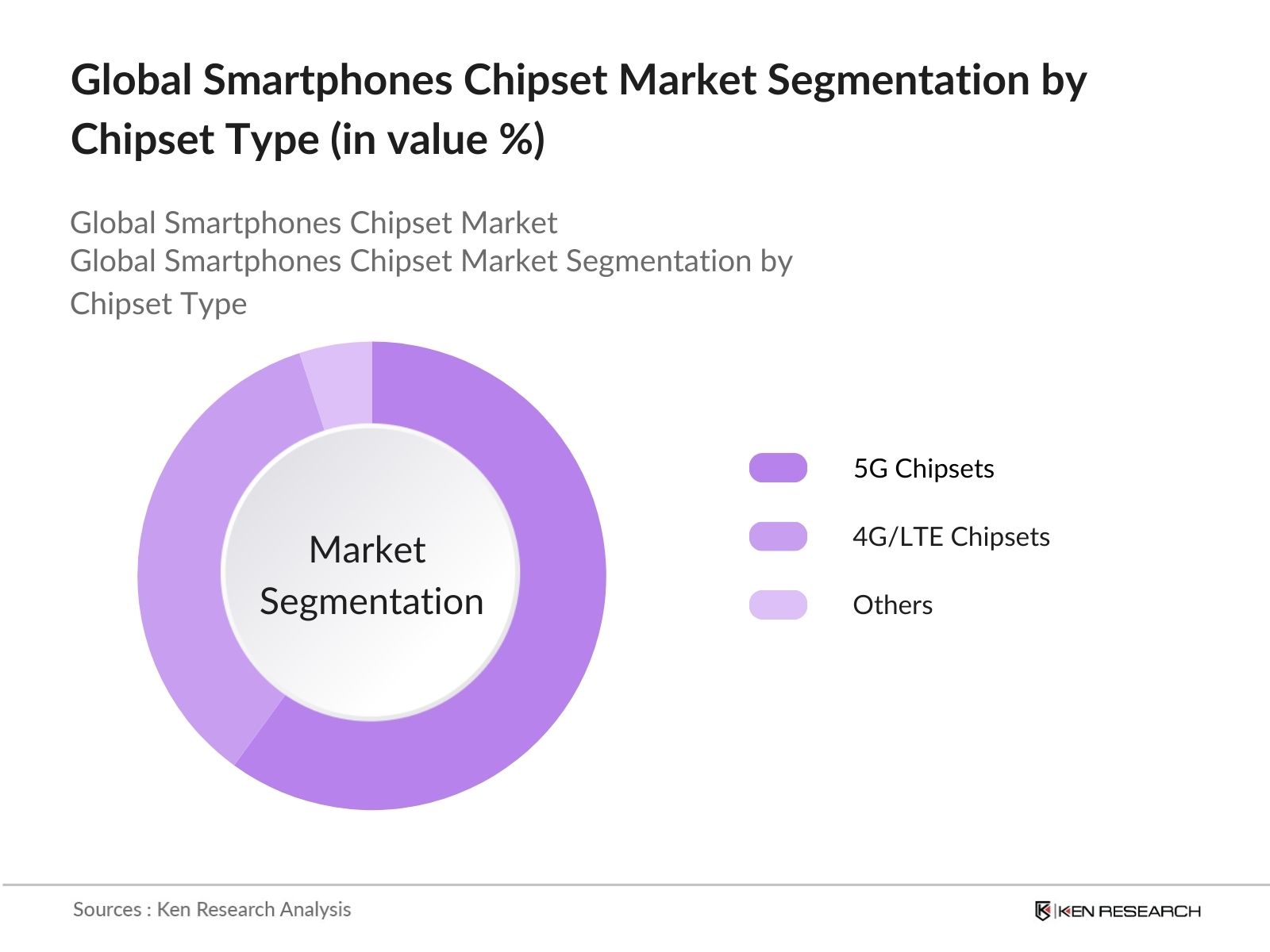
  • By Chipset Type: The market is segmented into 5G Chipsets, 4G/LTE Chipsets, and Others. In 2023, 5G chipsets held the largest market share due to the increasing deployment of 5G networks globally, particularly in regions like North America, Europe, and Asia-Pacific.

Global Smartphones Chipset Market segmentation by chipset type

  • By Technology: The market is segmented into AI-Based Chipsets, Energy-Efficient Chipsets, and High-Performance Gaming Chipsets. In 2023, AI-based chipsets held the largest share as smartphones increasingly incorporate AI-driven functionalities like facial recognition, voice assistants, and smart camera features.
  • By Region: The market is segmented into North America, Europe, Asia-Pacific, Latin America, and Middle East & Africa. In 2023, Asia-Pacific held the largest market share, driven by its strong position in smartphone manufacturing and growing consumer demand for high-tech devices.

Global Smartphones Chipset Market Segmentation by Region

Global Smartphones Chipset Market Competitive Landscape

Company Name

Establishment Year

Headquarters

Qualcomm Technologies

1985

California, USA

MediaTek

1997

Hsinchu, Taiwan

Apple Inc.

1976

California, USA

Samsung Electronics

1969

Suwon, South Korea

HiSilicon Technologies

2004

Shenzhen, China

  • Apple Inc.: Apple's A17 Bionic chip, launched on September 12, 2023, powers the iPhone 15 Pro and Pro Max. Built on a 3nm process, it features 19 billion transistors, a 6-core CPU, and a 6-core GPU, enhancing performance, efficiency, and machine learning capabilities in smartphones.
  • MediaTek: MediaTek unveiled its flagship Dimensity 9300 chipset on November 6, 2023. Built on a 4nm process, it features a 3.25GHz Cortex-X4 core, three Cortex-X4 cores, and four Cortex-A720 cores. The chip supports 8K video recording, 320MP cameras, and hardware-based generative AI capabilities, enhancing smartphone performance substantially.

Global Smartphones Chipset Market Analysis

Global Smartphones Chipset Market Growth Drivers:

  • 5G Expansion and Adoption: The global rollout of 5G networks is a major driver of chipset demand. As of early 2024, over 315 wireless service providers have deployed 5G networks worldwide, indicating strong momentum in the rollout and adoption of this technology.
  • AI Integration in Smartphones: AI integration is transforming smartphones, with 28% of new smartphones projected to be generative AI-capable by 2025. This shift is driven by advancements in chipset technologies and growing consumer demand for AI features, enhancing user experiences through smarter, more intuitive devices.
  • Rising Demand for High-Performance Gaming: The popularity of mobile gaming is impacting chipset demand. The Gen AI smartphone segment is expected to grow by 364% year-over-year in 2024, highlighting the need for chipsets that can handle advanced graphics and gaming applications effectively, particularly in regions like Asia-Pacific.

Global Smartphones Chipset Market Challenges:

  • Supply Chain Disruptions: Ongoing semiconductor shortages have severely impacted production, with lead times extending beyond 40 weeks for basic semiconductors and over 52 weeks for high-end components. Labour shortages have left the U.S. semiconductor industry short by 70,000 to 90,000 skilled workers as of 2023.
  • High Research & Development Costs: The development of advanced chipsets requires R&D investment, with companies like Intel and Micron committing $35 billion collectively to expand production capabilities. This high cost of innovation can limit market entry for smaller players, making it challenging for them to secure necessary funding.

Global Smartphones Chipset Market Government Initiatives:

  • US CHIPS Act: In 2022, the US government passed the CHIPS Act, allocating $52.7 billion to support domestic semiconductor manufacturing. This initiative aims to reduce reliance on foreign suppliers and bolster the US semiconductor industry, which is critical for national security and technological leadership.
  • Chinas 14th Five-Year Plan: China's 14th Five-Year Plan aims to increase self-sufficiency in semiconductor production, targeting 70% domestic chipset production by 2025. This initiative is expected to enhance China's technological capabilities and boost the global supply of smartphone chipsets, reducing dependency on foreign technology and suppliers.

Global Smartphones Chipset Market Future Market Outlook

The Global smartphone chipset market is expected to grow substantially over the next five years, driven by the increasing adoption of 5G technology, the integration of AI capabilities, and continuous innovations in chipset manufacturing.

Future Market Trends:

  • AI-Driven Chipsets: AI-enabled chipsets are expected to grow substantially as smartphones increasingly rely on machine learning for enhanced user experiences. AI chips outperform general-purpose chips in tasks like image recognition and natural language processing, making them crucial for the next generation of smart devices.
  • Foldable and Modular Smartphones: The rise of foldable smartphones is anticipated to drive demand for specialized chipsets that support flexible displays and modular hardware configurations. This trend is particularly evident in the premium smartphone segment, where manufacturers are innovating to create versatile devices.

Scope of the Report

By Chipset Type

5G Chipsets

4G/LTE Chipsets

Others

By Application

Consumer Electronics

Telecommunications

IT Infrastructure

Others

By Technology

AI-Based Chipsets

Energy-Efficient Chipsets

High-Performance Gaming Chipsets

By Region

North America

Europe

Asia-Pacific

Latin America

Middle East & Africa

Products

Key Target Audience Organizations and Entities Who Can Benefit by Subscribing This Report:

  • Government and Regulatory Bodies

  • Banks and Financial Institutes

  • Investors and Venture Capitalists

  • Semiconductor Manufacturers

  • Smartphone Manufacturers

  • Telecom Companies

Time Period Captured in the Report

  • Historical Period: 2018-2023

  • Base Year: 2023

  • Forecast Period: 2023-2028

Companies


Players Mentioned in the Report:

  • Qualcomm Technologies

  • MediaTek

  • Apple Inc.

  • Samsung Electronics

  • HiSilicon Technologies

  • Intel Corporation

  • Broadcom Inc.

  • Nvidia Corporation

  • UNISOC

  • Spreadtrum Communications

  • Marvell Technology Group

  • AMD (Advanced Micro Devices)

  • Texas Instruments

  • STMicroelectronics

  • Micron Technology

Table of Contents

1. Global Smartphones Chipset Market Overview

1.1. Definition and Scope

1.2. Market Taxonomy (Product Type, Application, Technology, Region)

1.3. Market Growth Rate and Trends

1.4. Overview of Key Market Developments

2. Global Smartphones Chipset Market Size (in USD billion)

2.1. Historical Market Size

2.2. Year-on-Year Growth Analysis

2.3. Key Market Milestones and Achievements

2.4. Current Market Valuation

3. Global Smartphones Chipset Market Analysis

3.1. Growth Drivers

3.1.1. Expansion of 5G Networks

3.1.2. AI Integration in Smartphones

3.1.3. Increasing Demand for High-Performance Chipsets (Gaming and Energy Efficiency)

3.2. Restraints

3.2.1. Semiconductor Supply Chain Disruptions

3.2.2. High R&D Costs

3.2.3. Regulatory Challenges

3.3. Opportunities

3.3.1. Emerging Markets for Smartphones

3.3.2. Technological Innovations in Chip Manufacturing

3.3.3. AI-Driven Chipsets and Machine Learning Expansion

3.4. Market Trends

3.4.1. Rise of Foldable and Modular Smartphones

3.4.2. Increased Adoption of Energy-Efficient Technologies

3.4.3. Growth in Mobile Gaming Chipset Demand

3.5. SWOT Analysis (Strengths, Weaknesses, Opportunities, Threats)

3.6. Government Initiatives and Support

3.6.1. U.S. CHIPS Act and Its Impact

3.6.2. China's 14th Five-Year Plan

4. Global Smartphones Chipset Market Segmentation

4.1. By Chipset Type (in Value %)

4.1.1. 5G Chipsets

4.1.2. 4G/LTE Chipsets

4.1.3. Others

4.2. By Technology (in Value %)

4.2.1. AI-Based Chipsets

4.2.2. Energy-Efficient Chipsets

4.2.3. High-Performance Gaming Chipsets

4.3. By Application (in Value %)

4.3.1. Consumer Electronics

4.3.2. Telecommunications

4.3.3. IT Infrastructure

4.3.4. Others

4.4. By Region (in Value %)

4.4.1. North America

4.4.2. Europe

4.4.3. Asia-Pacific

4.4.4. Latin America

4.4.5. Middle East & Africa

5. Global Smartphones Chipset Market Competitive Landscape

5.1. Market Share Analysis (in %)

5.2. Strategic Initiatives

5.2.1. Product Launches

5.2.2. Mergers and Acquisitions

5.2.3. Joint Ventures and Partnerships

5.3. Competitive Benchmarking (Revenue, R&D Expenditure, Global Reach)

5.4. Company Profiles and Developments

5.4.1. Qualcomm Technologies

5.4.2. MediaTek

5.4.3. Apple Inc.

5.4.4. Samsung Electronics

5.4.5. HiSilicon Technologies

5.4.6. Intel Corporation

5.4.7. Broadcom Inc.

5.4.8. Nvidia Corporation

5.4.9. UNISOC

5.4.10. Spreadtrum Communications

5.4.11. Marvell Technology Group

5.4.12. AMD (Advanced Micro Devices)

5.4.13. Texas Instruments

5.4.14. STMicroelectronics

5.4.15. Micron Technology

6. Global Smartphones Chipset Market Financial and Investment Landscape

6.1. Investment Analysis

6.1.1. Venture Capital Funding

6.1.2. Government Grants

6.1.3. Private Equity Investments

6.2. R&D Expenditure of Key Players (20182028)

6.3. Investment Trends in Semiconductor Manufacturing

7. Global Smartphones Chipset Market Regulatory Framework

7.1. Environmental Regulations and Impact on Chipset Manufacturing

7.2. Semiconductor Certification Standards (ISO, RoHS Compliance)

7.3. Global Trade Policies and Impact on Supply Chains

8. Global Smartphones Chipset Market Future Market Size (in USD billion)

8.1. Projected Market Size

8.2. Key Factors Driving Future Market Growth

8.3. Emerging Markets and Growth Opportunities

9. Global Smartphones Chipset Market Future Market Segmentation

9.1. By Chipset Type (in Value %)

9.2. By Application (in Value %)

9.3. By Technology (in Value %)

9.4. By Region (in Value %)

10. Global Smartphones Chipset Market Analysts Recommendations

10.1. TAM/SAM/SOM Analysis (Total Available Market, Serviceable Available Market, Serviceable Obtainable Market)

10.2. Customer Cohort Analysis (Consumer Preferences and Segment-Specific Insights)

10.3. Key Marketing Initiatives

10.4. White Space Opportunity Analysis

Disclaimer Contact Us

Research Methodology

Step: 1 Identifying Key Variables

Ecosystem creation for all the major entities and referring to multiple secondary and proprietary databases to perform desk research around the market to collate market-level information.

Step: 2 Market Building

Collating statistics on the Global Smartphones Chipset market over the years and analyzing the penetration of products as well as the ratio of suppliers to compute the revenue generated for the market. We will also review product quality statistics to ensure accuracy behind the data points shared.

Step: 3 Validating and Finalizing

Building market hypotheses and conducting CATIs with market experts from different companies to validate statistics and seek operational and financial information from company representatives.

Step: 4 Research Output

Our research team approaches multiple smartphone manufacturers and chipset suppliers to understand product segments, sales trends, consumer preferences, and other parameters. This supports us in validating the statistics derived from the bottom-up approach of these smartphone manufacturers and chipset suppliers.

Frequently Asked Questions

01. How big is the Global Smartphones Chipset Market?

The Global Smartphones Chipset Market was valued at USD 14.7 billion in 2023, driven by the increasing demand for 5G and AI-enabled smartphones.

02. Who are the major players in the Global Smartphones Chipset market?

The major players in the Global Smartphones Chipset Market include Qualcomm Technologies, MediaTek, Apple Inc., Samsung Electronics, and HiSilicon Technologies, leading the market with innovative chipset solutions.

03. What are the growth drivers of the Global Smartphones Chipset market?

Key growth drivers of the Global Smartphones Chipset Market include the increasing demand for 5G-enabled devices, the growing integration of AI-driven features, and the expansion of mobile gaming applications.

04. What are the Global Smartphones Chipset market challenges?

Global Smartphones Chipset Market challenges include supply chain disruptions, semiconductor shortages, and the high cost of research and development for advanced chipsets.

Why Buy From Us?

RRR
Refine Robust Result (RRR) Framework

What makes us stand out is that our consultants follows Robust, Refine and Result (RRR) methodology. i.e. Robust for clear definitions, approaches and sanity checking, Refine for differentiating respondents facts and opinions and Result for presenting data with story

Our Reach Is Unmatched

We have set a benchmark in the industry by offering our clients with syndicated and customized market research reports featuring coverage of entire market as well as meticulous research and analyst insights.

Research
Shifting the Research Paradigm

While we don't replace traditional research, we flip the method upside down. Our dual approach of Top Bottom & Bottom Top ensures quality deliverable by not just verifying company fundamentals but also looking at the sector and macroeconomic factors.

Insite
More Insights-Better Decisions

With one step in the future, our research team constantly tries to show you the bigger picture. We help with some of the tough questions you may encounter along the way: How is the industry positioned? Best marketing channel? KPI's of competitors? By aligning every element, we help maximize success.

Trust
Transparency and Trust

Our report gives you instant access to the answers and sources that other companies might choose to hide. We elaborate each steps of research methodology we have used and showcase you the sample size to earn your trust.

support
Round the Clock Support

If you need any support, we are here! We pride ourselves on universe strength, data quality, and quick, friendly, and professional service.

Why Client Choose Us?

400000+ Reports in repository
150+ Consulting project a year
100+ Analysts
8000+ Client Queries in 2022