















Global Smokeless Grill Market Outlook to 2030
Region:Global
Author(s):Shambhavi
Product Code:KROD4857
December 2024
85
About the Report
Global Smokeless Grill Market Overview
- The Global Smokeless Grill Market was valued at USD 620 Million in 2023, driven by the rising consumer demand for indoor grilling solutions that minimize smoke emissions, especially in urban areas where traditional grilling may be impractical. The market has expanded due to the growing popularity of compact, indoor-friendly appliances and advancements in smoke reduction technology. Companies like Philips and George Foreman have led innovations, enhancing functionality and accessibility for consumers. Furthermore, rising health consciousness has spurred demand for smokeless cooking solutions, as consumers prefer healthier cooking methods.
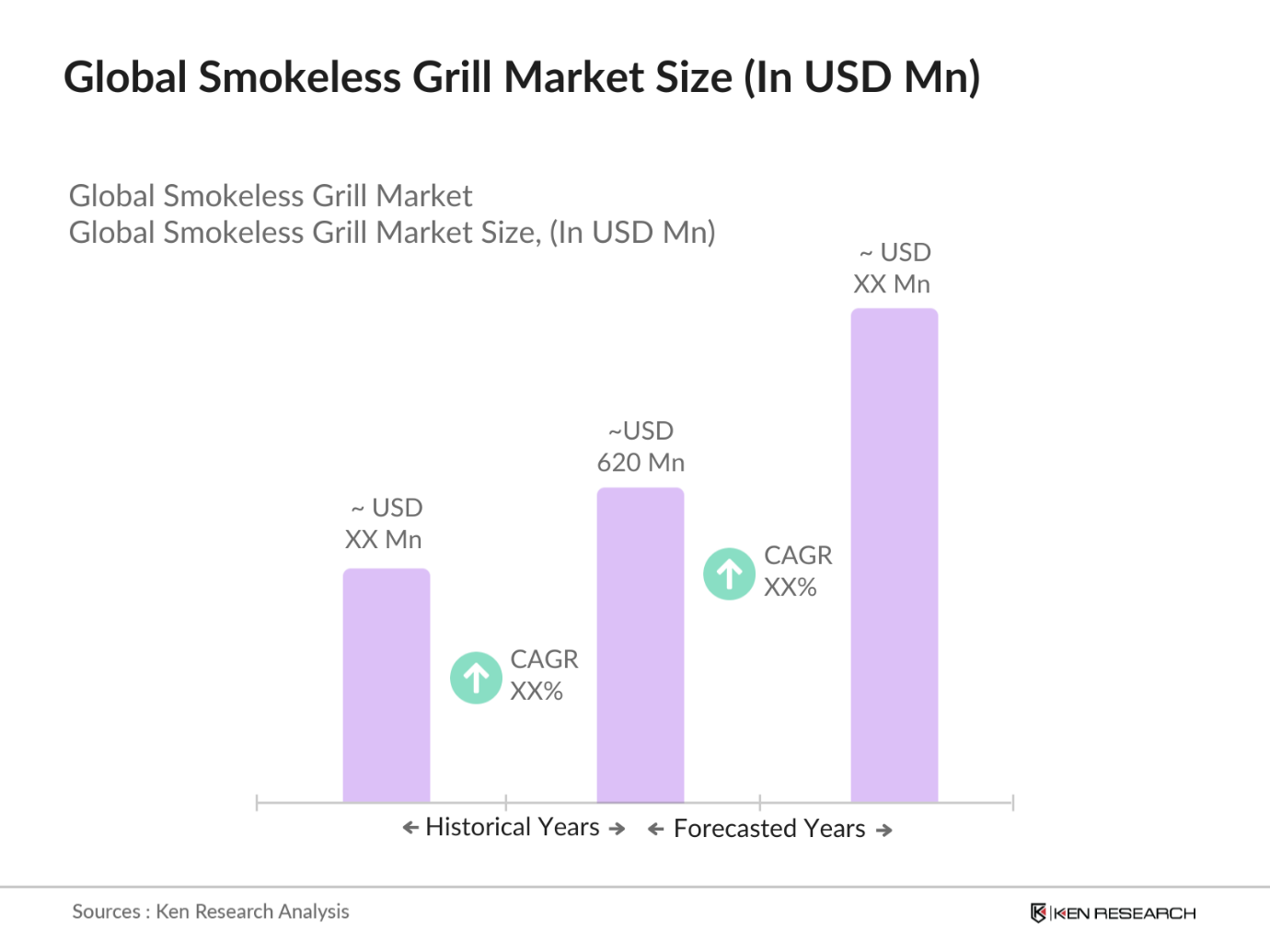
- The market dominance is notable in North America and East Asia, where urbanization and compact housing conditions favor indoor, low-emission grilling solutions. The United States, Japan, and South Korea are particularly strong markets, with consumers valuing convenience and home-based leisure activities. Urban households in these regions are inclined toward convenient cooking appliances, driven by limited outdoor space and strict air quality regulations that make traditional grilling less feasible.
- Smokeless grills must comply with international safety standards, particularly for electrical safety and indoor use. These certifications ensure the safety and reliability of the devices but add to compliance costs for manufacturers. Regulatory bodies enforce these standards strictly to reduce fire hazards and other risks, impacting manufacturing timelines and costs. Compliance with safety certifications is crucial to gaining consumer trust and market entry, especially in regions with strict product standards.
Global Smokeless Grill Market Segmentation
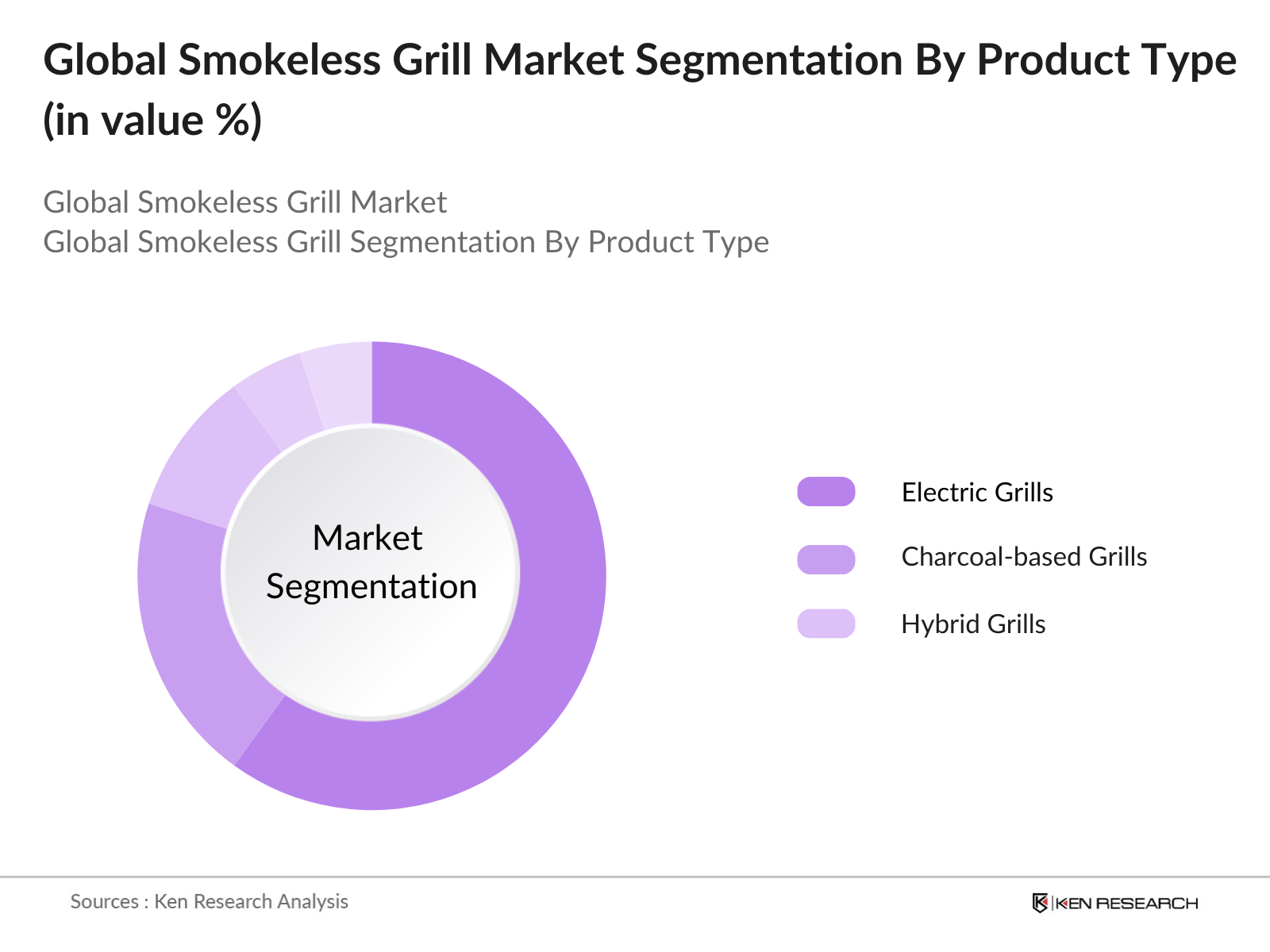
- By Product Type: The Global Smokeless Grill Market is segmented by product type into electric grills, charcoal-based smokeless grills, and hybrid grills. Recently, electric grills hold the dominant market share under the product type segmentation due to their convenience, easy temperature control, and suitability for indoor use. Unlike charcoal and hybrid models, electric grills have a plug-and-play functionality that requires minimal maintenance, making them ideal for urban households. Brands like George Foreman and Hamilton Beach have established a strong foothold in the electric grill segment, with products designed to minimize smoke while providing authentic grill flavor.
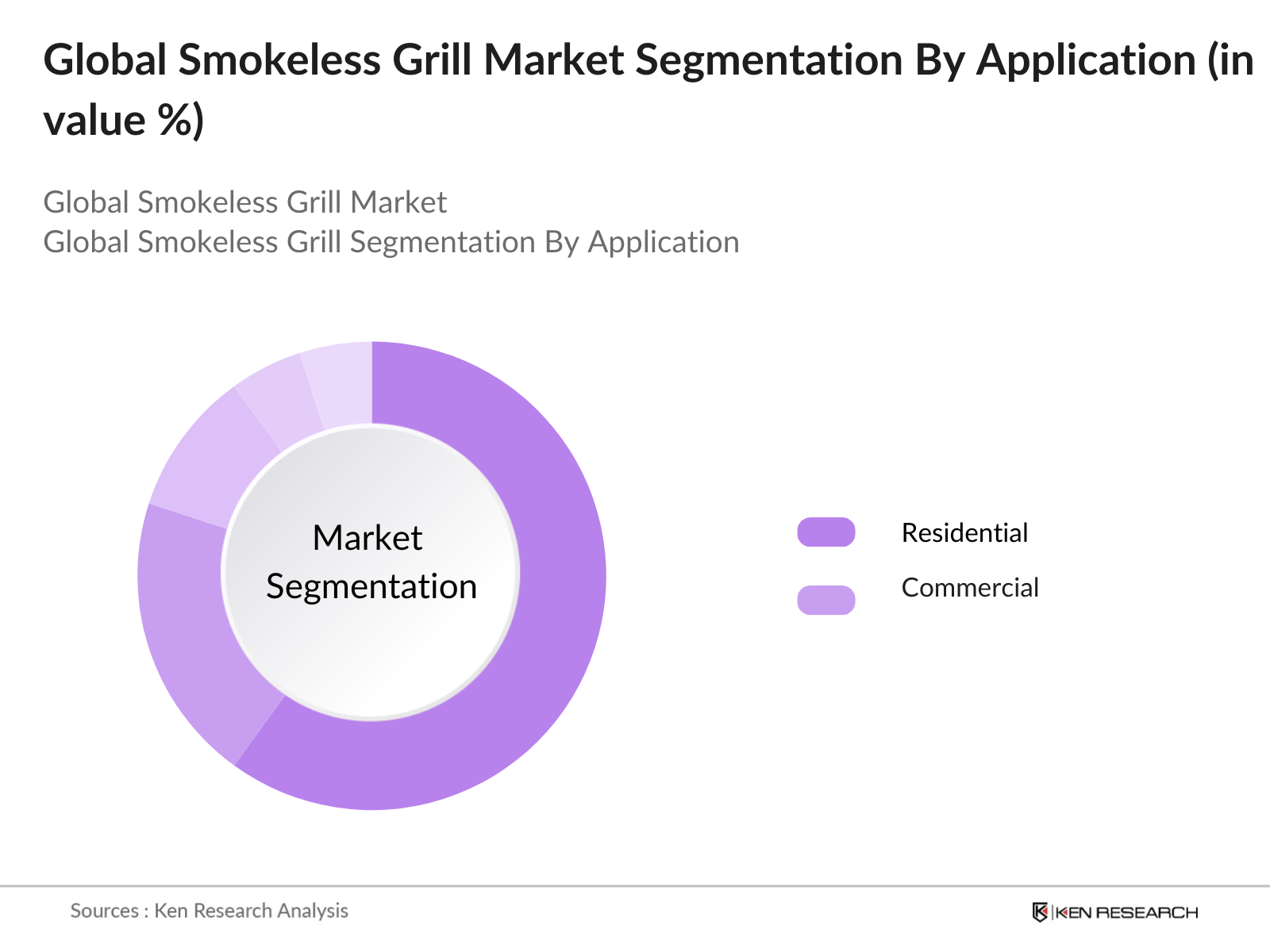
- By Application: The market is also segmented by application into residential and commercial sectors. The residential segment leads in market share, largely due to a rise in at-home cooking trends fueled by the pandemic and a growing preference for indoor grilling solutions among urban dwellers. Many consumers are investing in smokeless grills for healthier home-cooked meals without the hassle of outdoor setups. In contrast, the commercial segment, though smaller, is gaining momentum, particularly in the hospitality industry, where hotels and catering services are adopting smokeless grills to enhance guest experiences.
Global Smokeless Grill Market Competitive Landscape
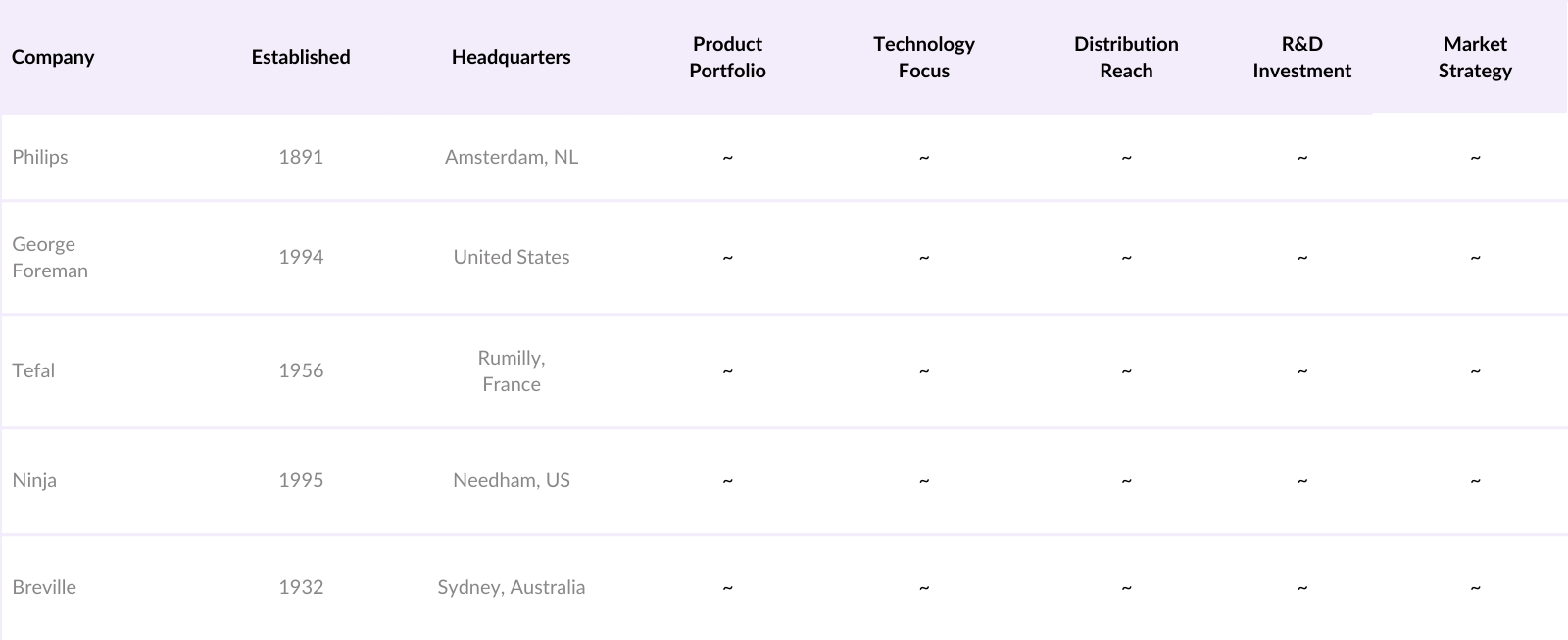
The Global Smokeless Grill Market is characterized by a few major players who dominate the landscape. Leading companies, including Philips and George Foreman, have established their brand presence through innovation and extensive marketing efforts. Their dominance reflects the industry's consolidation, where established brands set the pace for technological advancements.
Global Smokeless Grill Market Analysis
Growth Drivers
- Indoor Grilling Trend: Increasing urbanization has led to a surge in demand for compact and efficient kitchen appliances. In 2024, over 4.4 billion people globally live in urban areas. This urban lifestyle trend is driving the adoption of indoor, space-saving cooking appliances like smokeless grills. As more consumers seek convenient and clean cooking solutions that align with limited space and high-rise living, smokeless grills are becoming a preferred choice for urban households, especially in North America and Europe, where apartment living is prevalent.
- Rising Health Awareness: Growing awareness about health and wellness is boosting the demand for smokeless grills, which offer a healthier grilling alternative by reducing oil and smoke residue. Air pollution contributes to millions of respiratory-related issues each year, underscoring a strong case for cleaner cooking solutions. This shift towards health-conscious cooking methods, especially in regions where grilled foods are popular, supports the increased adoption of smokeless grills, as they offer low-fat cooking options by removing excess grease and providing a clean cooking environment.
- Demand for Smoke-Free Kitchens: As more urban areas implement stricter indoor air quality regulations, there is a rising demand for cooking devices that reduce indoor smoke emissions. Over 87% of urban households in the U.S. use ventilation or air quality measures indoors, which aligns with smokeless grill technology. This demand for low-emission kitchen appliances has boosted the adoption of smokeless grills as an alternative to traditional grilling, especially in densely populated areas where indoor pollution is a growing concern.
Challenges
- Product Cost Limitations: The cost of smokeless grills can be a barrier for some consumers, particularly in developing markets. High-quality smokeless grills incorporate advanced technology like infrared and ceramic heating, which drives up production costs. This makes them less accessible to price-sensitive markets where traditional cooking methods are more affordable. The market faces the challenge of balancing technological advancements with affordability to expand consumer reach in diverse economic regions.
- Limited Awareness in Emerging Markets: While smokeless grills are popular in developed economies, awareness and accessibility remain low in many emerging markets. Limited marketing, lack of product knowledge, and price sensitivity can restrict the adoption of smokeless grills in regions where outdoor grilling or traditional stoves are prevalent. To grow in these markets, manufacturers need to invest in consumer education and create affordable product lines that appeal to a broader demographic.
Global Smokeless Grill Market Future Outlook
Over the next five years, the Global Smokeless Grill Market is expected to experience sustained growth driven by technological advancements in smokeless grilling, rising consumer preference for healthier cooking options, and increasing product availability in emerging markets. The trend of compact and user-friendly home appliances continues to grow, particularly in regions with high urbanization rates, where outdoor grilling is limited. Additionally, the development of advanced grill models with improved smoke control features is anticipated to attract new consumers in both residential and commercial sectors.
Market Opportunities
- Expansion in Residential Markets: With increasing demand for convenient, health-conscious cooking solutions, smokeless grills have significant growth potential in residential markets. As urbanization accelerates and apartment living rises, more consumers are choosing appliances that reduce smoke and fit compact kitchen spaces. Residential demand is also influenced by the rise in work-from-home culture, encouraging consumers to invest in appliances that support healthy cooking options at home.
- Growth in Commercial Food Sector: The restaurant industry, particularly in urban centers, is turning to smokeless grills to enhance customer dining experiences without compromising indoor air quality. Fast-casual dining chains and smaller food outlets are adopting smokeless grills to comply with local air quality standards and offer healthier food preparation options. This trend represents an opportunity for smokeless grill manufacturers to develop commercial-grade products that cater to restaurants and cafes seeking to meet customer demand for healthier, smoke-free environments.
Scope of the Report
|
Segment |
Sub-Segment |
|
By Product Type |
Electric Smokeless Grills; Gas-Based Smokeless Grills; Charcoal-Based Smokeless Grills |
|
By Distribution Channel |
Online Retail; Offline Retail |
|
By Application |
Residential; Commercial |
|
By Component |
Grilling Surface; Heating Element; Smoke Extraction Fan; Temperature Control System |
|
By Region |
North America; Europe; Asia Pacific; Latin America; Middle East & Africa |
Products
Key Target Audience
Investors and Venture Capitalist Firms
Government and Regulatory Bodies (e.g., EPA, Department of Energy)
Residential and Commercial Appliance Distributors
Health and Wellness Retail Chains
Kitchen Appliance Manufacturers
Technology Innovators in Home Appliances
Hospitality Industry Stakeholders
Consumer Goods E-commerce Platforms
Companies
Players mentioned in report
Philips
George Foreman
Tefal
Ninja
Breville
Hamilton Beach
Weber
Char-Broil
Cuisinart
Kenyon
PowerXL
Kalorik
Zojirushi
Jumbuck
GreenPan
Table of Contents
1. Global Smokeless Grill Market Overview
1.1 Definition and Scope
1.2 Market Taxonomy
1.3 Market Dynamics Overview
1.4 Market Segmentation Overview
2. Global Smokeless Grill Market Size (In USD Bn)
2.1 Historical Market Size
2.2 Year-On-Year Growth Analysis
2.3 Key Developments and Milestones
3. Global Smokeless Grill Market Analysis
3.1 Growth Drivers
3.1.1 Indoor Grilling Trend
3.1.2 Rising Health Awareness
3.1.3 Demand for Smoke-Free Kitchens
3.1.4 Technological Advancements
3.2 Market Challenges
3.2.1 Product Cost Limitations
3.2.2 Limited Awareness in Emerging Markets
3.2.3 High Power Consumption
3.3 Opportunities
3.3.1 Expansion in Residential Markets
3.3.2 Growth in Commercial Food Sector
3.3.3 Government Support for Healthy Cooking Alternatives
3.4 Trends
3.4.1 Integration with Smart Kitchen Systems
3.4.2 Enhanced Energy Efficiency Standards
3.4.3 Increased Consumer Preference for Portable Grills
3.5 Government Regulations
3.5.1 Safety Certifications
3.5.2 Energy Efficiency Regulations
3.5.3 Emission Standards
3.6 SWOT Analysis
3.7 Value Chain Analysis
3.8 Porters Five Forces Analysis
3.9 Competitive Ecosystem
4. Global Smokeless Grill Market Segmentation
4.1 By Product Type
4.1.1 Electric Smokeless Grills
4.1.2 Gas-Based Smokeless Grills
4.1.3 Charcoal-Based Smokeless Grills
4.2 By Distribution Channel
4.2.1 Online Retail
4.2.2 Offline Retail
4.3 By Application
4.3.1 Residential
4.3.2 Commercial
4.4 By Component
4.4.1 Grilling Surface
4.4.2 Heating Element
4.4.3 Smoke Extraction Fan
4.4.4 Temperature Control System
4.5 By Region
4.5.1 North America
4.5.2 Europe
4.5.3 Asia Pacific
4.5.4 Latin America
4.5.5 Middle East & Africa
5. Global Smokeless Grill Market Competitive Analysis
5.1 Profiles of Major Companies
5.1.1 Philips
5.1.2 Hamilton Beach
5.1.3 Tefal
5.1.4 George Foreman Grills
5.1.5 Breville
5.1.6 Ninja Kitchen
5.1.7 Zojirushi
5.1.8 Cuisinart
5.1.9 Char-Broil
5.1.10 Kitchen + Home
5.1.11 Gotham Steel
5.1.12 Presto
5.1.13 Maxi-Matic
5.1.14 Klarstein
5.1.15 Hamilton Beach
5.2 Cross Comparison Parameters (Annual Revenue, Employee Count, Global Reach, Production Capacity, R&D Investment, Innovation Index, Brand Reputation, Customer Retention Rate)
5.3 Market Share Analysis
5.4 Strategic Initiatives
5.5 Mergers and Acquisitions
5.6 Investment Analysis
5.7 Venture Capital Funding
5.8 Government Grants
5.9 Private Equity Investments
6. Global Smokeless Grill Market Regulatory Framework
6.1 Product Safety Standards
6.2 Energy Efficiency Certification
6.3 Emission Compliance
7. Global Smokeless Grill Future Market Size (In USD Bn)
7.1 Future Market Size Projections
7.2 Key Factors Driving Future Market Growth
8. Global Smokeless Grill Future Market Segmentation
8.1 By Product Type
8.2 By Application
8.3 By Component
8.4 By Distribution Channel
8.5 By Region
9. Global Smokeless Grill Market Analysts Recommendations
9.1 TAM/SAM/SOM Analysis
9.2 Customer Segment Analysis
9.3 Product Innovation Recommendations
9.4 Emerging Market Entry Strategies
Disclaimer Contact UsResearch Methodology
Step 1: Identification of Key Variables
The initial phase involved mapping the entire smokeless grill market ecosystem, identifying key variables like product types, application areas, and regional trends through in-depth secondary research, proprietary databases, and industry sources to define critical market dynamics.
Step 2: Market Analysis and Construction
In this phase, historical data was analyzed to assess trends in product penetration and revenue generation. This included evaluating the impact of changing consumer preferences on sales and profitability, while validating data accuracy through multiple independent sources.
Step 3: Hypothesis Validation and Expert Consultation
Hypotheses on market trends and growth drivers were developed and tested through expert consultations. Industry insiders, including product managers and market analysts, provided insights on current trends, consumer behavior, and key growth factors in smokeless grilling.
Step 4: Research Synthesis and Final Output
The final phase involved direct interaction with industry stakeholders to validate product segmentation, technology trends, and market challenges. This phase ensured that all data points reflected real-world market conditions, supporting a thorough, validated analysis.
Frequently Asked Questions
01. How big is the Global Smokeless Grill Market?
The Global Smokeless Grill Market was valued at approximately USD 620 Million in 2023, driven by urbanization, advancements in smoke reduction technologies, and a growing preference for indoor-friendly grilling solutions.
02. What are the challenges in the Global Smokeless Grill Market?
Key challenges include high competition among established brands, the cost of advanced technologies for smoke control, and regulatory standards regarding indoor appliance safety. Additionally, premium pricing for high-quality products limits market accessibility.
03. Who are the major players in the Global Smokeless Grill Market?
Leading players include Philips, George Foreman, Tefal, and Ninja. These brands maintain strong positions due to their technological innovations, brand presence, and diversified product portfolios.
04. What drives the growth of the Global Smokeless Grill Market?
Growth drivers include increased urbanization, consumer preference for home-cooked, healthy meals, and the demand for compact cooking appliances that can be safely used indoors without smoke concerns.
05. Which regions dominate the Global Smokeless Grill Market?
North America and East Asia are leading regions due to high urbanization, compact housing structures, and a focus on convenient cooking solutions. These factors make smokeless grills popular, particularly in the US, Japan, and South Korea.
06. How are smokeless grills used in the commercial sector?
In the commercial sector, smokeless grills are gaining traction in hospitality, particularly within hotels and catering services, where they provide a high-quality cooking experience without outdoor grilling setups.
Why Buy From Us?

What makes us stand out is that our consultants follows Robust, Refine and Result (RRR) methodology. i.e. Robust for clear definitions, approaches and sanity checking, Refine for differentiating respondents facts and opinions and Result for presenting data with story

We have set a benchmark in the industry by offering our clients with syndicated and customized market research reports featuring coverage of entire market as well as meticulous research and analyst insights.

While we don't replace traditional research, we flip the method upside down. Our dual approach of Top Bottom & Bottom Top ensures quality deliverable by not just verifying company fundamentals but also looking at the sector and macroeconomic factors.

With one step in the future, our research team constantly tries to show you the bigger picture. We help with some of the tough questions you may encounter along the way: How is the industry positioned? Best marketing channel? KPI's of competitors? By aligning every element, we help maximize success.

Our report gives you instant access to the answers and sources that other companies might choose to hide. We elaborate each steps of research methodology we have used and showcase you the sample size to earn your trust.

If you need any support, we are here! We pride ourselves on universe strength, data quality, and quick, friendly, and professional service.