
Global Soccer Ball Market Outlook to 2030
Global Soccer Ball Market: Trends, Segmentation & Future Outlook 2019–2030
Region:Global
Author(s):Sanjeev
Product Code:KROD2073
November 2024
81
About the Report
```html
Global Soccer Ball Market Overview
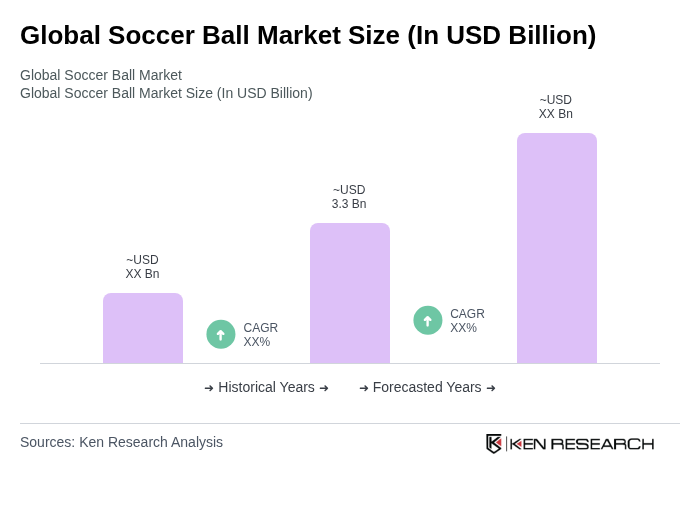
- The Global Soccer Ball Market is valued at USD 3.3 billion, based on a five-year historical analysis. This growth is primarily driven by the increasing popularity of soccer worldwide, coupled with rising participation rates in youth and amateur leagues. The demand for high-quality soccer balls, especially during major tournaments, has significantly contributed to market expansion. Additionally, technological advancements such as smart soccer balls equipped with performance-tracking sensors have revolutionized player training and performance analysis capabilities.
- Countries such as the United States, Germany, Brazil, and Spain dominate the market due to their strong soccer culture, extensive youth programs, and professional leagues. These nations have a well-established infrastructure for soccer, including training facilities and academies, which fosters a large consumer base for soccer-related products. The United States alone accounts for approximately 22 percent of global soccer ball consumption, while the Asia-Pacific region, particularly China and India, is emerging as a significant growth driver with China maintaining a production capacity of 5.6 million units and India demonstrating domestic demand for 2 million units annually.
- The European Union has established binding regulatory frameworks to ensure the safety and quality of sports equipment, including soccer balls. These regulations mandate that all soccer balls sold within the EU must meet specific performance and safety standards, promoting consumer confidence and enhancing the overall quality of products in the market.
Global Soccer Ball Market Segmentation
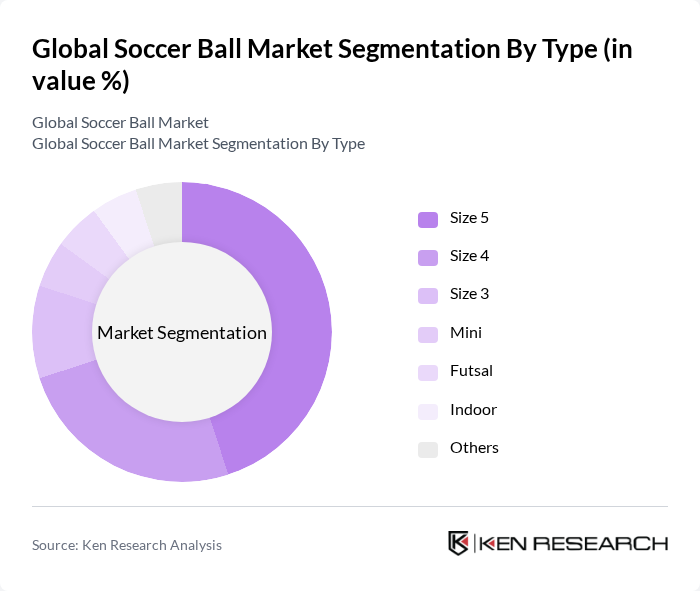
By Type: The market is segmented into various types of soccer balls, including Size 5, Size 4, Size 3, Mini, Futsal, Indoor, and Others. Size 5 soccer balls dominate the market due to their use in professional and competitive matches, making them the preferred choice for players and teams. The increasing participation in youth leagues has also boosted the demand for Size 4 and Size 3 balls, catering to younger players. Mini and Futsal balls are gaining traction as indoor soccer becomes more popular, especially in urban areas.
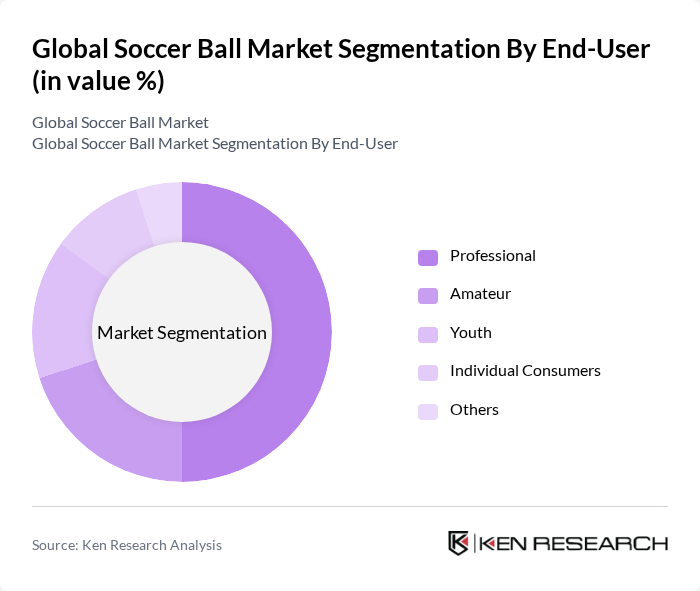
By End-User: The end-user segmentation includes Professional, Amateur, Youth, Individual Consumers, and Others. The Professional segment leads the market, driven by the demand from professional leagues and clubs that require high-quality soccer balls for training and matches. The Amateur and Youth segments are also significant, as grassroots initiatives and youth leagues promote soccer participation. Individual consumers are increasingly purchasing soccer balls for recreational use, contributing to the overall market growth.
Global Soccer Ball Market Competitive Landscape
The Global Soccer Ball Market is characterized by a dynamic mix of regional and international players. Leading participants such as Adidas, Nike, Puma, Umbro, Mitre, Select Sport, Molten, Wilson Sporting Goods, Spalding, Diadora, Kappa, New Balance, Joma, Lotto, Hummel contribute to innovation, geographic expansion, and service delivery in this space.
| Adidas | 1949 | Herzogenaurach, Germany | – | – | – | – | – | – |
| Nike | 1964 | Beaverton, Oregon, USA | – | – | – | – | – | – |
| Puma | 1948 | Herzogenaurach, Germany | – | – | – | – | – | – |
| Umbro | 1924 | Manchester, England | – | – | – | – | – | – |
| Mitre | 1817 | Huddersfield, England | – | – | – | – | – | – |
| Company | Establishment Year | Headquarters | Revenue (USD Million, Latest FY) | YoY Revenue Growth Rate (%) | Market Share (%) | EBITDA Margin (%) | R&D Spend as % of Revenue | Global Market Penetration (# Countries) |
|---|
``````html
Global Soccer Ball Market Industry Analysis
Growth Drivers
- Increasing Popularity of Soccer Globally: The global soccer fan base has reached approximately 4 billion, with significant growth in regions like Asia and Africa. According to FIFA, the number of registered players worldwide has surpassed 270 million, indicating a robust interest in the sport. This surge in popularity drives demand for soccer balls, as more individuals engage in recreational and competitive play, contributing to a projected increase in sales volume in the coming years.
- Rising Participation in Youth Soccer Programs: In the United States alone, youth soccer participation has grown to over 3.5 million players, reflecting a broader trend of increased engagement in youth sports. The National Federation of State High School Associations reported a 12% rise in high school soccer participation from 2019 to 2021. This growing demographic not only boosts immediate sales of soccer balls but also fosters long-term brand loyalty as young players transition into adult consumers.
- Growth of E-commerce Platforms for Sports Goods: E-commerce sales of sports equipment, including soccer balls, have surged, with online retail expected to account for 25% of total sports goods sales in future. According to Statista, the global e-commerce market for sports equipment is projected to reach $120 billion. This shift towards online shopping enhances accessibility for consumers, driving sales and allowing brands to reach a wider audience, particularly in underserved regions.
Market Challenges
- Intense Competition Among Manufacturers: The soccer ball market is characterized by numerous players, including established brands like Adidas and Nike, as well as emerging companies. This competition leads to price wars and reduced profit margins. According to IBISWorld, the industry has seen a 6% annual decline in profit margins over the past five years, as companies strive to differentiate their products in a saturated market, impacting overall profitability.
- Fluctuating Raw Material Prices: The soccer ball manufacturing process relies heavily on materials such as rubber and synthetic leather, whose prices can be volatile. For instance, the price of natural rubber has increased by 35% over the past two years due to supply chain disruptions and increased demand from other industries. This volatility can lead to unpredictable production costs, affecting pricing strategies and profit margins for manufacturers in the soccer ball market.
Global Soccer Ball Market Future Outlook
The future of the soccer ball market appears promising, driven by increasing global participation in soccer and the rise of e-commerce. As sustainability becomes a priority, manufacturers are likely to innovate with eco-friendly materials and production processes. Additionally, the integration of technology into soccer balls, such as performance tracking features, is expected to attract tech-savvy consumers. These trends will likely shape the market landscape, fostering growth and diversification in product offerings.
Market Opportunities
- Expansion into Emerging Markets: Countries in Asia and Africa present significant growth opportunities, with soccer's popularity rising rapidly. For instance, India has seen a 20% increase in soccer participation over the last three years. Targeting these markets with tailored marketing strategies and affordable products can enhance brand presence and drive sales.
- Development of Eco-Friendly Soccer Balls: With increasing consumer awareness of environmental issues, the demand for sustainable products is on the rise. Companies that invest in developing eco-friendly soccer balls using recycled materials can tap into this growing market segment. Research indicates that 65% of consumers are willing to pay a premium for sustainable products, presenting a lucrative opportunity for manufacturers.
```
Scope of the Report
| By Type |
Size 5 Size 4 Size 3 Mini Futsal Indoor Others |
| By End-User |
Professional Amateur Youth Individual Consumers Others |
| By Distribution Channel |
Online/E-commerce Offline/Sport Stores Specialty Stores Hyper/Supermarkets Others |
| By Material |
PU PVC TPU Leather Others |
Products
Key Target Audience
Investors and Venture Capitalist Firms
Government and Regulatory Bodies (e.g., FIFA, UEFA)
Manufacturers and Producers
Distributors and Retailers
Sports Teams and Clubs
Event Organizers and Promoters
Sports Equipment Wholesalers
Advertising and Marketing Agencies
Companies
Players Mentioned in the Report:
Adidas
Nike
Puma
Umbro
Mitre
Select Sport
Molten
Wilson Sporting Goods
Spalding
Diadora
Kappa
New Balance
Joma
Lotto
Hummel
Table of Contents
Market Assessment Phase
1. Executive Summary and Approach
2. Global Soccer Ball Market Overview
2.1 Key Insights and Strategic Recommendations
2.2 Global Soccer Ball Market Overview
2.3 Definition and Scope
2.4 Evolution of Market Ecosystem
2.5 Timeline of Key Regulatory Milestones
2.6 Value Chain & Stakeholder Mapping
2.7 Business Cycle Analysis
2.8 Policy & Incentive Landscape
3. Global Soccer Ball Market Analysis
3.1 Growth Drivers
3.1.1 Increasing popularity of soccer globally
3.1.2 Rising participation in youth soccer programs
3.1.3 Growth of e-commerce platforms for sports goods
3.1.4 Technological advancements in ball manufacturing
3.2 Market Challenges
3.2.1 Intense competition among manufacturers
3.2.2 Fluctuating raw material prices
3.2.3 Counterfeit products in the market
3.2.4 Seasonal demand fluctuations
3.3 Market Opportunities
3.3.1 Expansion into emerging markets
3.3.2 Development of eco-friendly soccer balls
3.3.3 Collaborations with sports organizations
3.3.4 Customization and personalization trends
3.4 Market Trends
3.4.1 Increasing focus on sustainability
3.4.2 Growth of smart soccer balls with technology integration
3.4.3 Rise of online sales channels
3.4.4 Popularity of soccer as a lifestyle brand
3.5 Government Regulation
3.5.1 Compliance with international quality standards
3.5.2 Regulations on material safety
3.5.3 Import/export tariffs affecting pricing
3.5.4 Environmental regulations on manufacturing processes
4. SWOT Analysis
5. Stakeholder Analysis
6. Porter's Five Forces Analysis
7. Global Soccer Ball Market Market Size, 2019-2024
7.1 By Value
7.2 By Volume
7.3 By Average Selling Price
8. Global Soccer Ball Market Segmentation
8.1 By Type
8.1.1 Size 5
8.1.2 Size 4
8.1.3 Size 3
8.1.4 Mini
8.1.5 Futsal
8.1.6 Indoor
8.1.7 Others
8.2 By End-User
8.2.1 Professional
8.2.2 Amateur
8.2.3 Youth
8.2.4 Individual Consumers
8.2.5 Others
8.3 By Distribution Channel
8.3.1 Online/E-commerce
8.3.2 Offline/Sport Stores
8.3.3 Specialty Stores
8.3.4 Hyper/Supermarkets
8.3.5 Others
8.4 By Material
8.4.1 PU
8.4.2 PVC
8.4.3 TPU
8.4.4 Leather
8.4.5 Others
9. Global Soccer Ball Market Competitive Analysis
9.1 Market Share of Key Players
9.2 Cross Comparison of Key Players
9.2.1 Company Name
9.2.2 Revenue (USD Million, Latest FY)
9.2.3 YoY Revenue Growth Rate (%)
9.2.4 Market Share (%)
9.2.5 EBITDA Margin (%)
9.2.6 R&D Spend as % of Revenue
9.2.7 Global Market Penetration (# Countries)
9.2.8 Production Capacity (Million Units)
9.2.9 Brand Value Score (Interbrand Ranking)
9.2.10 Patent Filings (Last 3 Years)
9.3 SWOT Analysis of Top Players
9.4 Pricing Analysis
9.5 Detailed Profile of Major Companies
9.5.1 Adidas
9.5.2 Nike
9.5.3 Puma
9.5.4 Umbro
9.5.5 Mitre
9.5.6 Select Sport
9.5.7 Molten
9.5.8 Wilson Sporting Goods
9.5.9 Spalding
9.5.10 Diadora
9.5.11 Kappa
9.5.12 New Balance
9.5.13 Joma
9.5.14 Lotto
9.5.15 Hummel
10. Global Soccer Ball Market End-User Analysis
10.1 Procurement Behavior of Key Ministries
10.1.1 Government contracts for sports equipment
10.1.2 Budget allocation for youth sports programs
10.1.3 Partnerships with local sports organizations
10.1.4 Compliance with procurement regulations
10.2 Corporate Spend on Infrastructure & Energy
10.2.1 Investment in sports facilities
10.2.2 Sponsorship of local teams
10.2.3 Funding for community sports initiatives
10.2.4 Equipment donations and support
10.3 Pain Point Analysis by End-User Category
10.3.1 Quality concerns among amateur players
10.3.2 Accessibility of affordable options
10.3.3 Availability of specialized training equipment
10.3.4 Need for durable products
10.4 User Readiness for Adoption
10.4.1 Awareness of product innovations
10.4.2 Willingness to invest in quality
10.4.3 Interest in eco-friendly options
10.4.4 Engagement in community sports programs
10.5 Post-Deployment ROI and Use Case Expansion
10.5.1 Measurement of performance improvements
10.5.2 Feedback from end-users
10.5.3 Opportunities for product upgrades
10.5.4 Expansion into new markets
11. Global Soccer Ball Market Future Size, 2025-2030
11.1 By Value
11.2 By Volume
11.3 By Average Selling Price
Go-To-Market Strategy Phase
1. Whitespace Analysis + Business Model Canvas
1.1 Market gaps and opportunities
2. Marketing and Positioning Recommendations
2.1 Branding strategies and Product USPs
3. Distribution Plan
3.1 Urban retail vs rural NGO tie-ups
4. Channel & Pricing Gaps
4.1 Underserved routes and Pricing bands
5. Unmet Demand & Latent Needs
5.1 Category gaps and Consumer segments
6. Customer Relationship
6.1 Loyalty programs and After-sales service
7. Value Proposition
7.1 Sustainability and Integrated supply chains
8. Key Activities
8.1 Regulatory compliance, Branding, Distribution setup
9. Entry Strategy Evaluation
9.1 Domestic Market Entry Strategy
9.1.1 Product mix and Pricing band
9.2 Export Entry Strategy
9.2.1 Target countries and Compliance roadmap
10. Entry Mode Assessment
10.1 JV, Greenfield, M&A, Distributor Model
11. Capital and Timeline Estimation
11.1 Capital requirements and Timelines
12. Control vs Risk Trade-Off
12.1 Ownership vs Partnerships
13. Profitability Outlook
13.1 Breakeven analysis and Long-term sustainability
14. Potential Partner List
14.1 Distributors, JVs, Acquisition targets
15. Execution Roadmap
15.1 Phased Plan for Market Entry
15.1.1 Market Setup → Market Entry → Growth Acceleration → Scale & Stabilize
15.2 Key Activities and Milestones
15.2.1 Timeline and Responsibilities
Disclaimer Contact UsResearch Methodology
```html
Phase 1: Approach
Desk Research
- Analysis of market reports from sports industry associations and federations
- Review of sales data from major soccer ball manufacturers and retailers
- Examination of consumer behavior studies related to sports equipment purchases
Primary Research
- Interviews with product managers at leading soccer ball brands
- Surveys targeting soccer coaches and players to understand preferences
- Focus groups with parents of youth soccer players to gauge purchasing decisions
Validation & Triangulation
- Cross-validation of findings with industry expert opinions and market trends
- Triangulation of data from sales figures, consumer surveys, and expert interviews
- Sanity checks through feedback from a panel of sports marketing professionals
Phase 2: Market Size Estimation
Top-down Assessment
- Estimation of total market size based on global sports equipment sales data
- Segmentation by geographic regions and product types (e.g., training vs. match balls)
- Incorporation of growth rates from emerging markets and youth participation trends
Bottom-up Modeling
- Volume estimates derived from production data of major soccer ball manufacturers
- Analysis of retail pricing strategies and average selling prices across regions
- Calculation of market size based on unit sales and revenue generation
Forecasting & Scenario Analysis
- Multi-variable forecasting using historical sales data and market growth indicators
- Scenario analysis based on potential impacts of global events (e.g., World Cup years)
- Development of optimistic, pessimistic, and baseline forecasts through 2030
Phase 3: CATI Sample Composition
| Scope Item/Segment | Sample Size | Target Respondent Profiles |
|---|---|---|
| Retail Sales of Soccer Balls | 150 | Store Managers, Sales Representatives |
| Soccer Training Equipment Purchases | 100 | Coaches, Athletic Directors |
| Consumer Preferences in Soccer Balls | 120 | Players, Parents of Youth Players |
| Market Trends in Soccer Equipment | 80 | Industry Analysts, Sports Retail Experts |
| Impact of Major Soccer Events on Sales | 120 | Event Organizers, Marketing Managers |
```
Frequently Asked Questions
What is the current value of the Global Soccer Ball Market?
The Global Soccer Ball Market is valued at approximately USD 3.3 billion, reflecting a significant growth trend driven by the increasing popularity of soccer and rising participation rates in youth and amateur leagues worldwide.
Which countries dominate the Global Soccer Ball Market?
Countries such as the United States, Germany, Brazil, and Spain lead the Global Soccer Ball Market due to their strong soccer culture, extensive youth programs, and professional leagues, fostering a large consumer base for soccer-related products.
What are the key growth drivers for the soccer ball market?
Key growth drivers include the increasing global popularity of soccer, rising youth participation in soccer programs, and advancements in e-commerce platforms, which enhance accessibility and convenience for consumers purchasing soccer balls.
How does the European Union regulate soccer balls?
The European Union has established binding regulatory frameworks that ensure the safety and quality of sports equipment, including soccer balls. All soccer balls sold within the EU must meet specific performance and safety standards, promoting consumer confidence.
What types of soccer balls are available in the market?
The market offers various types of soccer balls, including Size 5, Size 4, Size 3, Mini, Futsal, and Indoor balls. Size 5 balls dominate due to their use in professional matches, while Size 4 and Size 3 cater to younger players.
Who are the major players in the Global Soccer Ball Market?
Major players in the Global Soccer Ball Market include Adidas, Nike, Puma, Umbro, Mitre, and Select Sport. These companies contribute to innovation, geographic expansion, and service delivery within the soccer ball industry.
What is the significance of smart soccer balls?
Smart soccer balls equipped with performance-tracking sensors have revolutionized player training and performance analysis. These technological advancements enhance training efficiency and provide valuable data for players and coaches, contributing to improved performance on the field.
What is the market segmentation by end-user?
The Global Soccer Ball Market is segmented by end-user into Professional, Amateur, Youth, Individual Consumers, and Others. The Professional segment leads due to high demand from leagues and clubs, while youth and amateur segments are also significant contributors.
How has youth soccer participation changed recently?
Youth soccer participation in the United States has grown to over 3.5 million players, with a reported 12% increase in high school soccer participation from 2019 to 2021. This trend reflects a broader engagement in youth sports and boosts soccer ball sales.
What role does e-commerce play in the soccer ball market?
The growth of e-commerce platforms has significantly impacted the soccer ball market by providing consumers with easier access to a wide range of products. This convenience drives sales and allows brands to reach a broader audience effectively.
What are the safety standards for soccer balls in the EU?
Soccer balls sold in the European Union must comply with specific performance and safety standards established by regulatory frameworks. These standards ensure that products are safe for consumers and meet quality expectations, enhancing overall market integrity.
What is the projected growth trend for the soccer ball market?
The Global Soccer Ball Market is expected to continue growing due to increasing soccer popularity, rising youth participation, and technological advancements. This growth trend indicates a robust future for soccer-related products and services.
How does the soccer ball market cater to different age groups?
The soccer ball market caters to various age groups by offering different sizes and types of balls. Size 5 balls are preferred for adults and professionals, while Size 4 and Size 3 balls are designed for youth players, promoting inclusivity in the sport.
What impact does the soccer culture have on the market?
The strong soccer culture in countries like the United States, Germany, Brazil, and Spain significantly impacts the market by driving demand for soccer balls. This cultural enthusiasm fosters participation at all levels, from grassroots to professional leagues.
What are the emerging trends in the soccer ball market?
Emerging trends in the soccer ball market include the increasing popularity of indoor soccer, the rise of smart soccer balls with performance tracking, and the growing influence of e-commerce, which enhances consumer access to a variety of soccer products.
Why Buy From Us?

What makes us stand out is that our consultants follows Robust, Refine and Result (RRR) methodology. i.e. Robust for clear definitions, approaches and sanity checking, Refine for differentiating respondents facts and opinions and Result for presenting data with story

We have set a benchmark in the industry by offering our clients with syndicated and customized market research reports featuring coverage of entire market as well as meticulous research and analyst insights.

While we don't replace traditional research, we flip the method upside down. Our dual approach of Top Bottom & Bottom Top ensures quality deliverable by not just verifying company fundamentals but also looking at the sector and macroeconomic factors.

With one step in the future, our research team constantly tries to show you the bigger picture. We help with some of the tough questions you may encounter along the way: How is the industry positioned? Best marketing channel? KPI's of competitors? By aligning every element, we help maximize success.

Our report gives you instant access to the answers and sources that other companies might choose to hide. We elaborate each steps of research methodology we have used and showcase you the sample size to earn your trust.

If you need any support, we are here! We pride ourselves on universe strength, data quality, and quick, friendly, and professional service.