
Global SDR (Software-Defined Radio) Market Outlook to 2030
Region:Global
Author(s):Naman Rohilla
Product Code:KROD7571
Region:Global
Author(s):Naman Rohilla
Product Code:KROD7571
December 2024
85


The global SDR market is dominated by a mix of large multinational corporations and niche defense communication system providers. The leading companies in this sector are focusing on innovative product development, strategic partnerships, and government contracts to maintain their market position.
|
Company |
Establishment Year |
Headquarters |
Revenue |
Employees |
R&D Spending |
Product Portfolio |
Defense Contracts |
Commercial Contracts |
|
BAE Systems |
1999 |
Farnborough, UK |
- |
- |
- |
- |
- |
- |
|
Northrop Grumman Corporation |
1939 |
Falls Church, VA, USA |
- |
- |
- |
- |
- |
- |
|
Elbit Systems Ltd. |
1966 |
Haifa, Israel |
- |
- |
- |
- |
- |
- |
|
Thales Group |
2000 |
Paris, France |
- |
- |
- |
- |
- |
- |
|
Raytheon Technologies |
2020 |
Waltham, MA, USA |
- |
- |
- |
- |
- |
- |
Over the next five years, the global SDR market is expected to witness growth driven by increased adoption across defense and commercial sectors. The integration of advanced technologies like AI, IoT, and 5G will propel the demand for adaptive communication systems, while governments continue to modernize their military communications infrastructure. The expanding use of SDR in public safety, emergency response, and commercial telecommunications will also open new avenues for market growth.
|
By Component |
Hardware Software Services |
|
By Frequency Band |
HF VHF UHF |
|
By Application |
Military and Defense Telecommunication Aerospace Public Safety |
|
By End User |
Government Commercial Enterprises Research Institutes Emergency Services |
|
By Region |
North America Europe Asia Pacific Latin America Middle East & Africa |
1.1 Definition and Scope
1.2 Market Taxonomy
1.3 Market Evolution
1.4 Market Segmentation Overview
2.1 Historical Market Size
2.2 Year-On-Year Growth Analysis
2.3 Key Milestones and Developments
3.1 Growth Drivers
3.1.1 Military and Defense Communication Needs
3.1.2 Increasing Demand for Wireless Connectivity
3.1.3 Rising Adoption in Telecommunications Infrastructure
3.1.4 Integration of IoT and 5G Technologies
3.2 Market Challenges
3.2.1 High Cost of Implementation
3.2.2 Complexity in System Integration
3.2.3 Limited Awareness in Emerging Economies
3.3 Opportunities
3.3.1 Expansion in Commercial and Civil Applications
3.3.2 Development of Cognitive Radio Technologies
3.3.3 Rising Demand in Emergency Communication Systems
3.4 Market Trends
3.4.1 Cloud-Based SDR Solutions
3.4.2 AI Integration in SDR Systems
3.4.3 Deployment of SDR in Edge Computing
3.5 Regulatory Landscape
3.5.1 Spectrum Allocation Guidelines
3.5.2 Standards and Compliance (e.g., ETSI, FCC)
3.5.3 Government Policies on Defense Contracts
3.6 SWOT Analysis
3.7 Stakeholder Ecosystem
3.8 Porters Five Forces Analysis
3.9 Competition Ecosystem
4.1 By Component (in Value %)
4.1.1 Hardware (Transceivers, Antennas, RF Components)
4.1.2 Software (Firmware, Modulation, Demodulation)
4.1.3 Services (Installation, Maintenance, Upgrades)
4.2 By Frequency Band (in Value %)
4.2.1 HF (High Frequency)
4.2.2 VHF (Very High Frequency)
4.2.3 UHF (Ultra-High Frequency)
4.3 By Application (in Value %)
4.3.1 Military and Defense
4.3.2 Telecommunication
4.3.3 Aerospace and Aviation
4.3.4 Public Safety
4.4 By End User (in Value %)
4.4.1 Government and Defense Agencies
4.4.2 Commercial Enterprises
4.4.3 Research Institutes
4.4.4 Emergency Services
4.5 By Region (in Value %)
4.5.1 North America
4.5.2 Europe
4.5.3 Asia Pacific
4.5.4 Latin America
4.5.5 Middle East & Africa
5.1 Detailed Profiles of Major Companies
5.1.1 BAE Systems
5.1.2 Northrop Grumman Corporation
5.1.3 Elbit Systems Ltd.
5.1.4 Thales Group
5.1.5 Raytheon Technologies
5.1.6 Harris Corporation
5.1.7 Analog Devices, Inc.
5.1.8 General Dynamics Corporation
5.1.9 Leonardo S.p.A.
5.1.10 FlexRadio Systems
5.1.11 National Instruments Corporation
5.1.12 Rohde & Schwarz GmbH & Co KG
5.1.13 Cobham Plc
5.1.14 Collins Aerospace
5.1.15 L3Harris Technologies
5.2 Cross Comparison Parameters (Headquarters, Global Revenue, Employees, Product Portfolio, Market Presence, Technology Collaborations, Recent Contracts, Defense vs. Commercial Revenue Split)
5.3 Market Share Analysis
5.4 Strategic Initiatives
5.5 Mergers and Acquisitions
5.6 Investment Analysis
5.7 R&D Investments
5.8 Government Contracts
5.9 Private Equity and Venture Capital Funding
6.1 Frequency Allocation Policies
6.2 Licensing and Certification
6.3 Defense Contracting Guidelines
6.4 Spectrum Management Standards
7.1 Future Market Projections
7.2 Key Factors Driving Future Growth
8.1 By Component (in Value %)
8.2 By Frequency Band (in Value %)
8.3 By Application (in Value %)
8.4 By End User (in Value %)
8.5 By Region (in Value %)
9.1 TAM/SAM/SOM Analysis
9.2 Business Model Innovation
9.3 Market Penetration Strategy
9.4 Partnership and Collaboration Opportunities
The initial phase involved mapping the SDR market ecosystem, including stakeholders from defense, telecommunications, and public safety sectors. Extensive desk research was conducted to gather data from secondary and proprietary sources, ensuring the identification of variables influencing the market.
Historical data regarding SDR market penetration, market-to-service ratios, and revenue generation was compiled and analyzed. Service quality and performance statistics were assessed to ensure accuracy and reliability in estimating revenue projections.
Market assumptions were validated through consultations with SDR experts from various industries. CATIS was used to engage experts, providing financial insights and operational data, refining the accuracy of the report.
The final phase involved direct engagement with SDR manufacturers and service providers. Insights into product segments, sales trends, and consumer preferences were used to verify and complement bottom-up data collection methods, producing a validated report.
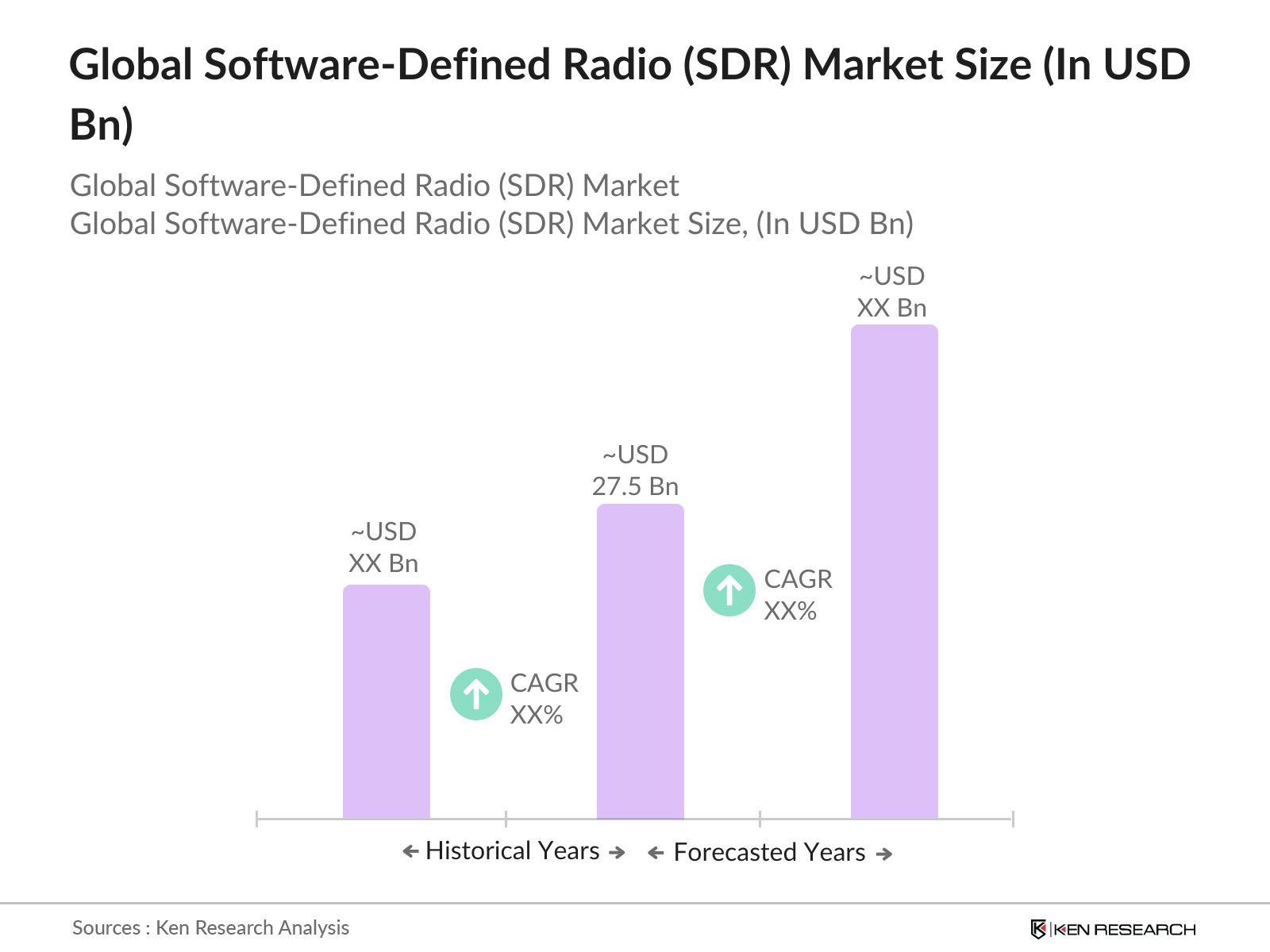
The global SDR market was valued at USD 27.5 billion, driven by growing demand for flexible communication systems across defense and telecommunications industries.
Key challenges in the global SDR market include the high initial cost of implementation, technical complexity in system integration, and limited awareness in emerging markets. Overcoming these challenges is critical for market expansion.
Major players in the global SDR market include BAE Systems, Northrop Grumman, Elbit Systems, Thales Group, and Raytheon Technologies, which dominate through their established presence in defense and telecommunications sectors.
Growth drivers in the global SDR market include increasing defense communication needs, the rise of IoT and 5G technologies, and government investments in public safety communication systems.

What makes us stand out is that our consultants follows Robust, Refine and Result (RRR) methodology. i.e. Robust for clear definitions, approaches and sanity checking, Refine for differentiating respondents facts and opinions and Result for presenting data with story

We have set a benchmark in the industry by offering our clients with syndicated and customized market research reports featuring coverage of entire market as well as meticulous research and analyst insights.

While we don't replace traditional research, we flip the method upside down. Our dual approach of Top Bottom & Bottom Top ensures quality deliverable by not just verifying company fundamentals but also looking at the sector and macroeconomic factors.

With one step in the future, our research team constantly tries to show you the bigger picture. We help with some of the tough questions you may encounter along the way: How is the industry positioned? Best marketing channel? KPI's of competitors? By aligning every element, we help maximize success.

Our report gives you instant access to the answers and sources that other companies might choose to hide. We elaborate each steps of research methodology we have used and showcase you the sample size to earn your trust.

If you need any support, we are here! We pride ourselves on universe strength, data quality, and quick, friendly, and professional service.