















Global Solar Powered Vehicle Market Outlook to 2030
Region:Global
Author(s):Naman Rohilla
Product Code:KROD5444
December 2024
86
About the Report
Global Solar Powered Vehicle Market Overview
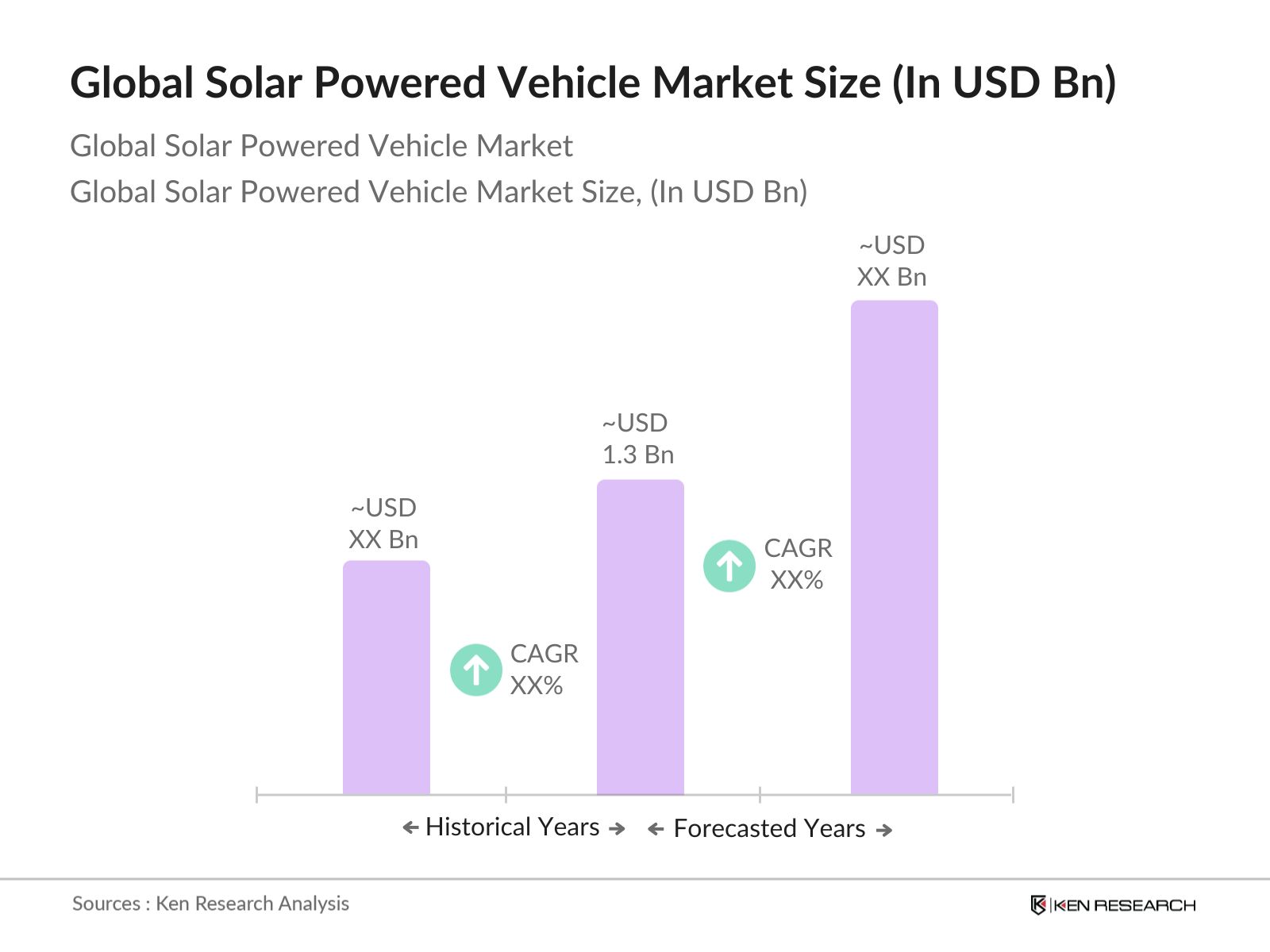
- The global solar-powered vehicle market is valued at USD 1.3 billion, driven by increasing demand for sustainable and eco-friendly transportation solutions. This demand is propelled by advancements in solar technology and integration of photovoltaic panels into vehicles, which allows for longer driving ranges and reduces reliance on conventional fuels. Major automotive manufacturers are investing heavily in the development of solar-powered electric vehicles, pushing the market forward. Additionally, government regulations promoting the use of renewable energy sources have further fueled the growth of the solar-powered vehicle market.
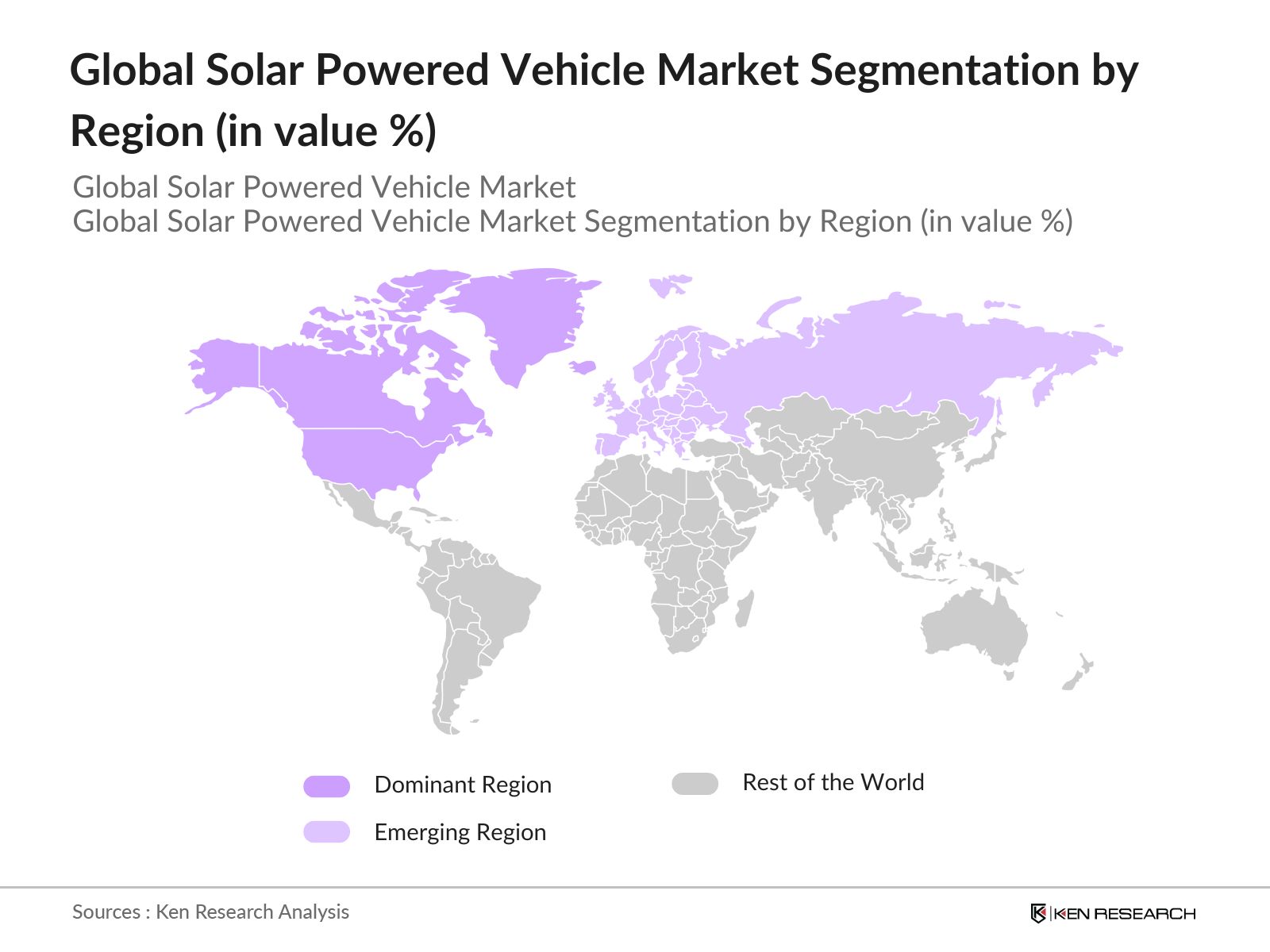
- Countries such as the United States, Germany, and Japan dominate the solar-powered vehicle market due to their advanced technological infrastructure and substantial investments in renewable energy solutions. These countries have a well-established automotive industry that is rapidly transitioning towards electric and solar-powered vehicles. Additionally, the favourable regulatory environment in these regions, such as government incentives for green energy solutions and solar technology adoption, provides a strong foundation for market dominance. Other regions like Europe and China are also key players, thanks to their aggressive climate policies.
- Governments across the globe are introducing stringent emission reduction policies aimed at decarbonizing the transport sector, directly impacting the adoption of solar-powered vehicles. In 2024, the European Union reinforced its commitment to achieving net-zero emissions by 2050, with regulations that target a 50% reduction in transport-related emissions by 2030. Similarly, the U.S. has implemented new Clean Air Act amendments that push for cleaner transportation solutions, incentivizing the development and purchase of solar-powered vehicles as part of broader emission reduction goals. These policies are reshaping the future of transportation, making solar vehicles a key player.
Global Solar Powered Vehicle Market Segmentation
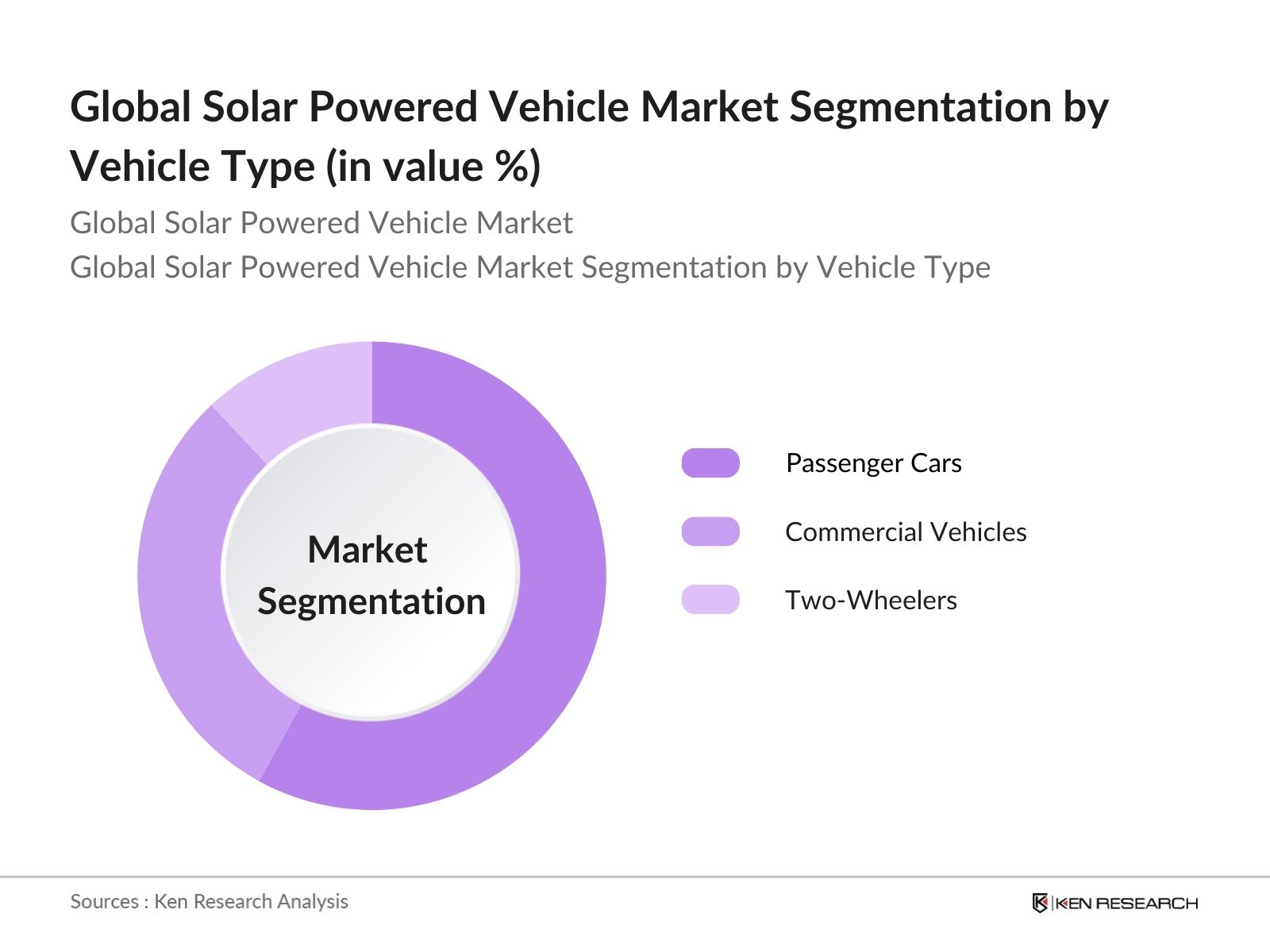
- By Vehicle Type: The global solar-powered vehicle market is segmented by vehicle type into passenger cars, commercial vehicles, and two-wheelers. Passenger cars hold the dominant market share in the solar-powered vehicle segment. This is largely due to the increasing adoption of electric vehicles (EVs) in urban areas, where sustainability is a priority. Manufacturers are increasingly integrating solar panels into EVs to extend the range and improve energy efficiency, especially in the passenger vehicle sector. The growing demand for eco-friendly personal transportation is a driver for the dominance of this segment.
- By Solar Technology: Solar-powered vehicles are classified by solar technology into photovoltaic cells and concentrated solar power. Photovoltaic cells, particularly silicon-based and thin-film technologies, hold the largest market share. These cells are favoured due to their relatively lower cost and higher efficiency in converting sunlight into electricity, making them the preferred choice for vehicle integration. Innovations in photovoltaic technology, including the use of flexible solar panels, further solidify their position as the dominant technology in this market.
- By Region: The global solar-powered vehicle market is geographically segmented into North America, Europe, Asia-Pacific, the Middle East & Africa, and Latin America. North America is the leading region, primarily driven by the strong presence of EV manufacturers and a well-developed renewable energy infrastructure. The U.S. has been at the forefront of solar energy adoption, and the government's strong push for green energy solutions has provided a conducive environment for the growth of solar-powered vehicles. Other key markets include Europe and Asia-Pacific, where government policies aimed at reducing carbon emissions are boosting the adoption of solar-powered vehicles.
Global Solar Powered Vehicle Market Competitive Landscape
The global solar-powered vehicle market is dominated by a few key players that have established strong positions through continuous innovations and strategic partnerships. These players focus on improving the efficiency of solar technology, expanding their product offerings, and integrating advanced systems into their vehicles. Key players in the market include Tesla, Toyota, and Lightyear One, each of which plays a major role in pushing technological boundaries in the renewable energy vehicle space.
|
Company |
Establishment Year |
Headquarters |
R&D Investment |
Solar Technology |
Revenue (USD Bn) |
EV Integration |
Patent Portfolio |
Partnerships |
Global Reach |
|
Tesla, Inc. |
2003 |
Palo Alto, USA |
- |
- |
- |
- |
- |
- |
- |
|
Toyota Motor Corp. |
1937 |
Toyota City, Japan |
- |
- |
- |
- |
- |
- |
- |
|
Lightyear One |
2016 |
Helmond, Netherlands |
- |
- |
- |
- |
- |
- |
- |
|
Hyundai Motor Company |
1967 |
Seoul, South Korea |
- |
- |
- |
- |
- |
- |
- |
|
Sono Motors GmbH |
2016 |
Munich, Germany |
- |
- |
- |
- |
- |
- |
- |
Global Solar Powered Vehicle Market Analysis
Global Solar Powered Vehicle Market Growth Drivers
- Increasing Demand for Sustainable Mobility Solutions: In 2024, the shift towards sustainable transportation has gained substantial traction, driven by the global push to reduce carbon emissions. According to the World Bank, over 30% of global CO2 emissions are linked to the transport sector, and governments are prioritizing low-emission solutions like solar-powered vehicles. This demand is particularly strong in regions with ambitious climate goals such as the European Union and the U.S., where renewable energy adoption is expected to double by 2030. Solar-powered vehicles present a sustainable mobility solution that aligns with these trends, offering zero emissions during operation.
- Advancements in Solar Technology Integration: Technological innovations in solar power systems, particularly in solar photovoltaic (PV) technology, have improved energy capture and conversion efficiency. In 2024, solar PV efficiency rates have reached over 22% on average, compared to 15% a decade ago, as noted by the International Renewable Energy Agency (IRENA). This improved efficiency allows vehicles to store more solar energy and extend their operational range. Moreover, ongoing research into flexible and lightweight solar panels specifically for automotive applications is reducing the weight burden on vehicles, promoting greater adoption of solar-powered cars.
- Rising Awareness of Climate Change and Carbon Emissions Reduction: With the global temperature rising by an average of 1.2C since pre-industrial times, the need to curb emissions has never been more urgent. In 2024, awareness campaigns, especially in urbanized regions, are focusing on reducing vehicle-based emissions, which account for around 25% of global greenhouse gas emissions. Solar-powered vehicles, as fully sustainable alternatives, are being positioned as a critical tool to address these environmental concerns, aligning with climate action initiatives outlined in the Paris Agreement.
Global Solar Powered Vehicle Market Challenges
- High Initial Costs of Solar Technology: While solar technology offers long-term benefits, the initial costs remain a substantial barrier. In 2024, solar panels for vehicles can cost up to $5,000 per car, making them more expensive than traditional EVs. These costs stem from the intricate process of integrating solar cells into a vehicles design while ensuring safety and efficiency. This high initial investment deters potential buyers and manufacturers, particularly in emerging markets where cost sensitivity is higher. Even with government subsidies, affordability continues to challenge large-scale adoption of solar-powered vehicles.
- Limited Solar Charging Infrastructure: The infrastructure needed to charge solar-powered vehicles is underdeveloped, especially in developing regions. As of 2024, only a few countries, such as the Netherlands and Germany, have begun integrating solar charging stations into their EV infrastructure. In contrast, many regions lack any form of public solar charging, limiting the potential of solar-powered vehicles. This challenge is exacerbated by the limited availability of solar power during night hours or overcast conditions, necessitating hybrid systems and supplementary charging networks.
Global Solar Powered Vehicle Market Future Outlook
Over the next five years, the global solar-powered vehicle market is expected to see growth due to advancements in solar technology and increasing consumer demand for sustainable transportation. Governments across the world are continuing to offer incentives for green energy adoption, which will further fuel market growth. As solar energy technology becomes more cost-effective and efficient, the range and capabilities of solar-powered vehicles will improve, making them a more viable alternative to traditional electric vehicles.
Global Solar Powered Vehicle Market Opportunities
- Expansion in Emerging Markets: Emerging markets, particularly in Asia and Latin America, present growth opportunities for solar-powered vehicles. Countries like India and Brazil are rapidly developing their EV infrastructure, with government-supported programs to promote clean energy. In 2024, India announced plans to increase its EV sales to 10 million units by 2025, with solar integration being a key component of its mobility strategy. The focus on reducing oil imports and tackling urban air pollution in these regions opens doors for solar-powered solutions, creating a promising outlook for market expansion.
- Integration of Solar Vehicles into Smart City Solutions: As cities worldwide aim to transition into "smart cities," solar-powered vehicles play a crucial role in integrating sustainable transportation into broader energy management systems. In 2024, several European cities, such as Oslo and Amsterdam, are piloting solar vehicle fleets within their urban ecosystems. These vehicles are part of larger energy networks, where excess solar energy generated by vehicles is fed back into the grid. This creates a synergistic system between transportation and energy infrastructure, offering both environmental and economic benefits.
Scope of the Report
|
Vehicle Type |
Passenger Cars Commercial Vehicles Two-Wheelers |
|
Solar Technology |
Photovoltaic Cells (Silicon-based, Thin-film, Multijunction Cells) Concentrated Solar Power |
|
Power Source |
Fully Solar Powered Vehicles Hybrid Solar-Battery Vehicles |
|
End-User Application |
Personal Use Public Transport Commercial Fleet |
|
Region |
North America Europe Asia-Pacific Middle East & Africa Latin America |
Products
Key Target Audience
Automotive Manufacturers
Solar Technology Providers
Investors and Venture Capitalist Firms
Banks and Financial Institutions
Government and Regulatory Bodies (U.S. Environmental Protection Agency, European Environment Agency)
Solar Panel Manufacturers
Electric Vehicle Infrastructure Companies
Renewable Energy Associations
Energy Storage Solutions Providers
Companies
Players Mentioned in the Market
Tesla, Inc.
Toyota Motor Corporation
Lightyear One
Sono Motors GmbH
Hyundai Motor Company
Fisker Inc.
Aptera Motors
General Motors
Volkswagen AG
Nissan Motor Corporation
Table of Contents
1. Global Solar Powered Vehicle Market Overview
1.1 Definition and Scope
1.2 Market Taxonomy
1.3 Market Growth Rate
1.4 Market Segmentation Overview
2. Global Solar Powered Vehicle Market Size (In USD Bn)
2.1 Historical Market Size
2.2 Year-on-Year Growth Analysis
2.3 Key Market Developments and Milestones
3. Global Solar Powered Vehicle Market Analysis
3.1 Growth Drivers
3.1.1 Increasing Demand for Sustainable Mobility Solutions
3.1.2 Advancements in Solar Technology Integration
3.1.3 Government Incentives and Regulatory Support
3.1.4 Rising Awareness of Climate Change and Carbon Emissions Reduction
3.2 Market Challenges
3.2.1 High Initial Costs of Solar Technology
3.2.2 Limited Solar Charging Infrastructure
3.2.3 Battery Efficiency and Range Limitations
3.2.4 Challenges in Solar Panel Durability
3.3 Opportunities
3.3.1 Expansion in Emerging Markets (Developing Electric Vehicle Ecosystem)
3.3.2 Technological Innovations in Solar Efficiency
3.3.3 Integration of Solar Vehicles into Smart City Solutions
3.3.4 Increasing Collaborations with Solar Panel Manufacturers
3.4 Trends
3.4.1 Adoption of Solar as Auxiliary Power Source for EVs
3.4.2 Development of Hybrid Solar-Powered and Battery Vehicles
3.4.3 Growth of Solar-Powered Public Transportation Systems
3.4.4 Integration of Solar Energy in Connected Autonomous Vehicles
3.5 Government Regulation
3.5.1 Emission Reduction Policies
3.5.2 Solar Incentive Schemes and Subsidies
3.5.3 Global Electric Vehicle Standards Compliance
3.5.4 Public-Private Partnerships in Solar Infrastructure
3.6 SWOT Analysis
3.7 Stakeholder Ecosystem (Solar Manufacturers, Vehicle OEMs, Energy Storage Providers)
3.8 Porters Five Forces
3.9 Competitive Ecosystem
4. Global Solar Powered Vehicle Market Segmentation
4.1 By Vehicle Type (In Value %)
4.1.1 Passenger Cars
4.1.2 Commercial Vehicles
4.1.3 Two-Wheelers
4.2 By Solar Technology (In Value %)
4.2.1 Photovoltaic Cells (Silicon-based, Thin-film, Multijunction Cells)
4.2.2 Concentrated Solar Power
4.3 By Power Source (In Value %)
4.3.1 Fully Solar Powered Vehicles
4.3.2 Hybrid Solar-Battery Vehicles
4.4 By End-User Application (In Value %)
4.4.1 Personal Use
4.4.2 Public Transport
4.4.3 Commercial Fleet
4.5 By Region (In Value %)
4.5.1 North America
4.5.2 Europe
4.5.3 Asia-Pacific
4.5.4 Middle East & Africa
4.5.5 Latin America
5. Global Solar Powered Vehicle Market Competitive Analysis
5.1 Detailed Profiles of Major Companies
5.1.1 Tesla, Inc.
5.1.2 Toyota Motor Corporation
5.1.3 Lightyear One
5.1.4 Sono Motors GmbH
5.1.5 Fisker Inc.
5.1.6 Hyundai Motor Company
5.1.7 Aptera Motors
5.1.8 General Motors
5.1.9 Volkswagen AG
5.1.10 Nissan Motor Corporation
5.1.11 Ford Motor Company
5.1.12 BYD Auto
5.1.13 Hanergy Holding Group
5.1.14 Solar Electric Vehicle Company
5.1.15 Mahindra Electric
5.2 Cross Comparison Parameters (No. of Employees, Headquarters, Market Penetration, Solar Technology Adoption, Revenue, R&D Investments, Patents, Strategic Collaborations)
5.3 Market Share Analysis
5.4 Strategic Initiatives
5.5 Mergers and Acquisitions
5.6 Investment Analysis
5.7 Venture Capital Funding
5.8 Government Grants
5.9 Private Equity Investments
6. Global Solar Powered Vehicle Market Regulatory Framework
6.1 Environmental Standards for Solar-Powered Vehicles
6.2 Compliance Requirements for Solar Technology in Vehicles
6.3 Certification Processes for Solar Vehicle Manufacturing
7. Global Solar Powered Vehicle Future Market Size (In USD Bn)
7.1 Future Market Size Projections
7.2 Key Factors Driving Future Market Growth
8. Global Solar Powered Vehicle Future Market Segmentation
8.1 By Vehicle Type (In Value %)
8.2 By Solar Technology (In Value %)
8.3 By Power Source (In Value %)
8.4 By End-User Application (In Value %)
8.5 By Region (In Value %)
9. Global Solar Powered Vehicle Market Analysts Recommendations
9.1 TAM/SAM/SOM Analysis
9.2 Customer Cohort Analysis
9.3 Marketing Initiatives
9.4 White Space Opportunity Analysis
Research Methodology
Step 1: Identification of Key Variables
The initial step involves constructing a comprehensive ecosystem map of the solar-powered vehicle market, considering all major stakeholders, such as automotive manufacturers, solar technology providers, and regulatory bodies. Extensive desk research and industry-specific databases are used to gather essential data on market dynamics.
Step 2: Market Analysis and Construction
The next phase involves compiling historical data on market size, market share distribution, and solar technology adoption rates. This step also includes an analysis of solar vehicle penetration and the performance of different vehicle types.
Step 3: Hypothesis Validation and Expert Consultation
Hypotheses regarding market trends and future projections are validated through consultations with industry experts, including engineers and executives from key solar-powered vehicle manufacturers. These interviews provide real-world insights into operational challenges and opportunities.
Step 4: Research Synthesis and Final Output
In the final step, the collected data is synthesized into actionable insights and validated through direct engagement with manufacturers. This ensures the final report reflects the latest developments and trends in the solar-powered vehicle market.
Frequently Asked Questions
01. How big is the Global Solar Powered Vehicle Market?
The global solar-powered vehicle market is valued at USD 1.3 billion, driven by advancements in solar technology and growing consumer demand for sustainable transportation.
02. What are the challenges in the Global Solar Powered Vehicle Market?
Challenges in the global solar-powered vehicle market include the high initial costs of solar technology, limited infrastructure for solar charging, and concerns over the durability of solar panels in vehicles.
03. Who are the major players in the Global Solar Powered Vehicle Market?
Key players in the global solar-powered vehicle market include Tesla, Toyota Motor Corporation, Lightyear One, Sono Motors GmbH, and Hyundai Motor Company. These companies are at the forefront of technological advancements in solar-powered vehicles.
04. What are the growth drivers of the Global Solar Powered Vehicle Market?
The global solar-powered vehicle market is driven by increasing demand for eco-friendly transportation, government incentives for renewable energy adoption, and technological advancements in solar energy efficiency.
Why Buy From Us?

What makes us stand out is that our consultants follows Robust, Refine and Result (RRR) methodology. i.e. Robust for clear definitions, approaches and sanity checking, Refine for differentiating respondents facts and opinions and Result for presenting data with story

We have set a benchmark in the industry by offering our clients with syndicated and customized market research reports featuring coverage of entire market as well as meticulous research and analyst insights.

While we don't replace traditional research, we flip the method upside down. Our dual approach of Top Bottom & Bottom Top ensures quality deliverable by not just verifying company fundamentals but also looking at the sector and macroeconomic factors.

With one step in the future, our research team constantly tries to show you the bigger picture. We help with some of the tough questions you may encounter along the way: How is the industry positioned? Best marketing channel? KPI's of competitors? By aligning every element, we help maximize success.

Our report gives you instant access to the answers and sources that other companies might choose to hide. We elaborate each steps of research methodology we have used and showcase you the sample size to earn your trust.

If you need any support, we are here! We pride ourselves on universe strength, data quality, and quick, friendly, and professional service.