
Global Space Launch Services Market Outlook to 2030
Region:Global
Author(s):Mukul
Product Code:KROD7149
Region:Global
Author(s):Mukul
Product Code:KROD7149
December 2024
80
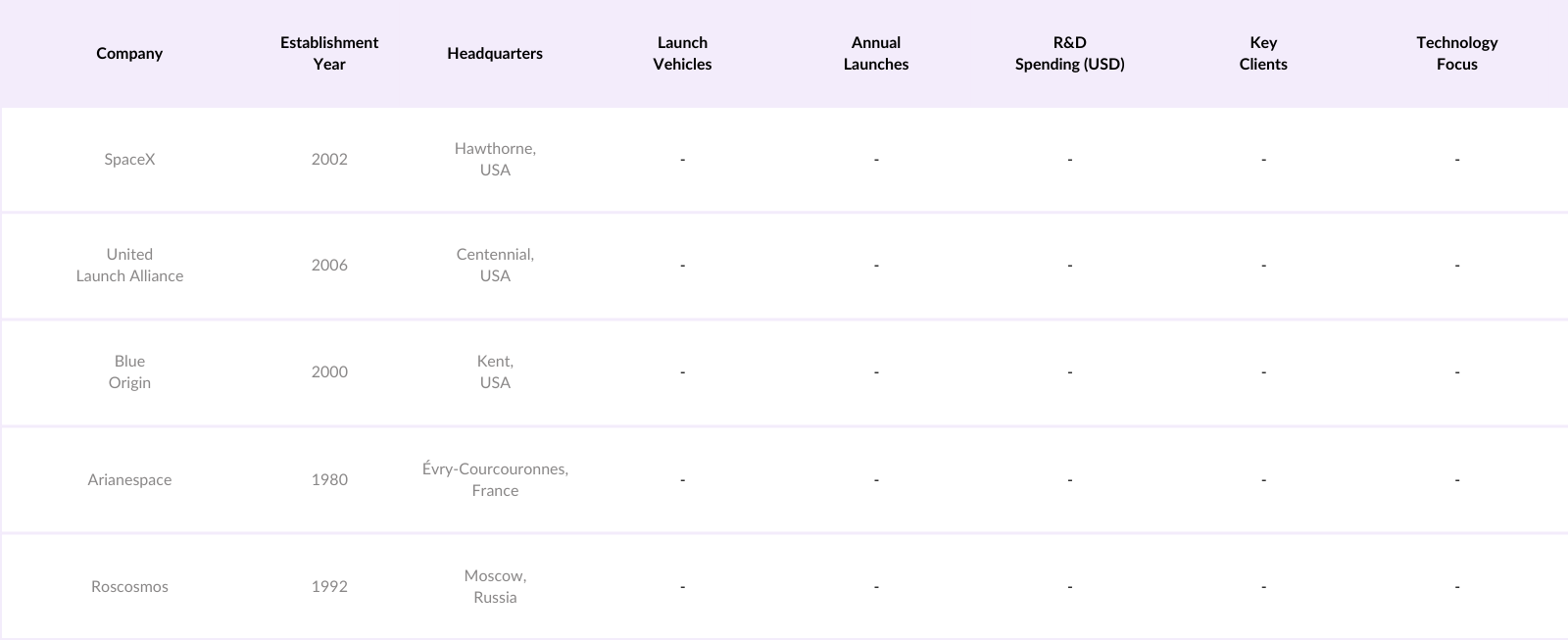
The space launch services market is dominated by key global players, who leverage technological innovation, strategic partnerships, and government support to strengthen their positions. Companies such as SpaceX, United Launch Alliance (ULA), and Blue Origin lead the market due to their extensive launch capabilities and breakthroughs in reusable rocket technology. These players not only dominate commercial satellite launches but also have significant defense and governmental contracts, further consolidating their influence.
Growth Drivers
Market Restraints
The global space launch services market is poised for significant growth in the next five years, driven by continuous advancements in launch technology, growing demand for small satellite constellations, and the expansion of private space ventures. Increasing investments in reusable rockets, along with the rise of space tourism and deep space exploration missions, are expected to create new opportunities for market players. The integration of artificial intelligence in satellite deployment and launch systems is also anticipated to enhance operational efficiency and reduce launch costs.
Market Opportunities
|
By Service Type |
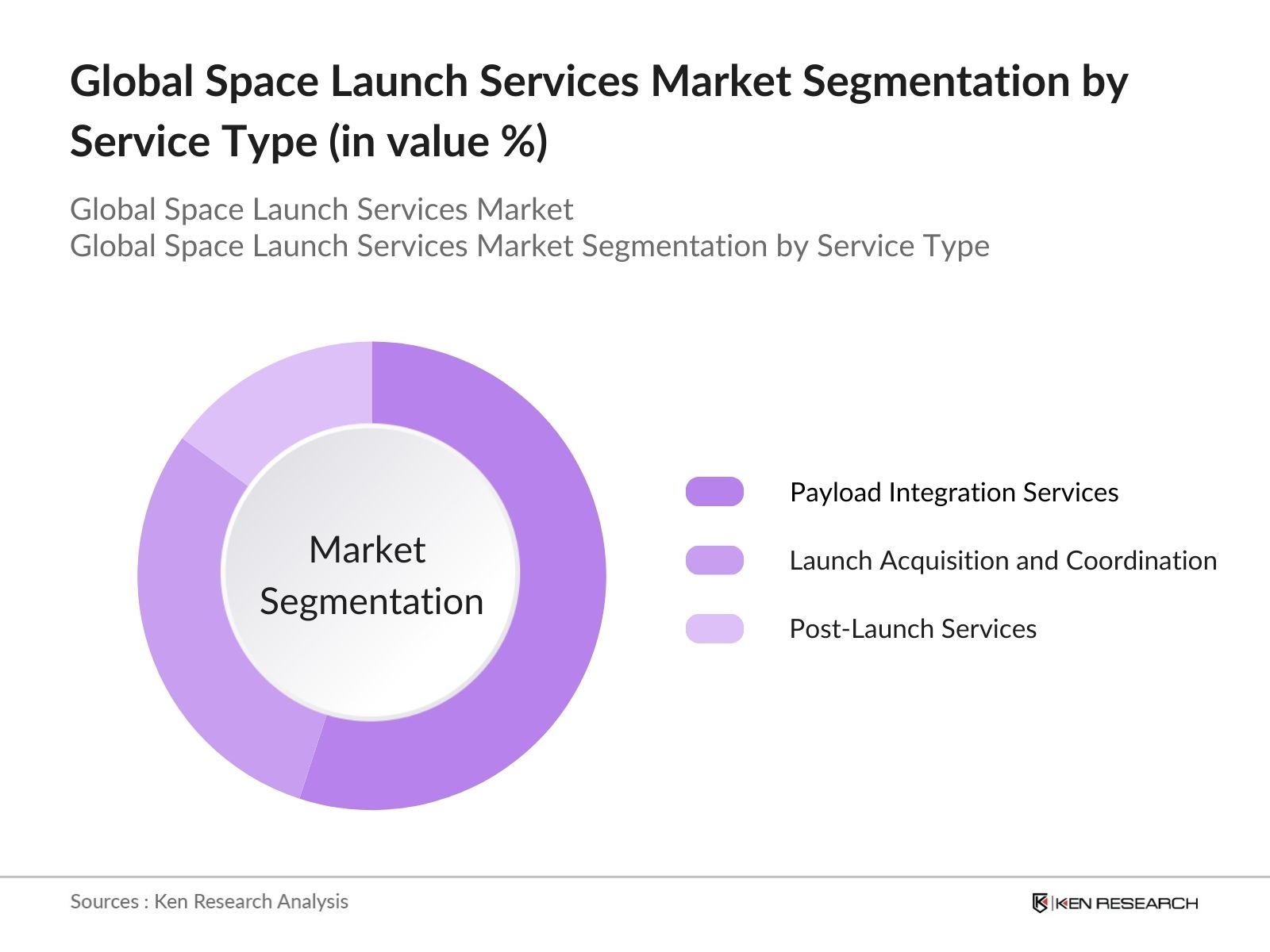
Payload Integration Services |
|
Launch Acquisition and Coordination |
|
|
Post-Launch Services |
|
|
By Payload Type |
Small Satellites (1500 kg) |
|
Medium Satellites (5001000 kg) |
|
|
Heavy Satellites (1000+ kg) |
|
|
By Orbit Type |
Low Earth Orbit (LEO) |
|
Geostationary Orbit (GEO) |
|
|
Medium Earth Orbit (MEO) |
|
|
Polar Orbits |
|
|
By Launch Platform |
Ground Launch |
|
Sea Launch |
|
|
Airborne Launch |
|
|
By End User |
Government |
|
Commercial |
|
|
Defense |
1.1. Definition and Scope
1.2. Market Taxonomy
1.3. Market Growth Rate
1.4. Market Segmentation Overview
2.1. Historical Market Size
2.2. Year-On-Year Growth Analysis
2.3. Key Market Developments and Milestones
3.1. Growth Drivers
3.1.1. Increasing Demand for Satellite Deployments
3.1.2. Rising Government and Private Sector Investments
3.1.3. Expansion of Commercial Space Ventures
3.1.4. Technological Advancements in Rocket Propulsion
3.2. Market Challenges
3.2.1. High Launch Costs [Cost Efficiency]
3.2.2. Stringent International Regulations [Compliance]
3.2.3. Geopolitical Tensions [Political Instability]
3.3. Opportunities
3.3.1. Development of Reusable Launch Vehicles [Sustainability]
3.3.2. Growing Demand for Space Tourism [Commercial Expansion]
3.3.3. Increasing Collaborations with Emerging Markets [Global Partnerships]
3.4. Trends
3.4.1. Rise of Private Space Companies [Industry Disruption]
3.4.2. Miniaturization of Satellites [Satellite Technology]
3.4.3. Integration of AI in Launch Systems [Technological Integration]
3.5. Government Regulation
3.5.1. National Space Policy [Policy Impact]
3.5.2. Launch Licensing Procedures [Licensing]
3.5.3. Environmental Regulations [Sustainability Compliance]
3.5.4. Collaboration with Defense Programs [Strategic Defense]
3.6. SWOT Analysis
3.7. Stakeholder Ecosystem
3.8. Porters Five Forces Analysis
3.9. Competitive Ecosystem
4.1. By Service Type (In Value %)
4.1.1. Payload Integration Services
4.1.2. Launch Acquisition and Coordination
4.1.3. Post-Launch Services
4.2. By Payload Type (In Value %)
4.2.1. Small Satellites (1500 kg)
4.2.2. Medium Satellites (5001000 kg)
4.2.3. Heavy Satellites (1000+ kg)
4.3. By Orbit Type (In Value %)
4.3.1. Low Earth Orbit (LEO)
4.3.2. Geostationary Orbit (GEO)
4.3.3. Medium Earth Orbit (MEO)
4.3.4. Polar Orbits
4.4. By Launch Platform (In Value %)
4.4.1. Ground Launch
4.4.2. Sea Launch
4.4.3. Airborne Launch
4.5. By End User (In Value %)
4.5.1. Government
4.5.2. Commercial
4.5.3. Defense
5.1. Detailed Profiles of Major Companies
5.1.1. SpaceX
5.1.2. United Launch Alliance (ULA)
5.1.3. Blue Origin
5.1.4. Arianespace
5.1.5. Rocket Lab
5.1.6. Northrop Grumman
5.1.7. Roscosmos
5.1.8. China Aerospace Science and Technology Corporation (CASC)
5.1.9. Indian Space Research Organization (ISRO)
5.1.10. Mitsubishi Heavy Industries
5.1.11. Boeing
5.1.12. Lockheed Martin
5.1.13. Relativity Space
5.1.14. Firefly Aerospace
5.1.15. Virgin Orbit
5.2. Cross Comparison Parameters (Revenue, Number of Launches, Technological Capability, Market Reach, Strategic Partnerships, Launch Success Rate, Manufacturing Capabilities, R&D Spending)
5.3. Market Share Analysis
5.4. Strategic Initiatives
5.5. Mergers and Acquisitions
5.6. Investment Analysis
5.7. Venture Capital Funding
5.8. Government Grants
5.9. Private Equity Investments
6.1. International Space Treaties [Legal Compliance]
6.2. Launch Safety Regulations [Safety Standards]
6.3. Intellectual Property in Space [IP Protection]
7.1. Future Market Size Projections
7.2. Key Factors Driving Future Market Growth
8.1. By Service Type (In Value %)
8.2. By Payload Type (In Value %)
8.3. By Orbit Type (In Value %)
8.4. By Launch Platform (In Value %)
8.5. By End User (In Value %)
9.1. TAM/SAM/SOM Analysis
9.2. Customer Cohort Analysis
9.3. Marketing Initiatives
9.4. White Space Opportunity Analysis
The research process begins with identifying key variables such as launch vehicle capabilities, payload demand, and regulatory factors in the space launch services market. This involves a thorough analysis of historical and proprietary data from industry sources to map the ecosystem and its dynamics.
This step involves gathering and analyzing historical market data, focusing on launch service providers' revenues and the ratio of government vs. commercial launches. We compile this information using a combination of top-down and bottom-up approaches to construct a reliable market model.
In this phase, industry hypotheses are developed and validated through interviews with space industry experts and key players, including executives from leading companies like SpaceX and Arianespace. These insights help refine market assumptions and provide clarity on future trends.
The final step synthesizes all data points, from financial analysis to industry trends, into a comprehensive report. This is supplemented by primary research from major space launch players and detailed insights into technological advancements and market shifts.
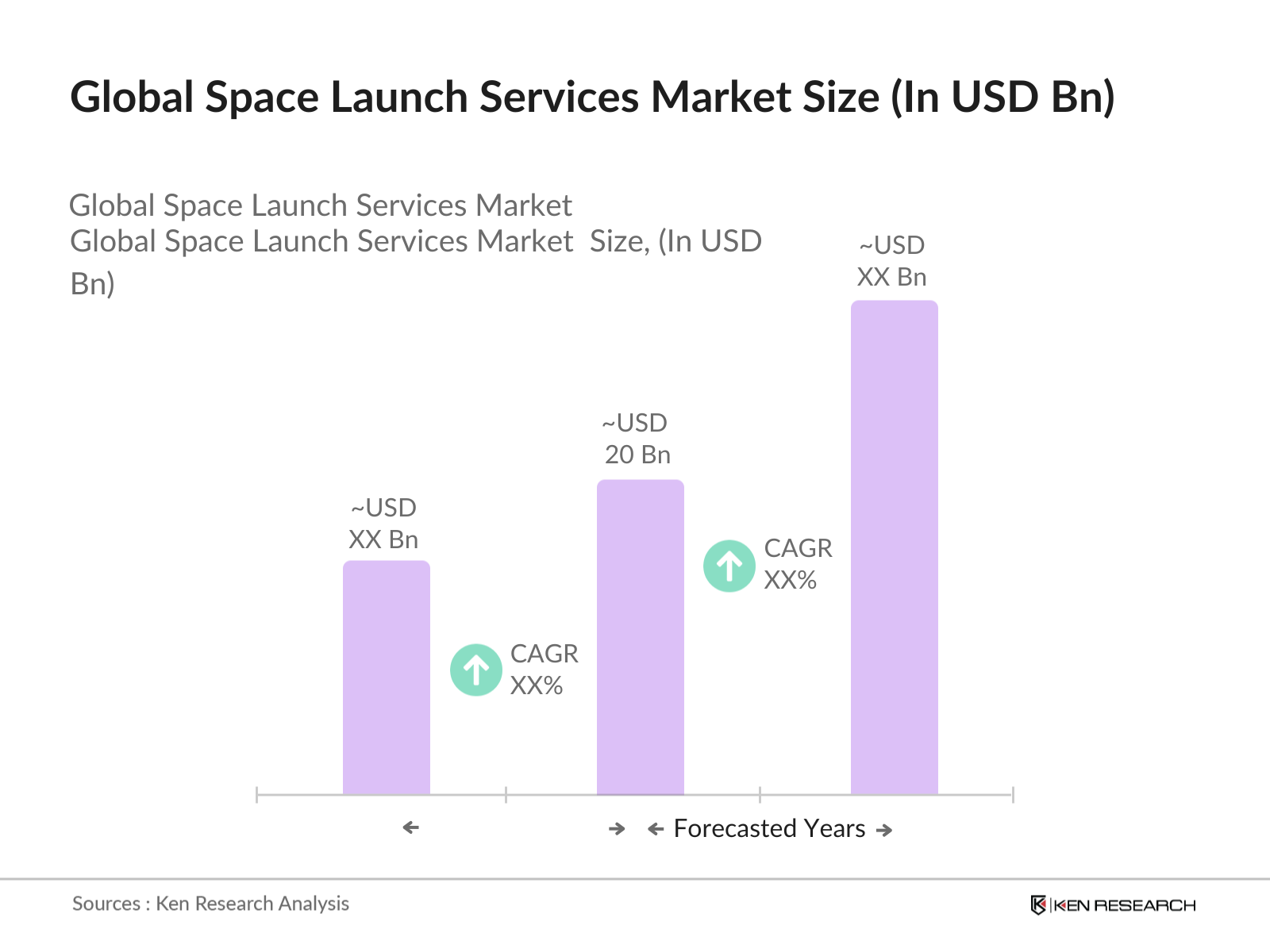
The global space launch services market is valued at USD 20 billion. It is driven by increasing demand for satellite deployments and advancements in reusable rocket technology.
Key challenges include high launch costs, stringent international regulations, and geopolitical tensions. These factors create barriers to entry for new players and limit growth for existing ones.
Major players include SpaceX, United Launch Alliance, Blue Origin, Arianespace, and Roscosmos. These companies dominate the market due to their advanced technology and strategic government contracts.
Growth drivers include the rising demand for satellite constellations, increasing private sector investments in space exploration, and breakthroughs in reusable launch vehicles.

What makes us stand out is that our consultants follows Robust, Refine and Result (RRR) methodology. i.e. Robust for clear definitions, approaches and sanity checking, Refine for differentiating respondents facts and opinions and Result for presenting data with story

We have set a benchmark in the industry by offering our clients with syndicated and customized market research reports featuring coverage of entire market as well as meticulous research and analyst insights.

While we don't replace traditional research, we flip the method upside down. Our dual approach of Top Bottom & Bottom Top ensures quality deliverable by not just verifying company fundamentals but also looking at the sector and macroeconomic factors.

With one step in the future, our research team constantly tries to show you the bigger picture. We help with some of the tough questions you may encounter along the way: How is the industry positioned? Best marketing channel? KPI's of competitors? By aligning every element, we help maximize success.

Our report gives you instant access to the answers and sources that other companies might choose to hide. We elaborate each steps of research methodology we have used and showcase you the sample size to earn your trust.

If you need any support, we are here! We pride ourselves on universe strength, data quality, and quick, friendly, and professional service.