















Global Spacesuit Market Outlook to 2030
Region:Global
Author(s):Shreya
Product Code:KROD4760
December 2024
86
About the Report
Global Spacesuit Market Overview
- The global spacesuit market is valued at USD 750 million, driven by the increasing demand for robust, high-performing spacesuits required for advanced space missions. The market benefits from rising investments in space exploration and commercialization, as well as the heightened interest from private enterprises engaged in space tourism. The drive for materials capable of enduring extreme conditions and the demand for suits offering autonomy and flexibility has further spurred this market's growth, showcasing the high-value nature of each product.
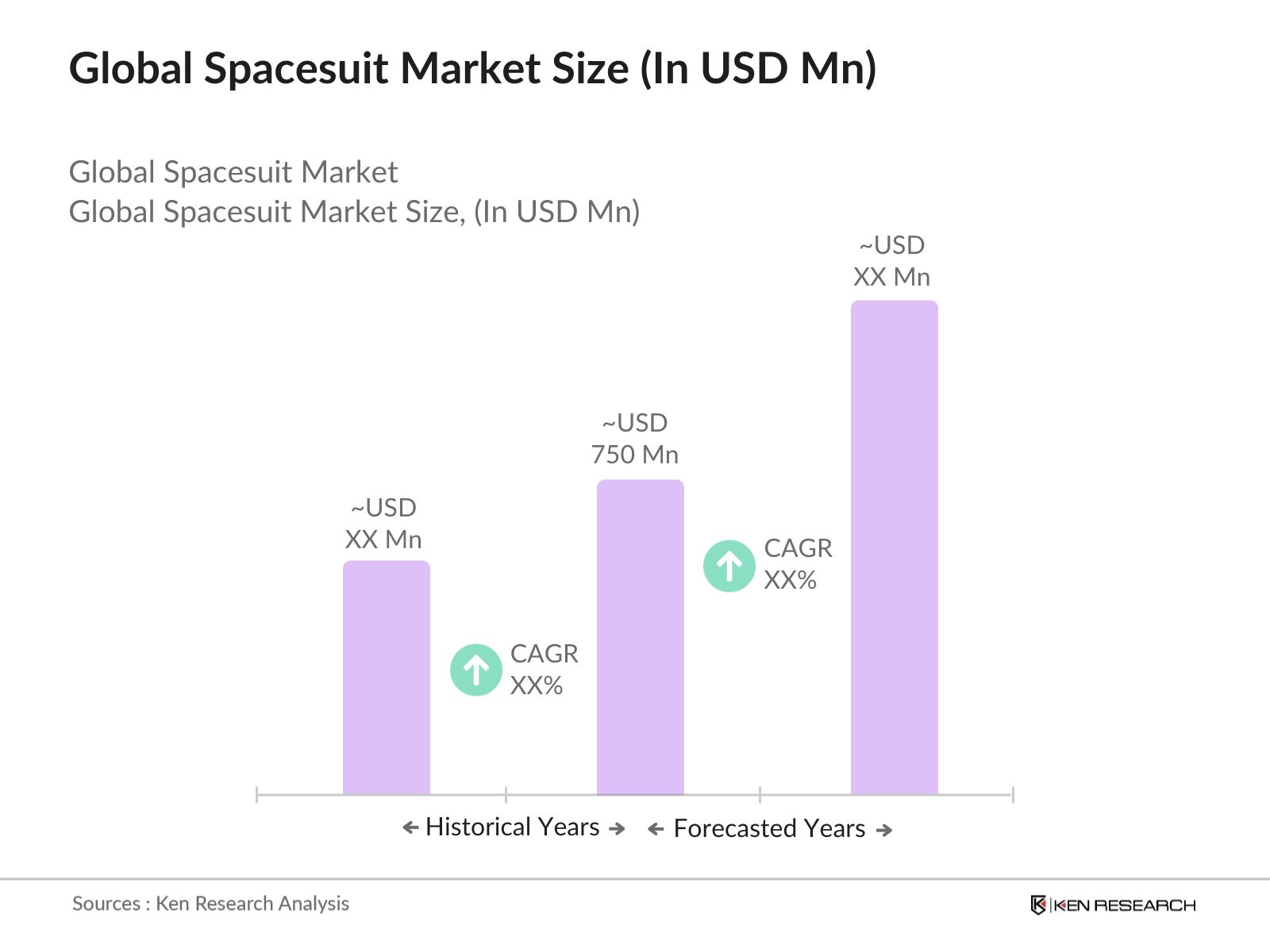
- The market is primarily dominated by countries with well-established space programs, notably the United States, Russia, and China. The U.S. leads the market due to NASA's advanced R&D capabilities and collaborations with private entities like SpaceX and Boeing. Russia's historical expertise and Chinas expanding space ambitions position them as key players, underpinned by substantial government support and initiatives focused on deep space exploration and extraterrestrial missions.
- Spacesuit development is governed by international standards set by agencies like NASA and the European Space Agency (ESA). These standards encompass safety protocols, material specifications, and performance criteria to ensure astronaut protection during missions. Compliance with these regulations is mandatory for manufacturers aiming to supply suits for international space missions. Adherence to such standards ensures interoperability and safety across multinational space endeavors.
Global Spacesuit Market Segmentation
By Material Type: The market is segmented by material type into Fabrics (Polymer, Kevlar, Nylon), Metals and Alloys (Titanium, Aluminum), and Composites (Carbon, Graphene). Composite materials hold a significant share due to their superior strength-to-weight ratio, essential for maintaining suit flexibility and durability in low-gravity environments. Carbon and graphene composites, for instance, provide high tensile strength while being lightweight, a critical attribute for extended space missions. This preference is further supported by composites' enhanced resistance to temperature fluctuations and radiation exposure. 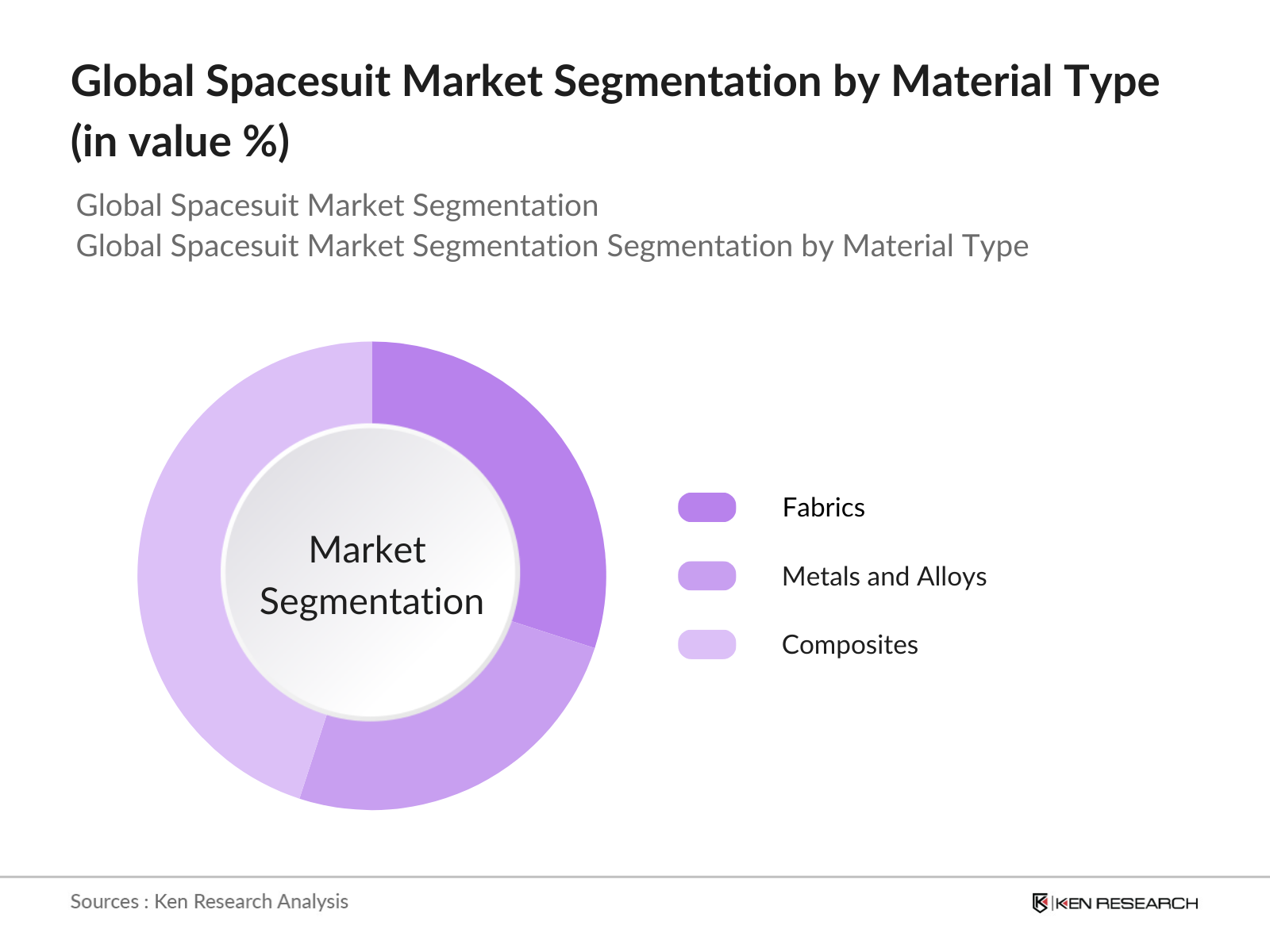
By Suit Type: The market is segmented by suit type into Intravehicular Activity (IVA), Extravehicular Activity (EVA), and Hybrid Spacesuits. Extravehicular Activity (EVA) suits currently dominate the market share, driven by the increasing number of extravehicular missions that require suits designed for durability and radiation protection. These suits are essential for missions involving repair work on space stations or planetary exploration, where safety from space hazards is paramount. EVA suits, equipped with reinforced materials and radiation shields, are preferred for their robustness and extensive mobility features, addressing the demanding needs of these missions.
By Region: The market is segmented by region into North America, Europe, Asia Pacific, Middle East & Africa, and Latin America. North America leads the regional segment, owing to the strong presence of space agencies such as NASA and private space companies like SpaceX, which continue to drive innovations in spacesuit technology. The regions technological prowess, coupled with a supportive regulatory environment and extensive R&D funding, establishes it as a primary market. Europe also has a growing share due to initiatives by ESA and collaborations with international agencies. 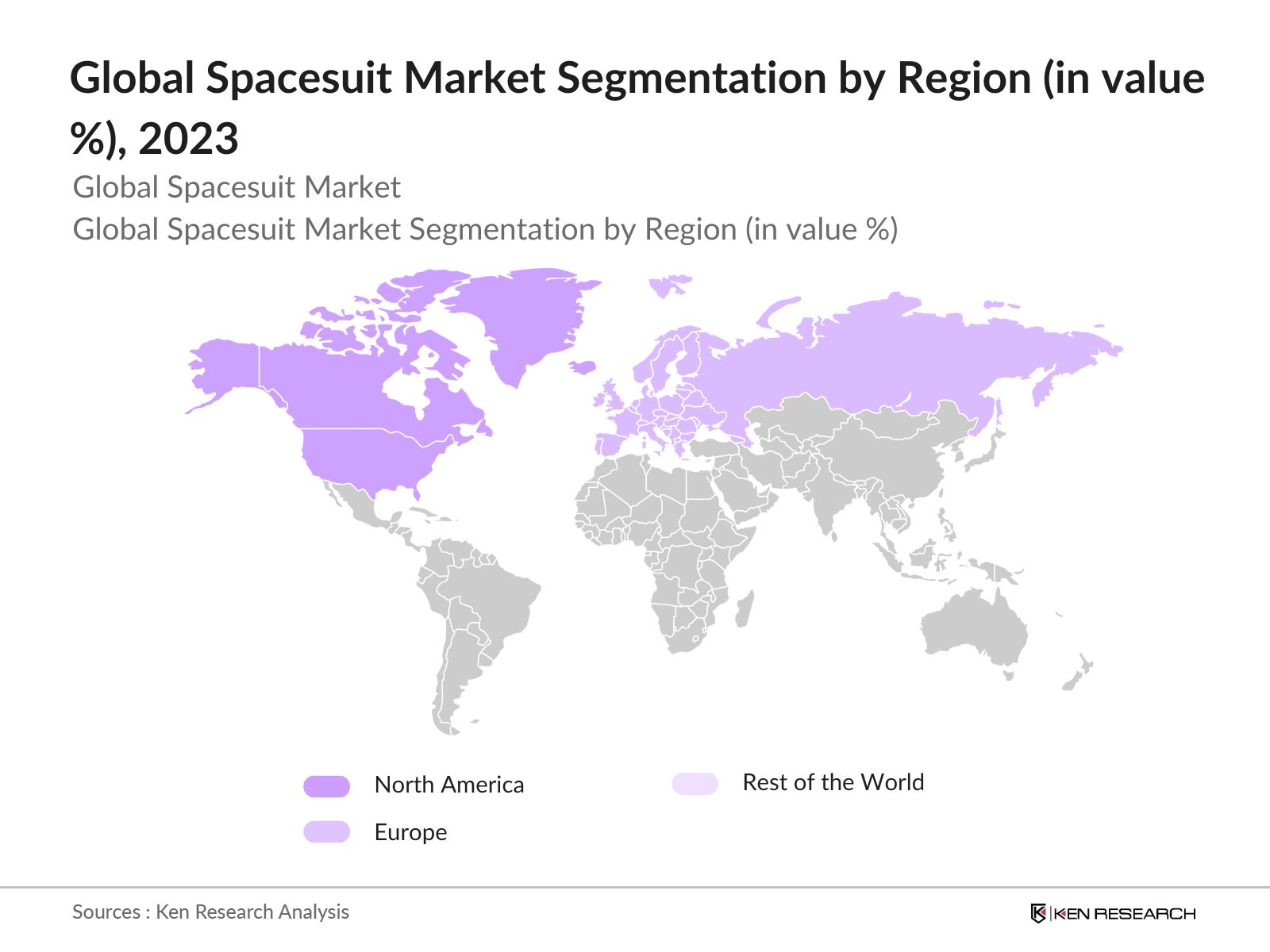
Global Spacesuit Market Competitive Landscape
The global spacesuit market is characterized by a few key players with substantial expertise and advanced R&D capabilities. These companies, backed by years of innovation and industry partnerships, cater to both government agencies and commercial space enterprises, highlighting their influence in the market. 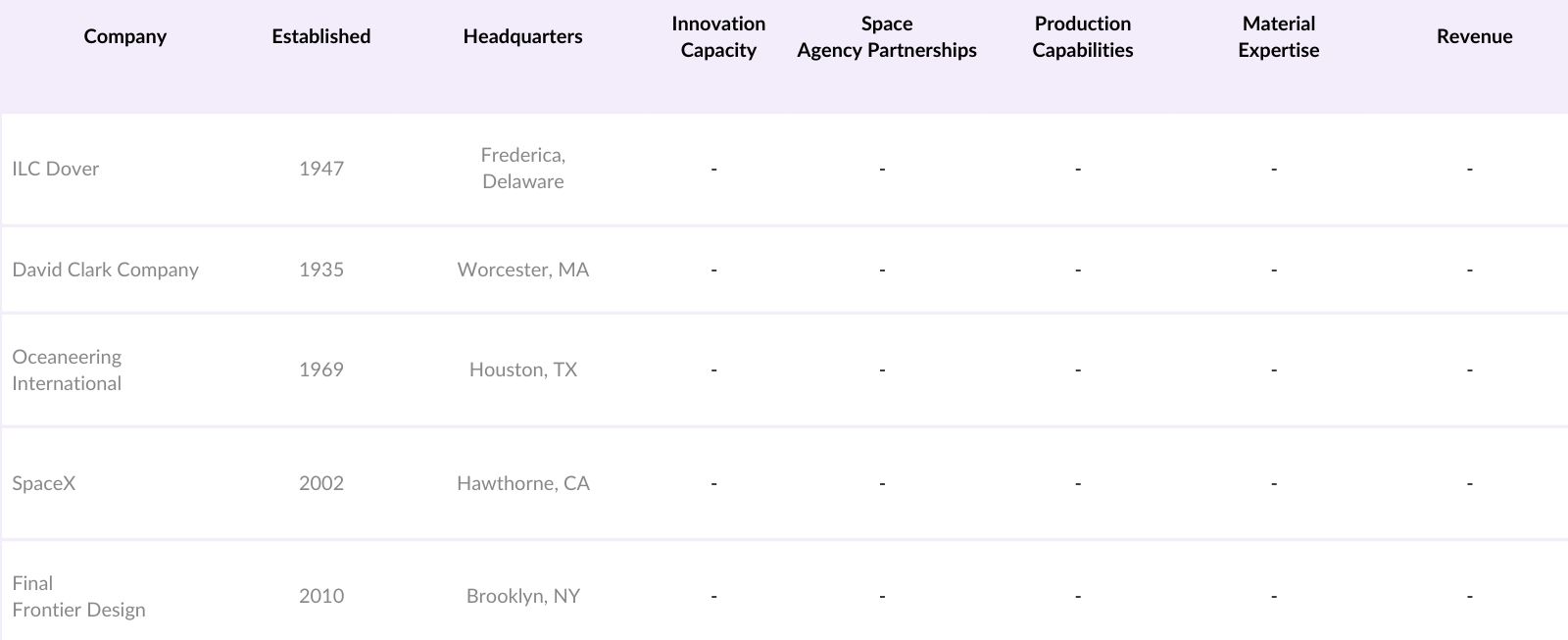
Global Spacesuit Market Outlook to 2028
Growth Drivers
- Advancements in Space Exploration: In 2024, global space agencies have significantly increased their mission portfolios. NASA's Artemis program aims to return humans to the Moon, with the Artemis III mission scheduled for 2025. The European Space Agency (ESA) has committed to lunar exploration through its European Large Logistics Lander (EL3) project. These initiatives necessitate the development of advanced spacesuits capable of supporting extended extravehicular activities (EVAs) in diverse environments. The heightened mission requirements drive innovation in spacesuit technology, focusing on enhanced mobility, durability, and life support systems.
- Private Sector Investment: The private sector's role in space exploration has expanded, with companies like SpaceX and Blue Origin investing billions into developing human spaceflight capabilities. SpaceX's Crew Dragon missions have transported astronauts to the International Space Station (ISS), and Blue Origin's New Shepard has conducted crewed suborbital flights. These ventures have led to collaborations with NASA and other agencies, fostering innovation in spacesuit design to meet commercial and governmental needs. The influx of private funding accelerates the development of next-generation spacesuits tailored for various missions.
- Increasing Government Initiatives: Governments worldwide have increased investments in space programs. The U.S. government allocated $25.2 billion to NASA in 2024, marking a 3% increase from the previous year. ESA's budget for 2024 stands at 7.15 billion, reflecting a commitment to space exploration and technology development. These investments support the development of advanced spacesuits essential for upcoming missions, aligning with national space policies that prioritize human spaceflight and exploration.
Market Challenges
- High Production Costs: The development and manufacturing of spacesuits involve substantial costs due to specialized materials, rigorous testing, and compliance with stringent safety standards. For instance, NASA's Extravehicular Mobility Unit (EMU) suits have an estimated cost of $12 million per unit. These high production costs impact pricing strategies, making it challenging for new market entrants and limiting affordability for commercial space ventures.
- Limited Manufacturing Capabilities: The production of spacesuits requires specialized equipment and expertise, leading to a limited number of manufacturers capable of meeting the stringent requirements. Supply chain constraints, such as the availability of high-performance materials and precision components, further complicate manufacturing processes. These limitations can result in production delays and increased costs, affecting the timely delivery of suits for scheduled missions.
Global Spacesuit Market Future Outlook
Over the next five years, the global spacesuit market is expected to see substantial growth, driven by the increasing emphasis on space exploration and the rising demand for commercial space tourism. Advancements in material science, along with modular design innovations, will contribute to the development of more flexible and durable spacesuits. Government agencies and private entities are expected to increase investments in R&D to enhance suit functionality, paving the way for next-generation spacesuit designs that support extended extraterrestrial missions.
Future Market Opportunities
- Growth in Commercial Space Tourism: The burgeoning commercial space tourism industry presents significant opportunities for the spacesuit market. Companies like Virgin Galactic and Blue Origin have commenced suborbital flights, with ticket prices ranging from $250,000 to $450,000 per seat. As more civilians participate in space travel, there is a growing demand for user-friendly, comfortable, and safe spacesuits tailored to non-professional astronauts. This market expansion encourages innovation in suit design and materials to cater to diverse customer needs.
- Increasing Demand for Extravehicular Activities: The rise in planned EVAs for satellite servicing, space station maintenance, and lunar exploration increases the demand for specialized spacesuits. NASA's Artemis program includes multiple EVAs on the lunar surface, requiring suits with enhanced mobility and durability. Customization of suits to match specific mission profiles, such as varying gravity conditions and environmental factors, offers opportunities for manufacturers to develop tailored solutions, meeting the unique requirements of each mission.
Scope of the Report
|
Suit Type |
- Intravehicular Activity (IVA) |
|
End User |
- Government Space Agencies |
|
Material Type |
- Fabrics (Polymer, Kevlar, Nylon) |
|
Functionality |
- Temperature Regulation |
|
Region |
- North America |
Products
Key Target Audience
Space Agencies (NASA, ESA, CSA, JAXA)
Private Space Companies
Government and Regulatory Bodies (U.S. Department of Defense, European Space Agency)
Space Tourism Operators
Aerospace Manufacturers
Material Suppliers
Investments and Venture Capitalist Firms
Research Institutions and Innovation Labs
Companies
Major Players in the Market
ILC Dover
David Clark Company
Oceaneering International
SpaceX
Final Frontier Design
Collins Aerospace
Boeing
Surefoot Designs
NASA Technology Transfer Program
Northrop Grumman
Teledyne Brown Engineering
Honeywell Aerospace
Axiom Space
Paragon Space Development Corporation
Exploration Outfitters
Table of Contents
Global Spacesuit Market Overview
1.1 Definition and Scope
1.2 Market Taxonomy
1.3 Market Growth Rate
1.4 Market Segmentation Overview
Global Spacesuit Market Size (In USD Bn)
2.1 Historical Market Size
2.2 Year-On-Year Growth Analysis
2.3 Key Market Developments and Milestones
Global Spacesuit Market Analysis
3.1 Growth Drivers
3.1.1 Advancements in Space Exploration (Innovation, Mission Requirements)
3.1.2 Private Sector Investment (Private Funding, Collaborations)
3.1.3 Increasing Government Initiatives (NASA, ESA, Space Policies)
3.1.4 Technological Advancements in Materials (Durability, Lightweight Materials)
3.2 Market Challenges
3.2.1 High Production Costs (Cost Components, Impact on Pricing)
3.2.2 Limited Manufacturing Capabilities (Supply Chain, Specialized Equipment)
3.2.3 Stringent Safety Standards (Certification Requirements, Testing Phases)
3.3 Opportunities
3.3.1 Growth in Commercial Space Tourism (Tourism Needs, Market Expansion)
3.3.2 Increasing Demand for Extravehicular Activities (Suit Customization, Mission Profiles)
3.3.3 Collaboration with Emerging Space Programs (India, UAE, Japan)
3.4 Trends
3.4.1 Use of Advanced Fabrics and Materials (Composite Materials, Thermal Control)
3.4.2 Focus on Modular Design (Interchangeable Components, Suit Modularity)
3.4.3 Development of Autonomous Mobility Support (Robotics Integration, Powered Movement)
3.5 Government Regulation
3.5.1 International Space Regulations (NASA, ESA Standards)
3.5.2 National Space Programs Standards
3.5.3 Environmental Considerations for Space Components (Sustainability, Recycling)
3.6 SWOT Analysis
3.7 Stakeholder Ecosystem
3.8 Porters Five Forces Analysis
3.9 Competition Ecosystem
Global Spacesuit Market Segmentation
4.1 By Suit Type (In Value %)
4.1.1 Intravehicular Activity (IVA)
4.1.2 Extravehicular Activity (EVA)
4.1.3 Hybrid Spacesuits
4.2 By End User (In Value %)
4.2.1 Government Space Agencies
4.2.2 Commercial Space Enterprises
4.2.3 Research Institutions
4.2.4 Private Space Tourists
4.3 By Material Type (In Value %)
4.3.1 Fabrics (Polymer, Kevlar, Nylon)
4.3.2 Metals and Alloys (Titanium, Aluminum)
4.3.3 Composites (Carbon, Graphene)
4.4 By Functionality (In Value %)
4.4.1 Temperature Regulation
4.4.2 Radiation Protection
4.4.3 Pressure Maintenance
4.5 By Region (In Value %)
4.5.1 North America
4.5.2 Europe
4.5.3 Asia Pacific
4.5.4 Middle East & Africa
4.5.5 Latin America
Global Spacesuit Market Competitive Analysis
5.1 Detailed Profiles of Major Companies
5.1.1 ILC Dover
5.1.2 David Clark Company
5.1.3 Oceaneering International
5.1.4 Collins Aerospace
5.1.5 SpaceX
5.1.6 Boeing
5.1.7 Final Frontier Design
5.1.8 Surefoot Designs
5.1.9 NASA Technology Transfer Program
5.1.10 Northrop Grumman
5.1.11 Teledyne Brown Engineering
5.1.12 Honeywell Aerospace
5.1.13 Axiom Space
5.1.14 Paragon Space Development Corporation
5.1.15 Exploration Outfitters
5.2 Cross Comparison Parameters (Market Reach, Product Portfolio, Revenue, Manufacturing Capabilities, Innovations, Cost-Efficiency, Space Agency Partnerships, Production Volume)
5.3 Market Share Analysis
5.4 Strategic Initiatives
5.5 Mergers and Acquisitions
5.6 Investment Analysis
5.7 Venture Capital Funding
5.8 Government Grants
5.9 Private Equity Investments
Global Spacesuit Market Regulatory Framework
6.1 Safety and Compliance Standards
6.2 Certification Processes
6.3 Environmental Sustainability Initiatives
Global Spacesuit Future Market Size (In USD Bn)
7.1 Future Market Size Projections
7.2 Key Factors Driving Future Market Growth
Global Spacesuit Future Market Segmentation
8.1 By Suit Type (In Value %)
8.2 By End User (In Value %)
8.3 By Material Type (In Value %)
8.4 By Functionality (In Value %)
8.5 By Region (In Value %)
Global Spacesuit Market Analysts Recommendations
9.1 TAM/SAM/SOM Analysis
9.2 Market Expansion Strategies
9.3 Customer Cohort Analysis
9.4 White Space Opportunity Analysis
Disclaimer Contact UsResearch Methodology
Step 1: Identification of Key Variables
The research begins with mapping out the major stakeholders and dynamics in the global spacesuit market. This involves extensive desk research, drawing from credible databases to gather in-depth information on technological advancements, market drivers, and industry challenges.
Step 2: Market Analysis and Construction
In this step, historical data on the spacesuit market is compiled and analyzed. The research assesses the adoption rates across private and government sectors, examining production volume and innovations to accurately estimate current market value.
Step 3: Hypothesis Validation and Expert Consultation
To validate key hypotheses, industry experts from various companies are consulted through computer-assisted interviews. This provides insight into financial and operational metrics, ensuring robust data verification and market representation.
Step 4: Research Synthesis and Final Output
The final step consolidates data from primary and secondary research, engaging directly with spacesuit manufacturers for insights into market-specific details like segment growth, pricing dynamics, and production capacity.
Frequently Asked Questions
01. How big is the global spacesuit market?
The global spacesuit market is valued at USD 750 million, propelled by heightened demand for advanced, durable suits designed for both government and commercial space missions.
02. What challenges are facing the global spacesuit market?
Challenges in the global spacesuit market include high production costs, limited manufacturing capabilities, and the stringent safety standards required for both testing and certification.
03. Who are the major players in the global spacesuit market?
Key players in the global spacesuit market include ILC Dover, David Clark Company, SpaceX, Oceaneering International, and Final Frontier Design, known for their innovation and collaboration with prominent space agencies.
04. What drives the demand in the global spacesuit market?
Demand in the global spacesuit market is driven by increased space exploration initiatives, private sector investment, and the need for suits that support complex missions with enhanced safety and flexibility features.
05. Which regions are leading in the global spacesuit market?
North America is the leading region in the global spacesuit market, attributed to the strong presence of NASA and collaboration with private companies like SpaceX, which are constantly innovating spacesuit technologies.
Why Buy From Us?

What makes us stand out is that our consultants follows Robust, Refine and Result (RRR) methodology. i.e. Robust for clear definitions, approaches and sanity checking, Refine for differentiating respondents facts and opinions and Result for presenting data with story

We have set a benchmark in the industry by offering our clients with syndicated and customized market research reports featuring coverage of entire market as well as meticulous research and analyst insights.

While we don't replace traditional research, we flip the method upside down. Our dual approach of Top Bottom & Bottom Top ensures quality deliverable by not just verifying company fundamentals but also looking at the sector and macroeconomic factors.

With one step in the future, our research team constantly tries to show you the bigger picture. We help with some of the tough questions you may encounter along the way: How is the industry positioned? Best marketing channel? KPI's of competitors? By aligning every element, we help maximize success.

Our report gives you instant access to the answers and sources that other companies might choose to hide. We elaborate each steps of research methodology we have used and showcase you the sample size to earn your trust.

If you need any support, we are here! We pride ourselves on universe strength, data quality, and quick, friendly, and professional service.