
Global Spatial Computing Market Outlook to 2030
Region:Global
Author(s):Shambhavi
Product Code:KROD523
Region:Global
Author(s):Shambhavi
Product Code:KROD523
December 2024
82

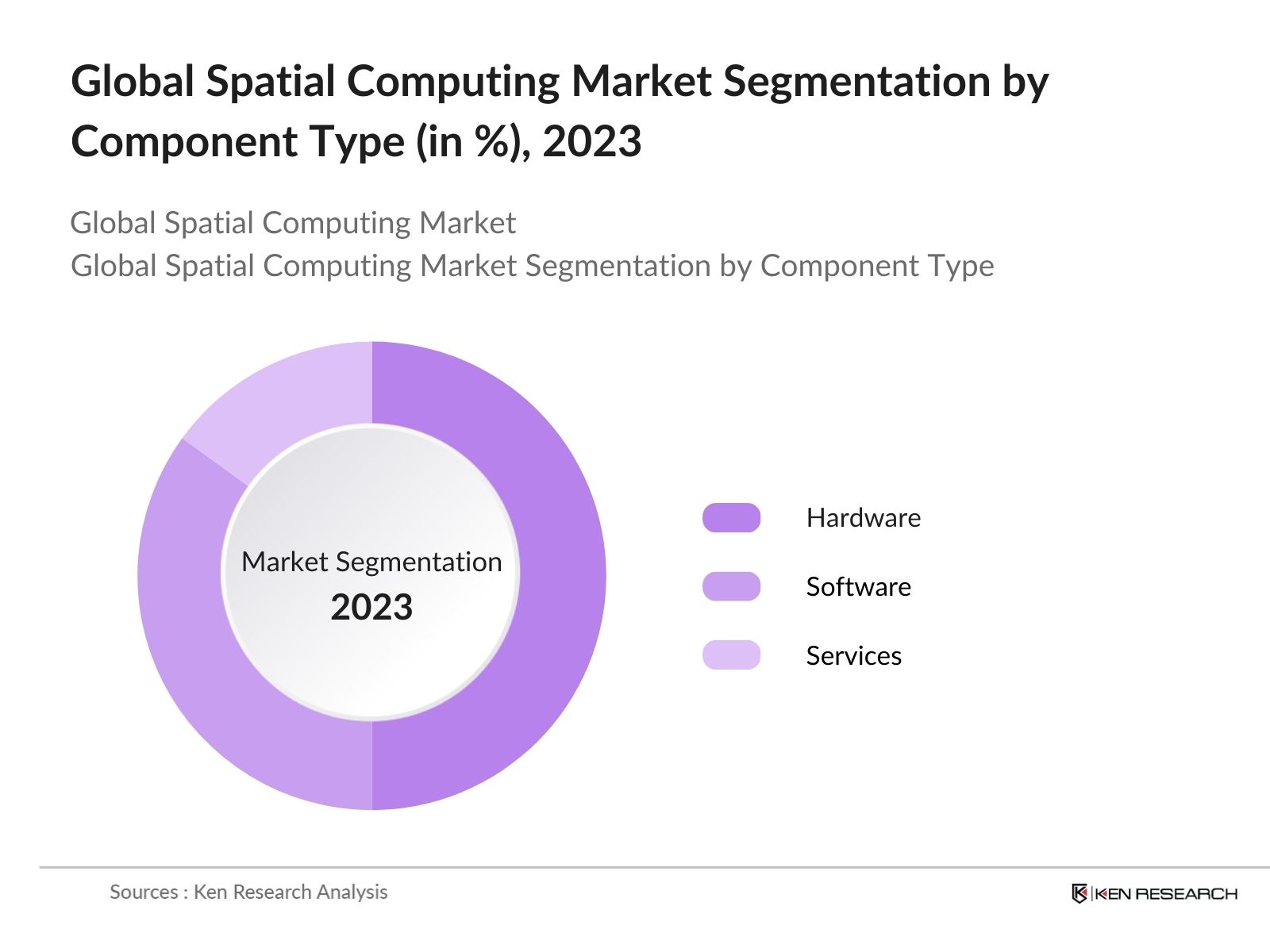
By Component: In 2023, the hardware segment held the largest share of the Asia-Pacific remote patient monitoring market, primarily due to rising demand for advanced AR/VR headsets, spatial sensors, and sophisticated computing devices. These technologies support immersive, interactive experiences that enhance patient engagement and enable more precise remote monitoring. Healthcare providers increasingly rely on these hardware solutions to facilitate real-time data collection and analysis, improving patient outcomes and enabling efficient care management.
|
Component Type |
Market Share (2023) |
|
Hardware |
50% |
|
Software |
35% |
|
Services |
15% |
By Application: The market is segmented into augmented reality, virtual reality, mixed reality, spatial mapping, and geospatial analytics. In 2023, the augmented reality segment accounted for the largest market share, fuelled by the growing use of AR applications in gaming, retail, and industrial training.
|
Application |
Market Share (in %) |
|
Augmented Reality (AR) |
40% |
|
Virtual Reality (VR) |
30% |
|
Mixed Reality (MR) |
15% |
|
Spatial Mapping |
10% |
|
Geospatial Analytics |
5% |
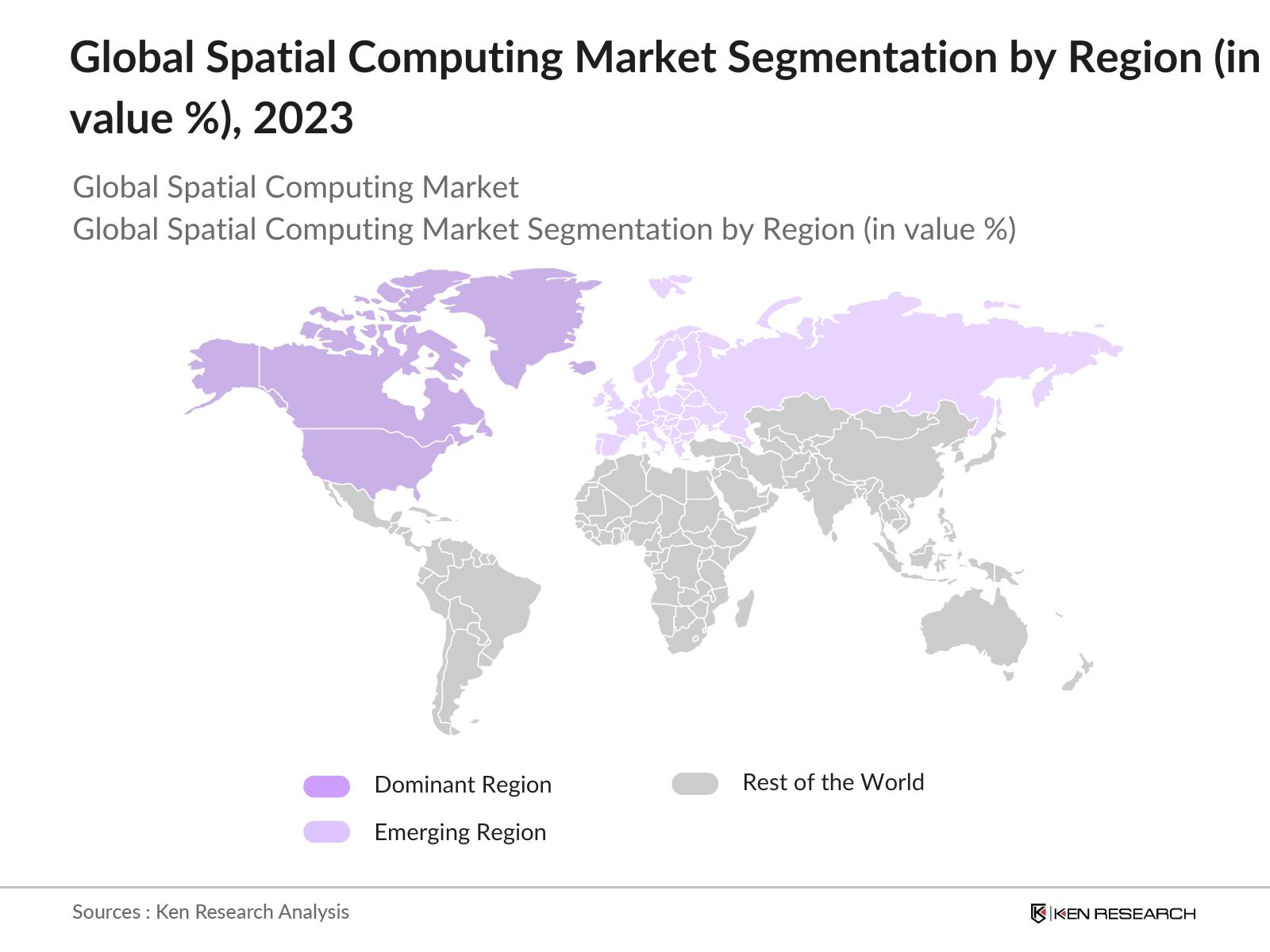
By Region: The global spatial computing market is segmented into North America, Europe, Asia-Pacific (APAC), Middle East & Africa (MEA), and Latin America. In 2023, North America dominated the global spatial computing market, holding the largest share due to its robust technology ecosystem and significant investments in research and development. This region is home to leading tech firms and innovation hubs that drive advancements in spatial computing, including AR, VR, and AI technologies. Government and private sector funding further fuel innovation, enabling the development of applications in sectors like healthcare, manufacturing, and retail.
|
Company |
Establishment Year |
Headquarters |
|
Microsoft Corporation |
1975 |
Redmond, Washington, USA |
|
Apple Inc. |
1976 |
Cupertino, California, USA |
|
Google LLC |
1998 |
Mountain View, California, USA |
|
Magic Leap, Inc. |
2010 |
Plantation, Florida, USA |
|
Meta Platforms, Inc. |
2004 |
Menlo Park, California, USA |
U.S. Federal Funding for Spatial Computing Research: The U.S. government has significantly increased its investment in spatial computing research and development to maintain technological leadership. In 2023, the U.S. Department of Defense allocated USD 150 million for spatial computing projects, focusing on enhancing military training and simulation capabilities. This funding has accelerated the development of advanced spatial computing solutions, supporting both military and commercial applications.
European Unions Digital Strategy for AR/VR: The European Union has implemented a comprehensive digital strategy to promote the adoption of AR/VR technologies across member states. As part of this strategy, the EU launched the "Digital Europe Programme" in 2022, which allocated EUR 200 million for spatial computing initiatives aimed at fostering innovation in digital industries. This initiative supports startups and SMEs in developing cutting-edge AR/VR applications, driving the growth of the spatial computing market in Europe.
The Global Spatial Computing Market is expected to experience robust growth over the next five years, driven by continuous advancements in AR/VR technologies and the increasing integration of spatial computing solutions across various sectors.
|
By Component Type |
Hardware Software Services |
|
By Application |
Augmented Reality (AR) Virtual Reality (VR) Mixed Reality (MR) Spatial Mapping Geospatial Analytics |
|
By End-Use Industry: |
Healthcare Education Retail Manufacturing Others |
|
By Technology |
Computer Vision Machine Learning Spatial Analytics Others |
|
By Region |
North America Europe Asia-Pacific (APAC) Middle East & Africa (MEA) Latin America |
1.1. Definition and Scope
1.2. Market Taxonomy
1.3. Market Growth Rate
1.4. Market Segmentation Overview
2.1. Historical Market Size
2.2. Year-on-Year Growth Analysis
2.3. Key Market Developments and Milestones
3.1. Growth Drivers
3.1.1. Increasing Adoption of AR/VR Technologies
3.1.2. Advancements in AI and Machine Learning
3.1.3. Rising Demand for Spatial Mapping and Geospatial Analysis
3.2. Restraints
3.2.1. Data Privacy and Security Concerns
3.2.2. High Cost of Implementation
3.3. Opportunities
3.3.1. Technological Advancements in Spatial Computing
3.3.2. Expansion in Emerging Markets
3.4. Trends
3.4.1. Integration with AI and Machine Learning
3.4.2. Focus on Immersive Experiences
3.5. Government Regulation
3.5.1. US Governments AI Research Initiative
3.5.2. EUs Digital Strategy for AR/VR
3.6. SWOT Analysis
3.7. Stakeholder Ecosystem
3.8. Competition Ecosystem
4.1. By Component (in Value %)
4.1.1. Hardware
4.1.2. Software
4.1.3. Services
4.2. By Application (in Value %)
4.2.1. Augmented Reality (AR)
4.2.2. Virtual Reality (VR)
4.2.3. Mixed Reality (MR)
4.2.4. Spatial Mapping
4.2.5. Geospatial Analytics
4.3. By End-Use Industry (in Value %)
4.3.1. Healthcare
4.3.2. Education
4.3.3. Retail
4.3.4. Manufacturing
4.3.5. Others
4.4. By Technology (in Value %)
4.4.1. Computer Vision
4.4.2. Machine Learning
4.4.3. Spatial Analytics
4.4.4. Others
4.5. By Region (in Value %)
4.5.1. North America
4.5.2. Europe
4.5.3. Asia-Pacific (APAC)
4.5.4. Middle East & Africa (MEA)
4.5.5. Latin America
5.1. Detailed Profiles of Major Companies
5.1.1. Microsoft Corporation
5.1.2. Apple Inc.
5.1.3. Google LLC
5.1.4. Magic Leap, Inc.
5.1.5. Meta Platforms, Inc.
5.2. Cross Comparison Parameters (No. of Employees, Headquarters, Inception Year, Revenue)
6.1. Market Share Analysis
6.2. Strategic Initiatives
6.3. Mergers and Acquisitions
6.4. Investment Analysis
6.4.1. Venture Capital Funding
6.4.2. Government Grants
6.4.3. Private Equity Investments
7.1. Data Protection Standards
7.2. Compliance Requirements
7.3. Certification Processes
8.1. Future Market Size Projections
8.2. Key Factors Driving Future Market Growth
9.1. By Component (in Value %)
9.2. By Application (in Value %)
9.3. By End-Use Industry (in Value %)
9.4. By Technology (in Value %)
9.5. By Region (in Value %)
10.1. TAM/SAM/SOM Analysis
10.2. Customer Cohort Analysis
10.3. Marketing Initiatives
10.4. White Space Opportunity Analysis
Disclaimer Contact UsEcosystem creation for all major entities and referring to multiple secondary and proprietary databases to perform desk research around the market to collate market-level information.
Collating statistics on the Global Spatial Computing Market over the years, analyzing the penetration of spatial computing technologies, and computing the revenue generated for the market. This step also involves reviewing technology adoption rates and application effectiveness to ensure accuracy behind the data points shared.
Building market hypotheses and conducting CATIs with market experts belonging to different companies to validate statistics and seek operational and financial information from company representatives.
Our team will approach multiple spatial computing companies to understand the nature of technology segments, consumer preferences, and other parameters. This supports validating statistics derived through a bottom-to-top approach from these spatial computing companies, ensuring accuracy and reliability in the report.
The Global Spatial Computing Market was valued at USD 98 billion in 2023, driven by the increasing adoption of AR/VR technologies and the growing demand for advanced spatial mapping and geospatial analytics.
The major players in the global spatial computing market include Microsoft Corporation, Apple Inc., Google LLC, Magic Leap, Inc., and Meta Platforms, Inc., all of which are leaders in providing innovative spatial computing solutions and technologies.
The growth drivers in the global spatial computing market include the increasing adoption of AR/VR technologies, advancements in AI and machine learning, and the rising demand for spatial mapping and geospatial analysis.
The global spatial computing market faces challenges such as data privacy and security concerns, high cost of implementation, and the need for advanced technological infrastructure.

What makes us stand out is that our consultants follows Robust, Refine and Result (RRR) methodology. i.e. Robust for clear definitions, approaches and sanity checking, Refine for differentiating respondents facts and opinions and Result for presenting data with story

We have set a benchmark in the industry by offering our clients with syndicated and customized market research reports featuring coverage of entire market as well as meticulous research and analyst insights.

While we don't replace traditional research, we flip the method upside down. Our dual approach of Top Bottom & Bottom Top ensures quality deliverable by not just verifying company fundamentals but also looking at the sector and macroeconomic factors.

With one step in the future, our research team constantly tries to show you the bigger picture. We help with some of the tough questions you may encounter along the way: How is the industry positioned? Best marketing channel? KPI's of competitors? By aligning every element, we help maximize success.

Our report gives you instant access to the answers and sources that other companies might choose to hide. We elaborate each steps of research methodology we have used and showcase you the sample size to earn your trust.

If you need any support, we are here! We pride ourselves on universe strength, data quality, and quick, friendly, and professional service.