Global Stock Market Outlook to 2030
Region:Global
Author(s):Geetanshi
Product Code:KROD-005
Region:Global
Author(s):Geetanshi
Product Code:KROD-005
June 2025
88
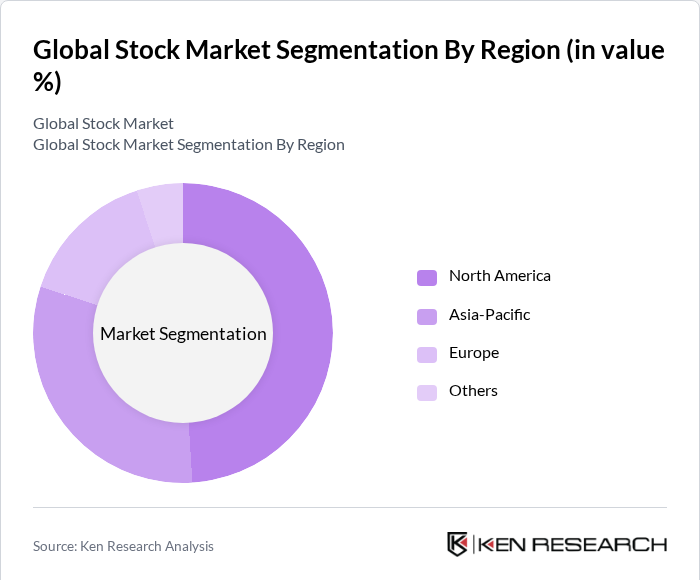
By Region: The Global Stock Market is segmented by region into North America, Asia-Pacific, Europe, and others. North America, led by the United States, dominates with nearly half of the global market capitalization, owing to its mature financial markets, high liquidity, and concentration of institutional investors. The Asia-Pacific region is significant, driven by the economic growth of China, Japan, and India, and marked by increasing retail and institutional investor participation. Europe remains a key player, with major exchanges in the UK, Germany, and France contributing to its market presence.
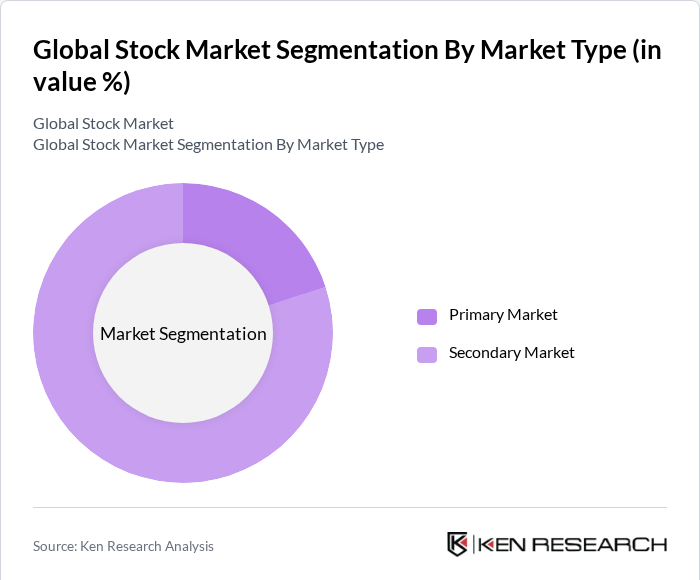
By Market Type: The market is further segmented into primary and secondary markets. The primary market, where new securities are issued, is vital for capital formation and is dominated by initial public offerings (IPOs). The secondary market, where existing securities are traded, is characterized by high liquidity and is heavily influenced by investor sentiment and global market trends. The secondary market accounts for the vast majority of trading volume, making it the focal point for both retail and institutional investors.
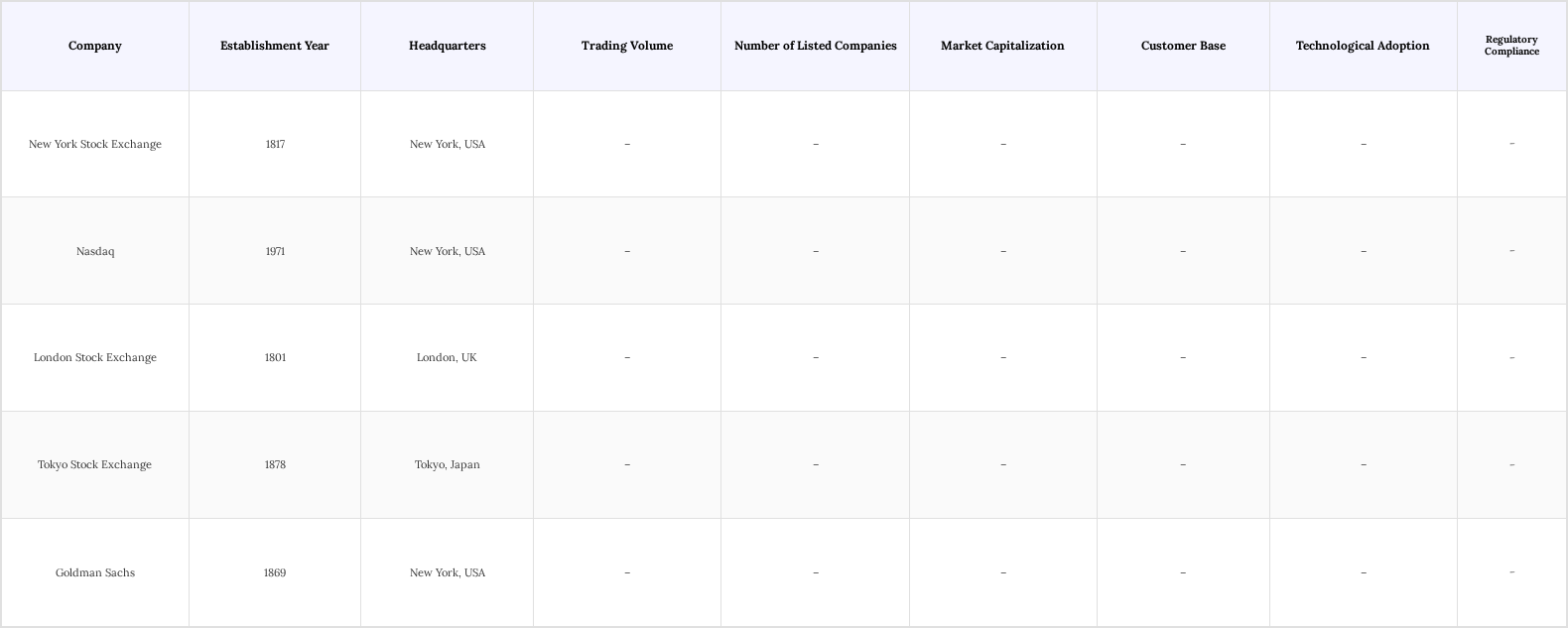
The Global Stock Market features a highly competitive landscape, with major stock exchanges and financial institutions as key players. Leading exchanges such as the New York Stock Exchange (NYSE), Nasdaq, London Stock Exchange (LSE), and Tokyo Stock Exchange (TSE) provide platforms for a vast array of securities. Prominent investment firms, including Goldman Sachs and Morgan Stanley, play significant roles in facilitating trading and providing market insights.
The future of the stock market appears promising, driven by technological advancements and increasing investor engagement. As digital platforms continue to evolve, they will likely enhance trading efficiency and accessibility. Furthermore, the growing emphasis on sustainable investing is expected to reshape investment strategies, attracting a new wave of investors. Overall, the market is poised for growth, with innovations and changing investor preferences playing pivotal roles in its evolution.
| By Region |
North America Asia-Pacific Europe Others |
| By Market Type |
Primary Markets Secondary Markets |
| By Investor Type |
Institutional Investors Retail Investors |
| By Trading Platform |
Online Trading Platforms Traditional Brokerage Firms |
| By Asset Class |
Equities Fixed Income Derivatives Exchange-Traded Funds (ETFs) |
1.1. Definition and Scope
1.2. Market Taxonomy
1.3. Market Growth Rate
1.4. Market Segmentation Overview
2.1. Historical Market Size
2.2. Year-On-Year Growth Analysis
2.3. Key Market Developments and Milestones
3.1. Growth Drivers
3.1.1. Increasing Global Investment Trends
3.1.2. Technological Advancements in Trading Platforms
3.1.3. Rising Participation of Retail Investors
3.2. Market Challenges
3.2.1. Economic Volatility and Uncertainty
3.2.2. Regulatory Changes and Compliance Costs
3.2.3. Market Manipulation and Fraud Risks
3.3. Opportunities
3.3.1. Expansion of Emerging Markets
3.3.2. Growth of Sustainable and Ethical Investing
3.3.3. Innovations in Financial Technology (FinTech)
3.4. Trends
3.4.1. Increasing Use of Artificial Intelligence in Trading
3.4.2. Shift Towards Passive Investment Strategies
3.4.3. Growth of Environmental, Social, and Governance (ESG) Investing
3.5. Government Regulation
3.5.1. Overview of Regulatory Bodies
3.5.2. Impact of Regulations on Market Operations
3.5.3. Compliance with International Standards
3.5.4. Future Regulatory Trends and Implications
3.6. SWOT Analysis
3.7. Stake Ecosystem
3.8. Porter’s Five Forces
3.9. Competition Ecosystem
4.1. By Region
4.1.1. North America
4.1.2. Asia-Pacific
4.1.3. Europe
4.1.4. Others
4.2. By Market Type
4.2.1. Primary Markets
4.2.2. Secondary Markets
4.3. By Investor Type
4.3.1. Institutional Investors
4.3.2. Retail Investors
4.4. By Trading Platform
4.4.1. Online Trading Platforms
4.4.2. Traditional Brokerage Firms
4.5. By Asset Class
4.5.1. Equities
4.5.2. Fixed Income
4.5.3. Derivatives
4.5.4. Exchange-Traded Funds (ETFs)
5.1. Detailed Profiles of Major Companies
5.1.1. New York Stock Exchange
5.1.2. Nasdaq
5.1.3. London Stock Exchange
5.1.4. Tokyo Stock Exchange
5.1.5. Goldman Sachs
5.1.6. Global Equity Exchange
5.1.7. Apex Market Solutions
5.1.8. Horizon Trading Group
5.1.9. Universal Stock Network
5.1.10. Capital Market Innovations
5.2. Cross Comparison Parameters
5.2.1. Market Capitalization
5.2.2. Trading Volume
5.2.3. Number of Listed Companies
5.2.4. Average Daily Turnover
5.2.5. Price-to-Earnings Ratios
5.2.6. Dividend Yield
5.2.7. Market Liquidity
5.2.8. Investor Sentiment Indicators
6.1. Environmental Standards
6.2. Compliance Requirements
6.3. Certification Processes
7.1. Future Market Size Projections
7.2. Key Factors Driving Future Market Growth
8.1. By Region
8.1.1. North America
8.1.2. Asia-Pacific
8.1.3. Europe
8.1.4. Others
8.2. By Market Type
8.2.1. Primary Markets
8.2.2. Secondary Markets
8.3. By Investor Type
8.3.1. Institutional Investors
8.3.2. Retail Investors
8.4. By Trading Platform
8.4.1. Online Trading Platforms
8.4.2. Traditional Brokerage Firms
8.5. By Asset Class
8.5.1. Equities
8.5.2. Fixed Income
8.5.3. Derivatives
8.5.4. Exchange-Traded Funds (ETFs)
9.1. TAM/SAM/SOM Analysis
9.2. Customer Cohort Analysis
9.3. Marketing Initiatives
9.4. White Space Opportunity Analysis
The initial phase involves mapping out the essential components of the Global Stock Market, including key players, market segments, and regulatory frameworks. This step relies on extensive desk research, utilizing secondary data sources such as financial reports, market studies, and academic literature to identify and define the critical variables that impact market behavior and trends.
In this phase, we will gather quantitative and qualitative data from various sources, including stock exchanges, financial institutions, and market analysts. This data will be analyzed to identify trends, correlations, and anomalies within the Global Stock Market, focusing on trading volumes, price movements, and investor sentiment to build a comprehensive market profile.
Based on the insights gained from the data analysis, we will formulate hypotheses regarding market trends and investor behavior. These hypotheses will be tested through statistical methods and models, including regression analysis and time-series forecasting, to validate assumptions and draw meaningful conclusions about market dynamics.
The final phase involves synthesizing the research findings into a coherent report that outlines key insights, trends, and actionable recommendations for stakeholders. This report will be designed to inform investment strategies, policy decisions, and market entry approaches, ensuring that the analysis is both comprehensive and practical for various market participants.
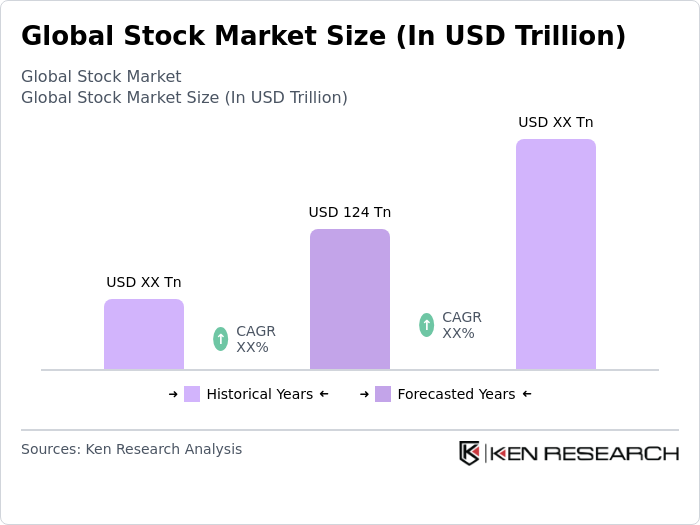
The Global Stock Market is valued at USD 124 trillion, driven by factors such as increasing demand, technological advancements, and supportive government initiatives.
Key challenges in the Global Stock Market include intense competition, regulatory complexities, and infrastructure limitations affecting market dynamics.
Major players in the Global Stock Market include New York Stock Exchange, Nasdaq, London Stock Exchange, Tokyo Stock Exchange, Goldman Sachs, among others.
The primary growth drivers for the Global Stock Market are increasing consumer demand, favorable policies, innovation, and substantial investment inflows.

What makes us stand out is that our consultants follows Robust, Refine and Result (RRR) methodology. i.e. Robust for clear definitions, approaches and sanity checking, Refine for differentiating respondents facts and opinions and Result for presenting data with story

We have set a benchmark in the industry by offering our clients with syndicated and customized market research reports featuring coverage of entire market as well as meticulous research and analyst insights.

While we don't replace traditional research, we flip the method upside down. Our dual approach of Top Bottom & Bottom Top ensures quality deliverable by not just verifying company fundamentals but also looking at the sector and macroeconomic factors.

With one step in the future, our research team constantly tries to show you the bigger picture. We help with some of the tough questions you may encounter along the way: How is the industry positioned? Best marketing channel? KPI's of competitors? By aligning every element, we help maximize success.

Our report gives you instant access to the answers and sources that other companies might choose to hide. We elaborate each steps of research methodology we have used and showcase you the sample size to earn your trust.

If you need any support, we are here! We pride ourselves on universe strength, data quality, and quick, friendly, and professional service.