
Global Thermal Camera Market Outlook 2030
Region:Global
Author(s):Shivani Mehra
Product Code:KROD8574
December 2024
84
About the Report
Global Thermal Camera Market Overview
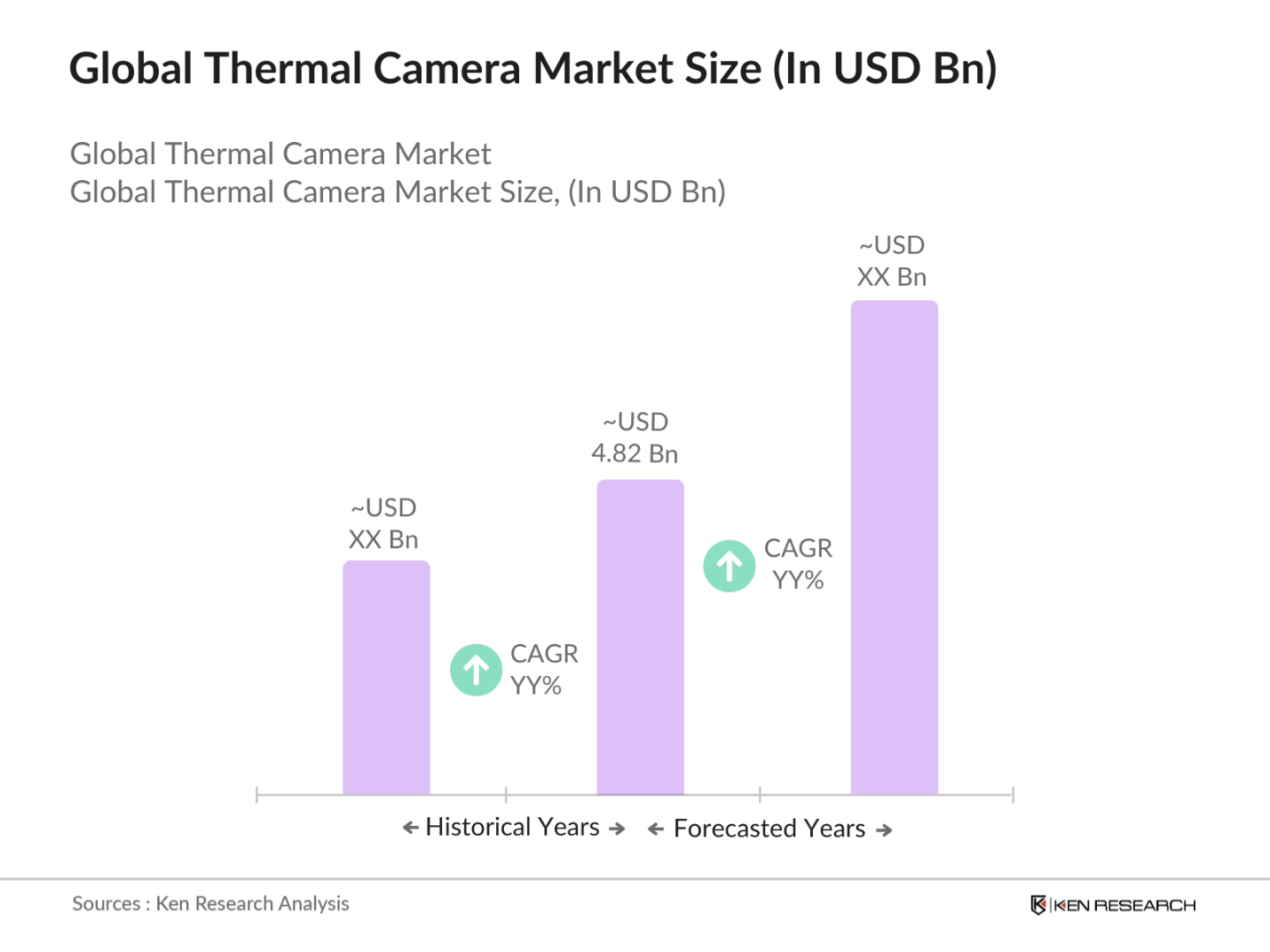
- The global thermal camera market is valued at USD 4.82 billion, primarily driven by the increasing demand for security and surveillance applications across various industries, such as defense, industrial monitoring, automotive, and healthcare. The rise in border surveillance and the adoption of thermal imaging technologies in automotive systems, especially in advanced driver-assistance systems (ADAS), are significant contributors to market growth.
- Countries such as the United States, China, and Israel dominate the thermal camera market due to their strong defense sectors, significant investment in surveillance technology, and technological advancements. The U.S., with its high defense spending and security concerns, leads in terms of technological integration, while China and Israel have rapidly expanded their surveillance and industrial infrastructure, driving demand for thermal imaging solutions. These nations also benefit from having a robust network of manufacturers and innovators in the field.
- Government defense procurement processes are highly regulated, requiring strict adherence to security guidelines for thermal imaging technologies. For instance, NATO countries have specific procurement standards for thermal cameras used in defense applications, ensuring they meet operational safety and confidentiality requirements . This creates opportunities and challenges for manufacturers aiming to supply to defense forces.
Global Thermal Camera Market Segmentation
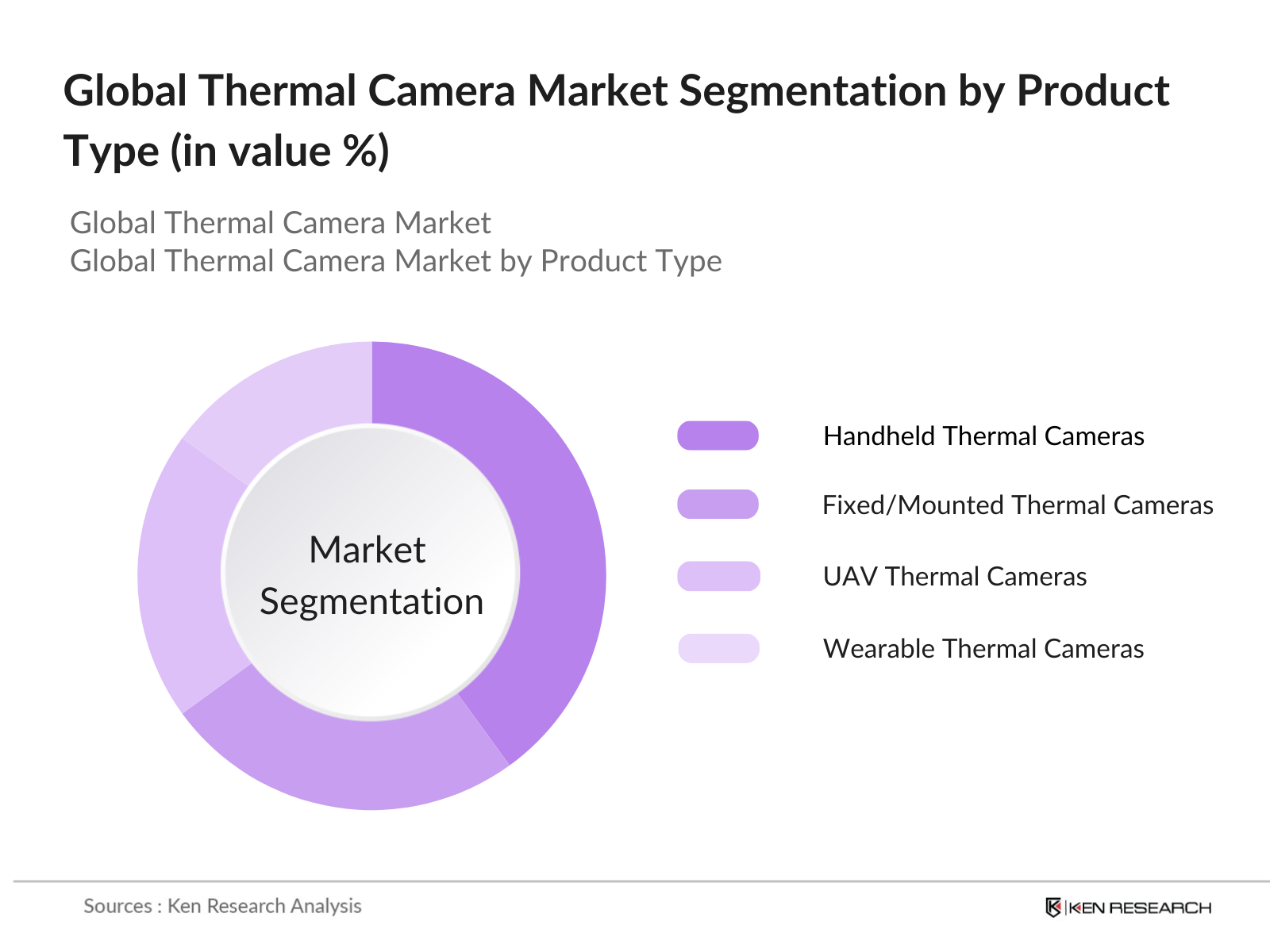
By Product Type: The thermal camera market is segmented by product type into handheld thermal cameras, fixed/mounted thermal cameras, UAV thermal cameras, and wearable thermal cameras. In recent years, handheld thermal cameras have been the dominant segment due to their versatility and widespread use across various sectors, including industrial inspections, firefighting, and law enforcement. Handheld cameras offer portability and ease of use, making them highly preferred for real-time diagnostics and surveillance. The increasing adoption of these cameras by law enforcement for border security further solidifies their position in the market.
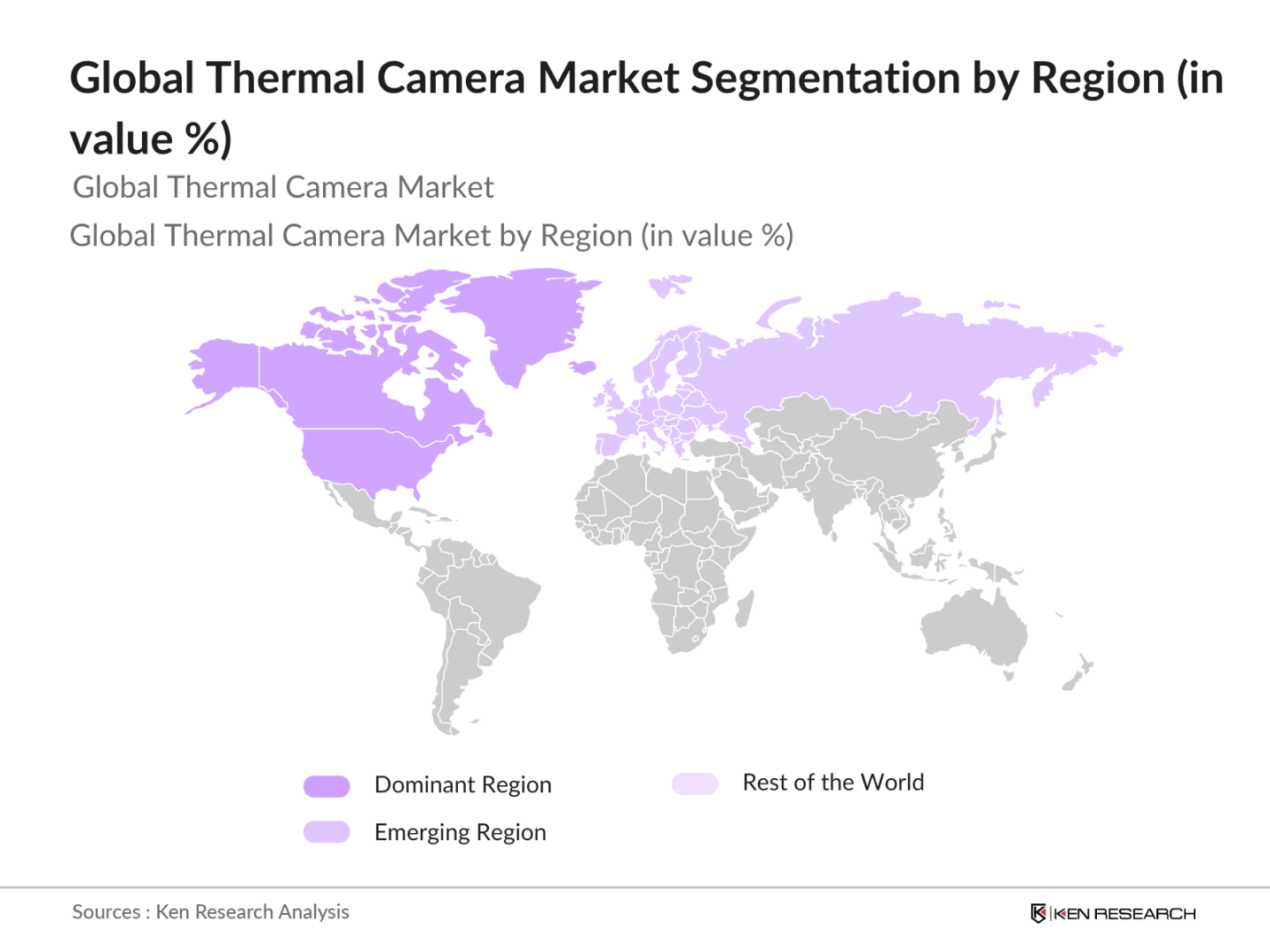
 By Region: The thermal camera market is geographically segmented into North America, Europe, Asia Pacific, Middle East & Africa, and Latin America. North America dominates the market, mainly due to the large-scale defense spending and technological innovations in surveillance and security. The presence of leading manufacturers and strong governmental support for the development of defense technologies ensures that North America remains at the forefront of the thermal camera industry. Moreover, the automotive sectors integration of thermal cameras in ADAS has further contributed to the markets growth in this region.
Global Thermal Camera Market Competitive Landscape
The global thermal camera market is dominated by key players such as FLIR Systems, Leonardo DRS, and Axis Communications. FLIR Systems has maintained its lead due to its extensive range of high-performance thermal imaging products and its dominance in the defense and industrial sectors. Leonardo DRS and Axis Communications also hold a significant market share owing to their strong focus on defense and surveillance applications. The entry of new players, particularly in the Asia Pacific region, has led to an increasing level of competition, with companies focusing on product differentiation and technological innovation.
|
Company |
Establishment Year |
Headquarters |
Revenue (USD Bn) |
No. of Patents |
Product Innovation |
Key Market |
Technological Focus |
|
FLIR Systems |
1978 |
Wilsonville, USA |
|||||
|
Leonardo DRS |
1969 |
Arlington, USA |
|||||
|
Axis Communications |
1984 |
Lund, Sweden |
|||||
|
L3Harris Technologies |
1895 |
Melbourne, USA |
|||||
|
Opgal Optronic Industries |
1983 |
Karmiel, Israel |
Global Thermal Camera Market Analysis
Market Growth Drivers
- Increasing Security Concerns: With escalating global security threats, the demand for thermal cameras in defense and surveillance has surged. In 2022, governments globally invested significantly in defense upgrades. For example, the U.S. allocated $778 billion to its defense budget, with a portion directed towards advanced thermal imaging systems to enhance border and military surveillance . Thermal cameras, with their ability to detect objects through smoke, fog, or darkness, have become critical for enhancing security infrastructure, leading to their integration in key border control agencies .
- Rising Demand for Border Surveillance: Border regions, particularly in volatile areas, have seen increased investment in thermal surveillance technologies. In 2023, the European Union allocated approximately 6 billion towards strengthening border security across member nations, incorporating advanced thermal imaging solutions to monitor illegal border crossings . Thermal cameras play a vital role in securing borders and ensuring real-time threat detection, aiding governments in maintaining control over extensive border areas in difficult weather conditions.
- Adoption of Thermal Imaging in Automotive (ADAS Integration): Thermal imaging has begun integrating with Advanced Driver Assistance Systems (ADAS) in automobiles, improving night-time visibility and pedestrian detection. In 2023, over 60 million vehicles equipped with ADAS were reported globally, with thermal imaging becoming a key component for enhanced safety features . This innovation enhances driver assistance, particularly in low-light conditions, making roads safer and minimizing accidents.
Market Challenges
- High Cost of Thermal Imaging Solutions: Thermal imaging systems, especially those with high resolution and advanced features, remain expensive, restricting their widespread adoption. In 2022, the average cost of thermal cameras for industrial use ranged between $10,000 to $50,000, which is a significant investment for smaller businesses . The high cost of entry poses a challenge for broader adoption across sectors.
- Regulatory Hurdles in Defense Applications: Governments impose strict regulations on the export and use of thermal cameras in defense applications due to national security concerns. The U.S. International Traffic in Arms Regulations (ITAR) governs the export of sensitive thermal imaging technology, creating hurdles for companies looking to expand in the defense sector . These regulations, although necessary, limit the scope of market expansion for thermal camera manufacturers.
Global Thermal Camera Market Future Outlook
Over the next few years, the global thermal camera market is expected to witness significant growth driven by advancements in sensor technologies and increasing adoption in emerging applications such as smart cities, automotive safety, and pandemic control measures. The integration of AI for enhanced image processing and automation will further boost the demand for thermal cameras in industrial and commercial applications. Additionally, the increasing need for border security, especially in the current geopolitical climate, is expected to sustain the demand for high-performance thermal imaging solutions.
Market Opportunities:
- AI Integration for Enhanced Image Analysis: Artificial intelligence (AI) is being integrated with thermal cameras to enhance image processing and analysis. In 2023, AI-based software for thermal imaging applications was widely adopted in surveillance and industrial safety, enabling real-time decision-making . The ability of AI to process large data sets quickly and identify anomalies accurately presents a significant leap in thermal imaging capabilities.
- Growth of Unmanned Aerial Vehicles (UAVs) with Thermal Capabilities: Thermal imaging technology is becoming a standard feature in UAVs, particularly for military, agriculture, and infrastructure inspections. In 2022, the global UAV market was valued at over $30 billion, with thermal camera-equipped drones accounting for a growing share . Their ability to capture thermal images in remote or dangerous areas without human intervention is transforming industries ranging from agriculture to energy.
Scope of the Report
|
By Product Type |
Handheld Thermal Cameras Fixed/Mounted Thermal Cameras UAV Thermal Cameras Wearable Thermal Cameras |
|
By Technology |
Cooled Thermal Imaging Uncooled Thermal Imaging |
|
By Application |
Defense and Surveillance Industrial Monitoring Automotive Healthcare Others |
|
By Wavelength |
Shortwave Infrared (SWIR) Midwave Infrared (MWIR) Longwave Infrared (LWIR) |
|
By Region |
North America Europe Asia Pacific Middle East & Africa Latin America |
Products
Key Target Audience
Defense Ministries (U.S. Department of Defense, Ministry of Defence UK)
Homeland Security Agencies (U.S. Homeland Security, European Border and Coast Guard Agency)
Industrial Equipment Manufacturers
Automotive Manufacturers (ADAS Developers)
Healthcare Providers and Equipment Suppliers
Investment and Venture Capitalist Firms
Government and Regulatory Bodies (Federal Aviation Administration, European Union Agency for Cybersecurity)
Technology Innovators and Developers
Companies
Players Mention in the Report
FLIR Systems
Leonardo DRS
Axis Communications
L3Harris Technologies
Opgal Optronic Industries
BAE Systems
Raytheon Technologies
Hikvision
Wuhan Guide Infrared Co.
FLUKE Corporation
Seek Thermal
Infrared Cameras Inc.
Testo SE & Co. KGaA
Thermoteknix Systems Ltd.
Xenics
Table of Contents
01. Global Thermal Camera Market Overview
1.1. Definition and Scope
1.2. Market Taxonomy
1.3. Market Growth Rate
1.4. Market Segmentation Overview
02. Global Thermal Camera Market Size (In USD Bn)
2.1. Historical Market Size
2.2. Year-On-Year Growth Analysis
2.3. Key Market Developments and Milestones
03. Global Thermal Camera Market Analysis
3.1. Growth Drivers
3.1.1. Increasing Security Concerns
3.1.2. Rising Demand for Border Surveillance
3.1.3. Adoption of Thermal Imaging in Automotive (ADAS integration)
3.1.4. Growing Use of Thermal Cameras in Industrial Inspections
3.2. Market Challenges
3.2.1. High Cost of Thermal Imaging Solutions
3.2.2. Regulatory Hurdles in Defense Applications
3.2.3. Integration and Calibration Complexities
3.3. Opportunities
3.3.1. Increasing Applications in Healthcare (Fever Detection, Pandemic Control)
3.3.2. Technological Advancements (Higher Resolution Sensors)
3.3.3. Expansion in Consumer Electronics (Smartphones, Wearables)
3.4. Trends
3.4.1. AI Integration for Enhanced Image Analysis
3.4.2. Growth of Unmanned Aerial Vehicles (UAVs) with Thermal Capabilities
3.4.3. Increasing Deployment in Smart City Projects
3.5. Government Regulations
3.5.1. Export Control Regulations on Thermal Imaging
3.5.2. Defense Procurement and Security Guidelines
3.5.3. Industry Safety Standards
3.6. SWOT Analysis
3.7. Stakeholder Ecosystem
3.8. Porters Five Forces Analysis
3.9. Competition Ecosystem
04. Global Thermal Camera Market Segmentation
4.1. By Product Type (In Value %)
4.1.1. Handheld Thermal Cameras
4.1.2. Fixed/Mounted Thermal Cameras
4.1.3. UAV Thermal Cameras
4.1.4. Wearable Thermal Cameras
4.2. By Technology (In Value %)
4.2.1. Cooled Thermal Imaging
4.2.2. Uncooled Thermal Imaging
4.3. By Application (In Value %)
4.3.1. Defense and Surveillance
4.3.2. Industrial Monitoring
4.3.3. Automotive
4.3.4. Healthcare
4.3.5. Others (Building Inspection, Wildlife Monitoring)
4.4. By Wavelength (In Value %)
4.4.1. Shortwave Infrared (SWIR)
4.4.2. Midwave Infrared (MWIR)
4.4.3. Longwave Infrared (LWIR)
4.5. By Region (In Value %)
4.5.1. North America
4.5.2. Europe
4.5.3. Asia Pacific
4.5.4. Middle East & Africa
4.5.5. Latin America
05. Global Thermal Camera Market Competitive Analysis
5.1. Detailed Profiles of Major Companies
5.1.1. FLIR Systems Inc.
5.1.2. Leonardo DRS
5.1.3. Axis Communications
5.1.4. L3Harris Technologies
5.1.5. Opgal Optronic Industries
5.1.6. BAE Systems
5.1.7. FLUKE Corporation
5.1.8. Seek Thermal
5.1.9. Infrared Cameras Inc.
5.1.10. Testo SE & Co. KGaA
5.1.11. Raytheon Technologies
5.1.12. Wuhan Guide Infrared Co.
5.1.13. Hikvision
5.1.14. Xenics
5.1.15. Thermoteknix Systems Ltd.
5.2. Cross Comparison Parameters
(No. of Employees, Headquarters, Inception Year, Product Offering, Revenue, Product Innovation, Patents Filed, Certifications)
5.3. Market Share Analysis
5.4. Strategic Initiatives
5.5. Mergers and Acquisitions
5.6. Investment Analysis
5.7. Venture Capital Funding
5.8. Government Grants
5.9. Private Equity Investments
06. Global Thermal Camera Market Regulatory Framework
6.1. Export Regulations
6.2. Defense and Homeland Security Guidelines
6.3. Environmental and Safety Certifications
07. Global Thermal Camera Future Market Size (In USD Bn)
7.1. Future Market Size Projections
7.2. Key Factors Driving Future Market Growth
08. Global Thermal Camera Future Market Segmentation
8.1. By Product Type (In Value %)
8.2. By Technology (In Value %)
8.3. By Application (In Value %)
8.4. By Wavelength (In Value %)
8.5. By Region (In Value %)
09. Global Thermal Camera Market Analysts Recommendations
9.1. TAM/SAM/SOM Analysis
9.2. Customer Cohort Analysis
9.3. Marketing Initiatives
9.4. White Space Opportunity Analysis
Disclaimer Contact UsResearch Methodology
Step 1: Identification of Key Variables
The first step involves mapping all critical stakeholders within the global thermal camera market ecosystem. This is achieved through extensive secondary research using proprietary databases and government reports. The aim is to identify key factors driving market trends, including technological developments and regulatory frameworks.
Step 2: Market Analysis and Construction
Historical data is compiled and analyzed, with a focus on market penetration across different regions and industries. The market performance of thermal cameras in defense, industrial, and healthcare sectors is compared to estimate the overall revenue generation. Key drivers, such as security concerns and pandemic monitoring, are considered in this phase.
Step 3: Hypothesis Validation and Expert Consultation
Industry hypotheses are tested through interviews with senior professionals from leading thermal camera manufacturers. Their insights on product innovation, technological integration, and market growth are used to validate the assumptions. This step also incorporates consultations with defense and healthcare experts to ensure accuracy in market analysis.
Step 4: Research Synthesis and Final Output
The final step involves synthesizing data from both primary and secondary sources, including direct engagement with industry professionals. This ensures that the final market report is comprehensive, accurate, and reflective of the current market trends and dynamics within the thermal camera industry.
Frequently Asked Questions
01. How big is the Global Thermal Camera Market?
The global thermal camera market is valued at USD 4.82 billion, driven by its increased use in defense, healthcare, and industrial applications.
02. What are the key growth drivers of the Global Thermal Camera Market?
Key growth drivers include increasing demand for security and surveillance, the integration of thermal imaging in automotive ADAS systems, and the growing use of thermal cameras for industrial monitoring.
03. Who are the major players in the Global Thermal Camera Market?
Key players in the market include FLIR Systems, Leonardo DRS, Axis Communications, L3Harris Technologies, and Opgal Optronic Industries, who lead the market with their technological innovations and robust defense sector focus.
04. What challenges does the Global Thermal Camera Market face?
Challenges include high production costs of thermal imaging systems, regulatory hurdles in defense applications, and the complexity of integrating these technologies into diverse industrial sectors.
Why Buy From Us?

What makes us stand out is that our consultants follows Robust, Refine and Result (RRR) methodology. i.e. Robust for clear definitions, approaches and sanity checking, Refine for differentiating respondents facts and opinions and Result for presenting data with story

We have set a benchmark in the industry by offering our clients with syndicated and customized market research reports featuring coverage of entire market as well as meticulous research and analyst insights.

While we don't replace traditional research, we flip the method upside down. Our dual approach of Top Bottom & Bottom Top ensures quality deliverable by not just verifying company fundamentals but also looking at the sector and macroeconomic factors.

With one step in the future, our research team constantly tries to show you the bigger picture. We help with some of the tough questions you may encounter along the way: How is the industry positioned? Best marketing channel? KPI's of competitors? By aligning every element, we help maximize success.

Our report gives you instant access to the answers and sources that other companies might choose to hide. We elaborate each steps of research methodology we have used and showcase you the sample size to earn your trust.

If you need any support, we are here! We pride ourselves on universe strength, data quality, and quick, friendly, and professional service.