
Global Tools Market Outlook to 2030
Region:Global
Author(s):Abhinav kumar
Product Code:KROD3108
Region:Global
Author(s):Abhinav kumar
Product Code:KROD3108
November 2024
89
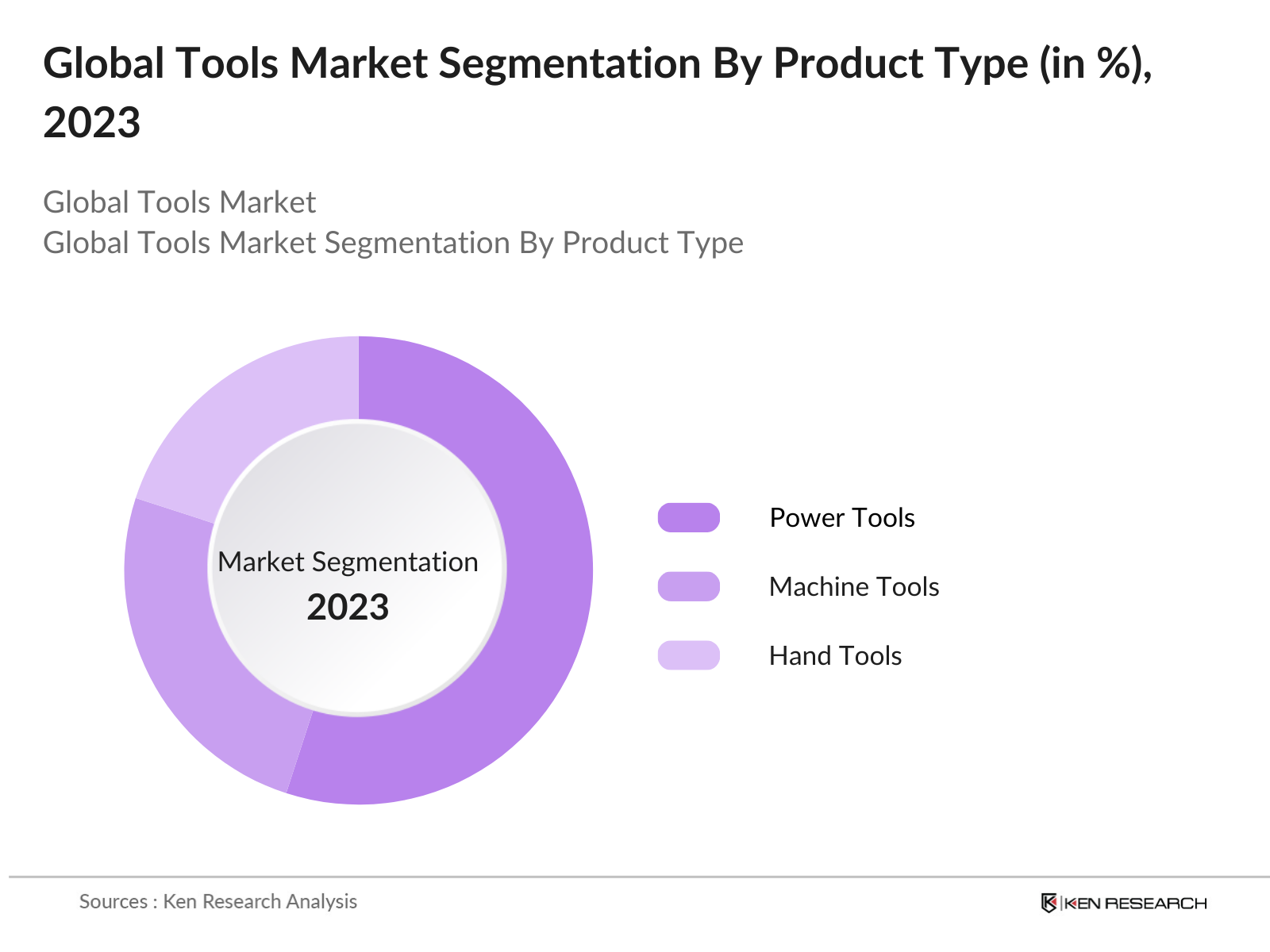
By Product Type: The Global Tools Market is segmented by product type into Hand Tools, Power Tools, and Machine Tools. Power tools have a dominant market share due to their extensive application across industries and enhanced productivity. The high demand for cordless, battery-powered tools, particularly in automotive and construction sectors, has been a driving force behind their popularity.
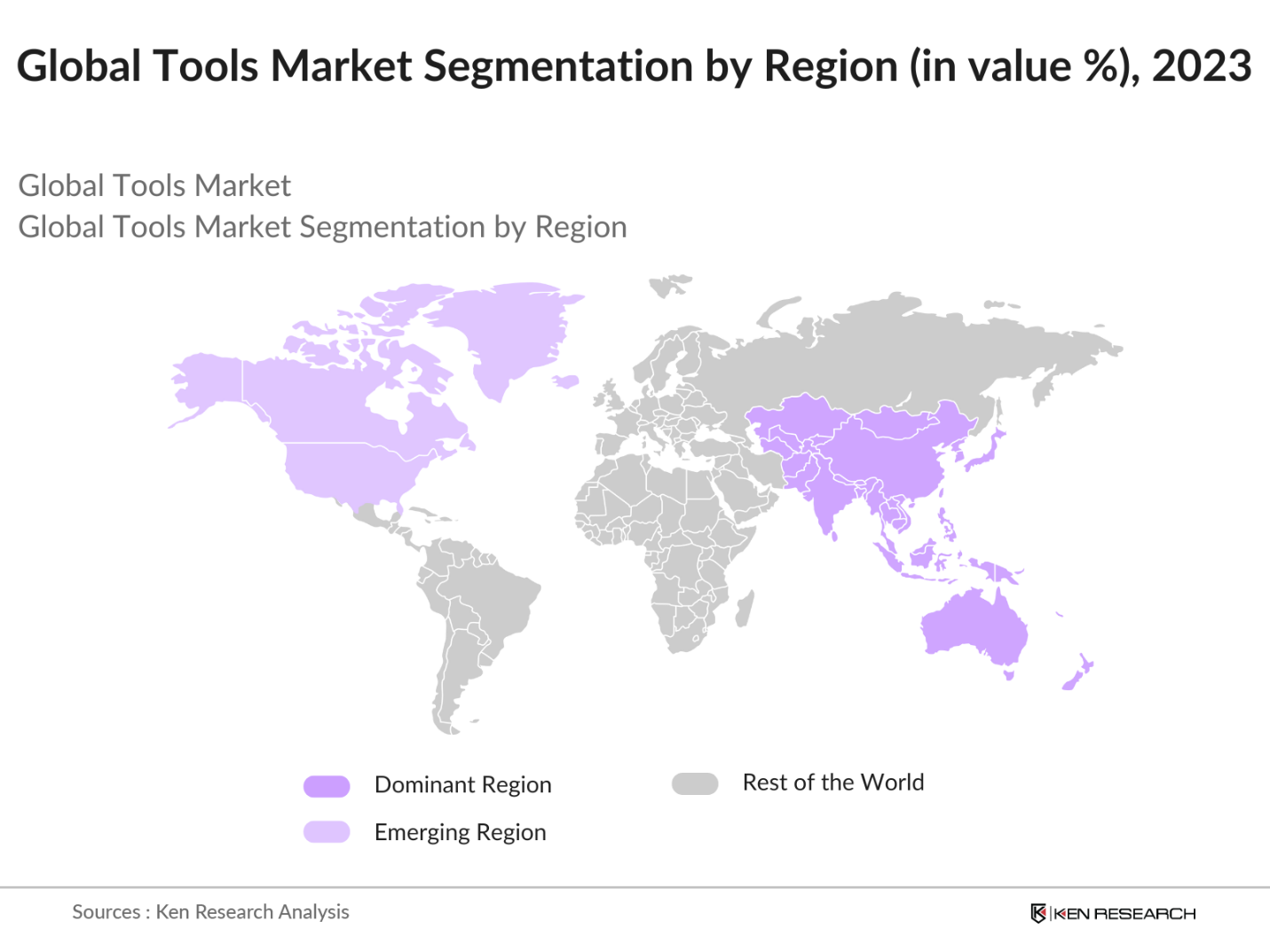
By Region: Regionally, the market is segmented into North America, Europe, Asia-Pacific, Middle East & Africa, and Latin America. Asia-Pacific holds the largest market share, with growing industrialization and substantial investments in infrastructure projects. The rise of manufacturing hubs in countries like China and India has further bolstered this region's dominance.
By Application: The tools market is categorized by application into Construction, Automotive, and Manufacturing sectors. The construction segment dominates this market, mainly due to increased residential and commercial building projects worldwide. The need for durable, efficient, and advanced tools for both small-scale and large-scale projects is pushing demand within this segment.
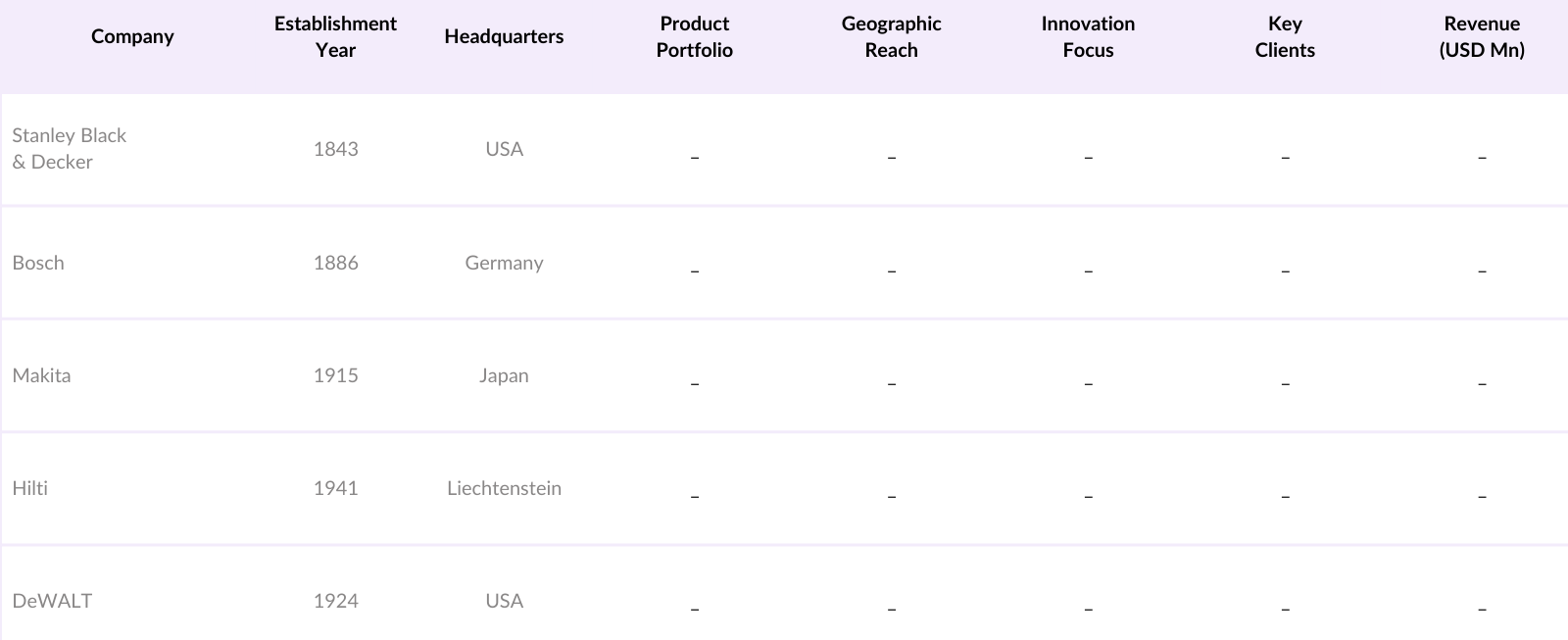
The Global Tools Market is dominated by a few major players who drive innovation and maintain significant influence due to their vast distribution networks and diverse product offerings. The market is led by established players such as Stanley Black & Decker and Bosch, who continually invest in research and development to introduce advanced power tools. Additionally, companies like Makita and Hilti have carved significant market shares by focusing on innovation and quality, particularly in cordless tool technology and ergonomics.
Technological Advancements: With the integration of AI and IoT in tools, the global tools market is experiencing a shift toward smarter functionalities. In 2024, IoT-connected tools in industrial applications are projected to reach 18 million units, supported by AI-driven analytics that enable predictive maintenance and operational efficiencies. According to the World Bank, over 60% of manufacturing firms in developed economies are integrating IoT-based tools to enhance productivity and reduce downtime, increasing their competitiveness globally. This trend aligns with the rise in global industrial output, recorded at 3.5 trillion USD in 2023.
Increasing Industrial Applications: Industries such as automotive, aerospace, and manufacturing are expanding their usage of tools for automation and precision, with a significant rise in demand for advanced power tools. For instance, the automotive industry alone reported the utilization of over 4 million units of power tools globally in 2023. The International Monetary Fund highlighted that manufacturing activities have contributed to 21% of GDP in emerging markets, fostering a higher demand for industrial-grade tools. The current emphasis on enhancing production efficiency drives these applications.
Expanding Construction and Renovation Sector: The construction sector is seeing steady growth in markets like North America and Asia-Pacific, where urban development initiatives have driven the sector's investment to nearly 4 trillion USD in 2024. Construction companies are increasingly purchasing durable and specialized tools to meet safety and efficiency standards. The World Bank notes that China alone completed construction projects worth 1.2 trillion USD in 2023, requiring significant quantities of high-quality tools for both large-scale and small-scale projects.
The Global Tools Market is projected to experience steady growth, fueled by advancements in tool technology, particularly in battery-powered and smart tools. The trend toward eco-friendly, sustainable tools aligns with global environmental initiatives, which is expected to open new opportunities within the sector. Expansion into emerging markets, combined with increased automation, will be pivotal in driving future market growth.
Growth in Emerging Markets: Emerging markets, particularly in Southeast Asia and Africa, present growth potential for the tools market, supported by rising industrialization and infrastructure development. Southeast Asia alone reported industrial expansion of 1.1 trillion USD in 2023, fostering a high demand for professional tools. Government incentives and infrastructure investments in these regions support a robust market entry point for tool manufacturers.
1.1 Definition and Scope
1.2 Market Taxonomy
1.3 Market Dynamics Overview
1.4 Market Segmentation Overview
2.1 Historical Market Size
2.2 Year-On-Year Growth Analysis
2.3 Key Market Developments and Milestones
3.1 Growth Drivers
3.1.1 Technological Advancements (AI, IoT Integration)
3.1.2 Increasing Industrial Applications
3.1.3 Expanding Construction and Renovation Sector
3.1.4 Rise in DIY Trends
3.2 Market Challenges
3.2.1 High Initial Investment
3.2.2 Fluctuations in Raw Material Prices
3.2.3 Skilled Workforce Shortage
3.3 Opportunities
3.3.1 Growth in Emerging Markets
3.3.2 Innovations in Battery-Powered Tools
3.3.3 Demand for Smart Tools
3.4 Trends
3.4.1 Rising Preference for Ergonomically Designed Tools
3.4.2 Shift Towards Environmentally Sustainable Tools
3.4.3 Integration of Automation in Tool Manufacturing
3.5 Government Regulations
3.5.1 Product Safety Standards
3.5.2 Environmental Compliance Requirements
3.5.3 Tax and Tariff Policies Impacting Imports/Exports
3.6 SWOT Analysis
3.7 Stakeholder Ecosystem
3.8 Porters Five Forces
3.9 Competition Ecosystem
4.1 By Product Type (In Value %)
4.1.1 Hand Tools
4.1.2 Power Tools
4.1.3 Machine Tools
4.1.4 Garden Tools
4.1.5 Specialty Tools
4.2 By Application (In Value %)
4.2.1 Construction
4.2.2 Automotive
4.2.3 Manufacturing
4.2.4 DIY (Do-It-Yourself)
4.2.5 Maintenance & Repair Operations
4.3 By Technology (In Value %)
4.3.1 Corded
4.3.2 Cordless
4.3.3 Pneumatic
4.4 By Distribution Channel (In Value %)
4.4.1 Online Retail
4.4.2 Offline Retail
4.4.3 Wholesale
4.4.4 Direct Sales
4.5 By Region (In Value %)
4.5.1 North America
4.5.2 Europe
4.5.3 Asia-Pacific
4.5.4 Middle East & Africa
4.5.5 Latin America
5.1 Detailed Profiles of Major Companies
5.1.1 Stanley Black & Decker
5.1.2 Bosch
5.1.3 Makita Corporation
5.1.4 Hilti Corporation
5.1.5 DeWALT
5.1.6 Snap-On
5.1.7 Techtronic Industries (TTI)
5.1.8 Koki Holdings (HiKOKI)
5.1.9 Apex Tool Group
5.1.10 Emerson Electric Co.
5.1.11 Husqvarna
5.1.12 Ingersoll Rand
5.1.13 Wurth Group
5.1.14 Atlas Copco
5.1.15 RIDGID (Emerson)
5.2 Cross Comparison Parameters (Revenue, Product Portfolio, Geographic Presence, Key Clients, R&D Investment, Strategic Partnerships, Technological Capabilities, Environmental Initiatives)
5.3 Market Share Analysis
5.4 Strategic Initiatives
5.5 Mergers and Acquisitions
5.6 Investment Analysis
5.7 Venture Capital Funding
5.8 Government Grants
5.9 Private Equity Investments
6.1 Occupational Safety Standards
6.2 Environmental Compliance
6.3 Certification Processes for Tools
6.4 Trade and Export Regulations
7.1 Market Size Projections
7.2 Key Factors Driving Future Market Growth
8.1 TAM/SAM/SOM Analysis
8.2 Customer Cohort Analysis
8.3 Marketing Initiatives
8.4 White Space Opportunity Analysis
9.1 Total Addressable Market (TAM), Serviceable Available Market (SAM), Serviceable Obtainable Market (SOM) Analysis
9.2 Customer Cohort Analysis
9.3 Marketing Initiatives
9.4 White Space Opportunity Analysis
Disclaimer Contact UsWe initiated by mapping all significant stakeholders within the Global Tools Market, involving extensive secondary research and proprietary databases to capture industry-level data. This helped us identify crucial variables impacting market dynamics.
Historical data analysis was conducted, assessing the distribution ratio of various tool types and their corresponding revenue contributions. We evaluated service quality benchmarks to ensure revenue estimates align with industry standards.
Market hypotheses were formulated and validated through CATI with industry experts. This provided operational insights from sector leaders, aiding in the refinement of data accuracy.
In the final phase, interactions with leading tool manufacturers and distributors provided deep insights into consumer preferences, product innovation trends, and market positioning. These findings supported our bottom-up approach to deliver a validated and comprehensive analysis of the tools market.
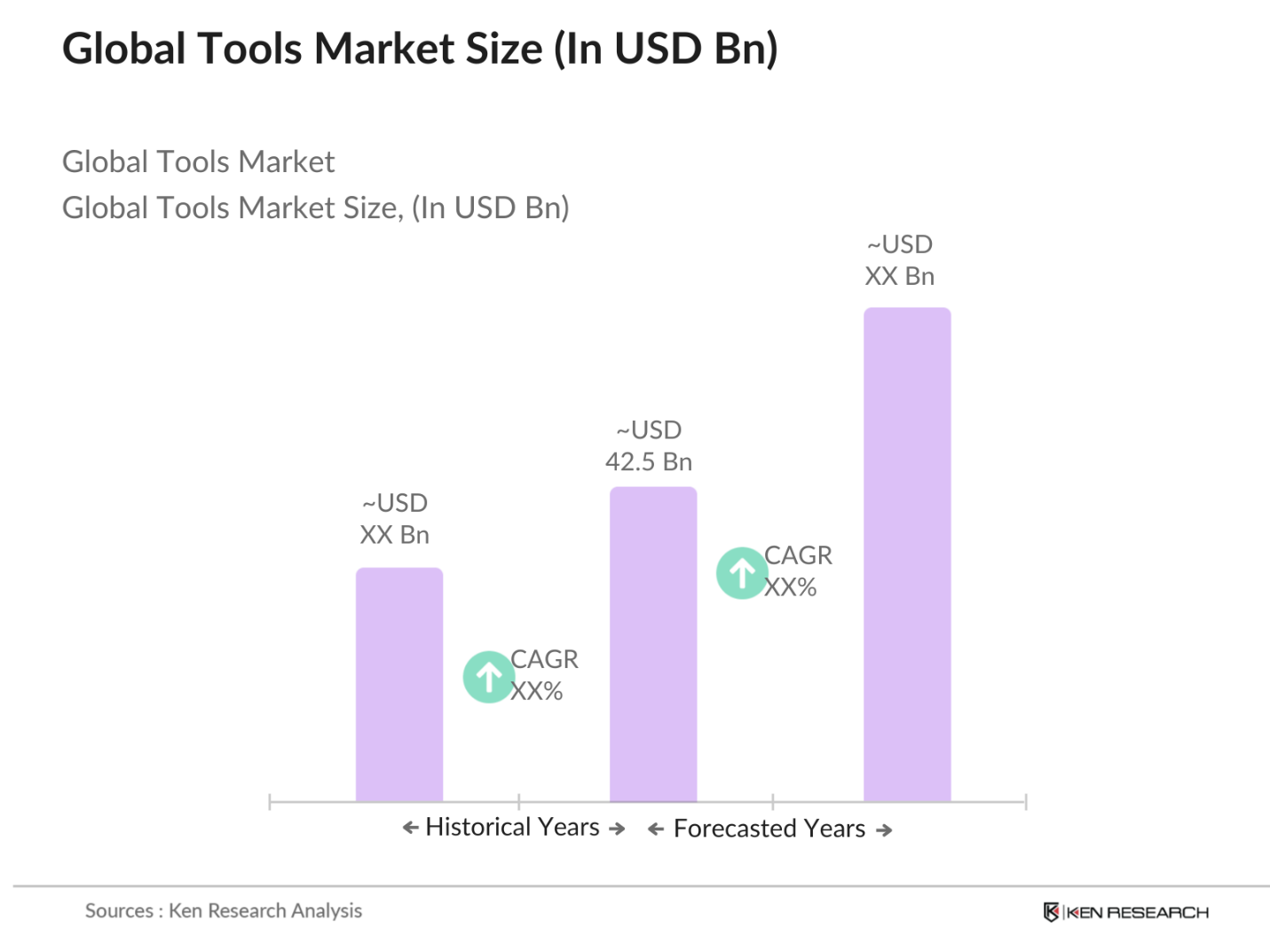
The Global Tools Market is valued at USD 42.5 billion, driven by increasing industrial applications, consumer DIY activities, and infrastructure investments globally.
Key drivers include technological advancements, increased demand from the construction sector, and the shift toward ergonomic, battery-powered tools that enhance user convenience.
Leading companies include Stanley Black & Decker, Bosch, Makita Corporation, Hilti Corporation, and DeWALT, known for their innovation and strong brand presence.
Challenges include fluctuating raw material costs, high initial investment requirements, and a shortage of skilled labor, impacting market growth and operational efficiency.

What makes us stand out is that our consultants follows Robust, Refine and Result (RRR) methodology. i.e. Robust for clear definitions, approaches and sanity checking, Refine for differentiating respondents facts and opinions and Result for presenting data with story

We have set a benchmark in the industry by offering our clients with syndicated and customized market research reports featuring coverage of entire market as well as meticulous research and analyst insights.

While we don't replace traditional research, we flip the method upside down. Our dual approach of Top Bottom & Bottom Top ensures quality deliverable by not just verifying company fundamentals but also looking at the sector and macroeconomic factors.

With one step in the future, our research team constantly tries to show you the bigger picture. We help with some of the tough questions you may encounter along the way: How is the industry positioned? Best marketing channel? KPI's of competitors? By aligning every element, we help maximize success.

Our report gives you instant access to the answers and sources that other companies might choose to hide. We elaborate each steps of research methodology we have used and showcase you the sample size to earn your trust.

If you need any support, we are here! We pride ourselves on universe strength, data quality, and quick, friendly, and professional service.