
Global Trade Management Market Outlook 2030
Region:Global
Author(s):Shivani Mehra
Product Code:KROD11399
December 2024
99
About the Report
Global Trade Management Market Overview
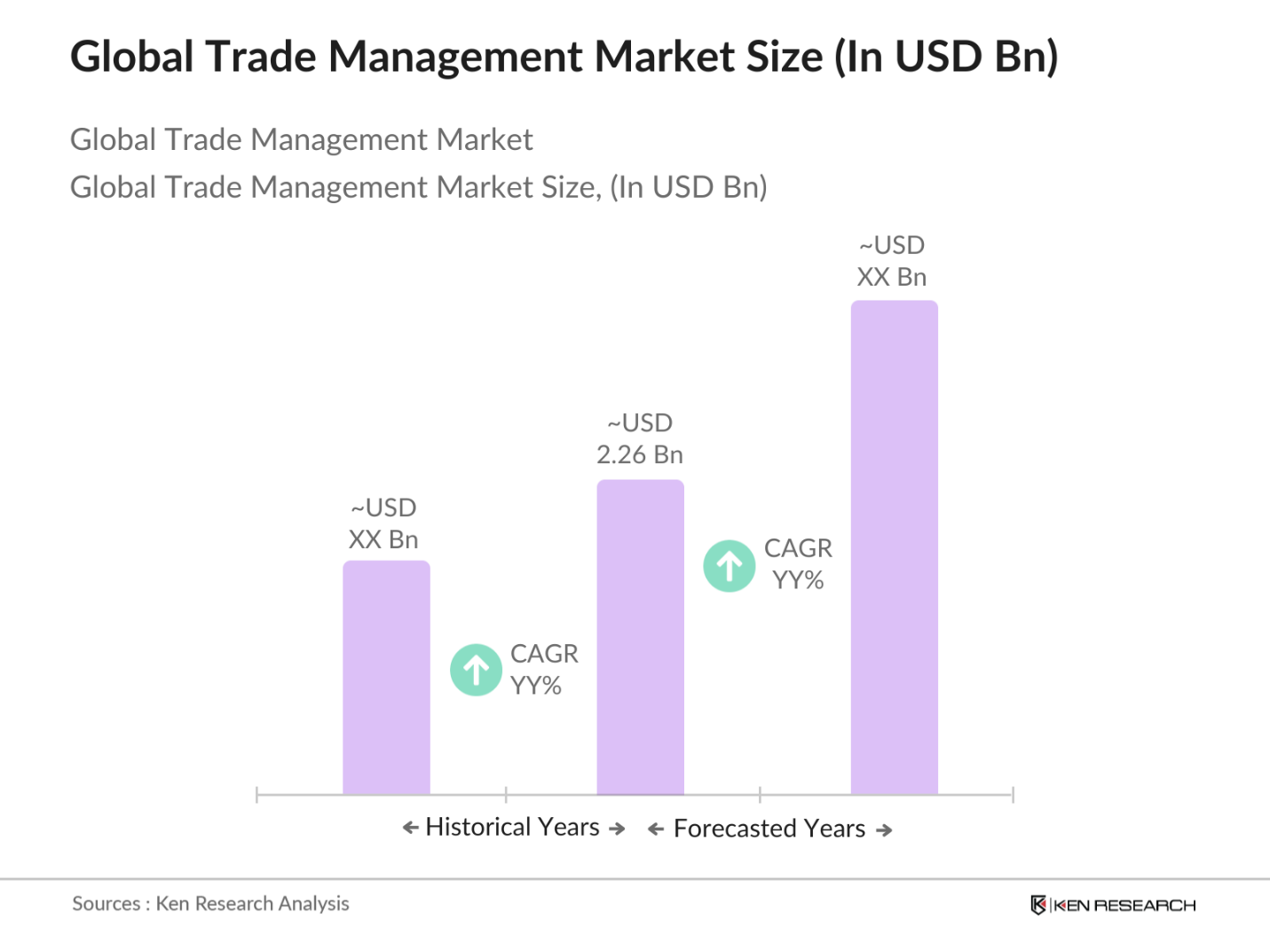
- The global trade management market is valued at USD 2.26 billion, based on a five-year historical analysis, driven by the rising demand for efficient trade management solutions. Key drivers include the increase in global trade volumes, complex regulations across borders, and the growing need for compliance with international trade laws. These factors compel companies to adopt advanced trade management solutions that streamline operations, ensure regulatory compliance, and reduce operational costs. The surge in demand for cloud-based solutions has also contributed to the expansion of this market.
- Countries like the United States, China, and Germany dominate the global trade management market. This dominance is attributed to their high trade volumes, robust export and import infrastructures, and established global supply chains. The United States leads due to its complex trade policies and strict regulatory environment, which requires businesses to adopt sophisticated trade management solutions. Similarly, China's role as a major exporter, and Germany's standing as a European trade hub, give these countries a leading edge in the market.
- The U.S. government, through U.S. Customs and Border Protection (CBP), has implemented the Automated Commercial Environment (ACE) to streamline the import and export process. This platform allows businesses to electronically submit data required by federal agencies, reducing paperwork and expediting trade processes. In 2023, ACE processed over 32 million entry summaries, demonstrating its impact on reducing customs delays and improving trade efficiency. ACE also supports various government programs that focus on compliance, making it essential for businesses engaged in cross-border trade.
Global Trade Management Market Segmentation
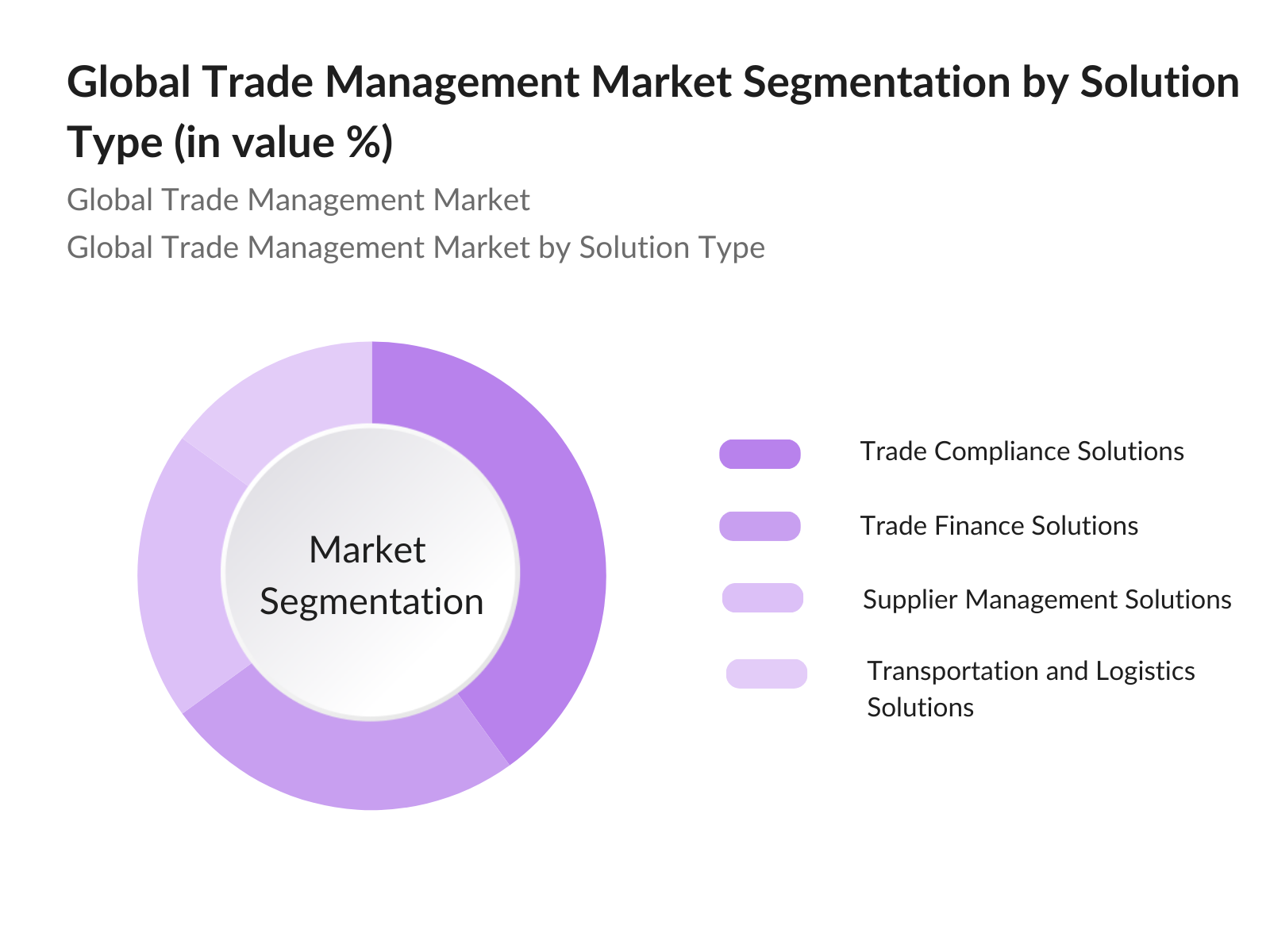
By Solution Type: The global trade management market is segmented by solution type into trade compliance solutions, trade finance solutions, supplier management solutions, and transportation and logistics management solutions. Recently, trade compliance solutions have a dominant market share due to the increasing complexity of global trade regulations and the necessity for businesses to ensure compliance across multiple regions. Companies must adhere to customs rules, tariffs, and sanctions, which increases the demand for solutions that offer real-time regulatory updates and ensure smooth customs clearance.
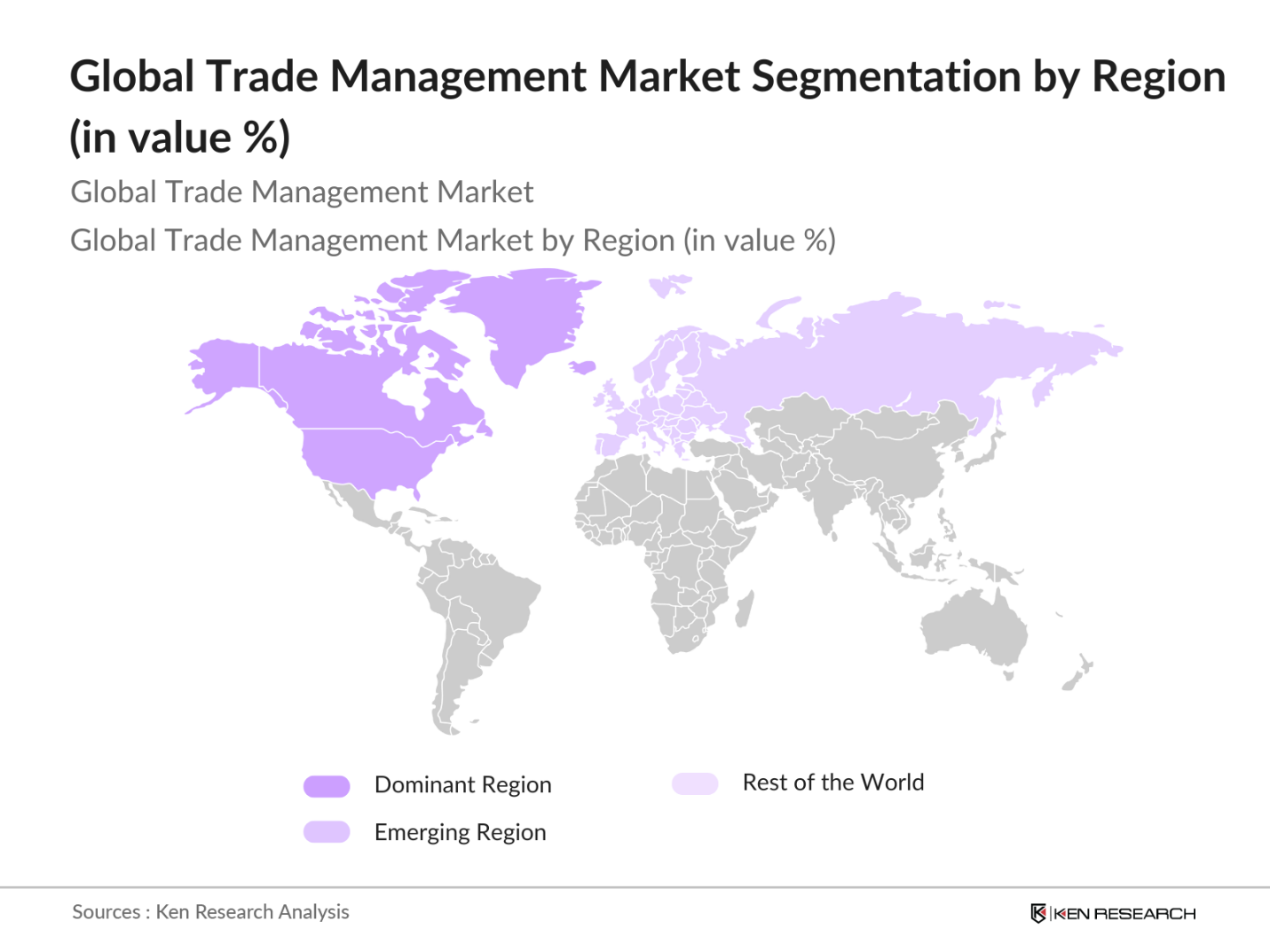
By Region: The global trade management market is also segmented by region, including North America, Europe, Asia-Pacific, Latin America, and the Middle East & Africa. North America holds the dominant market share due to its advanced IT infrastructure, high trade volumes, and strong regulatory frameworks. The presence of major market players and the adoption of advanced trade solutions in the U.S. and Canada also drive regional growth. Additionally, Asia-Pacific is emerging as a key player, driven by the rapid industrialization and increasing trade activities in China and India.
Global Trade Management Market Competitive Landscape
The global trade management market is characterized by the presence of a few key players that dominate the landscape through continuous innovation, partnerships, and strategic acquisitions. Companies in this space offer a wide array of solutions to cater to different industries, from manufacturing to financial services. Major players such as SAP SE and Oracle Corporation continue to enhance their software platforms to support new trade regulations and technologies, including AI and blockchain. This competitive environment fosters both innovation and consolidation as smaller companies are acquired by industry giants.
|
Company Name |
Establishment Year |
Headquarters |
Global Presence |
No. of Employees |
Trade Solutions Offered |
R&D Investment |
Partnerships |
Mergers & Acquisitions |
Product Innovation |
|
SAP SE |
1972 |
Walldorf, Germany |
High |
- |
- |
- |
- |
- |
- |
|
Oracle Corporation |
1977 |
Austin, U.S. |
High |
- |
- |
- |
- |
- |
- |
|
Infor |
2002 |
New York, U.S. |
High |
- |
- |
- |
- |
- |
- |
|
Descartes Systems Group |
1981 |
Waterloo, Canada |
High |
- |
- |
- |
- |
- |
- |
|
Amber Road |
1990 |
New Jersey, U.S. |
Medium |
- |
- |
- |
- |
- |
- |
Global Trade Management Market Analysis
Market Growth Drivers
- Increasing Globalization and International Trade Agreements: Globalization has significantly increased cross-border trade, while international trade agreements, such as the African Continental Free Trade Area (AfCFTA) and the Regional Comprehensive Economic Partnership (RCEP), have lowered trade barriers and fostered smoother flows of goods. These agreements have played a critical role in driving international trade and increasing the demand for robust trade management systems, as businesses navigate the growing complexity of regulatory requirements and compliance challenges.
- Technological Advancements in Trade Management Solutions: Technology is revolutionizing global trade management, with blockchain and AI-enabled platforms improving transparency and efficiency. For instance, trade management solutions integrated with AI-driven analytics have significantly reduced manual processing in leading logistics firms. The deployment of digital solutions such as AI, big data analytics, and blockchain has surged, driven by the need for real-time visibility in global supply chains. The World Economic Forum emphasizes the potential for blockchain to reduce costs and improve transparency in international shipping, supporting smoother trade management processes.
- Regulatory Compliance Mandates: Regulatory frameworks governing international trade have become stricter, particularly around customs clearance, tariffs, and documentation. In 2023, customs delays cost the global economy around $600 billion in lost revenue, mainly due to non-compliance. Countries such as the US, through programs like the Automated Commercial Environment (ACE), have digitized customs procedures, reducing processing time for shipments. This has created a significant demand for solutions that can assist businesses in complying with increasingly complex regulations. In Europe, non-compliance with export controls in 2022 led to penalties exceeding €1 billion, reflecting the importance of regulatory compliance.
Market Challenges:
- Complexities in Global Trade Regulations (Customs, Tariffs): Navigating international trade regulations remains challenging, with over 250 different customs procedures across countries globally. For example, non-compliance with the United States' customs regulations can result in penalties based on the shipment’s value, according to the US Customs and Border Protection. In 2022, many global exporters experienced delays due to incorrect documentation or misinterpreted customs procedures. As governments continue to evolve their tariff and non-tariff barriers, businesses face complexities in ensuring compliance, making it imperative to adopt advanced solutions that streamline regulatory adherence.
- High Initial Costs for Software Implementation: The initial investment required to implement trade management software can be high, particularly for small and medium-sized enterprises (SMEs). This financial barrier often discourages smaller businesses from adopting such systems, despite the long-term efficiency gains. Additionally, ongoing maintenance and updates can add to these costs annually. This has limited the adoption of such systems among SMEs, even though they play a significant role in global trade.
Global Trade Management Market Future Outlook
Over the next five years, the global trade management market is expected to show steady growth driven by increasing globalization, complex international trade regulations, and advancements in trade management technology. Governments and corporations worldwide are investing heavily in digital trade platforms, artificial intelligence, and blockchain to streamline operations and ensure compliance with evolving trade laws. The expansion of e-commerce and cross-border trade flows, along with automation in documentation and logistics, are anticipated to further propel the market's development.
Market Opportunities:
- Integration with Blockchain and IoT for Transparent Trade Management: Blockchain and IoT are offering new avenues for enhancing transparency in trade management. Blockchain enables tamper-proof documentation, which improves trust and reduces fraud in global trade. Meanwhile, IoT devices provide real-time tracking for shipments, enhancing security and reducing losses due to theft or damage. The integration of blockchain and IoT presents a significant growth opportunity for the trade management sector, as these technologies offer improved visibility and operational efficiency.
- Expansion of E-commerce Trade Flows: E-commerce is growing rapidly, creating increased demand for efficient trade management solutions to handle the complexity of cross-border transactions. As more transactions become international, businesses require robust trade management platforms that can manage customs, duties, and cross-border logistics seamlessly. The growing importance of online retail trade further highlights the need for trade solutions capable of handling high transaction volumes efficiently.
Scope of the Report
|
By Solution Type |
Trade Compliance Solutions Trade Finance Solutions Supplier Management Solutions Transportation and Logistics Management Solutions |
|
By Deployment Type |
On-Premise Cloud-Based |
|
By Industry Vertical |
Manufacturing Retail & E-commerce Transportation & Logistics Banking & Financial Services Energy & Utilities |
|
By End-User |
Small & Medium Enterprises (SMEs) Large Enterprises |
|
By Region |
North America Europe Asia-Pacific Latin America Middle East & Africa |
Products
Key Target Audience
Trade & Compliance Managers
Global Supply Chain Professionals
Transportation & Logistics Companies
Software and Cloud Solution Providers
Government & Regulatory Bodies (WTO, ITC)
Investments & Venture Capitalist Firms
Exporters & Importers
Custom Brokers & Freight Forwarders
Companies
Players Mention in the Report
SAP SE
Oracle Corporation
Infor
Descartes Systems Group
Amber Road
Thomson Reuters Corporation
E2open
Integration Point Inc.
MIC Customs Solutions
Aptean
AEB Software
BluJay Solutions Ltd.
Cognizant Technology Solutions
TradeBeam
QAD Inc.
Table of Contents
01. Global Trade Management Market Overview
1.1 Definition and Scope
1.2 Market Taxonomy
1.3 Market Growth Rate
1.4 Market Segmentation Overview
02. Global Trade Management Market Size (In USD Bn)
2.1 Historical Market Size
2.2 Year-On-Year Growth Analysis
2.3 Key Market Developments and Milestones
03. Global Trade Management Market Analysis
3.1 Growth Drivers
3.1.1 Increasing Globalization and International Trade Agreements
3.1.2 Technological Advancements in Trade Management Solutions
3.1.3 Rising Demand for Efficient Supply Chain Operations
3.1.4 Regulatory Compliance Mandates
3.2 Market Challenges
3.2.1 Complexities in Global Trade Regulations (Customs, Tariffs)
3.2.2 High Initial Costs for Software Implementation
3.2.3 Data Security and Privacy Concerns in Digital Solutions
3.3 Opportunities
3.3.1 Integration with Blockchain and IoT for Transparent Trade Management
3.3.2 Expansion of E-commerce Trade Flows
3.3.3 Automation of Trade Documentation and Processes
3.4 Trends
3.4.1 Adoption of AI and Machine Learning for Predictive Analytics in Trade Management
3.4.2 Increasing Use of Cloud-Based Trade Management Solutions
3.4.3 Digitalization of Customs Procedures
3.5 Government Regulation
3.5.1 Global Customs Regulations
3.5.2 Trade Tariff Policies
3.5.3 Export Control Laws
3.6 SWOT Analysis
3.7 Stakeholder Ecosystem
3.8 Porters Five Forces
3.9 Competition Ecosystem
04. Global Trade Management Market Segmentation
4.1 By Solution Type (In Value %)
4.1.1 Trade Compliance Solutions
4.1.2 Trade Finance Solutions
4.1.3 Supplier Management Solutions
4.1.4 Transportation and Logistics Management Solutions
4.2 By Deployment Type (In Value %)
4.2.1 On-Premise
4.2.2 Cloud-Based
4.3 By Industry Vertical (In Value %)
4.3.1 Manufacturing
4.3.2 Retail & E-commerce
4.3.3 Transportation & Logistics
4.3.4 Banking & Financial Services
4.3.5 Energy & Utilities
4.4 By End-User (In Value %)
4.4.1 Small & Medium Enterprises (SMEs)
4.4.2 Large Enterprises
4.5 By Region (In Value %)
4.5.1 North America
4.5.2 Europe
4.5.3 Asia-Pacific
4.5.4 Latin America
4.5.5 Middle East & Africa
05. Global Trade Management Market Competitive Analysis
5.1 Detailed Profiles of Major Companies
5.1.1 SAP SE
5.1.2 Oracle Corporation
5.1.3 Infor
5.1.4 Amber Road, Inc.
5.1.5 Descartes Systems Group Inc.
5.1.6 Thomson Reuters Corporation
5.1.7 E2open
5.1.8 Integration Point Inc.
5.1.9 MIC Customs Solutions
5.1.10 Aptean
5.1.11 AEB Software
5.1.12 BluJay Solutions Ltd.
5.1.13 Cognizant Technology Solutions
5.1.14 TradeBeam
5.1.15 QAD Inc.
5.2 Cross Comparison Parameters (Company Revenue, Global Presence, Trade Management Solutions Offered, Client Base, R&D Investment, Mergers & Acquisitions, Product Innovation, Partnerships & Collaborations)
5.3 Market Share Analysis
5.4 Strategic Initiatives
5.5 Mergers and Acquisitions
5.6 Investment Analysis
5.7 Venture Capital Funding
5.8 Government Grants
5.9 Private Equity Investments
06. Global Trade Management Market Regulatory Framework
6.1 Trade and Customs Standards
6.2 Compliance and Reporting Obligations
6.3 Certification Requirements for Trade Management Solutions
07. Global Trade Management Future Market Size (In USD Bn)
7.1 Future Market Size Projections
7.2 Key Factors Driving Future Market Growth
08. Global Trade Management Future Market Segmentation
8.1 By Solution Type (In Value %)
8.2 By Deployment Type (In Value %)
8.3 By Industry Vertical (In Value %)
8.4 By End-User (In Value %)
8.5 By Region (In Value %)
09. Global Trade Management Market Analysts Recommendations
9.1 TAM/SAM/SOM Analysis
9.2 Customer Cohort Analysis
9.3 Marketing Initiatives
9.4 White Space Opportunity Analysis
Disclaimer Contact UsResearch Methodology
Step 1: Identification of Key Variables
The first phase involves mapping the global trade management ecosystem, focusing on all relevant stakeholders such as exporters, importers, software providers, and government agencies. This step relies on extensive secondary research using industry databases, reports, and proprietary sources to gather the necessary data on market drivers and inhibitors.
Step 2: Market Analysis and Construction
In this phase, historical data on trade volumes, regulation changes, and market growth patterns are analyzed. The analysis includes evaluating the penetration of trade management solutions across different industries and geographic regions. The goal is to assess the demand trajectory for these solutions over the years.
Step 3: Hypothesis Validation and Expert Consultation
Market hypotheses are validated through detailed consultations with industry experts from various sectors, including logistics and compliance professionals. These interviews provide insights into the practical challenges and opportunities that exist in the market, ensuring the accuracy and relevance of our findings.
Step 4: Research Synthesis and Final Output
The final step integrates the findings from the research phases to create a cohesive report. This process involves synthesizing qualitative and quantitative data, followed by a validation phase where additional checks are conducted to ensure the data aligns with current market dynamics.
Frequently Asked Questions
01. How big is the global trade management market?
The global trade management market is valued at USD 2.26 billion, driven by the increasing complexity of international trade and the need for regulatory compliance.
02. What are the major challenges in the global trade management market?
Major challenges include the complex and dynamic nature of trade regulations, high initial costs for software adoption, and ensuring data privacy and security in cloud-based systems.
03. Who are the major players in the global trade management market?
Key players include SAP SE, Oracle Corporation, Descartes Systems Group, Infor, and Amber Road, which dominate the market due to their comprehensive trade management solutions and global presence.
04. What drives growth in the global trade management market?
The market is driven by globalization, regulatory changes, the rising need for compliance management, and advancements in trade management technology, such as cloud-based solutions and AI integration.
Why Buy From Us?

What makes us stand out is that our consultants follows Robust, Refine and Result (RRR) methodology. i.e. Robust for clear definitions, approaches and sanity checking, Refine for differentiating respondents facts and opinions and Result for presenting data with story

We have set a benchmark in the industry by offering our clients with syndicated and customized market research reports featuring coverage of entire market as well as meticulous research and analyst insights.

While we don't replace traditional research, we flip the method upside down. Our dual approach of Top Bottom & Bottom Top ensures quality deliverable by not just verifying company fundamentals but also looking at the sector and macroeconomic factors.

With one step in the future, our research team constantly tries to show you the bigger picture. We help with some of the tough questions you may encounter along the way: How is the industry positioned? Best marketing channel? KPI's of competitors? By aligning every element, we help maximize success.

Our report gives you instant access to the answers and sources that other companies might choose to hide. We elaborate each steps of research methodology we have used and showcase you the sample size to earn your trust.

If you need any support, we are here! We pride ourselves on universe strength, data quality, and quick, friendly, and professional service.