
Global Trench Shoring Market Outlook to 2030
Region:Global
Author(s):Sanjna
Product Code:KROD8601
November 2024
94
About the Report
Global Trench Shoring Market Overview
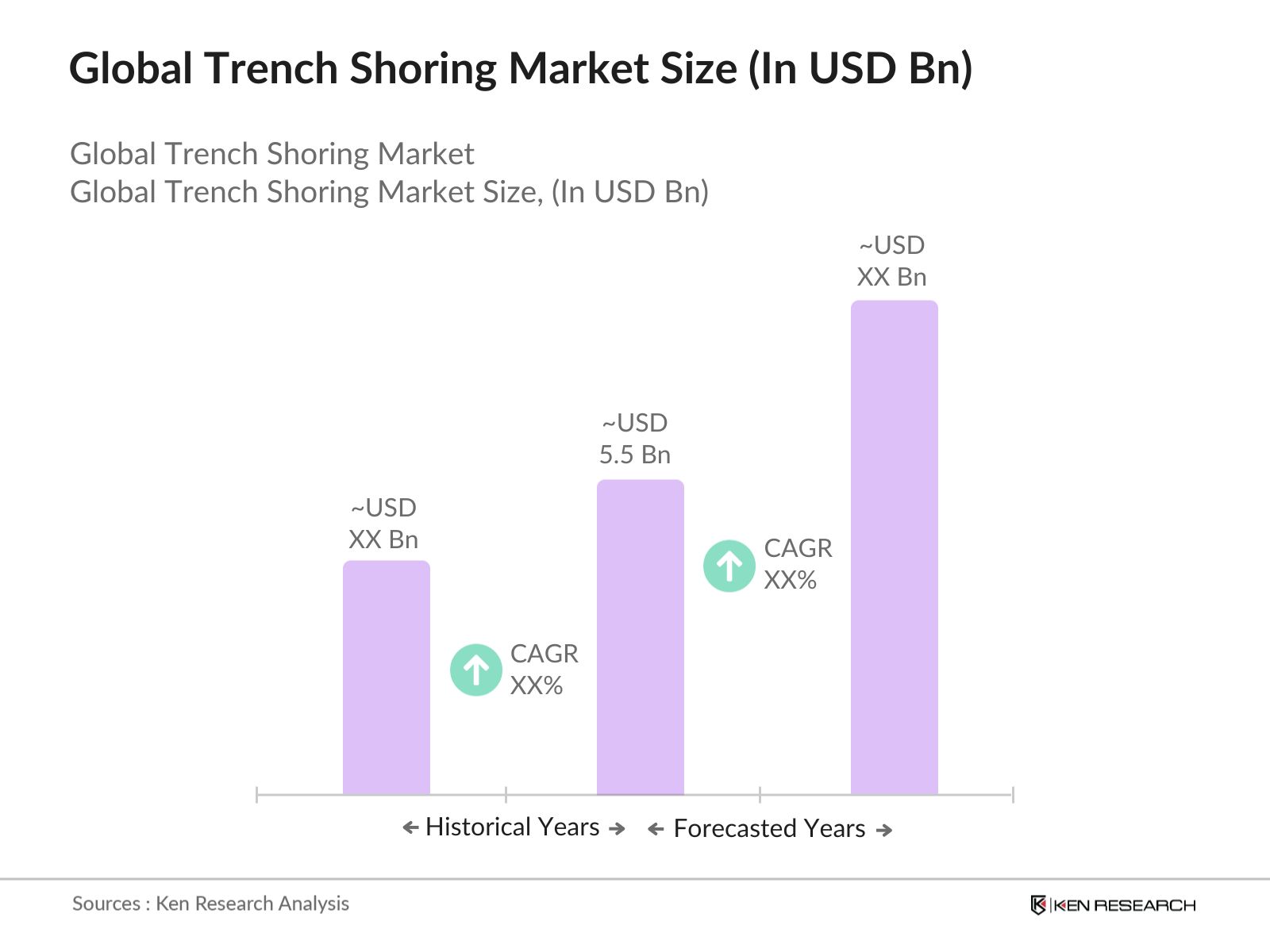
- Global Trench Shoring Market is valued at USD 5.5 billion, based on a five-year historical analysis. This valuation is primarily driven by the rise in global infrastructure projects and stringent safety regulations that emphasize the importance of trench safety in construction and utility works. Governments in regions like North America and Europe are focusing on worker safety through enforcement of Occupational Safety and Health Administration (OSHA) regulations, contributing to the adoption of advanced trench shoring equipment.
- North America and Europe dominate the Global Trench Shoring Market due to strict safety regulations and high government investments in infrastructure development. In North America, the United States leads the market, driven by its established construction industry and compliance with OSHA standards, ensuring worker safety and reducing risks in trench-related accidents. These countries also benefit from a strong demand for sustainable and technologically advanced trench shoring solutions.
- The Occupational Safety and Health Administration (OSHA) enforces stringent regulations on excavation and trench safety, directly impacting the trench shoring market. In 2022, OSHA cited over 2,300 violations related to trench safety, reflecting the importance of compliance for construction firms. The U.S. government has increased inspections, resulting in fines totaling $8 million for non-compliance. These regulations mandate the use of protective systems like trench shoring, driving demand for compliant equipment across the construction industry.
Global Trench Shoring Market Segmentation
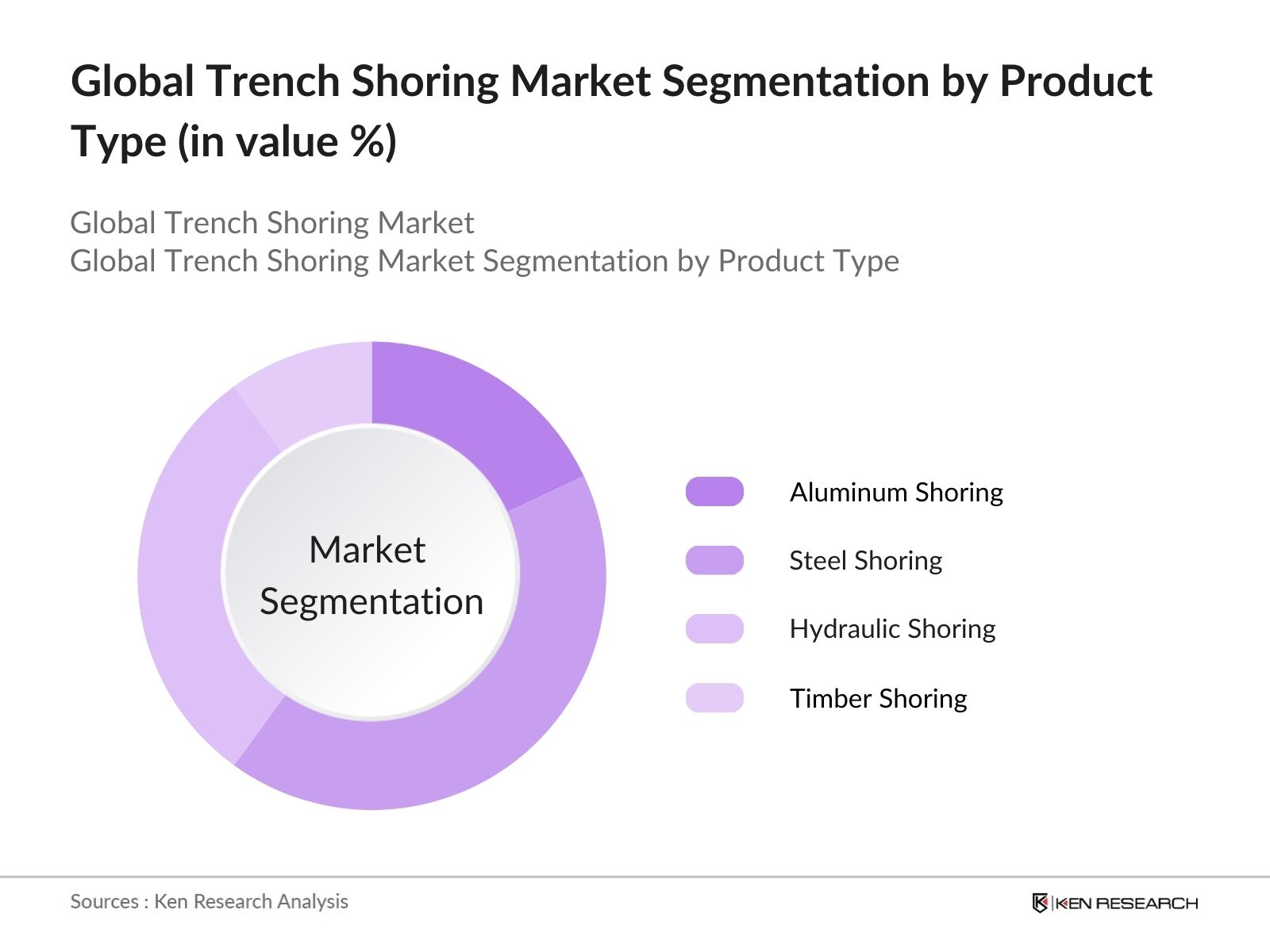
By Product Type: The Global Trench Shoring Market is segmented by product type into aluminum shoring, steel shoring, hydraulic shoring, and timber shoring. Steel shoring holds the dominant market share due to its durability and ability to withstand higher loads, making it the preferred choice in large-scale construction projects. Steel shoring systems provide flexibility in deep excavation works, particularly in the oil and gas and utility sectors, where safety standards are critical. The rising adoption of steel shoring across multiple industries further consolidates its position as a market leader.
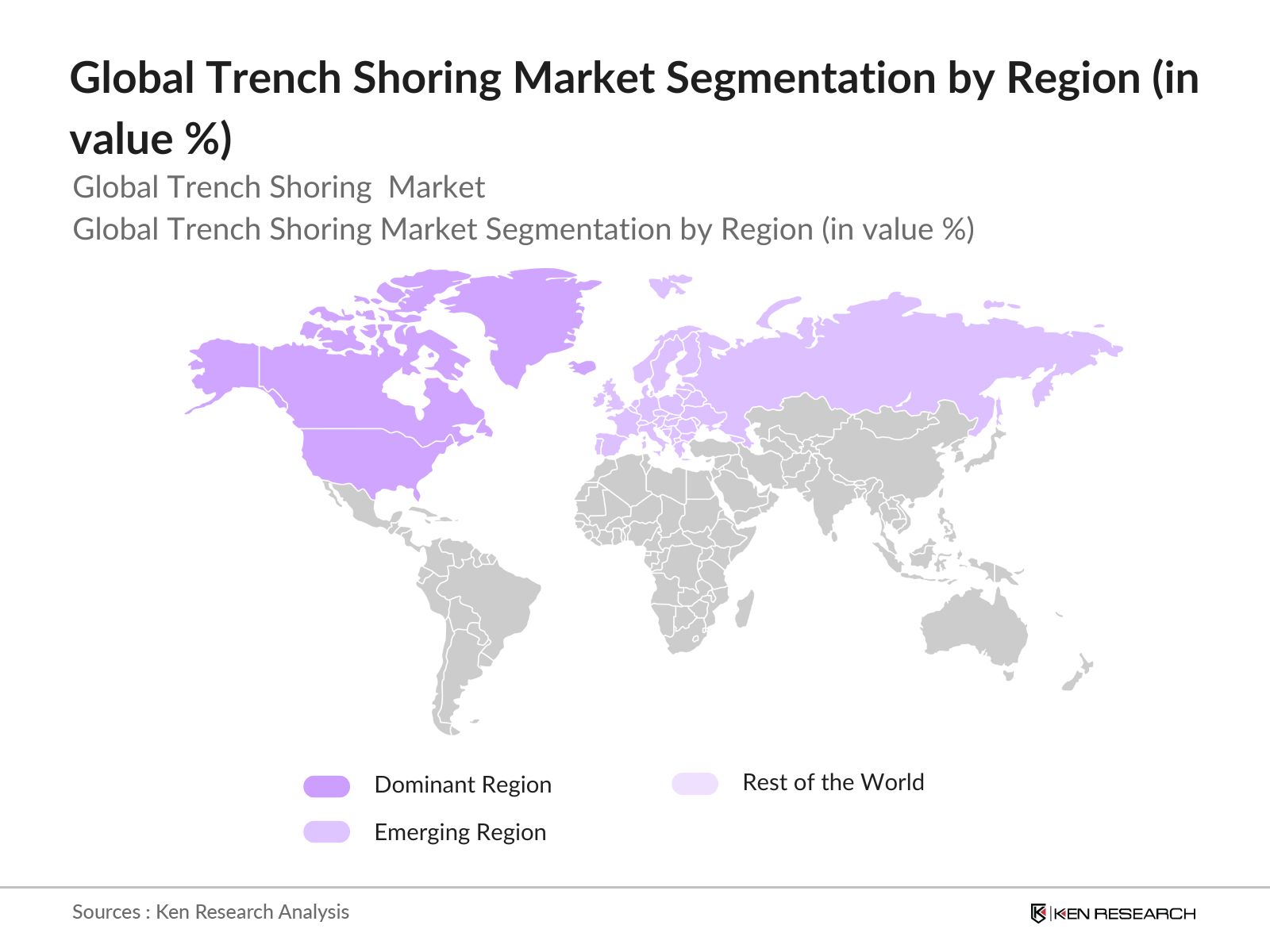
 By Region: The market is segmented by region into North America, Europe, Asia Pacific, Latin America, and the Middle East & Africa. North America holds the largest market share, supported by stringent safety regulations and large-scale infrastructure projects. The U.S. leads the region, benefiting from government initiatives aimed at modernizing infrastructure. Additionally, the presence of major industry players further strengthens the regions market position. Asia Pacific is the fastest-growing region due to rapid urbanization and industrial development in countries like China and India.
By Application: The market is segmented by application into building and construction, oil and gas, utilities, and transportation infrastructure. The utilities segment dominates the market, driven by ongoing investments in utility infrastructure, including water, gas, and electricity distribution networks. The need for safe trenching solutions in utility maintenance and installation ensures continuous demand for shoring products. Moreover, the increasing focus on upgrading aging utility infrastructure in developed economies is bolstering the segments market position.
Global Trench Shoring Market Competitive Landscape
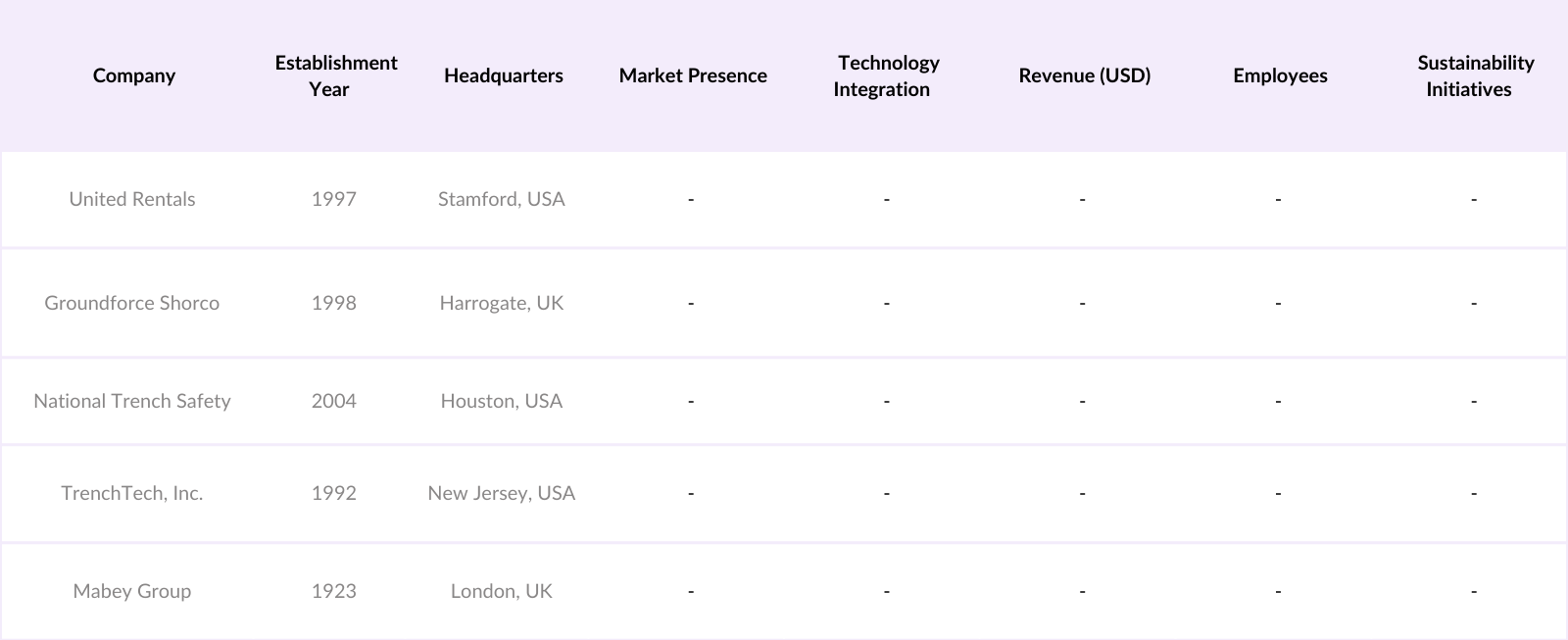
The Global Trench Shoring Market is dominated by a few key players, with companies like United Rentals, Groundforce Shorco, and National Trench Safety leading the market. These players have established a strong presence through their extensive product offerings, advanced technology integration, and regional focus. The consolidation of market share among a few players highlights the significant influence these companies have in setting industry standards and driving innovation.
Global Trench Shoring Market Analysis
Growth Drivers
- Infrastructure Spending: The trench shoring market is seeing growth driven by significant infrastructure investment, particularly in developing economies. In 2022, global infrastructure spending reached $2.1 trillion, with major projects in regions like North America and Asia Pacific. The U.S. government has allocated over $550 billion towards infrastructure as part of its Infrastructure Investment and Jobs Act (IIJA), fueling demand for trench shoring solutions. Similar trends are being observed in India, where the government has planned $1.4 trillion for infrastructure under the National Infrastructure Pipeline by 2025, focusing on urban and transport development.
- Safety Regulations: Regulatory frameworks such as the U.S. Occupational Safety and Health Administration (OSHA) are critical drivers of trench shoring market growth. OSHA mandates strict safety requirements for trench safety, with penalties of up to $14,502 per violation. Additionally, countries like Canada and the UK have reinforced their safety standards for trenching and excavation activities, encouraging adoption of safer and more efficient shoring equipment. The increasing number of construction accidents worldwide, which accounted for 1,092 fatalities in the U.S. alone in 2022, underpins the necessity for enhanced safety practices.
- Environmental Impact Considerations: Environmental regulations are becoming increasingly stringent, particularly regarding the carbon footprint of construction activities. The adoption of environmentally friendly shoring solutions, such as low-emission hydraulic shoring equipment, is growing. In 2023, the global construction industry was responsible for around 40% of total CO2 emissions, prompting governments to enforce stricter guidelines. The EUs Green Deal, which aims to cut emissions by 55% by 2030, has also prompted companies to adopt more sustainable construction methods, including the use of trench shoring systems that minimize environmental impact.
Challenges
- Fluctuating Raw Material Prices: The trench shoring market faces significant challenges due to fluctuating raw material costs. Steel, a primary material in shoring equipment, saw a price increase of over 50% between 2021 and 2022, driven by supply chain disruptions and increased demand from the construction sector. This has led to higher production costs for trench shoring solutions, impacting profitability for manufacturers and contractors alike. According to the World Steel Association, global steel production stood at 1,831.5 million tonnes in 2022, further illustrating the volatility in supply.
- High Training and Certification Costs: The implementation of advanced trench shoring technologies often requires specialized training for workers, which poses a challenge due to the high cost of certification programs. In the U.S., OSHA training courses for trenching and excavation safety can range between $60 and $650 per person, adding to operational costs for contractors. Additionally, certification programs in emerging markets are limited, slowing the adoption of newer and more efficient shoring solutions, further exacerbating the skilled labor shortage in this sector.
Global Trench Shoring Market Future Outlook
The Global Trench Shoring Market is expected to experience steady growth over the next five years, driven by ongoing infrastructure development projects, regulatory pressures, and technological advancements. Increasing investments in public utility infrastructures, such as water and gas pipelines, will fuel demand for reliable trench shoring systems. Moreover, advancements in automation and smart construction technologies will further drive market expansion, providing safer and more efficient trenching solutions to meet the growing needs of various sectors, including construction, oil and gas, and utilities.
Market Opportunities
- Adoption of Modular Shoring Solutions: Modular shoring solutions are gaining traction due to their flexibility and cost-efficiency. These systems can be easily transported and assembled on-site, reducing downtime and labor costs. In 2023, the global modular construction market reached $75 billion, with modular shoring systems playing a critical role in its growth. The adaptability of these systems makes them particularly attractive for large-scale infrastructure projects such as highways and urban redevelopment. The increasing demand for such flexible solutions presents a significant growth opportunity in both developed and emerging markets.
- Growing Demand in APAC: Asia Pacific, particularly China and India, is expected to see strong growth in trench shoring demand, driven by large infrastructure projects. The rapid pace of urbanization in these countries, coupled with government-led infrastructure projects, is creating vast opportunities for shoring equipment providers. This region represents one of the fastest-growing markets for trench shoring solutions.
Products
Key Target Audience
Construction companies
Oil and gas companies
Public utility companies
Infrastructure development firms
Trench shoring equipment manufacturers
Safety training and certification organizations
Investors and venture capital firms
Government and regulatory bodies (OSHA, European Safety Standards Authority)
Companies
Players Mentioned in the Report
United Rentals
Groundforce Shorco
National Trench Safety
TrenchTech, Inc.
Mabey Group
Pro-Tec Equipment
Krings International GmbH
ShoreHire
Efficiency Production, Inc.
HT Group
Table of Contents
1. Global Trench Shoring Market Overview
1.1 Definition and Scope
1.2 Market Taxonomy
1.3 Market Growth Rate
1.4 Market Segmentation Overview
2. Global Trench Shoring Market Size (In USD Mn)
2.1 Historical Market Size
2.2 Year-On-Year Growth Analysis
2.3 Key Market Developments and Milestones
3. Global Trench Shoring Market Analysis
3.1 Growth Drivers (Industry Consolidation, Infrastructure Development, Technological Advancements)
3.1.1 Infrastructure Spending
3.1.2 Safety Regulations
3.1.3 Technological Improvements
3.1.4 Environmental Impact Considerations
3.2 Market Challenges (Lack of Standardization, High Initial Costs, Skilled Workforce Shortage)
3.2.1 Fluctuating Raw Material Prices
3.2.2 High Training and Certification Costs
3.2.3 Dependency on Government Spending
3.2.4 Limited Technological Adaptation in Emerging Markets
3.3 Opportunities (Expansion in Developing Markets, Integration with Smart Construction, Customization Demand)
3.3.1 Adoption of Modular Shoring Solutions
3.3.2 Growing Demand in APAC
3.3.3 Urbanization and Sustainable Infrastructure Development
3.3.4 Integration with Smart Construction Technologies
3.4 Trends (Automation, Digital Twin Integration, Sustainability Focus, Rent-to-Own Models)
3.4.1 Rise of Automated Shoring Equipment
3.4.2 Digital Twin Technology Adoption
3.4.3 Green Construction Practices
3.4.4 Shoring Equipment as a Service
3.5 Government Regulations (OSHA Standards, Environmental Laws, Regional Safety Mandates)
3.5.1 Compliance with OSHA Regulations
3.5.2 Environmental Impact Assessments
3.5.3 Regional and National Safety Standards
3.5.4 Public-Private Partnerships for Infrastructure Safety
3.6 SWOT Analysis
3.7 Stakeholder Ecosystem
3.8 Porters Five Forces
3.9 Competition Ecosystem
4. Global Trench Shoring Market Segmentation
4.1 By Product Type (In Value %)
4.1.1 Aluminum Shoring
4.1.2 Steel Shoring
4.1.3 Hydraulic Shoring
4.1.4 Timber Shoring
4.2 By Application (In Value %)
4.2.1 Building and Construction
4.2.2 Oil and Gas
4.2.3 Utilities
4.2.4 Transportation Infrastructure
4.3 By Shoring Method (In Value %)
4.3.1 Beam and Plate Shoring
4.3.2 Slide Rail Systems
4.3.3 Trench Boxes
4.4 By End-User (In Value %)
4.4.1 Contractors
4.4.2 Municipalities
4.4.3 Utility Companies
4.5 By Region (In Value %)
4.5.1 North America
4.5.2 Europe
4.5.3 Asia Pacific
4.5.4 Latin America
4.5.5 Middle East & Africa
5. Global Trench Shoring Market Competitive Analysis
5.1 Detailed Profiles of Major Companies
5.1.1 Efficiency Production, Inc.
5.1.2 National Trench Safety
5.1.3 TrenchTech, Inc.
5.1.4 Groundforce Shorco
5.1.5 Pro-Tec Equipment
5.1.6 United Rentals
5.1.7 Mabey Group
5.1.8 Krings International GmbH
5.1.9 HT Group
5.1.10 ShoreHire
5.2 Cross Comparison Parameters (No. of Patents, Product Offerings, Regional Presence, Product Customization, Revenue Streams, Safety Certifications, R&D Investments, Customer Satisfaction)
5.3 Market Share Analysis
5.4 Strategic Initiatives
5.5 Mergers And Acquisitions
5.6 Investment Analysis
5.7 Government and Public-Private Partnership Contracts
6. Global Trench Shoring Market Regulatory Framework
6.1 Safety Standards and Certifications
6.2 Environmental Compliance Requirements
6.3 Certification and Approval Processes
7. Global Trench Shoring Future Market Size (In USD Mn)
7.1 Future Market Size Projections
7.2 Key Factors Driving Future Market Growth
8. Global Trench Shoring Future Market Segmentation
8.1 By Product Type (In Value %)
8.2 By Application (In Value %)
8.3 By Shoring Method (In Value %)
8.4 By End-User (In Value %)
8.5 By Region (In Value %)
9. Global Trench Shoring Market Analysts Recommendations
9.1 TAM/SAM/SOM Analysis
9.2 Customer Segment Insights
9.3 Marketing Strategies for Key Players
9.4 White Space Opportunity Analysis
Research Methodology
Step 1: Identification of Key Variables
The initial phase involves mapping the Global Trench Shoring Market by identifying key stakeholders, including manufacturers, end-users, and regulatory bodies. We utilized secondary research through industry databases and proprietary sources to define critical variables such as product penetration and regional adoption.
Step 2: Market Analysis and Construction
Historical data was compiled to assess market dynamics and growth patterns. This phase involved evaluating the market share of key players and segmenting the market based on product type, application, and regional focus. Our analysis ensured the reliability and accuracy of revenue estimates.
Step 3: Hypothesis Validation and Expert Consultation
We consulted industry experts through computer-assisted telephone interviews (CATIs) to validate market hypotheses. These interviews provided operational and financial insights, which were critical for refining our understanding of market trends and product performance.
Step 4: Research Synthesis and Final Output
We engaged with manufacturers to obtain detailed insights into product innovations and consumer preferences. This data, combined with our bottom-up approach, resulted in a comprehensive and validated analysis of the Global Trench Shoring Market.
Frequently Asked Questions
1. How big is the Global Trench Shoring Market?
The Global Trench Shoring Market is valued at USD 5.5 billion, driven by increasing infrastructure development and compliance with safety regulations across key regions such as North America and Europe.
2. What are the challenges in the Global Trench Shoring Market?
Challenges in Global Trench Shoring Market include fluctuating raw material prices, high initial equipment costs, and a shortage of skilled labor. Additionally, dependence on government spending in emerging markets affects overall market stability.
3. Who are the major players in the Global Trench Shoring Market?
Key players in Global Trench Shoring Market include United Rentals, Groundforce Shorco, National Trench Safety, TrenchTech, and Mabey Group. These companies dominate the market due to their extensive product offerings, regional presence, and strong technology integration.
4. What are the growth drivers of the Global Trench Shoring Market?
Global Trench Shoring Market is propelled by increasing investments in infrastructure, stringent safety regulations, and the growing demand for technologically advanced shoring solutions. The adoption of automation and digital twin technology also contributes to market growth.
Why Buy From Us?

What makes us stand out is that our consultants follows Robust, Refine and Result (RRR) methodology. i.e. Robust for clear definitions, approaches and sanity checking, Refine for differentiating respondents facts and opinions and Result for presenting data with story

We have set a benchmark in the industry by offering our clients with syndicated and customized market research reports featuring coverage of entire market as well as meticulous research and analyst insights.

While we don't replace traditional research, we flip the method upside down. Our dual approach of Top Bottom & Bottom Top ensures quality deliverable by not just verifying company fundamentals but also looking at the sector and macroeconomic factors.

With one step in the future, our research team constantly tries to show you the bigger picture. We help with some of the tough questions you may encounter along the way: How is the industry positioned? Best marketing channel? KPI's of competitors? By aligning every element, we help maximize success.

Our report gives you instant access to the answers and sources that other companies might choose to hide. We elaborate each steps of research methodology we have used and showcase you the sample size to earn your trust.

If you need any support, we are here! We pride ourselves on universe strength, data quality, and quick, friendly, and professional service.