Region:Global
Product Code:KRBR57
Invalid Date
150
Market Overview:
UV radiation is a form of electromagnetic radiation or energy emitted by the sun and man-made sources such as phototherapy, welders, tanning beds, and solariums. Additionally, they are categorized into three categories: ultraviolet A (UV-A), ultraviolet B (UV-B), and ultraviolet C (UV-C). UV Light Emitting Diodes (LEDs) are a form of electromagnetic radiation that emits light in the ultraviolet (UV) spectrum at a higher frequency, which is used in a variety of applications, such as light curing, disinfection, military, plant factory (an indoor vertical farming system), exhaust gas treatment, gemological, and medical fields. The significant advantage of using UV LEDs is that they are environmentally friendly as they consume less energy, do not contain harmful mercury, and do not generate ozone.
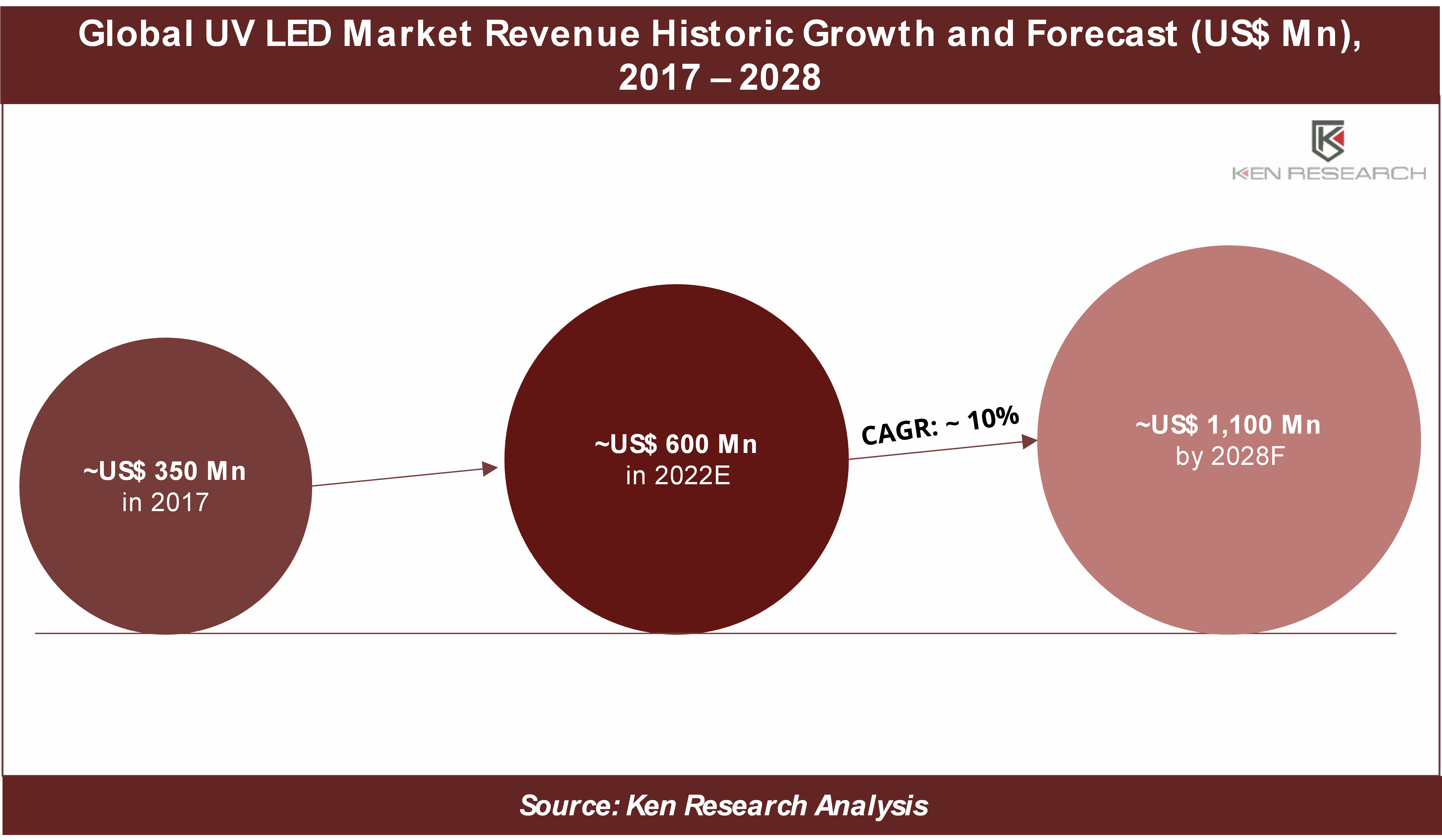
According to Ken Research Analysis, the global UV LED market was valued at ~USD 350 million in 2017, it is estimated to be ~USD 600 million in 2022, and is expected to reach a market size of ~US$ 1,100 million by 2028 growing with a CAGR of 10%. The growth is primarily attributed to the increasing adoption of smart home devices across countries. The growing trend of horticulture and indoor farming in developing countries is also a major contributing factor to UV LED growth.
Scope of the Report:
The UV LED Market is segmented by Product Type, Application, and End-User. In addition, the report also covers the market size for each of the five regions' UV LED markets. The revenue used to size and forecast the market for each segment is USD billion.
|
By Product Type |
|
|
By Application |
|
|
By End User |
|
|
By Geography |
|
|
Key Players |
|
Key Trends by Market Segment
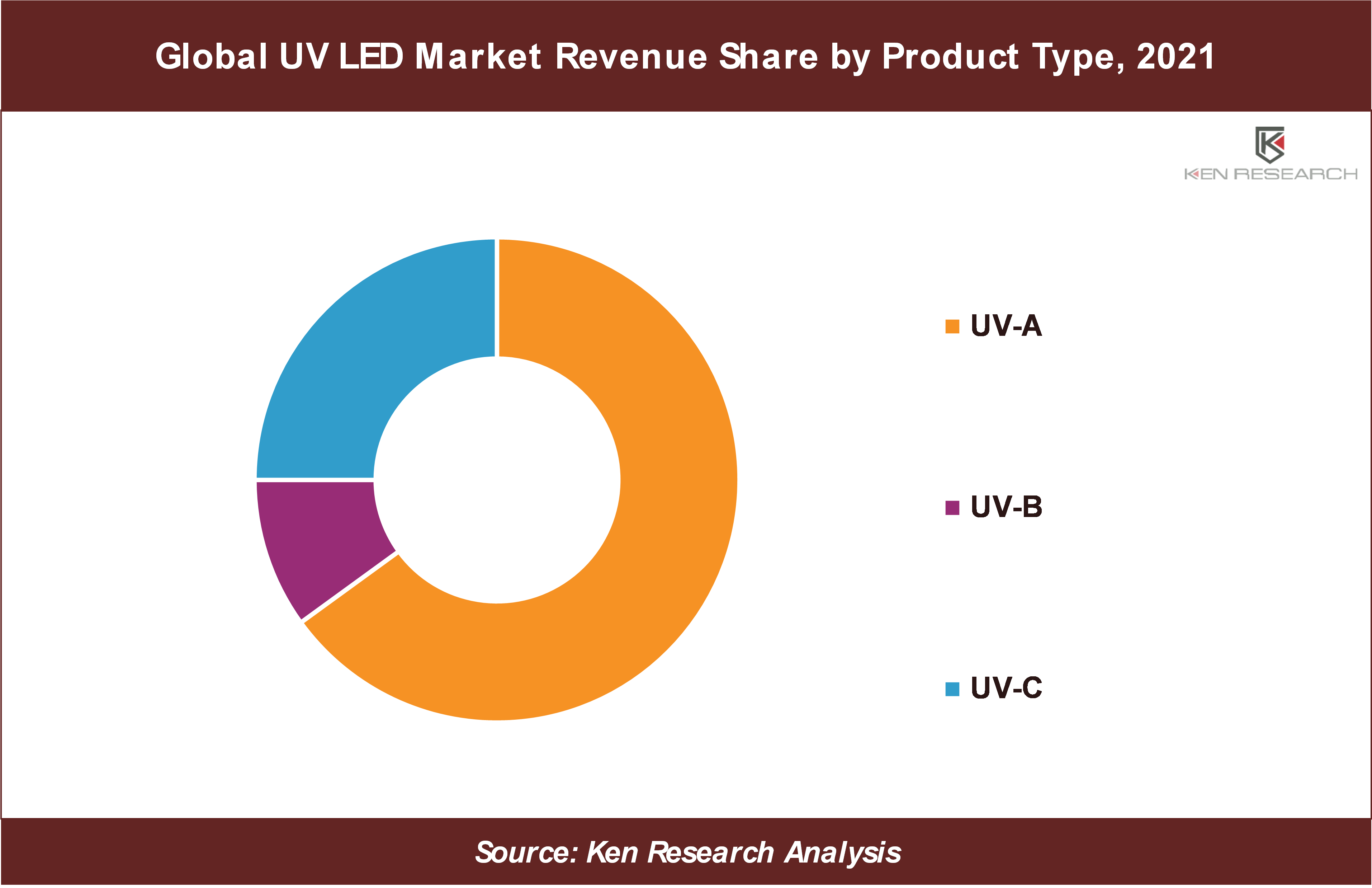
By Product Type: TheUV-A segment held the largest market share of the Global UV LED Market in 2021.
- UV-A (315-400 nm)
- UV-B (280-315 nm)
- UV-C (100-280 nm)

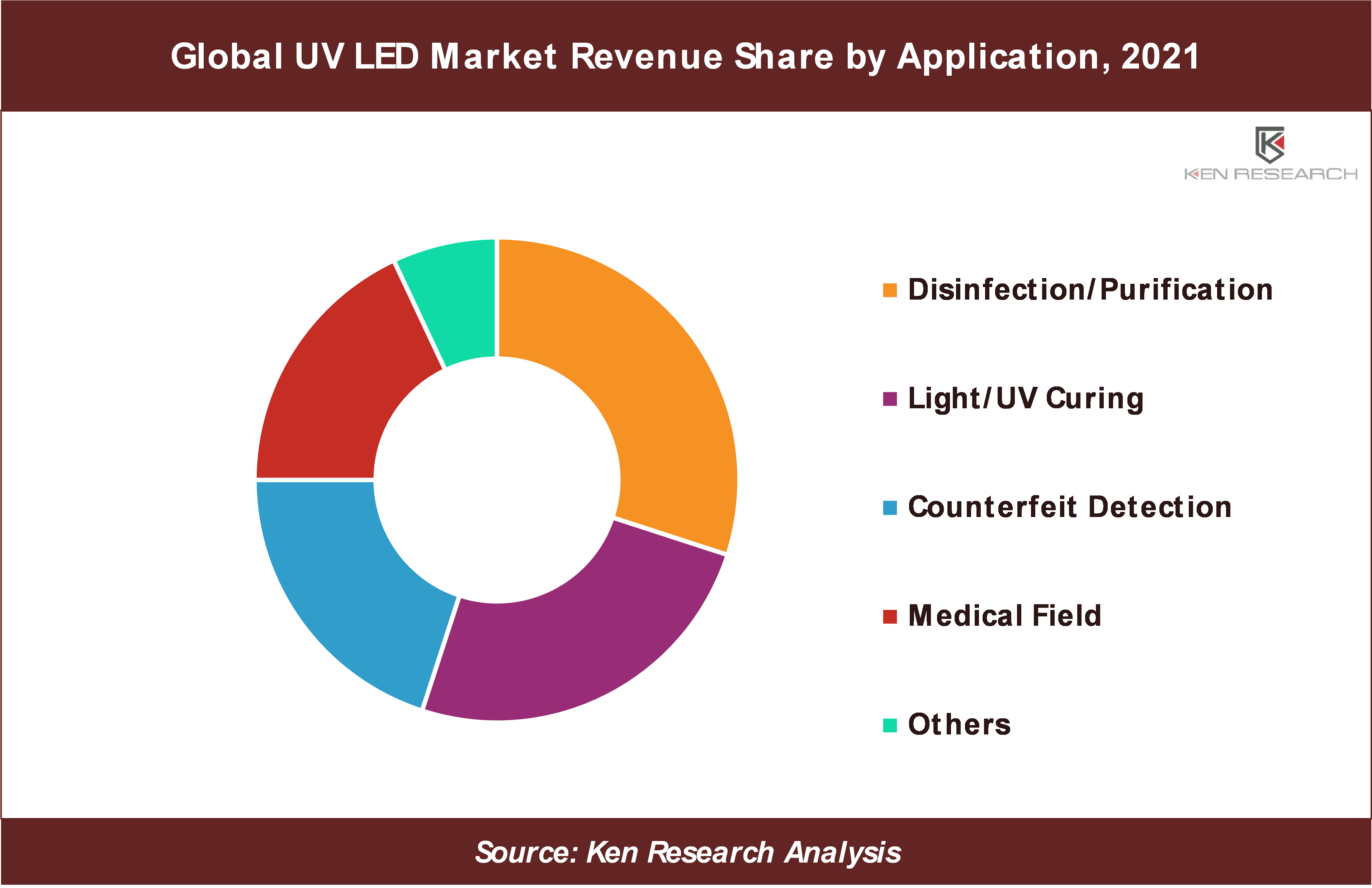
By Application: The disinfection/purification segment held the largest market share of the Global UV LED Market in 2021.

By End User: The industrial segment accounted for the majority share of the Global UV LED Market in 2021.
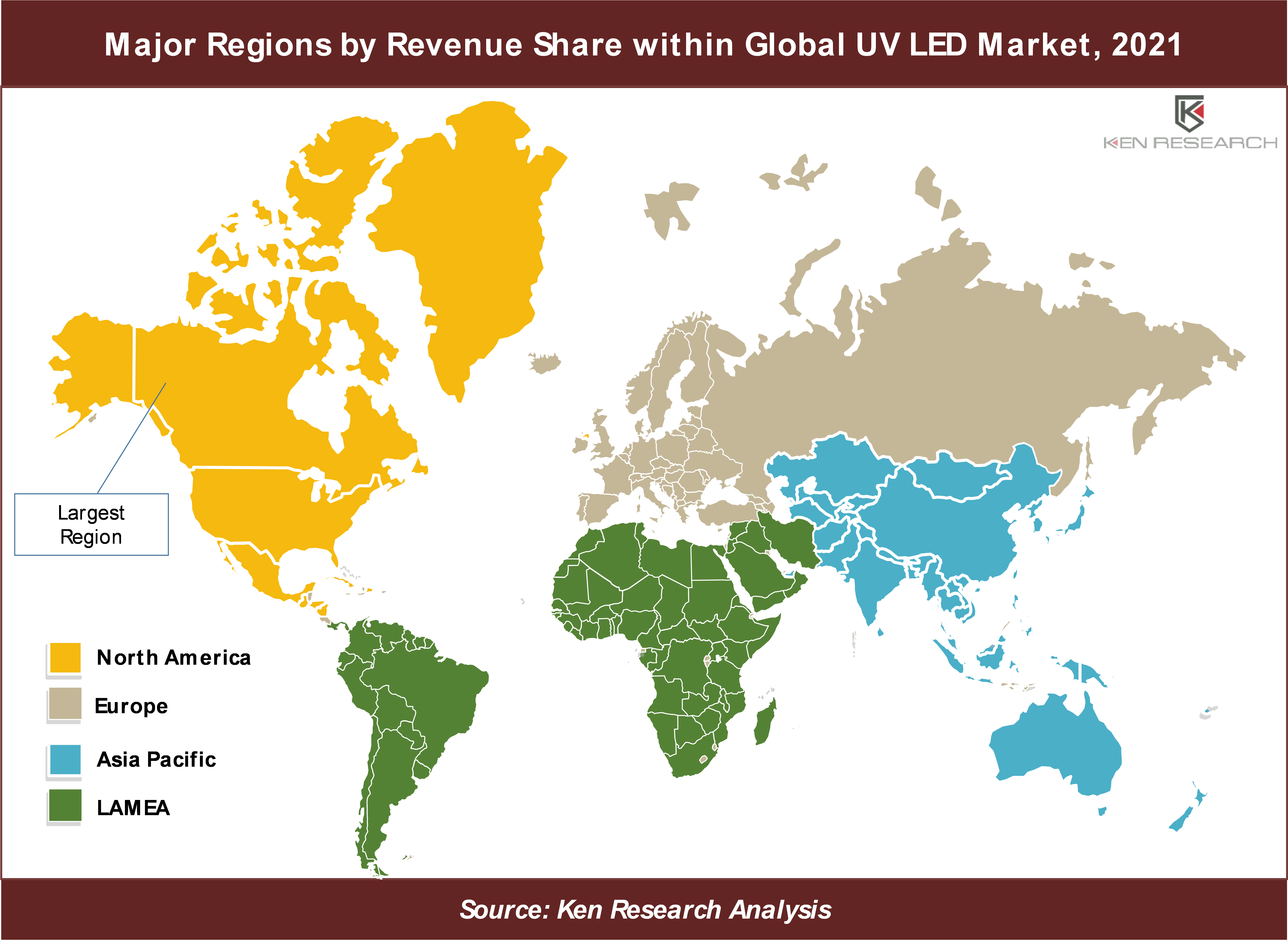
By Geography: North Americaaccounted for the largest market share in the global UV LED market in 2021.

Competitive Landscape
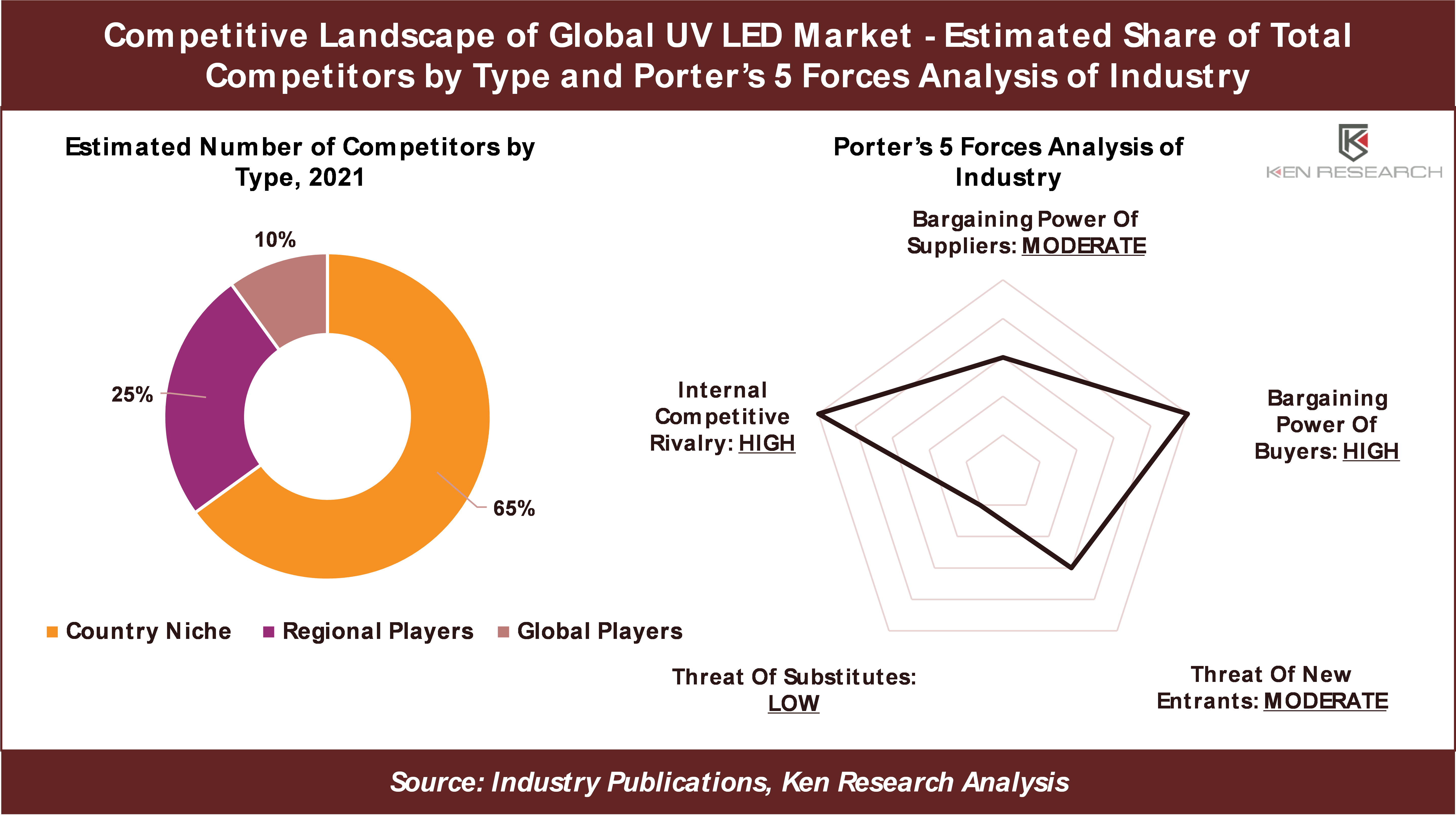
The Global UV LED market is highly competitive, with ~500 players, including globally diversified players, regional players, and a large number of country-niche players, each with their emerging deep-UV (DUV) chip-scale technologies due to significant advancement, as well as increasing interest in the development and deployment of disinfection systems using compact devices that emit in the deep-UV spectral band with wavelengths ranging from 200 to 280 nm. The industry's ongoing progress in chip-scale solutions for deep-UV light sources is expected to drive demand for UV disinfection in the forthcoming years.
Country-Niche players control about ~65% of the market, while regional players hold a share of ~25%. Some of the major players in the market include Koninklijke Philips N.V., Nichia Corporation, Nordson Corporation, Phoseon Technology, SemiLEDs Corporation, Seoul Semiconductor Co. Ltd., Crystal IS, Inc., Lumileds Holding B.V., L.G Electronic, Sensor Electronics Technology and among others.
Recent Developments Related to Major Players and Organizations
CONCLUSION
The global UV LEDs market is forecasted to continue an exponential growth that is witnessed since 2017. The major driving factors contributing to the expansion of UV LEDs is increasing prevalence of water-borne diseases across countries, along with the Increasing government energy-saving policies, and strategies. Though the market is highly competitive with around ~500 participants, few country-niche players control the dominant share and regional players also hold a significant share.
Note: This is an upcoming/planned report, so the figures quoted here for a market size estimate, forecast, growth, segment share, and competitive landscape are based on initial findings and might vary slightly in the actual report. Also, any required customizations can be covered to the best feasible extent for Pre-booking clients and report delivered within maximum 2 working weeks.
Key Topics Covered in the Report
Notable Emerging Companies Mentioned in the Report
Key Target Audience – Organizations and Entities Who Can Benefit by Subscribing This Report
Period Captured in the Report
Frequently Asked Questions
The Global UV LED Market is covered from 2017-2028 in this report, including a forecast for 2022-2028.
The Global UV LED Market is expected to witness a CAGR of about 10% over the next 6 years.
The rising adoption of smart home devices across countries along with the increasing government policies and strategies regarding energy savings.
The disinfection/purification segment holds the largest share of the Global UV LED Market.
Koninklijke Philips N.V., Nichia Corporation, Nordson Corporation, Phoseon Technology, SemiLEDs Corporation, Seoul Semiconductor Co. Ltd., Crystal IS, Inc., Lumileds Holding B.V., L.G Electronic, Sensor Electronics Technology and among other are the major companies operating in Global UV LED Market.
Notable Emerging Companies Mentioned in the Report
Key Target Audience – Organizations and Entities Who Can Benefit by Subscribing This Report
1.1 Highlights of Global UV LED Market Historic Growth & Forecast
1.2 Highlights of Market Trends, Challenges, and Competition
1.3 Highlights of Market Revenue Share by Segments
2.1 Global UV LED Market Taxonomy
2.2 Industry Value Chain
2.3 The Ecosystem of Major Entities in the Global UV LED Market
2.4 Government Regulations & Developments
2.5 Key Growth Drivers & Challenges Impacting the Market
2.6 COVID-19 Impact on Global UV LED Market
2.7 Total Global UV LED Market Historic Growth by Product Type, 2017-2021
2.7.1 By Product Type
2.7.2 By Application
2.7.3 By End User
2.7.4 By Region
2.8 Total Global UV LED Market Historic Growth and Forecast, 2017-2028
2.9 Key Takeaways
3.1 Market Definition - Segmentation by Product Type
3.2 Market Revenue Share, Historic Growth, Outlook, and Forecasts by Product Type, 2017-2028
3.2.1 UV-A
3.2.2 UV-B
3.2.3 UV-C
3.3 Key Takeaways from Market Segmentation by Product Type
4.1 Market Definition - Segmentation by Application
4.2 Market Revenue Share, Historic Growth, Outlook, and Forecasts by Application, 2017-2028
4.2.1 Light/UV Curing
4.2.2 Medical Field
4.2.3 Disinfection/Purification
4.2.4 Counterfeit Detection
4.2.5 Others
4.3 Key Takeaways from Market Segmentation by Application
5.1 Market Definition - Segmentation by End User
5.2 Market Revenue Share, Historic Growth, Outlook, and Forecasts by End User, 2017-2028
5.2.1 Healthcare
5.2.2 Residential
5.2.3 Commercial
5.2.4 Industrial
5.2.5 Others
5.3 Key Takeaways from Market Segmentation by End User
6.1 Types of Players (Competitors) & Business Models
6.2 Porter’s 5 Forces Analysis of Global UV LED Competitors
6.3 Key Developments in the Global UV LED Sector Impacting Market Growth
6.4 Comparison of Leading Competitors within Global UV LED Market, 2021
6.5 Comparison of Leading Competitors within Global UV LED Market by Coverage of Product Type Segments, 2021
6.6 Comparison of Leading Competitors within Global UV LED Market by Coverage of Application, 2021
6.7 Comparison of Leading Competitors within Global UV LED Market by Coverage of End User, 2021
6.8 Comparison of Leading Competitors within Global UV LED Market by Coverage of Regions, 2021
6.9 Key Takeaways from Competitive Landscape
7.1 Koninklijke Philips N.V.
7.2 Nichia Corporation
7.3 Nordson Corporation
7.4 Phoseon Technology
7.5 SemiLEDs Corporation
7.6 Seoul Semiconductor Co. Ltd.
7.7 Crystal IS, Inc.
7.8 Lumileds Holding B.V.
7.9 L.G Electronic
7.10 Sensor Electronics Technology
8.1 Major Countries Comparison of Macroeconomic Factors
8.2 Global- Market Revenue Share, Historic Growth, Outlook and Forecasts by Geography, 2017-2028
8.3 Major Countries Market Analysis, Historic Growth, Outlook & Forecasts
8.4 North America – UV LED Market Analysis
8.4.1 Major Production and Consumption Hubs in North America
8.4.2 Notable Emerging UV LED Companies in North America
8.4.3 Market Revenue Share, Historic Growth, Outlook and Forecasts by Product Type, 2017-2028
8.4.4 Market Revenue Share, Historic Growth, Outlook, and Forecasts by Applications, 2017-2028
8.4.5 Market Revenue Share, Historic Growth, Outlook, and Forecasts by End User, 2017-2028
8.4.6 Market Revenue Share, Historic Growth, Outlook, and Forecasts by Major Countries, 2017-2028
- USA
- Canada
- Mexico
8.5 Europe – UV LED Market Analysis
8.5.1 Major Production and Consumption Hubs in Europe
8.5.2 Notable Emerging UV LED Companies in Europe
8.5.3 Market Revenue Share, Historic Growth, Outlook and Forecasts by Product Type, 2017-2028
8.5.4 Market Revenue Share, Historic Growth, Outlook, and Forecasts by Applications, 2017-2028
8.5.5 Market Revenue Share, Historic Growth, Outlook, and Forecasts by End User, 2017-2028
8.5.6 Market Revenue Share, Historic Growth, Outlook, and Forecasts by Major Countries, 2017-2028
- Germany
- UK
- France
- Italy
- Spain
- Rest of Europe
8.6 Asia Pacific – UV LED Market Analysis
8.6.1 Major Production and Consumption Hubs in the Asia Pacific
8.6.2 Notable Emerging UV LED Companies in the Asia Pacific
8.6.3 Market Revenue Share, Historic Growth, Outlook and Forecasts by Product Type, 2019-2028
8.6.4 Market Revenue Share, Historic Growth, Outlook, and Forecasts by Applications, 2019-2028
8.6.5 Market Revenue Share, Historic Growth, Outlook, and Forecasts by End User, 2019-2028
8.6.6 Market Revenue Share, Historic Growth, Outlook, and Forecasts by Major Countries, 2017-2028
- China
- Japan
- India
- Australia
- South Korea
- Rest of Asia Pacific
8.7 LAMEA – UV LED Market Analysis
8.7.1 Major Production and Consumption Hubs in LAMEA
8.7.2 Notable Emerging UV LED Companies in LAMEA
8.7.3 Market Revenue Share, Historic Growth, Outlook and Forecasts by Product Type, 2017-2028
8.7.4 Market Revenue Share, Historic Growth, Outlook, and Forecasts by Applications, 2017-2028
8.7.5 Market Revenue Share, Historic Growth, Outlook, and Forecasts by Sub-Regions, 2017-2028
- Latin America
- Middle East
- Africa
9.1 Notable Statements/Quotes from Industry Experts and C-Level Executives on Current Status and Future Outlook of the Market
10.1 Analyst Recommendations on Identified Major Opportunities and Potential Strategies to Gain from Opportunities
11.1 Research Methodology - Market Size Estimation, Forecast, and Sanity Check Approach
11.2 Sample Discussion Guide
Disclaimer

What makes us stand out is that our consultants follows Robust, Refine and Result (RRR) methodology. i.e. Robust for clear definitions, approaches and sanity checking, Refine for differentiating respondents facts and opinions and Result for presenting data with story
We have set a benchmark in the industry by offering our clients with syndicated and customized market research reports featuring coverage of entire market as well as meticulous research and analyst insights.
While we don't replace traditional research, we flip the method upside down. Our dual approach of Top Bottom & Bottom Top ensures quality deliverable by not just verifying company fundamentals but also looking at the sector and macroeconomic factors.
With one step in the future, our research team constantly tries to show you the bigger picture. We help with some of the tough questions you may encounter along the way: How is the industry positioned? Best marketing channel? KPI's of competitors? By aligning every element, we help maximize success.
Our report gives you instant access to the answers and sources that other companies might choose to hide. We elaborate each steps of research methodology we have used and showcase you the sample size to earn your trust.
If you need any support, we are here! We pride ourselves on universe strength, data quality, and quick, friendly, and professional service.