Ken Research Logo

Global Urban Agriculture Market Outlook to 2030

Region:Global

Author(s):Shambhavi

Product Code:KROD2267

Published On

December 2024

Total pages

97

About the Report

Global Urban Agriculture Market Overview

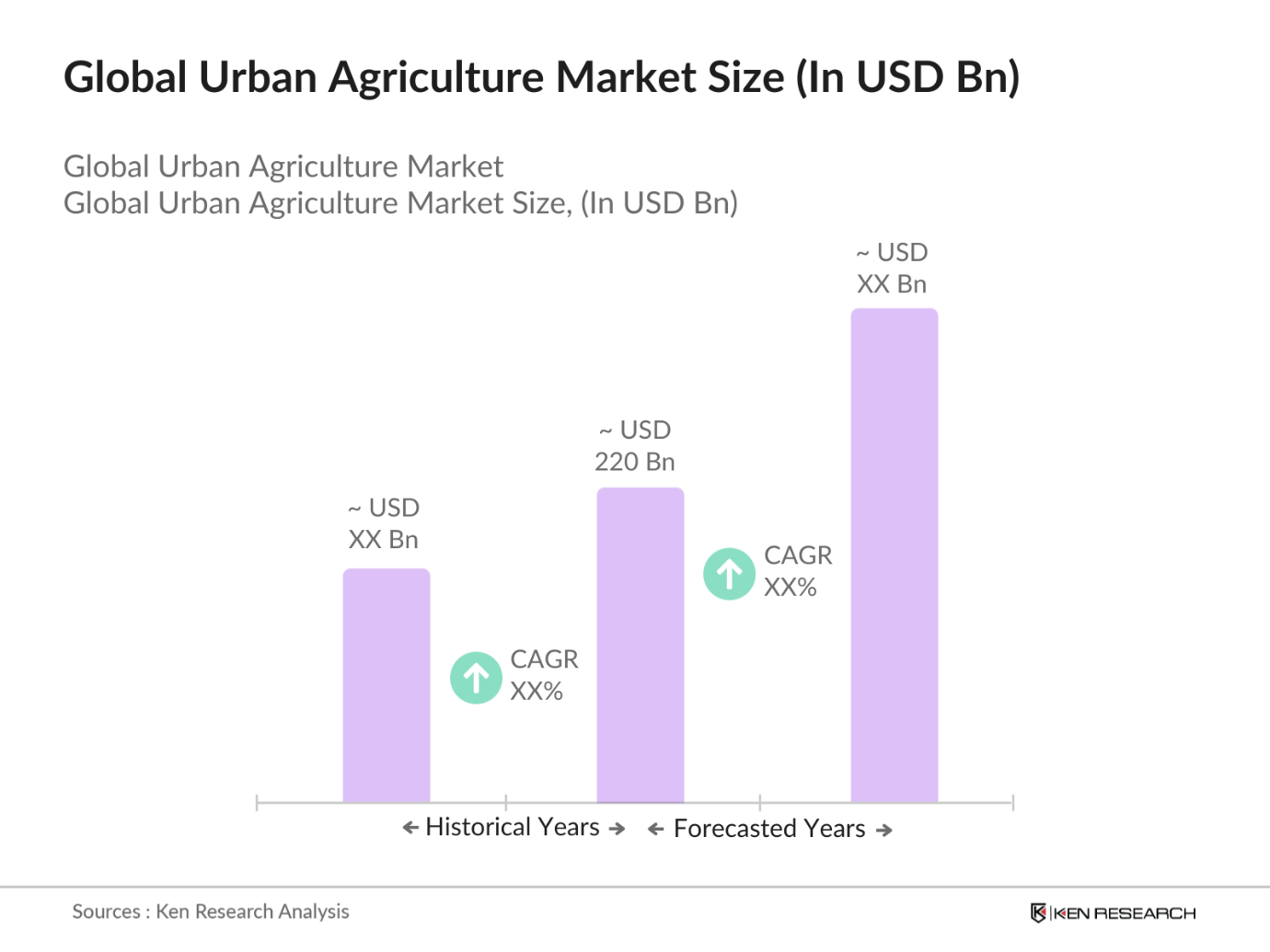
  • The global urban agriculture market witnessed robust growth in 2023, with a market valuation USD 220 Billion in 2023. This market has been driven by the increasing demand for local, fresh produce in urban areas, as well as innovations in agriculture technologies such as vertical farming, hydroponics, and aeroponics. Rising urban populations, coupled with the demand for efficient land use, are significant contributors to market expansion. Urban agriculture plays a critical role in reducing food miles, fostering sustainable city ecosystems, and addressing food security challenges.

Global Urban Agriculture Market

  • Prominent players in the global urban agriculture market include AeroFarms, Gotham Greens, BrightFarms, Plenty, and Bowery Farming. AeroFarms, headquartered in Newark, New Jersey, has been a pioneer in vertical farming and is widely recognized for its innovative use of aeroponics. Gotham Greens, based in Brooklyn, operates several greenhouses across the United States, providing fresh produce to urban consumers. BrightFarms, known for its hydroponic systems, has also gained traction by shortening the food supply chain, while Plenty and Bowery Farming are recognized for their technological advances in urban farming.
  • Governments worldwide are increasingly recognizing the importance of urban agriculture. In 2023, the European Union launched the "Farm to Fork" strategy as part of the Green Deal, aiming to promote sustainable food systems. Additionally, in 2024, Singapore's "30 by 30" initiative, which aims to produce 30% of the country's nutritional needs locally by 2030, further highlighted the critical role of urban agriculture. The Singaporean government has invested heavily in technological infrastructure and research, including a $144 million grant for sustainable urban farming projects.
  • Cities like New York, Tokyo, Singapore, and Paris have emerged as dominant players in the urban agriculture market. The rapid urbanization in these cities, combined with the scarcity of arable land, has driven significant investment in vertical farming and rooftop farming initiatives. For instance, Singapore's urban agriculture projects have made substantial strides, given its land constraints, while Tokyo and New York have established themselves as pioneers due to advanced technological innovations and strong local government support for sustainable agriculture.

Global Urban Agriculture Market Segmentation

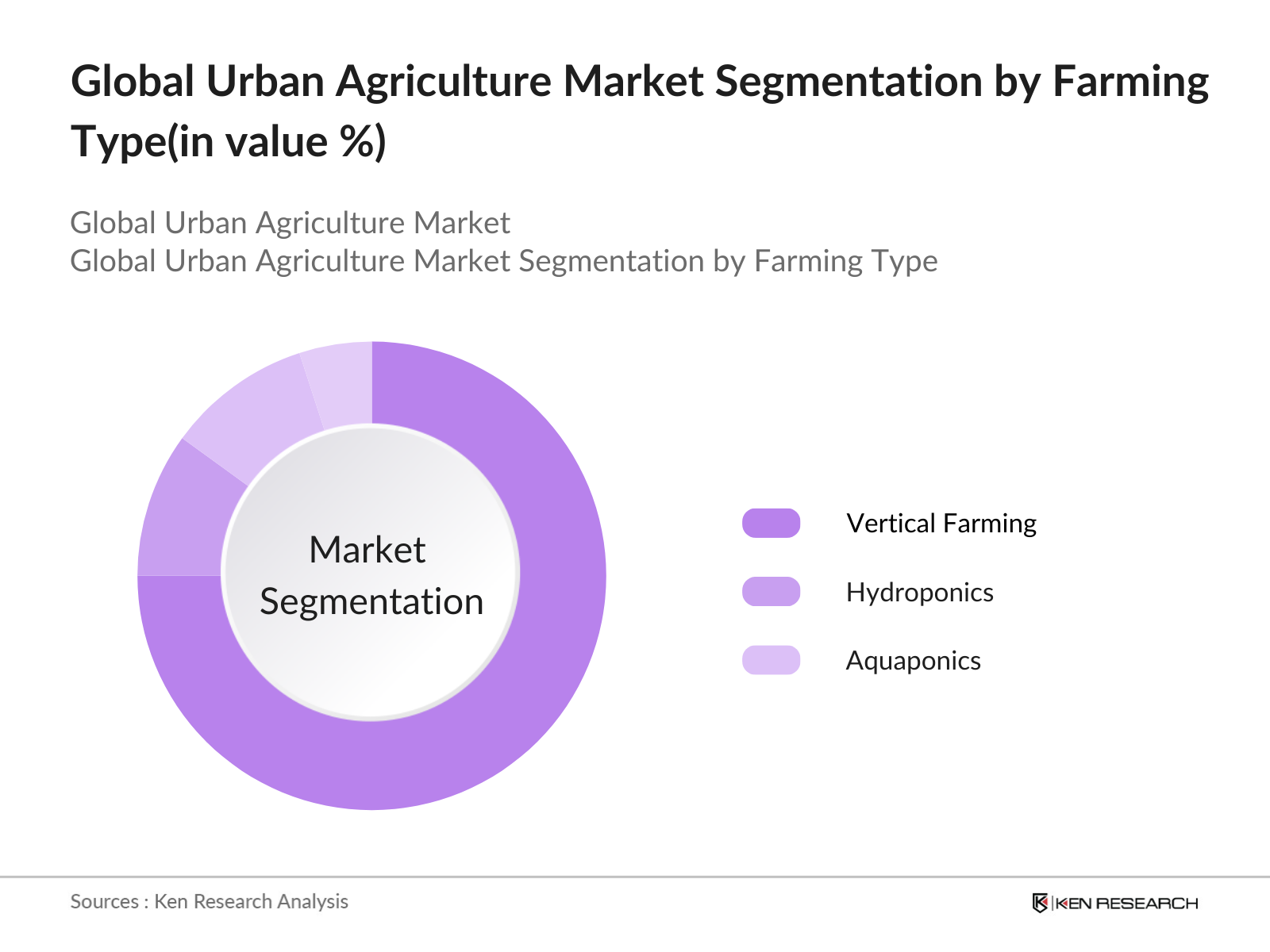
By Farming Type: The urban agriculture market is segmented by farming type into vertical farming, hydroponics, and aquaponics. In 2023, vertical farming held the largest market share, due to its high space efficiency and year-round production capability. Companies like AeroFarms and Bowery Farming have optimized vertical farming techniques to produce large quantities of crops in urban spaces, making it the go-to farming type in densely populated areas where land availability is minimal. Hydroponics and aquaponics, while growing, have not reached the same scale of adoption as vertical farming due to higher initial setup costs and complexity.
Global Urban Agriculture Market Segmentation

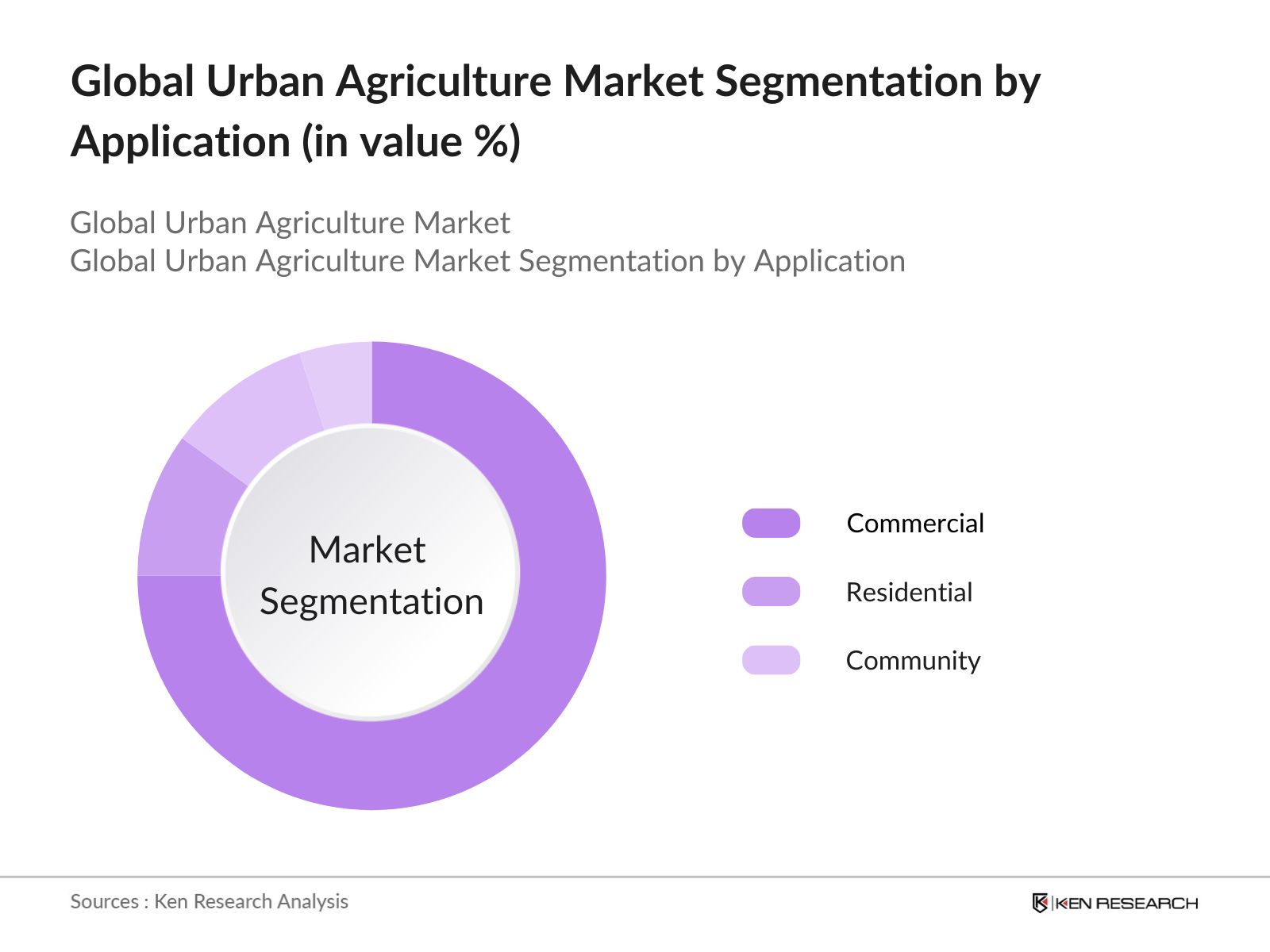
By Application: The market is also segmented by application into commercial, residential, and community. In 2023, the commercial segment held the dominant market share driven by the growing number of urban commercial farming enterprises focused on supplying fresh produce to supermarkets, restaurants, and other food services. Commercial operations benefit from economies of scale and technological innovation, allowing them to produce larger quantities of crops at reduced costs. Residential and community segments, while growing, have not yet reached the same level of market penetration, primarily due to lower production capacities.
Global Urban Agriculture Market Segmentation

By Region: The urban agriculture market is segmented by region, with a focus on North America, Europe, APAC, MEA, and Latin America. In 2023, North America held the dominant market share driven by significant investments in urban farming technologies and the growing trend of local food sourcing. Europe followed closely seeing strong government support and rising consumer demand for locally grown produce.

Competitive Landscape

Company

Year of Establishment

Headquarters

AeroFarms

2004

Newark, NJ, USA

Gotham Greens

2009

Brooklyn, NY, USA

BrightFarms

2011

Irvington, NY, USA

Plenty

2014

San Francisco, CA, USA

Bowery Farming

2015

New York, NY, USA

  • AeroFarms: In 2023, AeroFarms partnered with global technology giant Siemens to enhance automation in its vertical farming processes. The partnership focuses on improving the efficiency of aeroponic farming systems, reducing water consumption by 95%, and optimizing energy use. The collaboration is expected to further solidify AeroFarms' position as a leader in the vertical farming industry.
  • Gotham Greens: In 2024, Gotham Greens announced its expansion into the Midwest with a new 200,000 square foot greenhouse in Ohio. This facility is expected to produce up to 40 million heads of lettuce annually, supplying fresh produce to over 1,000 retail locations. This move marks a significant step in Gotham Greens goal to increase its national footprint and become the leading provider of urban-grown produce in the United States.

Global Urban Agriculture Market Analysis

Growth Drivers

  • Increased Demand for Fresh, Locally Sourced Produce The demand for fresh, locally grown produce in urban centers has risen significantly, fueled by changing consumer preferences for healthier and more sustainable food options. In 2023, the United States saw a surge in local food sales, with urban agriculture accounting for $19 billion in fresh produce sales, according to government food security reports. Cities like New York and Los Angeles have invested in urban farming initiatives to reduce reliance on imports and decrease carbon footprints, further driving the market.
  • Rising Investments in Controlled Environment Agriculture (CEA) Controlled Environment Agriculture (CEA) is rapidly transforming the urban farming landscape. In 2024, global investments in CEA reached $7.5 billion, according to data from the USDA. These investments have enabled farmers to use advanced technology, including automation, AI, and climate control systems, to optimize crop yields. This shift toward high-tech, sustainable farming has been particularly beneficial in cities where land scarcity and weather constraints limit traditional farming methods.
  • Food Security Concerns in Urban Areas The global population in urban areas is projected to increase by 2.5 billion by 2050, leading to a rising concern over food security. In 2024, food imports in several Middle Eastern countries like the UAE and Saudi Arabia were reduced by 12% due to urban agriculture initiatives, according to the United Nations Food and Agriculture Organization (FAO). These initiatives have increased self-sufficiency in densely populated urban regions, reducing dependency on imported goods

Challenges

  • High Initial Capital Expenditure The setup costs for urban farming technologies, particularly for vertical farming and hydroponic systems, are significant. In 2023, an urban farm utilizing vertical farming techniques in the United States reported an average startup cost of $15 million for a 10,000 square foot facility, as per government funding reports. This high capital expenditure can be a barrier for small-scale farmers and businesses, limiting market entry. Despite the long-term benefits of urban farming, the initial financial burden can hinder market growth in regions with less access to investment or government subsidies.
  • Limited Availability of Skilled Labor The rapid technological advancements in urban agriculture require specialized skills, particularly in managing automated systems, climate control technologies, and CEA. A 2024 industry report from Germany's Ministry of Agriculture indicated that the urban agriculture sector is facing a shortage of skilled labor, particularly in the areas of system management and agronomy. The lack of adequately trained professionals has led to operational inefficiencies and slower adoption of advanced farming technologies, posing a significant challenge for market growth.

Government Initiatives

  • Singapore's "30 by 30" Initiative (2024) Singapore has set a goal to produce 30% of its nutritional needs locally by 2030, a government strategy known as the 30 by 30 initiative. In 2024, the Singapore government allocated $144 million to support urban farming technologies and research into sustainable agriculture. This initiative is aimed at addressing Singapores heavy reliance on food imports and bolstering the local food supply chain through urban agriculture. By leveraging controlled environment agriculture and rooftop farms, Singapore aims to secure its food future and become a model for urban farming.
  • European Union's "Farm to Fork" Strategy (2023) The European Union launched the "Farm to Fork" strategy as part of its broader Green Deal in 2023, focusing on sustainable food systems and urban agriculture. The strategy encourages the development of urban farms and local food systems across European cities. It aims to reduce the environmental impact of food production and shorten food supply chains. The strategy includes a 100 million investment in urban farming research, technology, and infrastructure development across EU member states, highlighting the importance of urban agriculture in future food security plans.

Global Urban Agriculture Market Future Outlook (2028)

The global urban agriculture market is poised for significant growth over the next five years, driven by technological advancements in farming systems, increasing urbanization, and government initiatives aimed at improving food security. The market is expected to see widespread adoption of vertical farming and hydroponic systems, particularly in densely populated urban areas where traditional farming methods are less feasible. Growing investments in controlled environment agriculture (CEA) will also play a key role in shaping the market, allowing for more efficient use of resources like water and energy.

Future Trends

  1. Expansion of Vertical Farming in Urban Centers: Vertical farming will continue to expand in major urban centers due to its efficient use of space and ability to produce high yields. Cities with limited arable land, such as Tokyo and Singapore, are expected to see increased adoption of vertical farming technologies. These systems will become more advanced, integrating automation and AI to further optimize crop growth and reduce energy consumption.
  2. Increased Integration of Smart Technologies: The future of urban agriculture will see the widespread use of smart farming technologies, including AI-driven crop monitoring systems, automated irrigation, and climate control systems. These technologies will enable farmers to monitor plant health and optimize growth conditions in real-time, resulting in higher crop yields and lower operational costs. By 2028, smart farming technologies are expected to be a standard feature in urban farms globally.

Scope of the Report

By Farming Type

Vertical Farming

Hydroponics

Aquaponics

By Application

Commercial

Residential

Community

By Region

North America

Europe

Asia-Pacific (APAC)

Middle East & Africa (MEA)

Latin America

Products

Key Target Audience Organizations and Entities Who Can Benefit by Subscribing This Report:

  • Urban Farming Companies

  • Food and Beverage Retailers

  • Supermarkets and Grocery Chains

  • Restaurants and Food Services

  • Environmental Organizations

  • Tech Firms (specializing in agricultural innovations)

  • Food Distribution Companies

  • Logistics and Supply Chain Companies

  • Investors and Venture Capital Firms

  • Government and Regulatory Bodies (e.g., USDA, European Commission)


Time Period Captured in the Report:


  • Historical Period: 2018-2023

  • Base Year: 2023

  • Forecast Period: 2023-2028

Companies

Players Mentioned in the Report:

  • AeroFarms

  • Gotham Greens

  • BrightFarms

  • Plenty

  • Bowery Farming

  • Urban Crop Solutions

  • Agricool

  • Infarm

  • Sky Greens

  • Green Sense Farms

  • GrowUp Urban Farms

  • Edenworks

  • Metropolis Farms

  • Farm.One

  • Square Roots

Table of Contents

1. Global Urban Agriculture Market Overview

1.1. Definition and Scope
1.2. Market Taxonomy (segmentation by farming type, technology, application, region)
1.3. Market Growth Rate (key growth metrics and drivers)
1.4. Market Segmentation Overview

2. Global Urban Agriculture Market Size (in USD million)

2.1. Historical Market Size (evaluation of past growth trends)
2.2. Year-on-Year Growth Analysis
2.3. Key Market Developments and Milestones

3. Global Urban Agriculture Market Analysis

3.1. Growth Drivers
3.1.1. Demand for Fresh, Locally Sourced Produce
3.1.2. Rise of Controlled Environment Agriculture (CEA)
3.1.3. Government Support and Sustainability Goals
3.2. Restraints
3.2.1. High Initial Capital Investment
3.2.2. Regulatory Barriers and Zoning Challenges
3.2.3. Limited Availability of Skilled Workforce
3.3. Opportunities
3.3.1. Technological Advancements in Automation and AI
3.3.2. Integration with Smart City Initiatives
3.3.3. Expansion into Developing Economies and Mega Cities
3.4. Trends
3.4.1. Growth of Vertical Farming in Urban Centers
3.4.2. Adoption of Smart Farming Technologies
3.4.3. Sustainability and Eco-friendly Practices
3.5. Government Regulation
3.5.1. EU Farm to Fork Strategy
3.5.2. USDA Urban Agriculture and Innovative Production Grants
3.5.3. Singapores 30 by 30 Initiative
3.6. SWOT Analysis
3.7. Stakeholder Ecosystem
3.8. Competition Ecosystem

4. Global Urban Agriculture Market Segmentation

4.1. By Farming Type (in value %) 4.1.1. Vertical Farming
4.1.2. Hydroponics
4.1.3. Aquaponics
4.1.4. Community Gardens
4.1.5. Rooftop Farming
4.2. By Technology (in value %) 4.2.1. LED Lighting
4.2.2. Automation Systems
4.2.3. IoT Integration
4.2.4. Climate Control Systems
4.2.5. Irrigation and Water Management
4.3. By Application (in value %) 4.3.1. Commercial
4.3.2. Residential
4.3.3. Institutional
4.3.4. Community-based
4.4. By Produce Type (in value %) 4.4.1. Leafy Greens
4.4.2. Herbs
4.4.3. Fruits (small-scale)
4.4.4. Microgreens
4.4.5. Vegetables
4.5. By Region (in value %) 4.5.1. North America
4.5.2. Europe
4.5.3. APAC
4.5.4. MEA
4.5.5. Latin America

5. Global Urban Agriculture Market Competitive Landscape

5.1. Detailed Profiles of Major Competitors
5.1.1. AeroFarms
5.1.2. Gotham Greens
5.1.3. BrightFarms
5.1.4. Plenty
5.1.5. Bowery Farming
5.1.6. Infarm
5.1.7. Urban Crop Solutions
5.1.8. Agricool
5.1.9. Sky Greens
5.1.10. Green Sense Farms
5.1.11. Edenworks
5.1.12. GrowUp Urban Farms
5.1.13. Square Roots
5.1.14. Farm.One
5.1.15. Metropolis Farms
5.2. Cross Comparison (inception year, headquarters, revenue, no. of employees)
5.3. Market Share Analysis (by company, farming type, and region)
5.4. Strategic Initiatives (mergers, acquisitions, partnerships)
5.5. Recent Investments and Funding (venture capital, private equity, government grants)

6. Global Urban Agriculture Market Regulatory Framework

6.1. Global and Regional Environmental Standards
6.2. Compliance Requirements for Urban Farming
6.3. Certification Processes for Urban Farms (e.g., organic certification)
6.4. Government Policies and Subsidies for Urban Farming
6.5. Role of Local Governments and City Planning Departments

7. Global Urban Agriculture Market Financial and Operational Analysis

7.1. Revenue Analysis by Farming Type and Region
7.2. Operational Cost Structure (fixed and variable costs, setup vs. operational expenses)
7.3. Profitability and Margin Analysis (per square foot, per farm type)
7.4. Capital Expenditure Analysis (CAPEX for vertical farming, hydroponics, etc.)
7.5. ROI and Payback Period Estimates (for various urban agriculture models)

8. Global Urban Agriculture Market Supply Chain and Logistics Analysis

8.1. Supply Chain Overview (seed suppliers, technology providers, distribution channels)
8.2. Role of Local Food Distribution Networks
8.3. Cold Chain Management in Urban Agriculture
8.4. Challenges in Urban Agriculture Logistics (intra-city transport, packaging, food miles)

9. Global Urban Agriculture Market Future Outlook

9.1. Future Market Size Projections
9.2. Key Factors Driving Future Market Growth
9.3. Technological Innovations in the Next 5 Years (AI, robotics, sustainable energy)
9.4. Opportunities in Developing Countries
9.5. Future Regulatory Changes Impacting the Market

10. Global Urban Agriculture Market Analysts Recommendations

10.1. TAM/SAM/SOM Analysis (Total Addressable Market, Serviceable Available Market, Serviceable Obtainable Market)
10.2. Investment Opportunities by Farming Type and Region
10.3. White Space and Growth Opportunities
10.4. Market Entry Strategies for New Entrants
10.5. Potential Risks and Mitigation Strategies

11. Contact Information

11.1. Research Team Contact
11.2. Additional Insights and Customization Requests

Research Methodology

Step 1: Identifying Key Variables

Ecosystem creation for all major entities and referring to multiple secondary and proprietary databases to perform desk research around the market to collate market-level information.

Step 2: Market Building

Collating statistics on the global urban agriculture market over the years, analyzing the penetration of urban agriculture technologies, and computing the revenue generated for the market. this step also involves reviewing technology adoption rates and application effectiveness to ensure accuracy behind the data points shared.

Step 3: Validating and Finalizing

Building market hypotheses and conducting CATIs with market experts belonging to different companies to validate statistics and seek operational and financial information from company representatives.

Step 4: Research Output

our team will approach multiple urban agriculture companies to understand the nature of technology segments, consumer preferences, and other parameters. this supports validating statistics derived through a bottom-to-top approach from these urban agriculture companies, ensuring accuracy and reliability in the report.

Frequently Asked Questions

01. How big is the global urban agriculture market?

The global urban agriculture market was valued at USD 220 Billion in 2023. It is driven by rising urbanization, the need for sustainable food production systems, and the increasing demand for fresh, locally sourced produce in cities.

02. What are the challenges in the global urban agriculture market?

Challenges in the global urban agriculture market include high initial capital expenditure for setting up advanced farming technologies, limited availability of skilled labor, and regulatory barriers such as zoning restrictions in urban areas.

03. Who are the major players in the global urban agriculture market?

Key players in the global urban agriculture market include AeroFarms, Gotham Greens, BrightFarms, Plenty, and Bowery Farming. These companies lead due to their innovative technologies, strong market presence, and large-scale urban farming projects.

04. What are the growth drivers of the global urban agriculture market?

Growth drivers include increased demand for fresh, locally sourced produce, rising investments in controlled environment agriculture (CEA), and the growing concern over food security in urban areas, which has led cities to prioritize sustainable food production systems.

Why Buy From Us?

RRR
Refine Robust Result (RRR) Framework

What makes us stand out is that our consultants follows Robust, Refine and Result (RRR) methodology. i.e. Robust for clear definitions, approaches and sanity checking, Refine for differentiating respondents facts and opinions and Result for presenting data with story

Our Reach Is Unmatched

We have set a benchmark in the industry by offering our clients with syndicated and customized market research reports featuring coverage of entire market as well as meticulous research and analyst insights.

Research
Shifting the Research Paradigm

While we don't replace traditional research, we flip the method upside down. Our dual approach of Top Bottom & Bottom Top ensures quality deliverable by not just verifying company fundamentals but also looking at the sector and macroeconomic factors.

Insite
More Insights-Better Decisions

With one step in the future, our research team constantly tries to show you the bigger picture. We help with some of the tough questions you may encounter along the way: How is the industry positioned? Best marketing channel? KPI's of competitors? By aligning every element, we help maximize success.

Trust
Transparency and Trust

Our report gives you instant access to the answers and sources that other companies might choose to hide. We elaborate each steps of research methodology we have used and showcase you the sample size to earn your trust.

support
Round the Clock Support

If you need any support, we are here! We pride ourselves on universe strength, data quality, and quick, friendly, and professional service.

Why Client Choose Us?

400000+ Reports in repository
150+ Consulting project a year
100+ Analysts
8000+ Client Queries in 2022